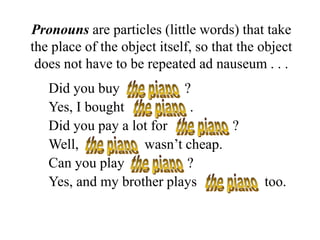
Pronouns are particles (little words) that take
the place of the object itself, so that the object
does not have to be repeated ad nauseum . . .
Did you buy
?
Yes, I bought
.
Did you pay a lot for
?
Well,
wasn’t cheap.
Can you play
?
Yes, and my brother plays

too.
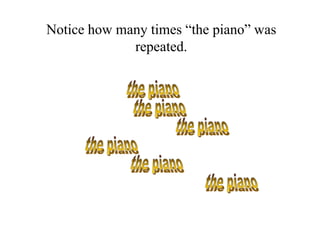
Notice how many times “the piano” was
repeated.
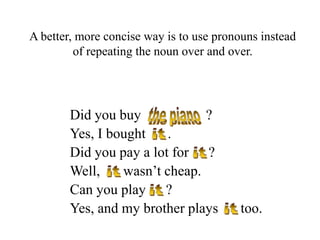
A better, more concise way is to use pronouns instead
of repeating the noun over and over.

Did you buy
?
Yes, I bought
.
Did you pay a lot for ?
Well,
wasn’t cheap.
Can you play ?
Yes, and my brother plays

too.
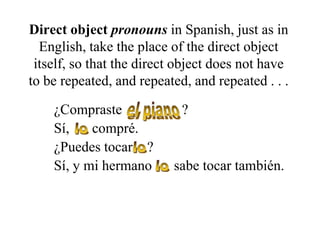
Direct object pronouns in Spanish, just as in
English, take the place of the direct object
itself, so that the direct object does not have
to be repeated, and repeated, and repeated . . .
¿Compraste
Sí,
compré.
¿Puedes tocar ?
Sí, y mi hermano

?

sabe tocar también.
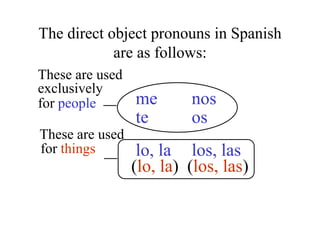
The direct object pronouns in Spanish
are as follows:
These are used
exclusively
for people
These are used
for things

me
te

nos
os

lo, la los, las
(lo, la) (los, las)
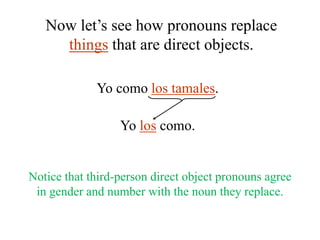
Now let’s see how pronouns replace
things that are direct objects.
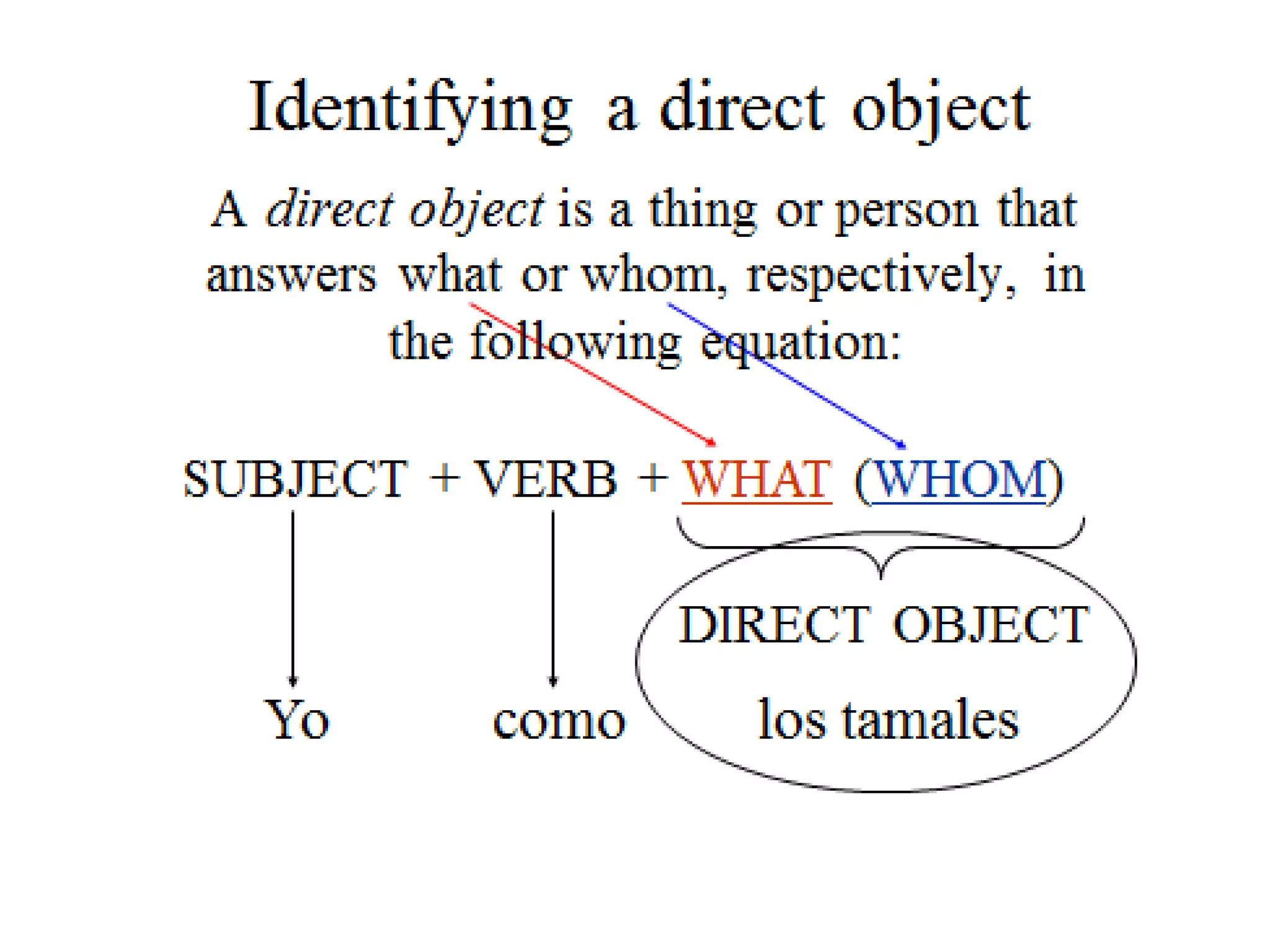
Yo como los tamales.
Yo los como.

Notice that third-person direct object pronouns agree
in gender and number with the noun they replace.
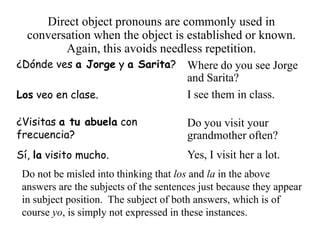
Direct object pronouns are commonly used in
conversation when the object is established or known.
Again, this avoids needless repetition.
¿Dónde ves a Jorge y a Sarita?
Los veo en clase.

Where do you see Jorge
and Sarita?
I see them in class.

¿Visitas a tu abuela con
frecuencia?

Do you visit your
grandmother often?

Sí, la visito mucho.

Yes, I visit her a lot.

Do not be misled into thinking that los and la in the above
answers are the subjects of the sentences just because they appear
in subject position. The subject of both answers, which is of
course yo, is simply not expressed in these instances.

Objecto directo

  • 2.
    Pronouns are particles(little words) that take the place of the object itself, so that the object does not have to be repeated ad nauseum . . . Did you buy ? Yes, I bought . Did you pay a lot for ? Well, wasn’t cheap. Can you play ? Yes, and my brother plays too.
  • 3.
    Notice how manytimes “the piano” was repeated.
  • 4.
    A better, moreconcise way is to use pronouns instead of repeating the noun over and over. Did you buy ? Yes, I bought . Did you pay a lot for ? Well, wasn’t cheap. Can you play ? Yes, and my brother plays too.
  • 5.
    Direct object pronounsin Spanish, just as in English, take the place of the direct object itself, so that the direct object does not have to be repeated, and repeated, and repeated . . . ¿Compraste Sí, compré. ¿Puedes tocar ? Sí, y mi hermano ? sabe tocar también.
  • 6.
    The direct objectpronouns in Spanish are as follows: These are used exclusively for people These are used for things me te nos os lo, la los, las (lo, la) (los, las)
  • 7.
    Now let’s seehow pronouns replace things that are direct objects. Yo como los tamales. Yo los como. Notice that third-person direct object pronouns agree in gender and number with the noun they replace.
  • 8.
    Direct object pronounsare commonly used in conversation when the object is established or known. Again, this avoids needless repetition. ¿Dónde ves a Jorge y a Sarita? Los veo en clase. Where do you see Jorge and Sarita? I see them in class. ¿Visitas a tu abuela con frecuencia? Do you visit your grandmother often? Sí, la visito mucho. Yes, I visit her a lot. Do not be misled into thinking that los and la in the above answers are the subjects of the sentences just because they appear in subject position. The subject of both answers, which is of course yo, is simply not expressed in these instances.