GRAM Á TICA Indirect Object Pronouns (pronombres de complemento indirecto)
What is an  indirect object ? The  indirect object  (IO) tells us where the direct object (DO) is going. He gives the flowers to Mar ía. Where are the flowers going?  To María IO =  María They left the bread at home.  Who did this happen to?  To them IO = They The indirect object may also be based on whom the event happened to.
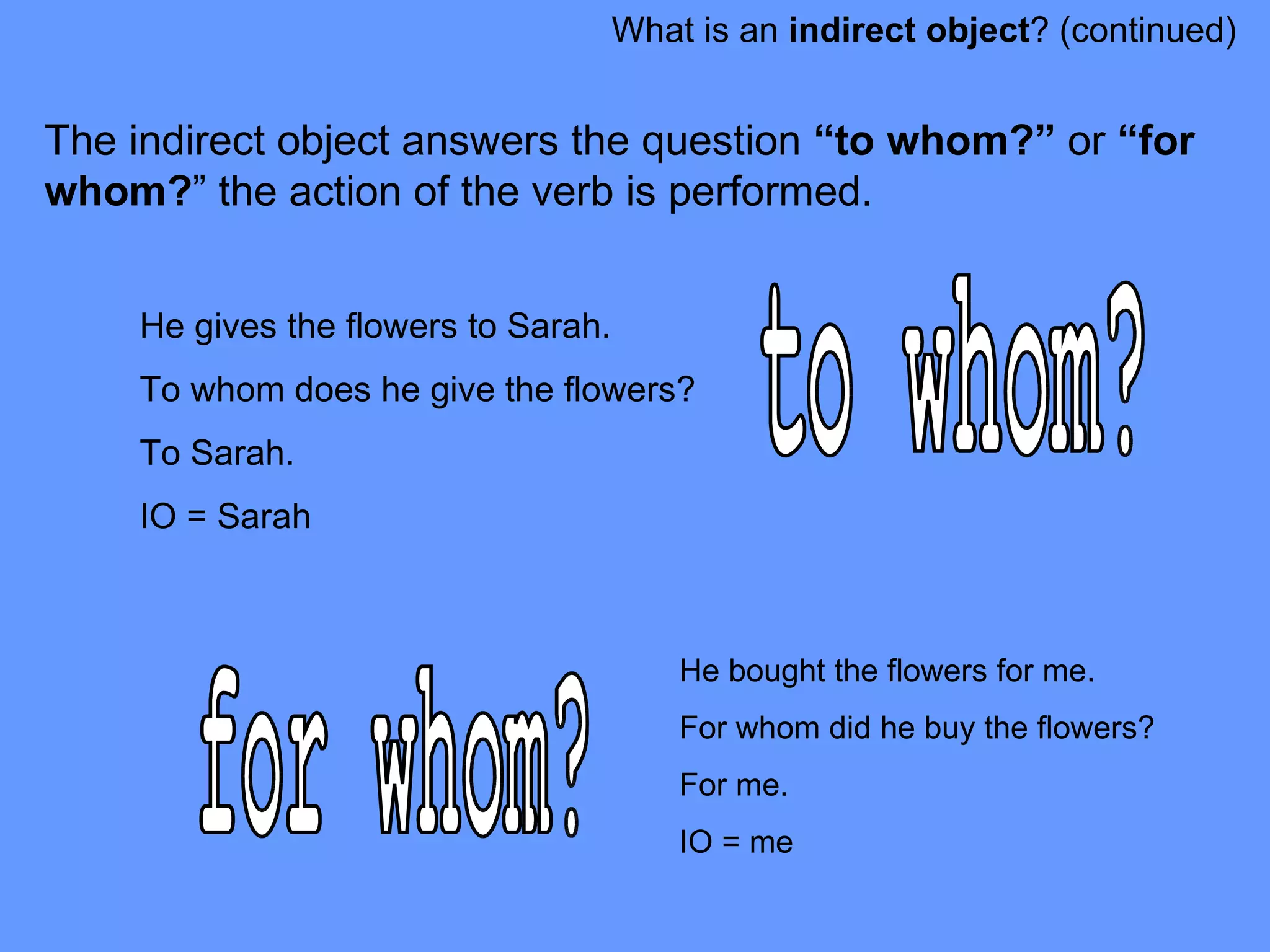
What is an  indirect object ? (continued) The indirect object answers the question  “to whom?”  or  “for whom? ” the action of the verb is performed.  He gives the flowers to Sarah. To whom does he give the flowers?  To Sarah.  IO = Sarah  He bought the flowers for me.  For whom did he buy the flowers? For me.  IO = me  to whom?  for whom?
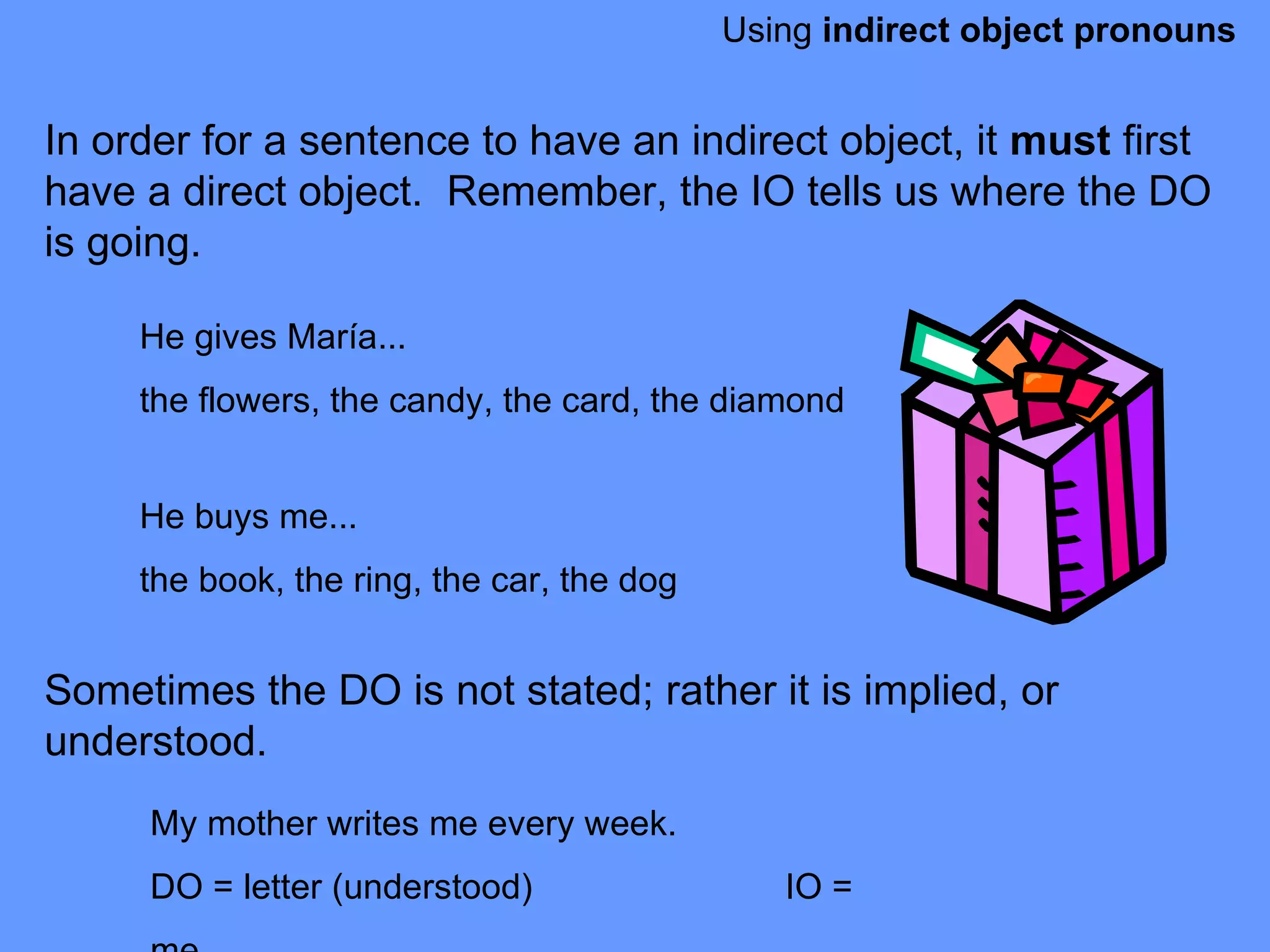
Using  indirect object pronouns In order for a sentence to have an indirect object, it  must  first have a direct object.  Remember, the IO tells us where the DO is going.  He gives Mar ía... the flowers, the candy, the card, the diamond He buys me... the book, the ring, the car, the dog Sometimes the DO is not stated; rather it is implied, or understood.  My mother writes me every week.  DO = letter (understood) IO = me
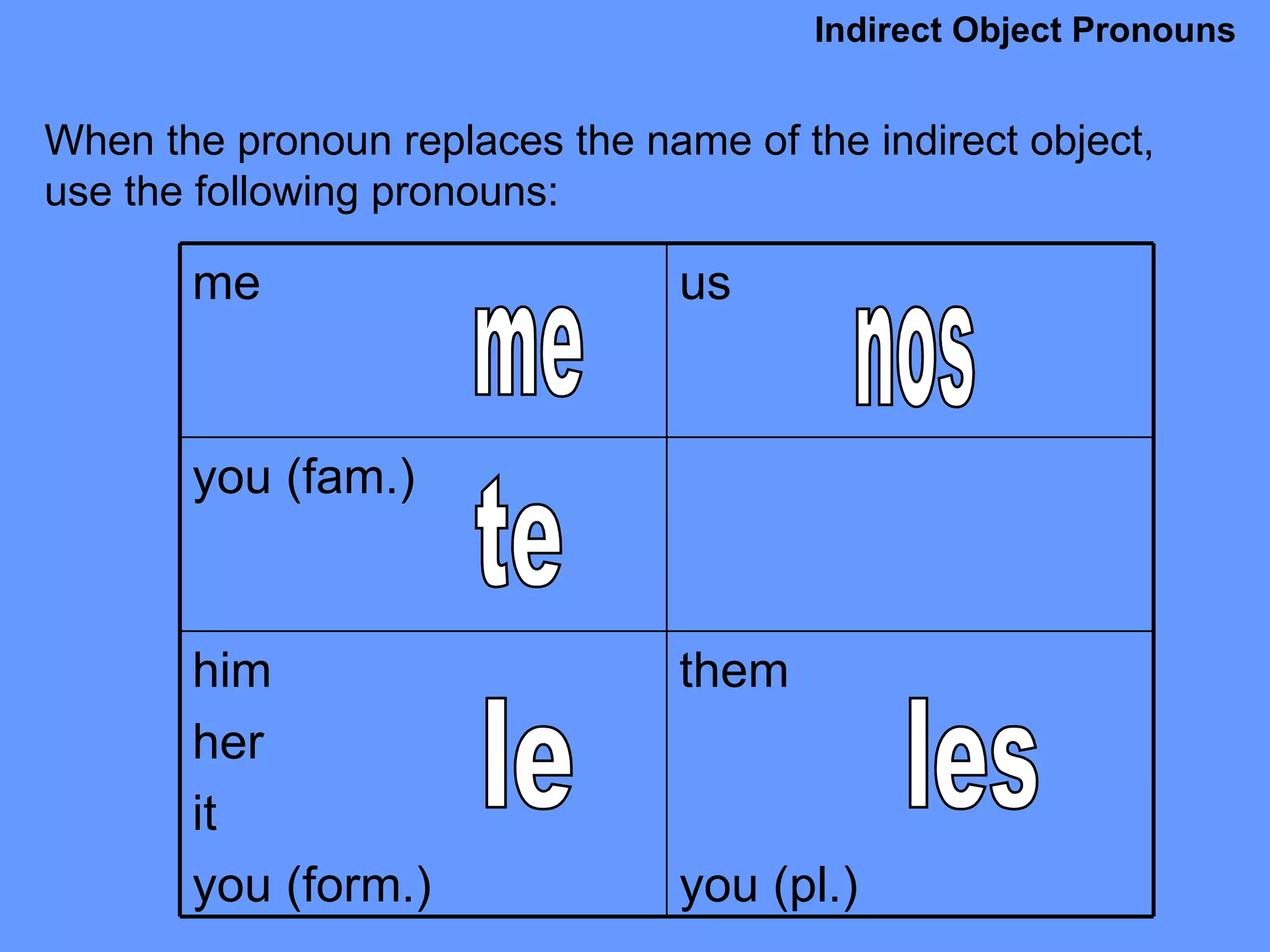
Indirect Object Pronouns When the pronoun replaces the name of the indirect object, use the following pronouns:  me te le nos les them you (pl.) him her it you (form.) you (fam.) us me
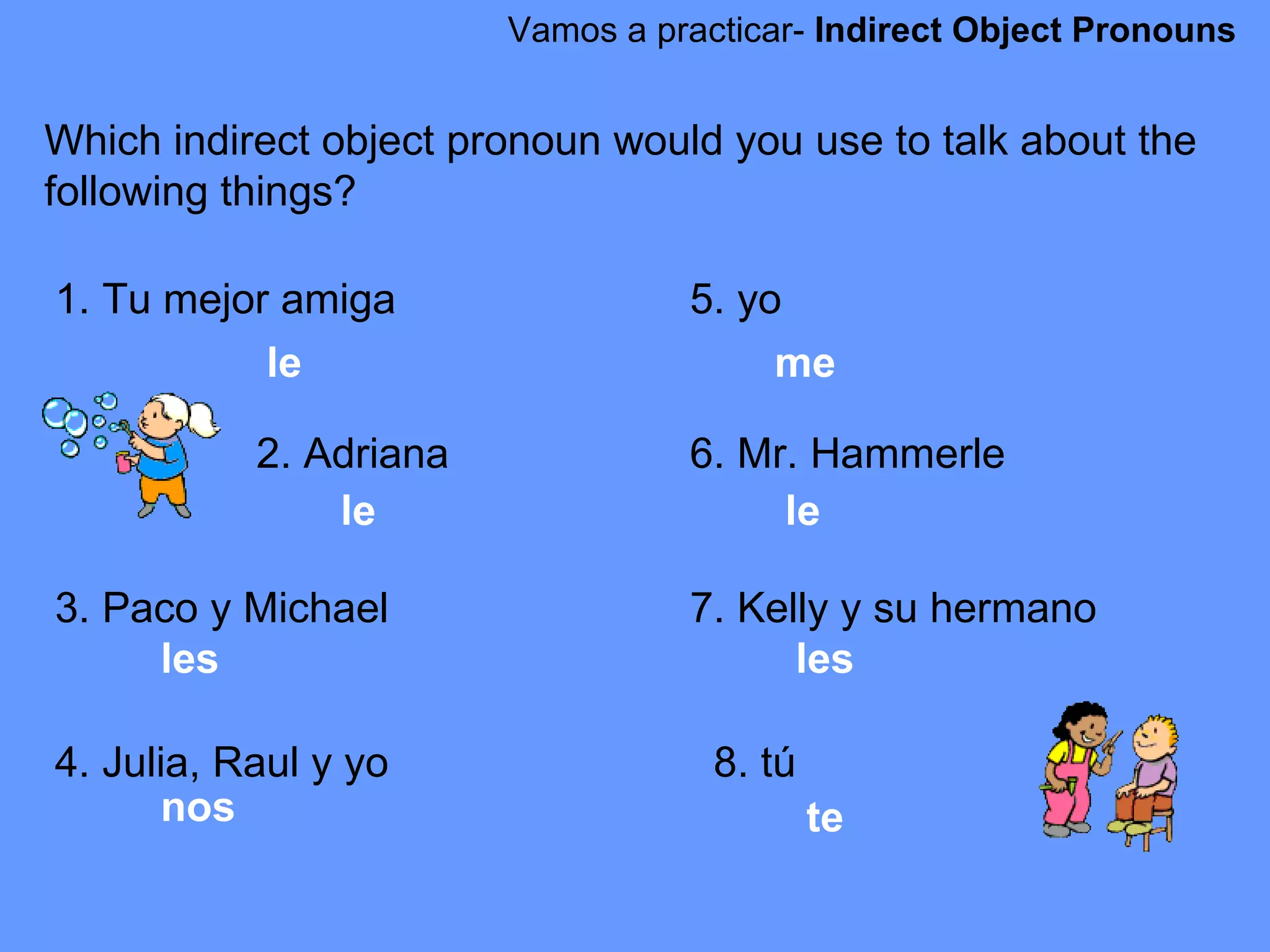
Vamos a practicar-  Indirect Object Pronouns Which indirect object pronoun would you use to talk about the following things?  1. Tu mejor amiga 5. yo 2. Adriana 6. Mr. Hammerle 3. Paco y Michael 7. Kelly y su hermano 4. Julia, Raul y yo    8. t ú le le les nos me le les te
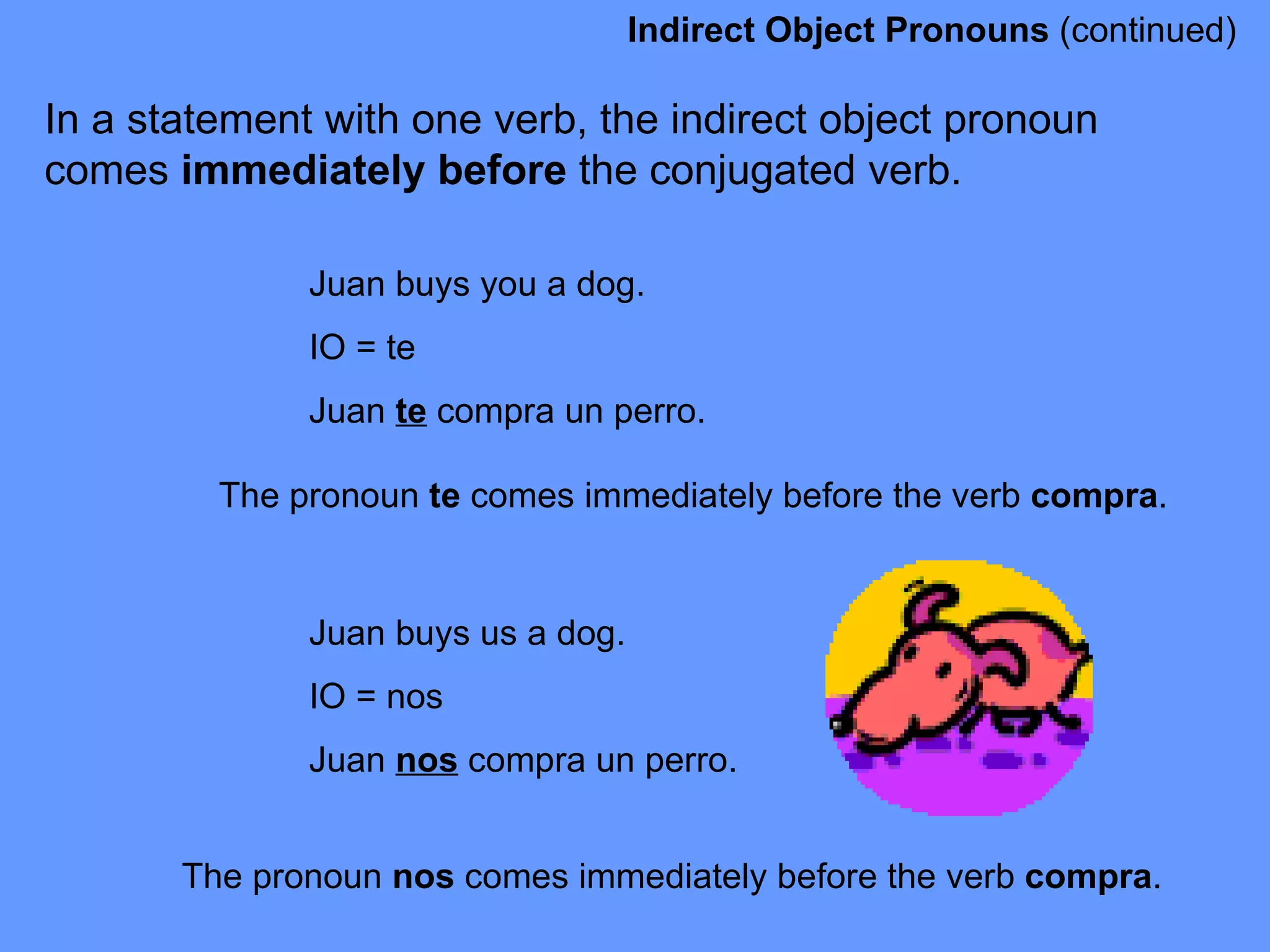
Indirect Object Pronouns  (continued) In a statement with one verb, the indirect object pronoun comes  immediately before  the conjugated verb.  Juan buys you a dog.  IO = te Juan  te  compra un perro.  The pronoun  te  comes immediately before the verb  compra . The pronoun  nos  comes immediately before the verb  compra . Juan buys us a dog.  IO = nos Juan  nos  compra un perro.
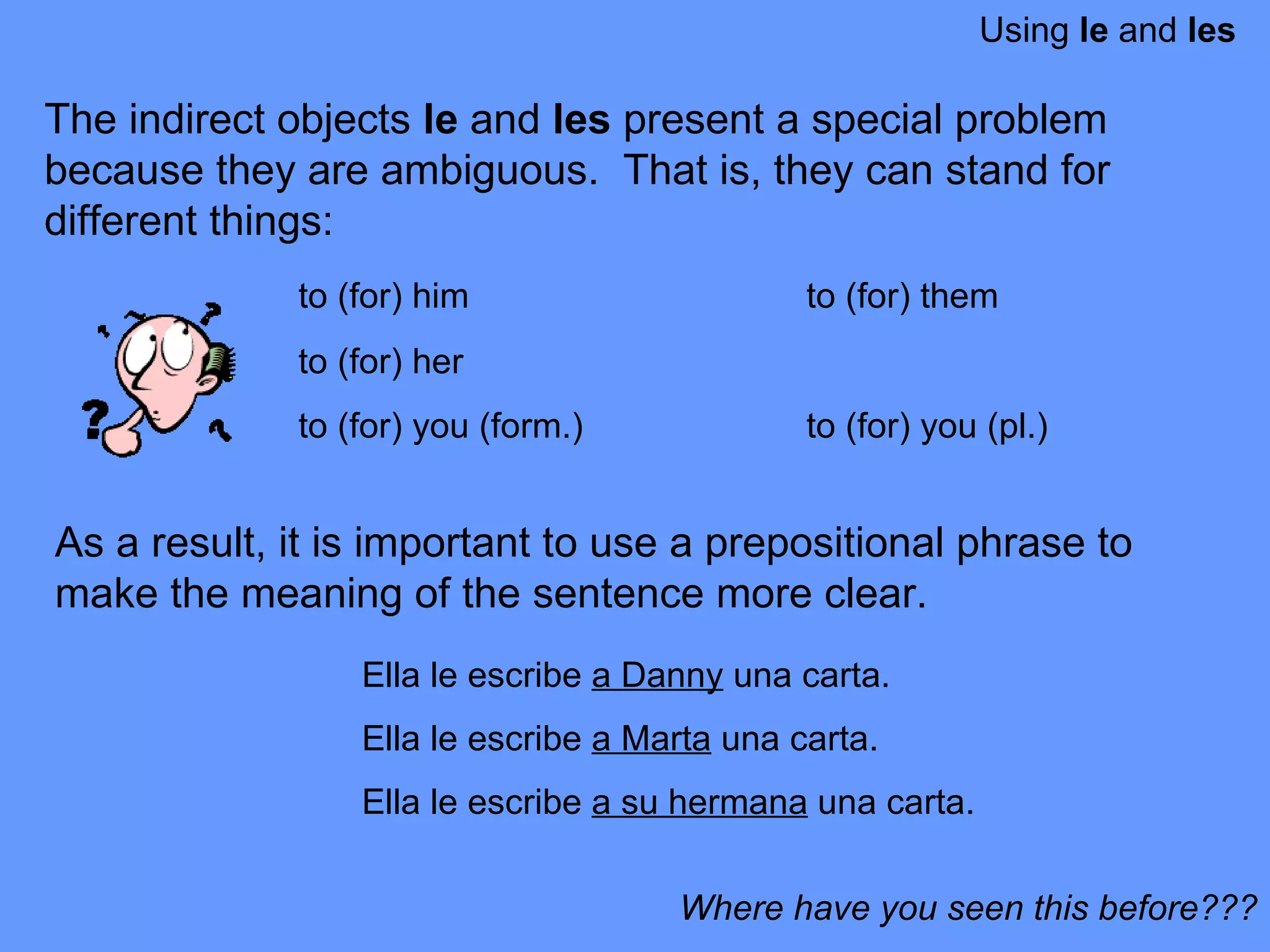
Using  le  and  les The indirect objects  le  and  les  present a special problem because they are ambiguous.  That is, they can stand for different things:  to (for) him to (for) them to (for) her to (for) you (form.) to (for) you (pl.) Where have you seen this before??? Ella le escribe  a Danny  una carta.  Ella le escribe  a Marta  una carta.  Ella le escribe  a su hermana  una carta.  As a result, it is important to use a prepositional phrase to make the meaning of the sentence more clear.
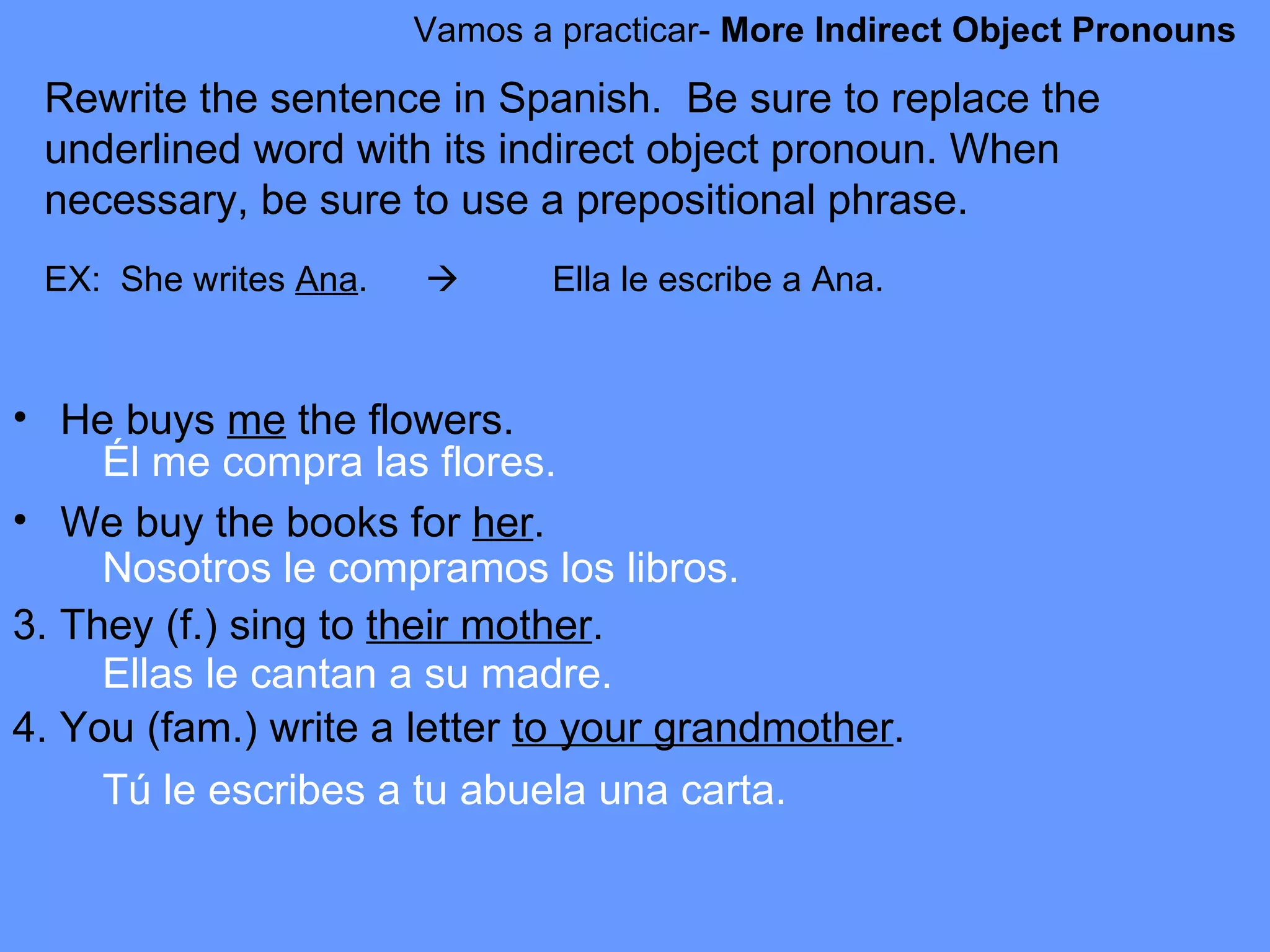
Vamos a practicar-  More Indirect Object Pronouns Rewrite the sentence in Spanish.  Be sure to replace the underlined word with its indirect object pronoun. When necessary, be sure to use a prepositional phrase. EX:  She writes  Ana .    Ella le escribe a Ana.   He buys  me  the flowers. We buy the books for  her .  3. They (f.) sing to  their mother .  4. You (fam.) write a letter  to your grandmother .  Él me compra las flores. Nosotros le compramos los libros. Ellas le cantan a su madre. Tú le escribes a tu abuela una carta.
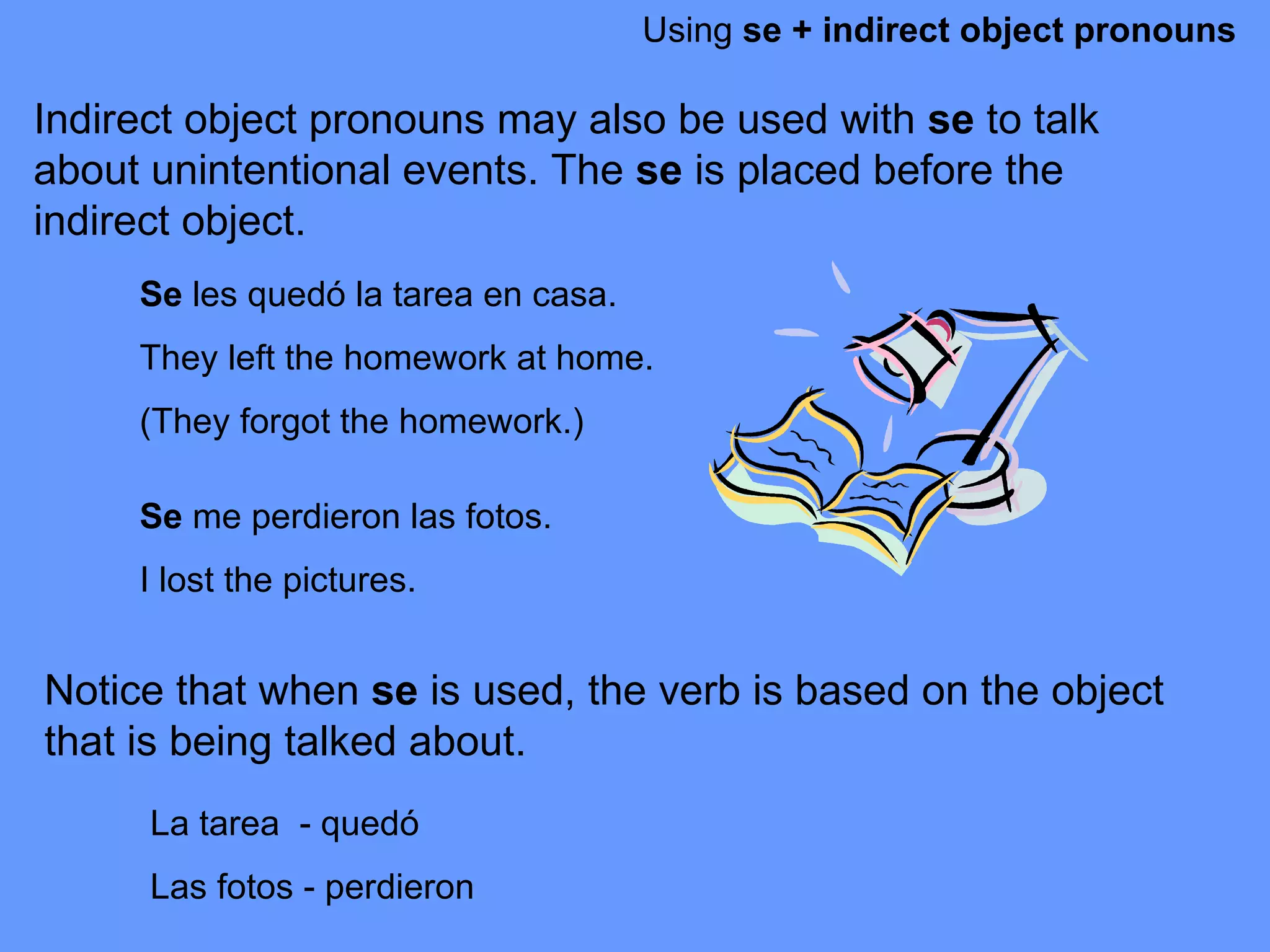
Using  se + indirect object pronouns Indirect object pronouns may also be used with  se  to talk about unintentional events. The  se  is placed before the indirect object.  Se  les qued ó la tarea en casa.  They left the homework at home.  (They forgot the homework.) Se  me perdieron las fotos.  I lost the pictures.  Notice that when  se  is used, the verb is based on the object that is being talked about.  La tarea  - qued ó Las fotos - perdieron
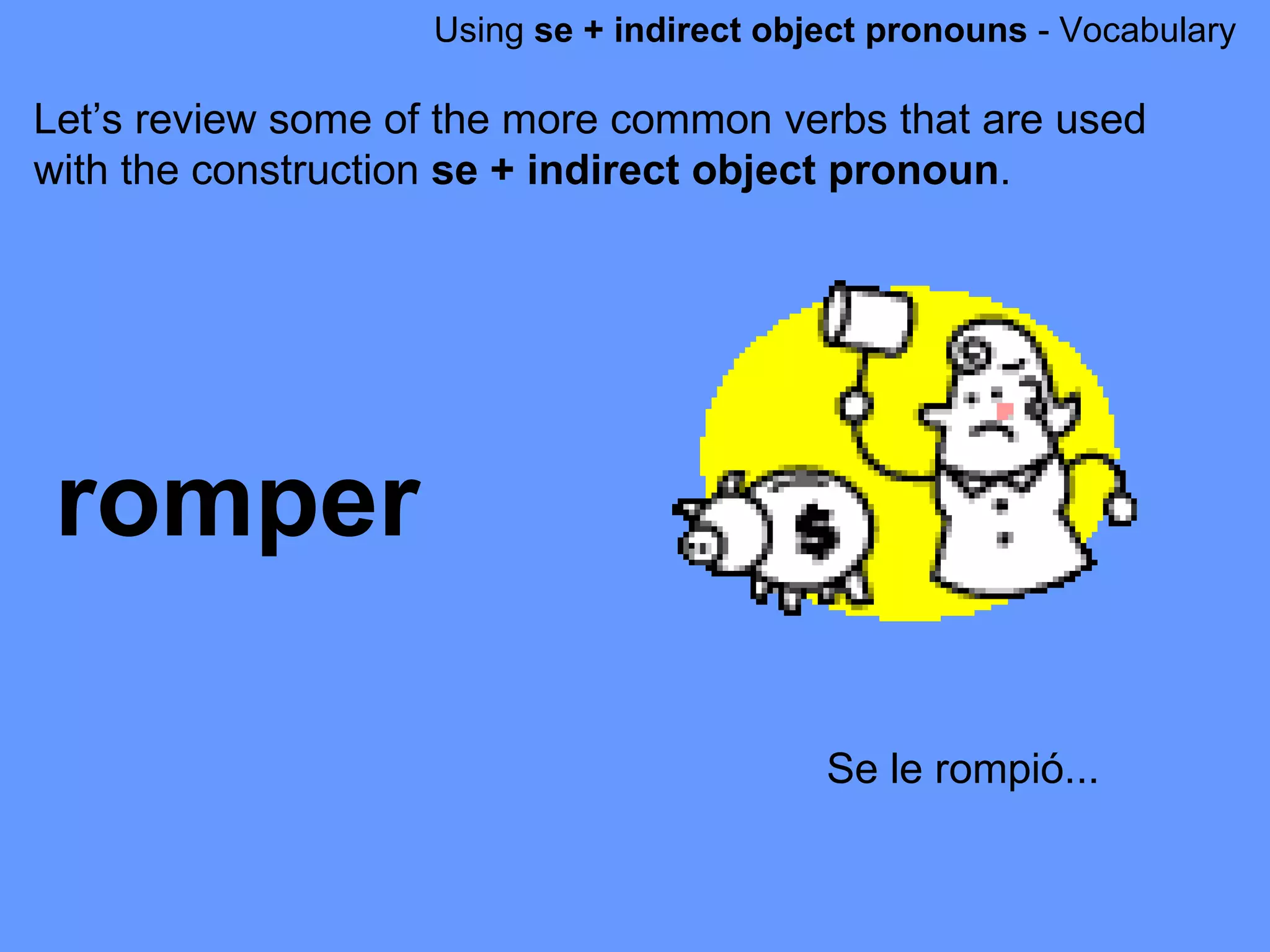
Using  se + indirect object pronouns  - Vocabulary Let’s review some of the more common verbs that are used with the construction  se + indirect object pronoun .  romper Se le rompi ó...
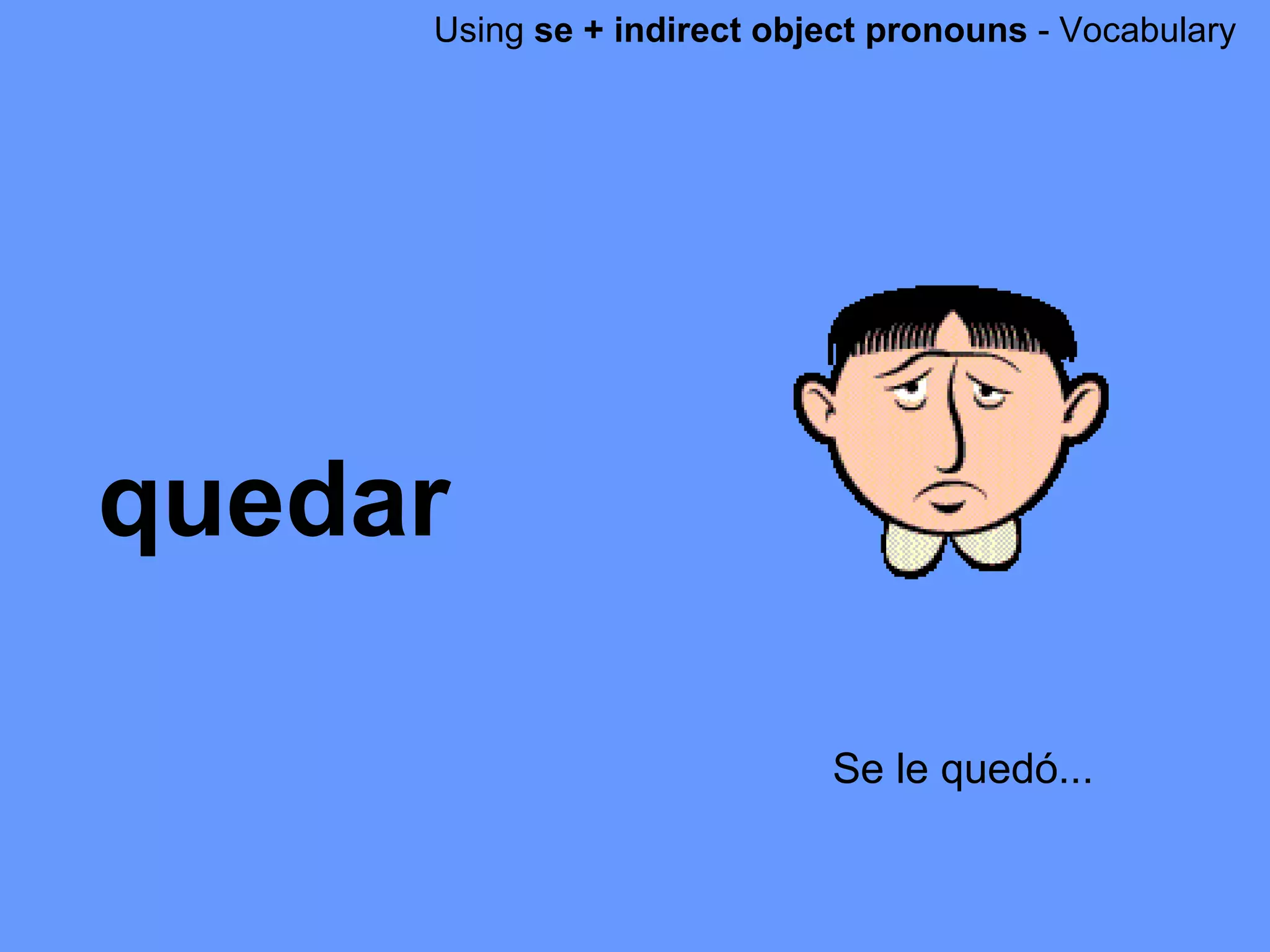
Using  se + indirect object pronouns  - Vocabulary quedar Se le qued ó...
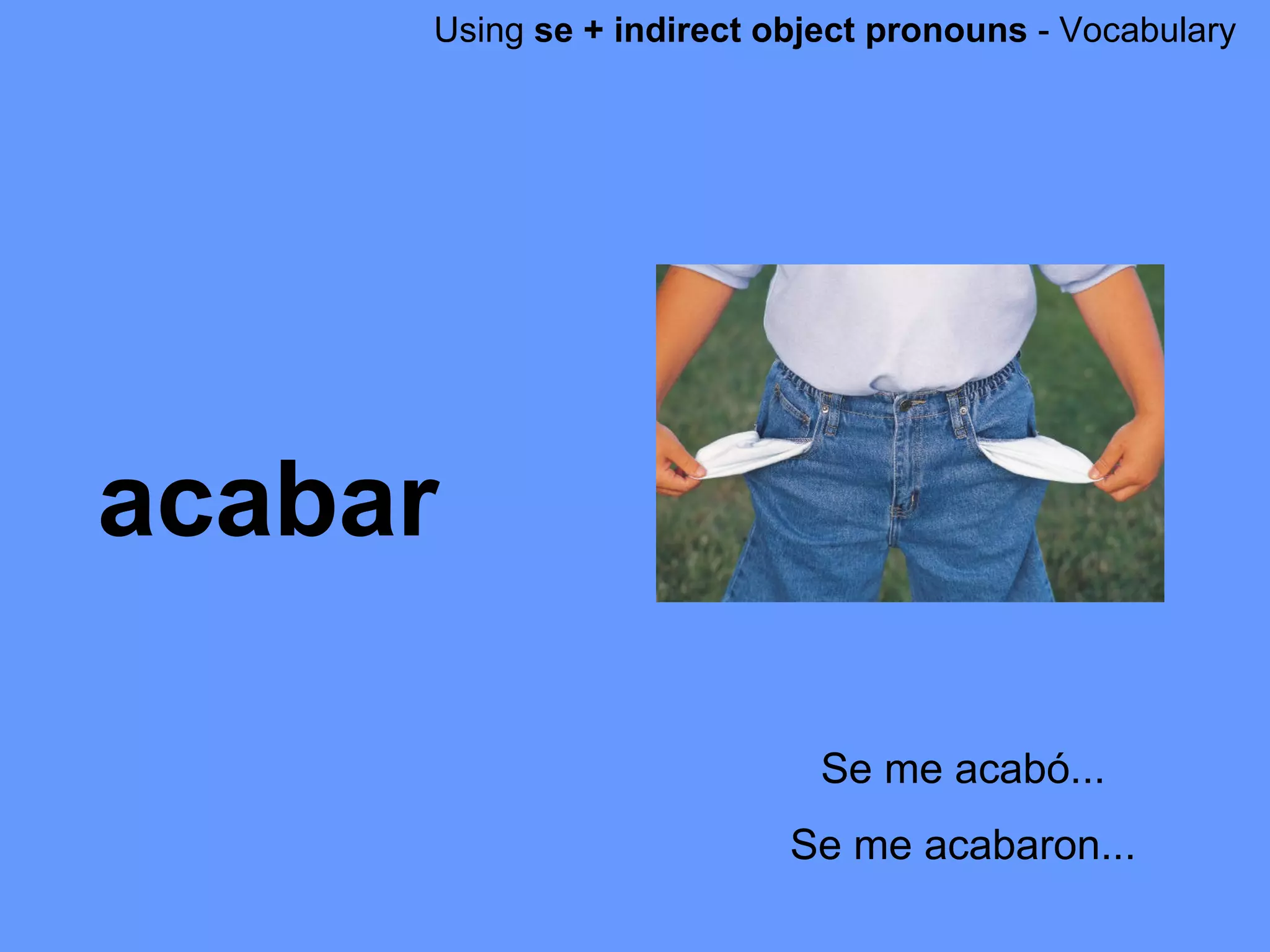
Using  se + indirect object pronouns  - Vocabulary acabar Se me acab ó... Se me acabaron...
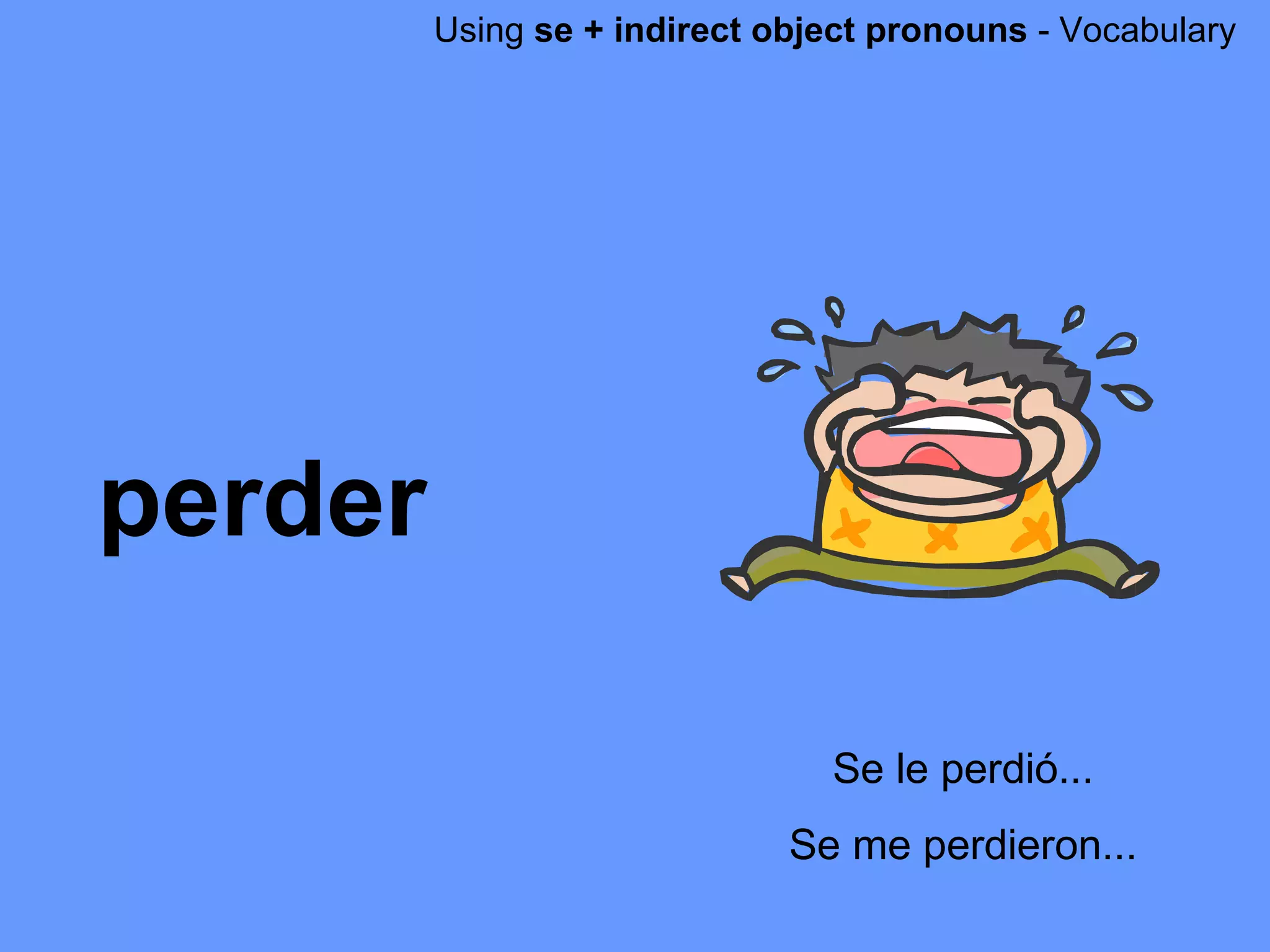
Using  se + indirect object pronouns  - Vocabulary perder Se le perdi ó... Se me perdieron...
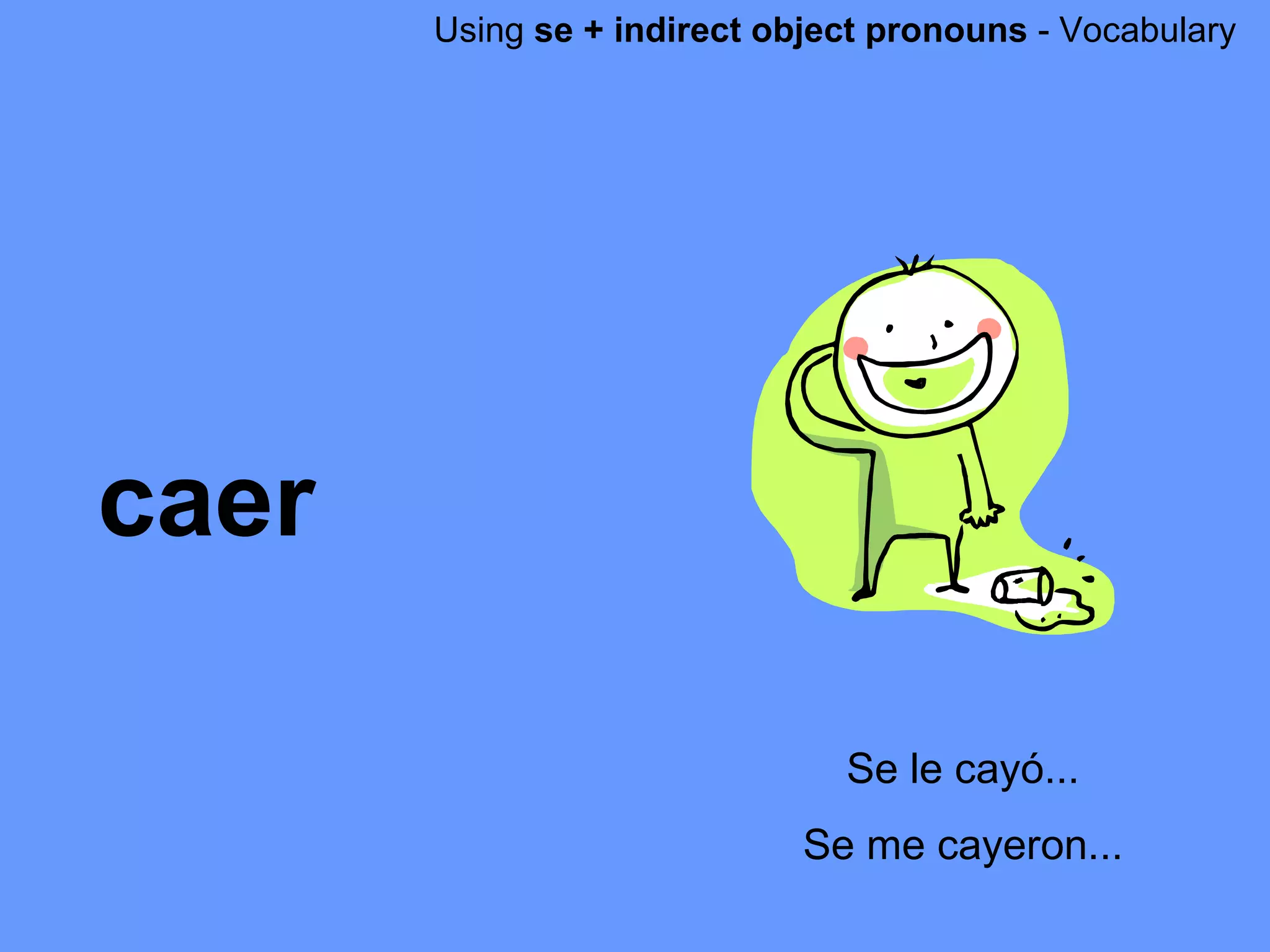
Using  se + indirect object pronouns  - Vocabulary caer Se le cay ó... Se me cayeron...
Using  se + indirect object pronouns  - Vocabulary olvidar Se te olvid ó...

Pronombres de complementos indirectos

  • 1.
    GRAM Á TICAIndirect Object Pronouns (pronombres de complemento indirecto)
  • 2.
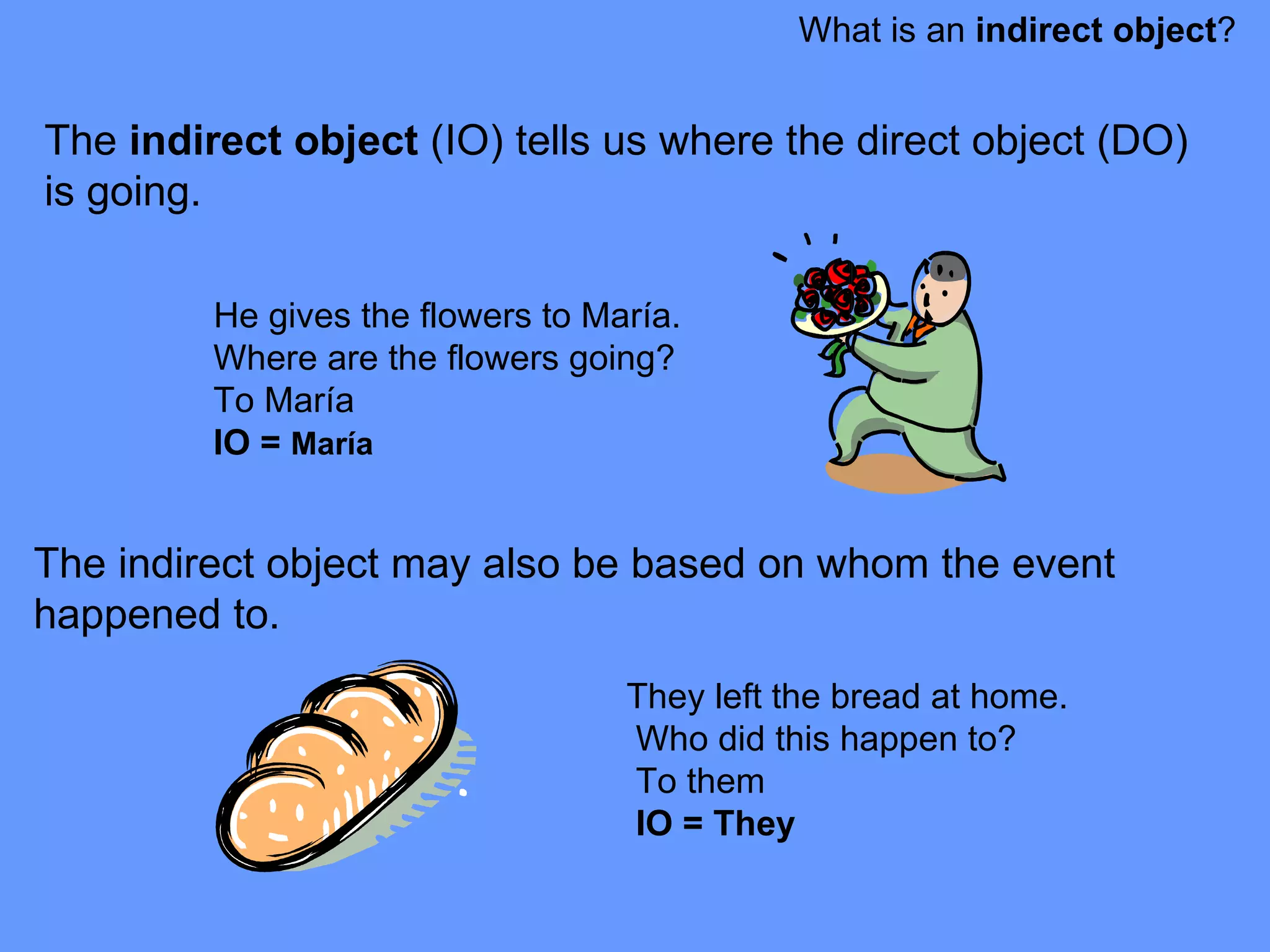
    What is an indirect object ? The indirect object (IO) tells us where the direct object (DO) is going. He gives the flowers to Mar ía. Where are the flowers going? To María IO = María They left the bread at home. Who did this happen to? To them IO = They The indirect object may also be based on whom the event happened to.
  • 3.
    What is an indirect object ? (continued) The indirect object answers the question “to whom?” or “for whom? ” the action of the verb is performed. He gives the flowers to Sarah. To whom does he give the flowers? To Sarah. IO = Sarah He bought the flowers for me. For whom did he buy the flowers? For me. IO = me to whom? for whom?
  • 4.
    Using indirectobject pronouns In order for a sentence to have an indirect object, it must first have a direct object. Remember, the IO tells us where the DO is going. He gives Mar ía... the flowers, the candy, the card, the diamond He buys me... the book, the ring, the car, the dog Sometimes the DO is not stated; rather it is implied, or understood. My mother writes me every week. DO = letter (understood) IO = me
  • 5.
    Indirect Object PronounsWhen the pronoun replaces the name of the indirect object, use the following pronouns: me te le nos les them you (pl.) him her it you (form.) you (fam.) us me
  • 6.
    Vamos a practicar- Indirect Object Pronouns Which indirect object pronoun would you use to talk about the following things? 1. Tu mejor amiga 5. yo 2. Adriana 6. Mr. Hammerle 3. Paco y Michael 7. Kelly y su hermano 4. Julia, Raul y yo 8. t ú le le les nos me le les te
  • 7.
    Indirect Object Pronouns (continued) In a statement with one verb, the indirect object pronoun comes immediately before the conjugated verb. Juan buys you a dog. IO = te Juan te compra un perro. The pronoun te comes immediately before the verb compra . The pronoun nos comes immediately before the verb compra . Juan buys us a dog. IO = nos Juan nos compra un perro.
  • 8.
    Using le and les The indirect objects le and les present a special problem because they are ambiguous. That is, they can stand for different things: to (for) him to (for) them to (for) her to (for) you (form.) to (for) you (pl.) Where have you seen this before??? Ella le escribe a Danny una carta. Ella le escribe a Marta una carta. Ella le escribe a su hermana una carta. As a result, it is important to use a prepositional phrase to make the meaning of the sentence more clear.
  • 9.
    Vamos a practicar- More Indirect Object Pronouns Rewrite the sentence in Spanish. Be sure to replace the underlined word with its indirect object pronoun. When necessary, be sure to use a prepositional phrase. EX: She writes Ana .  Ella le escribe a Ana. He buys me the flowers. We buy the books for her . 3. They (f.) sing to their mother . 4. You (fam.) write a letter to your grandmother . Él me compra las flores. Nosotros le compramos los libros. Ellas le cantan a su madre. Tú le escribes a tu abuela una carta.
  • 10.
    Using se+ indirect object pronouns Indirect object pronouns may also be used with se to talk about unintentional events. The se is placed before the indirect object. Se les qued ó la tarea en casa. They left the homework at home. (They forgot the homework.) Se me perdieron las fotos. I lost the pictures. Notice that when se is used, the verb is based on the object that is being talked about. La tarea - qued ó Las fotos - perdieron
  • 11.
    Using se+ indirect object pronouns - Vocabulary Let’s review some of the more common verbs that are used with the construction se + indirect object pronoun . romper Se le rompi ó...
  • 12.
    Using se+ indirect object pronouns - Vocabulary quedar Se le qued ó...
  • 13.
    Using se+ indirect object pronouns - Vocabulary acabar Se me acab ó... Se me acabaron...
  • 14.
    Using se+ indirect object pronouns - Vocabulary perder Se le perdi ó... Se me perdieron...
  • 15.
    Using se+ indirect object pronouns - Vocabulary caer Se le cay ó... Se me cayeron...
  • 16.
    Using se+ indirect object pronouns - Vocabulary olvidar Se te olvid ó...