VERB TENSES
Relax, don’t be tense;
these are just tenses.
PAST TENSE
Review
PAST TENSE
 The past tense of regular verbs is made by
adding -d or -ed to the base form of the verb,
while those of irregular verbs are formed in
various different ways (such as see→saw,
go→went, be→was/were). With regular and
some irregular verbs, the past tense form also
serves as a past participle.
SIMPLE PAST TENSE: EXAMPLES
 I worked yesterday.
 Rodrigo was here a moment ago.
 Karen sat on the bench.
 Jahir got his driver license last week.
 We studied for the midterm.
HOW TO PRONOUNCE…
SIMPLE PRESENT TENSE
 The PRESENT TENSE uses the verb's base form
(write, work), or, for third-person singular subjects,
the base form plus an -s ending (he writes, she
works). The PRESENT TENSE indicates that an
action is present, now, relative to the speaker or
writer.
SIMPLE PRESENT TENSE
 I study for the exam.
 She goes to the gym.
 Norma is an excellent student.
 Jerome and Jess are in the lobby.
 They get new badges.
FUTURE TENSE
FUTURE TENSE
 In grammar, a future tense is a verb form that
generally marks the event described by the verb
as not having happened yet, but expected to
happen in the future. An example of a future
tense form is the French aimera, meaning "will
love", derived from the verb aimer ("love").
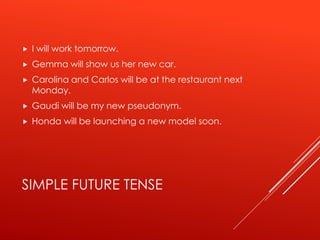
SIMPLE FUTURE TENSE
 I will work tomorrow.
 Gemma will show us her new car.
 Carolina and Carlos will be at the restaurant next
Monday.
 Gaudi will be my new pseudonym.
 Honda will be launching a new model soon.
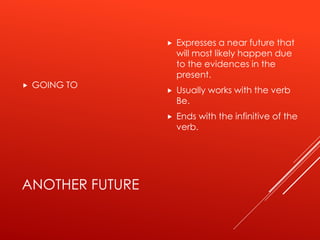
ANOTHER FUTURE
 GOING TO
 Expresses a near future that
will most likely happen due
to the evidences in the
present.
 Usually works with the verb
Be.
 Ends with the infinitive of the
verb.
ANOTHER FUTURE
 I am going to study.
 This is not going to affect my shipment.
 We are going to the warehouse tomorrow.
 Jenna and Carla are going to assist later today.
 Brandon is going to take the risk.
Verb Tenses   (Present, Past, Fuure)

Verb Tenses (Present, Past, Fuure)

  • 1.
    VERB TENSES Relax, don’tbe tense; these are just tenses.
  • 2.
  • 3.
    PAST TENSE  Thepast tense of regular verbs is made by adding -d or -ed to the base form of the verb, while those of irregular verbs are formed in various different ways (such as see→saw, go→went, be→was/were). With regular and some irregular verbs, the past tense form also serves as a past participle.
  • 4.
    SIMPLE PAST TENSE:EXAMPLES  I worked yesterday.  Rodrigo was here a moment ago.  Karen sat on the bench.  Jahir got his driver license last week.  We studied for the midterm.
  • 5.
  • 6.
    SIMPLE PRESENT TENSE The PRESENT TENSE uses the verb's base form (write, work), or, for third-person singular subjects, the base form plus an -s ending (he writes, she works). The PRESENT TENSE indicates that an action is present, now, relative to the speaker or writer.
  • 7.
    SIMPLE PRESENT TENSE I study for the exam.  She goes to the gym.  Norma is an excellent student.  Jerome and Jess are in the lobby.  They get new badges.
  • 8.
  • 9.
    FUTURE TENSE  Ingrammar, a future tense is a verb form that generally marks the event described by the verb as not having happened yet, but expected to happen in the future. An example of a future tense form is the French aimera, meaning "will love", derived from the verb aimer ("love").
  • 10.
    SIMPLE FUTURE TENSE I will work tomorrow.  Gemma will show us her new car.  Carolina and Carlos will be at the restaurant next Monday.  Gaudi will be my new pseudonym.  Honda will be launching a new model soon.
  • 11.
    ANOTHER FUTURE  GOINGTO  Expresses a near future that will most likely happen due to the evidences in the present.  Usually works with the verb Be.  Ends with the infinitive of the verb.
  • 12.
    ANOTHER FUTURE  Iam going to study.  This is not going to affect my shipment.  We are going to the warehouse tomorrow.  Jenna and Carla are going to assist later today.  Brandon is going to take the risk.