

















Retrograde Urethrography
Presenter: Dr. Dheeraj Kumar
MRIT, Ph.D. (Radiology and Imaging)
Assistant Professor
Medical Radiology and Imaging Technology
School of Health Sciences, CSJM University, Kanpur
18/08/2023 Retrograde Urethrography By- Dr. Dheeraj Kumar 1
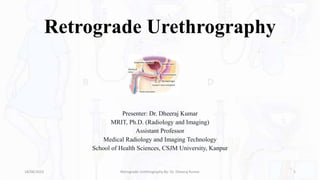
Retrograde Urethrography
Retrograde Urethrography is a specialized
X-ray procedure used to visualize the male
urethra, which is the tube that carries urine
from the bladder to the external body
opening. This procedure is typically
performed to diagnose and evaluate various
conditions and abnormalities within the
urethra, such as strictures, obstructions, or
injuries.
18/08/2023 Retrograde Urethrography By- Dr. Dheeraj Kumar 2
Purpose
The primary purpose of
Retrograde Urethrography is to
assess the structure and function
of the urethra. It helps in
diagnosing conditions that may
cause pain, difficulty urinating, or
other urinary problems in males.
18/08/2023 Retrograde Urethrography By- Dr. Dheeraj Kumar 3
Indications
Retrograde Urethrography is
commonly used to diagnose
conditions such as urethral strictures
(narrowing of the urethra), trauma or
injury to the urethra, congenital
abnormalities, and recurrent urinary
tract infections.
18/08/2023 Retrograde Urethrography By- Dr. Dheeraj Kumar 4
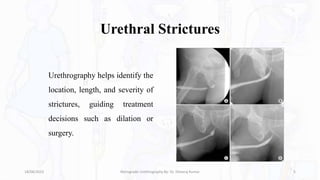
Urethral Strictures
Urethrography helps identify the
location, length, and severity of
strictures, guiding treatment
decisions such as dilation or
surgery.
18/08/2023 Retrograde Urethrography By- Dr. Dheeraj Kumar 5
Trauma or Injury
• Explanation: In cases of trauma or
injury to the pelvic region, such as
accidents or falls, the urethra can
be damaged. This procedure helps
assess the extent of the injury and
guides surgical repair if necessary.
18/08/2023 Retrograde Urethrography By- Dr. Dheeraj Kumar 6
Congenital Abnormalities
• Explanation: Some individuals are born
with congenital (present from birth)
urethral abnormalities. Retrograde
Urethrography is used to diagnose these
conditions, such as urethral diverticula or
congenital strictures.
18/08/2023 Retrograde Urethrography By- Dr. Dheeraj Kumar 7
Recurrent Urinary Tract Infections (UTIs)
• Explanation: Frequent UTIs
may be caused by an
underlying urethral issue. This
test can identify any structural
problems or obstructions that
could contribute to recurring
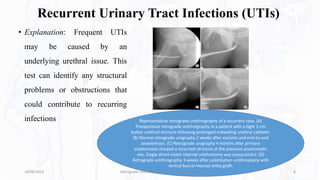
infections Representative retrograde urethrography of a recurrent case. (A)
Preoperative retrograde urethrography in a patient with a tight 1-cm
bulbar urethral stricture following prolonged indwelling urethral catheter.
(B) Normal retrograde urography 2 weeks after excision and end-to-end
anastomosis. (C) Retrograde urography 4 months after primary
anastomosis showed a recurrent stricture at the previous anastomotic
site. Single direct-vision internal urethrotomy was unsuccessful. (D)
Retrograde urethrography 3 weeks after substitution urethroplasty with
ventral buccal mucosa onlay graft.
18/08/2023 Retrograde Urethrography By- Dr. Dheeraj Kumar 8
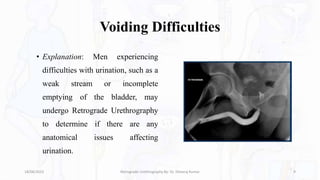
Voiding Difficulties
• Explanation: Men experiencing
difficulties with urination, such as a
weak stream or incomplete
emptying of the bladder, may
undergo Retrograde Urethrography
to determine if there are any
anatomical issues affecting
urination.
18/08/2023 Retrograde Urethrography By- Dr. Dheeraj Kumar 9
Hematuria (Blood in Urine)
• Explanation: Blood in the urine
can have various causes,
including urethral problems.
This test can help identify the
source of bleeding, such as
urethral injury or abnormal
blood vessels.
18/08/2023 Retrograde Urethrography By- Dr. Dheeraj Kumar 10
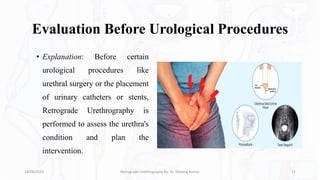
Evaluation Before Urological Procedures
• Explanation: Before certain
urological procedures like
urethral surgery or the placement
of urinary catheters or stents,
Retrograde Urethrography is
performed to assess the urethra's
condition and plan the
intervention.
18/08/2023 Retrograde Urethrography By- Dr. Dheeraj Kumar 11
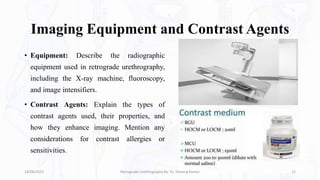
Imaging Equipment and Contrast Agents
• Equipment: Describe the radiographic
equipment used in retrograde urethrography,
including the X-ray machine, fluoroscopy,
and image intensifiers.
• Contrast Agents: Explain the types of
contrast agents used, their properties, and
how they enhance imaging. Mention any
considerations for contrast allergies or
sensitivities.
18/08/2023 Retrograde Urethrography By- Dr. Dheeraj Kumar 12
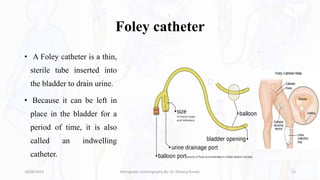
Foley catheter
• A Foley catheter is a thin,
sterile tube inserted into
the bladder to drain urine.
• Because it can be left in
place in the bladder for a
period of time, it is also
called an indwelling
catheter.
18/08/2023 Retrograde Urethrography By- Dr. Dheeraj Kumar 13
Patient Preparation
• Ensure the patient is informed about the procedure and its purpose.
• Obtain informed consent from the patient.
• Explain the procedure to the patient and address any concerns.
• Instruct the patient to fast for several hours before the procedure to
minimize the risk of aspiration during the use of contrast agents.
• Emphasize the importance of emptying the bladder before the examination
to optimize imaging quality.
18/08/2023 Retrograde Urethrography By- Dr. Dheeraj Kumar 14
Procedure Steps
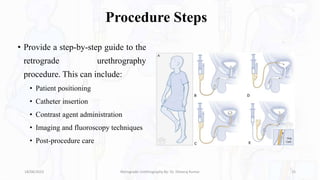
• Provide a step-by-step guide to the
retrograde urethrography
procedure. This can include:
• Patient positioning
• Catheter insertion
• Contrast agent administration
• Imaging and fluoroscopy techniques
• Post-procedure care
18/08/2023 Retrograde Urethrography By- Dr. Dheeraj Kumar 15
Radiographic Equipment Setup
• Position the X-ray machine and fluoroscopy equipment in a manner
that allows clear visualization of the urethra.
• Ensure the equipment is calibrated and functioning correctly.
• Check the availability of contrast agents and ensure they are properly
stored and prepared.
18/08/2023 Retrograde Urethrography By- Dr. Dheeraj Kumar 16
Patient Positioning
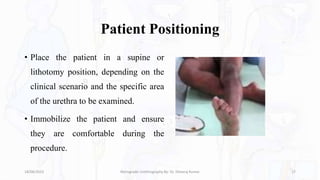
• Place the patient in a supine or
lithotomy position, depending on the
clinical scenario and the specific area
of the urethra to be examined.
• Immobilize the patient and ensure
they are comfortable during the
procedure.
18/08/2023 Retrograde Urethrography By- Dr. Dheeraj Kumar 17
Catheter Insertion
• Sterilize the genital area and the urethral meatus
to minimize the risk of infection.
• Insert a sterile catheter gently into the urethra.
• Secure the catheter in place to prevent
accidental removal during the procedure.
• Depending on the specific case, a Foley
catheter or a specialized catheter with a balloon
may be used.
18/08/2023 Retrograde Urethrography By- Dr. Dheeraj Kumar 18
Contrast Agent Administration
• Connect a syringe with a radiopaque
contrast agent to the catheter.
• Slowly inject the contrast agent into the
urethra while monitoring the flow under
fluoroscopy.
• Continue injecting until the urethra is
adequately filled with contrast, ensuring
that it flows into the bladder.
18/08/2023 Retrograde Urethrography By- Dr. Dheeraj Kumar 19
Post-procedure Care
• After completing the imaging, carefully remove the catheter.
• Monitor the patient for any immediate adverse reactions.
• Provide post-procedure instructions to the patient, such as drinking
fluids to flush out any residual contrast material.
• Address any discomfort or concerns the patient may have.
18/08/2023 Retrograde Urethrography By- Dr. Dheeraj Kumar 20
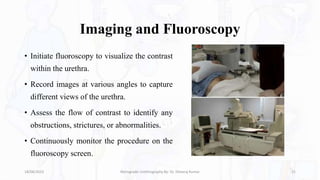
Imaging and Fluoroscopy
• Initiate fluoroscopy to visualize the contrast
within the urethra.
• Record images at various angles to capture
different views of the urethra.
• Assess the flow of contrast to identify any
obstructions, strictures, or abnormalities.
• Continuously monitor the procedure on the
fluoroscopy screen.
18/08/2023 Retrograde Urethrography By- Dr. Dheeraj Kumar 21
Normal Anatomy and Variants
• Anatomy of the Male Urethra: Present
detailed illustrations and radiographic
images depicting the normal anatomy of
the male urethra.
• Common Anatomical Variants:
Highlight variations that radiologists may
encounter, emphasizing the need for
familiarity with both typical and atypical
anatomy.
18/08/2023 Retrograde Urethrography By- Dr. Dheeraj Kumar 22
Common Pathologies Detected
The various pathologies that can be detected through retrograde urethrography, such as:
• Urethral strictures
• Urethral diverticula
• Urethral trauma
• Neoplastic lesions
• Infections
• Fistulas
• Other relevant conditions
18/08/2023 Retrograde Urethrography By- Dr. Dheeraj Kumar 23
Common Complications
• Allergic Reactions:
• Some patients may be allergic to the contrast agent used. This can result in mild to severe allergic reactions,
including itching, rash, or even anaphylaxis.
• Safety Measure: Prior to the procedure, assess the patient's history for allergies and administer premedication if
necessary. Be prepared to manage allergic reactions promptly.
• Infection:
• The introduction of catheters into the urethra increases the risk of infection, including urinary tract infections.
• Safety Measure: Strict aseptic techniques, including sterilization of catheters and the genital area, should be
maintained throughout the procedure to minimize the risk of infection.
18/08/2023 Retrograde Urethrography By- Dr. Dheeraj Kumar 24
• Hematuria:
• Hematuria, or blood in the urine, can occur due to urethral trauma or other complications
during the procedure.
• Safety Measure: Use gentle catheter insertion techniques, and carefully monitor the patient for
any signs of bleeding during the procedure. Address any bleeding promptly.
• Urethral Injury:
• The insertion of a catheter carries the risk of urethral injury, particularly in patients with
strictures or anatomical abnormalities.
• Safety Measure: Careful catheter insertion and monitoring of the catheter's path are essential.
Use appropriate catheter sizes and lubricants to minimize trauma.
18/08/2023 Retrograde Urethrography By- Dr. Dheeraj Kumar 25
Safety Measures
• Patient Assessment:
• Thoroughly assess the patient's medical history, including allergies and previous
adverse reactions to contrast agents.
• Ensure patients are adequately informed about the procedure and potential risks.
• Aseptic Technique:
• Maintain strict aseptic techniques during catheter insertion to prevent infection.
• Use sterile equipment, gloves, and drapes.
18/08/2023 Retrograde Urethrography By- Dr. Dheeraj Kumar 26
• Contrast Agent Selection:
• Choose contrast agents with the lowest risk of allergic reactions for sensitized
patients.
• Be prepared with emergency medications and equipment to manage allergic
reactions.
• Catheter Insertion:
• Select an appropriate catheter size and ensure it is inserted gently and carefully.
• Monitor the catheter's progress during insertion to minimize trauma.
18/08/2023 Retrograde Urethrography By- Dr. Dheeraj Kumar 27
• Post-procedure Monitoring:
• Keep patients under observation for a period after the procedure to detect any immediate
complications.
• Educate patients on post-procedure care, including increased fluid intake.
• Emergency Preparedness:
• Have emergency equipment and medications readily available to manage complications
such as allergic reactions or hematuria.
• Documentation:
• Maintain detailed records of the procedure, including any complications and how they
were managed.
18/08/2023 Retrograde Urethrography By- Dr. Dheeraj Kumar 28
References
• Smith's Textbook of Endourology, Arthur D. Smith, Glenn M. Preminger, Gopal H. Badlani, Louis R. Kavoussi, 2019 Publisher:
Wiley,ISBN-13: 978-1119245273
• Hinman's Atlas of UroSurgical Anatomy, Greg T. MacLennan, MD, 2011. Publisher: Saunders, ISBN-13: 978-1416029713
• Smith, A. D., & Badlani, G. H. (2004). Imaging of the male urethra. Urologic Clinics of North America, 31(2), 207-217. doi:
10.1016/j.ucl.2004.02.002
This article provides an overview of imaging techniques for the male urethra, including RGU, and discusses its diagnostic utility in
various conditions.
• Wein, A. J., Kavoussi, L. R., Partin, A. W., & Peters, C. A. (Eds.). (2015). Campbell-Walsh Urology (11th ed.). Elsevier.
The "Campbell-Walsh Urology" textbook is a comprehensive resource for urological procedures, including RGU. It covers the
procedure, indications, and clinical applications in detail.
18/08/2023 Retrograde Urethrography By- Dr. Dheeraj Kumar 29
Thank You
18/08/2023 Retrograde Urethrography By- Dr. Dheeraj Kumar 30
Q&A Session
Continue the question-and-answer session with the students audience,
addressing any additional queries or comments.
18/08/2023 Retrograde Urethrography By- Dr. Dheeraj Kumar 31

RGU.pptx

  • 1.
    Retrograde Urethrography Presenter: Dr.Dheeraj Kumar MRIT, Ph.D. (Radiology and Imaging) Assistant Professor Medical Radiology and Imaging Technology School of Health Sciences, CSJM University, Kanpur 18/08/2023 Retrograde Urethrography By- Dr. Dheeraj Kumar 1
  • 2.
    Retrograde Urethrography Retrograde Urethrographyis a specialized X-ray procedure used to visualize the male urethra, which is the tube that carries urine from the bladder to the external body opening. This procedure is typically performed to diagnose and evaluate various conditions and abnormalities within the urethra, such as strictures, obstructions, or injuries. 18/08/2023 Retrograde Urethrography By- Dr. Dheeraj Kumar 2
  • 3.
    Purpose The primary purposeof Retrograde Urethrography is to assess the structure and function of the urethra. It helps in diagnosing conditions that may cause pain, difficulty urinating, or other urinary problems in males. 18/08/2023 Retrograde Urethrography By- Dr. Dheeraj Kumar 3
  • 4.
    Indications Retrograde Urethrography is commonlyused to diagnose conditions such as urethral strictures (narrowing of the urethra), trauma or injury to the urethra, congenital abnormalities, and recurrent urinary tract infections. 18/08/2023 Retrograde Urethrography By- Dr. Dheeraj Kumar 4
  • 5.
    Urethral Strictures Urethrography helpsidentify the location, length, and severity of strictures, guiding treatment decisions such as dilation or surgery. 18/08/2023 Retrograde Urethrography By- Dr. Dheeraj Kumar 5
  • 6.
    Trauma or Injury •Explanation: In cases of trauma or injury to the pelvic region, such as accidents or falls, the urethra can be damaged. This procedure helps assess the extent of the injury and guides surgical repair if necessary. 18/08/2023 Retrograde Urethrography By- Dr. Dheeraj Kumar 6
  • 7.
    Congenital Abnormalities • Explanation:Some individuals are born with congenital (present from birth) urethral abnormalities. Retrograde Urethrography is used to diagnose these conditions, such as urethral diverticula or congenital strictures. 18/08/2023 Retrograde Urethrography By- Dr. Dheeraj Kumar 7
  • 8.
    Recurrent Urinary TractInfections (UTIs) • Explanation: Frequent UTIs may be caused by an underlying urethral issue. This test can identify any structural problems or obstructions that could contribute to recurring infections Representative retrograde urethrography of a recurrent case. (A) Preoperative retrograde urethrography in a patient with a tight 1-cm bulbar urethral stricture following prolonged indwelling urethral catheter. (B) Normal retrograde urography 2 weeks after excision and end-to-end anastomosis. (C) Retrograde urography 4 months after primary anastomosis showed a recurrent stricture at the previous anastomotic site. Single direct-vision internal urethrotomy was unsuccessful. (D) Retrograde urethrography 3 weeks after substitution urethroplasty with ventral buccal mucosa onlay graft. 18/08/2023 Retrograde Urethrography By- Dr. Dheeraj Kumar 8
  • 9.
    Voiding Difficulties • Explanation:Men experiencing difficulties with urination, such as a weak stream or incomplete emptying of the bladder, may undergo Retrograde Urethrography to determine if there are any anatomical issues affecting urination. 18/08/2023 Retrograde Urethrography By- Dr. Dheeraj Kumar 9
  • 10.
    Hematuria (Blood inUrine) • Explanation: Blood in the urine can have various causes, including urethral problems. This test can help identify the source of bleeding, such as urethral injury or abnormal blood vessels. 18/08/2023 Retrograde Urethrography By- Dr. Dheeraj Kumar 10
  • 11.
    Evaluation Before UrologicalProcedures • Explanation: Before certain urological procedures like urethral surgery or the placement of urinary catheters or stents, Retrograde Urethrography is performed to assess the urethra's condition and plan the intervention. 18/08/2023 Retrograde Urethrography By- Dr. Dheeraj Kumar 11
  • 12.
    Imaging Equipment andContrast Agents • Equipment: Describe the radiographic equipment used in retrograde urethrography, including the X-ray machine, fluoroscopy, and image intensifiers. • Contrast Agents: Explain the types of contrast agents used, their properties, and how they enhance imaging. Mention any considerations for contrast allergies or sensitivities. 18/08/2023 Retrograde Urethrography By- Dr. Dheeraj Kumar 12
  • 13.
    Foley catheter • AFoley catheter is a thin, sterile tube inserted into the bladder to drain urine. • Because it can be left in place in the bladder for a period of time, it is also called an indwelling catheter. 18/08/2023 Retrograde Urethrography By- Dr. Dheeraj Kumar 13
  • 14.
    Patient Preparation • Ensurethe patient is informed about the procedure and its purpose. • Obtain informed consent from the patient. • Explain the procedure to the patient and address any concerns. • Instruct the patient to fast for several hours before the procedure to minimize the risk of aspiration during the use of contrast agents. • Emphasize the importance of emptying the bladder before the examination to optimize imaging quality. 18/08/2023 Retrograde Urethrography By- Dr. Dheeraj Kumar 14
  • 15.
    Procedure Steps • Providea step-by-step guide to the retrograde urethrography procedure. This can include: • Patient positioning • Catheter insertion • Contrast agent administration • Imaging and fluoroscopy techniques • Post-procedure care 18/08/2023 Retrograde Urethrography By- Dr. Dheeraj Kumar 15
  • 16.
    Radiographic Equipment Setup •Position the X-ray machine and fluoroscopy equipment in a manner that allows clear visualization of the urethra. • Ensure the equipment is calibrated and functioning correctly. • Check the availability of contrast agents and ensure they are properly stored and prepared. 18/08/2023 Retrograde Urethrography By- Dr. Dheeraj Kumar 16
  • 17.
    Patient Positioning • Placethe patient in a supine or lithotomy position, depending on the clinical scenario and the specific area of the urethra to be examined. • Immobilize the patient and ensure they are comfortable during the procedure. 18/08/2023 Retrograde Urethrography By- Dr. Dheeraj Kumar 17
  • 18.
    Catheter Insertion • Sterilizethe genital area and the urethral meatus to minimize the risk of infection. • Insert a sterile catheter gently into the urethra. • Secure the catheter in place to prevent accidental removal during the procedure. • Depending on the specific case, a Foley catheter or a specialized catheter with a balloon may be used. 18/08/2023 Retrograde Urethrography By- Dr. Dheeraj Kumar 18
  • 19.
    Contrast Agent Administration •Connect a syringe with a radiopaque contrast agent to the catheter. • Slowly inject the contrast agent into the urethra while monitoring the flow under fluoroscopy. • Continue injecting until the urethra is adequately filled with contrast, ensuring that it flows into the bladder. 18/08/2023 Retrograde Urethrography By- Dr. Dheeraj Kumar 19
  • 20.
    Post-procedure Care • Aftercompleting the imaging, carefully remove the catheter. • Monitor the patient for any immediate adverse reactions. • Provide post-procedure instructions to the patient, such as drinking fluids to flush out any residual contrast material. • Address any discomfort or concerns the patient may have. 18/08/2023 Retrograde Urethrography By- Dr. Dheeraj Kumar 20
  • 21.
    Imaging and Fluoroscopy •Initiate fluoroscopy to visualize the contrast within the urethra. • Record images at various angles to capture different views of the urethra. • Assess the flow of contrast to identify any obstructions, strictures, or abnormalities. • Continuously monitor the procedure on the fluoroscopy screen. 18/08/2023 Retrograde Urethrography By- Dr. Dheeraj Kumar 21
  • 22.
    Normal Anatomy andVariants • Anatomy of the Male Urethra: Present detailed illustrations and radiographic images depicting the normal anatomy of the male urethra. • Common Anatomical Variants: Highlight variations that radiologists may encounter, emphasizing the need for familiarity with both typical and atypical anatomy. 18/08/2023 Retrograde Urethrography By- Dr. Dheeraj Kumar 22
  • 23.
    Common Pathologies Detected Thevarious pathologies that can be detected through retrograde urethrography, such as: • Urethral strictures • Urethral diverticula • Urethral trauma • Neoplastic lesions • Infections • Fistulas • Other relevant conditions 18/08/2023 Retrograde Urethrography By- Dr. Dheeraj Kumar 23
  • 24.
    Common Complications • AllergicReactions: • Some patients may be allergic to the contrast agent used. This can result in mild to severe allergic reactions, including itching, rash, or even anaphylaxis. • Safety Measure: Prior to the procedure, assess the patient's history for allergies and administer premedication if necessary. Be prepared to manage allergic reactions promptly. • Infection: • The introduction of catheters into the urethra increases the risk of infection, including urinary tract infections. • Safety Measure: Strict aseptic techniques, including sterilization of catheters and the genital area, should be maintained throughout the procedure to minimize the risk of infection. 18/08/2023 Retrograde Urethrography By- Dr. Dheeraj Kumar 24
  • 25.
    • Hematuria: • Hematuria,or blood in the urine, can occur due to urethral trauma or other complications during the procedure. • Safety Measure: Use gentle catheter insertion techniques, and carefully monitor the patient for any signs of bleeding during the procedure. Address any bleeding promptly. • Urethral Injury: • The insertion of a catheter carries the risk of urethral injury, particularly in patients with strictures or anatomical abnormalities. • Safety Measure: Careful catheter insertion and monitoring of the catheter's path are essential. Use appropriate catheter sizes and lubricants to minimize trauma. 18/08/2023 Retrograde Urethrography By- Dr. Dheeraj Kumar 25
  • 26.
    Safety Measures • PatientAssessment: • Thoroughly assess the patient's medical history, including allergies and previous adverse reactions to contrast agents. • Ensure patients are adequately informed about the procedure and potential risks. • Aseptic Technique: • Maintain strict aseptic techniques during catheter insertion to prevent infection. • Use sterile equipment, gloves, and drapes. 18/08/2023 Retrograde Urethrography By- Dr. Dheeraj Kumar 26
  • 27.
    • Contrast AgentSelection: • Choose contrast agents with the lowest risk of allergic reactions for sensitized patients. • Be prepared with emergency medications and equipment to manage allergic reactions. • Catheter Insertion: • Select an appropriate catheter size and ensure it is inserted gently and carefully. • Monitor the catheter's progress during insertion to minimize trauma. 18/08/2023 Retrograde Urethrography By- Dr. Dheeraj Kumar 27
  • 28.
    • Post-procedure Monitoring: •Keep patients under observation for a period after the procedure to detect any immediate complications. • Educate patients on post-procedure care, including increased fluid intake. • Emergency Preparedness: • Have emergency equipment and medications readily available to manage complications such as allergic reactions or hematuria. • Documentation: • Maintain detailed records of the procedure, including any complications and how they were managed. 18/08/2023 Retrograde Urethrography By- Dr. Dheeraj Kumar 28
  • 29.
    References • Smith's Textbookof Endourology, Arthur D. Smith, Glenn M. Preminger, Gopal H. Badlani, Louis R. Kavoussi, 2019 Publisher: Wiley,ISBN-13: 978-1119245273 • Hinman's Atlas of UroSurgical Anatomy, Greg T. MacLennan, MD, 2011. Publisher: Saunders, ISBN-13: 978-1416029713 • Smith, A. D., & Badlani, G. H. (2004). Imaging of the male urethra. Urologic Clinics of North America, 31(2), 207-217. doi: 10.1016/j.ucl.2004.02.002 This article provides an overview of imaging techniques for the male urethra, including RGU, and discusses its diagnostic utility in various conditions. • Wein, A. J., Kavoussi, L. R., Partin, A. W., & Peters, C. A. (Eds.). (2015). Campbell-Walsh Urology (11th ed.). Elsevier. The "Campbell-Walsh Urology" textbook is a comprehensive resource for urological procedures, including RGU. It covers the procedure, indications, and clinical applications in detail. 18/08/2023 Retrograde Urethrography By- Dr. Dheeraj Kumar 29
  • 30.
    Thank You 18/08/2023 RetrogradeUrethrography By- Dr. Dheeraj Kumar 30
  • 31.
    Q&A Session Continue thequestion-and-answer session with the students audience, addressing any additional queries or comments. 18/08/2023 Retrograde Urethrography By- Dr. Dheeraj Kumar 31