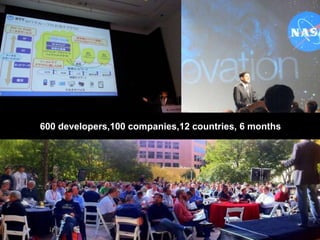
Cloud LaunchThe NASA Nebula ProjectChris C. KempChief Technology Officer for IT1
2National Aeronautics and Space Administration
3National Aeronautics and Space Administration
NASA’s IT ChallengesAs a result of NASA’s diverse mission and distributed workforce (across centers, labs, and universities), we have a uniquely balkanized – and expensive - IT environment.Typical Enterprise IT infrastructure is only utilized to 5-20% of its capacity1NASA’s Supercomputers are also only available to the largest projects, with small projects often waiting many weeks in queue… many jobs do not require HPC.Thousands of new computers are inefficiently procured and operated each year, continuing the cycle.  This process often takes many months and costs more in overhead than the actual value of the computers.1 Source: http://www.eecs.berkeley.edu/Pubs/TechRpts/2009/EECS-2009-28.pdf 4National Aeronautics and Space Administration
5National Aeronautics and Space Administration
6
7
8
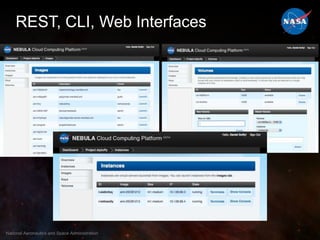
REST, CLI, Web Interfaces9
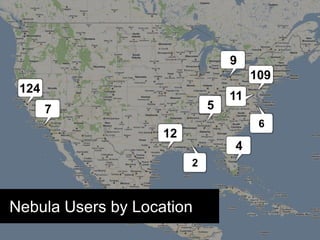
WISE in the Cloud11124712549109  2  6Nebula Users by Location10
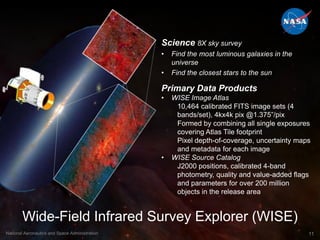
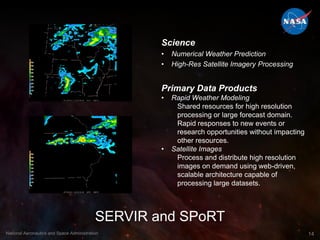
Science 8X sky surveyFind the most luminous galaxies in the universe
Find the closest stars to the sunPrimary Data ProductsWISE Image Atlas10,464 calibrated FITS image sets (4 bands/set), 4kx4k pix @1.375”/pixFormed by combining all single exposures covering Atlas Tile footprintPixel depth-of-coverage, uncertainty maps and metadata for each imageWISE Source CatalogJ2000 positions, calibrated 4-band photometry, quality and value-added flags and parameters for over 200 million objects in the release areaWide-Field Infrared Survey Explorer (WISE)11National Aeronautics and Space Administration
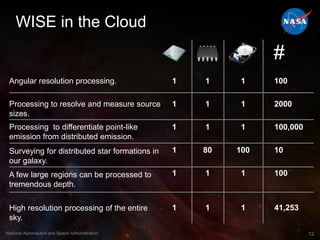
WISE in the Cloud#Angular resolution processing. Processing to resolve and measure source sizes.1             1              1             1001             1            1             20001             1           1             100,0001            80           100           101             1          1           1001             1          1             41,253Processing  to differentiate point-like emission from distributed emission.Surveying for distributed star formations in our galaxy. A few large regions can be processed to tremendous depth. High resolution processing of the entire sky.12National Aeronautics and Space Administration
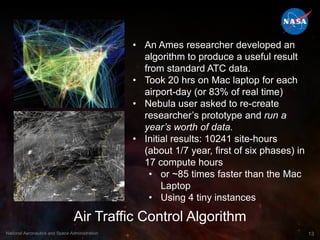
An Ames researcher developed an algorithm to produce a useful result from standard ATC data.
Took 20 hrs on Mac laptop for each airport-day (or 83% of real time)
Nebula user asked to re-create researcher’s prototype and run a year’s worth of data.
Initial results: 10241 site-hours (about 1/7 year, first of six phases) in 17 compute hours
or ~85 times faster than the Mac Laptop

NASA's Movement Towards Cloud Computing

  • 1.
    Cloud LaunchThe NASANebula ProjectChris C. KempChief Technology Officer for IT1
  • 2.
    2National Aeronautics andSpace Administration
  • 3.
    3National Aeronautics andSpace Administration
  • 4.
    NASA’s IT ChallengesAsa result of NASA’s diverse mission and distributed workforce (across centers, labs, and universities), we have a uniquely balkanized – and expensive - IT environment.Typical Enterprise IT infrastructure is only utilized to 5-20% of its capacity1NASA’s Supercomputers are also only available to the largest projects, with small projects often waiting many weeks in queue… many jobs do not require HPC.Thousands of new computers are inefficiently procured and operated each year, continuing the cycle. This process often takes many months and costs more in overhead than the actual value of the computers.1 Source: http://www.eecs.berkeley.edu/Pubs/TechRpts/2009/EECS-2009-28.pdf 4National Aeronautics and Space Administration
  • 5.
    5National Aeronautics andSpace Administration
  • 6.
  • 7.
  • 8.
  • 9.
    REST, CLI, WebInterfaces9
  • 10.
    WISE in theCloud11124712549109 2 6Nebula Users by Location10
  • 11.
    Science 8X skysurveyFind the most luminous galaxies in the universe
  • 12.
    Find the closeststars to the sunPrimary Data ProductsWISE Image Atlas10,464 calibrated FITS image sets (4 bands/set), 4kx4k pix @1.375”/pixFormed by combining all single exposures covering Atlas Tile footprintPixel depth-of-coverage, uncertainty maps and metadata for each imageWISE Source CatalogJ2000 positions, calibrated 4-band photometry, quality and value-added flags and parameters for over 200 million objects in the release areaWide-Field Infrared Survey Explorer (WISE)11National Aeronautics and Space Administration
  • 13.
    WISE in theCloud#Angular resolution processing. Processing to resolve and measure source sizes.1 1 1 1001 1 1 20001 1 1 100,0001 80 100 101 1 1 1001 1 1 41,253Processing to differentiate point-like emission from distributed emission.Surveying for distributed star formations in our galaxy. A few large regions can be processed to tremendous depth. High resolution processing of the entire sky.12National Aeronautics and Space Administration
  • 14.
    An Ames researcherdeveloped an algorithm to produce a useful result from standard ATC data.
  • 15.
    Took 20 hrson Mac laptop for each airport-day (or 83% of real time)
  • 16.
    Nebula user askedto re-create researcher’s prototype and run a year’s worth of data.
  • 17.
    Initial results: 10241site-hours (about 1/7 year, first of six phases) in 17 compute hours
  • 18.
    or ~85 timesfaster than the Mac Laptop

Editor's Notes

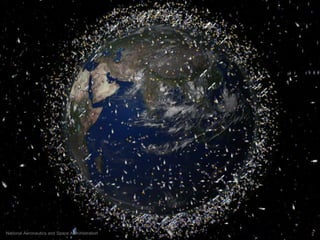
  • #3 The launch of the first artificial satellite by the then Soviet Union in 1957 marked the beginning of the utilization of space for science and commercial activity. During the Cold War, space was a prime area of competition between the Soviet Union and the U.S. 

In 1964 the first TV satellite was launched into a geostationary orbit to transmit the Olympic games from Tokyo. Later, Russian launch activities declined while other nations set up their own space programs. Thus, the number of objects in Earth orbit has increased steadily -- by 200 per year on average. 

The debris objects shown in the images are an artist's impression based on actual density data. However, the debris objects are shown at an exaggerated size to make them visible at the scale shown.

Image Credit: European Space Agency
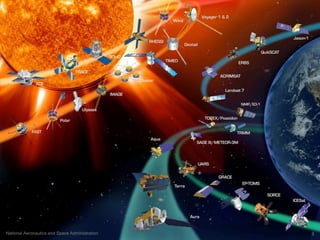
  • #4 Today there are over 100 active NASA missions, some of them bringing back a TB or two of data EVERY DAY. There are many challenges in handling this vast amount of data… (Note: This is an artist’s rendering of recent NASA missions)