UC Berkeley
1
The Potential of Cloud Computing:

Challenges, Opportunities, Impact
Armando Fox, UC Berkeley
Reliable Adaptive Distributed Systems Laboratory

NAE Frontiers of Engineering, September 2010
Image: John Curley http://www.flickr.com/photos/jay_que/1834540/
Get Your Own Supercomputer
•  41.88 Teraflops on LINPACK benchmark
– Faster than #145 entry on current Top500 list
•  No batch queues—start your job in minutes
•  No grantwriting—just a credit card ($1400/hour,
1 hour minimum purchase)
•  No need to predict usage in advance—pay only
for what you use, get more on demand
•  Lease several simultaneously
•  MPI and Matlab available, among other
packages
3
Warehouse Scale Computers
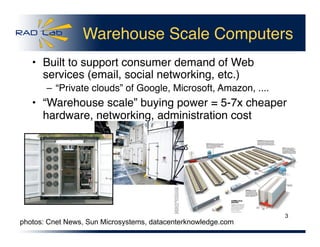
•  Built to support consumer demand of Web
services (email, social networking, etc.)
– “Private clouds” of Google, Microsoft, Amazon, ....
•  “Warehouse scale” buying power = 5-7x cheaper
hardware, networking, administration cost
photos: Cnet News, Sun Microsystems, datacenterknowledge.com
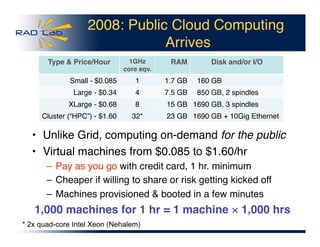
2008: Public Cloud Computing
Arrives
•  Unlike Grid, computing on-demand for the public
•  Virtual machines from $0.085 to $1.60/hr
– Pay as you go with credit card, 1 hr. minimum
– Cheaper if willing to share or risk getting kicked off
– Machines provisioned & booted in a few minutes
1,000 machines for 1 hr = 1 machine × 1,000 hrs
Type & Price/Hour
 1GHz
core eqv.
RAM
 Disk and/or I/O
Small - $0.085
 1
 1.7 GB
 160 GB
Large - $0.34
 4
 7.5 GB
 850 GB, 2 spindles
XLarge - $0.68
 8
 15 GB
 1690 GB, 3 spindles
Cluster (“HPC”) - $1.60
 32*
 23 GB
 1690 GB + 10Gig Ethernet
* 2x quad-core Intel Xeon (Nehalem)
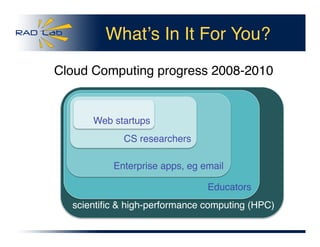
Whatʼs In It For You?
scientific & high-performance computing (HPC)
Educators
Enterprise apps, eg email
CS researchers
Web startups 
Cloud Computing progress 2008-2010
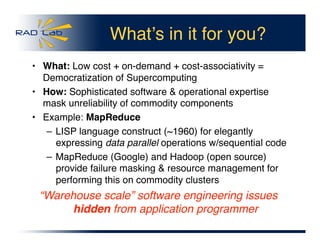
Whatʼs in it for you?
•  What: Low cost + on-demand + cost-associativity =
Democratization of Supercomputing
•  How: Sophisticated software & operational expertise
mask unreliability of commodity components
•  Example: MapReduce
– LISP language construct (~1960) for elegantly
expressing data parallel operations w/sequential code
– MapReduce (Google) and Hadoop (open source)
provide failure masking & resource management for
performing this on commodity clusters
“Warehouse scale” software engineering issues
hidden from application programmer
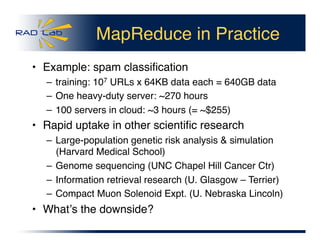
MapReduce in Practice
•  Example: spam classification
– training: 107 URLs x 64KB data each = 640GB data
– One heavy-duty server: ~270 hours
– 100 servers in cloud: ~3 hours (= ~$255)
•  Rapid uptake in other scientific research
– Large-population genetic risk analysis & simulation
(Harvard Medical School)
– Genome sequencing (UNC Chapel Hill Cancer Ctr)
– Information retrieval research (U. Glasgow – Terrier)
– Compact Muon Solenoid Expt. (U. Nebraska Lincoln)
•  Whatʼs the downside?
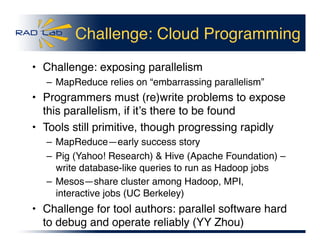
Challenge: Cloud Programming
•  Challenge: exposing parallelism
– MapReduce relies on “embarrassing parallelism” 
•  Programmers must (re)write problems to expose
this parallelism, if itʼs there to be found
•  Tools still primitive, though progressing rapidly
– MapReduce—early success story
– Pig (Yahoo! Research) & Hive (Apache Foundation) –
write database-like queries to run as Hadoop jobs
– Mesos—share cluster among Hadoop, MPI,
interactive jobs (UC Berkeley)
•  Challenge for tool authors: parallel software hard
to debug and operate reliably (YY Zhou)
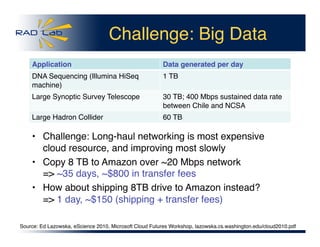
Challenge: Big Data
Application
 Data generated per day
DNA Sequencing (Illumina HiSeq
machine)
1 TB
Large Synoptic Survey Telescope
 30 TB; 400 Mbps sustained data rate
between Chile and NCSA
Large Hadron Collider
 60 TB
Source: Ed Lazowska, eScience 2010, Microsoft Cloud Futures Workshop, lazowska.cs.washington.edu/cloud2010.pdf
•  Challenge: Long-haul networking is most expensive
cloud resource, and improving most slowly
•  Copy 8 TB to Amazon over ~20 Mbps network 

=> ~35 days, ~$800 in transfer fees
•  How about shipping 8TB drive to Amazon instead?

=> 1 day, ~$150 (shipping + transfer fees)
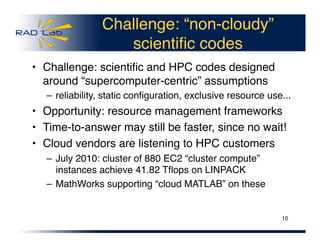
Challenge: “non-cloudy”

scientific codes
•  Challenge: scientific and HPC codes designed
around “supercomputer-centric” assumptions
– reliability, static configuration, exclusive resource use...
•  Opportunity: resource management frameworks
•  Time-to-answer may still be faster, since no wait!
•  Cloud vendors are listening to HPC customers
– July 2010: cluster of 880 EC2 “cluster compute”
instances achieve 41.82 Tflops on LINPACK 
– MathWorks supporting “cloud MATLAB” on these
10
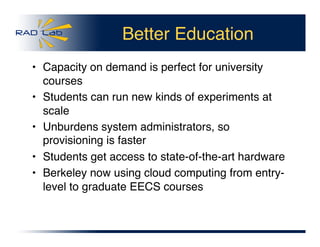
Better Education
•  Capacity on demand is perfect for university
courses
•  Students can run new kinds of experiments at
scale
•  Unburdens system administrators, so
provisioning is faster
•  Students get access to state-of-the-art hardware
•  Berkeley now using cloud computing from entry-
level to graduate EECS courses
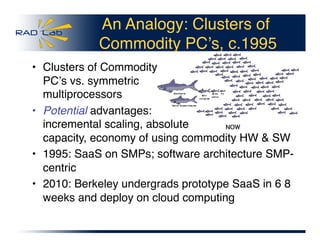
An Analogy: Clusters of
Commodity PCʼs, c.1995
•  Clusters of Commodity 

PCʼs vs. symmetric 

multiprocessors
•  Potential advantages:

incremental scaling, absolute

capacity, economy of using commodity HW & SW
•  1995: SaaS on SMPs; software architecture SMP-
centric
•  2010: Berkeley undergrads prototype SaaS in 6 8
weeks and deploy on cloud computing
Conclusion
•  Democratization of supercomputing capability
– Time to answer may be faster even if hardware isnʼt
– Writing a grant proposal around a supercomputer? 
•  Software & hardware rapidly improving as
vendors listen to scientific/HPC customers
•  HPC opportunity to influence design of
commodity equipment
Impact: Potential democratizing effect
comparable to microprocessor
Acknowledgments
•  Colleagues at UC Berkeley RAD Lab
– Co-authors of Above The Clouds: Michael Armbrust,
Rean Griffith, Anthony D. Joseph, Randy Katz, Andy
Konwinski, Gunho Lee, David Patterson, Ariel Rabkin,
Ion Stoica, Matei Zaharia
– And everyone else in the RAD Lab
•  Colleagues at our industrial collaborators
14
UC Berkeley
Thank you!

Scientific Computing in the Cloud

  • 1.
    UC Berkeley 1 The Potentialof Cloud Computing:
 Challenges, Opportunities, Impact Armando Fox, UC Berkeley Reliable Adaptive Distributed Systems Laboratory
 NAE Frontiers of Engineering, September 2010 Image: John Curley http://www.flickr.com/photos/jay_que/1834540/
  • 2.
    Get Your OwnSupercomputer •  41.88 Teraflops on LINPACK benchmark – Faster than #145 entry on current Top500 list •  No batch queues—start your job in minutes •  No grantwriting—just a credit card ($1400/hour, 1 hour minimum purchase) •  No need to predict usage in advance—pay only for what you use, get more on demand •  Lease several simultaneously •  MPI and Matlab available, among other packages
  • 3.
    3 Warehouse Scale Computers • Built to support consumer demand of Web services (email, social networking, etc.) – “Private clouds” of Google, Microsoft, Amazon, .... •  “Warehouse scale” buying power = 5-7x cheaper hardware, networking, administration cost photos: Cnet News, Sun Microsystems, datacenterknowledge.com
  • 4.
    2008: Public CloudComputing Arrives •  Unlike Grid, computing on-demand for the public •  Virtual machines from $0.085 to $1.60/hr – Pay as you go with credit card, 1 hr. minimum – Cheaper if willing to share or risk getting kicked off – Machines provisioned & booted in a few minutes 1,000 machines for 1 hr = 1 machine × 1,000 hrs Type & Price/Hour 1GHz core eqv. RAM Disk and/or I/O Small - $0.085 1 1.7 GB 160 GB Large - $0.34 4 7.5 GB 850 GB, 2 spindles XLarge - $0.68 8 15 GB 1690 GB, 3 spindles Cluster (“HPC”) - $1.60 32* 23 GB 1690 GB + 10Gig Ethernet * 2x quad-core Intel Xeon (Nehalem)
  • 5.
    Whatʼs In ItFor You? scientific & high-performance computing (HPC) Educators Enterprise apps, eg email CS researchers Web startups Cloud Computing progress 2008-2010
  • 6.
    Whatʼs in itfor you? •  What: Low cost + on-demand + cost-associativity = Democratization of Supercomputing •  How: Sophisticated software & operational expertise mask unreliability of commodity components •  Example: MapReduce – LISP language construct (~1960) for elegantly expressing data parallel operations w/sequential code – MapReduce (Google) and Hadoop (open source) provide failure masking & resource management for performing this on commodity clusters “Warehouse scale” software engineering issues hidden from application programmer
  • 7.
    MapReduce in Practice • Example: spam classification – training: 107 URLs x 64KB data each = 640GB data – One heavy-duty server: ~270 hours – 100 servers in cloud: ~3 hours (= ~$255) •  Rapid uptake in other scientific research – Large-population genetic risk analysis & simulation (Harvard Medical School) – Genome sequencing (UNC Chapel Hill Cancer Ctr) – Information retrieval research (U. Glasgow – Terrier) – Compact Muon Solenoid Expt. (U. Nebraska Lincoln) •  Whatʼs the downside?
  • 8.
    Challenge: Cloud Programming • Challenge: exposing parallelism – MapReduce relies on “embarrassing parallelism” •  Programmers must (re)write problems to expose this parallelism, if itʼs there to be found •  Tools still primitive, though progressing rapidly – MapReduce—early success story – Pig (Yahoo! Research) & Hive (Apache Foundation) – write database-like queries to run as Hadoop jobs – Mesos—share cluster among Hadoop, MPI, interactive jobs (UC Berkeley) •  Challenge for tool authors: parallel software hard to debug and operate reliably (YY Zhou)
  • 9.
    Challenge: Big Data Application Data generated per day DNA Sequencing (Illumina HiSeq machine) 1 TB Large Synoptic Survey Telescope 30 TB; 400 Mbps sustained data rate between Chile and NCSA Large Hadron Collider 60 TB Source: Ed Lazowska, eScience 2010, Microsoft Cloud Futures Workshop, lazowska.cs.washington.edu/cloud2010.pdf •  Challenge: Long-haul networking is most expensive cloud resource, and improving most slowly •  Copy 8 TB to Amazon over ~20 Mbps network 
 => ~35 days, ~$800 in transfer fees •  How about shipping 8TB drive to Amazon instead?
 => 1 day, ~$150 (shipping + transfer fees)
  • 10.
    Challenge: “non-cloudy”
 scientific codes • Challenge: scientific and HPC codes designed around “supercomputer-centric” assumptions – reliability, static configuration, exclusive resource use... •  Opportunity: resource management frameworks •  Time-to-answer may still be faster, since no wait! •  Cloud vendors are listening to HPC customers – July 2010: cluster of 880 EC2 “cluster compute” instances achieve 41.82 Tflops on LINPACK – MathWorks supporting “cloud MATLAB” on these 10
  • 11.
    Better Education •  Capacityon demand is perfect for university courses •  Students can run new kinds of experiments at scale •  Unburdens system administrators, so provisioning is faster •  Students get access to state-of-the-art hardware •  Berkeley now using cloud computing from entry- level to graduate EECS courses
  • 12.
    An Analogy: Clustersof Commodity PCʼs, c.1995 •  Clusters of Commodity 
 PCʼs vs. symmetric 
 multiprocessors •  Potential advantages:
 incremental scaling, absolute
 capacity, economy of using commodity HW & SW •  1995: SaaS on SMPs; software architecture SMP- centric •  2010: Berkeley undergrads prototype SaaS in 6 8 weeks and deploy on cloud computing
  • 13.
    Conclusion •  Democratization ofsupercomputing capability – Time to answer may be faster even if hardware isnʼt – Writing a grant proposal around a supercomputer? •  Software & hardware rapidly improving as vendors listen to scientific/HPC customers •  HPC opportunity to influence design of commodity equipment Impact: Potential democratizing effect comparable to microprocessor
  • 14.
    Acknowledgments •  Colleagues atUC Berkeley RAD Lab – Co-authors of Above The Clouds: Michael Armbrust, Rean Griffith, Anthony D. Joseph, Randy Katz, Andy Konwinski, Gunho Lee, David Patterson, Ariel Rabkin, Ion Stoica, Matei Zaharia – And everyone else in the RAD Lab •  Colleagues at our industrial collaborators 14
  • 15.