LLNL-PRES-808845
This work was performed under the auspices of the U.S. Department of Energy by Lawrence Livermore National Laboratory under contract DE-
AC52-07NA27344. Lawrence Livermore National Security, LLC
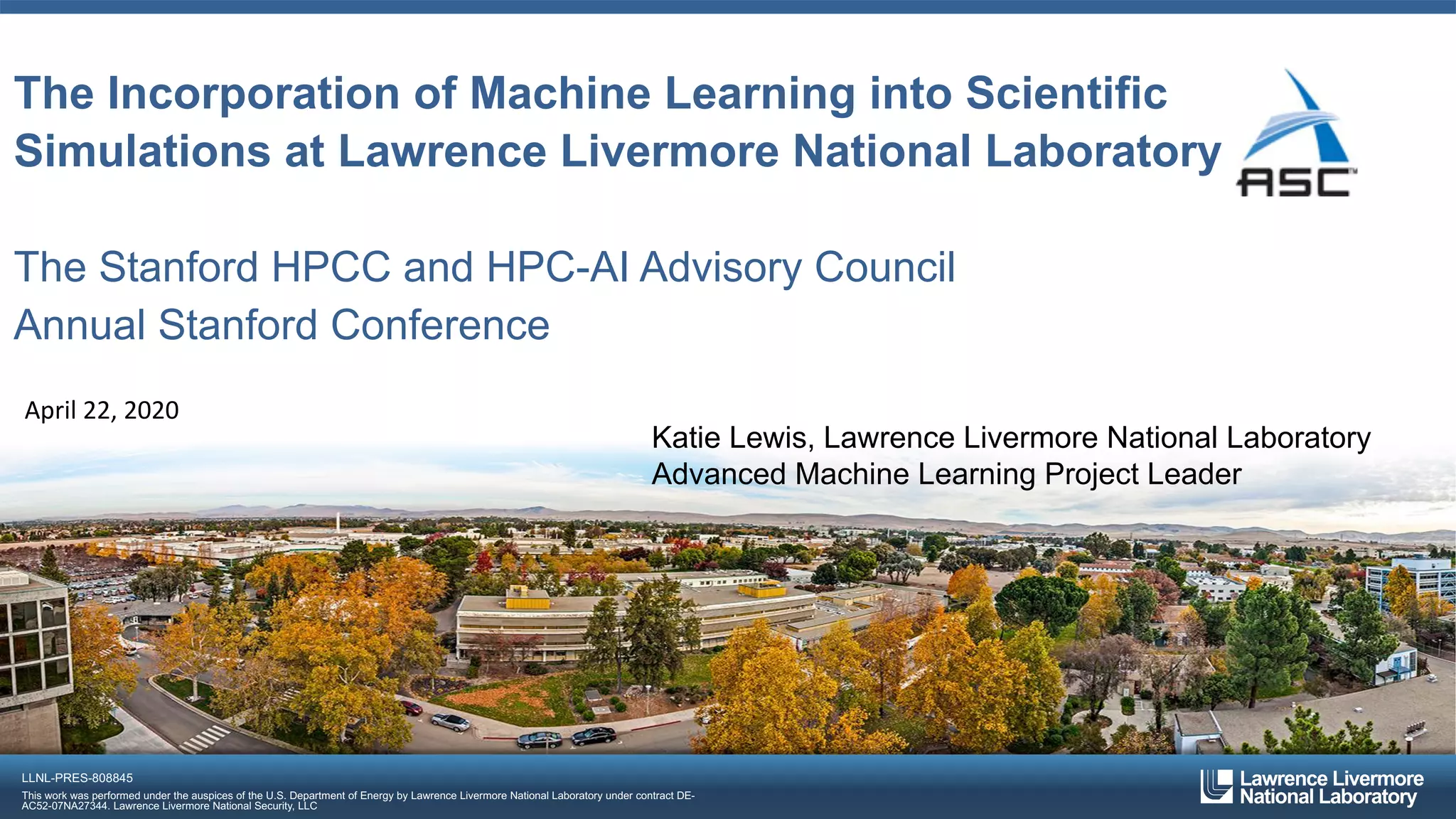
The Incorporation of Machine Learning into Scientific
Simulations at Lawrence Livermore National Laboratory
The Stanford HPCC and HPC-AI Advisory Council
Annual Stanford Conference
Katie Lewis, Lawrence Livermore National Laboratory
Advanced Machine Learning Project Leader
April 22, 2020
2
LLNL-PRES-808845
Supercomputing and Computational Physics at
Lawrence Livermore National Laboratory
www.llnl.gov/about/history
www.llnl.gov/news/berni-alder-pioneer-times
www.top500.org
§ Lawrence Livermore National Laboratory (LLNL) was founded in 1952
— Scientific Computing was part of our initial portfolio
§ “It is now accepted that in addition to the experimental and theoretical branches of physics,
there is a third: computer simulation.” - David Young, postdoc who worked with Bernie Alder
in the late 1960s
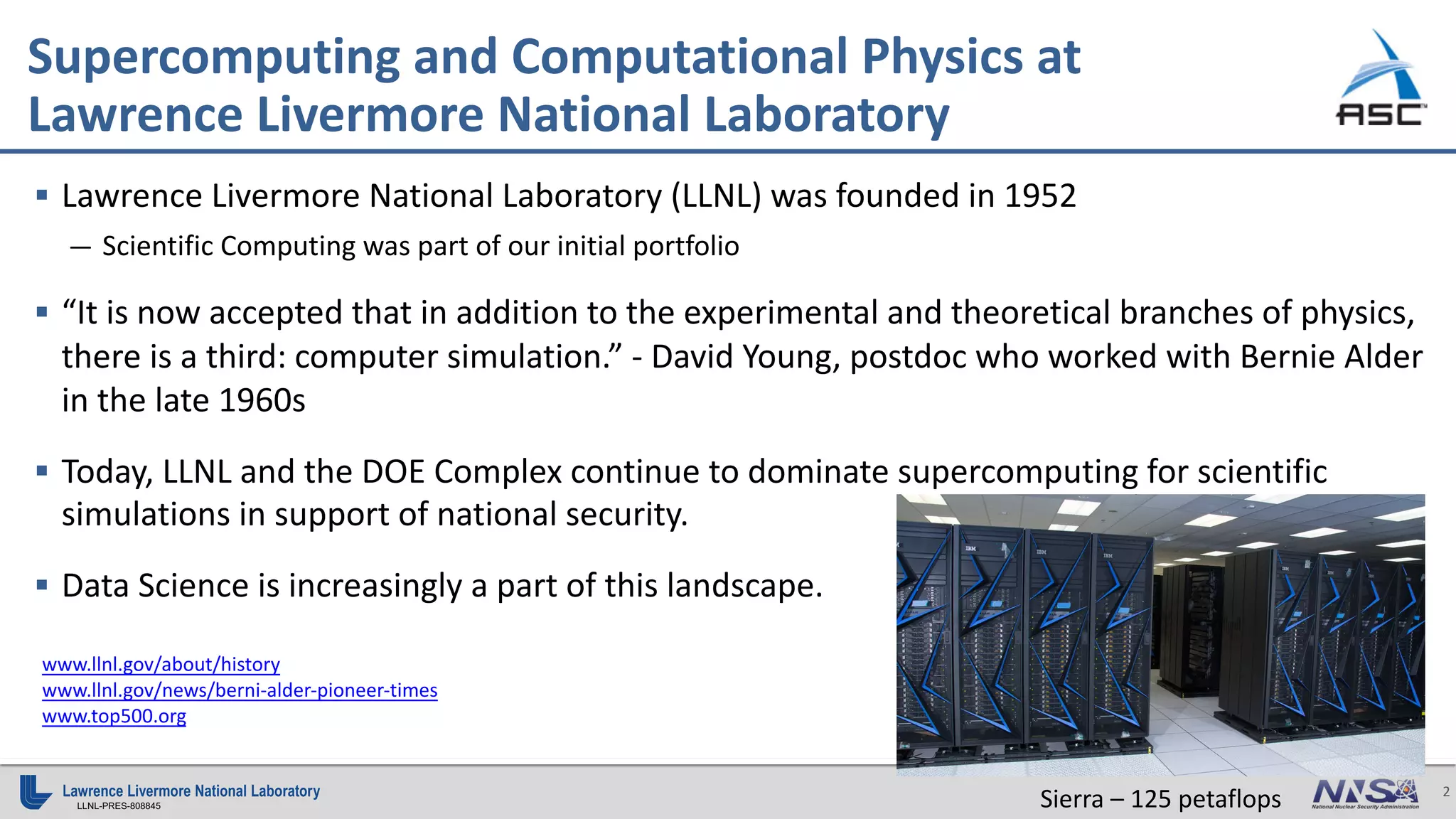
§ Today, LLNL and the DOE Complex continue to dominate supercomputing for scientific
simulations in support of national security.
§ Data Science is increasingly a part of this landscape.
Sierra – 125 petaflops
3
LLNL-PRES-808845
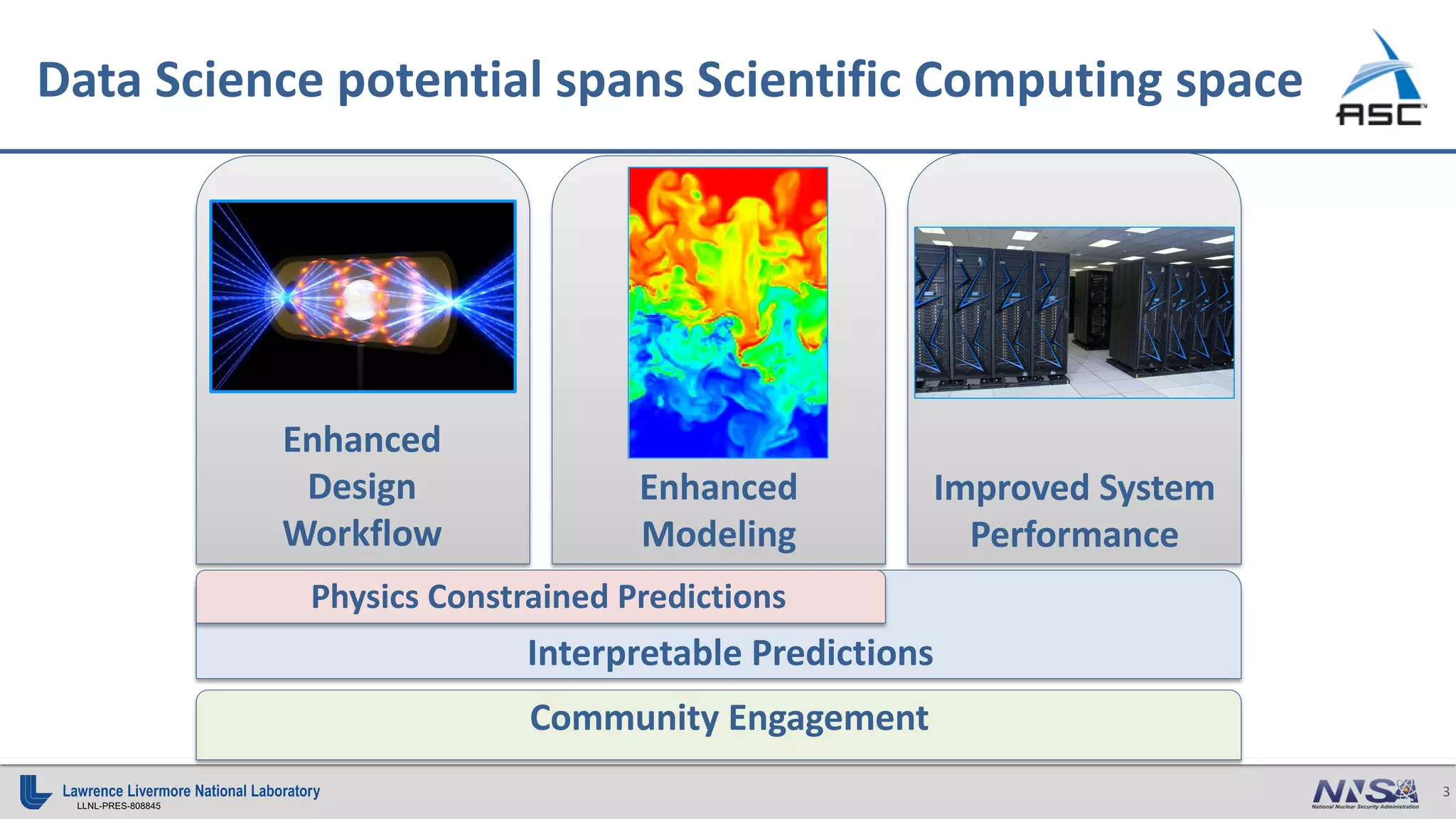
Enhanced
Design
Workflow
Interpretable Predictions
Community Engagement
Data Science potential spans Scientific Computing space
Improved System
Performance
Enhanced
Modeling
Physics Constrained Predictions
4
LLNL-PRES-808845
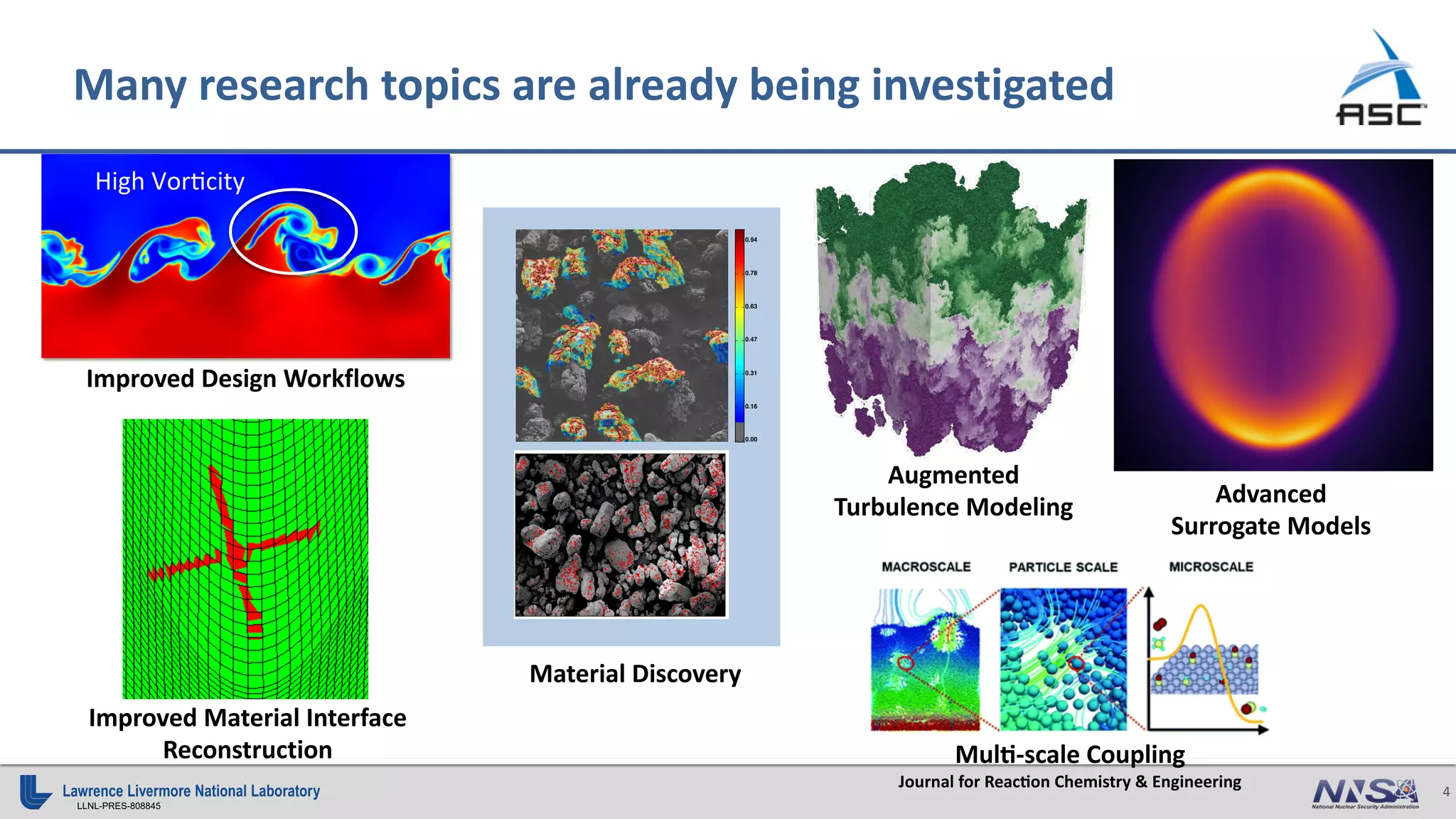
Many research topics are already being investigated
a_rf_nobkg (No Bkg)
0.00
0.16
0.31
0.47
0.63
0.78
0.94
Material Discovery
Augmented
Turbulence Modeling
B" C"
A"
D"
A"
C"
B" D"
High%Vor)city%
Improved Design Workflows
Improved Material Interface
Reconstruction
Advanced
Surrogate Models
Mul?-scale Coupling
Journal for Reac-on Chemistry & Engineering
5
LLNL-PRES-808845
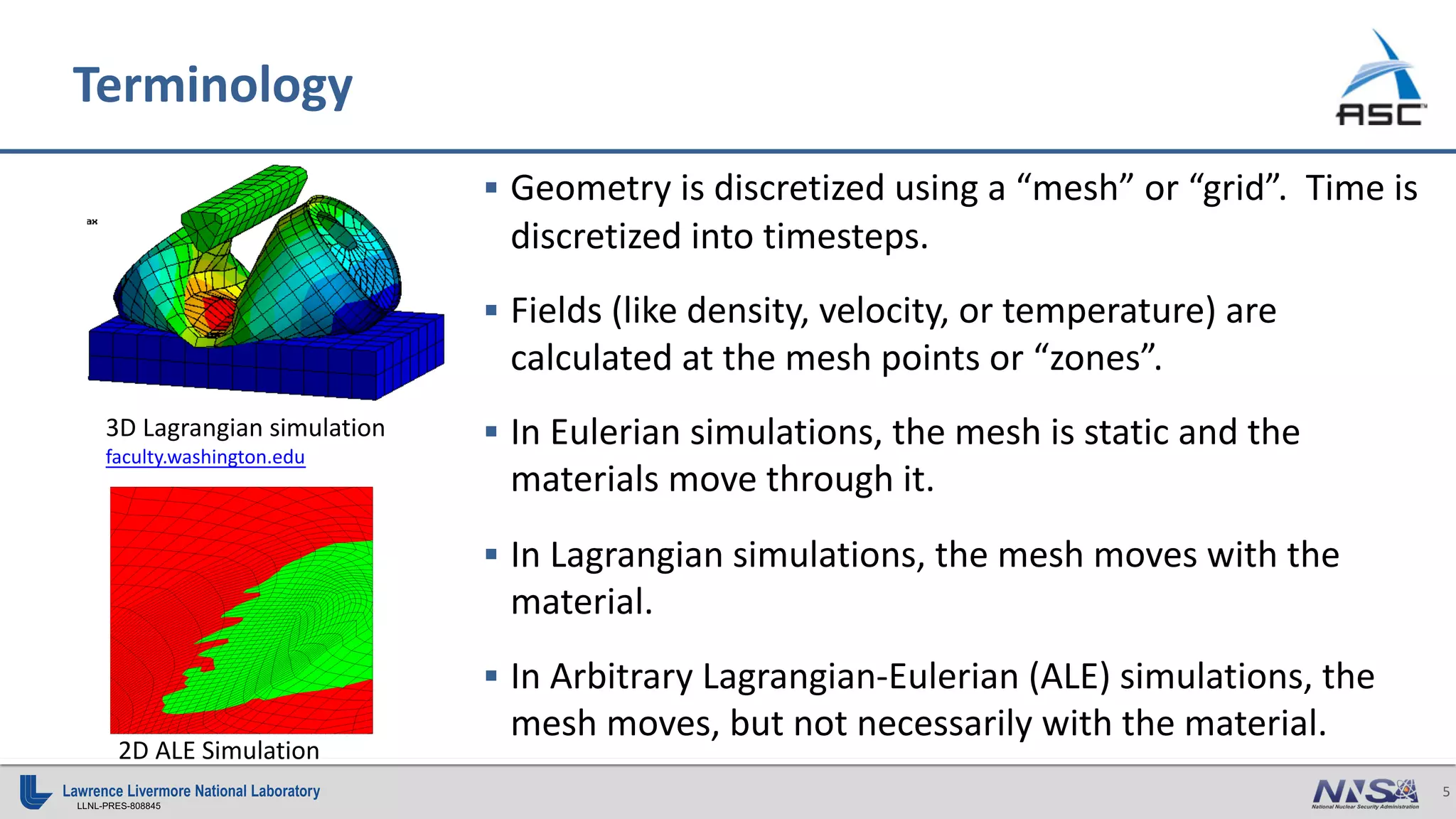
Terminology
§ Geometry is discretized using a “mesh” or “grid”. Time is
discretized into timesteps.
§ Fields (like density, velocity, or temperature) are
calculated at the mesh points or “zones”.
§ In Eulerian simulations, the mesh is static and the
materials move through it.
§ In Lagrangian simulations, the mesh moves with the
material.
§ In Arbitrary Lagrangian-Eulerian (ALE) simulations, the
mesh moves, but not necessarily with the material.
3D Lagrangian simulation
faculty.washington.edu
2D ALE Simulation
6
LLNL-PRES-808845
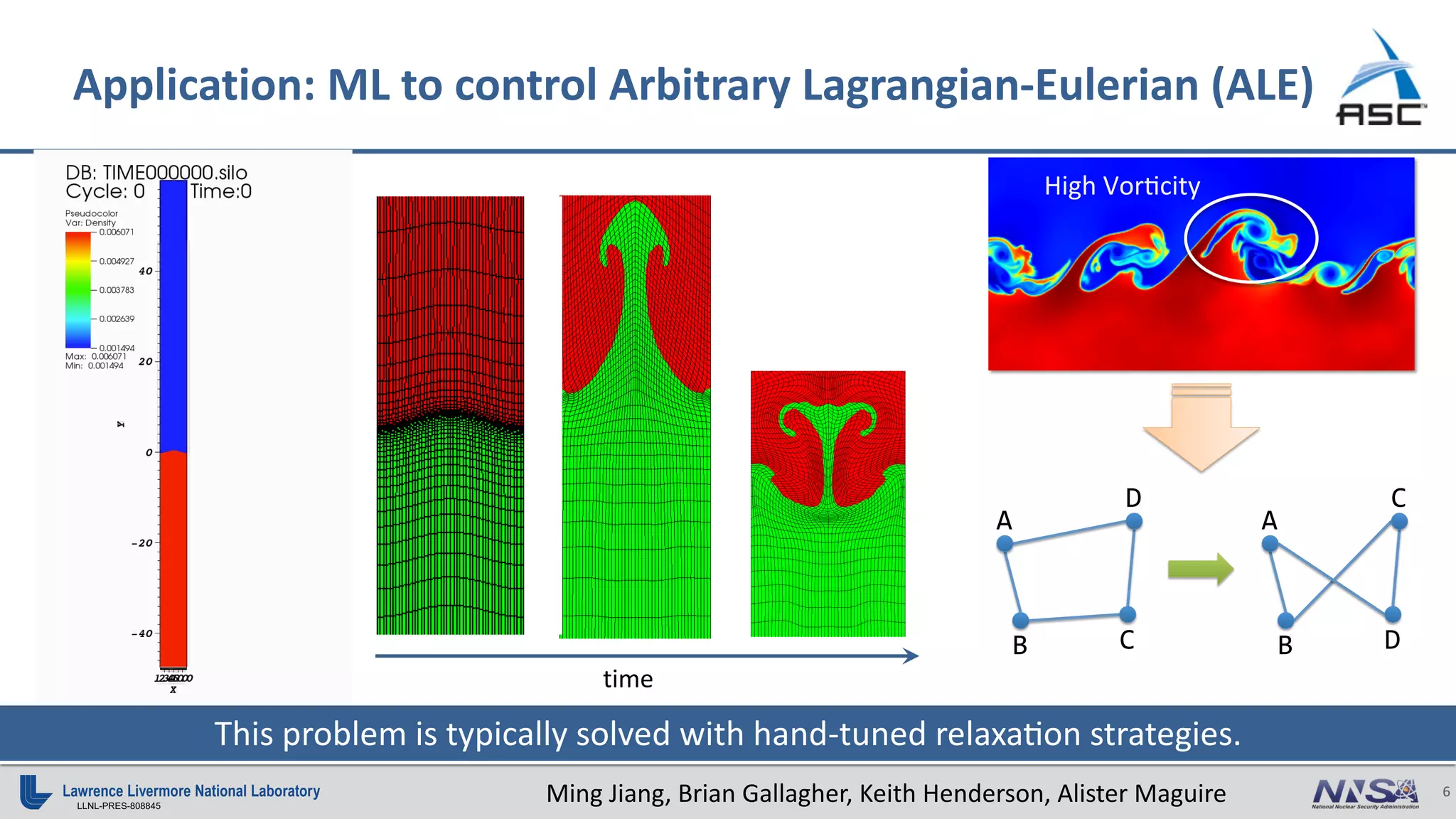
Application: ML to control Arbitrary Lagrangian-Eulerian (ALE)
B" C"
A"
D"
A"
C"
B" D"
High%Vor)city%
This problem is typically solved with hand-tuned relaxaSon strategies.
Ming Jiang, Brian Gallagher, Keith Henderson, Alister Maguire
time
7
LLNL-PRES-808845
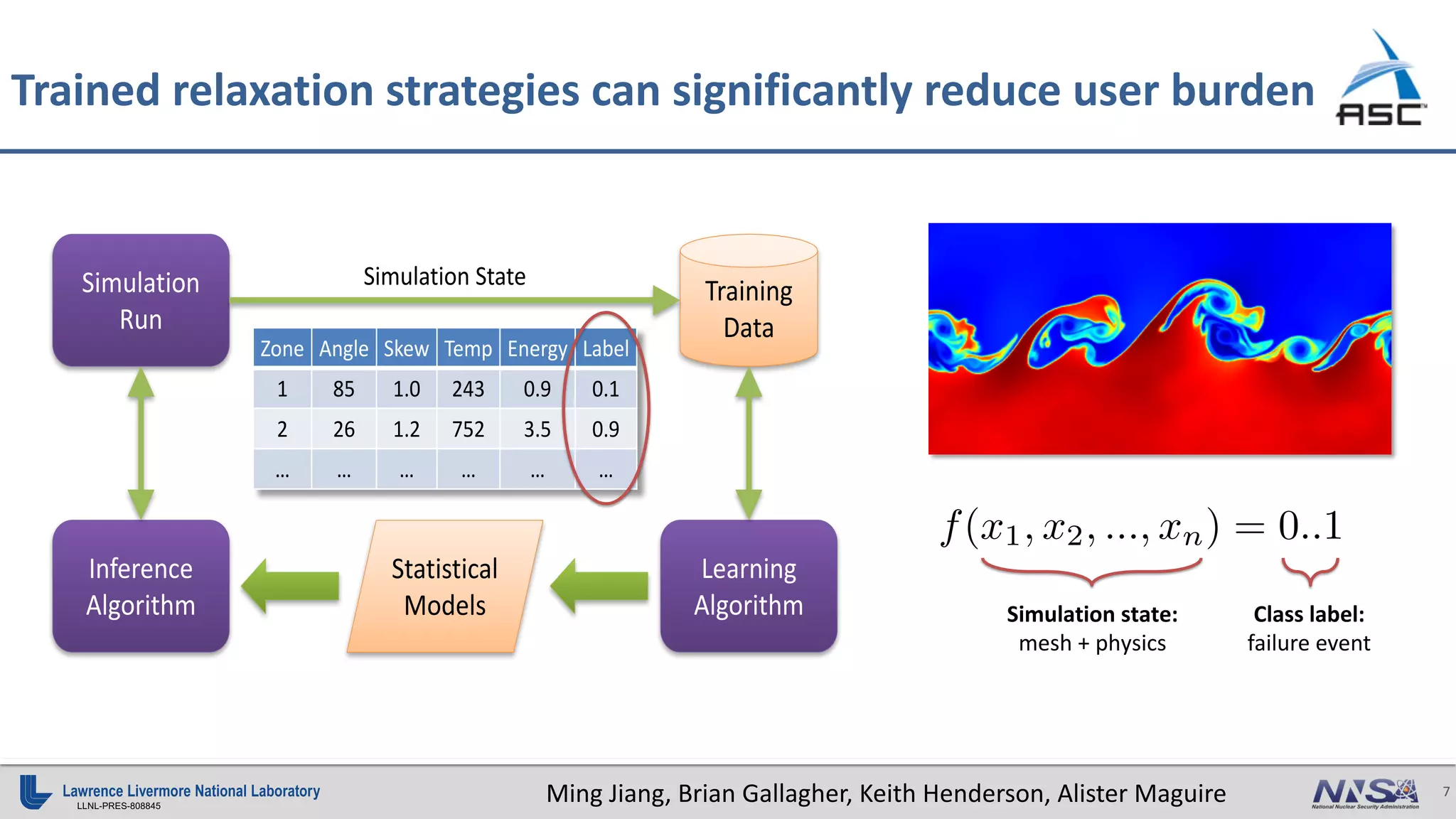
Trained relaxation strategies can significantly reduce user burden
Ming Jiang, Brian Gallagher, Keith Henderson, Alister Maguire
Zone Angle Skew Temp Energy Label
1 85 1.0 243 0.9 0.1
2 26 1.2 752 3.5 0.9
… … … … … …
Simulation	
Run
Inference	
Algorithm
Learning	
Algorithm
Statistical	
Models
Training	
Data
Simulation	State
Simulation state:
mesh + physics
Class label:
failure event
f(x1, x2, ..., xn) = 0..1
8
LLNL-PRES-808845
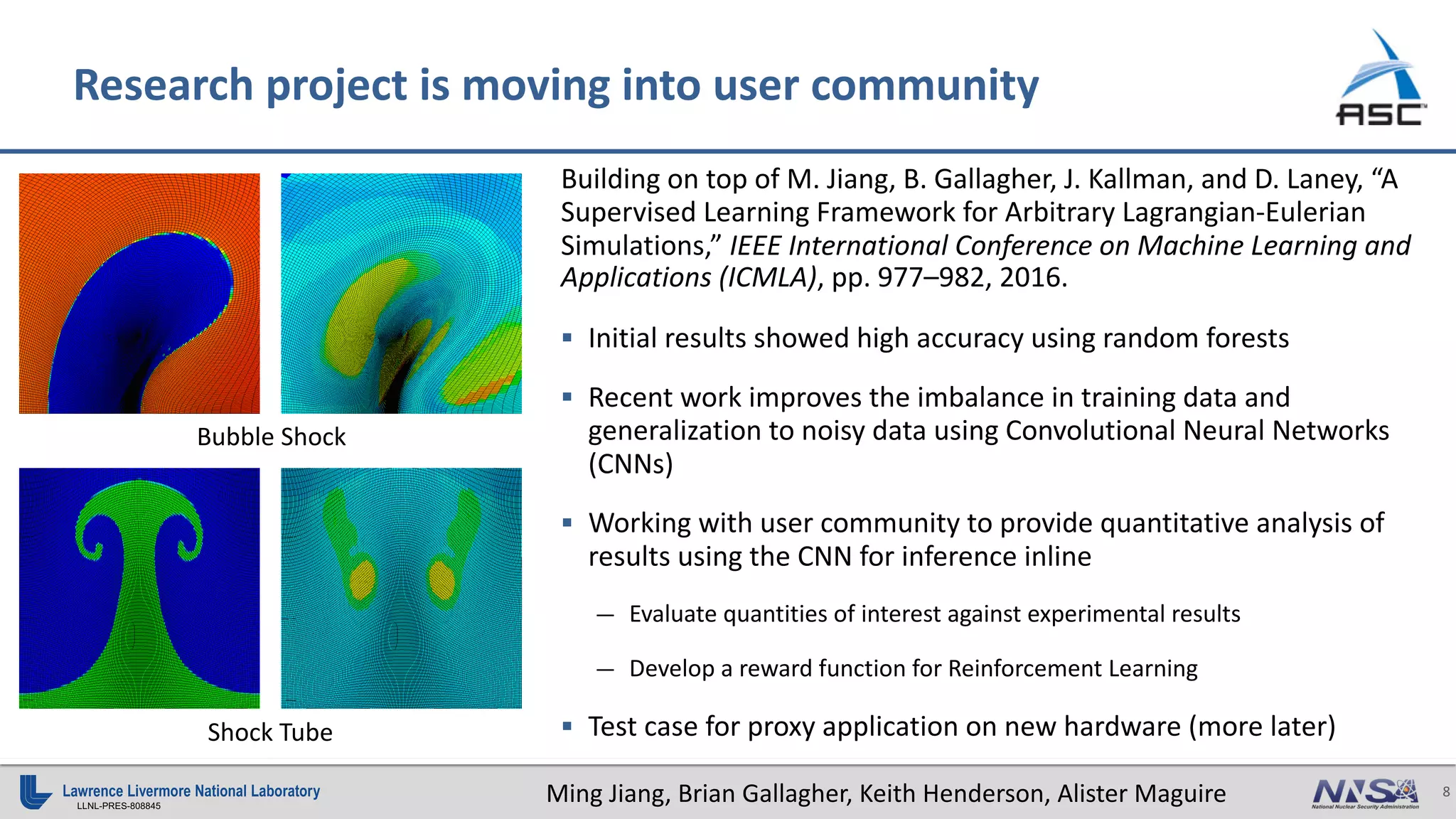
Research project is moving into user community
Building on top of M. Jiang, B. Gallagher, J. Kallman, and D. Laney, “A
Supervised Learning Framework for Arbitrary Lagrangian-Eulerian
Simulations,” IEEE International Conference on Machine Learning and
Applications (ICMLA), pp. 977–982, 2016.
§ Initial results showed high accuracy using random forests
§ Recent work improves the imbalance in training data and
generalization to noisy data using Convolutional Neural Networks
(CNNs)
§ Working with user community to provide quantitative analysis of
results using the CNN for inference inline
— Evaluate quantities of interest against experimental results
— Develop a reward function for Reinforcement Learning
§ Test case for proxy application on new hardware (more later)
Bubble Shock
Shock Tube
Ming Jiang, Brian Gallagher, Keith Henderson, Alister Maguire
9
LLNL-PRES-808845
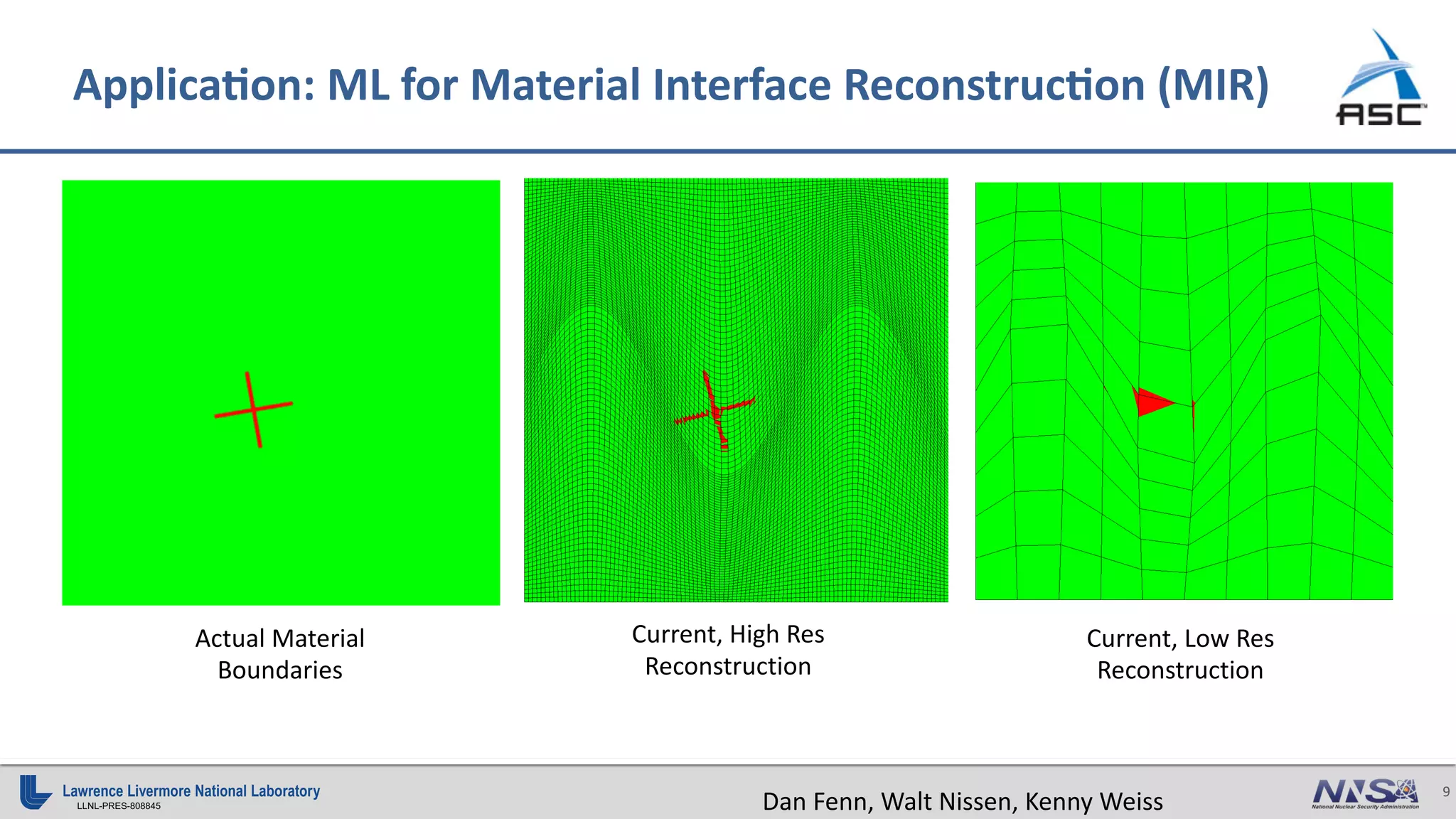
ApplicaBon: ML for Material Interface ReconstrucBon (MIR)
Current, High Res
Reconstruction
Actual Material
Boundaries
Current, Low Res
Reconstruction
Dan Fenn, Walt Nissen, Kenny Weiss
10
LLNL-PRES-808845
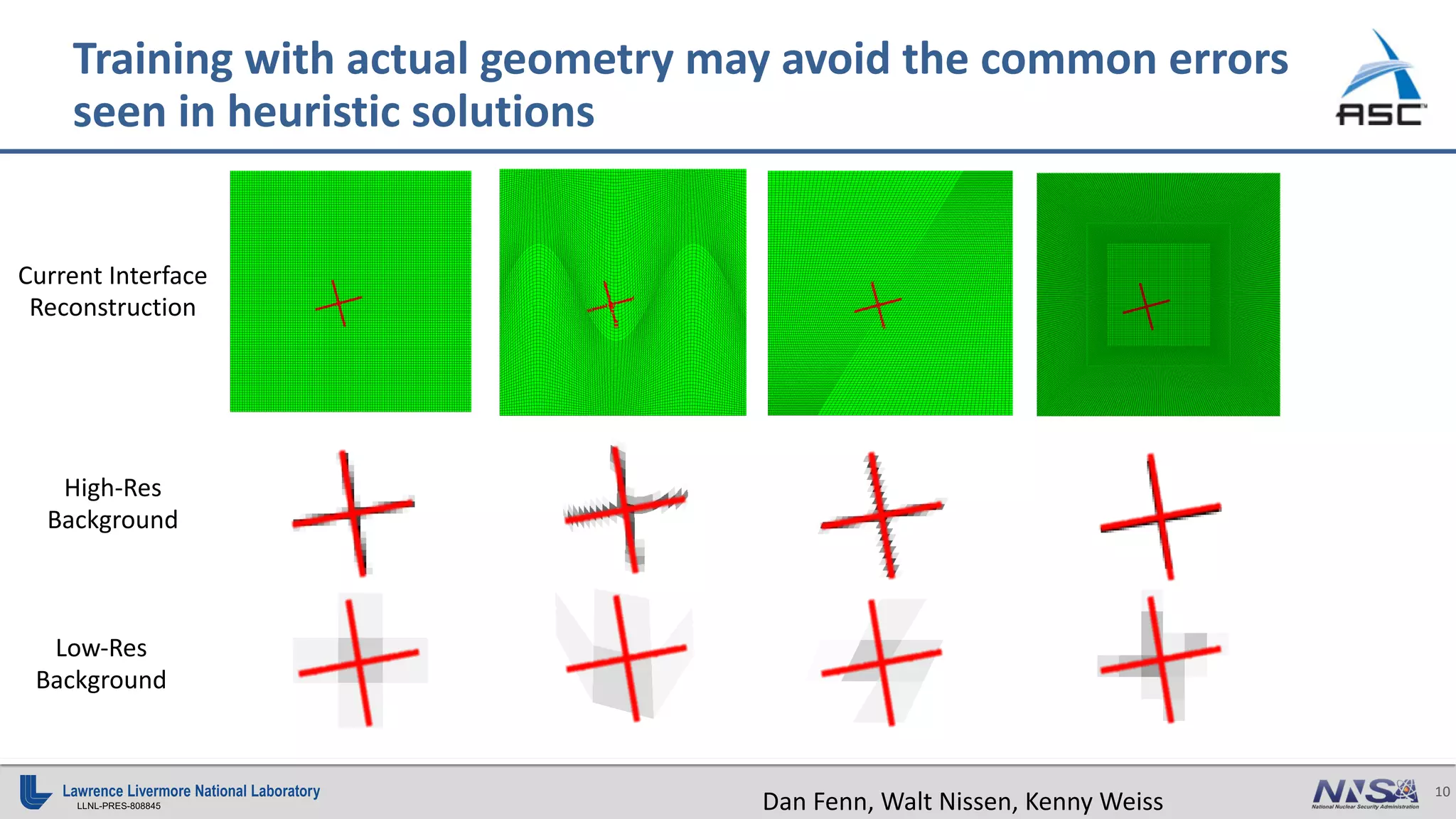
Training with actual geometry may avoid the common errors
seen in heuristic solutions
High-Res
Background
Low-Res
Background
Current Interface
Reconstruction
Dan Fenn, Walt Nissen, Kenny Weiss
11
LLNL-PRES-808845
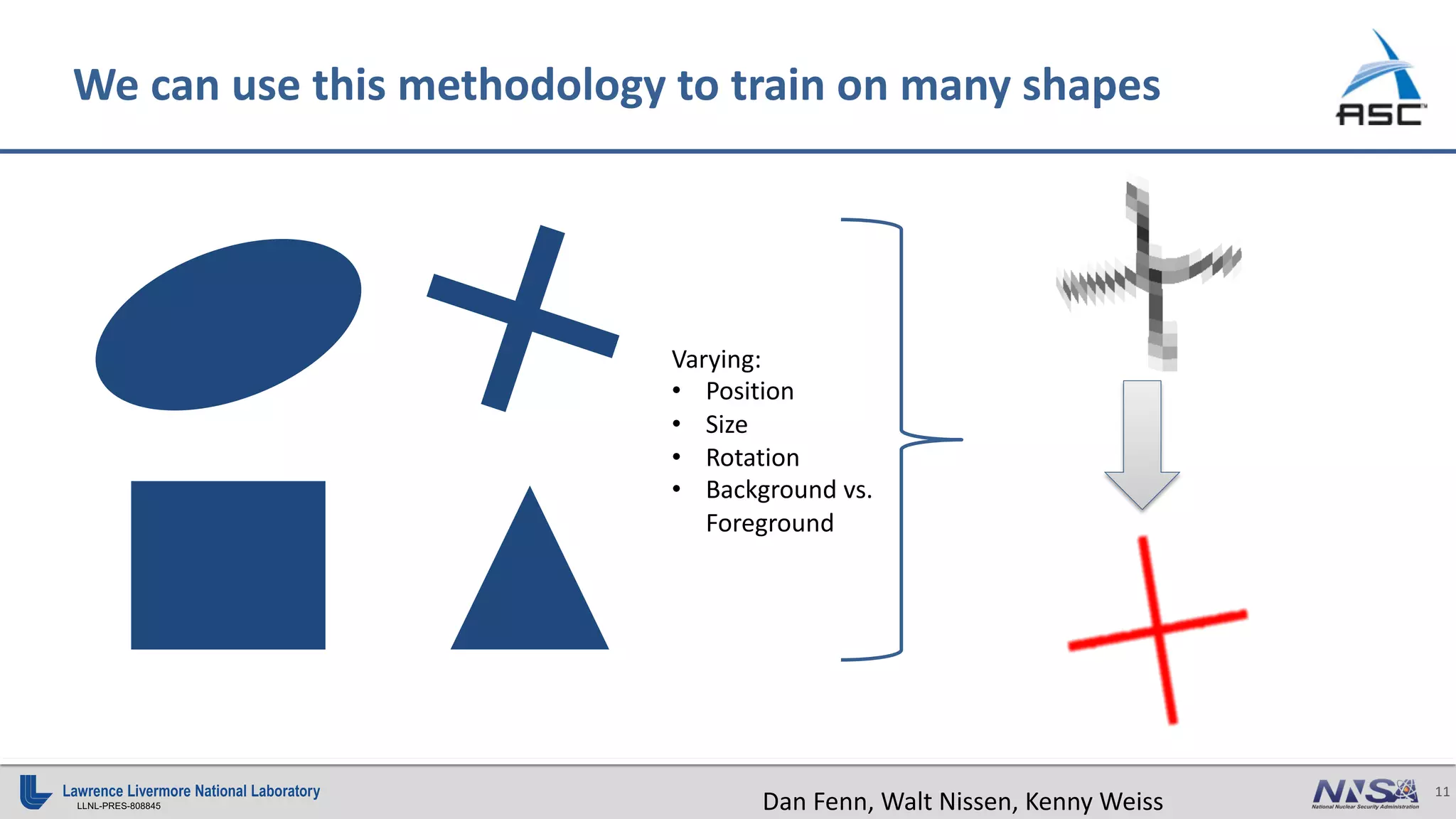
We can use this methodology to train on many shapes
Varying:
• Position
• Size
• Rotation
• Background vs.
Foreground
Dan Fenn, Walt Nissen, Kenny Weiss
12
LLNL-PRES-808845
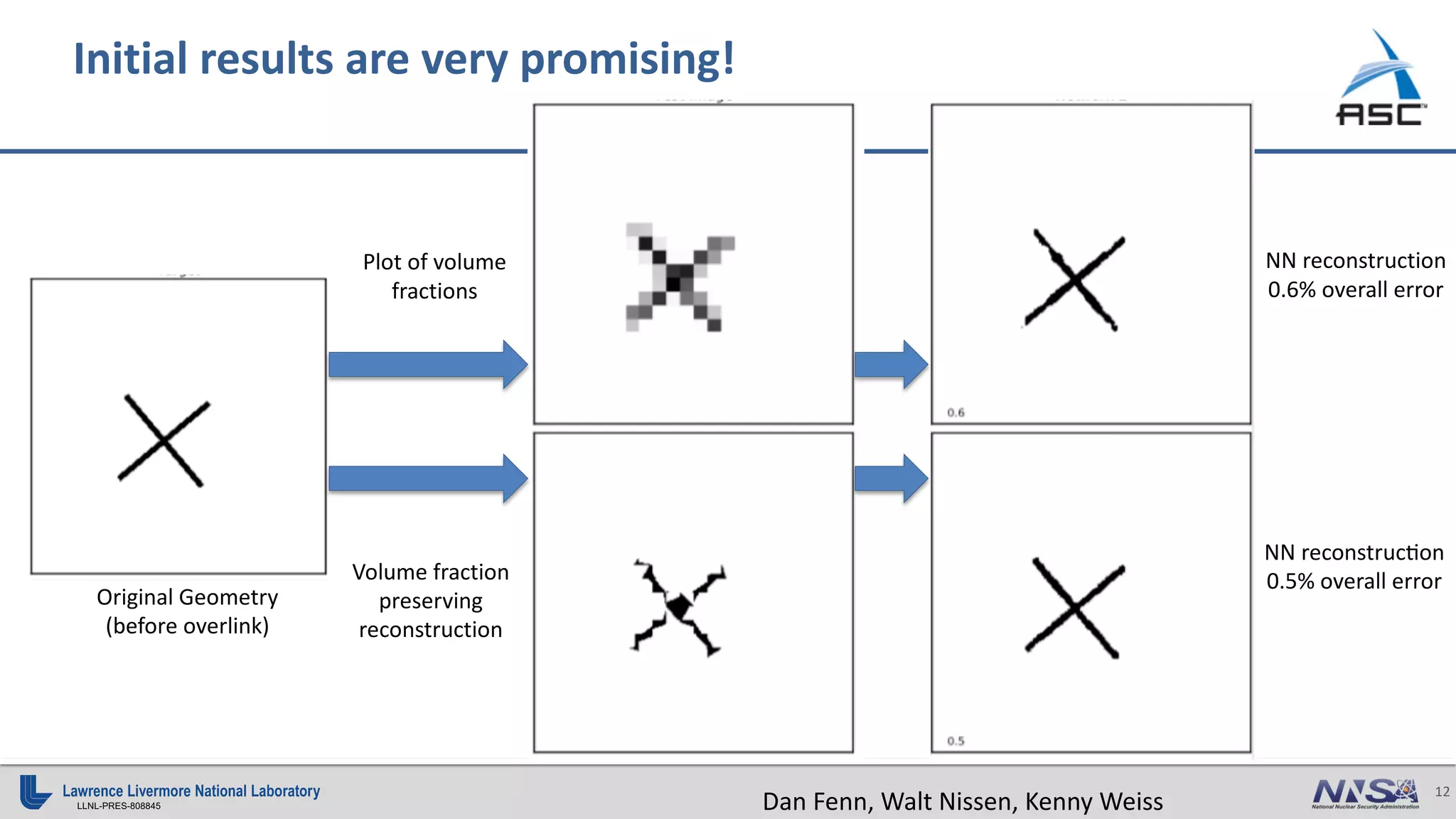
Initial results are very promising!
Original Geometry
(before overlink)
Plot of volume
fractions
Volume fraction
preserving
reconstruction
NN reconstruction
0.6% overall error
NN reconstrucBon
0.5% overall error
Dan Fenn, Walt Nissen, Kenny Weiss
13
LLNL-PRES-808845
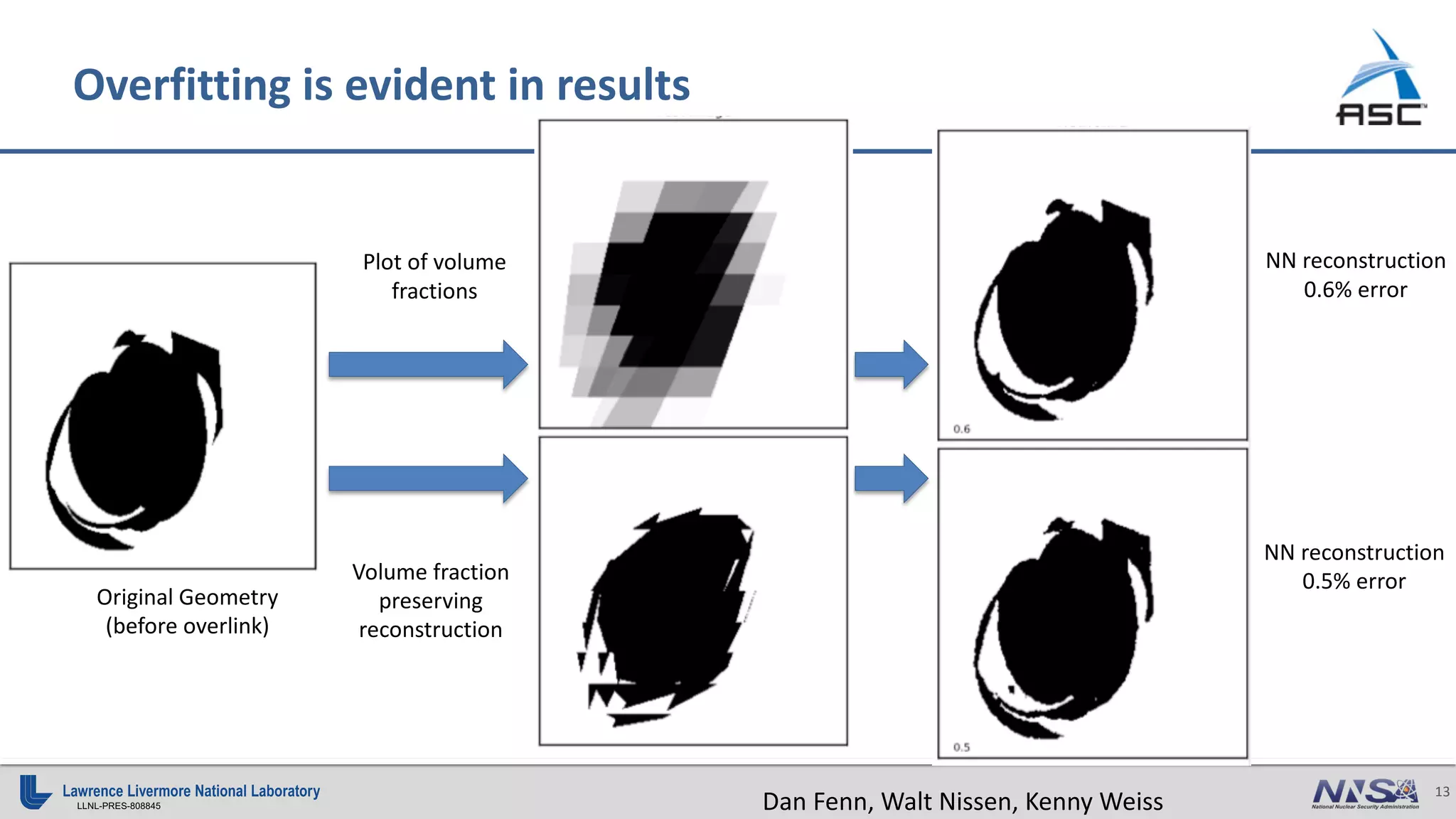
Overfitting is evident in results
Original Geometry
(before overlink)
NN reconstruction
0.6% error
NN reconstruction
0.5% error
Dan Fenn, Walt Nissen, Kenny Weiss
Plot of volume
fractions
Volume fraction
preserving
reconstruction
14
LLNL-PRES-808845
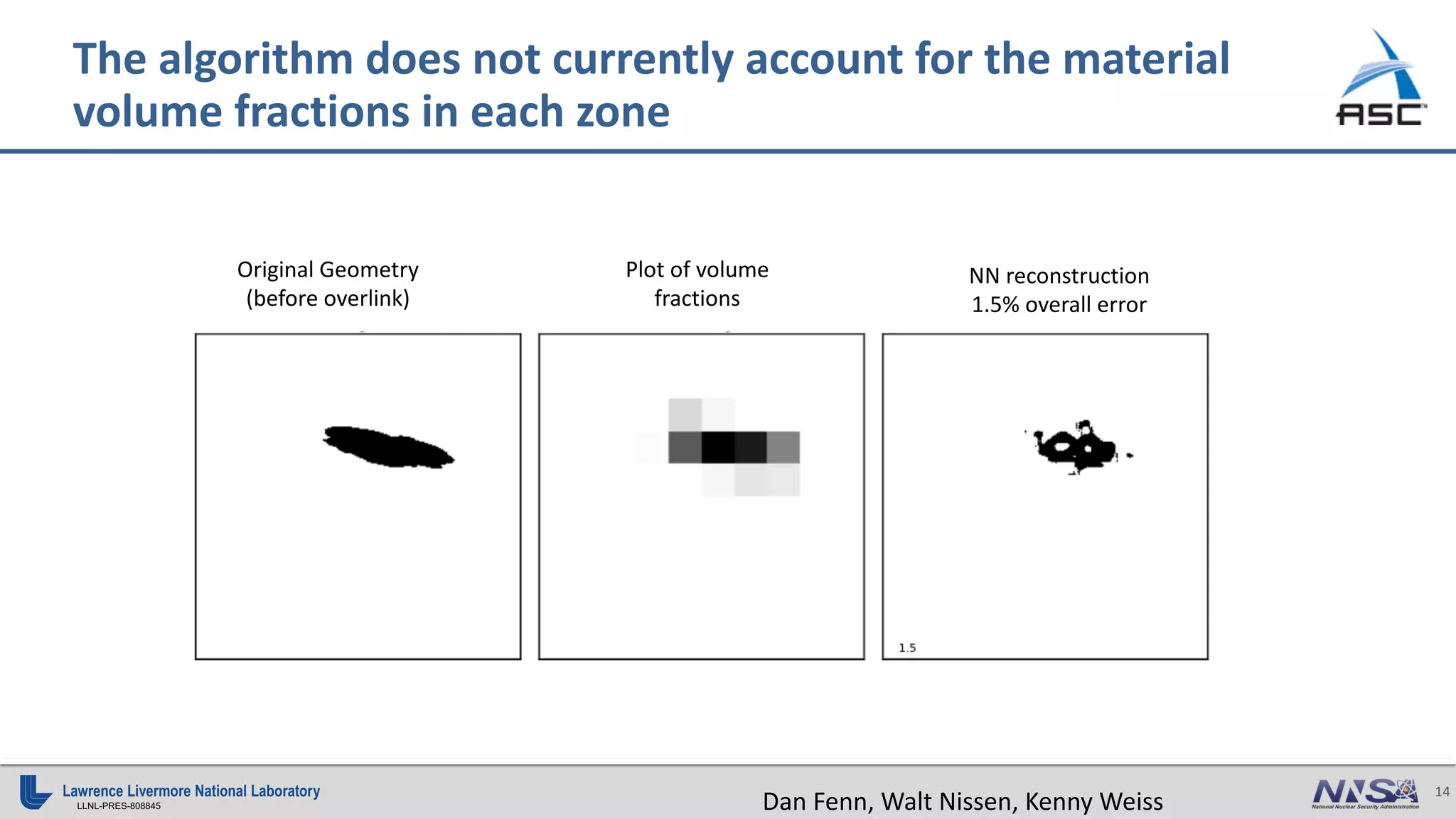
The algorithm does not currently account for the material
volume fractions in each zone
Original Geometry
(before overlink)
NN reconstruction
1.5% overall error
Dan Fenn, Walt Nissen, Kenny Weiss
Plot of volume
fractions
15
LLNL-PRES-808845
Material Interface Reconstruction – Next Steps
§ Incorporate volume fraction information into training as a loss/reward function
— Modifying threshold to meet volume fractions was unsuccessful (i.e., too noisy)
§ Incorporate active learning techniques to handle new types of geometries
§ Evaluate how the algorithm will work in-situ, accounting for conserved physical
quantities
§ Investigate reconstruction for multiple materials
Dan Fenn, Walt Nissen, Kenny Weiss
16
LLNL-PRES-808845 Tom Stitt
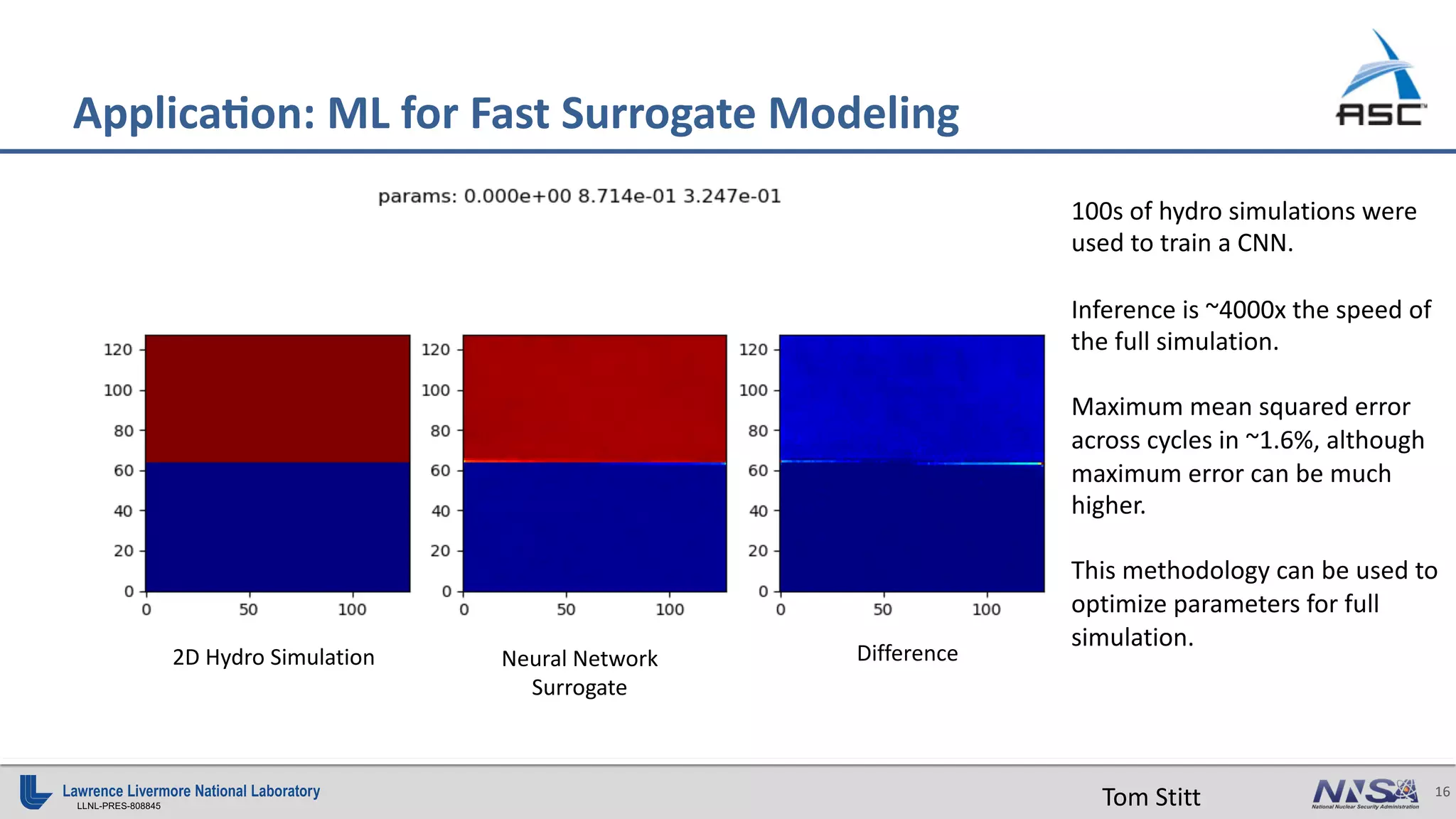
ApplicaBon: ML for Fast Surrogate Modeling
100s of hydro simulations were
used to train a CNN.
Inference is ~4000x the speed of
the full simulation.
Maximum mean squared error
across cycles in ~1.6%, although
maximum error can be much
higher.
This methodology can be used to
optimize parameters for full
simulation.
2D Hydro Simulation Neural Network
Surrogate
Difference
17
LLNL-PRES-808845
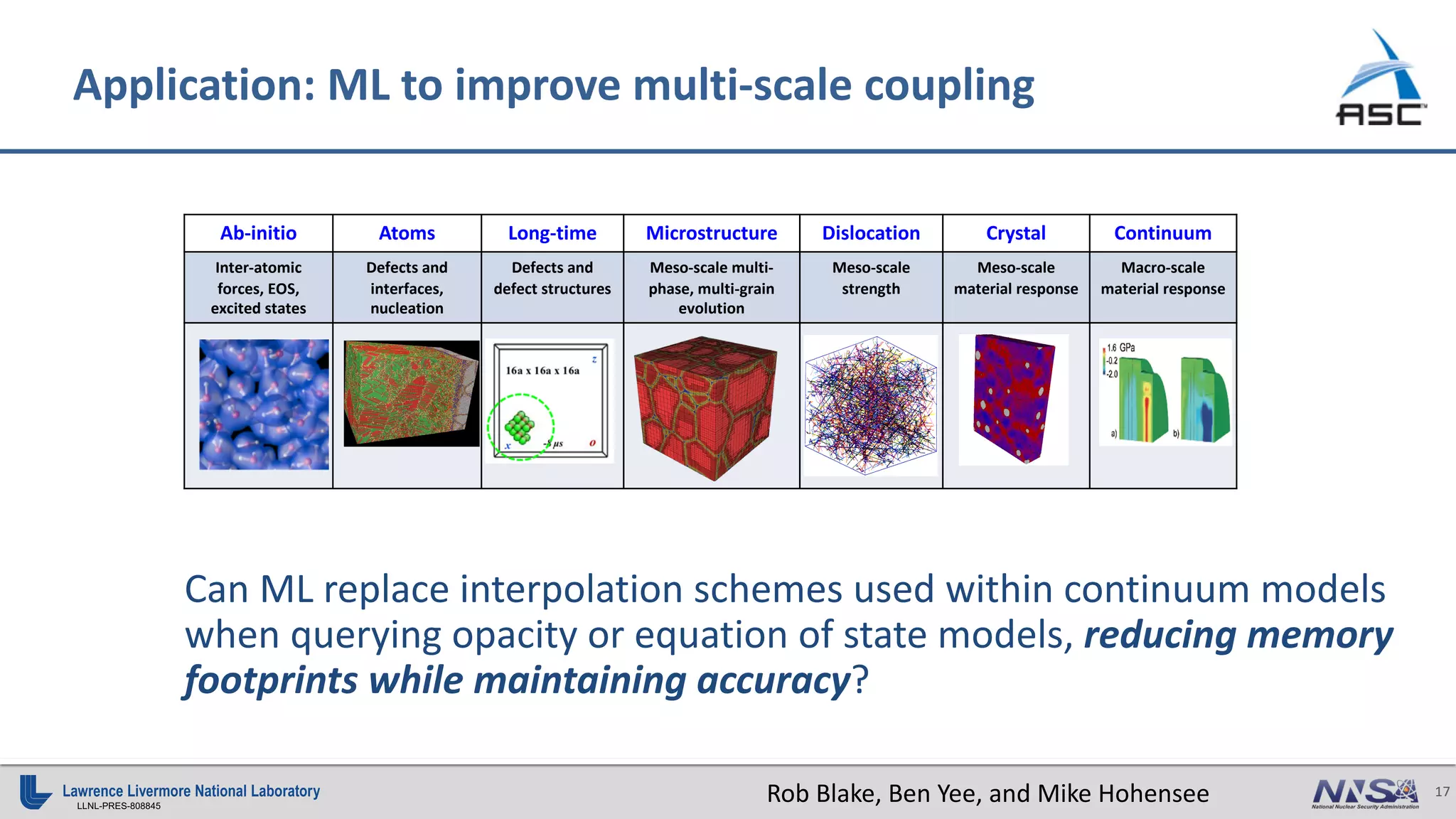
Can ML replace interpolation schemes used within continuum models
when querying opacity or equation of state models, reducing memory
footprints while maintaining accuracy?
Application: ML to improve multi-scale coupling
Ab-initio Atoms Long-time Microstructure Dislocation Crystal Continuum
Inter-atomic
forces, EOS,
excited states
Defects and
interfaces,
nucleation
Defects and
defect structures
Meso-scale multi-
phase, multi-grain
evolution
Meso-scale
strength
Meso-scale
material response
Macro-scale
material response
Rob Blake, Ben Yee, and Mike Hohensee
18
LLNL-PRES-808845
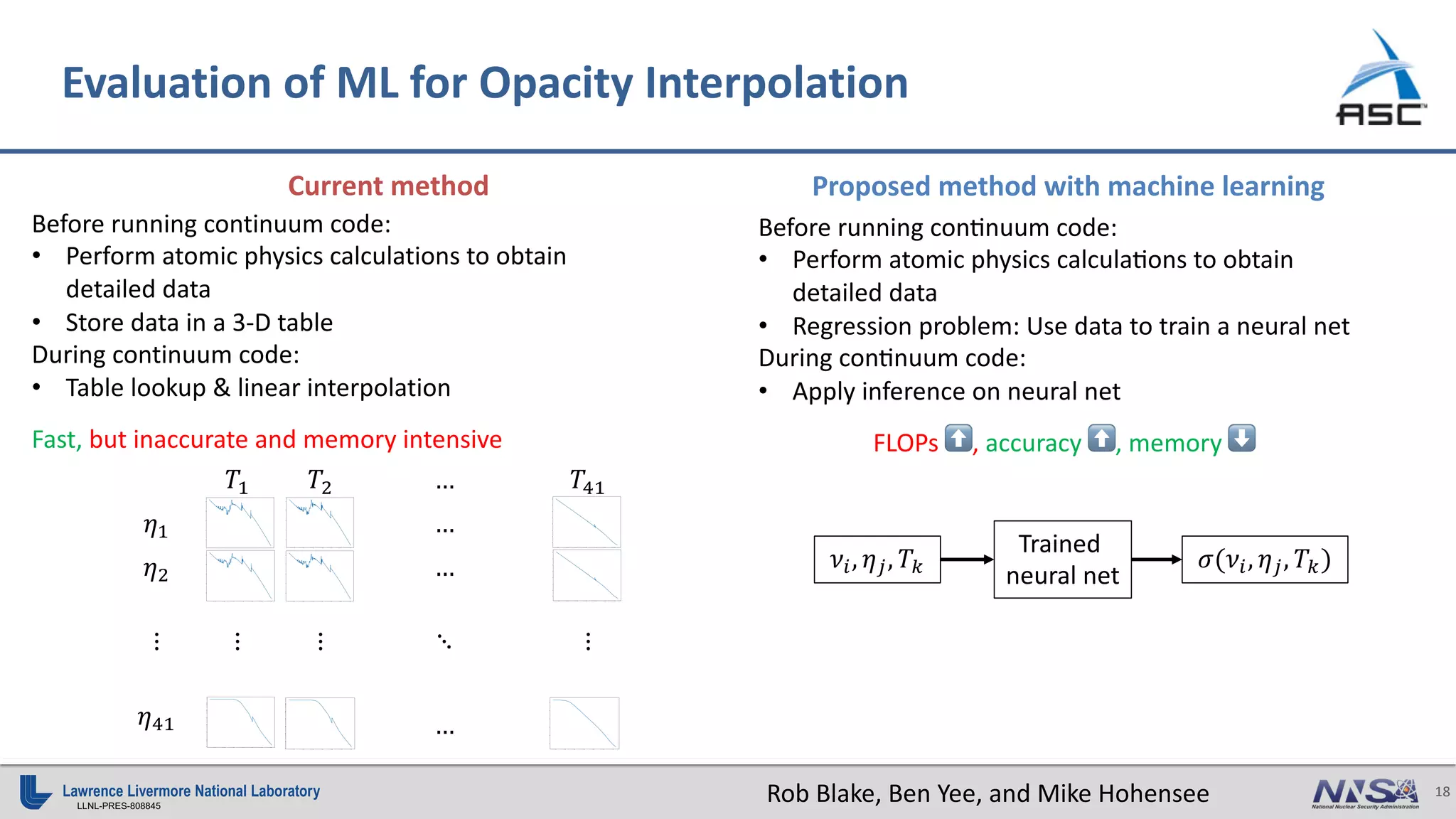
Before running continuum code:
• Perform atomic physics calculations to obtain
detailed data
• Store data in a 3-D table
During continuum code:
• Table lookup & linear interpolation
Fast, but inaccurate and memory intensive
Current method Proposed method with machine learning
Before running con`nuum code:
• Perform atomic physics calcula`ons to obtain
detailed data
• Regression problem: Use data to train a neural net
During con`nuum code:
• Apply inference on neural net
FLOPs ⬆, accuracy ⬆, memory ⬇
𝜈!, 𝜂", 𝑇#
Trained
neural net
𝜎(𝜈!, 𝜂", 𝑇#)
𝑇$ 𝑇% … 𝑇&$
𝜂$ …
𝜂% …
⋮ ⋮ ⋮ ⋱ ⋮
𝜂&$ …
Evaluation of ML for Opacity Interpolation
Rob Blake, Ben Yee, and Mike Hohensee
19
LLNL-PRES-808845
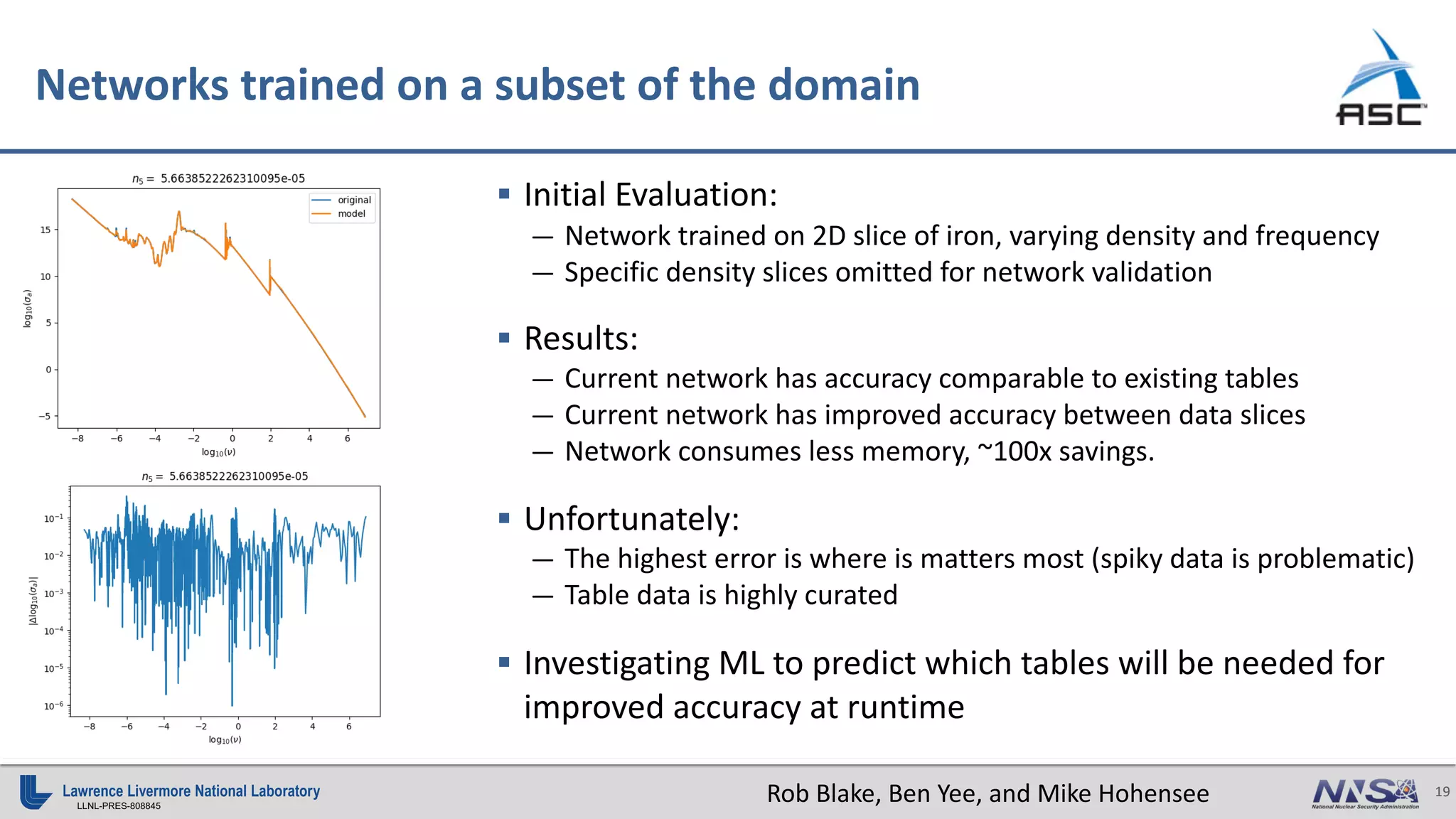
Networks trained on a subset of the domain
§ Initial Evaluation:
— Network trained on 2D slice of iron, varying density and frequency
— Specific density slices omitted for network validation
§ Results:
— Current network has accuracy comparable to existing tables
— Current network has improved accuracy between data slices
— Network consumes less memory, ~100x savings.
§ Unfortunately:
— The highest error is where is matters most (spiky data is problematic)
— Table data is highly curated
§ Investigating ML to predict which tables will be needed for
improved accuracy at runtime
Rob Blake, Ben Yee, and Mike Hohensee
20
LLNL-PRES-808845
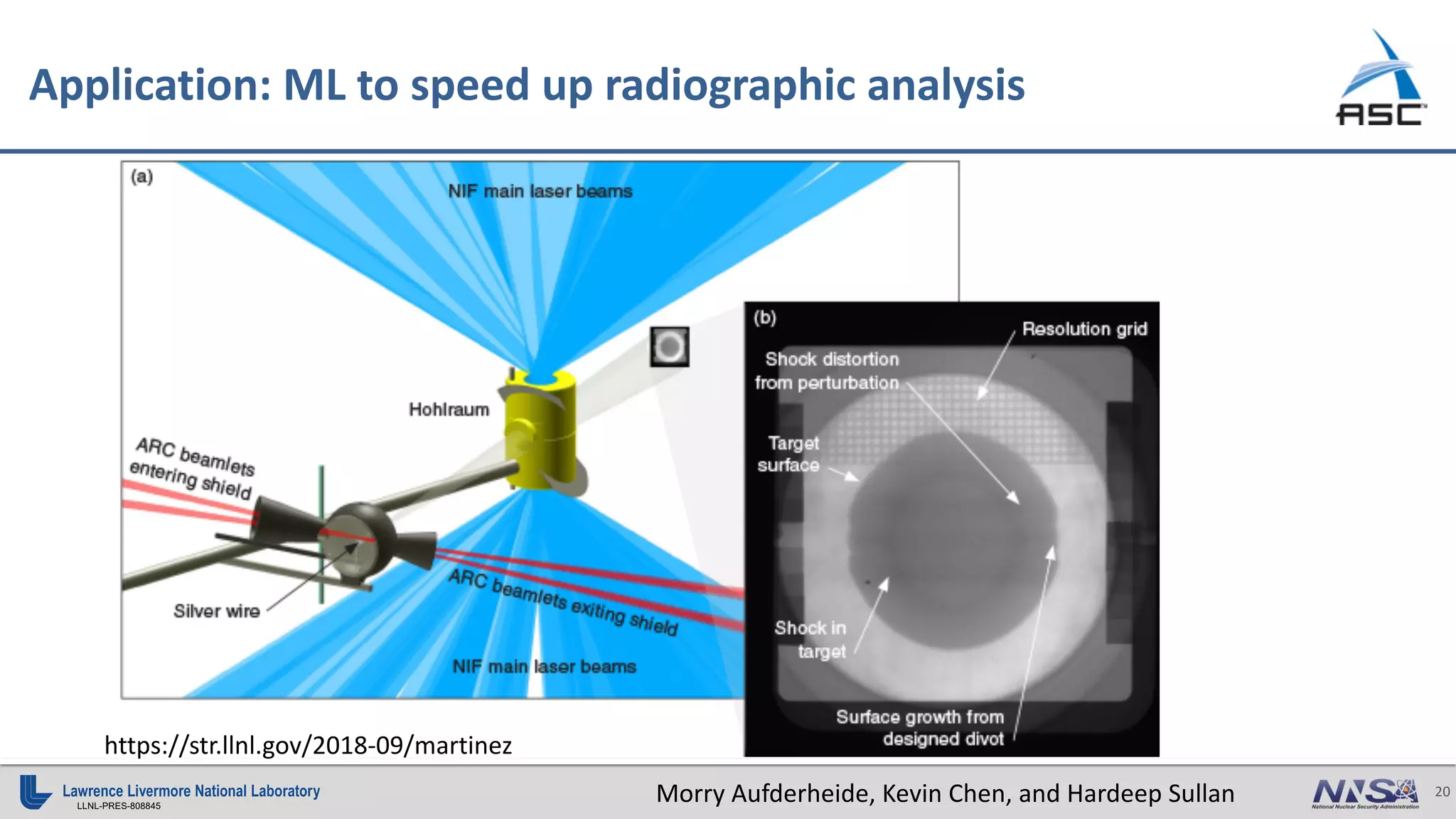
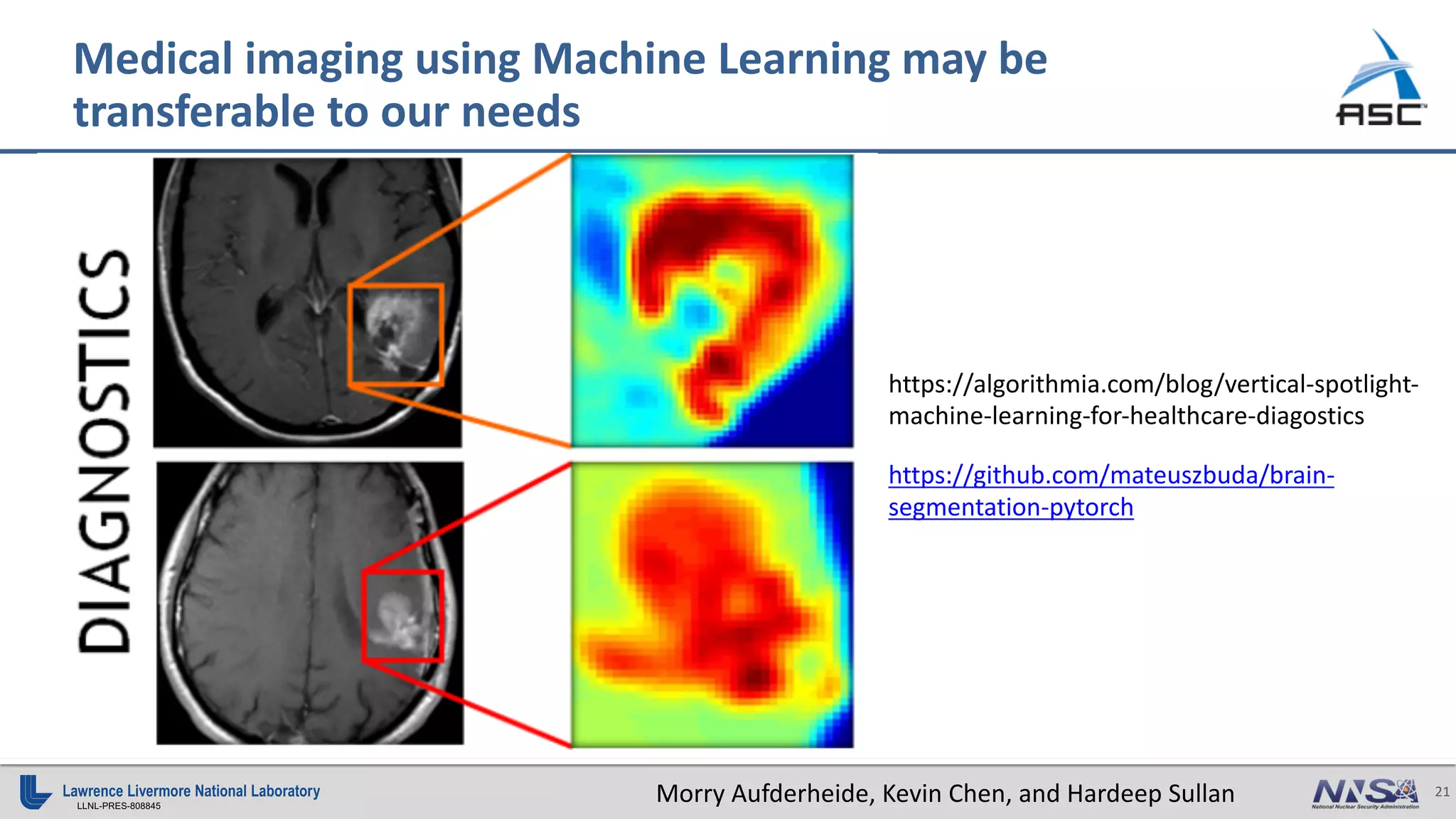
https://str.llnl.gov/2018-09/martinez
Application: ML to speed up radiographic analysis
Morry Aufderheide, Kevin Chen, and Hardeep Sullan
21
LLNL-PRES-808845
Medical imaging using Machine Learning may be
transferable to our needs
https://algorithmia.com/blog/vertical-spotlight-
machine-learning-for-healthcare-diagostics
https://github.com/mateuszbuda/brain-
segmentation-pytorch
Morry Aufderheide, Kevin Chen, and Hardeep Sullan
22
LLNL-PRES-808845
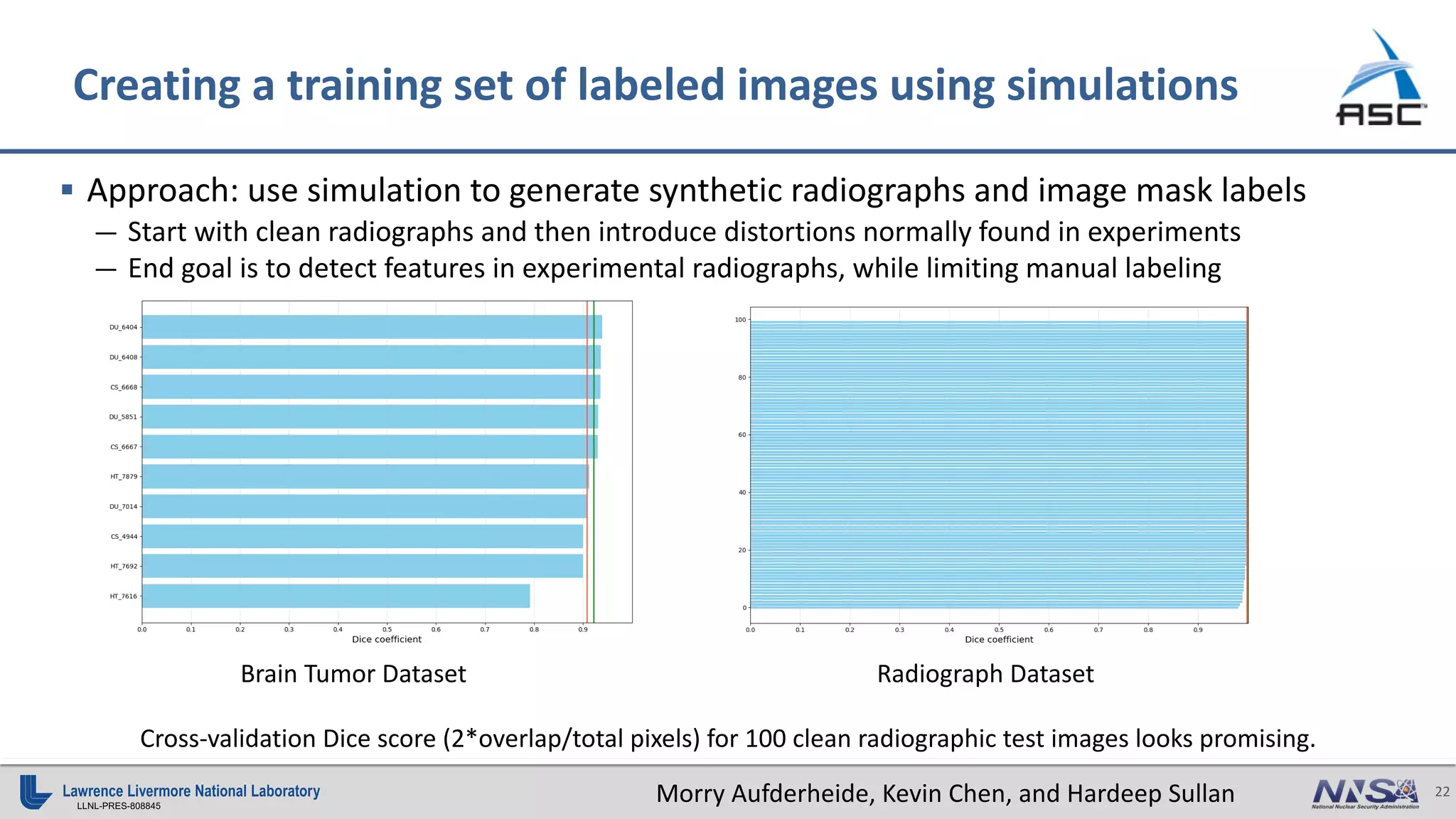
Creating a training set of labeled images using simulations
§ Approach: use simulation to generate synthetic radiographs and image mask labels
— Start with clean radiographs and then introduce distortions normally found in experiments
— End goal is to detect features in experimental radiographs, while limiting manual labeling
Brain Tumor Dataset Radiograph Dataset
Cross-validation Dice score (2*overlap/total pixels) for 100 clean radiographic test images looks promising.
Morry Aufderheide, Kevin Chen, and Hardeep Sullan
23
LLNL-PRES-808845
Data Infrastructure Needs
24
LLNL-PRES-808845
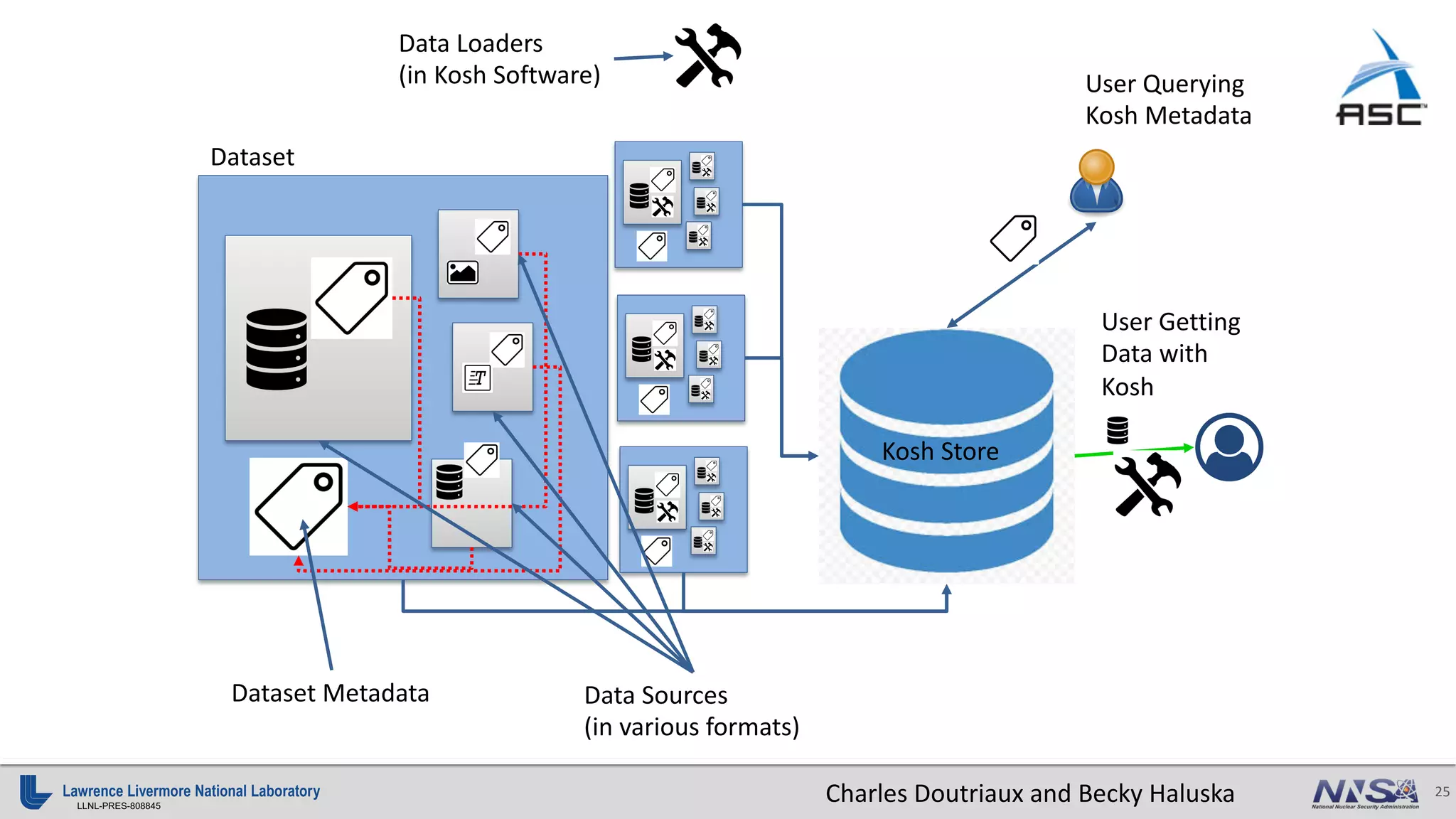
§ ML (esp. DL) needs a lot of data, with verified labels and provenance
§ Traditional databases are not common in the HPC environment
Kosh (Sanskrit for Treasury) is being developed to solve these problems
§ Multi-modal data sources seamlessly searchable and accessible by authenticated end-
users
— Plan to incorporated sampling algorithms (spatial and temporal)
— Datasets can have multiple files associated with them and multiple file formats
§ Data can be distributed across organization/lab/compute centers.
§ Users can query data to get only what they want for training. Adding augmentation
Data Infrastructure is a fundamental need for ML
Charles Doutriaux and Becky Haluska
25
LLNL-PRES-808845
Dataset
Kosh Store
Dataset Metadata
Data Loaders
(in Kosh Software)
Data Sources
(in various formats)
User Querying
Kosh Metadata
User Getting
Data with
Kosh
Charles Doutriaux and Becky Haluska
26
LLNL-PRES-808845
Exploration of new, ML
hardware
27
LLNL-PRES-808845
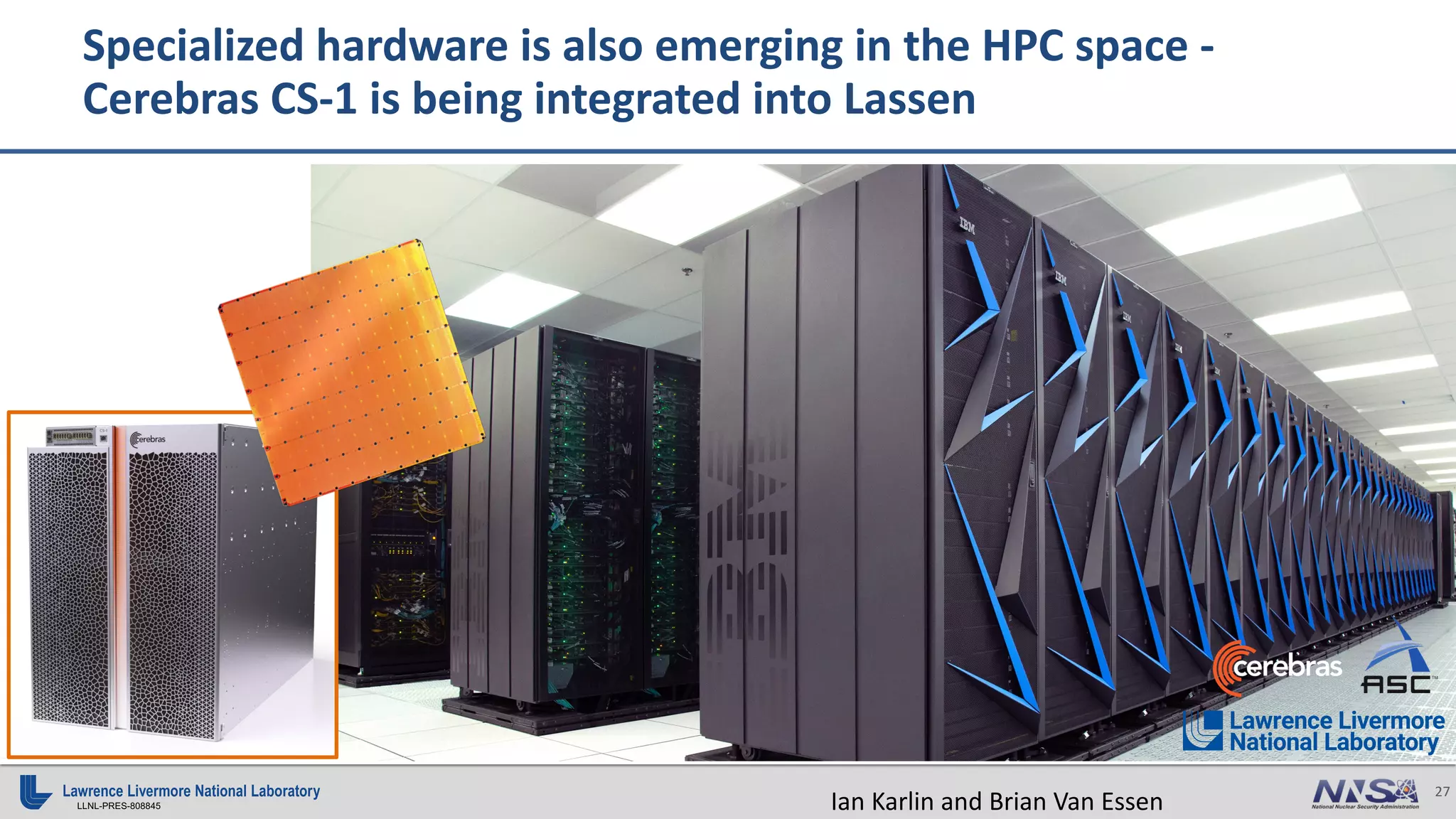
Specialized hardware is also emerging in the HPC space -
Cerebras CS-1 is being integrated into Lassen
Ian Karlin and Brian Van Essen
28
LLNL-PRES-808845
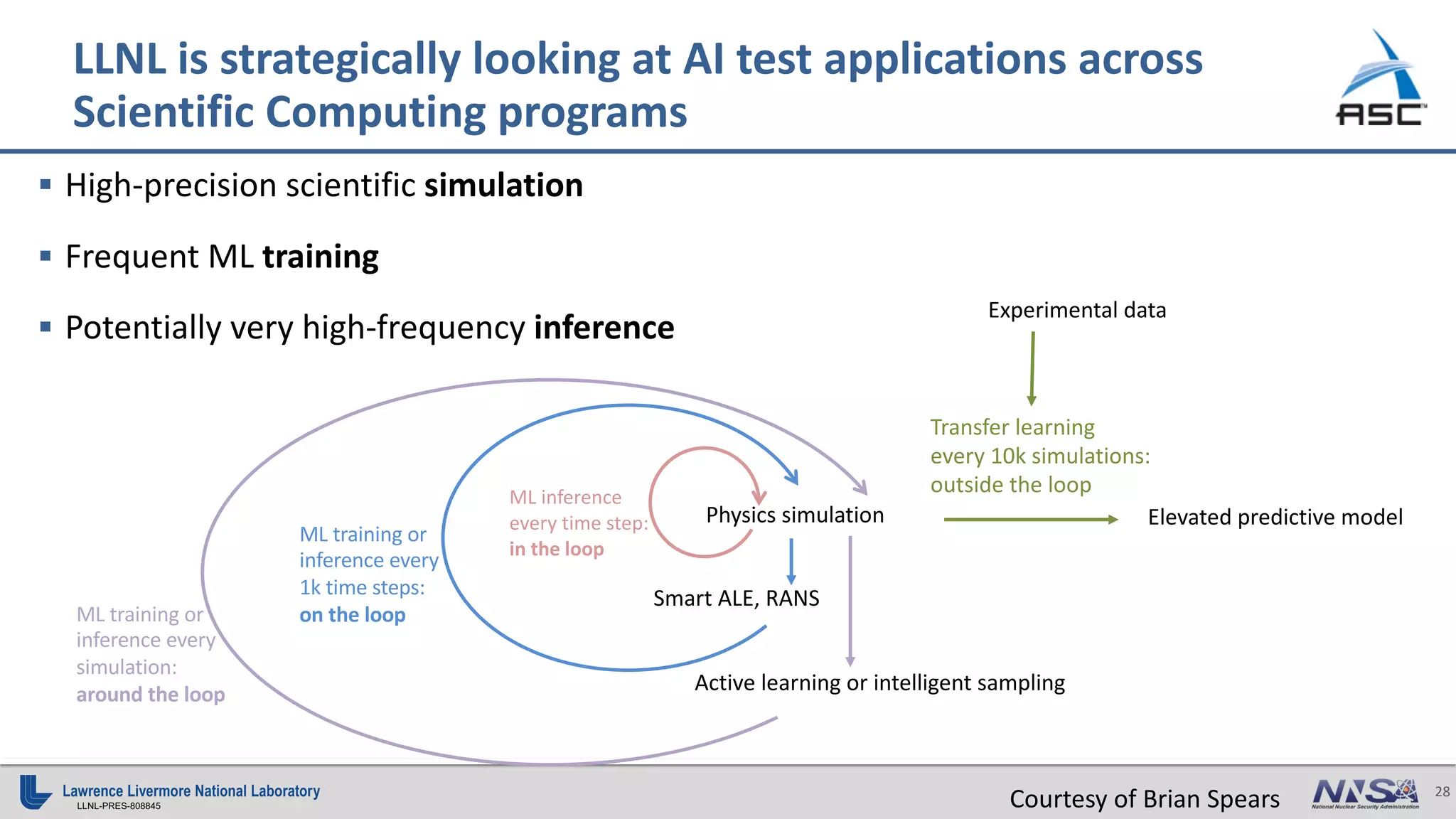
§ High-precision scientific simulation
§ Frequent ML training
§ Potentially very high-frequency inference
LLNL is strategically looking at AI test applications across
Scientific Computing programs
Active learning or intelligent sampling
Smart ALE, RANS
ML inference
every time step:
in the loop
ML training or
inference every
1k time steps:
on the loopML training or
inference every
simulation:
around the loop
Physics simulation
Experimental data
Transfer learning
every 10k simulations:
outside the loop
Elevated predictive model
Courtesy of Brian Spears
29
LLNL-PRES-808845
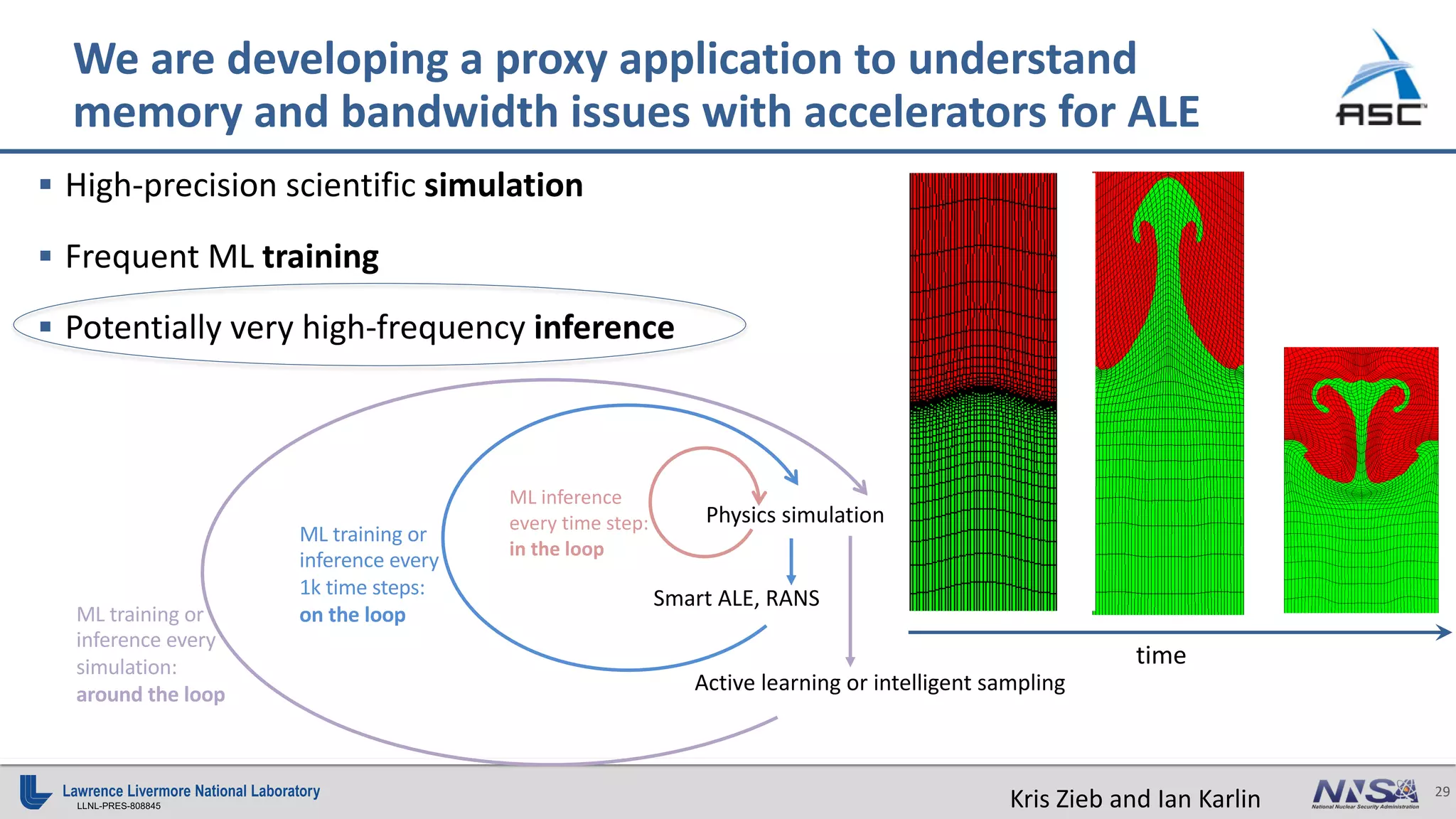
§ High-precision scientific simulation
§ Frequent ML training
§ Potentially very high-frequency inference
We are developing a proxy application to understand
memory and bandwidth issues with accelerators for ALE
Active learning or intelligent sampling
Smart ALE, RANS
ML inference
every time step:
in the loop
ML training or
inference every
1k time steps:
on the loopML training or
inference every
simulation:
around the loop
Physics simulation
Kris Zieb and Ian Karlin
time
30
LLNL-PRES-808845
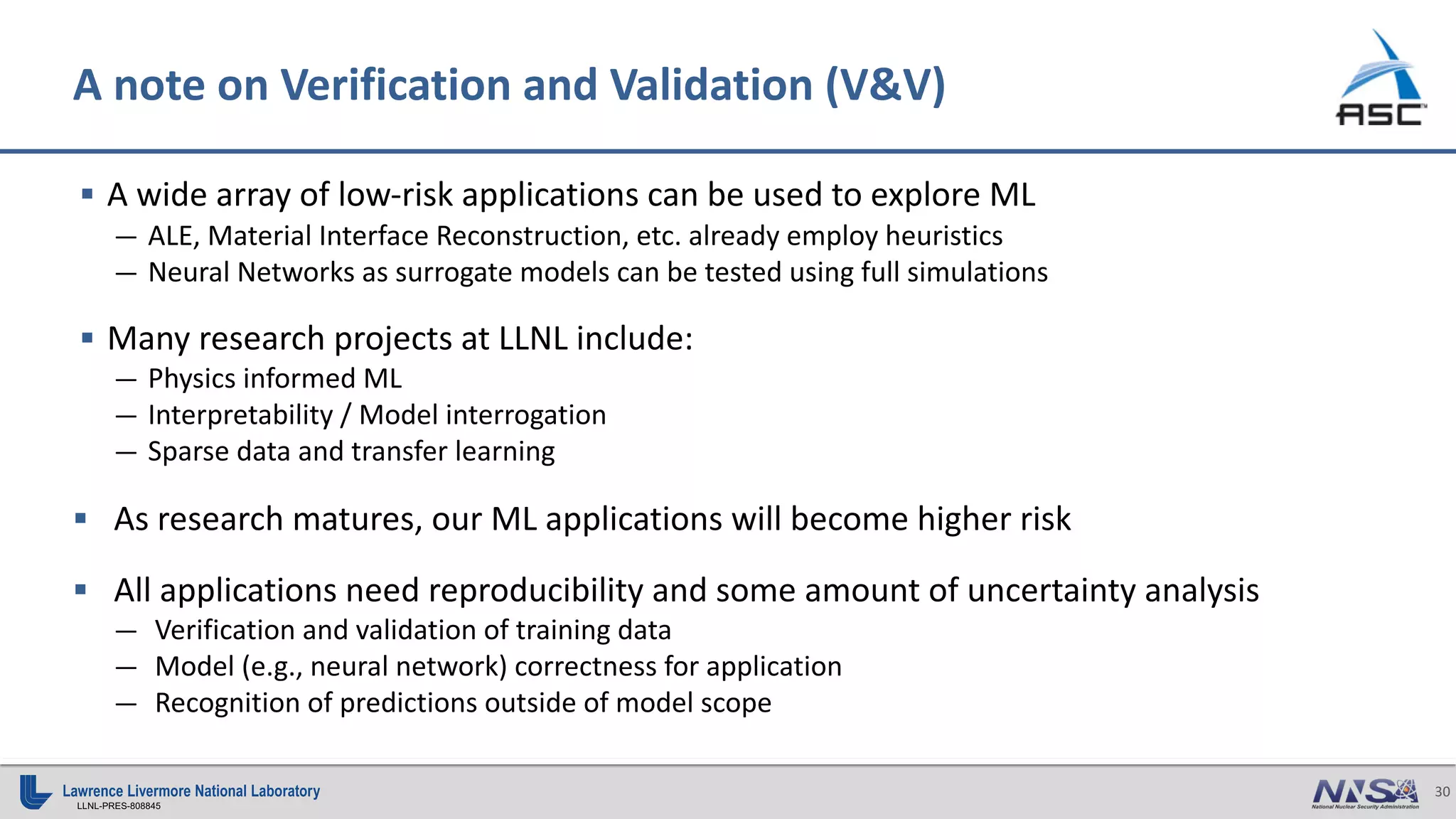
§ A wide array of low-risk applications can be used to explore ML
— ALE, Material Interface Reconstruction, etc. already employ heuristics
— Neural Networks as surrogate models can be tested using full simulations
§ Many research projects at LLNL include:
— Physics informed ML
— Interpretability / Model interrogation
— Sparse data and transfer learning
§ As research matures, our ML applications will become higher risk
§ All applications need reproducibility and some amount of uncertainty analysis
— Verification and validation of training data
— Model (e.g., neural network) correctness for application
— Recognition of predictions outside of model scope
A note on Verification and Validation (V&V)
31
LLNL-PRES-808845
Enhanced
Design
Workflow
Interpretable Predictions
Community Engagement
Data Science potential spans Scientific Computing space
Improved System
Performance
Enhanced
Modeling
Physics Constrained Predictions
32
LLNL-PRES-808845
Many Thanks!
Morry Aufderheide
Rob Blake
Kevin Chen
Sean Copeland
Charles Doutriaux
Dan Fenn
Brian Gallagher
Becky Haluska
Keith Henderson
Ming Jiang
Josh Kallman
Ian Karlin
Alister Maguire
Walt Nissen
Brian Spears
Tom Stitt
Hardeep Sullan
Brian Van Essen
Ping Wang
Kenny Weiss
Kris Zieb
Disclaimer
This document was prepared as an account of work sponsored by an agency of the United States government. Neither the United
States government nor Lawrence Livermore National Security, LLC, nor any of their employees makes any warranty, expressed or
implied, or assumes any legal liability or responsibility for the accuracy, completeness, or usefulness of any information, apparatus,
product, or process disclosed, or represents that its use would not infringe privately owned rights. Reference herein to any specific
commercial product, process, or service by trade name, trademark, manufacturer, or otherwise does not necessarily constitute or
imply its endorsement, recommendation, or favoring by the United States government or Lawrence Livermore National Security, LLC.
The views and opinions of authors expressed herein do not necessarily state or reflect those of the United States government or
Lawrence Livermore National Security, LLC, and shall not be used for advertising or product endorsement purposes.

The Incorporation of Machine Learning into Scientific Simulations at Lawrence Livermore National Laboratory

  • 1.
    LLNL-PRES-808845 This work wasperformed under the auspices of the U.S. Department of Energy by Lawrence Livermore National Laboratory under contract DE- AC52-07NA27344. Lawrence Livermore National Security, LLC The Incorporation of Machine Learning into Scientific Simulations at Lawrence Livermore National Laboratory The Stanford HPCC and HPC-AI Advisory Council Annual Stanford Conference Katie Lewis, Lawrence Livermore National Laboratory Advanced Machine Learning Project Leader April 22, 2020
  • 2.
    2 LLNL-PRES-808845 Supercomputing and ComputationalPhysics at Lawrence Livermore National Laboratory www.llnl.gov/about/history www.llnl.gov/news/berni-alder-pioneer-times www.top500.org § Lawrence Livermore National Laboratory (LLNL) was founded in 1952 — Scientific Computing was part of our initial portfolio § “It is now accepted that in addition to the experimental and theoretical branches of physics, there is a third: computer simulation.” - David Young, postdoc who worked with Bernie Alder in the late 1960s § Today, LLNL and the DOE Complex continue to dominate supercomputing for scientific simulations in support of national security. § Data Science is increasingly a part of this landscape. Sierra – 125 petaflops
  • 3.
    3 LLNL-PRES-808845 Enhanced Design Workflow Interpretable Predictions Community Engagement DataScience potential spans Scientific Computing space Improved System Performance Enhanced Modeling Physics Constrained Predictions
  • 4.
    4 LLNL-PRES-808845 Many research topicsare already being investigated a_rf_nobkg (No Bkg) 0.00 0.16 0.31 0.47 0.63 0.78 0.94 Material Discovery Augmented Turbulence Modeling B" C" A" D" A" C" B" D" High%Vor)city% Improved Design Workflows Improved Material Interface Reconstruction Advanced Surrogate Models Mul?-scale Coupling Journal for Reac-on Chemistry & Engineering
  • 5.
    5 LLNL-PRES-808845 Terminology § Geometry isdiscretized using a “mesh” or “grid”. Time is discretized into timesteps. § Fields (like density, velocity, or temperature) are calculated at the mesh points or “zones”. § In Eulerian simulations, the mesh is static and the materials move through it. § In Lagrangian simulations, the mesh moves with the material. § In Arbitrary Lagrangian-Eulerian (ALE) simulations, the mesh moves, but not necessarily with the material. 3D Lagrangian simulation faculty.washington.edu 2D ALE Simulation
  • 6.
    6 LLNL-PRES-808845 Application: ML tocontrol Arbitrary Lagrangian-Eulerian (ALE) B" C" A" D" A" C" B" D" High%Vor)city% This problem is typically solved with hand-tuned relaxaSon strategies. Ming Jiang, Brian Gallagher, Keith Henderson, Alister Maguire time
  • 7.
    7 LLNL-PRES-808845 Trained relaxation strategiescan significantly reduce user burden Ming Jiang, Brian Gallagher, Keith Henderson, Alister Maguire Zone Angle Skew Temp Energy Label 1 85 1.0 243 0.9 0.1 2 26 1.2 752 3.5 0.9 … … … … … … Simulation Run Inference Algorithm Learning Algorithm Statistical Models Training Data Simulation State Simulation state: mesh + physics Class label: failure event f(x1, x2, ..., xn) = 0..1
  • 8.
    8 LLNL-PRES-808845 Research project ismoving into user community Building on top of M. Jiang, B. Gallagher, J. Kallman, and D. Laney, “A Supervised Learning Framework for Arbitrary Lagrangian-Eulerian Simulations,” IEEE International Conference on Machine Learning and Applications (ICMLA), pp. 977–982, 2016. § Initial results showed high accuracy using random forests § Recent work improves the imbalance in training data and generalization to noisy data using Convolutional Neural Networks (CNNs) § Working with user community to provide quantitative analysis of results using the CNN for inference inline — Evaluate quantities of interest against experimental results — Develop a reward function for Reinforcement Learning § Test case for proxy application on new hardware (more later) Bubble Shock Shock Tube Ming Jiang, Brian Gallagher, Keith Henderson, Alister Maguire
  • 9.
    9 LLNL-PRES-808845 ApplicaBon: ML forMaterial Interface ReconstrucBon (MIR) Current, High Res Reconstruction Actual Material Boundaries Current, Low Res Reconstruction Dan Fenn, Walt Nissen, Kenny Weiss
  • 10.
    10 LLNL-PRES-808845 Training with actualgeometry may avoid the common errors seen in heuristic solutions High-Res Background Low-Res Background Current Interface Reconstruction Dan Fenn, Walt Nissen, Kenny Weiss
  • 11.
    11 LLNL-PRES-808845 We can usethis methodology to train on many shapes Varying: • Position • Size • Rotation • Background vs. Foreground Dan Fenn, Walt Nissen, Kenny Weiss
  • 12.
    12 LLNL-PRES-808845 Initial results arevery promising! Original Geometry (before overlink) Plot of volume fractions Volume fraction preserving reconstruction NN reconstruction 0.6% overall error NN reconstrucBon 0.5% overall error Dan Fenn, Walt Nissen, Kenny Weiss
  • 13.
    13 LLNL-PRES-808845 Overfitting is evidentin results Original Geometry (before overlink) NN reconstruction 0.6% error NN reconstruction 0.5% error Dan Fenn, Walt Nissen, Kenny Weiss Plot of volume fractions Volume fraction preserving reconstruction
  • 14.
    14 LLNL-PRES-808845 The algorithm doesnot currently account for the material volume fractions in each zone Original Geometry (before overlink) NN reconstruction 1.5% overall error Dan Fenn, Walt Nissen, Kenny Weiss Plot of volume fractions
  • 15.
    15 LLNL-PRES-808845 Material Interface Reconstruction– Next Steps § Incorporate volume fraction information into training as a loss/reward function — Modifying threshold to meet volume fractions was unsuccessful (i.e., too noisy) § Incorporate active learning techniques to handle new types of geometries § Evaluate how the algorithm will work in-situ, accounting for conserved physical quantities § Investigate reconstruction for multiple materials Dan Fenn, Walt Nissen, Kenny Weiss
  • 16.
    16 LLNL-PRES-808845 Tom Stitt ApplicaBon:ML for Fast Surrogate Modeling 100s of hydro simulations were used to train a CNN. Inference is ~4000x the speed of the full simulation. Maximum mean squared error across cycles in ~1.6%, although maximum error can be much higher. This methodology can be used to optimize parameters for full simulation. 2D Hydro Simulation Neural Network Surrogate Difference
  • 17.
    17 LLNL-PRES-808845 Can ML replaceinterpolation schemes used within continuum models when querying opacity or equation of state models, reducing memory footprints while maintaining accuracy? Application: ML to improve multi-scale coupling Ab-initio Atoms Long-time Microstructure Dislocation Crystal Continuum Inter-atomic forces, EOS, excited states Defects and interfaces, nucleation Defects and defect structures Meso-scale multi- phase, multi-grain evolution Meso-scale strength Meso-scale material response Macro-scale material response Rob Blake, Ben Yee, and Mike Hohensee
  • 18.
    18 LLNL-PRES-808845 Before running continuumcode: • Perform atomic physics calculations to obtain detailed data • Store data in a 3-D table During continuum code: • Table lookup & linear interpolation Fast, but inaccurate and memory intensive Current method Proposed method with machine learning Before running con`nuum code: • Perform atomic physics calcula`ons to obtain detailed data • Regression problem: Use data to train a neural net During con`nuum code: • Apply inference on neural net FLOPs ⬆, accuracy ⬆, memory ⬇ 𝜈!, 𝜂", 𝑇# Trained neural net 𝜎(𝜈!, 𝜂", 𝑇#) 𝑇$ 𝑇% … 𝑇&$ 𝜂$ … 𝜂% … ⋮ ⋮ ⋮ ⋱ ⋮ 𝜂&$ … Evaluation of ML for Opacity Interpolation Rob Blake, Ben Yee, and Mike Hohensee
  • 19.
    19 LLNL-PRES-808845 Networks trained ona subset of the domain § Initial Evaluation: — Network trained on 2D slice of iron, varying density and frequency — Specific density slices omitted for network validation § Results: — Current network has accuracy comparable to existing tables — Current network has improved accuracy between data slices — Network consumes less memory, ~100x savings. § Unfortunately: — The highest error is where is matters most (spiky data is problematic) — Table data is highly curated § Investigating ML to predict which tables will be needed for improved accuracy at runtime Rob Blake, Ben Yee, and Mike Hohensee
  • 20.
    20 LLNL-PRES-808845 https://str.llnl.gov/2018-09/martinez Application: ML tospeed up radiographic analysis Morry Aufderheide, Kevin Chen, and Hardeep Sullan
  • 21.
    21 LLNL-PRES-808845 Medical imaging usingMachine Learning may be transferable to our needs https://algorithmia.com/blog/vertical-spotlight- machine-learning-for-healthcare-diagostics https://github.com/mateuszbuda/brain- segmentation-pytorch Morry Aufderheide, Kevin Chen, and Hardeep Sullan
  • 22.
    22 LLNL-PRES-808845 Creating a trainingset of labeled images using simulations § Approach: use simulation to generate synthetic radiographs and image mask labels — Start with clean radiographs and then introduce distortions normally found in experiments — End goal is to detect features in experimental radiographs, while limiting manual labeling Brain Tumor Dataset Radiograph Dataset Cross-validation Dice score (2*overlap/total pixels) for 100 clean radiographic test images looks promising. Morry Aufderheide, Kevin Chen, and Hardeep Sullan
  • 23.
  • 24.
    24 LLNL-PRES-808845 § ML (esp.DL) needs a lot of data, with verified labels and provenance § Traditional databases are not common in the HPC environment Kosh (Sanskrit for Treasury) is being developed to solve these problems § Multi-modal data sources seamlessly searchable and accessible by authenticated end- users — Plan to incorporated sampling algorithms (spatial and temporal) — Datasets can have multiple files associated with them and multiple file formats § Data can be distributed across organization/lab/compute centers. § Users can query data to get only what they want for training. Adding augmentation Data Infrastructure is a fundamental need for ML Charles Doutriaux and Becky Haluska
  • 25.
    25 LLNL-PRES-808845 Dataset Kosh Store Dataset Metadata DataLoaders (in Kosh Software) Data Sources (in various formats) User Querying Kosh Metadata User Getting Data with Kosh Charles Doutriaux and Becky Haluska
  • 26.
  • 27.
    27 LLNL-PRES-808845 Specialized hardware isalso emerging in the HPC space - Cerebras CS-1 is being integrated into Lassen Ian Karlin and Brian Van Essen
  • 28.
    28 LLNL-PRES-808845 § High-precision scientificsimulation § Frequent ML training § Potentially very high-frequency inference LLNL is strategically looking at AI test applications across Scientific Computing programs Active learning or intelligent sampling Smart ALE, RANS ML inference every time step: in the loop ML training or inference every 1k time steps: on the loopML training or inference every simulation: around the loop Physics simulation Experimental data Transfer learning every 10k simulations: outside the loop Elevated predictive model Courtesy of Brian Spears
  • 29.
    29 LLNL-PRES-808845 § High-precision scientificsimulation § Frequent ML training § Potentially very high-frequency inference We are developing a proxy application to understand memory and bandwidth issues with accelerators for ALE Active learning or intelligent sampling Smart ALE, RANS ML inference every time step: in the loop ML training or inference every 1k time steps: on the loopML training or inference every simulation: around the loop Physics simulation Kris Zieb and Ian Karlin time
  • 30.
    30 LLNL-PRES-808845 § A widearray of low-risk applications can be used to explore ML — ALE, Material Interface Reconstruction, etc. already employ heuristics — Neural Networks as surrogate models can be tested using full simulations § Many research projects at LLNL include: — Physics informed ML — Interpretability / Model interrogation — Sparse data and transfer learning § As research matures, our ML applications will become higher risk § All applications need reproducibility and some amount of uncertainty analysis — Verification and validation of training data — Model (e.g., neural network) correctness for application — Recognition of predictions outside of model scope A note on Verification and Validation (V&V)
  • 31.
    31 LLNL-PRES-808845 Enhanced Design Workflow Interpretable Predictions Community Engagement DataScience potential spans Scientific Computing space Improved System Performance Enhanced Modeling Physics Constrained Predictions
  • 32.
    32 LLNL-PRES-808845 Many Thanks! Morry Aufderheide RobBlake Kevin Chen Sean Copeland Charles Doutriaux Dan Fenn Brian Gallagher Becky Haluska Keith Henderson Ming Jiang Josh Kallman Ian Karlin Alister Maguire Walt Nissen Brian Spears Tom Stitt Hardeep Sullan Brian Van Essen Ping Wang Kenny Weiss Kris Zieb
  • 33.
    Disclaimer This document wasprepared as an account of work sponsored by an agency of the United States government. Neither the United States government nor Lawrence Livermore National Security, LLC, nor any of their employees makes any warranty, expressed or implied, or assumes any legal liability or responsibility for the accuracy, completeness, or usefulness of any information, apparatus, product, or process disclosed, or represents that its use would not infringe privately owned rights. Reference herein to any specific commercial product, process, or service by trade name, trademark, manufacturer, or otherwise does not necessarily constitute or imply its endorsement, recommendation, or favoring by the United States government or Lawrence Livermore National Security, LLC. The views and opinions of authors expressed herein do not necessarily state or reflect those of the United States government or Lawrence Livermore National Security, LLC, and shall not be used for advertising or product endorsement purposes.