Fragment molecular orbital calculations for COVID-19 proteins
Yuji Mochizuki (Rikkyo University)
■Research group and objectives
Yuji Mochizuki (Rikkyo University) conducts the project in close collaboration with Shigenori
Tanaka (Kobe University) and Kaori Fukuzawa (Hoshi Univeristy). By using our ABINIT-MP
program, a series of fragment molecular orbital (FMO) calculations are carried out on
COVID-19 proteins, and detailed interaction analyses are performed. Resulted data are
made public as well.
■Evidences
ABINIT-MP has been used in the field of computational drug discovery for the last two
decades, and a related consortium activity (FMODD) on the K-computer is organized by
Fukuzawa. On the present topic, we have performed FMO-based interaction analyses for a
complex formed between a COVID-19 main protease and an inhibitor N3, where FX100 at
Nagoya University was employed for computations. The analyzed results were published
as a paper at ChemRxiv site, after a month from the release of original PDB structure
(6LU7). Crucial residues in interacting with the inhibitor were identified by our analyses.
<https://chemrxiv.org/articles/Fragment_Molecular_Orbital_Based_Interaction_Analyses_on_COVID-19_Main_Protease_-_Inhibitor_N3_Complex_PDB_ID_6LU7_/11988120/1>
■Schedule plan
(1) Exploratory FMO calculations and analyses (including structural fluctuations) for
complexes between SARS-CoV-2/COVID-19 proteins and inhibitor candidates. (2) Similar
studies for related SARS-CoV systems. (3) Data release at FMODD (database) site.
■Expected results
(1) Supplemental information for inhibitor candidates based on interaction analyses.
(2) Guideline information for development of new inhibitors. (3) Basic data for machine
learning toward discovery of effective inhibitors.
Simulation analysis of pandemic phenomena
RIKEN Nobuyasu Ito
Research content:
Social and economic impact is increasing globally, and Japan is now at critical bifurcation point.
And challenges to make its visualization and “big data” mining have started. In this project,
making the most of the “Fugaku” and other supercomputers, estimations of possible future of our
social and economic activities, and policy options to control and resolve the situation.
For the purpose, simulations of disease propagation and economic activities, and SNS text mining
are applied together with the National Institute of Advanced Industrial Science and
Technology,Kyoto University, Tokyo Institute of Technology, the Univesity of Hyogo, the
University of Ryukyus and the University of Tsukuba.
Expected results:
Candidates of policy options to
control and resolve the disease
propagation and its social and
economic effects are visible.
Dynamic control of the situation
together with localized policy
will be clear.
Not only in case of disease
propagation, policy options in
cases of large scale disasters
and accidents will also be
guided.
Preliminary simulation result of economic damage after lockdown of Tokyo area:
the left figure shows the first days and the right 14th day by Dr. Inoue of the
University of Hyogo. In this project, not only the case of lockdown, but also partia
restrictions in various areas are searched using the “Fugaku” supercomputer.
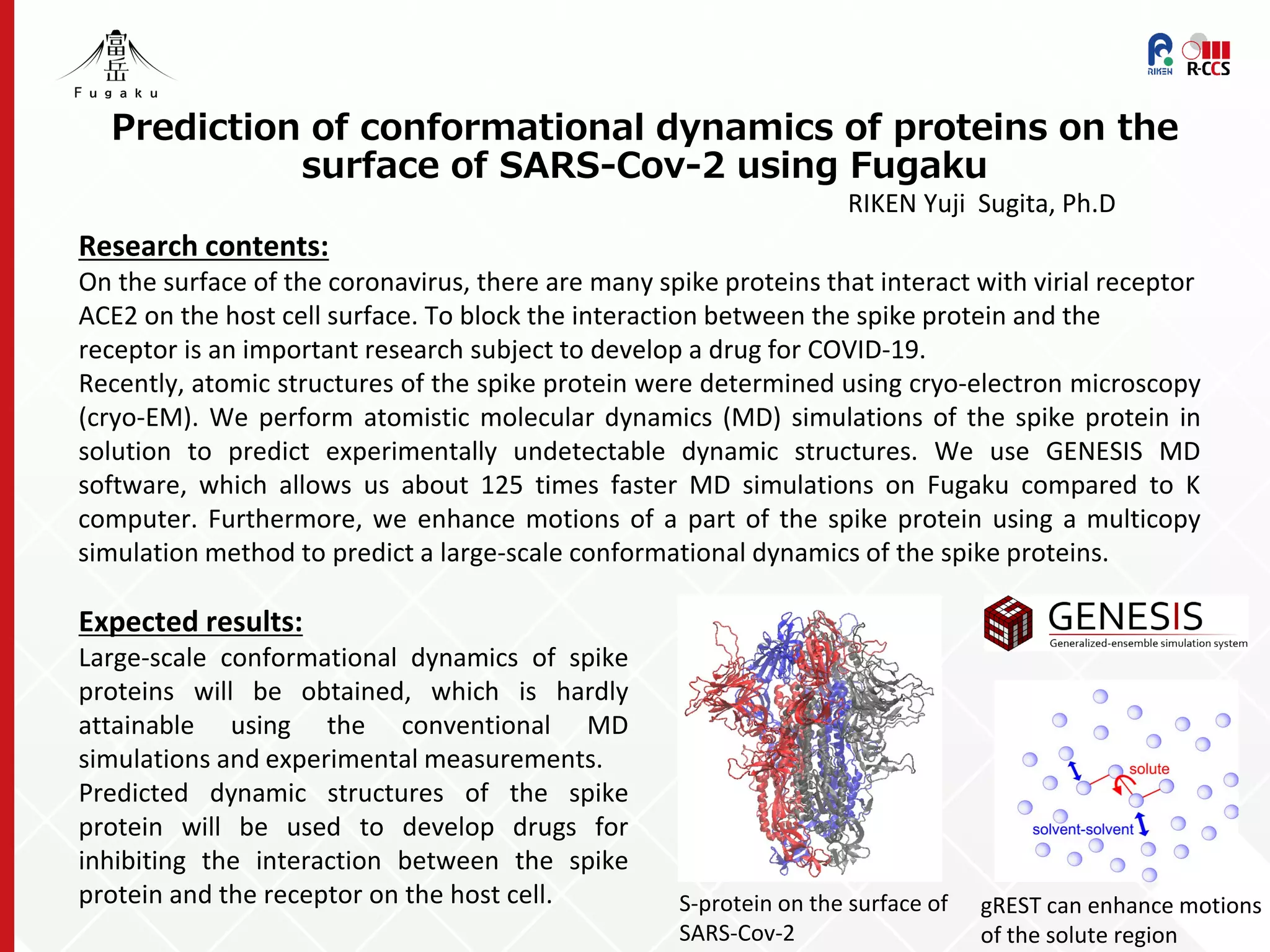
Prediction of conformational dynamics of proteins on the
surface of SARS-Cov-2 using Fugaku
RIKEN Yuji Sugita, Ph.D
Research contents:
On the surface of the coronavirus, there are many spike proteins that interact with virial receptor
ACE2 on the host cell surface. To block the interaction between the spike protein and the
receptor is an important research subject to develop a drug for COVID-19.
Recently, atomic structures of the spike protein were determined using cryo-electron microscopy
(cryo-EM). We perform atomistic molecular dynamics (MD) simulations of the spike protein in
solution to predict experimentally undetectable dynamic structures. We use GENESIS MD
software, which allows us about 125 times faster MD simulations on Fugaku compared to K
computer. Furthermore, we enhance motions of a part of the spike protein using a multicopy
simulation method to predict a large-scale conformational dynamics of the spike proteins.
Expected results:
Large-scale conformational dynamics of spike
proteins will be obtained, which is hardly
attainable using the conventional MD
simulations and experimental measurements.
Predicted dynamic structures of the spike
protein will be used to develop drugs for
inhibiting the interaction between the spike
protein and the receptor on the host cell. S-protein on the surface of
SARS-Cov-2
gREST can enhance motions
of the solute region
Exploring new drug candidates for COVID-19 by "Fugaku"
RIKEN / Kyoto University Yasushi OKUNO, Prof. PhD.
Research content:
Currently, clinical trials are underway in Japan and overseas to confirm the effects of existing
drugs on COVID-19. Some reports have shown that the drug has shown efficacy through these
clinical trials, but the number of cases has been small, and no effective therapeutic drug has yet
been identified. Furthermore, due to the small number of drugs being tested, it is possible that
none of the drugs have a definite effect.
Therefore, in this study, we performe molecular dynamics calculations using "Fugaku" to search
and identify therapeutic drug candidates showing high affinity for the target proteins of COVID-19
from approximately 2,000 existing drugs that are not limited to existing antiviral drugs targeted in
clinical trials.
Target proteins of COVID-19
2,000 existing drugsExpected results:
New therapeutic drug candidates other than
those currently undergoing clinical trials can be
discovered.
Combination effects of multiple drugs can be
estimated
The molecular action mechanism of existing
drugs currently undergoing clinical trials will be
elucidated. In addition, these findings provide a
clear direction for developing new drugs that go
beyond the existing drugs.

Fugaku Supercomputer joins fight against COVID-19

  • 1.
    Fragment molecular orbitalcalculations for COVID-19 proteins Yuji Mochizuki (Rikkyo University) ■Research group and objectives Yuji Mochizuki (Rikkyo University) conducts the project in close collaboration with Shigenori Tanaka (Kobe University) and Kaori Fukuzawa (Hoshi Univeristy). By using our ABINIT-MP program, a series of fragment molecular orbital (FMO) calculations are carried out on COVID-19 proteins, and detailed interaction analyses are performed. Resulted data are made public as well. ■Evidences ABINIT-MP has been used in the field of computational drug discovery for the last two decades, and a related consortium activity (FMODD) on the K-computer is organized by Fukuzawa. On the present topic, we have performed FMO-based interaction analyses for a complex formed between a COVID-19 main protease and an inhibitor N3, where FX100 at Nagoya University was employed for computations. The analyzed results were published as a paper at ChemRxiv site, after a month from the release of original PDB structure (6LU7). Crucial residues in interacting with the inhibitor were identified by our analyses. <https://chemrxiv.org/articles/Fragment_Molecular_Orbital_Based_Interaction_Analyses_on_COVID-19_Main_Protease_-_Inhibitor_N3_Complex_PDB_ID_6LU7_/11988120/1> ■Schedule plan (1) Exploratory FMO calculations and analyses (including structural fluctuations) for complexes between SARS-CoV-2/COVID-19 proteins and inhibitor candidates. (2) Similar studies for related SARS-CoV systems. (3) Data release at FMODD (database) site. ■Expected results (1) Supplemental information for inhibitor candidates based on interaction analyses. (2) Guideline information for development of new inhibitors. (3) Basic data for machine learning toward discovery of effective inhibitors.
  • 2.
    Simulation analysis ofpandemic phenomena RIKEN Nobuyasu Ito Research content: Social and economic impact is increasing globally, and Japan is now at critical bifurcation point. And challenges to make its visualization and “big data” mining have started. In this project, making the most of the “Fugaku” and other supercomputers, estimations of possible future of our social and economic activities, and policy options to control and resolve the situation. For the purpose, simulations of disease propagation and economic activities, and SNS text mining are applied together with the National Institute of Advanced Industrial Science and Technology,Kyoto University, Tokyo Institute of Technology, the Univesity of Hyogo, the University of Ryukyus and the University of Tsukuba. Expected results: Candidates of policy options to control and resolve the disease propagation and its social and economic effects are visible. Dynamic control of the situation together with localized policy will be clear. Not only in case of disease propagation, policy options in cases of large scale disasters and accidents will also be guided. Preliminary simulation result of economic damage after lockdown of Tokyo area: the left figure shows the first days and the right 14th day by Dr. Inoue of the University of Hyogo. In this project, not only the case of lockdown, but also partia restrictions in various areas are searched using the “Fugaku” supercomputer.
  • 3.
    Prediction of conformationaldynamics of proteins on the surface of SARS-Cov-2 using Fugaku RIKEN Yuji Sugita, Ph.D Research contents: On the surface of the coronavirus, there are many spike proteins that interact with virial receptor ACE2 on the host cell surface. To block the interaction between the spike protein and the receptor is an important research subject to develop a drug for COVID-19. Recently, atomic structures of the spike protein were determined using cryo-electron microscopy (cryo-EM). We perform atomistic molecular dynamics (MD) simulations of the spike protein in solution to predict experimentally undetectable dynamic structures. We use GENESIS MD software, which allows us about 125 times faster MD simulations on Fugaku compared to K computer. Furthermore, we enhance motions of a part of the spike protein using a multicopy simulation method to predict a large-scale conformational dynamics of the spike proteins. Expected results: Large-scale conformational dynamics of spike proteins will be obtained, which is hardly attainable using the conventional MD simulations and experimental measurements. Predicted dynamic structures of the spike protein will be used to develop drugs for inhibiting the interaction between the spike protein and the receptor on the host cell. S-protein on the surface of SARS-Cov-2 gREST can enhance motions of the solute region
  • 4.
    Exploring new drugcandidates for COVID-19 by "Fugaku" RIKEN / Kyoto University Yasushi OKUNO, Prof. PhD. Research content: Currently, clinical trials are underway in Japan and overseas to confirm the effects of existing drugs on COVID-19. Some reports have shown that the drug has shown efficacy through these clinical trials, but the number of cases has been small, and no effective therapeutic drug has yet been identified. Furthermore, due to the small number of drugs being tested, it is possible that none of the drugs have a definite effect. Therefore, in this study, we performe molecular dynamics calculations using "Fugaku" to search and identify therapeutic drug candidates showing high affinity for the target proteins of COVID-19 from approximately 2,000 existing drugs that are not limited to existing antiviral drugs targeted in clinical trials. Target proteins of COVID-19 2,000 existing drugsExpected results: New therapeutic drug candidates other than those currently undergoing clinical trials can be discovered. Combination effects of multiple drugs can be estimated The molecular action mechanism of existing drugs currently undergoing clinical trials will be elucidated. In addition, these findings provide a clear direction for developing new drugs that go beyond the existing drugs.