Intel® Cyber Security Briefing:

Trends, Challenges, and Leadership Opportunities
Matthew Rosenquist, Cyber Security Strategist, Intel Corp
January 2014
Legal Notices and Disclaimers
INFORMATION IN THIS DOCUMENT IS PROVIDED IN CONNECTION WITH INTEL® PRODUCTS. NO LICENSE, EXPRESS OR IMPLIED, BY
ESTOPPEL OR OTHERWISE, TO ANY INTELLECTUAL PROPERTY RIGHTS IS GRANTED BY THIS DOCUMENT. EXCEPT AS PROVIDED IN
INTEL’S TERMS AND CONDITIONS OF SALE FOR SUCH PRODUCTS, INTEL ASSUMES NO LIABILITY WHATSOEVER, AND INTEL DISCLAIMS
ANY EXPRESS OR IMPLIED WARRANTY, RELATING TO SALE AND/OR USE OF INTEL ® PRODUCTS INCLUDING LIABILITY OR WARRANTIES
RELATING TO FITNESS FOR A PARTICULAR PURPOSE, MERCHANTABILITY, OR INFRINGEMENT OF ANY PATENT, COPYRIGHT OR OTHER
INTELLECTUAL PROPERTY RIGHT. INTEL PRODUCTS ARE NOT INTENDED FOR USE IN MEDICAL, LIFE SAVING, OR LIFE SUSTAINING
APPLICATIONS.
Intel may make changes to specifications and product descriptions at any time, without notice.
All products, dates, and figures specified are preliminary based on current expectations, and are subject to change without notice.
Intel, processors, chipsets, and desktop boards may contain design defects or errors known as errata, which may cause the product to deviate from
published specifications. Current characterized errata are available on request.
Software and workloads used in performance tests may have been optimized for performance only on Intel microprocessors. Performance tests, such
as SYSmark* and MobileMark*, are measured using specific computer systems, components, software, operations and functions. Any change to any
of those factors may cause the results to vary. You should consult other information and performance tests to assist you in fully evaluating your
contemplated purchases, including the performance of that product when combined with other products. For more information go to
http://www.intel.com/performance
Intel, Intel Inside, the Intel logo, Intel Core, and Xeon are trademarks of Intel Corporation in the United States and other countries.
Security features enabled by Intel® AMT require an enabled chipset, network hardware and software and a corporate network connection. Intel AMT
may not be available or certain capabilities may be limited over a host OS-based VPN or when connecting wirelessly, on battery power, sleeping,
hibernating or powered off. Setup requires configuration and may require scripting with the management console or further integration into existing
security frameworks, and modifications or implementation of new business processes. For more information, see
http://www.intel.com/technology/manage/iamt.
No system can provide absolute security under all conditions. Requires an enabled chipset, BIOS, firmware and software and a subscription with a
capable Service Provider. Consult your system manufacturer and Service Provider for availability and functionality. Intel assumes no liability for lost or
stolen data and/or systems or any other damages resulting thereof. For more information, visit http://www.intel.com/go/anti-theft
Intel® vPro™ Technology is sophisticated and requires setup and activation. Availability of features and results will depend upon the setup and
configuration of your hardware, software and IT environment. To learn more visit: http://www.intel.com/technology/vpro
The original equipment manufacturer must provide TPM functionality, which requires a TPM-supported BIOS. TPM functionality must be initialized and
may not be available in all countries.
Intel® AES-NI requires a computer system with an AES-NI enabled processor, as well as non-Intel software to execute the instructions in the correct
sequence. AES-NI is available on select Intel® processors. For availability, consult your reseller or system manufacturer. For more information,
see http://software.intel.com/en-us/articles/intel-advanced-encryption-standard-instructions-aes-ni/
*Other names and brands may be claimed as the property of others.
Copyright © 2011 Intel Corporation, All Rights Reserved
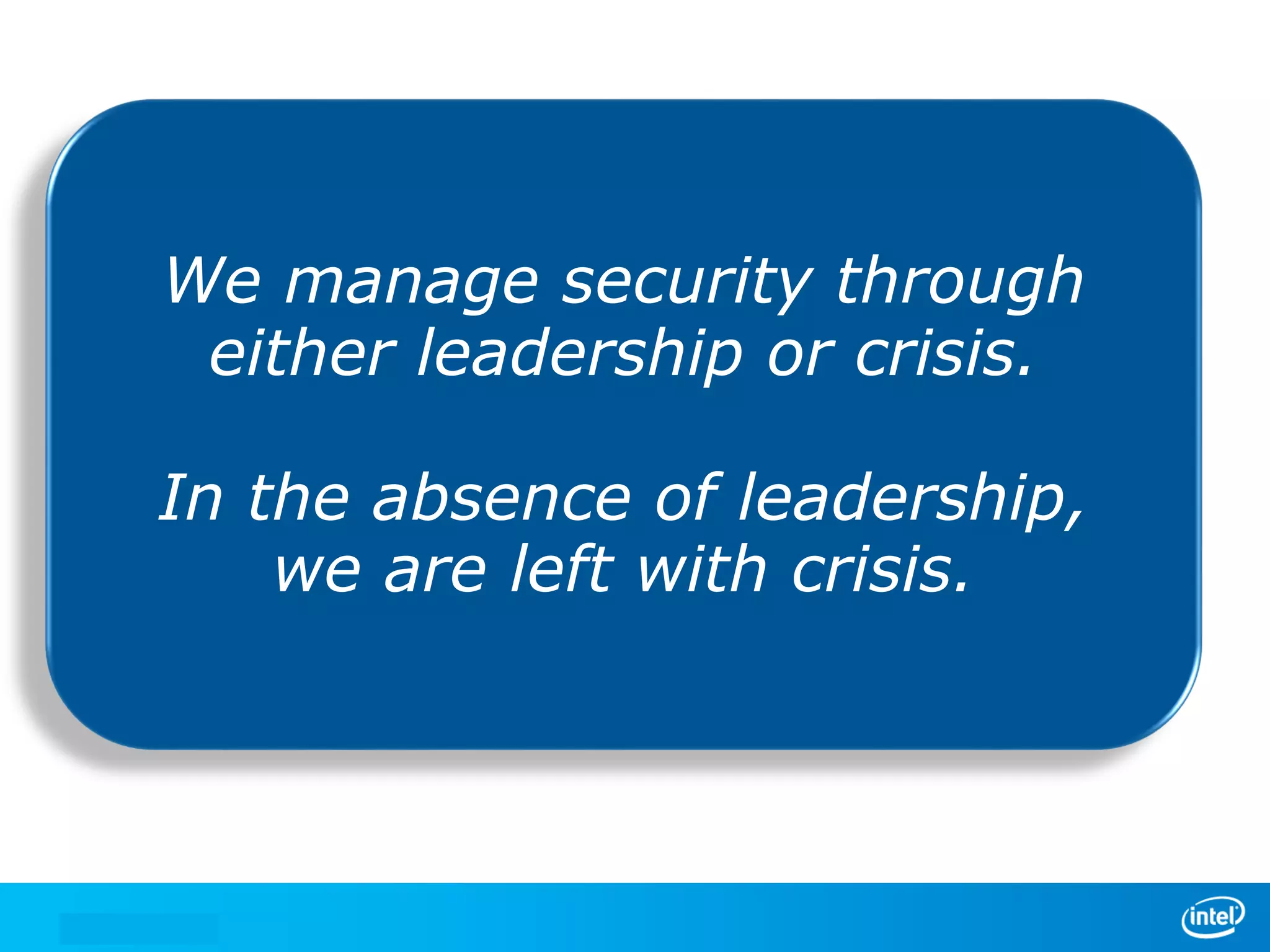
We manage securitythrough
We manage security through
either leadershipor crisis.
either leadership or crisis.
In the absence of leadership,
of leadership,
In the absence
we are left with crisis.
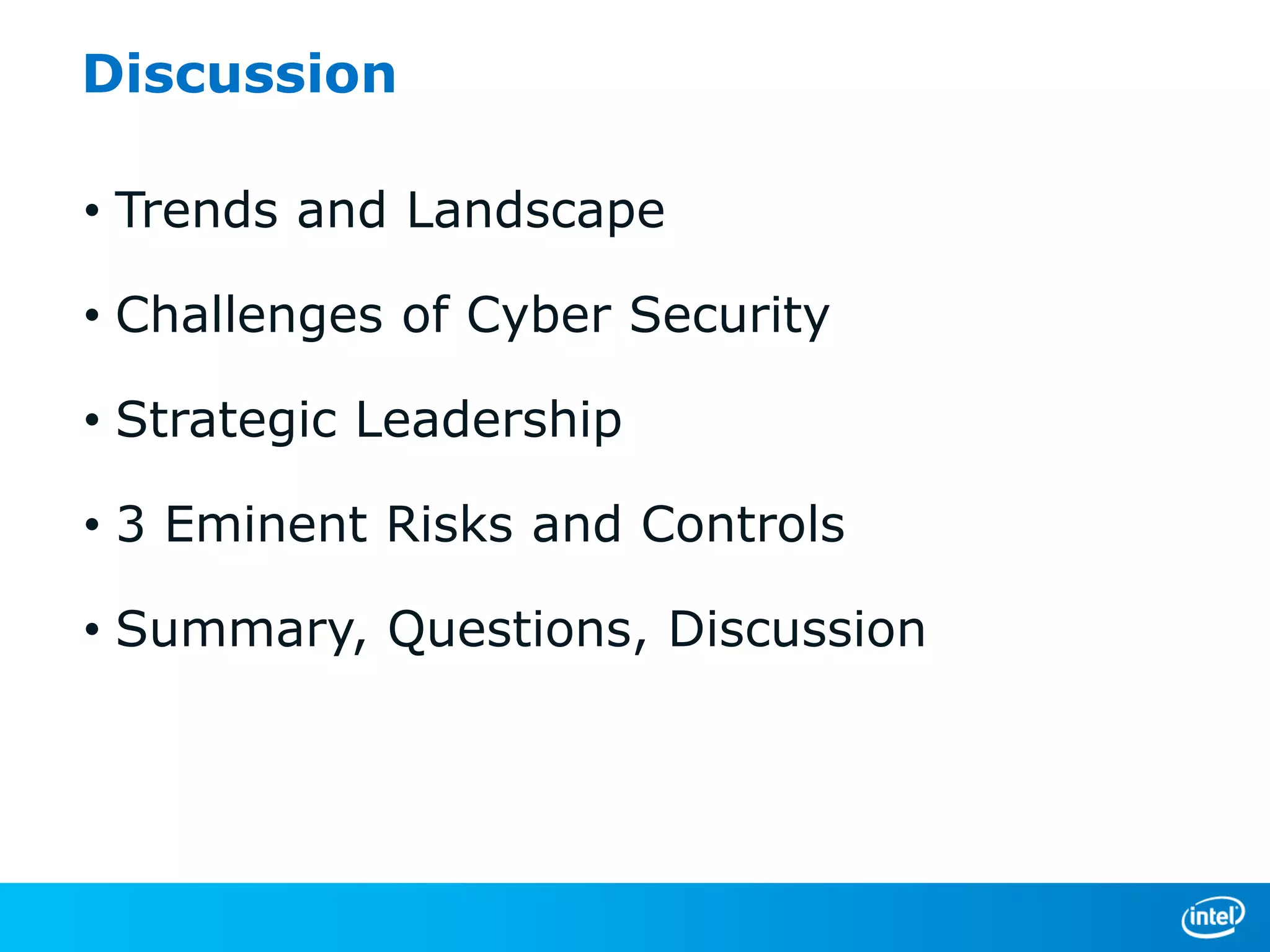
Discussion
• Trends and Landscape
• Challenges of Cyber Security

• Strategic Leadership
• 3 Eminent Risks and Controls
• Summary, Questions, Discussion
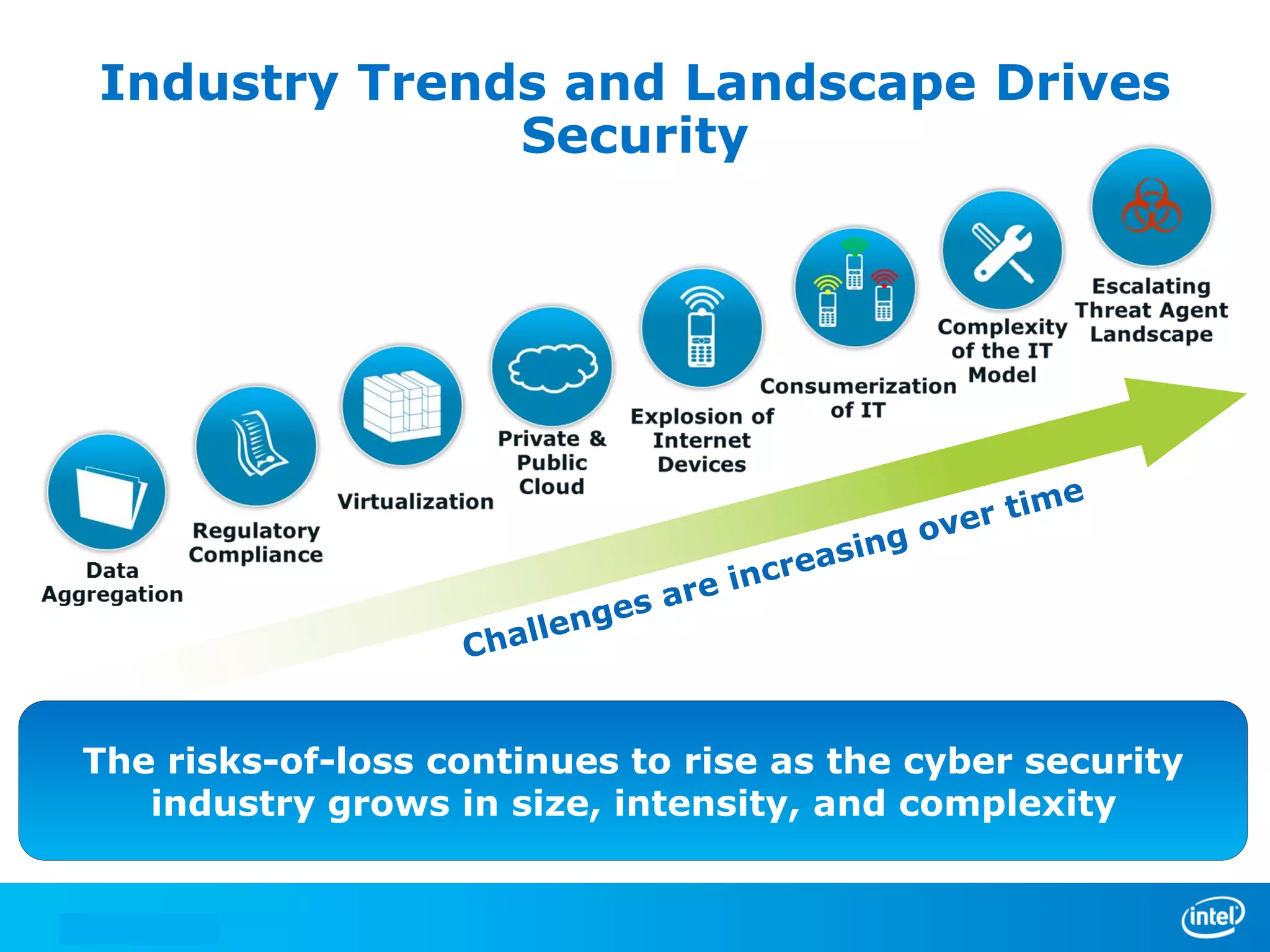
Industry Trends and Landscape Drives
Security

The risks-of-loss continues to rise as the cyber security
industry grows in size, intensity, and complexity
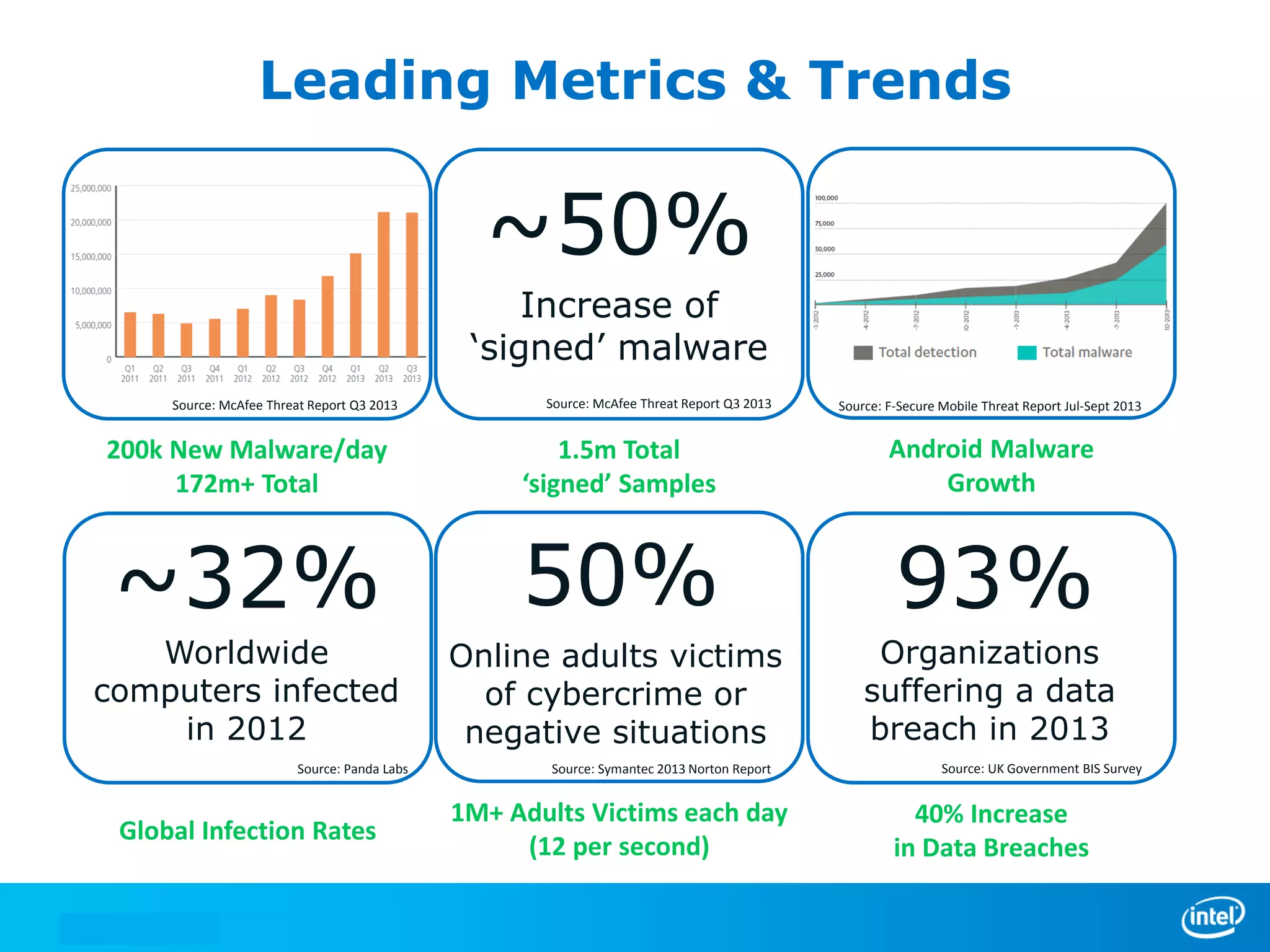
Leading Metrics & Trends

~50%
Increase of
‘signed’ malware
Source: McAfee Threat Report Q3 2013

Source: McAfee Threat Report Q3 2013

Source: F-Secure Mobile Threat Report Jul-Sept 2013

200k New Malware/day
172m+ Total

1.5m Total
‘signed’ Samples

Android Malware
Growth

~32%

50%

93%

Worldwide
computers infected
in 2012

Online adults victims
of cybercrime or
negative situations

Organizations
suffering a data
breach in 2013

Source: Panda Labs

Global Infection Rates

Source: Symantec 2013 Norton Report

1M+ Adults Victims each day
(12 per second)

Source: UK Government BIS Survey

40% Increase
in Data Breaches
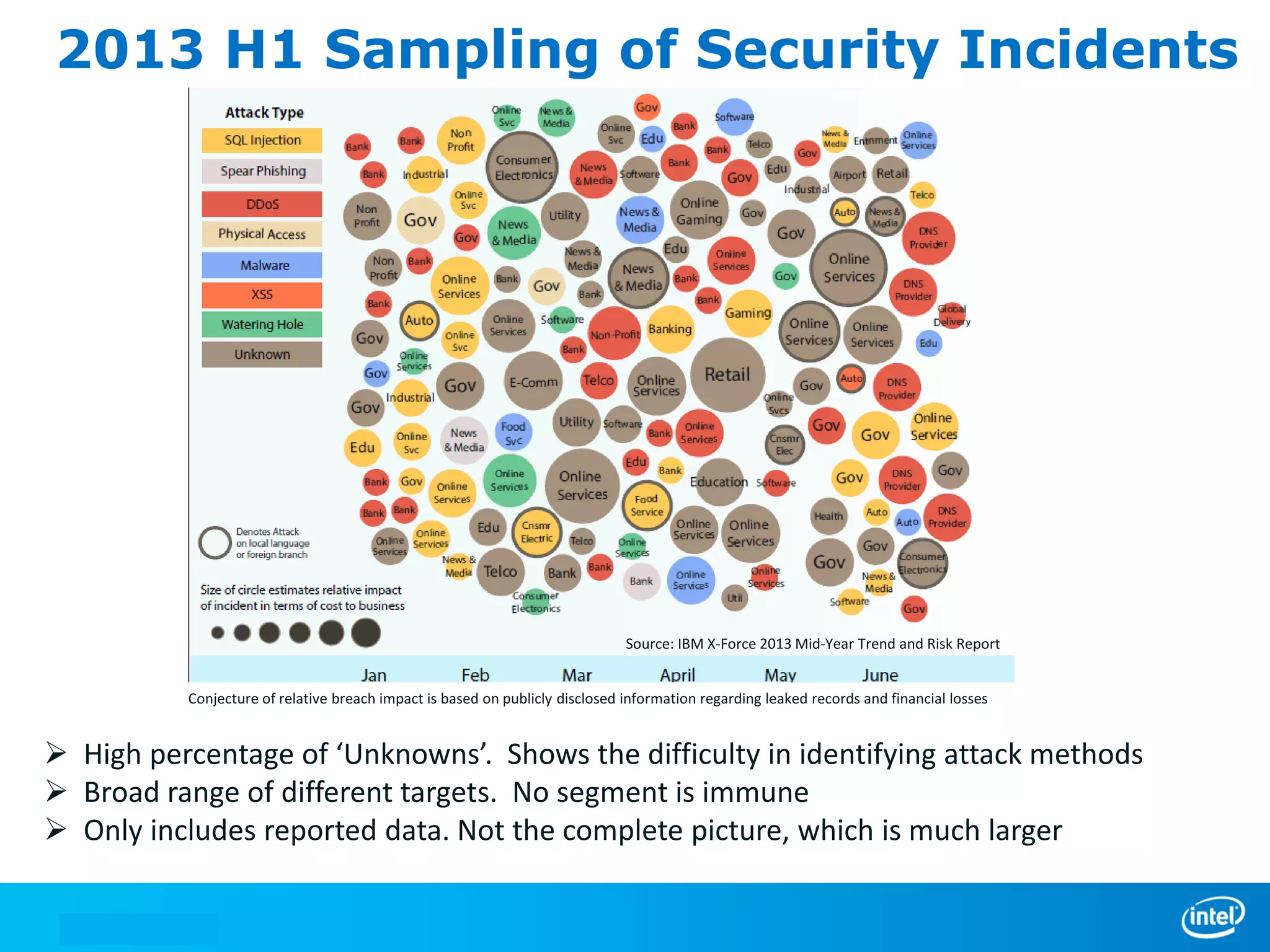
2013 H1 Sampling of Security Incidents

Source: IBM X-Force 2013 Mid-Year Trend and Risk Report
Conjecture of relative breach impact is based on publicly disclosed information regarding leaked records and financial losses

 High percentage of ‘Unknowns’. Shows the difficulty in identifying attack methods
 Broad range of different targets. No segment is immune
 Only includes reported data. Not the complete picture, which is much larger
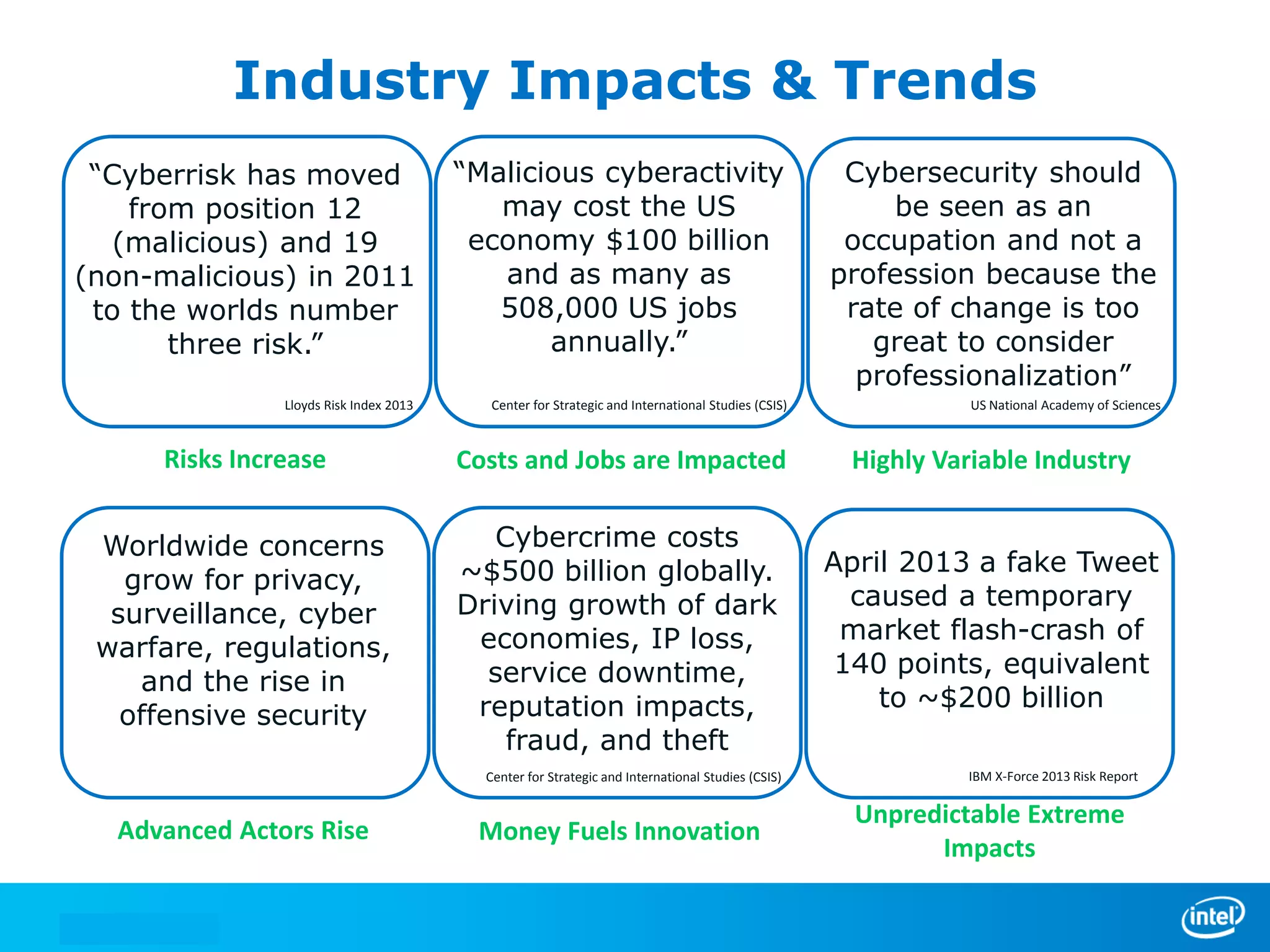
Industry Impacts & Trends
“Cyberrisk has moved
from position 12
(malicious) and 19
(non-malicious) in 2011
to the worlds number
three risk.”

“Malicious cyberactivity
may cost the US
economy $100 billion
and as many as
508,000 US jobs
annually.”

Cybersecurity should
be seen as an
occupation and not a
profession because the
rate of change is too
great to consider
professionalization”

Lloyds Risk Index 2013

Center for Strategic and International Studies (CSIS)

US National Academy of Sciences

Risks Increase

Costs and Jobs are Impacted

Highly Variable Industry

Worldwide concerns
grow for privacy,
surveillance, cyber
warfare, regulations,
and the rise in
offensive security

Cybercrime costs
~$500 billion globally.
Driving growth of dark
economies, IP loss,
service downtime,
reputation impacts,
fraud, and theft

April 2013 a fake Tweet
caused a temporary
market flash-crash of
140 points, equivalent
to ~$200 billion

Center for Strategic and International Studies (CSIS)

Advanced Actors Rise

Money Fuels Innovation

IBM X-Force 2013 Risk Report

Unpredictable Extreme
Impacts
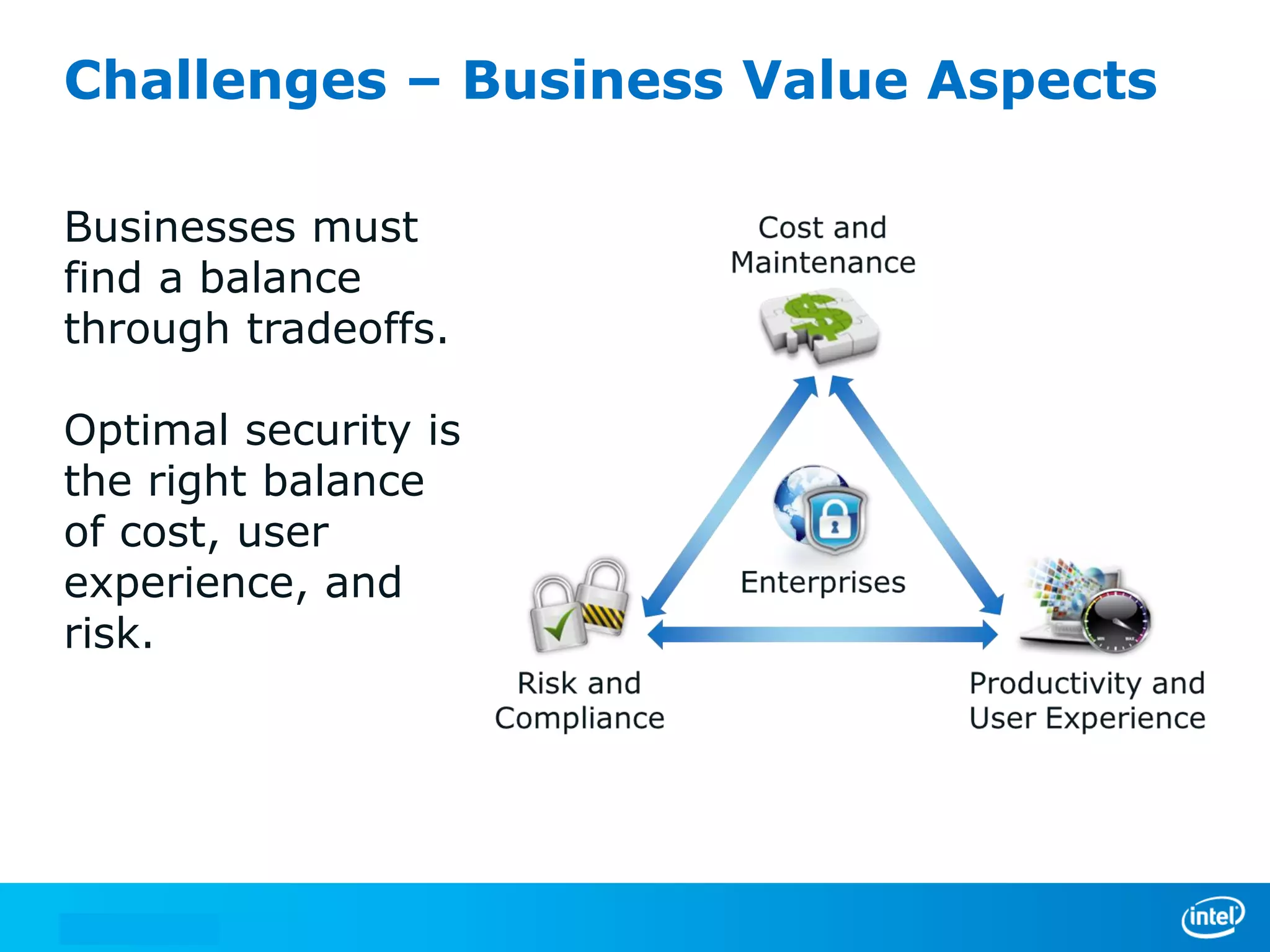
Challenges – Business Value Aspects
Businesses must
find a balance
through tradeoffs.
Optimal security is
the right balance
of cost, user
experience, and
risk.
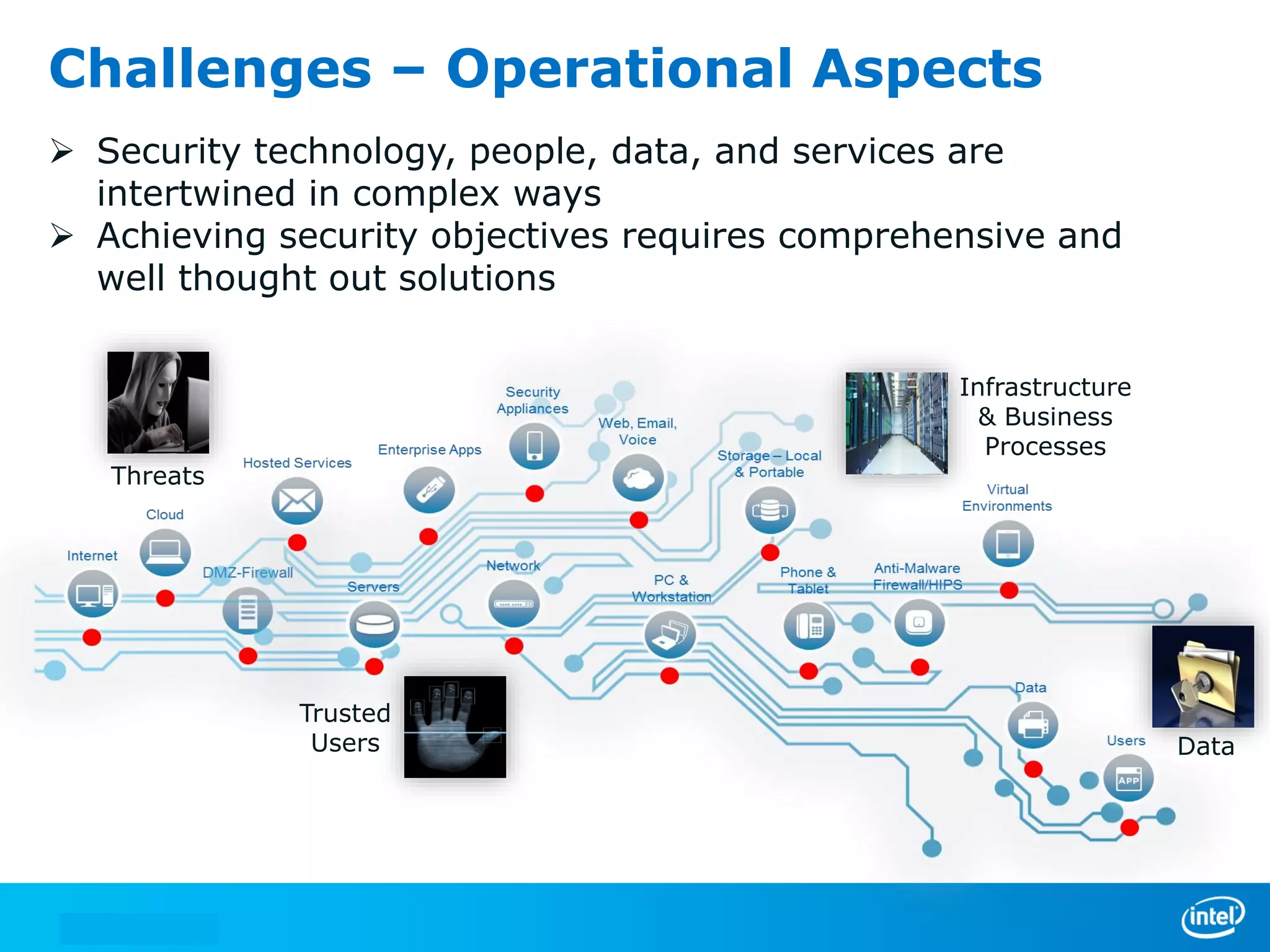
Challenges – Operational Aspects
 Security technology, people, data, and services are
intertwined in complex ways
 Achieving security objectives requires comprehensive and
well thought out solutions
Infrastructure
& Business
Processes

Threats

Trusted
Users

Data
We manage security through
Leadership is key in organizing
either leadership or crisis.
resources to achieve and
In the absence of leadership,
maintain an optimal level of
we are left with crisis.
security value
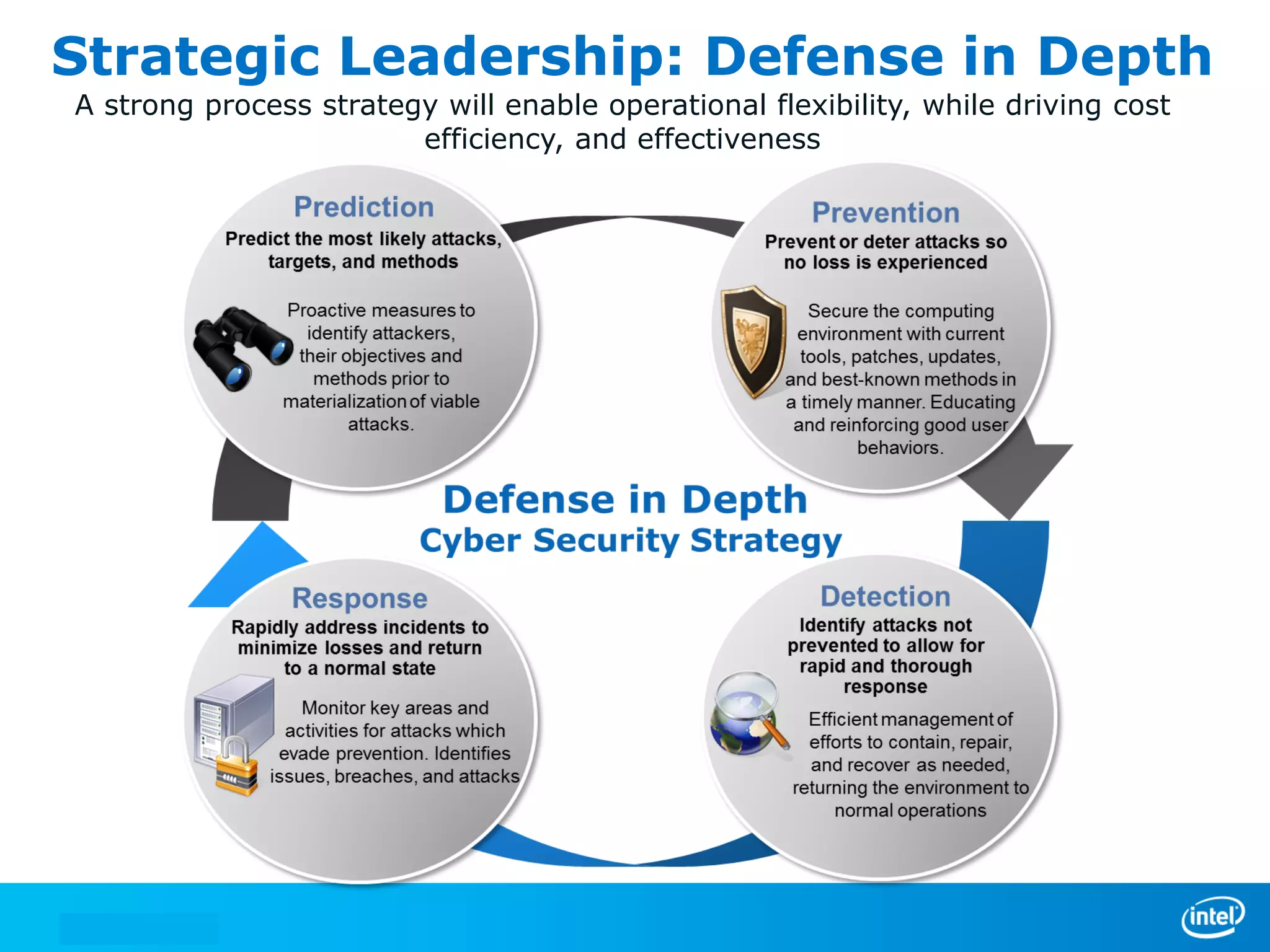
Strategic Leadership: Defense in Depth
A strong process strategy will enable operational flexibility, while driving cost
efficiency, and effectiveness
Tactical Security Technology
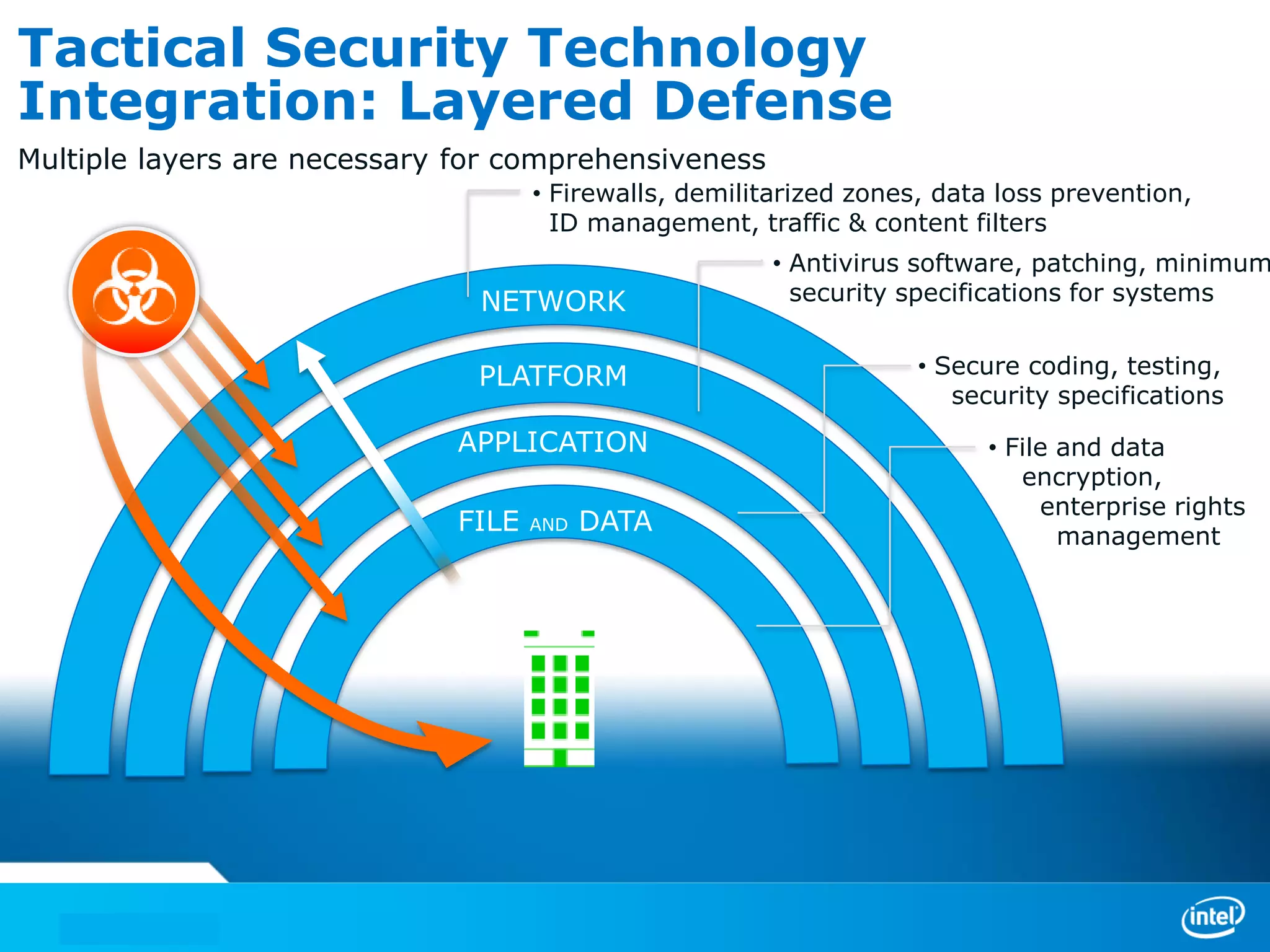
Integration: Layered Defense
Multiple layers are necessary for comprehensiveness
• Firewalls, demilitarized zones, data loss prevention,
ID management, traffic & content filters

NETWORK
PLATFORM
APPLICATION
FILE

AND

DATA

• Antivirus software, patching, minimum
security specifications for systems
• Secure coding, testing,
security specifications
• File and data
encryption,
enterprise rights
management
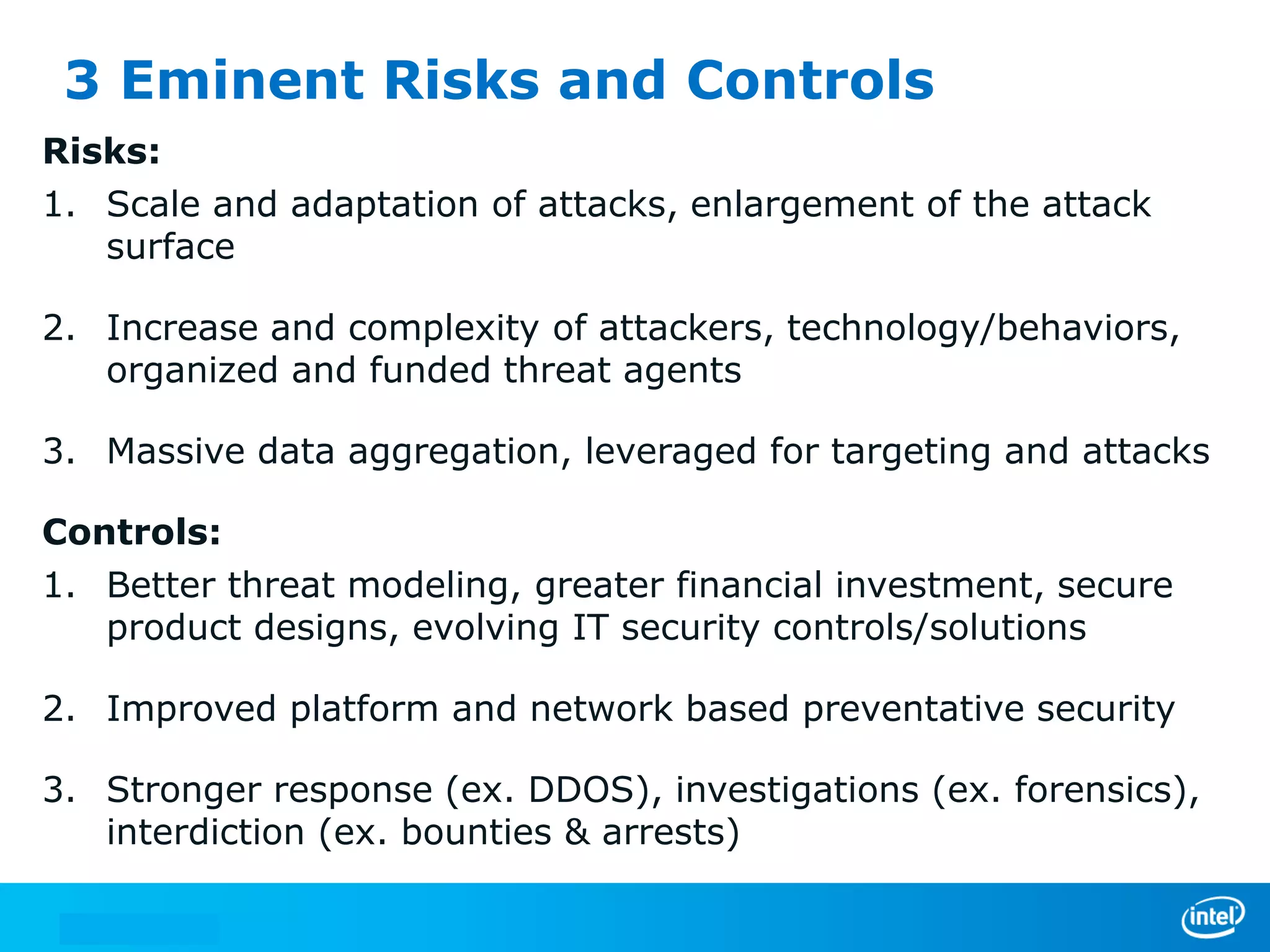
3 Eminent Risks and Controls
Risks:
1. Scale and adaptation of attacks, enlargement of the attack
surface
2. Increase and complexity of attackers, technology/behaviors,
organized and funded threat agents
3. Massive data aggregation, leveraged for targeting and attacks
Controls:
1. Better threat modeling, greater financial investment, secure
product designs, evolving IT security controls/solutions
2. Improved platform and network based preventative security
3. Stronger response (ex. DDOS), investigations (ex. forensics),
interdiction (ex. bounties & arrests)
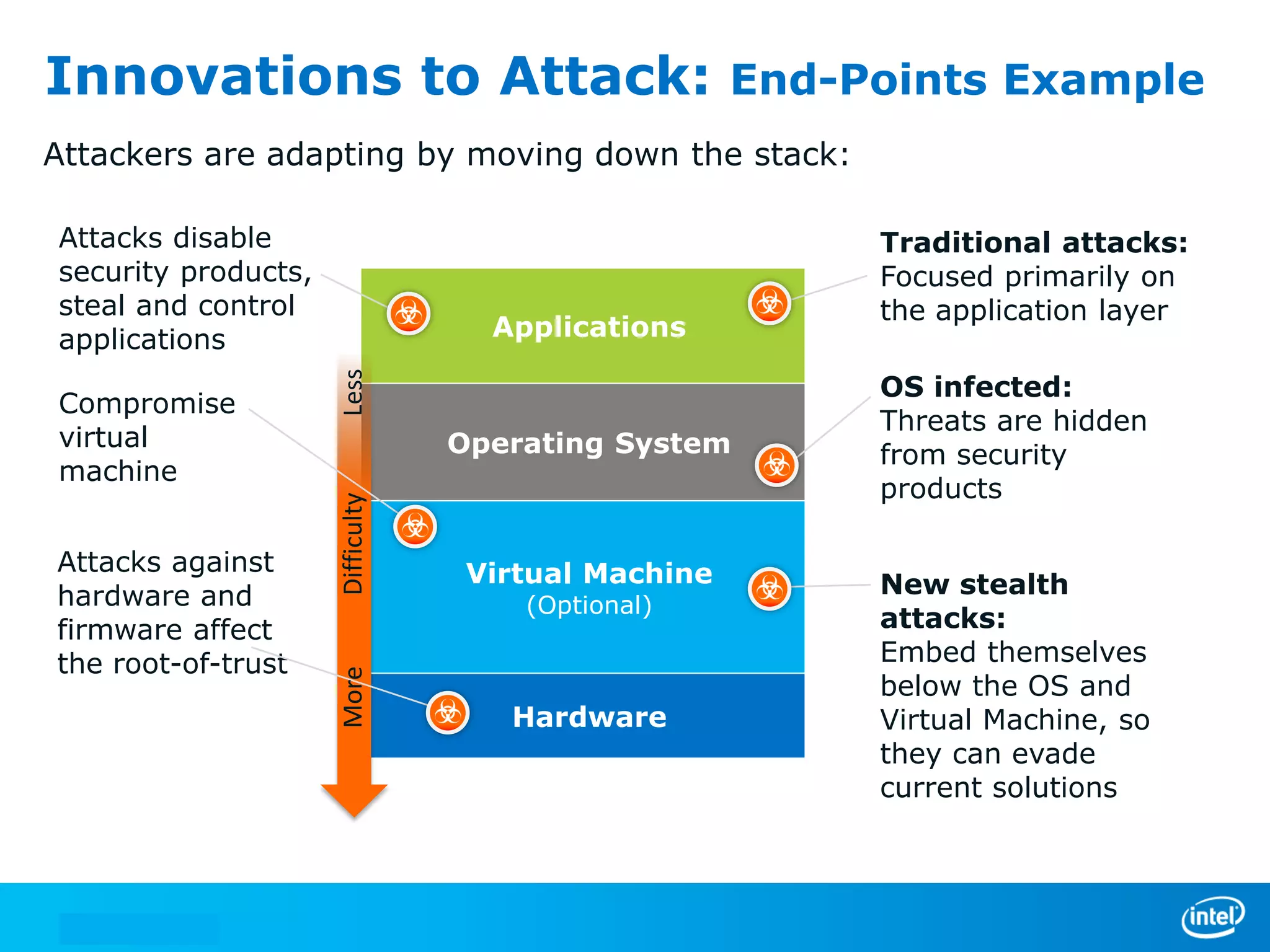
Innovations to Attack:

End-Points Example

Attackers are adapting by moving down the stack:
Attacks disable
security products,
steal and control
applications

Less
Difficulty

Attacks against
hardware and
firmware affect
the root-of-trust

Operating System

Virtual Machine

More

Compromise
virtual
machine

Applications

Hardware

(Optional)

Traditional attacks:
Focused primarily on
the application layer
OS infected:
Threats are hidden
from security
products
New stealth
attacks:
Embed themselves
below the OS and
Virtual Machine, so
they can evade
current solutions
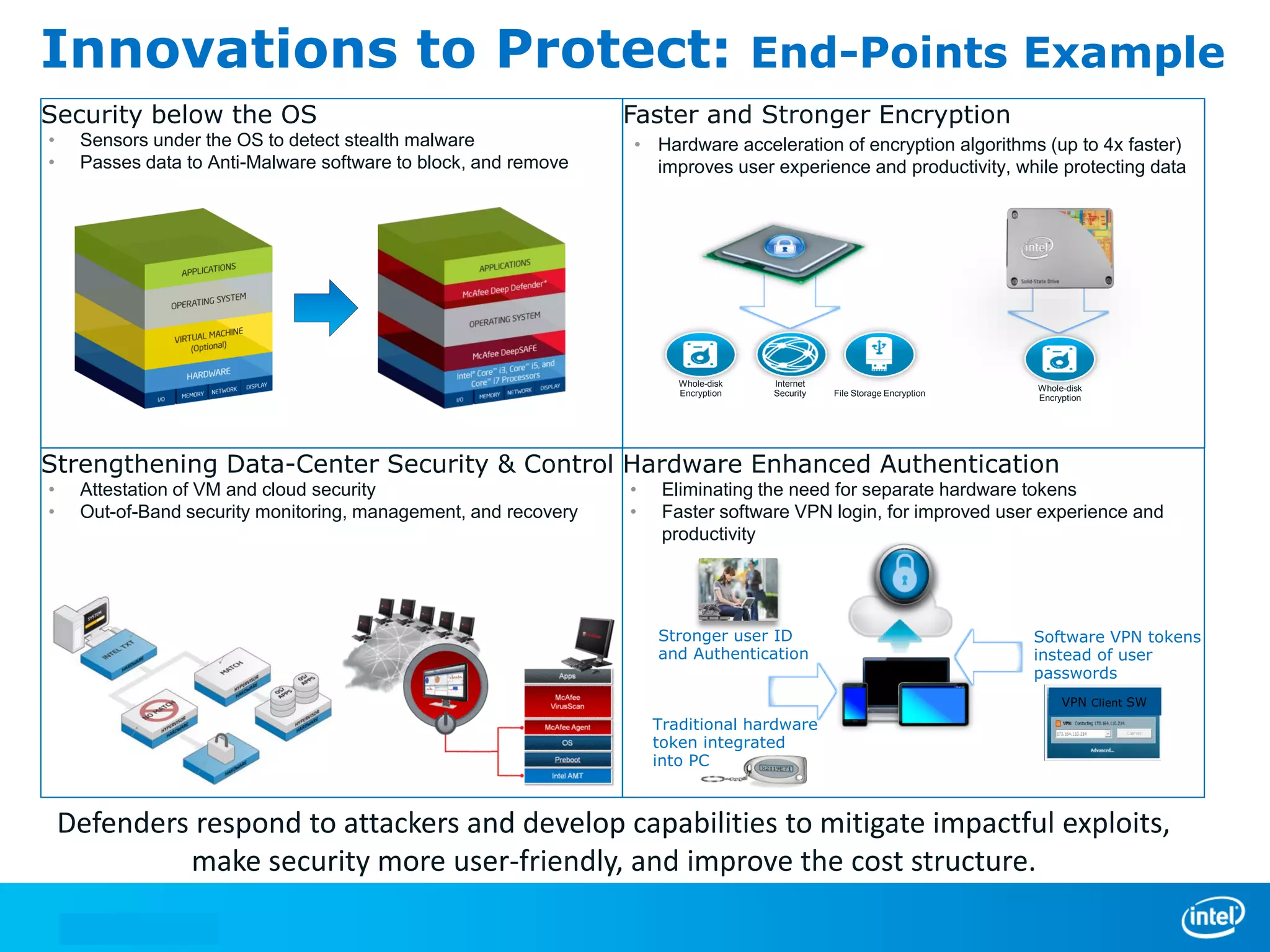
Innovations to Protect:
Security below the OS
•
•

Sensors under the OS to detect stealth malware
Passes data to Anti-Malware software to block, and remove

End-Points Example

Faster and Stronger Encryption
• Hardware acceleration of encryption algorithms (up to 4x faster)
improves user experience and productivity, while protecting data

Whole-disk
Encryption

Internet
Security

File Storage Encryption

Whole-disk
Encryption

Strengthening Data-Center Security & Control Hardware Enhanced Authentication
•
•

Attestation of VM and cloud security
Out-of-Band security monitoring, management, and recovery

•
•

Eliminating the need for separate hardware tokens
Faster software VPN login, for improved user experience and
productivity

Stronger user ID
and Authentication

Software VPN tokens
instead of user
passwords
VPN Client SW

Traditional hardware
token integrated
into PC

Defenders respond to attackers and develop capabilities to mitigate impactful exploits,
make security more user-friendly, and improve the cost structure.
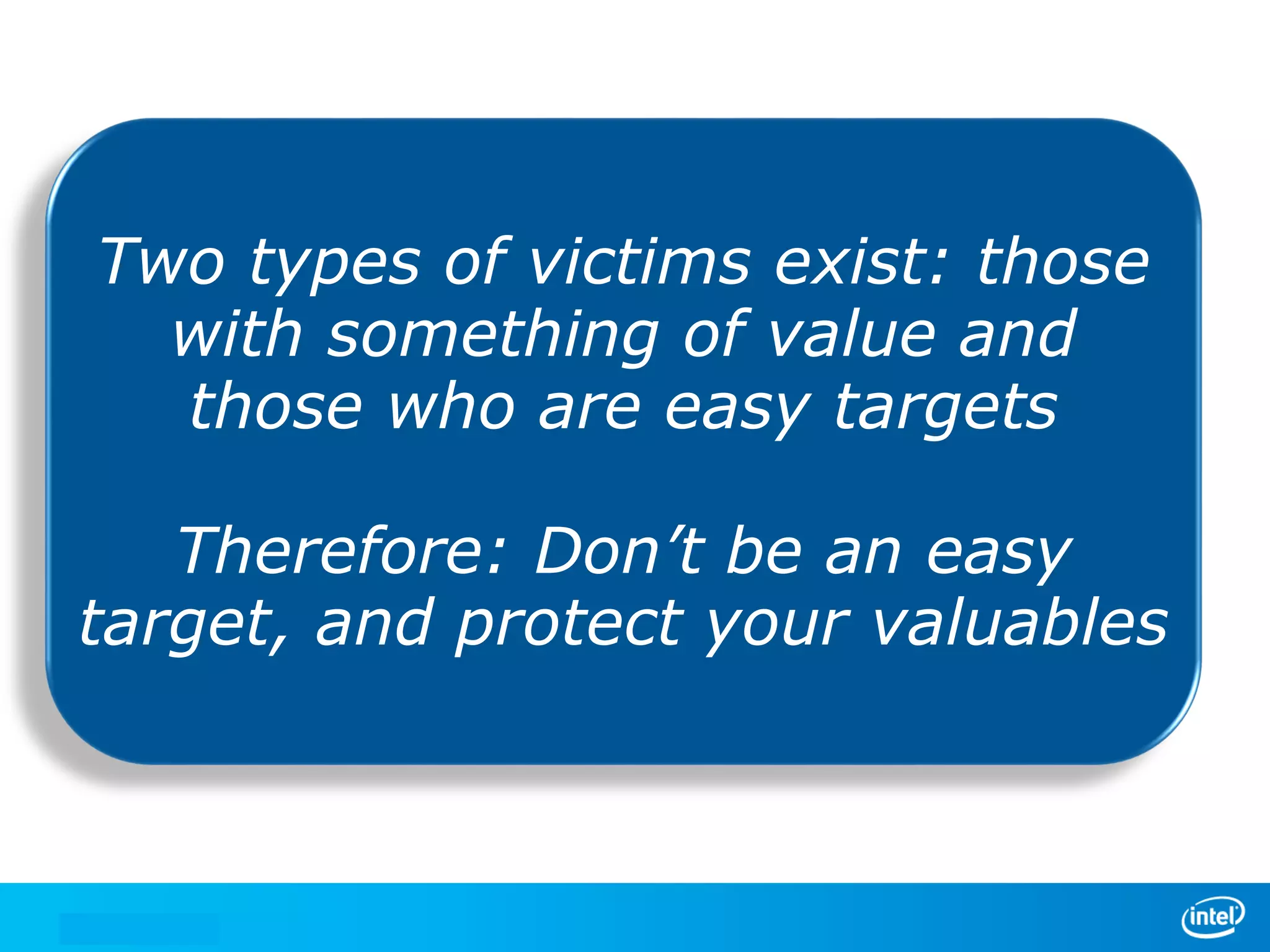
Two types of victims exist: those
We manage security through
with something of or crisis.
either leadershipvalue and
those who are easy targets
In the absence of leadership,
we are left with an easy
Therefore: Don’t be crisis.
target, and protect your valuables
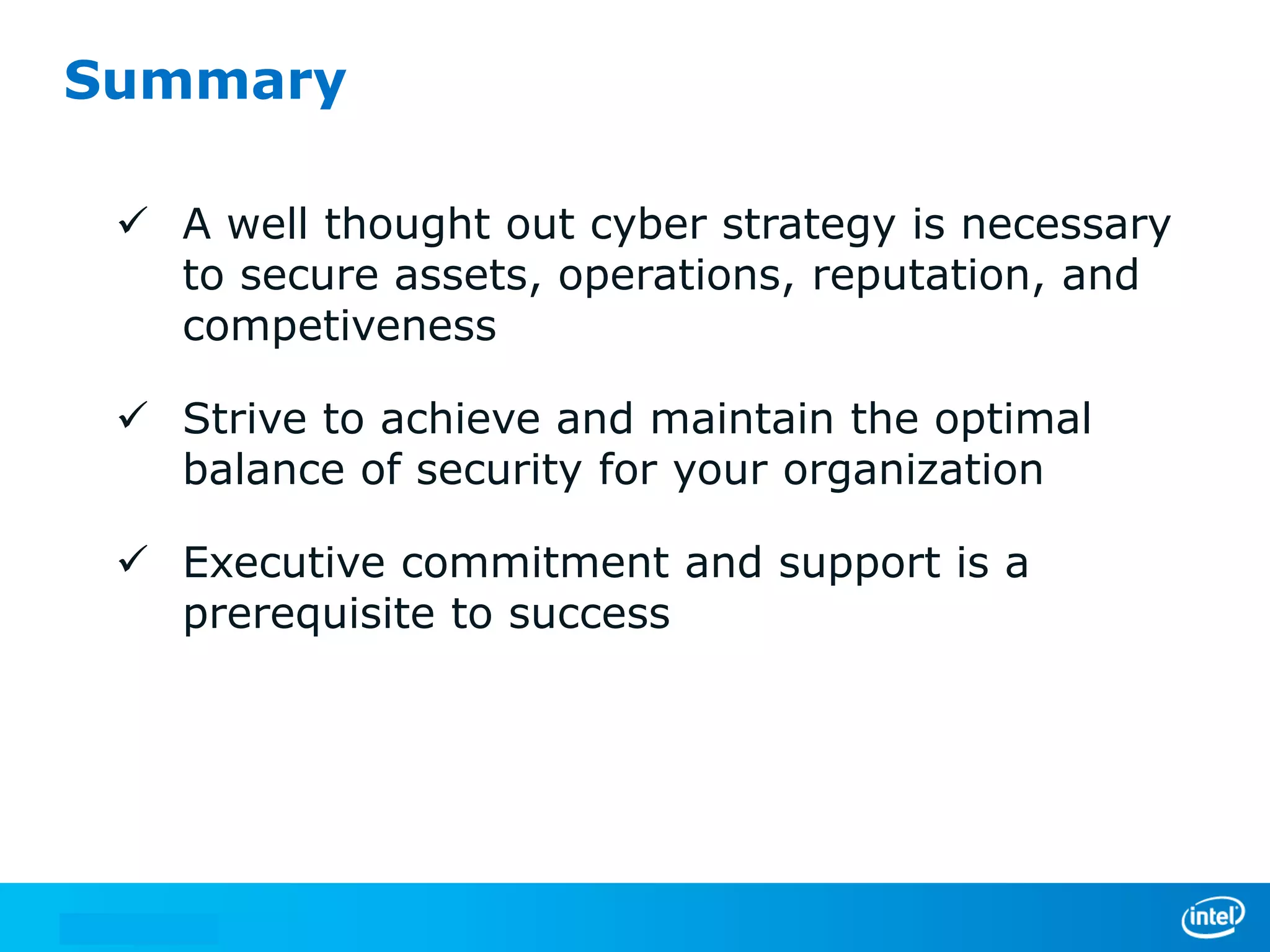
Summary
 A well thought out cyber strategy is necessary
to secure assets, operations, reputation, and
competiveness
 Strive to achieve and maintain the optimal
balance of security for your organization

 Executive commitment and support is a
prerequisite to success
Intel Cyber Security Briefing at the Cyberstrat14 Security Conference in Helsinki, Matthew Rosenquist Cyber Security Strategist 2014 public

Intel Cyber Security Briefing at the Cyberstrat14 Security Conference in Helsinki, Matthew Rosenquist Cyber Security Strategist 2014 public

  • 1.
    Intel® Cyber SecurityBriefing: Trends, Challenges, and Leadership Opportunities Matthew Rosenquist, Cyber Security Strategist, Intel Corp January 2014
  • 2.
    Legal Notices andDisclaimers INFORMATION IN THIS DOCUMENT IS PROVIDED IN CONNECTION WITH INTEL® PRODUCTS. NO LICENSE, EXPRESS OR IMPLIED, BY ESTOPPEL OR OTHERWISE, TO ANY INTELLECTUAL PROPERTY RIGHTS IS GRANTED BY THIS DOCUMENT. EXCEPT AS PROVIDED IN INTEL’S TERMS AND CONDITIONS OF SALE FOR SUCH PRODUCTS, INTEL ASSUMES NO LIABILITY WHATSOEVER, AND INTEL DISCLAIMS ANY EXPRESS OR IMPLIED WARRANTY, RELATING TO SALE AND/OR USE OF INTEL ® PRODUCTS INCLUDING LIABILITY OR WARRANTIES RELATING TO FITNESS FOR A PARTICULAR PURPOSE, MERCHANTABILITY, OR INFRINGEMENT OF ANY PATENT, COPYRIGHT OR OTHER INTELLECTUAL PROPERTY RIGHT. INTEL PRODUCTS ARE NOT INTENDED FOR USE IN MEDICAL, LIFE SAVING, OR LIFE SUSTAINING APPLICATIONS. Intel may make changes to specifications and product descriptions at any time, without notice. All products, dates, and figures specified are preliminary based on current expectations, and are subject to change without notice. Intel, processors, chipsets, and desktop boards may contain design defects or errors known as errata, which may cause the product to deviate from published specifications. Current characterized errata are available on request. Software and workloads used in performance tests may have been optimized for performance only on Intel microprocessors. Performance tests, such as SYSmark* and MobileMark*, are measured using specific computer systems, components, software, operations and functions. Any change to any of those factors may cause the results to vary. You should consult other information and performance tests to assist you in fully evaluating your contemplated purchases, including the performance of that product when combined with other products. For more information go to http://www.intel.com/performance Intel, Intel Inside, the Intel logo, Intel Core, and Xeon are trademarks of Intel Corporation in the United States and other countries. Security features enabled by Intel® AMT require an enabled chipset, network hardware and software and a corporate network connection. Intel AMT may not be available or certain capabilities may be limited over a host OS-based VPN or when connecting wirelessly, on battery power, sleeping, hibernating or powered off. Setup requires configuration and may require scripting with the management console or further integration into existing security frameworks, and modifications or implementation of new business processes. For more information, see http://www.intel.com/technology/manage/iamt. No system can provide absolute security under all conditions. Requires an enabled chipset, BIOS, firmware and software and a subscription with a capable Service Provider. Consult your system manufacturer and Service Provider for availability and functionality. Intel assumes no liability for lost or stolen data and/or systems or any other damages resulting thereof. For more information, visit http://www.intel.com/go/anti-theft Intel® vPro™ Technology is sophisticated and requires setup and activation. Availability of features and results will depend upon the setup and configuration of your hardware, software and IT environment. To learn more visit: http://www.intel.com/technology/vpro The original equipment manufacturer must provide TPM functionality, which requires a TPM-supported BIOS. TPM functionality must be initialized and may not be available in all countries. Intel® AES-NI requires a computer system with an AES-NI enabled processor, as well as non-Intel software to execute the instructions in the correct sequence. AES-NI is available on select Intel® processors. For availability, consult your reseller or system manufacturer. For more information, see http://software.intel.com/en-us/articles/intel-advanced-encryption-standard-instructions-aes-ni/ *Other names and brands may be claimed as the property of others. Copyright © 2011 Intel Corporation, All Rights Reserved
  • 3.
    We manage securitythrough Wemanage security through either leadershipor crisis. either leadership or crisis. In the absence of leadership, of leadership, In the absence we are left with crisis. we are left with crisis.
  • 4.
    Discussion • Trends andLandscape • Challenges of Cyber Security • Strategic Leadership • 3 Eminent Risks and Controls • Summary, Questions, Discussion
  • 5.
    Industry Trends andLandscape Drives Security The risks-of-loss continues to rise as the cyber security industry grows in size, intensity, and complexity
  • 6.
    Leading Metrics &Trends ~50% Increase of ‘signed’ malware Source: McAfee Threat Report Q3 2013 Source: McAfee Threat Report Q3 2013 Source: F-Secure Mobile Threat Report Jul-Sept 2013 200k New Malware/day 172m+ Total 1.5m Total ‘signed’ Samples Android Malware Growth ~32% 50% 93% Worldwide computers infected in 2012 Online adults victims of cybercrime or negative situations Organizations suffering a data breach in 2013 Source: Panda Labs Global Infection Rates Source: Symantec 2013 Norton Report 1M+ Adults Victims each day (12 per second) Source: UK Government BIS Survey 40% Increase in Data Breaches
  • 7.
    2013 H1 Samplingof Security Incidents Source: IBM X-Force 2013 Mid-Year Trend and Risk Report Conjecture of relative breach impact is based on publicly disclosed information regarding leaked records and financial losses  High percentage of ‘Unknowns’. Shows the difficulty in identifying attack methods  Broad range of different targets. No segment is immune  Only includes reported data. Not the complete picture, which is much larger
  • 8.
    Industry Impacts &Trends “Cyberrisk has moved from position 12 (malicious) and 19 (non-malicious) in 2011 to the worlds number three risk.” “Malicious cyberactivity may cost the US economy $100 billion and as many as 508,000 US jobs annually.” Cybersecurity should be seen as an occupation and not a profession because the rate of change is too great to consider professionalization” Lloyds Risk Index 2013 Center for Strategic and International Studies (CSIS) US National Academy of Sciences Risks Increase Costs and Jobs are Impacted Highly Variable Industry Worldwide concerns grow for privacy, surveillance, cyber warfare, regulations, and the rise in offensive security Cybercrime costs ~$500 billion globally. Driving growth of dark economies, IP loss, service downtime, reputation impacts, fraud, and theft April 2013 a fake Tweet caused a temporary market flash-crash of 140 points, equivalent to ~$200 billion Center for Strategic and International Studies (CSIS) Advanced Actors Rise Money Fuels Innovation IBM X-Force 2013 Risk Report Unpredictable Extreme Impacts
  • 9.
    Challenges – BusinessValue Aspects Businesses must find a balance through tradeoffs. Optimal security is the right balance of cost, user experience, and risk.
  • 10.
    Challenges – OperationalAspects  Security technology, people, data, and services are intertwined in complex ways  Achieving security objectives requires comprehensive and well thought out solutions Infrastructure & Business Processes Threats Trusted Users Data
  • 11.
    We manage securitythrough Leadership is key in organizing either leadership or crisis. resources to achieve and In the absence of leadership, maintain an optimal level of we are left with crisis. security value
  • 12.
    Strategic Leadership: Defensein Depth A strong process strategy will enable operational flexibility, while driving cost efficiency, and effectiveness
  • 13.
    Tactical Security Technology Integration:Layered Defense Multiple layers are necessary for comprehensiveness • Firewalls, demilitarized zones, data loss prevention, ID management, traffic & content filters NETWORK PLATFORM APPLICATION FILE AND DATA • Antivirus software, patching, minimum security specifications for systems • Secure coding, testing, security specifications • File and data encryption, enterprise rights management
  • 14.
    3 Eminent Risksand Controls Risks: 1. Scale and adaptation of attacks, enlargement of the attack surface 2. Increase and complexity of attackers, technology/behaviors, organized and funded threat agents 3. Massive data aggregation, leveraged for targeting and attacks Controls: 1. Better threat modeling, greater financial investment, secure product designs, evolving IT security controls/solutions 2. Improved platform and network based preventative security 3. Stronger response (ex. DDOS), investigations (ex. forensics), interdiction (ex. bounties & arrests)
  • 15.
    Innovations to Attack: End-PointsExample Attackers are adapting by moving down the stack: Attacks disable security products, steal and control applications Less Difficulty Attacks against hardware and firmware affect the root-of-trust Operating System Virtual Machine More Compromise virtual machine Applications Hardware (Optional) Traditional attacks: Focused primarily on the application layer OS infected: Threats are hidden from security products New stealth attacks: Embed themselves below the OS and Virtual Machine, so they can evade current solutions
  • 16.
    Innovations to Protect: Securitybelow the OS • • Sensors under the OS to detect stealth malware Passes data to Anti-Malware software to block, and remove End-Points Example Faster and Stronger Encryption • Hardware acceleration of encryption algorithms (up to 4x faster) improves user experience and productivity, while protecting data Whole-disk Encryption Internet Security File Storage Encryption Whole-disk Encryption Strengthening Data-Center Security & Control Hardware Enhanced Authentication • • Attestation of VM and cloud security Out-of-Band security monitoring, management, and recovery • • Eliminating the need for separate hardware tokens Faster software VPN login, for improved user experience and productivity Stronger user ID and Authentication Software VPN tokens instead of user passwords VPN Client SW Traditional hardware token integrated into PC Defenders respond to attackers and develop capabilities to mitigate impactful exploits, make security more user-friendly, and improve the cost structure.
  • 17.
    Two types ofvictims exist: those We manage security through with something of or crisis. either leadershipvalue and those who are easy targets In the absence of leadership, we are left with an easy Therefore: Don’t be crisis. target, and protect your valuables
  • 18.
    Summary  A wellthought out cyber strategy is necessary to secure assets, operations, reputation, and competiveness  Strive to achieve and maintain the optimal balance of security for your organization  Executive commitment and support is a prerequisite to success