This presentation discusses cyber security and cyber crimes. It defines cyber security as the technologies and processes used to protect computers, networks, and data from unauthorized access and attacks. It explains the need for security to protect organizations' ability to function safely and protect collected data. Cyber crimes are described as any crimes involving computers and networks, and include computer viruses, denial of service attacks, malware, fraud, and identity theft. The presentation provides an overview of cyber threat evolution over time and the top countries where malicious code originates. It concludes with recommendations for cyber security measures that can be implemented on a campus network, such as virus filtering, firewalls, and using free anti-virus, encryption, and change management software.
An overview of the presentation focused on Cyber Security.
Defines cyber security, outlines its need, features, and dives into cyber crime, its characteristics, and major types including viruses and identity theft.
Presents a timeline of significant cyber crimes and incidents from 1977 to 2008, indicating the evolution of threats.
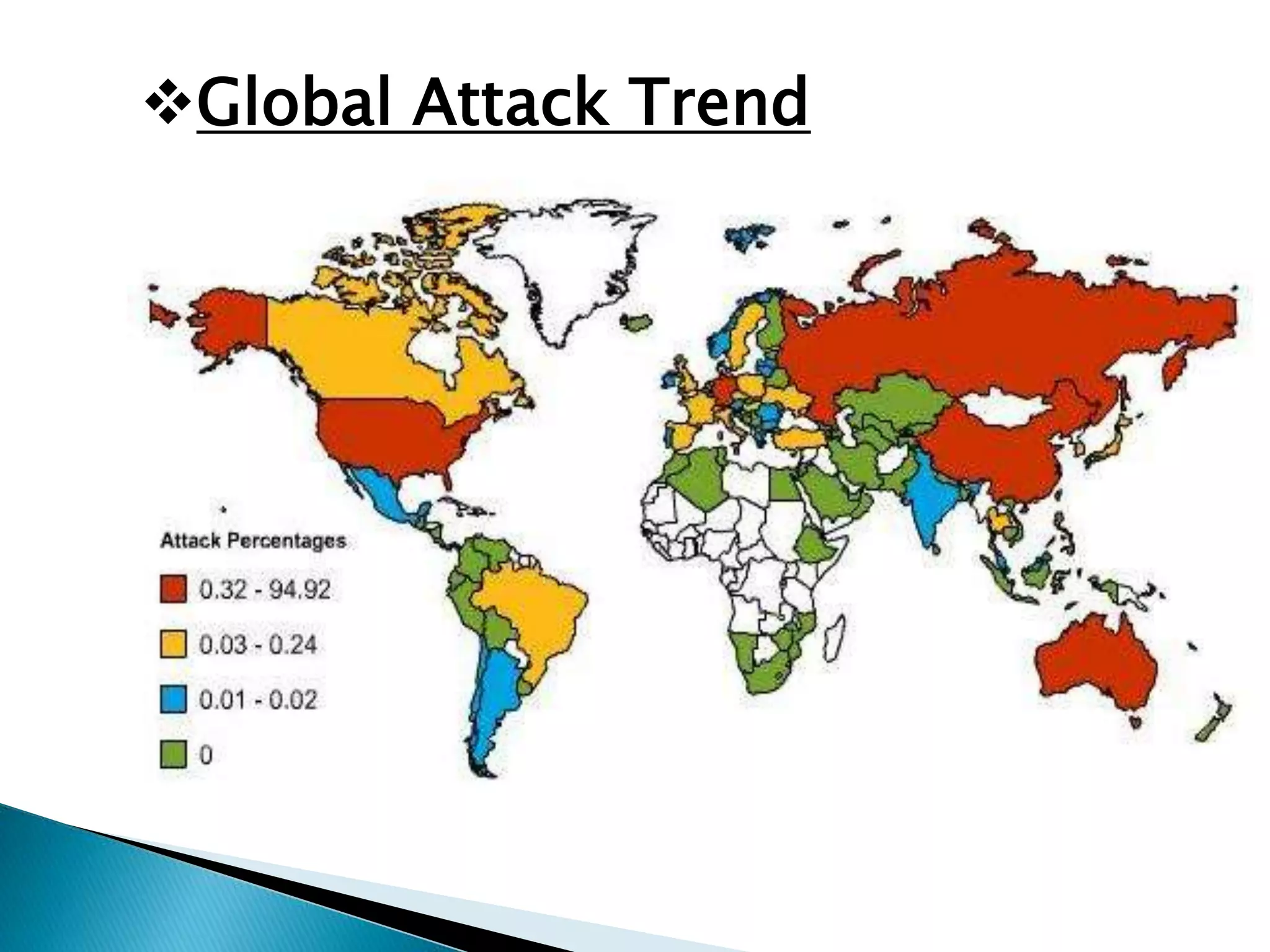
Discusses global attack trends, top countries for malicious code, and essential security measures like encryption and password management.
Outlines essential services and free software for enhancing campus network cyber security, including virus filtering and anti-virus software.
Concludes the presentation with gratitude and an invitation for questions or suggestions.
What is cybersecurity?
The need for security.
Features of cyber security.
What is cyber crime?
Characteristics of cyber crime.
What cyber crime includes?
Cyber threat evolution.
Global Attack trend.
Top originating countries-Malicious code.
Cyber security measures.
Campus cyber security measures.
3.
What is CyberSecurity?
Cyber-safety is a common term used to describe
a set of practices, measures and/or actions you
can take to protect personal information and
your computer from attacks.
Cyber security refers to the technologies and
processes designed to protect computers,
networks and data from unauthorized access,
vulnerabilities and attacks delivered via the
Internet by cyber criminals.
4.
The need forsecurity
Industrial Need for Information Security:-
An organization needs information security for four important
reasons:
To protect the organization’s ability to function.
To enable the safe operation of applications
implemented on the organization’s IT systems.
To protect the data that the organization collects
and uses.
To safeguard the technology assets in use at the
organization.
5.
Features of CyberSecurity:-
Comprehensive protection against viruses, spyware,
and other malware.
Bidirectional firewall with intrusion detection and
network integrity safeguard.
System Guard to protect critical system files and
registry.
Web Control to block inappropriate web-sites.
Protection against unauthorized termination
of security functions.
6.
What is Cybercrime?
Cyber crime,refers to any crime that
involves a computer and a network.
The computer may have been used in
the commission of a crime, or it may
be the target.
7.
Characteristics of Cybercrime
oSilent in nature.
oGlobal in character.
oNon existance of physical evidence.
oCreates high impact.
oHigh potential and easy to perpetrate.
8.
What Cyber crimeincludes?
Cyber crime includes the cateories:-
1.Computer viruses
2.Denial of service attacks
3.Malware(malicious code)
4.Frauds
5.Identity theft
9.
Computer virus:-
A computervirus is a type of malware that, when executed,replicates by
inserting copies of itself (possibly modified) into other computer
programs, data files, or the boot sector of the hard drive; when this
replication succeeds, the affected areas are then said to be "infected".
Denial of service attacks:-
In computing, a denial-of-service (DoS) or distributed denial-of-service
(DDoS) attack is an attempt to make a machine or network resource
unavailable to its intended users.
Malware(malicious code):-
Malware, short for malicious software, is software used to disrupt
computer operation, gather sensitive information, or gain access to
private computer systems.
10.
Frauds:-
Fraud is theuse of information technology to commit crime.
Identity theft:-
Identity theft is a form of stealing someone's identity in which someone
pretends to be someone else by assuming that person's identity, usually
as a method to gain access to resources or obtain credit and other
benefits in that person's name.
Cyber Security Measures:-
Usingintrusion and alert programs:-
They need to be operated constantly so that all unusual behavior on
network is caught immediately.
Using encryption:-
Encryption is able to transform data into a form that makes almost
impossible to read it without the right key. The key is used to allow
controlled access to the information to selected people.
Passwords:-
Passwords should be changed with regular intervals of time and it
should be alpha-numeric, so that it should be difficult to judge.
Using network scanning programs:-
We should install harmful programs detecting softwares in our system
to get all information about the trojan and malicious code in the network.
15.
Campus cyber securitybasics
Services
Campus email virus filtering
Campus firewall services
Email attachment filtering
Vulnerability scanning
Intrusion prevention system
Software
Free anti-virus software:
Sophos Anti-virus
Free encryption software:
Pointsec for PC
Free change
management software:
Tripwire
Here are some services and software to protect the
campus network against cyber-safety attacks. These
include: