
Independent Study On
CYBER SECURITY
Under guidance of: By: Anand Katera
Dr.SB Kulkarni 8th Sem-SDMCET
Contents
UNIT1: Cyber Security Fundamentals
1.1 Introduction to cyber security
1.2 Basic Cryptography
1.3 Symmetric Encryption
1.4 Public Key Encryption
1.5 The Domain Name System (DNS)
1.6 Firewalls
1.7 Virtualization
1.8 Radio-Frequency Identification
What is cyber security?
 Cyber security refers to the technologies and processes
designed to protect computers, networks and data from
unauthorized access, vulnerabilities and attacks delivered
via the Internet by cyber criminals.
ADVANTAGES OF CYBER SECURITY
 The cyber security will defend us from critical
attacks.
 It helps us to browse the various websites securely.
 Internet Security process all the incoming and
outgoing data on your computer.
 It will defend us from hacks and virus.
 Application of cyber security used in our PC needs to
update regularly.
Cyber crimes includes
 Illegal access
 Illegal Interception
 System Interference
 Data Interference
 Misuse of devices
 Fraud
Basic Cryptography
Definition: Cryptography is a method of storing
and transmitting data in a particular form so that
only those for whom it is intended can read and
process it.
Symmetric Encryption
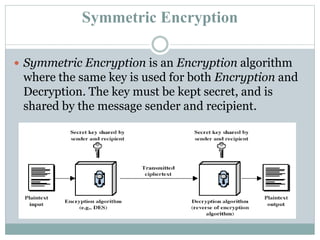
 Symmetric Encryption is an Encryption algorithm
where the same key is used for both Encryption and
Decryption. The key must be kept secret, and is
shared by the message sender and recipient.
Public Key Encryption
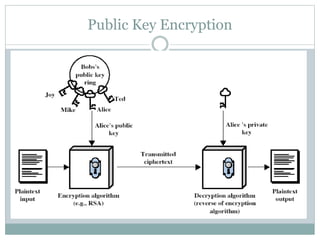
 A Public Key Encryption system that uses two keys --
a public key known to everyone and a private or
secret key known only to the recipient of the
message.
Example:
 When Bob’s wants to send a secure message to Alice,
he uses Alice's public key to encrypt the message.
Alice then uses his private key to decrypt it.
Public Key Encryption
Domain Name System (DNS)
 The DNS translates Internet domain and host
names to IP addresses. DNS automatically converts
the names we type in our Web browser address bar
to the IP addresses of Web servers hosting those
sites.
 DNS implements a distributed database to store this
name and address information for all public hosts on
the Internet.
Firewall
 A firewall is a set of related programs, located at a
network gateway server, that protects the resources
of a private network from users from other networks.
 imposes restrictions on network services
 only authorized traffic is allowed
 auditing and controlling access
 can implement alarms for abnormal behavior
Virtualization
 Virtualization is nothing but creating a virtual
environment for any program to run on an existing
platform as a guest, without interfering or
interrupting with the host platform’s services or
programs. The virtual environment running might be
an Operating System, Storage devices,etc.
Example:
 Application virtualization is software technology
that encapsulates application software from the
underlying operating system on which it is executed.
What is RFID?
 Radio-frequency identification (RFID) is the wireless
use of electromagnetic fields to transfer data, for
the purposes of automatically identifying and
tracking tags attached to objects. The tags contain
electronically stored information.
 A technology that employs a microchip with an
antenna that broadcasts its unique identifier and
location to receivers.
RFID Tags
Contains two main parts:
 Silicon chips
 Antennas
Components enable tags to receive and respond to radio
frequencies queries from RFID transceivers.
Three types by power:
 Passive
 Semi-Passive
 Active
Passive
 Have no internal power supply
 Very Small, Limited Range, Unlimited Life
Semi Passive(Battery-assisted passive)
 Similar to passive tags, with the addition of a small battery
 Battery powers the integrated circuit
 Bigger, Longer Range, Limited Life
Active
 Have their own internal power source
 Many operate at fixed intervals
 Also called beacons (broadcast own signal)
 Much larger memories, Longer range
THANK YOU

Presentation on Cyber Security

  • 1.
    Independent Study On CYBERSECURITY Under guidance of: By: Anand Katera Dr.SB Kulkarni 8th Sem-SDMCET
  • 2.
    Contents UNIT1: Cyber SecurityFundamentals 1.1 Introduction to cyber security 1.2 Basic Cryptography 1.3 Symmetric Encryption 1.4 Public Key Encryption 1.5 The Domain Name System (DNS) 1.6 Firewalls 1.7 Virtualization 1.8 Radio-Frequency Identification
  • 3.
    What is cybersecurity?  Cyber security refers to the technologies and processes designed to protect computers, networks and data from unauthorized access, vulnerabilities and attacks delivered via the Internet by cyber criminals.
  • 4.
    ADVANTAGES OF CYBERSECURITY  The cyber security will defend us from critical attacks.  It helps us to browse the various websites securely.  Internet Security process all the incoming and outgoing data on your computer.  It will defend us from hacks and virus.  Application of cyber security used in our PC needs to update regularly.
  • 5.
    Cyber crimes includes Illegal access  Illegal Interception  System Interference  Data Interference  Misuse of devices  Fraud
  • 6.
    Basic Cryptography Definition: Cryptographyis a method of storing and transmitting data in a particular form so that only those for whom it is intended can read and process it.
  • 7.
    Symmetric Encryption  SymmetricEncryption is an Encryption algorithm where the same key is used for both Encryption and Decryption. The key must be kept secret, and is shared by the message sender and recipient.
  • 8.
    Public Key Encryption A Public Key Encryption system that uses two keys -- a public key known to everyone and a private or secret key known only to the recipient of the message. Example:  When Bob’s wants to send a secure message to Alice, he uses Alice's public key to encrypt the message. Alice then uses his private key to decrypt it.
  • 9.
  • 10.
    Domain Name System(DNS)  The DNS translates Internet domain and host names to IP addresses. DNS automatically converts the names we type in our Web browser address bar to the IP addresses of Web servers hosting those sites.  DNS implements a distributed database to store this name and address information for all public hosts on the Internet.
  • 11.
    Firewall  A firewallis a set of related programs, located at a network gateway server, that protects the resources of a private network from users from other networks.  imposes restrictions on network services  only authorized traffic is allowed  auditing and controlling access  can implement alarms for abnormal behavior
  • 12.
    Virtualization  Virtualization isnothing but creating a virtual environment for any program to run on an existing platform as a guest, without interfering or interrupting with the host platform’s services or programs. The virtual environment running might be an Operating System, Storage devices,etc.
  • 13.
    Example:  Application virtualizationis software technology that encapsulates application software from the underlying operating system on which it is executed.
  • 14.
    What is RFID? Radio-frequency identification (RFID) is the wireless use of electromagnetic fields to transfer data, for the purposes of automatically identifying and tracking tags attached to objects. The tags contain electronically stored information.  A technology that employs a microchip with an antenna that broadcasts its unique identifier and location to receivers.
  • 15.
    RFID Tags Contains twomain parts:  Silicon chips  Antennas Components enable tags to receive and respond to radio frequencies queries from RFID transceivers. Three types by power:  Passive  Semi-Passive  Active
  • 16.
    Passive  Have nointernal power supply  Very Small, Limited Range, Unlimited Life Semi Passive(Battery-assisted passive)  Similar to passive tags, with the addition of a small battery  Battery powers the integrated circuit  Bigger, Longer Range, Limited Life Active  Have their own internal power source  Many operate at fixed intervals  Also called beacons (broadcast own signal)  Much larger memories, Longer range
  • 17.