Paper II Education
UNIT V
Educating
Learners with
Special Needs
Prepared by
Ashraf TP
Keyi Sahib Training College
Taliparamba
Outline of my presentation
• Introduction
• Who are learners with special
needs?
• Models of disability
• Educational provisions for CWSN
• Issues and Challenges
• Suggested remedial measures
• Conclusion/ Discussion.
2
The numbers:
World Report on Disability
• 1 billion persons have
some form of disability
( 15% of population )
• 1.9 billion children:
93– 150 million
children are living with
disabilities.
3
Education completion gaps are
found across the world!
• Disabled and non-disabled
• UNICEF. Global Initiative on Out-of
School Children
• About 90 % children with disabilities
in the developing countries do not go
to school.
4
Position of disabled people.
• UNESCO identifies only 3% of
disabled children complete primary
education in the majority world.
• 500,00 disabled people are still living
in 2500 mega institutions in EU.
(2004)
• 2 million disabled children are in
hospitals/institutions in Ex-Soviet
republics and eastern Europe.(2006)
5
Position of disabled people.
• 70% disabled adults of working age
not working across Europe. (Eurostat
2003)
• Infant mortality rates are much higher
for disabled children (under 5) than
non-disabled.(WHO) 6
In India
• The number of students in special
education has skyrocketed in India
since the 1980s.
• According to a UNICEF Report on the
Status of Disability in India (2000),
there were around 30 million children
that had some form of disability.
7
In India
• The sixth All-India Educational Survey
also reported that, of India’s 2,000
million school aged children (6_14
years), 20 million require special
needs education (Rehabilitation
Council of India (RCI), 2000).
8
• These kinds of data are not available
in all the countries!
• What is the result?
• No effective policies are formulated.
• Appropriate financing is lacking
9
Who are Learners with special needs?
• Different definitions in different
documents!
• For example in the DPEP) document
• “is defined as a child with disability,
namely, visual, hearing, loco motor, and
intellectual”. (DPEP, 2001).
10
Assessment of needs for Inclusive
Education: Report of the First Regional
Workshop for SAARC Countries (2000)
“ …….street children, victims of natural
catastrophes and social conflicts, and
those in extreme social and economic
deprivation belongs to SEN”
11
(ISCED-97)
• According to the International Standard
Classification of Education (UNESCO,
1997),
• the term Special Needs Education (SNE)
means educational intervention and
support designed to address SEN.
• In broad perspective– includes socially
disadvantaged groups also.
12
Children with Special Needs
 the educational requirements of
pupils or students suffering from
any of a wide range of physical
disabilities, medical conditions,
intellectual difficulties, or emotional
problems, including deafness,
blindness, dyslexia, learning
difficulties, and behavioural
problems.
Special education is a form of
instruction that's designed to
meet the needs of students with
disabilities, so that they can
learn the same skills and
information as other children in
school.
What is Inclusion ?
• Inclusive means all castes, religions,
races, gender, abilities learning and
working together.
• Schools and communities which
welcome all children and adults
– A Process
– A Journey
– Responsibility of all
– Building a community 15
MEANING OF INCLUSIVE
EDUCATION
Inclusive education implies all young
learners, young people-with or without
disabilities being able to learn together
through access to common pre-schools
and schools with an appropriate network
of support services.
16
17
• Inclusion means not only disabled children but
also other children in our context amongst the
poorer segments of society who face barriers to
learning.
 The girl child
 The socially and economically disadvantaged child
 The child with disabilities
Shift in IdeologyShift in Ideology
TYPES OF SPECIAL CHILDREN
 Mentally Retarded
 Visually Impaired
 Hearing Impaired
 Physically Handicapped
 Learning Disabled
 Socially Disadvantaged / Gifted?
Physical impairment
1. Deformity in neck, hand, fingers,
waist, legs.
2. Difficulty in sitting, standing, walking.
3. Difficulty in picking up, holding objects,
putting them at the appropriate place.
4. Frequently complains of pain in joints
19
(Contd.)
5. Difficulty in holding the pen to write
6. Walks with jerks
7. Involuntary movements of limbs
8. Amputated limbs.
20
Visual impairment
 Observable deformity in eye(s)
 Rubs eyes frequently
 Frequent reddening of eyes
 Covers one eye and tilts the head
forward
 Holds objects including the book close
to his eyes
21
(contd.)
 Asks other students for help when
taking notes from the blackboard
 Blinks frequently-squints eyelids
together
 Watery eyes
 Complains of headaches
 Bumps into people or objects
22
Students with hearing and
speech impairment
 Observable deformity in ear(s)
 Frequent discharge from the ear(s)
 Complain of pain in ears frequently
 Scratches ear(s) frequently
 Turns head on one side to hear better
 Makes many errors in taking dictation
 Displays speech difficulty
23
Students with low mental
ability
 Poor academic achievement
 Forgets
 Inattentive and distracted
 Seeks immediate reward
 Fear of failure
 Poor self-image
 Lacks self-confidence
24
(contd.)
 Restricted communication
 Poor muscular coordination
 Difficulty in doing things for himself
 Problem in following ……
 Slow pacing
 Seeks more repetition and practice
 Too much dependence on concrete examples
 Avoids active participation
25
Students with learning
disability
 Do not read well
 Mistakes in spelling
 Numbers wrong
 Untidy and late in submitting assignments
 Poor performance in examination
 Excited
 Reads individual letters in words and difficulty in
26
Understanding students with
special needs
1. Gifted and Talented
characteristics
 High ability for abstract and symbolic
thinking.
 Curiosity
 Large vocabulary
 Requires fewer repetitions and limited
exposure to learn.
27
Understanding students with
special needs (contd.)
 Special memory
 Good problem solving ability
 Long attention span
 Intense interest in one area.
 High energy level
 Dislike of rigid time table.
28
Models of Disability
• Models of disability are tools for
defining impairment.
• It provides a basis upon which
government and society can devise
strategies for meeting the needs of
disabled people.
29
.• Disability as an individual pathology
or social pathology
 the charity model,
 the bio-centric model,
the social model, and
the human rights model.
30
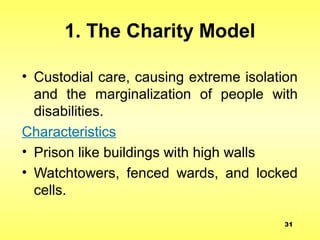
1. The Charity Model
• Custodial care, causing extreme isolation
and the marginalization of people with
disabilities.
Characteristics
• Prison like buildings with high walls
• Watchtowers, fenced wards, and locked
cells.
31
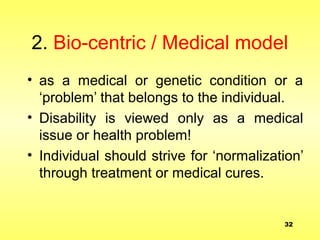
2. Bio-centric / Medical model
• as a medical or genetic condition or a
‘problem’ that belongs to the individual.
• Disability is viewed only as a medical
issue or health problem!
• Individual should strive for ‘normalization’
through treatment or medical cures.
32
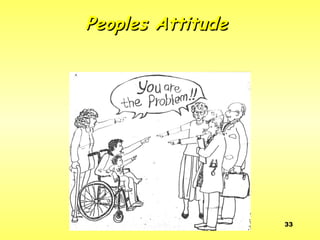
Peoples AttitudePeoples Attitude
33
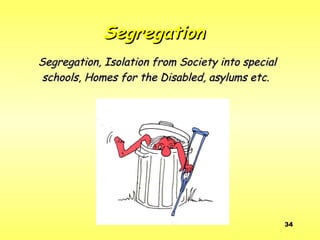
Segregation, Isolation from Society into specialSegregation, Isolation from Society into special
schools, Homes for the Disabled, asylums etc.schools, Homes for the Disabled, asylums etc.
34
SegregationSegregation
3. The Social Model
• The problem is the way that society
views a person with a disability
• Disabled people should be included in
society
• Society should see the person first and
not the disablement
• Diversity brings strength to all
Society
istheproblem!
35
Barriers for development!
 Attitudinal: This is expressed in fear,
ignorance and low expectations (influenced
by culture and religion);
 Environmental: This results in physical
inaccessibility affecting all aspects of life
(market and shops, public buildings, places
of worship, transport, etc.); and
36
4. Human Rights Model
 Important dimension of human
culture.
 Disability is an ordinary condition of
all human being.
 Not an health problem.
37
EDUCATIONAL PROVISIONS FOR
CHILDREN WITH SPECIAL NEEDS
 Kothari Commission (1966).
 The commission highlighted the issue
of children with disabilities in the Plan
of Action in 1964.
38
The Commission emphasized
that:
 (a) the education of children with
disabilities should be “an inseparable
part of the general education system”
and
 (b) it should be organized, not merely
on humanitarian grounds, but also on
grounds of utility.
39
Targets by 1986:
 Education for about 15 percent of the
blind, the deaf, and orthopedically
handicapped and
 5 percent of the mentally retarded.
40
In 1970
 Integrated Education for Disabled
Children (IEDC).
 To provide educational opportunities to
learners with disabilities in regular
schools, and to facilitate their
achievement and retention.
41
Objectives:
 To integrate children with
disabilities in the general
community at all levels as equal
partners to prepare them for normal
development and to enable them to
face life with courage and
confidence
42
Objectives:
 Retention of children with disabilities in
the regular school system.
 Pre-school training for children with
disabilities
 Counseling for parents.
43
NCERT) and UNICEF
 Project Integrated Education for
Disabled Children (PIED) in the year
1987, to strengthen the integration of
learners with disabilities into regular
schools.
 Evaluation in 1994
44
 Pre-school training
 Counseling for parents,
 Allowances for books and stationery,
uniforms, transport, readers and
 Escorts, hostel facilities, and other
assistive devices
IEDC interventions
45
IEDC
 One special teacher for every eight
children with disabilities,
 Community involvement,
 A resource room in a cluster of eight
to 10 schools.
46
Scheme failed!
 Non-availability of trained and
experienced teachers;
 Lack of orientation among school
staff
 Educational materials
47
 International Year for the Disabled
Persons (IYDP) in 1981.
48
MHRD, UNICEF and NCERT
 Project for Integrated Education
for the Disabled (PIED)
49
Key aspect
 a five day orientation course for all the
teachers in the regular schools,
 a six-week intensive training course for
10 percent of the teachers, and
 a one-year multi-category training
program for eight to ten regular school
teachers.
50
PWD Act 1996
 In 1996, the Government of India
enacted the Persons with Disabilities
(Equal Opportunities, Protection of
Rights and Full Participation) Act (PWD
Act) of 1995 (Ministry of Law Justice
and Company Affairs, 1996)
implementing the principles and
guidelines of Salamanca statement
51
The Salamanca Statement
 More than 300 participants representing
92 governments and 25 international
organizations met in Salamanca, Spain,
from 7 to IO June 1994 to further the
objective of Education for All by
considering the fundamental policy
shifts required to promote the approach
of inclusive education
52
 The Conference adopted the
Salamanca Statement on
Principles, Policy and Practice in
Special Needs Education and a
Framework for Action.
 The Framework for Action on
Special Needs Education was
adopted by the World Conference
on Special Needs Education.
53
The guiding principle
 Schools should accommodate all
children regardless of their physical,
intellectual, social, emotional,
linguistic or other conditions.
54
PWD Act
Transport facilities to the students with disabilities
Architectural barrier free Environment.
The supply of books, uniforms and Aids & Appliances.
The grant of scholarship to students with disabilities.
55
The National Policy on Education,
1986 (NPE, 1986)
The objective to be achieved as stated in the NPE,
1986 is "to integrate the physically and mentally
handicapped with general community as equal
partners, to prepare them for normal growth and to
enable them to face life with courage and confidence".
56
Rehabilitation Council of India Act 1992.
The said act was passed by the Parliament in
1992,
Mandatory for every special teacher to be
registered by the council and
Punishment without a valid registration.
57
Sarva Shiksha Abhiyan, 2002 (SSA)
Sarva Shiksha Abhiyan (SSA) is the government’s
millennial Education For All (EFA) umbrella
programme for all education schemes, which aims to
universalize elementary education, the goals are that
all children aged 6-14 including the enrolment of
children with disabilities.
58
THE RIGHT OF CHILDREN TO FREE AND COMPULSORY
EDUCATION (AMENDMENT) BILL, 2012
The Act stresses the need to provide and to
have right to free and compulsory education
neighborhood school till the completion of
his or her elementary education and further
emphasize confirming the zero rejection in
school admission:
59
Socially disadvantaged
 A host of Articles (Articles 46,332,335, and 338
to 342) and the entire fifth and sixth Scheduled
of the constitution deal with promotion of
education and economic
interests of these sections and to protect them 
from all forms of social exploitation. 
 
60
CHALLENGES TO IMPLEMENT INTEGRATED
EDUCATION
1. The challenge of poverty
associated with disability
61
Still!
260 million people living in utter
poverty (Canadian International
Development Agency [CIDA].
2003)
62
 "simultaneous deprivation”.
3 percent funds in poverty
alleviation programs targeting
families of children with
disabilities.
63
Challenge!
However, motivating poor families,
with all the associated costs to send
their child to school, is proving to be a
big challenge.
64
2. The challenge of modifying
deeply held attitudes:
 Attitudes of the non-disabled are
proving to be a major barrier in the
social integration of persons with
disabilities.
65
Indian society
is integrated in accepting and valuing
diversity in so many ways, has a social role
construct of disability which is negative,
discriminatory and exclusionary.
66
3. Dissemination and public
education
Unaware of the full intent of the
recent legislation passed by Indian
Parliament.
A large number of school personnel
are also not aware of funding available
to include students with disabilities in
regular schools.
67
U. Sharma, 2001
When parents are knowledgeable
and supportive of integrated
education; they tend to have a
positive effect on school personnel.
.
68
4. The challenge of providing adequate
levels of training to key stakeholders
The majority of school personnel in India
are not trained to design and implement
educational programs for students with
disabilities in regular schools.
Most teacher training programs in India do
not have a unit on Disability Studies.
69
Teacher training
No. of special teachers is extremely
small.
70
Inadequate resources:
Schools and colleges: Poorly
designed and poorly equipped!
71
Strategies to address some of
the challenges
Training of teachers- at least one
teacher from a school.
In-service and pre-service curriculum
…….
72
Need to design innovative
system of training:
 training at mass scale by using
Distance Open Learning or DOL
Practical aspects
73
different ministries in India
administer various services for persons
with disabilities.
For example, while "integrated education"
is the responsibility of Ministry of Human
Resource Development, education in
special schools is the responsibility of
Ministry of Social Justice and
Empowerment.
collaboration between
different ministries
74
Involve NGO's in implementing
integrated education programs:
 One million NGO’s working in India
 They can play a significant role in
implementing integrated education
75
Establish an alternate system
of examination
Lowering school standards
 may affect their promotion
 ability vs. disability
76
Conclusion
Children with special needs are first of all
children.
They have the same basic needs as
other children.
77
78

CWSN

  • 1.
    Paper II Education UNITV Educating Learners with Special Needs Prepared by Ashraf TP Keyi Sahib Training College Taliparamba
  • 2.
    Outline of mypresentation • Introduction • Who are learners with special needs? • Models of disability • Educational provisions for CWSN • Issues and Challenges • Suggested remedial measures • Conclusion/ Discussion. 2
  • 3.
    The numbers: World Reporton Disability • 1 billion persons have some form of disability ( 15% of population ) • 1.9 billion children: 93– 150 million children are living with disabilities. 3
  • 4.
    Education completion gapsare found across the world! • Disabled and non-disabled • UNICEF. Global Initiative on Out-of School Children • About 90 % children with disabilities in the developing countries do not go to school. 4
  • 5.
    Position of disabledpeople. • UNESCO identifies only 3% of disabled children complete primary education in the majority world. • 500,00 disabled people are still living in 2500 mega institutions in EU. (2004) • 2 million disabled children are in hospitals/institutions in Ex-Soviet republics and eastern Europe.(2006) 5
  • 6.
    Position of disabledpeople. • 70% disabled adults of working age not working across Europe. (Eurostat 2003) • Infant mortality rates are much higher for disabled children (under 5) than non-disabled.(WHO) 6
  • 7.
    In India • Thenumber of students in special education has skyrocketed in India since the 1980s. • According to a UNICEF Report on the Status of Disability in India (2000), there were around 30 million children that had some form of disability. 7
  • 8.
    In India • Thesixth All-India Educational Survey also reported that, of India’s 2,000 million school aged children (6_14 years), 20 million require special needs education (Rehabilitation Council of India (RCI), 2000). 8
  • 9.
    • These kindsof data are not available in all the countries! • What is the result? • No effective policies are formulated. • Appropriate financing is lacking 9
  • 10.
    Who are Learnerswith special needs? • Different definitions in different documents! • For example in the DPEP) document • “is defined as a child with disability, namely, visual, hearing, loco motor, and intellectual”. (DPEP, 2001). 10
  • 11.
    Assessment of needsfor Inclusive Education: Report of the First Regional Workshop for SAARC Countries (2000) “ …….street children, victims of natural catastrophes and social conflicts, and those in extreme social and economic deprivation belongs to SEN” 11
  • 12.
    (ISCED-97) • According tothe International Standard Classification of Education (UNESCO, 1997), • the term Special Needs Education (SNE) means educational intervention and support designed to address SEN. • In broad perspective– includes socially disadvantaged groups also. 12
  • 13.
    Children with SpecialNeeds  the educational requirements of pupils or students suffering from any of a wide range of physical disabilities, medical conditions, intellectual difficulties, or emotional problems, including deafness, blindness, dyslexia, learning difficulties, and behavioural problems.
  • 14.
    Special education isa form of instruction that's designed to meet the needs of students with disabilities, so that they can learn the same skills and information as other children in school.
  • 15.
    What is Inclusion? • Inclusive means all castes, religions, races, gender, abilities learning and working together. • Schools and communities which welcome all children and adults – A Process – A Journey – Responsibility of all – Building a community 15
  • 16.
    MEANING OF INCLUSIVE EDUCATION Inclusiveeducation implies all young learners, young people-with or without disabilities being able to learn together through access to common pre-schools and schools with an appropriate network of support services. 16
  • 17.
    17 • Inclusion meansnot only disabled children but also other children in our context amongst the poorer segments of society who face barriers to learning.  The girl child  The socially and economically disadvantaged child  The child with disabilities Shift in IdeologyShift in Ideology
  • 18.
    TYPES OF SPECIALCHILDREN  Mentally Retarded  Visually Impaired  Hearing Impaired  Physically Handicapped  Learning Disabled  Socially Disadvantaged / Gifted?
  • 19.
    Physical impairment 1. Deformityin neck, hand, fingers, waist, legs. 2. Difficulty in sitting, standing, walking. 3. Difficulty in picking up, holding objects, putting them at the appropriate place. 4. Frequently complains of pain in joints 19
  • 20.
    (Contd.) 5. Difficulty inholding the pen to write 6. Walks with jerks 7. Involuntary movements of limbs 8. Amputated limbs. 20
  • 21.
    Visual impairment  Observabledeformity in eye(s)  Rubs eyes frequently  Frequent reddening of eyes  Covers one eye and tilts the head forward  Holds objects including the book close to his eyes 21
  • 22.
    (contd.)  Asks otherstudents for help when taking notes from the blackboard  Blinks frequently-squints eyelids together  Watery eyes  Complains of headaches  Bumps into people or objects 22
  • 23.
    Students with hearingand speech impairment  Observable deformity in ear(s)  Frequent discharge from the ear(s)  Complain of pain in ears frequently  Scratches ear(s) frequently  Turns head on one side to hear better  Makes many errors in taking dictation  Displays speech difficulty 23
  • 24.
    Students with lowmental ability  Poor academic achievement  Forgets  Inattentive and distracted  Seeks immediate reward  Fear of failure  Poor self-image  Lacks self-confidence 24
  • 25.
    (contd.)  Restricted communication Poor muscular coordination  Difficulty in doing things for himself  Problem in following ……  Slow pacing  Seeks more repetition and practice  Too much dependence on concrete examples  Avoids active participation 25
  • 26.
    Students with learning disability Do not read well  Mistakes in spelling  Numbers wrong  Untidy and late in submitting assignments  Poor performance in examination  Excited  Reads individual letters in words and difficulty in 26
  • 27.
    Understanding students with specialneeds 1. Gifted and Talented characteristics  High ability for abstract and symbolic thinking.  Curiosity  Large vocabulary  Requires fewer repetitions and limited exposure to learn. 27
  • 28.
    Understanding students with specialneeds (contd.)  Special memory  Good problem solving ability  Long attention span  Intense interest in one area.  High energy level  Dislike of rigid time table. 28
  • 29.
    Models of Disability •Models of disability are tools for defining impairment. • It provides a basis upon which government and society can devise strategies for meeting the needs of disabled people. 29
  • 30.
    .• Disability asan individual pathology or social pathology  the charity model,  the bio-centric model, the social model, and the human rights model. 30
  • 31.
    1. The CharityModel • Custodial care, causing extreme isolation and the marginalization of people with disabilities. Characteristics • Prison like buildings with high walls • Watchtowers, fenced wards, and locked cells. 31
  • 32.
    2. Bio-centric /Medical model • as a medical or genetic condition or a ‘problem’ that belongs to the individual. • Disability is viewed only as a medical issue or health problem! • Individual should strive for ‘normalization’ through treatment or medical cures. 32
  • 33.
  • 34.
    Segregation, Isolation fromSociety into specialSegregation, Isolation from Society into special schools, Homes for the Disabled, asylums etc.schools, Homes for the Disabled, asylums etc. 34 SegregationSegregation
  • 35.
    3. The SocialModel • The problem is the way that society views a person with a disability • Disabled people should be included in society • Society should see the person first and not the disablement • Diversity brings strength to all Society istheproblem! 35
  • 36.
    Barriers for development! Attitudinal: This is expressed in fear, ignorance and low expectations (influenced by culture and religion);  Environmental: This results in physical inaccessibility affecting all aspects of life (market and shops, public buildings, places of worship, transport, etc.); and 36
  • 37.
    4. Human RightsModel  Important dimension of human culture.  Disability is an ordinary condition of all human being.  Not an health problem. 37
  • 38.
    EDUCATIONAL PROVISIONS FOR CHILDRENWITH SPECIAL NEEDS  Kothari Commission (1966).  The commission highlighted the issue of children with disabilities in the Plan of Action in 1964. 38
  • 39.
    The Commission emphasized that: (a) the education of children with disabilities should be “an inseparable part of the general education system” and  (b) it should be organized, not merely on humanitarian grounds, but also on grounds of utility. 39
  • 40.
    Targets by 1986: Education for about 15 percent of the blind, the deaf, and orthopedically handicapped and  5 percent of the mentally retarded. 40
  • 41.
    In 1970  IntegratedEducation for Disabled Children (IEDC).  To provide educational opportunities to learners with disabilities in regular schools, and to facilitate their achievement and retention. 41
  • 42.
    Objectives:  To integratechildren with disabilities in the general community at all levels as equal partners to prepare them for normal development and to enable them to face life with courage and confidence 42
  • 43.
    Objectives:  Retention ofchildren with disabilities in the regular school system.  Pre-school training for children with disabilities  Counseling for parents. 43
  • 44.
    NCERT) and UNICEF Project Integrated Education for Disabled Children (PIED) in the year 1987, to strengthen the integration of learners with disabilities into regular schools.  Evaluation in 1994 44
  • 45.
     Pre-school training Counseling for parents,  Allowances for books and stationery, uniforms, transport, readers and  Escorts, hostel facilities, and other assistive devices IEDC interventions 45
  • 46.
    IEDC  One specialteacher for every eight children with disabilities,  Community involvement,  A resource room in a cluster of eight to 10 schools. 46
  • 47.
    Scheme failed!  Non-availabilityof trained and experienced teachers;  Lack of orientation among school staff  Educational materials 47
  • 48.
     International Yearfor the Disabled Persons (IYDP) in 1981. 48
  • 49.
    MHRD, UNICEF andNCERT  Project for Integrated Education for the Disabled (PIED) 49
  • 50.
    Key aspect  afive day orientation course for all the teachers in the regular schools,  a six-week intensive training course for 10 percent of the teachers, and  a one-year multi-category training program for eight to ten regular school teachers. 50
  • 51.
    PWD Act 1996 In 1996, the Government of India enacted the Persons with Disabilities (Equal Opportunities, Protection of Rights and Full Participation) Act (PWD Act) of 1995 (Ministry of Law Justice and Company Affairs, 1996) implementing the principles and guidelines of Salamanca statement 51
  • 52.
    The Salamanca Statement More than 300 participants representing 92 governments and 25 international organizations met in Salamanca, Spain, from 7 to IO June 1994 to further the objective of Education for All by considering the fundamental policy shifts required to promote the approach of inclusive education 52
  • 53.
     The Conferenceadopted the Salamanca Statement on Principles, Policy and Practice in Special Needs Education and a Framework for Action.  The Framework for Action on Special Needs Education was adopted by the World Conference on Special Needs Education. 53
  • 54.
    The guiding principle Schools should accommodate all children regardless of their physical, intellectual, social, emotional, linguistic or other conditions. 54
  • 55.
    PWD Act Transport facilitiesto the students with disabilities Architectural barrier free Environment. The supply of books, uniforms and Aids & Appliances. The grant of scholarship to students with disabilities. 55
  • 56.
    The National Policyon Education, 1986 (NPE, 1986) The objective to be achieved as stated in the NPE, 1986 is "to integrate the physically and mentally handicapped with general community as equal partners, to prepare them for normal growth and to enable them to face life with courage and confidence". 56
  • 57.
    Rehabilitation Council ofIndia Act 1992. The said act was passed by the Parliament in 1992, Mandatory for every special teacher to be registered by the council and Punishment without a valid registration. 57
  • 58.
    Sarva Shiksha Abhiyan,2002 (SSA) Sarva Shiksha Abhiyan (SSA) is the government’s millennial Education For All (EFA) umbrella programme for all education schemes, which aims to universalize elementary education, the goals are that all children aged 6-14 including the enrolment of children with disabilities. 58
  • 59.
    THE RIGHT OFCHILDREN TO FREE AND COMPULSORY EDUCATION (AMENDMENT) BILL, 2012 The Act stresses the need to provide and to have right to free and compulsory education neighborhood school till the completion of his or her elementary education and further emphasize confirming the zero rejection in school admission: 59
  • 60.
    Socially disadvantaged  Ahost of Articles (Articles 46,332,335, and 338 to 342) and the entire fifth and sixth Scheduled of the constitution deal with promotion of education and economic interests of these sections and to protect them  from all forms of social exploitation.    60
  • 61.
    CHALLENGES TO IMPLEMENTINTEGRATED EDUCATION 1. The challenge of poverty associated with disability 61
  • 62.
    Still! 260 million peopleliving in utter poverty (Canadian International Development Agency [CIDA]. 2003) 62
  • 63.
     "simultaneous deprivation”. 3percent funds in poverty alleviation programs targeting families of children with disabilities. 63
  • 64.
    Challenge! However, motivating poorfamilies, with all the associated costs to send their child to school, is proving to be a big challenge. 64
  • 65.
    2. The challengeof modifying deeply held attitudes:  Attitudes of the non-disabled are proving to be a major barrier in the social integration of persons with disabilities. 65
  • 66.
    Indian society is integratedin accepting and valuing diversity in so many ways, has a social role construct of disability which is negative, discriminatory and exclusionary. 66
  • 67.
    3. Dissemination andpublic education Unaware of the full intent of the recent legislation passed by Indian Parliament. A large number of school personnel are also not aware of funding available to include students with disabilities in regular schools. 67
  • 68.
    U. Sharma, 2001 Whenparents are knowledgeable and supportive of integrated education; they tend to have a positive effect on school personnel. . 68
  • 69.
    4. The challengeof providing adequate levels of training to key stakeholders The majority of school personnel in India are not trained to design and implement educational programs for students with disabilities in regular schools. Most teacher training programs in India do not have a unit on Disability Studies. 69
  • 70.
    Teacher training No. ofspecial teachers is extremely small. 70
  • 71.
    Inadequate resources: Schools andcolleges: Poorly designed and poorly equipped! 71
  • 72.
    Strategies to addresssome of the challenges Training of teachers- at least one teacher from a school. In-service and pre-service curriculum ……. 72
  • 73.
    Need to designinnovative system of training:  training at mass scale by using Distance Open Learning or DOL Practical aspects 73
  • 74.
    different ministries inIndia administer various services for persons with disabilities. For example, while "integrated education" is the responsibility of Ministry of Human Resource Development, education in special schools is the responsibility of Ministry of Social Justice and Empowerment. collaboration between different ministries 74
  • 75.
    Involve NGO's inimplementing integrated education programs:  One million NGO’s working in India  They can play a significant role in implementing integrated education 75
  • 76.
    Establish an alternatesystem of examination Lowering school standards  may affect their promotion  ability vs. disability 76
  • 77.
    Conclusion Children with specialneeds are first of all children. They have the same basic needs as other children. 77
  • 78.

Editor's Notes

  • #36 Again, this is a very simple overview of the social model and learners should be encouraged to broaden their understanding through further reading. What this slide illustrates, though, is the very clear difference in perception of the root of the difficulty that disabled people face. The social model starts from the premise that there will, naturally, always be disabled people in any society and the diversity that brings should be welcomed instead of seeking to ‘cure’ it. A disablement is not the most important or defining aspect of a person – it is part of who they are but shouldn’t be the first or only thing that society sees. This is equally provocative and likely to prompt discussion and, perhaps, disagreement. The comparison with South Africa’s apartheid regime is particularly powerful, so do allow learners to reflect on it and share their thoughts (time permitting).