Addressing Diversity through the
Years: Special and Inclusive
Education
Objectives:
This chapter aims for you to develop the
following competencies:
1. The ability to create a safe, inclusive, and culturally
responsive learning environment for students with
additional needs.
2. The ability to use your knowledge of general and
specialized curricula to individualize learning students
with additional needs; and
3. The ability to demonstrate reflective thinking and
professional self-direction.
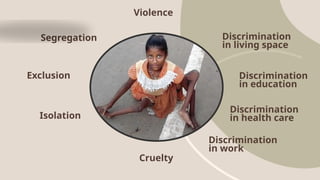
Segregation
Exclusion
Isolation
Violence
Cruelty
Discrimination
in living space
Discrimination
in health care
Discrimination
in education
Discrimination
in work
Events tend to shape
one’s beliefs and values
system.
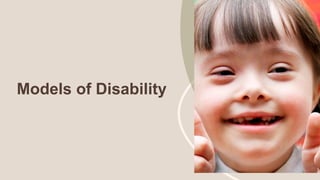
Models of Disability
Importance/Purpose of Models of Disability:
1. They provide definitions of disability.
2. They offer explanations of causal and responsibility
attributions.
3. They are based on “perceived needs”
4. They inform policy
5. They are not “value-neutral”
6. They define the academic disciplines that focus on
disability
7. They shape the self-identity of PWDs
8. They can provide insights on how prejudices and
discriminations occur.
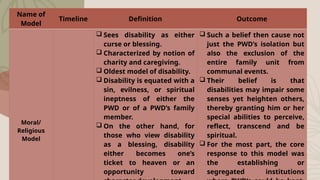
Moral/Religious
Model
Name of
Model
Timeline Definition Outcome
Moral/
Religious
Model
 Sees disability as either
curse or blessing.
 Characterized by notion of
charity and caregiving.
 Oldest model of disability.
 Disability is equated with a
sin, evilness, or spiritual
ineptness of either the
PWD or of a PWD’s family
member.
 On the other hand, for
those who view disability
as a blessing, disability
either becomes one’s
ticket to heaven or an
opportunity toward
 Such a belief then cause not
just the PWD’s isolation but
also the exclusion of the
entire family unit from
communal events.
 Their belief is that
disabilities may impair some
senses yet heighten others,
thereby granting him or her
special abilities to perceive,
reflect, transcend and be
spiritual.
 For the most part, the core
response to this model was
the establishing or
segregated institutions
Biomedical/
Individual
Model
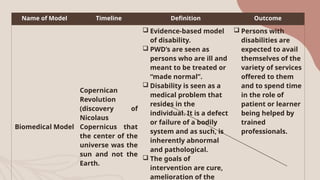
Name of Model Timeline Definition Outcome
Biomedical Model
Copernican
Revolution
(discovery of
Nicolaus
Copernicus that
the center of the
universe was the
sun and not the
Earth.
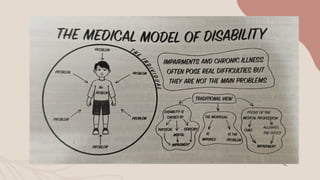
 Evidence-based model
of disability.
 PWD’s are seen as
persons who are ill and
meant to be treated or
“made normal”.
 Disability is seen as a
medical problem that
resides in the
individual. It is a defect
or failure of a bodily
system and as such, is
inherently abnormal
and pathological.
 The goals of
intervention are cure,
amelioration of the
 Persons with
disabilities are
expected to avail
themselves of the
variety of services
offered to them
and to spend time
in the role of
patient or learner
being helped by
trained
professionals.
17
Name of Model Timeline Definition Outcome
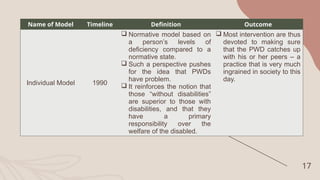
Individual Model 1990
 Normative model based on
a person’s levels of
deficiency compared to a
normative state.
 Such a perspective pushes
for the idea that PWDs
have problem.
 It reinforces the notion that
those “without disabilities”
are superior to those with
disabilities, and that they
have a primary
responsibility over the
welfare of the disabled.
 Most intervention are thus
devoted to making sure
that the PWD catches up
with his or her peers – a
practice that is very much
ingrained in society to this
day.
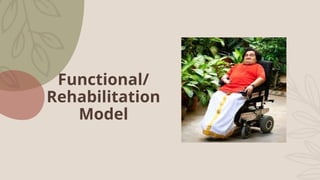
Functional/
Rehabilitation
Model
Name of
Model
Timeline Definition Outcome
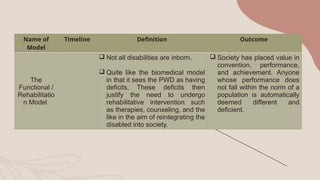
The
Functional /
Rehabilitatio
n Model
 Not all disabilities are inborn.
 Quite like the biomedical model
in that it sees the PWD as having
deficits. These deficits then
justify the need to undergo
rehabilitative intervention such
as therapies, counseling, and the
like in the aim of reintegrating the
disabled into society.
 Society has placed value in
convention, performance,
and achievement. Anyone
whose performance does
not fall within the norm of a
population is automatically
deemed different and
deficient.
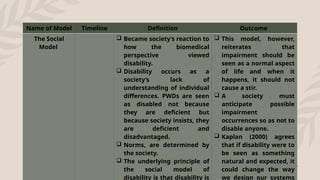
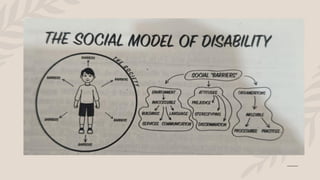
The Social Model
Name of Model Timeline Definition Outcome
The Social
Model
 Became society’s reaction to
how the biomedical
perspective viewed
disability.
 Disability occurs as a
society’s lack of
understanding of individual
differences. PWDs are seen
as disabled not because
they are deficient but
because society insists, they
are deficient and
disadvantaged.
 Norms, are determined by
the society.
 The underlying principle of
the social model of
disability is that disability is
 This model, however,
reiterates that
impairment should be
seen as a normal aspect
of life and when it
happens, it should not
cause a stir.
 A society must
anticipate possible
impairment
occurrences so as not to
disable anyone.
 Kaplan (2000) agrees
that if disability were to
be seen as something
natural and expected, it
could change the way
we design our systems
Rights-Based Model and
Twin Track Approach
24
The Twin
Track
Approach
 Combination of social
model and the rights-
based model.
 In education this
would mean
allowing a PWD to
join the mainstream
yet be given
opportunities for
disability – specific
programs in case
additional support
is needed.
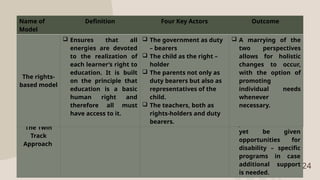
Name of
Model
Definition Four Key Actors Outcome
The rights-
based model
 Ensures that all
energies are devoted
to the realization of
each learner’s right to
education. It is built
on the principle that
education is a basic
human right and
therefore all must
have access to it.
 The government as duty
– bearers
 The child as the right –
holder
 The parents not only as
duty bearers but also as
representatives of the
child.
 The teachers, both as
rights-holders and duty
bearers.
 A marrying of the
two perspectives
allows for holistic
changes to occur,
with the option of
promoting
individual needs
whenever
necessary.
 Education is the action or process of teaching
someone especially in a school, college or
university.
 The real goal of education is becoming –
becoming a good person and becoming a more
capable person than when you started.
 It is not the filling of the pail but the lighting of a
fire.
What is Education?
It is presumably because of
education that the world now faces a
problems such as poverty, oppression,
and war. Yet, it is also through
education that all these problems are
expected to be addressed.
Education has to address four
aspects of learning:
oLearning in order to know.
oLearning in order to do.
oLearning so we can live
harmoniously with others.
oLearning in order to be.
Special Education
 An attempt to increase the fairness of universal public
education for exceptional learners because there are those
with special difficulties or extraordinary abilities in learning.
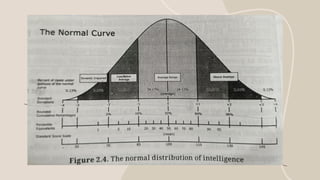
 Acknowledging learners' differences, the essence of special
education lies in its goal to educate a certain population of
students, particularly those at the tail ends of a normal statistical
distribution of performance.
 In other words, special education tries to
ensure that those perceived to have difficulties
learning will be taught, albeit in a different way.
Why Inclusion?
Inclusive Education is an educational practice that places
students with disabilities in the general education classroom
along with typically developing children under the supervision
and guidance of a general education teacher.
It takes root in special needs education and is anchored on
the philosophy that every child has an inherent right to be
educated equally with his peers, no matter how different he or she
may appear to society.
Timeline of Inclusive Education
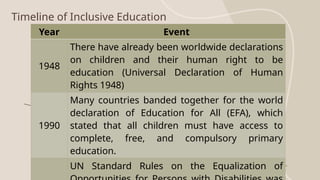
Year Event
1948
There have already been worldwide declarations
on children and their human right to be
education (Universal Declaration of Human
Rights 1948)
1990
Many countries banded together for the world
declaration of Education for All (EFA), which
stated that all children must have access to
complete, free, and compulsory primary
education.
UN Standard Rules on the Equalization of
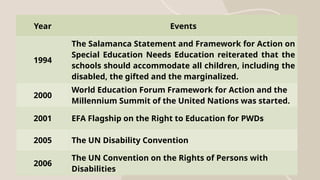
Year Events
1994
The Salamanca Statement and Framework for Action on
Special Education Needs Education reiterated that the
schools should accommodate all children, including the
disabled, the gifted and the marginalized.
2000
World Education Forum Framework for Action and the
Millennium Summit of the United Nations was started.
2001 EFA Flagship on the Right to Education for PWDs
2005 The UN Disability Convention
2006
The UN Convention on the Rights of Persons with
Disabilities
Year Events
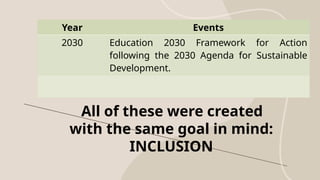
2030 Education 2030 Framework for Action
following the 2030 Agenda for Sustainable
Development.
All of these were created
with the same goal in mind:
INCLUSION
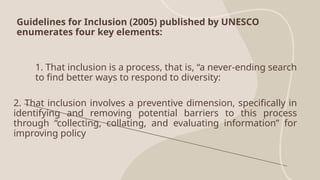
Guidelines for Inclusion (2005) published by UNESCO
enumerates four key elements:
1. That inclusion is a process, that is, “a never-ending search
to find better ways to respond to diversity:
2. That inclusion involves a preventive dimension, specifically in
identifying and removing potential barriers to this process
through “collecting, collating, and evaluating information” for
improving policy
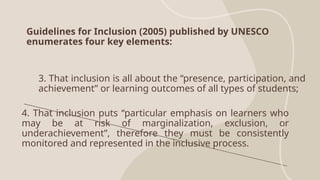
Guidelines for Inclusion (2005) published by UNESCO
enumerates four key elements:
3. That inclusion is all about the “presence, participation, and
achievement” or learning outcomes of all types of students;
4. That inclusion puts “particular emphasis on learners who
may be at risk of marginalization, exclusion, or
underachievement”, therefore they must be consistently
monitored and represented in the inclusive process.
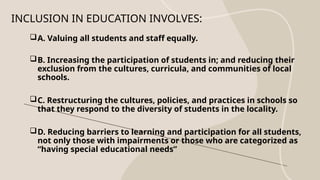
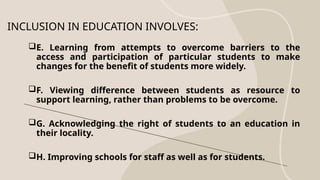
INCLUSION IN EDUCATION INVOLVES:
A. Valuing all students and staff equally.
B. Increasing the participation of students in; and reducing their
exclusion from the cultures, curricula, and communities of local
schools.
C. Restructuring the cultures, policies, and practices in schools so
that they respond to the diversity of students in the locality.
D. Reducing barriers to learning and participation for all students,
not only those with impairments or those who are categorized as
“having special educational needs”
INCLUSION IN EDUCATION INVOLVES:
E. Learning from attempts to overcome barriers to the
access and participation of particular students to make
changes for the benefit of students more widely.
F. Viewing difference between students as resource to
support learning, rather than problems to be overcome.
G. Acknowledging the right of students to an education in
their locality.
H. Improving schools for staff as well as for students.
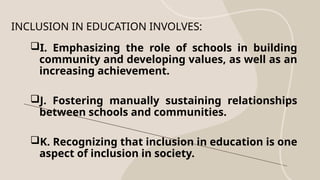
I. Emphasizing the role of schools in building
community and developing values, as well as an
increasing achievement.
J. Fostering manually sustaining relationships
between schools and communities.
K. Recognizing that inclusion in education is one
aspect of inclusion in society.
INCLUSION IN EDUCATION INVOLVES:
It has long been regarded that the
key to nation-building is quality
education accessible to all types of
learners. This accessibility is the
essence of inclusive education.
What are your takeaways?
Summary:
 Everyone has a right to education. Having a disability should not be
an excuse for being deprived access to schools; neither should
poverty, religion, nor race.
 Inclusive education is an inevitable direction to take and must be
properly understood, appreciated, and prepared for within the
context of society being accepting of individual differences.
 For a nation to be truly inclusive, one must start from a humane
perspective of disability and a transformative mindset on inclusion.
Thus, the success of inclusive education starts with an appreciation
and acceptance of diversity, reinforced by a supportive and
genuinely inclusive mind-set among our general education teachers.
thank you

Addressing-Diversity-through-the-Years (1).pptx

  • 1.
    Addressing Diversity throughthe Years: Special and Inclusive Education
  • 2.
    Objectives: This chapter aimsfor you to develop the following competencies: 1. The ability to create a safe, inclusive, and culturally responsive learning environment for students with additional needs. 2. The ability to use your knowledge of general and specialized curricula to individualize learning students with additional needs; and 3. The ability to demonstrate reflective thinking and professional self-direction.
  • 8.
  • 9.
    Events tend toshape one’s beliefs and values system.
  • 10.
  • 11.
    Importance/Purpose of Modelsof Disability: 1. They provide definitions of disability. 2. They offer explanations of causal and responsibility attributions. 3. They are based on “perceived needs” 4. They inform policy 5. They are not “value-neutral” 6. They define the academic disciplines that focus on disability 7. They shape the self-identity of PWDs 8. They can provide insights on how prejudices and discriminations occur.
  • 12.
  • 13.
    Name of Model Timeline DefinitionOutcome Moral/ Religious Model  Sees disability as either curse or blessing.  Characterized by notion of charity and caregiving.  Oldest model of disability.  Disability is equated with a sin, evilness, or spiritual ineptness of either the PWD or of a PWD’s family member.  On the other hand, for those who view disability as a blessing, disability either becomes one’s ticket to heaven or an opportunity toward  Such a belief then cause not just the PWD’s isolation but also the exclusion of the entire family unit from communal events.  Their belief is that disabilities may impair some senses yet heighten others, thereby granting him or her special abilities to perceive, reflect, transcend and be spiritual.  For the most part, the core response to this model was the establishing or segregated institutions
  • 14.
  • 15.
    Name of ModelTimeline Definition Outcome Biomedical Model Copernican Revolution (discovery of Nicolaus Copernicus that the center of the universe was the sun and not the Earth.  Evidence-based model of disability.  PWD’s are seen as persons who are ill and meant to be treated or “made normal”.  Disability is seen as a medical problem that resides in the individual. It is a defect or failure of a bodily system and as such, is inherently abnormal and pathological.  The goals of intervention are cure, amelioration of the  Persons with disabilities are expected to avail themselves of the variety of services offered to them and to spend time in the role of patient or learner being helped by trained professionals.
  • 17.
    17 Name of ModelTimeline Definition Outcome Individual Model 1990  Normative model based on a person’s levels of deficiency compared to a normative state.  Such a perspective pushes for the idea that PWDs have problem.  It reinforces the notion that those “without disabilities” are superior to those with disabilities, and that they have a primary responsibility over the welfare of the disabled.  Most intervention are thus devoted to making sure that the PWD catches up with his or her peers – a practice that is very much ingrained in society to this day.
  • 18.
  • 19.
    Name of Model Timeline DefinitionOutcome The Functional / Rehabilitatio n Model  Not all disabilities are inborn.  Quite like the biomedical model in that it sees the PWD as having deficits. These deficits then justify the need to undergo rehabilitative intervention such as therapies, counseling, and the like in the aim of reintegrating the disabled into society.  Society has placed value in convention, performance, and achievement. Anyone whose performance does not fall within the norm of a population is automatically deemed different and deficient.
  • 20.
  • 21.
    Name of ModelTimeline Definition Outcome The Social Model  Became society’s reaction to how the biomedical perspective viewed disability.  Disability occurs as a society’s lack of understanding of individual differences. PWDs are seen as disabled not because they are deficient but because society insists, they are deficient and disadvantaged.  Norms, are determined by the society.  The underlying principle of the social model of disability is that disability is  This model, however, reiterates that impairment should be seen as a normal aspect of life and when it happens, it should not cause a stir.  A society must anticipate possible impairment occurrences so as not to disable anyone.  Kaplan (2000) agrees that if disability were to be seen as something natural and expected, it could change the way we design our systems
  • 23.
  • 24.
    24 The Twin Track Approach  Combinationof social model and the rights- based model.  In education this would mean allowing a PWD to join the mainstream yet be given opportunities for disability – specific programs in case additional support is needed. Name of Model Definition Four Key Actors Outcome The rights- based model  Ensures that all energies are devoted to the realization of each learner’s right to education. It is built on the principle that education is a basic human right and therefore all must have access to it.  The government as duty – bearers  The child as the right – holder  The parents not only as duty bearers but also as representatives of the child.  The teachers, both as rights-holders and duty bearers.  A marrying of the two perspectives allows for holistic changes to occur, with the option of promoting individual needs whenever necessary.
  • 25.
     Education isthe action or process of teaching someone especially in a school, college or university.  The real goal of education is becoming – becoming a good person and becoming a more capable person than when you started.  It is not the filling of the pail but the lighting of a fire. What is Education?
  • 26.
    It is presumablybecause of education that the world now faces a problems such as poverty, oppression, and war. Yet, it is also through education that all these problems are expected to be addressed.
  • 27.
    Education has toaddress four aspects of learning: oLearning in order to know. oLearning in order to do. oLearning so we can live harmoniously with others. oLearning in order to be.
  • 28.
    Special Education  Anattempt to increase the fairness of universal public education for exceptional learners because there are those with special difficulties or extraordinary abilities in learning.  Acknowledging learners' differences, the essence of special education lies in its goal to educate a certain population of students, particularly those at the tail ends of a normal statistical distribution of performance.  In other words, special education tries to ensure that those perceived to have difficulties learning will be taught, albeit in a different way.
  • 30.
    Why Inclusion? Inclusive Educationis an educational practice that places students with disabilities in the general education classroom along with typically developing children under the supervision and guidance of a general education teacher. It takes root in special needs education and is anchored on the philosophy that every child has an inherent right to be educated equally with his peers, no matter how different he or she may appear to society.
  • 31.
    Timeline of InclusiveEducation Year Event 1948 There have already been worldwide declarations on children and their human right to be education (Universal Declaration of Human Rights 1948) 1990 Many countries banded together for the world declaration of Education for All (EFA), which stated that all children must have access to complete, free, and compulsory primary education. UN Standard Rules on the Equalization of
  • 32.
    Year Events 1994 The SalamancaStatement and Framework for Action on Special Education Needs Education reiterated that the schools should accommodate all children, including the disabled, the gifted and the marginalized. 2000 World Education Forum Framework for Action and the Millennium Summit of the United Nations was started. 2001 EFA Flagship on the Right to Education for PWDs 2005 The UN Disability Convention 2006 The UN Convention on the Rights of Persons with Disabilities
  • 33.
    Year Events 2030 Education2030 Framework for Action following the 2030 Agenda for Sustainable Development. All of these were created with the same goal in mind: INCLUSION
  • 34.
    Guidelines for Inclusion(2005) published by UNESCO enumerates four key elements: 1. That inclusion is a process, that is, “a never-ending search to find better ways to respond to diversity: 2. That inclusion involves a preventive dimension, specifically in identifying and removing potential barriers to this process through “collecting, collating, and evaluating information” for improving policy
  • 35.
    Guidelines for Inclusion(2005) published by UNESCO enumerates four key elements: 3. That inclusion is all about the “presence, participation, and achievement” or learning outcomes of all types of students; 4. That inclusion puts “particular emphasis on learners who may be at risk of marginalization, exclusion, or underachievement”, therefore they must be consistently monitored and represented in the inclusive process.
  • 36.
    INCLUSION IN EDUCATIONINVOLVES: A. Valuing all students and staff equally. B. Increasing the participation of students in; and reducing their exclusion from the cultures, curricula, and communities of local schools. C. Restructuring the cultures, policies, and practices in schools so that they respond to the diversity of students in the locality. D. Reducing barriers to learning and participation for all students, not only those with impairments or those who are categorized as “having special educational needs”
  • 37.
    INCLUSION IN EDUCATIONINVOLVES: E. Learning from attempts to overcome barriers to the access and participation of particular students to make changes for the benefit of students more widely. F. Viewing difference between students as resource to support learning, rather than problems to be overcome. G. Acknowledging the right of students to an education in their locality. H. Improving schools for staff as well as for students.
  • 38.
    I. Emphasizing therole of schools in building community and developing values, as well as an increasing achievement. J. Fostering manually sustaining relationships between schools and communities. K. Recognizing that inclusion in education is one aspect of inclusion in society. INCLUSION IN EDUCATION INVOLVES:
  • 39.
    It has longbeen regarded that the key to nation-building is quality education accessible to all types of learners. This accessibility is the essence of inclusive education.
  • 40.
    What are yourtakeaways?
  • 41.
    Summary:  Everyone hasa right to education. Having a disability should not be an excuse for being deprived access to schools; neither should poverty, religion, nor race.  Inclusive education is an inevitable direction to take and must be properly understood, appreciated, and prepared for within the context of society being accepting of individual differences.  For a nation to be truly inclusive, one must start from a humane perspective of disability and a transformative mindset on inclusion. Thus, the success of inclusive education starts with an appreciation and acceptance of diversity, reinforced by a supportive and genuinely inclusive mind-set among our general education teachers.
  • 42.