Inclusive Education : 
Some Justifications and 
Provisions 
Dr. Sankar Prasad Mohanty 
Lecturer, Department of Education 
Ravenshaw University, Cuttack, Odisha 
E-mail: spmcuttack@gmail.com
Inclusion: A Process 
Inclusive education is a process to cater for all children: 
including boys, girls, 
students from ethnic and linguistics 
minorities, 
population affected by HIV-AIDS, 
those with disability difficulty in 
learning. 
Aims is to eliminate exclusion- consequence of 
Negative attitude of towards the above 
Lack of response to diversity in race, economic status, 
social class, ethnicity, language, religion, gender and 
ability.
Contd.. 
Full inclusion of children 
with diverse abilities (i.e. gifted and 
disabilities) in all aspects of schooling that 
other children are able to access and enjoy 
(Loreman and Deppeler, 2001)
Inclusive Education: Justifications 
Educational Point of View 
Irrespective of talent, disability, socio-economic 
status, culturally origin in 
supportive mainstream schools and 
classrooms. 
Needs of all students are met –preparing them 
for life. 
 Teachers improve their professional skills. 
Society takes conscious decisions to operate 
according to social values.
Sociological point of view 
Our society needs the schools-- 
values like wider social acceptance, peace 
and cooperation are prevalent. 
Segregated education teaches children to 
be fearful, ignorant and generate 
prejudices. Only inclusive education can 
reduce these aspects and build friendship, 
respect and understanding (CSIE Report, 
2002)
Economic point of view 
Out of 700 million disable persons of World 
10 percent only in India. 
Inclusive education is cost-effective in nature 
(Salamanca Statement, UNESCO, 1994)
Humanitarian point of view 
Segregation generates 
a feeling of inferiority in respects of child’s 
status in the community which may affect his 
emotional and cognitive development. 
Lack of confidence, motivation, and positive 
expectation for achievements are the product 
of segregated learning environment (Stainback, 
Stainback and Forrest, 1989).
Democratic point of view 
In a democratic country the value of equality is 
most important. 
So, to bring disable children in the 
mainstreaming education, the fair, ethical and 
equitable measures need to be taken to avoid 
discrimination.
Key Provisions for 
Inclusive Education 
Constitution of India : 
• Article 45: Free and compulsory education 
for all children up to 14 years, changed to 
ECCE up to 6 years age (86th amendment of 
Constitution) 
• Article 21 A: Right to Education Act, 2009- 
Fundamental right of all children aged 6-14 to 
get equitable, free and quality education
Contd.. 
Education for All, 1990: 
Intensifies that large numbers of vulnerable 
and marginalized group of learners were 
excluded from the education system 
worldwide. 
It made its vision of education as a broader 
concept (EFA) than schooling including 
women literacy, lifelong education etc
Contd.. 
National Policy on Education-1986 and POA- 
1992: 
Gives emphasis on the removal of disparities 
and equalize educational opportunities by 
attending to the specific needs of those who 
have been denied equality.
Contd.. 
The Salamanca Conference, UNESCO, 1994: 
School should accommodate all children 
regardless of their physical, intellectual, social, 
linguistic or other conditions. 
Includes: 
disabled and gifted children, 
street and working children from remote or 
nomadic population, 
children from linguistic, ethnic or cultural 
minorities and 
children from other disadvantaged or 
marginalized areas of groups.
Contd.. 
Persons with Disability Act (Equal Opportunities, 
Protection of Rights and Full Participation), 1995: 
Direction to ensure equal opportunities for people with 
disabilities and their full participation in the nation 
building 
The Act provides for both preventive and promotional 
aspects of rehabilitation of persons with disability, 
unemployment and establishment of homes for 
persons with severe disability, etc. 
Every child with disability - right to free education till 
the age of 18 years in integrated schools or special 
schools. 
Special schools for children with disabilities shall be 
equipped with vocational training facilities
Contd.. 
The National Trust Act (1999) : 
To facilitate the realization of equal 
opportunities, protection of rights and full 
participation of persons with disability. 
World Education Forum in Dakar, Senegal 
(2000): 
Education must take into account -the most 
disadvantaged including working children, 
remote rural dwellers, nomads, ethnic and 
linguistic minority children, affected by 
conflicts, HIV-AIDS, hunger and poor health and 
those with special learning needs.
Contd.. 
Biwako Millennium Framework for Action, 
UNESCAP (2002): 
The framework envisages that major barriers to the 
provision of quality education for children with 
disabilities. 
These barriers can be overcome through policy, 
planning, implementation of strategies and allocation 
of resources (BMF-UNESCAP, 2002).
Contd.. 
The National Action Plan for Inclusion in 
Education of Children and Youth with 
Disabilities (IECYD)-2005: 
The goal of the Action Plan is –“to ensure the 
inclusion of children and youth with 
disabilities in all available general educational 
settings, by providing them with a learning 
environment that is available, accessible, 
affordable and appropriate.”
Contd.. 
National Curriculum Framework-2005: 
Schools need to become centres that prepare 
children for life and ensure that all children, 
 especially the differently abled, 
children from marginalized sections, 
children in difficult circumstances get the 
maximum benefit of this critical area of 
education. (NCF, 2005, p.85)
Contd.. 
National Policy for Persons with Disabilities, 
2006: 
The National Policy recognizes the fact that a 
majority of persons with disabilities can lead a 
better quality of life if they have equal 
opportunities and effective access to 
rehabilitation measures
Contd.. 
Inclusive Education of the Disabled at Secondary 
Stage (IEDSS, 2009-10): 
The scheme aims at enabling all students with 
disabilities, after completing eight years of 
elementary schooling, to pursue further four 
years of secondary schooling in an inclusive and 
enabling environment.
Contd.. 
RTE- SSA’s Policy on Inclusion (2001 & 2012): 
SSA has adopted a zero rejection policy. This means 
that no child having special needs should be deprived 
of the right to education and taught in an 
environment, which is best, suited to his/her learning 
needs (MHRD,GoI,2011). 
Every child with special needs should be placed in 
the neighborhood schools, with needed support 
services 
Children with special needs need to be facilitated to 
acquire certain skills that will enable them to access 
elementary education
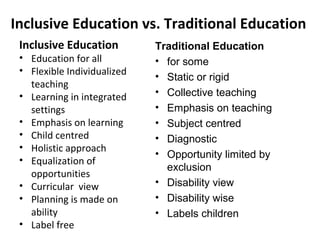
Inclusive Education vs. Traditional Education 
Inclusive Education 
• Education for all 
• Flexible Individualized 
teaching 
• Learning in integrated 
settings 
• Emphasis on learning 
• Child centred 
• Holistic approach 
• Equalization of 
opportunities 
• Curricular view 
• Planning is made on 
ability 
• Label free 
Traditional Education 
• for some 
• Static or rigid 
• Collective teaching 
• Emphasis on teaching 
• Subject centred 
• Diagnostic 
• Opportunity limited by 
exclusion 
• Disability view 
• Disability wise 
• Labels children
Education through Inclusion 
• Flexible teaching and learning methods 
• Learning styles with innovative approaches to teaching 
aids 
• equipments as well as the use of ICT and collaborative 
approach 
• Flexible curriculum responsive to diversify needs and 
not overloaded with academic content. 
• Initial training to the teachers on physical disability, 
multilingual and multicultural teaching 
• Creating child friendly environments 
• Qualitative assessment of learning 
• Involvement of parents and the community
Curriculum 
address the child’s holistic development 
based on the four pillars of education for the 
21 century- learning to know, learning to do, 
learning to live together and learning to be. 
adopts multilingual approaches
The teacher 
• Explore new methodology and stagey to make 
the classroom inclusive 
• Adopt child centred curriculum -active and 
cooperative learning 
• Knows each pupil’s reactions towards 
teachings learning process.
Suggestions 
• Appropriate monitoring & evaluation mechanisms 
need to be put in place to evaluate the impact of 
inclusive education policies. 
• A coordinated action plan of holistic approach is 
needed to bring out a change in the entire education 
system 
• Allow flexible use of funds to support activities for 
inclusive schools, education and training 
programmes. 
• Distance learning education should be provided
THANK YOU