Definition :
Bi-Pedal , Bi-Phasic , Rhythmic, cyclic movement of the limbs ,
In relation to the trunk resulting in forward propulsion of ,
centre of Gravity of the Human body , In which there are
Sinuous movements of different segments Of Human body with
Least expenditure of Energy .
NORMAL GAIT REQUIRES :
Normal functioning of musculoskeletal system of
lower limbs & spine.
Good sensory feedback from proprioceptive sensation
from feet and the joints.
Visual , labyrinthine sensory inputs & co ordination
add smoothness, rhythm & elegance to the human gait
The GAIT CYCLE
The sequences for Walking may be
summarised as follows :
 Registration and activation of Gait Command within CNS
 Transmission of Gait systems to the PNS
 Contraction of Muscles
 Generation of Several Forces
 Regulation of Joint forces and movements across synovial
Joints and Skeletal segments
 Generation of Ground Reaction Forces
GAIT TERMINOLOGY
 Base of support
 Step length
 Stride length
 Gait cycle
 Cadence
 Walking velocity
 Double limb support
 Single limb support
 Ground reaction force vector
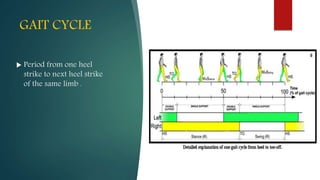
GAIT CYCLE
 Period from one heel
strike to next heel strike
of the same limb .
BASIC GAIT TERMS
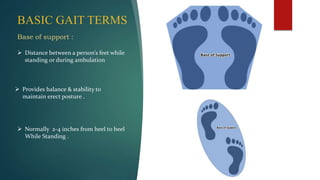
Base of support :
 Distance between a person’s feet while
standing or during ambulation
 Provides balance & stability to
maintain erect posture .
 Normally 2-4 inches from heel to heel
While Standing .
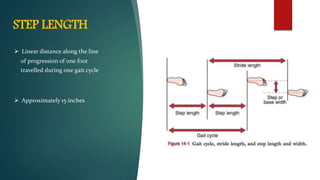
STEP LENGTH
 Linear distance along the line
of progression of one foot
travelled during one gait cycle
 Approximately 15 inches
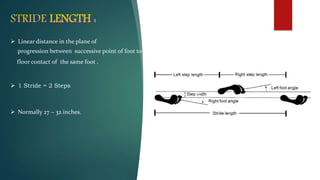
STRIDE LENGTH :
 Linear distance in the plane of
progression between successive point of foot to
floor contact of the same foot .
 Normally 27 – 32 inches.
 1 Stride = 2 Steps
Cadence
 It is measured as the number of steps / sec or per minute .
 Approximately 70 steps per minute
Double limb support
 During normal gait, for a moment , two lower extremities
are in simultaneous contact with the ground .
 During this period, both legs support the body weight .
 Happens between push off & toe off on same side and heel strike &
foot flat on the contra lateral side .
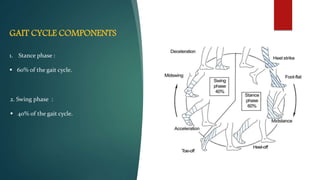
GAIT CYCLE COMPONENTS
1. Stance phase :
 60% of the gait cycle.
2. Swing phase :
 40% of the gait cycle.
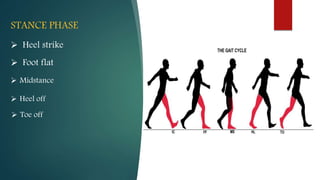
STANCE PHASE
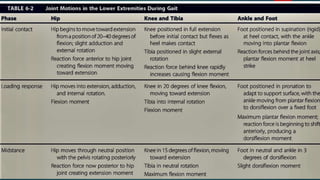
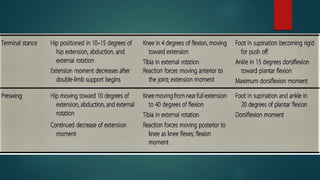
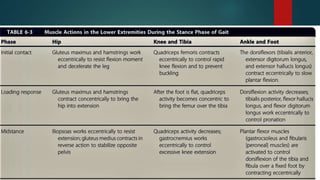
 Heel strike
 Foot flat
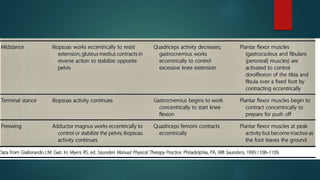
 Midstance
 Heel off
 Toe off
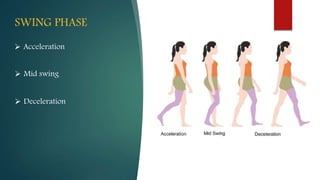
SWING PHASE
 Acceleration
 Mid swing
 Deceleration
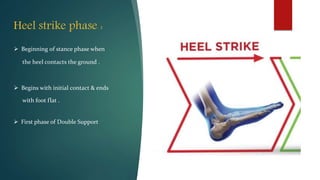
Heel strike phase :
 Beginning of stance phase when
the heel contacts the ground .
 Begins with initial contact & ends
with foot flat .
 First phase of Double Support
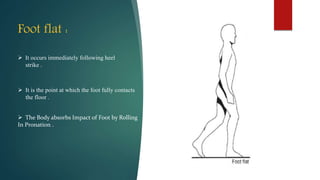
Foot flat :
 It occurs immediately following heel
strike .
 It is the point at which the foot fully contacts
the floor .
 The Body absorbs Impact of Foot by Rolling
In Pronation .
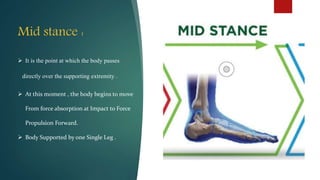
Mid stance :
 It is the point at which the body passes
directly over the supporting extremity .
 At this moment , the body begins to move
From force absorption at Impact to Force
Propulsion Forward.
 Body Supported by one Single Leg .
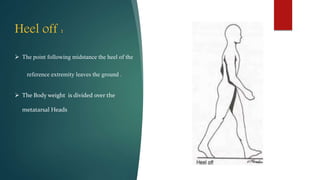
Heel off :
 The point following midstance the heel of the
reference extremity leaves the ground .
 The Body weight is divided over the
metatarsal Heads
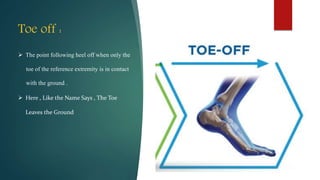
Toe off :
 The point following heel off when only the
toe of the reference extremity is in contact
with the ground .
 Here , Like the Name Says , The Toe
Leaves the Ground
Swing phase
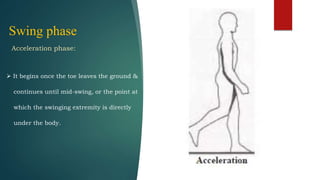
Acceleration phase:
 It begins once the toe leaves the ground &
continues until mid-swing, or the point at
which the swinging extremity is directly
under the body.
Swing phase
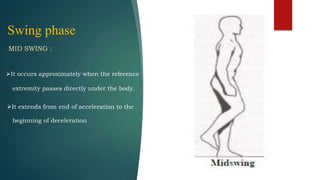
MID SWING :
It occurs approximately when the reference
extremity passes directly under the body.
It extends from end of acceleration to the
beginning of deceleration
Swing phase
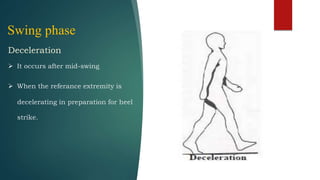
Deceleration
 It occurs after mid-swing
 When the referance extremity is
decelerating in preparation for heel
strike.
DETERMINANTS OF GAIT
 Displacement of center of gravity (COG).
 Factors responsible for minimizing
displacement of center of gravity.
CENTER OF GRAVITY
It is an imaginary point at which all the weight of the
body is concentrated at a given instant.
Center of gravity lies 2 inches in front of the second
sacral vertebra.
Centre of gravity follows vertical displacement and
horizontal displacement
Factors responsible for minimizing
the displacement of centre of gravity :
Major determinants
Pelvic Rotation
Pelvic Lateral Tilt
Knee Flexion During Stance
Ankle Mechanism
Step Width
Minor determinants:
 Neck movement.
 Swinging of arms.
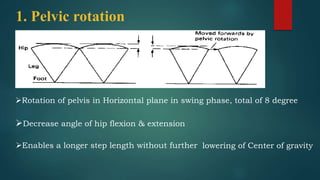
1. Pelvic rotation
Rotation of pelvis in Horizontal plane in swing phase, total of 8 degree
Decrease angle of hip flexion & extension
Enables a longer step length without further lowering of Center of gravity
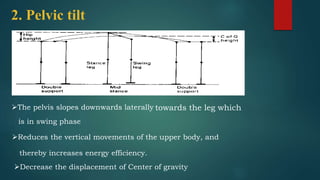
2. Pelvic tilt
The pelvis slopes downwards laterally towards the leg which
is in swing phase
Reduces the vertical movements of the upper body, and
thereby increases energy efficiency.
Decrease the displacement of Center of gravity
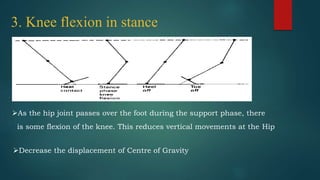
3. Knee flexion in stance
As the hip joint passes over the foot during the support phase, there
is some flexion of the knee. This reduces vertical movements at the Hip
Decrease the displacement of Centre of Gravity
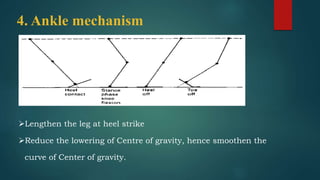
4. Ankle mechanism
Lengthen the leg at heel strike
Reduce the lowering of Centre of gravity, hence smoothen the
curve of Center of gravity.
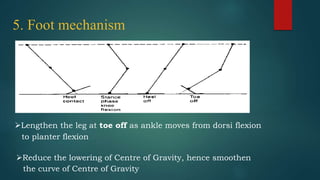
5. Foot mechanism
Lengthen the leg at toe off as ankle moves from dorsi flexion
to planter flexion
Reduce the lowering of Centre of Gravity, hence smoothen
the curve of Centre of Gravity
Trunk and Arms :
 The trunk, arms and shoulders also rotate to ensure
balance
 Upper limb swings opposite to stance leg to produce a
smooth balanced gait.
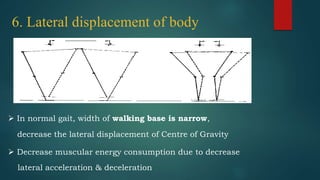
6. Lateral displacement of body
 In normal gait, width of walking base is narrow,
decrease the lateral displacement of Centre of Gravity
 Decrease muscular energy consumption due to decrease
lateral acceleration & deceleration
 Due to complex interaction of muscular activity & joints
motion in lower limb Centre of Gravity follows a smooth
sinusoidal curve.
 It reduce the significant energy consumption of
ambulation.
GAIT IN CHILDREN (<2years) :
 Gait of small children differs from that of adult
 The walking base is wider.
 The stride length & speed are lower & the cycle time
shorter(higher cadence).
 Small children have no heel strike, initial contact being made
by flat foot.
 There is very little stance phase and knee flexion.
 The whole leg is externally rotated during the swing phase.
 There is an absence of reciprocal arm swinging.
GAIT IN ELDERLY :
 The age related changes in gait takes place in decade
after 70yrs.
 There is a decreased stride length, increased cycle
time(decreased cadence).
 Relative increase in duration of stance phase of gait cycle.
 The speed almost always reduced in elderly people.
 Reduction in total range of hip flexion & extension,
 Reduction in swing phase and knee flexion
Function of the determinants of gait :
 Increase the efficiency and smoothness of gait.
 Decrease the vertical and lateral displacement of
center of gravity.
 Decrease the energy expenditure.
 Make gait more graceful.
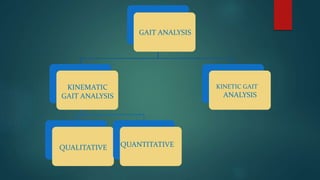
GAIT ANALYSIS
KINEMATIC
GAIT ANALYSIS
QUALITATIVE
KINETIC GAIT
ANALYSIS
QUANTITATIVE
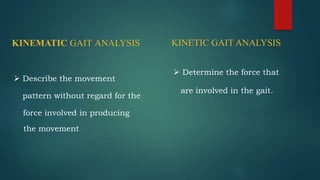
KINEMATIC GAIT ANALYSIS KINETIC GAIT ANALYSIS
 Describe the movement
pattern without regard for the
force involved in producing
the movement
 Determine the force that
are involved in the gait.
Gait analysis :
 Observational method- naked eye examination
 Photographic method- television , video, movie analysis
 Force plate study method-ground reaction force method
 Electro myographic study (EMG)
 Electro goniometric study
 Energy expenditure/requirement method
 Multichannel funtional electrical stimulation method(MFES)
Clinical gait analysis
Observational gait data: (Qualitative)
 Clinician watches patients walk
Advantage :
 Require
 Inexpensive
 Yield general description of gait variables
little or no instrumentation
Gait parameters (Quantitative)
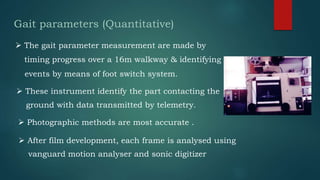
 The gait parameter measurement are made by
timing progress over a 16m walkway & identifying
events by means of foot switch system.
 These instrument identify the part contacting the
ground with data transmitted by telemetry.
 Photographic methods are most accurate .
 After film development, each frame is analysed using
vanguard motion analyser and sonic digitizer
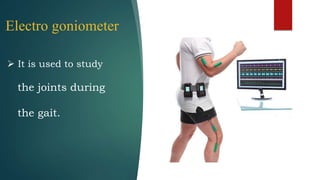
Electro goniometer
 It is used to study
the joints during
the gait.
Energetics
 Deals with measurement of oxygen consumption
during a specific task
 Oxygen uptake is inversely related to the efficiency of gait.
PATHOLOGICAL GAIT
Resulting from Musculoskeletal , often caused by :
 Soft Tissue Imbalance
 Joint Alignment
 Bony Abnormalities
The Common Deviation can be categorized as :
 Hip Pathology
 Knee Pathology
 Foot and Ankle Pathology
 Leg Length Discrepancy
 Pain
HIP PATHOLOGY
ARTHRITIS :
 Reduced range of movements during swing phase
 Causes an exaggeration of movement in the ‘
opposite Limb – ‘ Hip Hiking ‘
EXCESSIVE HIP FLEXION :
 Hip Flexion Contractures
 IT Band Contractures
 Hip Flexor Spasticity
 Hip Pain
OTHER CAUSES :
 Hip Abductor Weakness
 Hip Adductor Contracture
 Weak Hip Extensors
KNEE PATHOLOGY
Common Causes :
 Weak Quadriceps
 Knee Flexion Contracture
ANKLE PATHOLOGY
Common Causes :
 Ankle Dorsiflexion Weakness
 Calf Tightening or Contractures
FOOT PATHOLOGY
HALLUX RIGIDUS :
 Lack of dorsiflexion of Great Toe
 MPJ uses Windlass affect to raise the arch and stiffen the foot
 To be efficient in creating stiffness , the Hallux should be able
dorsiflex at least 65 degrees
LIMB LENGTH DISCREPANCY
 Can be a result of asymmetric Pelvis , Femur or Tibia Length
 Or Other reasons such as Scoliosis or Contractures
 Gait Pattern will present as Pelvic dip to the shortened side
during stance phase
 Possible , Toe Walking , on the Shortened side
PATHOLOGICAL GAIT PATTERNS
 Scissoring gait
 In toeing gait
 Out toeing gait
 High stepping gait
 Circumduction gait
 Waddling gait
 Trendelenberg gait
 Drunkers gait
 Festinant gait
 Antalgic gait
 Knock knee gait
 Genu recurvatum gait
 Short limb gait
 Quadricep gait
 Gluteus medius gait
 Gluteal maximus gait
 Stiff hip gait
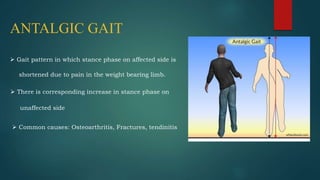
ANTALGIC GAIT
 Gait pattern in which stance phase on affected side is
shortened due to pain in the weight bearing limb.
 There is corresponding increase in stance phase on
unaffected side
 Common causes: Osteoarthritis, Fractures, tendinitis
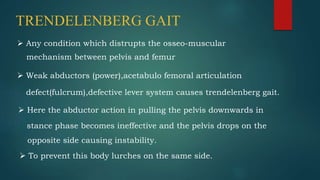
TRENDELENBERG GAIT
 Any condition which distrupts the osseo-muscular
mechanism between pelvis and femur
 Weak abductors (power),acetabulo femoral articulation
defect(fulcrum),defective lever system causes trendelenberg gait.
 Here the abductor action in pulling the pelvis downwards in
stance phase becomes ineffective and the pelvis drops on the
opposite side causing instability.
 To prevent this body lurches on the same side.
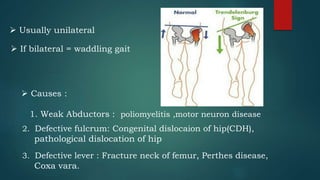
 Usually unilateral
 If bilateral = waddling gait
 Causes :
1. Weak Abductors : poliomyelitis ,motor neuron disease
2. Defective fulcrum: Congenital dislocaion of hip(CDH),
pathological dislocation of hip
3. Defective lever : Fracture neck of femur, Perthes disease,
Coxa vara.
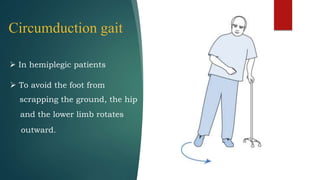
Circumduction gait
 In hemiplegic patients
 To avoid the foot from
scrapping the ground, the hip
and the lower limb rotates
outward.
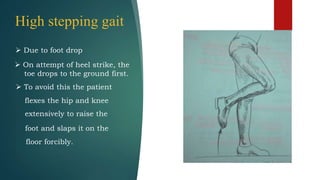
High stepping gait
 Due to foot drop
 On attempt of heel strike, the
toe drops to the ground first.
 To avoid this the patient
flexes the hip and knee
extensively to raise the
foot and slaps it on the
floor forcibly.
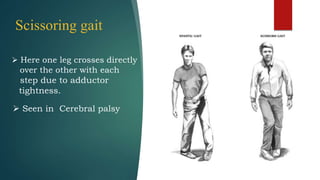
Scissoring gait
 Here one leg crosses directly
over the other with each
step due to adductor
tightness.
 Seen in Cerebral palsy
Drunkers or reeling gait
 Patient tends to walk irregularly on wide base, swinging
sideways without stability and balance.
 Caused due to cerebellar lesion.
 With unilateral lesion of cerebellum, balance is lost towards the
side of the lesion.
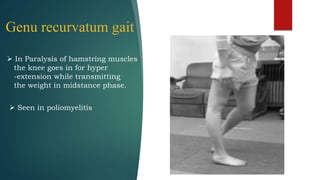
Genu recurvatum gait
 In Paralysis of hamstring muscles
the knee goes in for hyper
-extension while transmitting
the weight in midstance phase.
 Seen in poliomyelitis
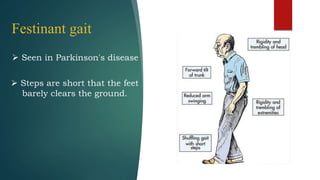
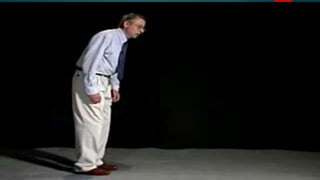
Festinant gait
 Seen in Parkinson's disease
 Steps are short that the feet
barely clears the ground.
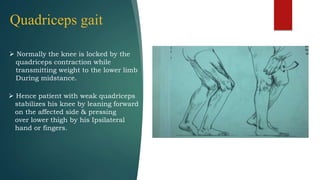
Quadriceps gait
 Normally the knee is locked by the
quadriceps contraction while
transmitting weight to the lower limb
During midstance.
 Hence patient with weak quadriceps
stabilizes his knee by leaning forward
on the affected side & pressing
over lower thigh by his Ipsilateral
hand or fingers.
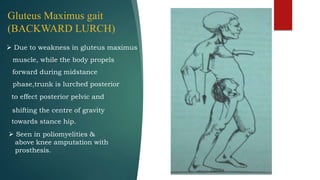
Gluteus Maximus gait
(BACKWARD LURCH)
 Due to weakness in gluteus maximus
muscle, while the body propels
forward during midstance
phase,trunk is lurched posterior
to effect posterior pelvic and
shifting the centre of gravity
towards stance hip.
 Seen in poliomyelities &
above knee amputation with
prosthesis.
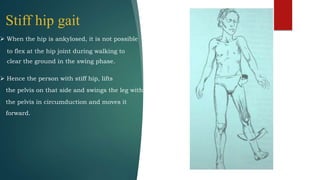
Stiff hip gait
 When the hip is ankylosed, it is not possible
to flex at the hip joint during walking to
clear the ground in the swing phase.
 Hence the person with stiff hip, lifts
the pelvis on that side and swings the leg with
the pelvis in circumduction and moves it
forward.
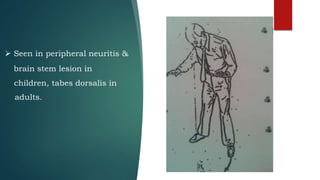
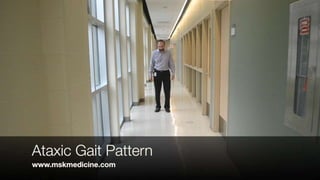
STAMPING/ATAXIC GAIT
 It occurs in sensory ataxia in which there is loss of sensation
in lower extremity due to disease processes in peripheral
nerves, dorsal roots, dorsal column of spinal cord.
 Due to absence of deep position sense,the patient constantly
observes placing of his feet.
 Hip is hyperflexed & externally rotated & forefoot is
dorsiflexed to strike ground with a Stamp.
 Seen in peripheral neuritis &
brain stem lesion in
children, tabes dorsalis in
adults.
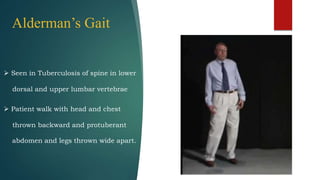
Alderman’s Gait
 Seen in Tuberculosis of spine in lower
dorsal and upper lumbar vertebrae
 Patient walk with head and chest
thrown backward and protuberant
abdomen and legs thrown wide apart.
GAIT TRAINING
AIM :
 To achieve safe, easy, effortless normal gait pattern.
Non ambulatory phase :
 Asses and improve the range of movement
 Treat contractures
 Improve the cardio respiratory status
 Shadow walking
 Assisted device
Ambulatory phase :
 Parallel bar walking
 Encourage reciprocal arm swinging
 Follow other forms of walking
 Turning
 Side walk
 back walk
 Squatting
 Getting up
 Walking on uneven rough surface
 Support by orthotic & prosthesis
Gait and its abnormalities

Gait and its abnormalities

  • 2.
    Definition : Bi-Pedal ,Bi-Phasic , Rhythmic, cyclic movement of the limbs , In relation to the trunk resulting in forward propulsion of , centre of Gravity of the Human body , In which there are Sinuous movements of different segments Of Human body with Least expenditure of Energy .
  • 3.
    NORMAL GAIT REQUIRES: Normal functioning of musculoskeletal system of lower limbs & spine. Good sensory feedback from proprioceptive sensation from feet and the joints. Visual , labyrinthine sensory inputs & co ordination add smoothness, rhythm & elegance to the human gait
  • 4.
    The GAIT CYCLE Thesequences for Walking may be summarised as follows :  Registration and activation of Gait Command within CNS  Transmission of Gait systems to the PNS  Contraction of Muscles  Generation of Several Forces  Regulation of Joint forces and movements across synovial Joints and Skeletal segments  Generation of Ground Reaction Forces
  • 5.
    GAIT TERMINOLOGY  Baseof support  Step length  Stride length  Gait cycle  Cadence  Walking velocity  Double limb support  Single limb support  Ground reaction force vector
  • 6.
    GAIT CYCLE  Periodfrom one heel strike to next heel strike of the same limb .
  • 7.
    BASIC GAIT TERMS Baseof support :  Distance between a person’s feet while standing or during ambulation  Provides balance & stability to maintain erect posture .  Normally 2-4 inches from heel to heel While Standing .
  • 8.
    STEP LENGTH  Lineardistance along the line of progression of one foot travelled during one gait cycle  Approximately 15 inches
  • 9.
    STRIDE LENGTH : Linear distance in the plane of progression between successive point of foot to floor contact of the same foot .  Normally 27 – 32 inches.  1 Stride = 2 Steps
  • 10.
    Cadence  It ismeasured as the number of steps / sec or per minute .  Approximately 70 steps per minute Double limb support  During normal gait, for a moment , two lower extremities are in simultaneous contact with the ground .  During this period, both legs support the body weight .  Happens between push off & toe off on same side and heel strike & foot flat on the contra lateral side .
  • 11.
    GAIT CYCLE COMPONENTS 1.Stance phase :  60% of the gait cycle. 2. Swing phase :  40% of the gait cycle.
  • 12.
    STANCE PHASE  Heelstrike  Foot flat  Midstance  Heel off  Toe off
  • 13.
    SWING PHASE  Acceleration Mid swing  Deceleration
  • 14.
    Heel strike phase:  Beginning of stance phase when the heel contacts the ground .  Begins with initial contact & ends with foot flat .  First phase of Double Support
  • 15.
    Foot flat : It occurs immediately following heel strike .  It is the point at which the foot fully contacts the floor .  The Body absorbs Impact of Foot by Rolling In Pronation .
  • 16.
    Mid stance : It is the point at which the body passes directly over the supporting extremity .  At this moment , the body begins to move From force absorption at Impact to Force Propulsion Forward.  Body Supported by one Single Leg .
  • 17.
    Heel off : The point following midstance the heel of the reference extremity leaves the ground .  The Body weight is divided over the metatarsal Heads
  • 18.
    Toe off : The point following heel off when only the toe of the reference extremity is in contact with the ground .  Here , Like the Name Says , The Toe Leaves the Ground
  • 23.
    Swing phase Acceleration phase: It begins once the toe leaves the ground & continues until mid-swing, or the point at which the swinging extremity is directly under the body.
  • 24.
    Swing phase MID SWING: It occurs approximately when the reference extremity passes directly under the body. It extends from end of acceleration to the beginning of deceleration
  • 25.
    Swing phase Deceleration  Itoccurs after mid-swing  When the referance extremity is decelerating in preparation for heel strike.
  • 26.
    DETERMINANTS OF GAIT Displacement of center of gravity (COG).  Factors responsible for minimizing displacement of center of gravity.
  • 27.
    CENTER OF GRAVITY Itis an imaginary point at which all the weight of the body is concentrated at a given instant. Center of gravity lies 2 inches in front of the second sacral vertebra. Centre of gravity follows vertical displacement and horizontal displacement
  • 28.
    Factors responsible forminimizing the displacement of centre of gravity : Major determinants Pelvic Rotation Pelvic Lateral Tilt Knee Flexion During Stance Ankle Mechanism Step Width Minor determinants:  Neck movement.  Swinging of arms.
  • 29.
    1. Pelvic rotation Rotationof pelvis in Horizontal plane in swing phase, total of 8 degree Decrease angle of hip flexion & extension Enables a longer step length without further lowering of Center of gravity
  • 30.
    2. Pelvic tilt Thepelvis slopes downwards laterally towards the leg which is in swing phase Reduces the vertical movements of the upper body, and thereby increases energy efficiency. Decrease the displacement of Center of gravity
  • 31.
    3. Knee flexionin stance As the hip joint passes over the foot during the support phase, there is some flexion of the knee. This reduces vertical movements at the Hip Decrease the displacement of Centre of Gravity
  • 32.
    4. Ankle mechanism Lengthenthe leg at heel strike Reduce the lowering of Centre of gravity, hence smoothen the curve of Center of gravity.
  • 33.
    5. Foot mechanism Lengthenthe leg at toe off as ankle moves from dorsi flexion to planter flexion Reduce the lowering of Centre of Gravity, hence smoothen the curve of Centre of Gravity
  • 34.
    Trunk and Arms:  The trunk, arms and shoulders also rotate to ensure balance  Upper limb swings opposite to stance leg to produce a smooth balanced gait.
  • 35.
    6. Lateral displacementof body  In normal gait, width of walking base is narrow, decrease the lateral displacement of Centre of Gravity  Decrease muscular energy consumption due to decrease lateral acceleration & deceleration
  • 36.
     Due tocomplex interaction of muscular activity & joints motion in lower limb Centre of Gravity follows a smooth sinusoidal curve.  It reduce the significant energy consumption of ambulation.
  • 37.
    GAIT IN CHILDREN(<2years) :  Gait of small children differs from that of adult  The walking base is wider.  The stride length & speed are lower & the cycle time shorter(higher cadence).  Small children have no heel strike, initial contact being made by flat foot.  There is very little stance phase and knee flexion.  The whole leg is externally rotated during the swing phase.  There is an absence of reciprocal arm swinging.
  • 38.
    GAIT IN ELDERLY:  The age related changes in gait takes place in decade after 70yrs.  There is a decreased stride length, increased cycle time(decreased cadence).  Relative increase in duration of stance phase of gait cycle.  The speed almost always reduced in elderly people.  Reduction in total range of hip flexion & extension,  Reduction in swing phase and knee flexion
  • 39.
    Function of thedeterminants of gait :  Increase the efficiency and smoothness of gait.  Decrease the vertical and lateral displacement of center of gravity.  Decrease the energy expenditure.  Make gait more graceful.
  • 40.
  • 41.
    KINEMATIC GAIT ANALYSISKINETIC GAIT ANALYSIS  Describe the movement pattern without regard for the force involved in producing the movement  Determine the force that are involved in the gait.
  • 42.
    Gait analysis : Observational method- naked eye examination  Photographic method- television , video, movie analysis  Force plate study method-ground reaction force method  Electro myographic study (EMG)  Electro goniometric study  Energy expenditure/requirement method  Multichannel funtional electrical stimulation method(MFES)
  • 43.
    Clinical gait analysis Observationalgait data: (Qualitative)  Clinician watches patients walk Advantage :  Require  Inexpensive  Yield general description of gait variables little or no instrumentation
  • 44.
    Gait parameters (Quantitative) The gait parameter measurement are made by timing progress over a 16m walkway & identifying events by means of foot switch system.  These instrument identify the part contacting the ground with data transmitted by telemetry.  Photographic methods are most accurate .  After film development, each frame is analysed using vanguard motion analyser and sonic digitizer
  • 45.
    Electro goniometer  Itis used to study the joints during the gait.
  • 46.
    Energetics  Deals withmeasurement of oxygen consumption during a specific task  Oxygen uptake is inversely related to the efficiency of gait.
  • 47.
    PATHOLOGICAL GAIT Resulting fromMusculoskeletal , often caused by :  Soft Tissue Imbalance  Joint Alignment  Bony Abnormalities The Common Deviation can be categorized as :  Hip Pathology  Knee Pathology  Foot and Ankle Pathology  Leg Length Discrepancy  Pain
  • 48.
    HIP PATHOLOGY ARTHRITIS : Reduced range of movements during swing phase  Causes an exaggeration of movement in the ‘ opposite Limb – ‘ Hip Hiking ‘ EXCESSIVE HIP FLEXION :  Hip Flexion Contractures  IT Band Contractures  Hip Flexor Spasticity  Hip Pain OTHER CAUSES :  Hip Abductor Weakness  Hip Adductor Contracture  Weak Hip Extensors
  • 49.
    KNEE PATHOLOGY Common Causes:  Weak Quadriceps  Knee Flexion Contracture ANKLE PATHOLOGY Common Causes :  Ankle Dorsiflexion Weakness  Calf Tightening or Contractures
  • 50.
    FOOT PATHOLOGY HALLUX RIGIDUS:  Lack of dorsiflexion of Great Toe  MPJ uses Windlass affect to raise the arch and stiffen the foot  To be efficient in creating stiffness , the Hallux should be able dorsiflex at least 65 degrees LIMB LENGTH DISCREPANCY  Can be a result of asymmetric Pelvis , Femur or Tibia Length  Or Other reasons such as Scoliosis or Contractures  Gait Pattern will present as Pelvic dip to the shortened side during stance phase  Possible , Toe Walking , on the Shortened side
  • 51.
    PATHOLOGICAL GAIT PATTERNS Scissoring gait  In toeing gait  Out toeing gait  High stepping gait  Circumduction gait  Waddling gait  Trendelenberg gait  Drunkers gait  Festinant gait  Antalgic gait  Knock knee gait  Genu recurvatum gait  Short limb gait  Quadricep gait  Gluteus medius gait  Gluteal maximus gait  Stiff hip gait
  • 52.
    ANTALGIC GAIT  Gaitpattern in which stance phase on affected side is shortened due to pain in the weight bearing limb.  There is corresponding increase in stance phase on unaffected side  Common causes: Osteoarthritis, Fractures, tendinitis
  • 54.
    TRENDELENBERG GAIT  Anycondition which distrupts the osseo-muscular mechanism between pelvis and femur  Weak abductors (power),acetabulo femoral articulation defect(fulcrum),defective lever system causes trendelenberg gait.  Here the abductor action in pulling the pelvis downwards in stance phase becomes ineffective and the pelvis drops on the opposite side causing instability.  To prevent this body lurches on the same side.
  • 55.
     Usually unilateral If bilateral = waddling gait  Causes : 1. Weak Abductors : poliomyelitis ,motor neuron disease 2. Defective fulcrum: Congenital dislocaion of hip(CDH), pathological dislocation of hip 3. Defective lever : Fracture neck of femur, Perthes disease, Coxa vara.
  • 57.
    Circumduction gait  Inhemiplegic patients  To avoid the foot from scrapping the ground, the hip and the lower limb rotates outward.
  • 59.
    High stepping gait Due to foot drop  On attempt of heel strike, the toe drops to the ground first.  To avoid this the patient flexes the hip and knee extensively to raise the foot and slaps it on the floor forcibly.
  • 61.
    Scissoring gait  Hereone leg crosses directly over the other with each step due to adductor tightness.  Seen in Cerebral palsy
  • 64.
    Drunkers or reelinggait  Patient tends to walk irregularly on wide base, swinging sideways without stability and balance.  Caused due to cerebellar lesion.  With unilateral lesion of cerebellum, balance is lost towards the side of the lesion.
  • 66.
    Genu recurvatum gait In Paralysis of hamstring muscles the knee goes in for hyper -extension while transmitting the weight in midstance phase.  Seen in poliomyelitis
  • 68.
    Festinant gait  Seenin Parkinson's disease  Steps are short that the feet barely clears the ground.
  • 70.
    Quadriceps gait  Normallythe knee is locked by the quadriceps contraction while transmitting weight to the lower limb During midstance.  Hence patient with weak quadriceps stabilizes his knee by leaning forward on the affected side & pressing over lower thigh by his Ipsilateral hand or fingers.
  • 72.
    Gluteus Maximus gait (BACKWARDLURCH)  Due to weakness in gluteus maximus muscle, while the body propels forward during midstance phase,trunk is lurched posterior to effect posterior pelvic and shifting the centre of gravity towards stance hip.  Seen in poliomyelities & above knee amputation with prosthesis.
  • 74.
    Stiff hip gait When the hip is ankylosed, it is not possible to flex at the hip joint during walking to clear the ground in the swing phase.  Hence the person with stiff hip, lifts the pelvis on that side and swings the leg with the pelvis in circumduction and moves it forward.
  • 76.
    STAMPING/ATAXIC GAIT  Itoccurs in sensory ataxia in which there is loss of sensation in lower extremity due to disease processes in peripheral nerves, dorsal roots, dorsal column of spinal cord.  Due to absence of deep position sense,the patient constantly observes placing of his feet.  Hip is hyperflexed & externally rotated & forefoot is dorsiflexed to strike ground with a Stamp.
  • 77.
     Seen inperipheral neuritis & brain stem lesion in children, tabes dorsalis in adults.
  • 79.
    Alderman’s Gait  Seenin Tuberculosis of spine in lower dorsal and upper lumbar vertebrae  Patient walk with head and chest thrown backward and protuberant abdomen and legs thrown wide apart.
  • 80.
    GAIT TRAINING AIM : To achieve safe, easy, effortless normal gait pattern. Non ambulatory phase :  Asses and improve the range of movement  Treat contractures  Improve the cardio respiratory status  Shadow walking  Assisted device
  • 81.
    Ambulatory phase : Parallel bar walking  Encourage reciprocal arm swinging  Follow other forms of walking  Turning  Side walk  back walk  Squatting  Getting up  Walking on uneven rough surface  Support by orthotic & prosthesis