Group Members:
Topic
“INTERNATIONALAND NATIONAL
TRENDS IN CURRICULUM
DEVELOPMENT AT PRIMARY LEVEL”
Introduction
Many immediate and complex issues overcome educators
today. With positive and negative global influences,

educators must look beyond the surface of education.
Students are not just products of their schools but will
become shaping forces in society, determining the success
and failure of their nation's future. Curricularists,
educators, and everyone in leadership need to work
together to develop a well-rounded curriculum, which
includes the learning of different cultures. Our next
generation will need to cope with cross-cultural matters
and grow into sensible adults who are fair and just to the
global society
International Trends
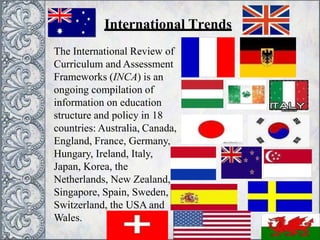
The International Review of
Curriculum and Assessment
Frameworks (INCA) is an
ongoing compilation of
information on education
structure and policy in 18
countries: Australia, Canada,
England, France, Germany,
Hungary, Ireland, Italy,
Japan, Korea, the
Netherlands, New Zealand,
Singapore, Spain, Sweden,
Switzerland, the USA and
Wales.
•All countries have a constitutional curriculum, prescribed
by national or sub-national authorities.
•Four countries that have introduced a statutory curriculum
within the past 15 years – England, the Netherlands, New
Zealand and Wales – have recently reduced the level of
prescription in favour of frameworks, within which schools
devise a curriculum to suit local circumstances.
•
•Italy, which had relaxed curricular control during the same
period, has recently begun to tighten control (2003).
•
•In Scotland, there are non-statutory curriculum guidelines,
which tend to be adopted by most schools.
Con't
•There is a tendency towards increasing review of curricula to
reflect changing needs, and most countries have undertaken
major reforms of the primary curriculum within the past 15
years.17 This has been accompanied by a trend towards the
creation of specialist curriculum (or curriculum and assessment)
agencies, separate from Ministries. These now exist in 11
countries.
•In all countries, there are greater expectations in terms of skills
and dispositions, which are perceived as relevant to lifelong
learning, employment and social participation. As a result,
curricula designed during the past fifteen years increasingly
stress the role of transferable skills and, in some cases, reduce
prescribed content.
Con't
•There is a trend towards formulating curricula in terms of
learning outcomes.19 In a few cases – Australia, Canada
(Ontario) and England – these are linked to achievement targets
which specify the percentage of pupils who are expected to
achieve a given level have been linked to these learning
outcomes.
. There is an increasing trend towards offering one or more
foreign languages, and/or extending provision for younger
pupils, even where it is not mandatory.
• Finland, which now bases its curriculum on PBL.
•Singapore, and other countries have shifted
curricula and classroom practices with overall
success.
•Costa Rica has been a leader in constructivist
education for a decade.
•larger countries such as India and China have
recently undertaken reforms intended to spark
development of higher-order cognition and
creativity.
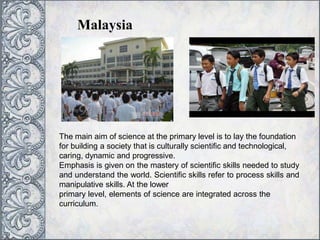
Malaysia
The main aim of science at the primary level is to lay the foundation
for building a society that is culturally scientific and technological,
caring, dynamic and progressive.
Emphasis is given on the mastery of scientific skills needed to study
and understand the world. Scientific skills refer to process skills and
manipulative skills. At the lower
primary level, elements of science are integrated across the
curriculum.
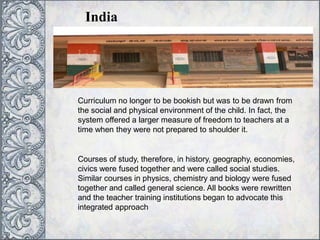
India
Curriculum no longer to be bookish but was to be drawn from
the social and physical environment of the child. In fact, the
system offered a larger measure of freedom to teachers at a
time when they were not prepared to shoulder it.
Courses of study, therefore, in history, geography, economies,
civics were fused together and were called social studies.
Similar courses in physics, chemistry and biology were fused
together and called general science. All books were rewritten
and the teacher training institutions began to advocate this
integrated approach
Elements of technology-based education are introduced at the
upper primary level through the living skills curriculum, which
covers various aspects of manipulative skills.
At the primary school level,
the subject focuses on three main topics, namely: Maintaining,
repairing and producing things; Buying and selling things;
Managing self and work.
Technology-based
education
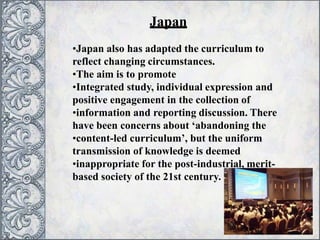
•Japan also has adapted the curriculum to
reflect changing circumstances.
•The aim is to promote
•Integrated study, individual expression and
positive engagement in the collection of
•information and reporting discussion. There
have been concerns about ‘abandoning the
•content-led curriculum’, but the uniform
transmission of knowledge is deemed
•inappropriate for the post-industrial, merit-
based society of the 21st century.
Japan
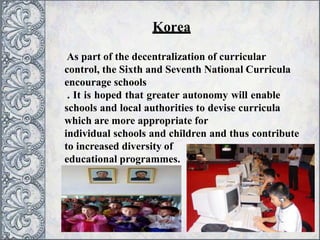
Korea
As part of the decentralization of curricular
control, the Sixth and Seventh National Curricula
encourage schools
. It is hoped that greater autonomy will enable
schools and local authorities to devise curricula
which are more appropriate for
individual schools and children and thus contribute
to increased diversity of
educational programmes.
Curriculum design and development
To ensure national cohesion, integration and
preservation of the ideological foundation of the State,
certain educational functions are the responsibilities
of the Federation—via the Federal Ministry of
Education.
These responsibilities include:
•Curriculum,
•Syllabus,
•Planning,
•Policy and
•Educational standards.
The 1976 Act of Parliament authorized the Ministry of Education
(MOE) to appoint competent authorities to perform the curriculum-
related functions.
A Central/National Bureau of Curriculum and Textbooks (NBCT,
commonly known as the Curriculum Wing) was appointed to
supervise curriculum and textbooks development/approval and to
maintain curriculum standards from the primary through to the
higher secondary levels.
Four counterpart provincial curriculum centers (one in each
province) were established to ensure provincial collaboration and
evolve consensus in all activities falling within
the purview of the Federation.
This initiative was followed by the establishment of four Provincial
Textbook Boards (PTTB)—one in each province.
• This initiative was followed by the establishment of four
Provincial Textbook Boards (PTBB)—one in each
province.
• Within their respective jurisdictions, these PTTBs are
responsible for:
8. preparing,
9. publishing,
10.stocking,
11.distributing and
12.marketing school textbooks.
THE CURRICULUM DEVELOPMENT PROCESS
Reform
The process of curriculum reform in Pakistan has been
introduced as part of the successive series of national
education policies.
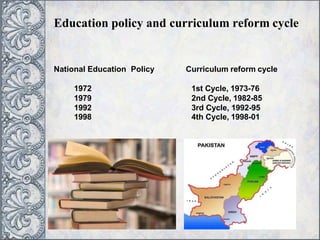
Education policy and curriculum reform cycle
National Education Policy Curriculum reform cycle
1972 1st Cycle, 1973-76
1979 2nd Cycle, 1982-85
1992 3rd Cycle, 1992-95
1998 4th Cycle, 1998-01
The studies scheme
The scheme of studies is based on three key
factors:
•
•
•
The national education policy,
Market demand,
Global issues that relate to new or
contemporary education dimensions.
•Provincial Textbook Boards (PTBB) are responsible for
development of text-books according to the approved syllabi.
•Established lists of textbook writers in various subjects
•are kept.
•From these lists, invitations are issued to writers to submit
draft materials within the prescribed syllabus parameters.
•Selections are made on the basis of the quality and
relevance of materials submitted to local situations.
•Finally, the selected materials are transformed into
textbooks; the final versions of which are sent to the NBCT for
approval.
Textbook development
Review and approval
A National Review Committee, comprising five or six
members includes:
•one expert from the Syllabus Formulation Committee
•two subject experts
•two schoolteachers
This committee conducts textbook reviews based on the following
parameters:
(a) the book truly reflects the curriculum;
(b) it meets the objectives stated in the curriculum;
(c)the book does not contain any material repugnant to Islamic and
Pakistani ideology.
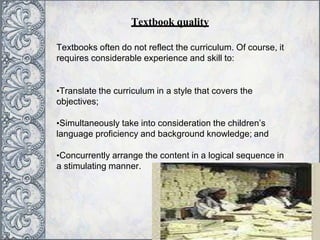
Textbooks often do not reflect the curriculum. Of course, it
requires considerable experience and skill to:
•Translate the curriculum in a style that covers the
objectives;
•Simultaneously take into consideration the children’s
language proficiency and background knowledge; and
•Concurrently arrange the content in a logical sequence in
a stimulating manner.
Textbook quality
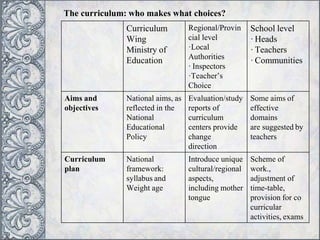
The curriculum: who makes what choices?
Curriculum
Wing
Ministry of
Education
Regional/Provin
cial level
·Local
Authorities
· Inspectors
·Teacher’s
Choice
School level
· Heads
· Teachers
· Communities
Aims and
objectives
National aims, as
reflected in the
National
Educational
Policy
Evaluation/study
reports of
curriculum
centers provide
change
direction
Some aims of
effective
domains
are suggested by
teachers
Curriculum
plan
National
framework:
syllabus and
Weight age
Introduce unique
cultural/regional
aspects,
including mother
tongue
Scheme of
work.,
adjustment of
time-table,
provision for co
curricular
activities, exams
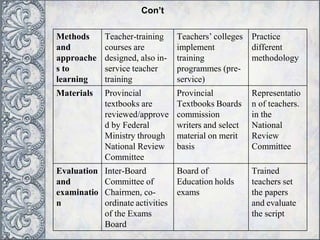
Methods
and
approache
s to
learning
Teacher-training
courses are
designed, also in-
service teacher
training
Teachers’ colleges
implement
training
programmes (pre-
service)
Practice
different
methodology
Materials Provincial
textbooks are
reviewed/approve
d by Federal
Ministry through
National Review
Committee
Provincial
Textbooks Boards
commission
writers and select
material on merit
basis
Representatio
n of teachers.
in the
National
Review
Committee
Evaluation
and
examinatio
n
Inter-Board
Committee of
Chairmen, co-
ordinate activities
of the Exams
Board
Board of
Education holds
exams
Trained
teachers set
the papers
and evaluate
the script
Con’t
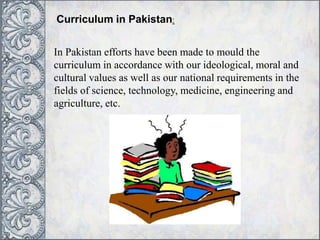
Curriculum in Pakistan:
In Pakistan efforts have been made to mould the
curriculum in accordance with our ideological, moral and
cultural values as well as our national requirements in the
fields of science, technology, medicine, engineering and
agriculture, etc.
Suggestions for curriculum development
•curriculum should be goal oriented
•Curriculum should be according to the future trends.
•Enhance critical thinking
•Develop vocational skills.
•Use white space.
•Headlines should be action or benefit oriented and short
•Formative assessment should be included for
curriculum assessment because it provides feedback
to the student during the course.
•Curriculum should always be according to needs of
the students and match the mental level of the
students, like the knowledge, vocabulary, skills.
•Technology plays an essential role in our education
today and will even more so in the future. Technology
should be available in every school funded by taxes
and donation from private industry.
Con’t
•We should also take advantage of technology to form a
curriculum for creating international awareness,
understanding various cultures, and learning different
opinions and values.
•
•Curriculums need to focus on melting down barriers
against others who are different and to encourage mutual
respect and understanding for other cultures and beliefs.
•Primary schools must continue to give priority to literacy
and numeracy.
•Schools should focus on teaching only one or two
languages.
•The curriculum should be subject to well-managed,
periodic change in response to national and global
developments that influence how our culture is
transmitted, conserved and renewed, for the benefit of
all, through the process of education in school and
beyond.
Mols 110504005341-phpapp01-converted

Mols 110504005341-phpapp01-converted

  • 2.
  • 3.
    Topic “INTERNATIONALAND NATIONAL TRENDS INCURRICULUM DEVELOPMENT AT PRIMARY LEVEL”
  • 4.
    Introduction Many immediate andcomplex issues overcome educators today. With positive and negative global influences, educators must look beyond the surface of education. Students are not just products of their schools but will become shaping forces in society, determining the success and failure of their nation's future. Curricularists, educators, and everyone in leadership need to work together to develop a well-rounded curriculum, which includes the learning of different cultures. Our next generation will need to cope with cross-cultural matters and grow into sensible adults who are fair and just to the global society
  • 5.
    International Trends The InternationalReview of Curriculum and Assessment Frameworks (INCA) is an ongoing compilation of information on education structure and policy in 18 countries: Australia, Canada, England, France, Germany, Hungary, Ireland, Italy, Japan, Korea, the Netherlands, New Zealand, Singapore, Spain, Sweden, Switzerland, the USA and Wales.
  • 6.
    •All countries havea constitutional curriculum, prescribed by national or sub-national authorities. •Four countries that have introduced a statutory curriculum within the past 15 years – England, the Netherlands, New Zealand and Wales – have recently reduced the level of prescription in favour of frameworks, within which schools devise a curriculum to suit local circumstances. • •Italy, which had relaxed curricular control during the same period, has recently begun to tighten control (2003). • •In Scotland, there are non-statutory curriculum guidelines, which tend to be adopted by most schools. Con't
  • 7.
    •There is atendency towards increasing review of curricula to reflect changing needs, and most countries have undertaken major reforms of the primary curriculum within the past 15 years.17 This has been accompanied by a trend towards the creation of specialist curriculum (or curriculum and assessment) agencies, separate from Ministries. These now exist in 11 countries. •In all countries, there are greater expectations in terms of skills and dispositions, which are perceived as relevant to lifelong learning, employment and social participation. As a result, curricula designed during the past fifteen years increasingly stress the role of transferable skills and, in some cases, reduce prescribed content. Con't
  • 8.
    •There is atrend towards formulating curricula in terms of learning outcomes.19 In a few cases – Australia, Canada (Ontario) and England – these are linked to achievement targets which specify the percentage of pupils who are expected to achieve a given level have been linked to these learning outcomes. . There is an increasing trend towards offering one or more foreign languages, and/or extending provision for younger pupils, even where it is not mandatory.
  • 9.
    • Finland, whichnow bases its curriculum on PBL. •Singapore, and other countries have shifted curricula and classroom practices with overall success. •Costa Rica has been a leader in constructivist education for a decade. •larger countries such as India and China have recently undertaken reforms intended to spark development of higher-order cognition and creativity.
  • 10.
    Malaysia The main aimof science at the primary level is to lay the foundation for building a society that is culturally scientific and technological, caring, dynamic and progressive. Emphasis is given on the mastery of scientific skills needed to study and understand the world. Scientific skills refer to process skills and manipulative skills. At the lower primary level, elements of science are integrated across the curriculum.
  • 11.
    India Curriculum no longerto be bookish but was to be drawn from the social and physical environment of the child. In fact, the system offered a larger measure of freedom to teachers at a time when they were not prepared to shoulder it. Courses of study, therefore, in history, geography, economies, civics were fused together and were called social studies. Similar courses in physics, chemistry and biology were fused together and called general science. All books were rewritten and the teacher training institutions began to advocate this integrated approach
  • 12.
    Elements of technology-basededucation are introduced at the upper primary level through the living skills curriculum, which covers various aspects of manipulative skills. At the primary school level, the subject focuses on three main topics, namely: Maintaining, repairing and producing things; Buying and selling things; Managing self and work. Technology-based education
  • 13.
    •Japan also hasadapted the curriculum to reflect changing circumstances. •The aim is to promote •Integrated study, individual expression and positive engagement in the collection of •information and reporting discussion. There have been concerns about ‘abandoning the •content-led curriculum’, but the uniform transmission of knowledge is deemed •inappropriate for the post-industrial, merit- based society of the 21st century. Japan
  • 14.
    Korea As part ofthe decentralization of curricular control, the Sixth and Seventh National Curricula encourage schools . It is hoped that greater autonomy will enable schools and local authorities to devise curricula which are more appropriate for individual schools and children and thus contribute to increased diversity of educational programmes.
  • 16.
    Curriculum design anddevelopment To ensure national cohesion, integration and preservation of the ideological foundation of the State, certain educational functions are the responsibilities of the Federation—via the Federal Ministry of Education. These responsibilities include: •Curriculum, •Syllabus, •Planning, •Policy and •Educational standards.
  • 17.
    The 1976 Actof Parliament authorized the Ministry of Education (MOE) to appoint competent authorities to perform the curriculum- related functions. A Central/National Bureau of Curriculum and Textbooks (NBCT, commonly known as the Curriculum Wing) was appointed to supervise curriculum and textbooks development/approval and to maintain curriculum standards from the primary through to the higher secondary levels. Four counterpart provincial curriculum centers (one in each province) were established to ensure provincial collaboration and evolve consensus in all activities falling within the purview of the Federation. This initiative was followed by the establishment of four Provincial Textbook Boards (PTTB)—one in each province.
  • 18.
    • This initiativewas followed by the establishment of four Provincial Textbook Boards (PTBB)—one in each province. • Within their respective jurisdictions, these PTTBs are responsible for: 8. preparing, 9. publishing, 10.stocking, 11.distributing and 12.marketing school textbooks.
  • 19.
    THE CURRICULUM DEVELOPMENTPROCESS Reform The process of curriculum reform in Pakistan has been introduced as part of the successive series of national education policies.
  • 20.
    Education policy andcurriculum reform cycle National Education Policy Curriculum reform cycle 1972 1st Cycle, 1973-76 1979 2nd Cycle, 1982-85 1992 3rd Cycle, 1992-95 1998 4th Cycle, 1998-01
  • 21.
    The studies scheme Thescheme of studies is based on three key factors: • • • The national education policy, Market demand, Global issues that relate to new or contemporary education dimensions.
  • 22.
    •Provincial Textbook Boards(PTBB) are responsible for development of text-books according to the approved syllabi. •Established lists of textbook writers in various subjects •are kept. •From these lists, invitations are issued to writers to submit draft materials within the prescribed syllabus parameters. •Selections are made on the basis of the quality and relevance of materials submitted to local situations. •Finally, the selected materials are transformed into textbooks; the final versions of which are sent to the NBCT for approval. Textbook development
  • 23.
    Review and approval ANational Review Committee, comprising five or six members includes: •one expert from the Syllabus Formulation Committee •two subject experts •two schoolteachers This committee conducts textbook reviews based on the following parameters: (a) the book truly reflects the curriculum; (b) it meets the objectives stated in the curriculum; (c)the book does not contain any material repugnant to Islamic and Pakistani ideology.
  • 24.
    Textbooks often donot reflect the curriculum. Of course, it requires considerable experience and skill to: •Translate the curriculum in a style that covers the objectives; •Simultaneously take into consideration the children’s language proficiency and background knowledge; and •Concurrently arrange the content in a logical sequence in a stimulating manner. Textbook quality
  • 25.
    The curriculum: whomakes what choices? Curriculum Wing Ministry of Education Regional/Provin cial level ·Local Authorities · Inspectors ·Teacher’s Choice School level · Heads · Teachers · Communities Aims and objectives National aims, as reflected in the National Educational Policy Evaluation/study reports of curriculum centers provide change direction Some aims of effective domains are suggested by teachers Curriculum plan National framework: syllabus and Weight age Introduce unique cultural/regional aspects, including mother tongue Scheme of work., adjustment of time-table, provision for co curricular activities, exams
  • 26.
    Methods and approache s to learning Teacher-training courses are designed,also in- service teacher training Teachers’ colleges implement training programmes (pre- service) Practice different methodology Materials Provincial textbooks are reviewed/approve d by Federal Ministry through National Review Committee Provincial Textbooks Boards commission writers and select material on merit basis Representatio n of teachers. in the National Review Committee Evaluation and examinatio n Inter-Board Committee of Chairmen, co- ordinate activities of the Exams Board Board of Education holds exams Trained teachers set the papers and evaluate the script Con’t
  • 27.
    Curriculum in Pakistan: InPakistan efforts have been made to mould the curriculum in accordance with our ideological, moral and cultural values as well as our national requirements in the fields of science, technology, medicine, engineering and agriculture, etc.
  • 28.
    Suggestions for curriculumdevelopment •curriculum should be goal oriented •Curriculum should be according to the future trends. •Enhance critical thinking •Develop vocational skills. •Use white space. •Headlines should be action or benefit oriented and short
  • 29.
    •Formative assessment shouldbe included for curriculum assessment because it provides feedback to the student during the course. •Curriculum should always be according to needs of the students and match the mental level of the students, like the knowledge, vocabulary, skills. •Technology plays an essential role in our education today and will even more so in the future. Technology should be available in every school funded by taxes and donation from private industry. Con’t
  • 30.
    •We should alsotake advantage of technology to form a curriculum for creating international awareness, understanding various cultures, and learning different opinions and values. • •Curriculums need to focus on melting down barriers against others who are different and to encourage mutual respect and understanding for other cultures and beliefs. •Primary schools must continue to give priority to literacy and numeracy. •Schools should focus on teaching only one or two languages.
  • 31.
    •The curriculum shouldbe subject to well-managed, periodic change in response to national and global developments that influence how our culture is transmitted, conserved and renewed, for the benefit of all, through the process of education in school and beyond.