Curriculum Development
Process in Pakistan?
Presenter - 1
HURIYA YASEEN
Educator
Objectives
• Understand the meaning of the Curriculum
• What are the Characteristics of the Curriculum?
• Elements of Curriculum
• Design and Development Processes in Pakistan.
• What are Curriculum pitfalls?
Curriculum
According to Ralph Taylor
• Curriculum means all those activities which are provides to students in the
school or out of school in order to achieve the predetermined activities.
According to Smith, Stanely and Shore
• The curriculum includes all the activities organized by the school inside or
outside the classroom. These activities are sequential in nature..
Characteristics of a Good
Curriculum
• Totality of activities
• A mean to an end
• Total school environment
• Totality of experience
• Mirror of educational trends
• Development of a balanced personality
• Process of living
• Dynamic
• Mirror of philosophy of life
• Achievement of goals
Differences Between Curriculum, Syllabus,
Course and Educational Program
Curriculum:
• The curriculum encompassed educational philosophy, values, objectives,
organizational structure, materials, teaching strategies, student experiences and
assessment and learning outcomes.
Syllabus:
• A list of the content of a course of the work simply means collection. It usually
specifies the content, learning outcomes and the time allocation for various topics.
Differences Between Curriculum, Syllabus,
Course and Educational Program
Course:
• It is defines as the series of planned units related to each other. In course
of study, organized subject is to the covered with specified minds,
teaching goods and suggestions for instructional strategies.
Educational program:
• It concerns with the specific period of a course of study. E.g L.L.B , BS , MS etc
Need of Curriculum
• Achievement of educational aims
• Fixing limits
• Development of democratic values
• Development of citizenship
• Development of character
• Satisfaction of needs
• Criteria of suitable teacher
• Acquisition of knowledge
• Development of personality
• Reflects trends in education
• Discoveries of and inventions
Presenter - 2
UME AYMEN
Educator, Co-founder of Ansharah Institute
Elements of Curriculum
Aims:
• Educational aims refer to the overall purpose of education, which
represents the needs and aspiration in an educational policy.
Goals:
• Goals are the general purpose of the educational that normally prepared
for particular stage or level of the education system.
Elements of Curriculum
Objectives:
• Objective refer more precisely to the changes in behavior ,which we hope
will result from studying particular courses.
Methodology:
• It includes the methods adopted by the teacher during instruction and the
learning experience or activities performed by the students.
Elements of Curriculum
Evaluation:
• Give a judgment decision about the worth, value or standard of
something according to some specific rules or regulations is called
evaluation.
Curriculum Development
Process in Pakistan
Introduction
• Education plays a vital role in nation-building.
• Federal Ministry of Education is responsible for the national cohesion,
integration and preservation of the ideological foundation of the state.
Responsibilities
Federal Ministry of Education is responsible in making of:
 Curriculum
 Syllabus
 Planning
 Policy
 Education standards.
National Bureau of Curriculum
and Textbooks (NBTC)
• Also known as curriculum wing.
• Supervise curriculum and textbooks.
• Approve and maintain curriculum standards from the
primary to the higher secondary levels.
Provincial Curriculum Centre
• Every province has a provincial curriculum centre.
• To ensure provincial collaboration.
• Involve in all activities falling within the purview of
the federation.
Provincial Textbook Board
(PTTB)
Each Province has its own Provincial Textbook Board.
PTTBs are responsible for:
• Preparing
• Publishing
• Stocking
• Distributing
• Marketing school textbooks
Presenter - 3
HAFIZ ABDUL WAJID
Educator, Founder of Ansharah Institute
Curriculum Design and
Development
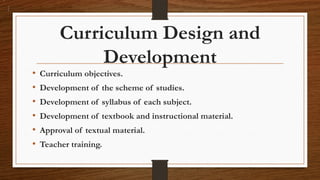
• Curriculum objectives.
• Development of the scheme of studies.
• Development of syllabus of each subject.
• Development of textbook and instructional material.
• Approval of textual material.
• Teacher training.
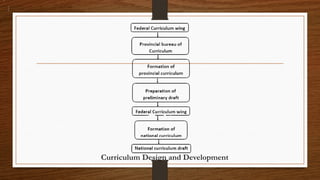
Curriculum Design and Development
Developing Objectives
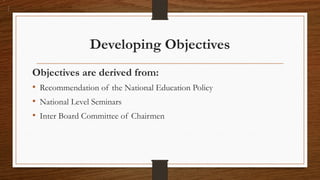
Objectives are derived from:
• Recommendation of the National Education Policy
• National Level Seminars
• Inter Board Committee of Chairmen
Developing Objectives
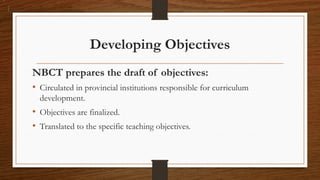
NBCT prepares the draft of objectives:
• Circulated in provincial institutions responsible for curriculum
development.
• Objectives are finalized.
• Translated to the specific teaching objectives.
The Studies Scheme
It is based on three Key factors:
• The national education policy
• Market demand.
• Global issues.
Development of syllabi
It is based on objectives and a scheme of study:
Subject-specific syllabi are prepared in consultation
with:
• Subject expert
• Psychologist
• Serving teacher
Textbook Development
Punjab Text Book Board (PTBB) is responsible for the
development of the text-books according to the approved
syllabi.
How textbook is developed?
• Establish a list of textbook writers.
• Invitations are sent to the writers to submit the material
within the syllabus parameter.
• The selected material is transformed into a textbook.
Review the Approval
National review committee comprises on five or six
members:
• At least one expert form the syllabus Formulation Committee.
• Two subject experts.
• Two school teachers
Textbooks review parameter
• The books truly reflects the curriculum.
• It meets the objectives stated in the curriculum.
• Book does not contain any material contradictory to
Islamic and Pakistani ideology.
Teacher Training
• Teacher training for curriculum implementation is the
responsibility of the provincial government.
• It is now stressed that each textbook must have a
teacher's guide.
• In some cases assistance in the training of the masters
trainers is provided to the provincial government.
Curriculum Development
Pitfalls
There are several obstacles affecting the quality and effectiveness of the
curriculum development process in Pakistan.
• Lack of subject area expert.
• Textbook often do not reflect the curriculum
• Lack of follow-up of actual curriculum implementation in classroom
practice.
• Curriculum often different from the official curriculum documentation.
Curriculum Development Process in Pakistan.pptx

Curriculum Development Process in Pakistan.pptx

  • 1.
  • 2.
    Presenter - 1 HURIYAYASEEN Educator
  • 3.
    Objectives • Understand themeaning of the Curriculum • What are the Characteristics of the Curriculum? • Elements of Curriculum • Design and Development Processes in Pakistan. • What are Curriculum pitfalls?
  • 4.
    Curriculum According to RalphTaylor • Curriculum means all those activities which are provides to students in the school or out of school in order to achieve the predetermined activities. According to Smith, Stanely and Shore • The curriculum includes all the activities organized by the school inside or outside the classroom. These activities are sequential in nature..
  • 5.
    Characteristics of aGood Curriculum • Totality of activities • A mean to an end • Total school environment • Totality of experience • Mirror of educational trends • Development of a balanced personality • Process of living • Dynamic • Mirror of philosophy of life • Achievement of goals
  • 6.
    Differences Between Curriculum,Syllabus, Course and Educational Program Curriculum: • The curriculum encompassed educational philosophy, values, objectives, organizational structure, materials, teaching strategies, student experiences and assessment and learning outcomes. Syllabus: • A list of the content of a course of the work simply means collection. It usually specifies the content, learning outcomes and the time allocation for various topics.
  • 7.
    Differences Between Curriculum,Syllabus, Course and Educational Program Course: • It is defines as the series of planned units related to each other. In course of study, organized subject is to the covered with specified minds, teaching goods and suggestions for instructional strategies. Educational program: • It concerns with the specific period of a course of study. E.g L.L.B , BS , MS etc
  • 8.
    Need of Curriculum •Achievement of educational aims • Fixing limits • Development of democratic values • Development of citizenship • Development of character • Satisfaction of needs • Criteria of suitable teacher • Acquisition of knowledge • Development of personality • Reflects trends in education • Discoveries of and inventions
  • 9.
    Presenter - 2 UMEAYMEN Educator, Co-founder of Ansharah Institute
  • 10.
    Elements of Curriculum Aims: •Educational aims refer to the overall purpose of education, which represents the needs and aspiration in an educational policy. Goals: • Goals are the general purpose of the educational that normally prepared for particular stage or level of the education system.
  • 11.
    Elements of Curriculum Objectives: •Objective refer more precisely to the changes in behavior ,which we hope will result from studying particular courses. Methodology: • It includes the methods adopted by the teacher during instruction and the learning experience or activities performed by the students.
  • 12.
    Elements of Curriculum Evaluation: •Give a judgment decision about the worth, value or standard of something according to some specific rules or regulations is called evaluation.
  • 13.
    Curriculum Development Process inPakistan Introduction • Education plays a vital role in nation-building. • Federal Ministry of Education is responsible for the national cohesion, integration and preservation of the ideological foundation of the state.
  • 14.
    Responsibilities Federal Ministry ofEducation is responsible in making of:  Curriculum  Syllabus  Planning  Policy  Education standards.
  • 15.
    National Bureau ofCurriculum and Textbooks (NBTC) • Also known as curriculum wing. • Supervise curriculum and textbooks. • Approve and maintain curriculum standards from the primary to the higher secondary levels.
  • 16.
    Provincial Curriculum Centre •Every province has a provincial curriculum centre. • To ensure provincial collaboration. • Involve in all activities falling within the purview of the federation.
  • 17.
    Provincial Textbook Board (PTTB) EachProvince has its own Provincial Textbook Board. PTTBs are responsible for: • Preparing • Publishing • Stocking • Distributing • Marketing school textbooks
  • 18.
    Presenter - 3 HAFIZABDUL WAJID Educator, Founder of Ansharah Institute
  • 19.
    Curriculum Design and Development •Curriculum objectives. • Development of the scheme of studies. • Development of syllabus of each subject. • Development of textbook and instructional material. • Approval of textual material. • Teacher training.
  • 20.
  • 21.
  • 22.
    Developing Objectives Objectives arederived from: • Recommendation of the National Education Policy • National Level Seminars • Inter Board Committee of Chairmen
  • 23.
    Developing Objectives NBCT preparesthe draft of objectives: • Circulated in provincial institutions responsible for curriculum development. • Objectives are finalized. • Translated to the specific teaching objectives.
  • 24.
    The Studies Scheme Itis based on three Key factors: • The national education policy • Market demand. • Global issues.
  • 25.
    Development of syllabi Itis based on objectives and a scheme of study: Subject-specific syllabi are prepared in consultation with: • Subject expert • Psychologist • Serving teacher
  • 26.
    Textbook Development Punjab TextBook Board (PTBB) is responsible for the development of the text-books according to the approved syllabi.
  • 27.
    How textbook isdeveloped? • Establish a list of textbook writers. • Invitations are sent to the writers to submit the material within the syllabus parameter. • The selected material is transformed into a textbook.
  • 28.
    Review the Approval Nationalreview committee comprises on five or six members: • At least one expert form the syllabus Formulation Committee. • Two subject experts. • Two school teachers
  • 29.
    Textbooks review parameter •The books truly reflects the curriculum. • It meets the objectives stated in the curriculum. • Book does not contain any material contradictory to Islamic and Pakistani ideology.
  • 30.
    Teacher Training • Teachertraining for curriculum implementation is the responsibility of the provincial government. • It is now stressed that each textbook must have a teacher's guide. • In some cases assistance in the training of the masters trainers is provided to the provincial government.
  • 31.
    Curriculum Development Pitfalls There areseveral obstacles affecting the quality and effectiveness of the curriculum development process in Pakistan. • Lack of subject area expert. • Textbook often do not reflect the curriculum • Lack of follow-up of actual curriculum implementation in classroom practice. • Curriculum often different from the official curriculum documentation.