Life in the Sea Chapter 16 & 17
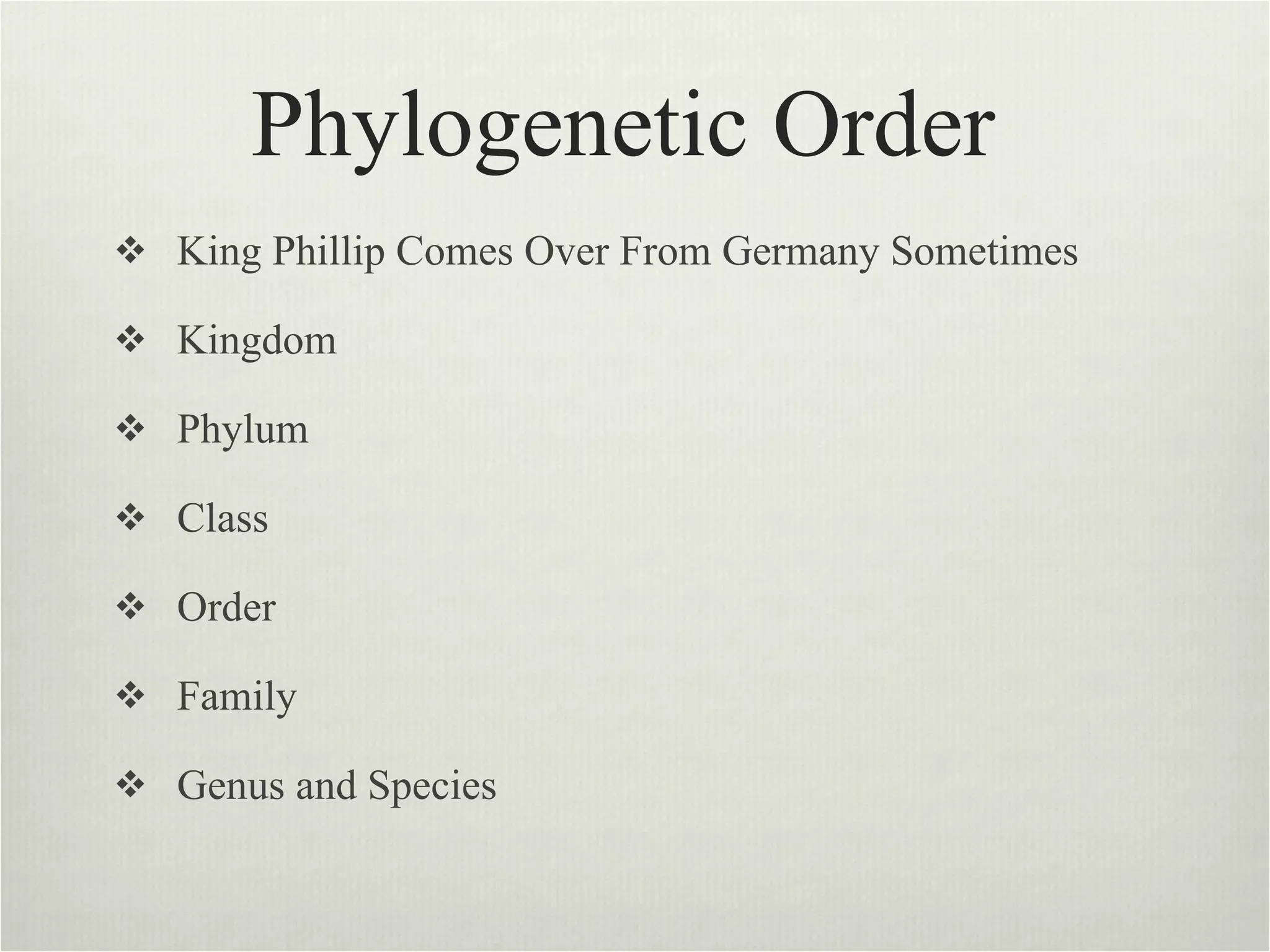
Phylogenetic Order  King Phillip Comes Over From Germany Sometimes Kingdom Phylum  Class  Order Family Genus and Species
Source: http://en.wikipedia.org/wiki/Kingdom_(biology)
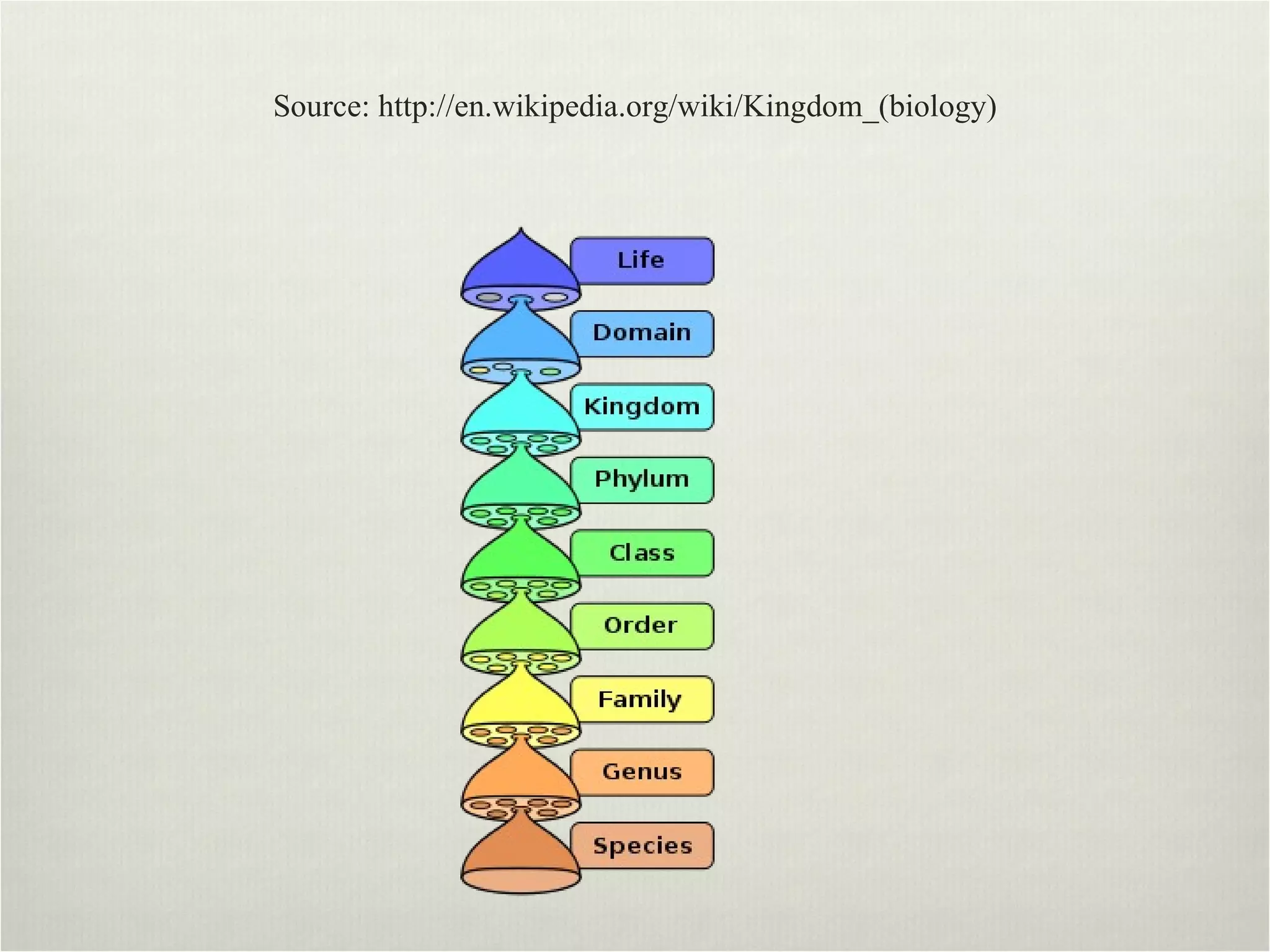
Phytoplankton Characteristics
Plankton does not only include phytoplankton (plants) and zooplankton (animals) but other free-floating organisms as well  This includes sea jellies (jelly fish), hatchling sea turtles, and the larval stage of many marine organisms  Many marine organisms that start out their life as planktonic (i.e. crabs, shrimp, oysters, etc.) and then are able to swim or settle to the bottom are called meroplankton
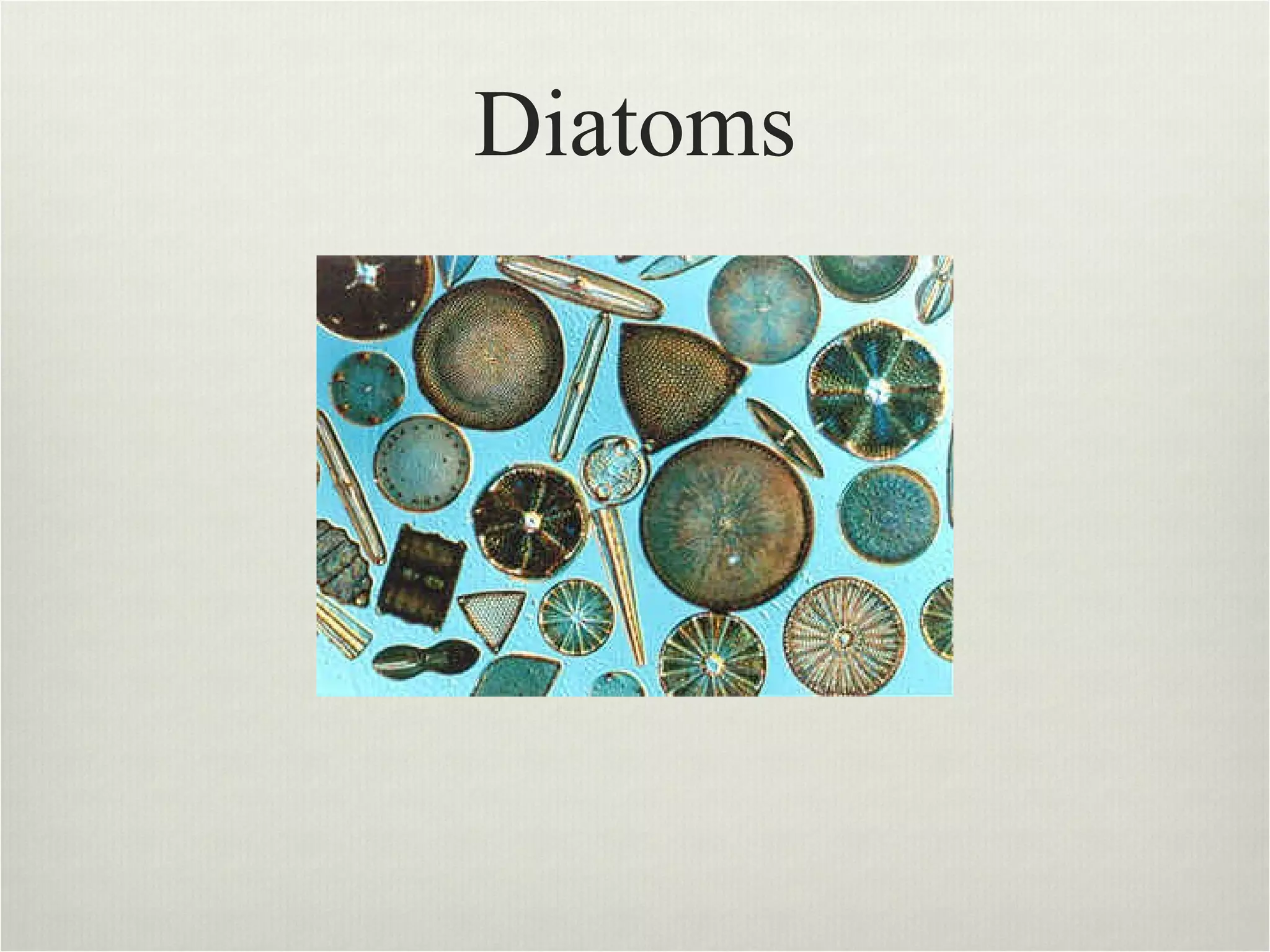
Holoplankton spends its whole life as a planktonic organism (i.e. phytoplankton and zooplankton) Phytoplankton are independent cells where as seaweed is an aggregation of cells. Sargassum seaweed which creates huge mats in the middle of the Atlantic Ocean (in the middle of the N. Atlantic Gyre) is the only multicellular plankton.
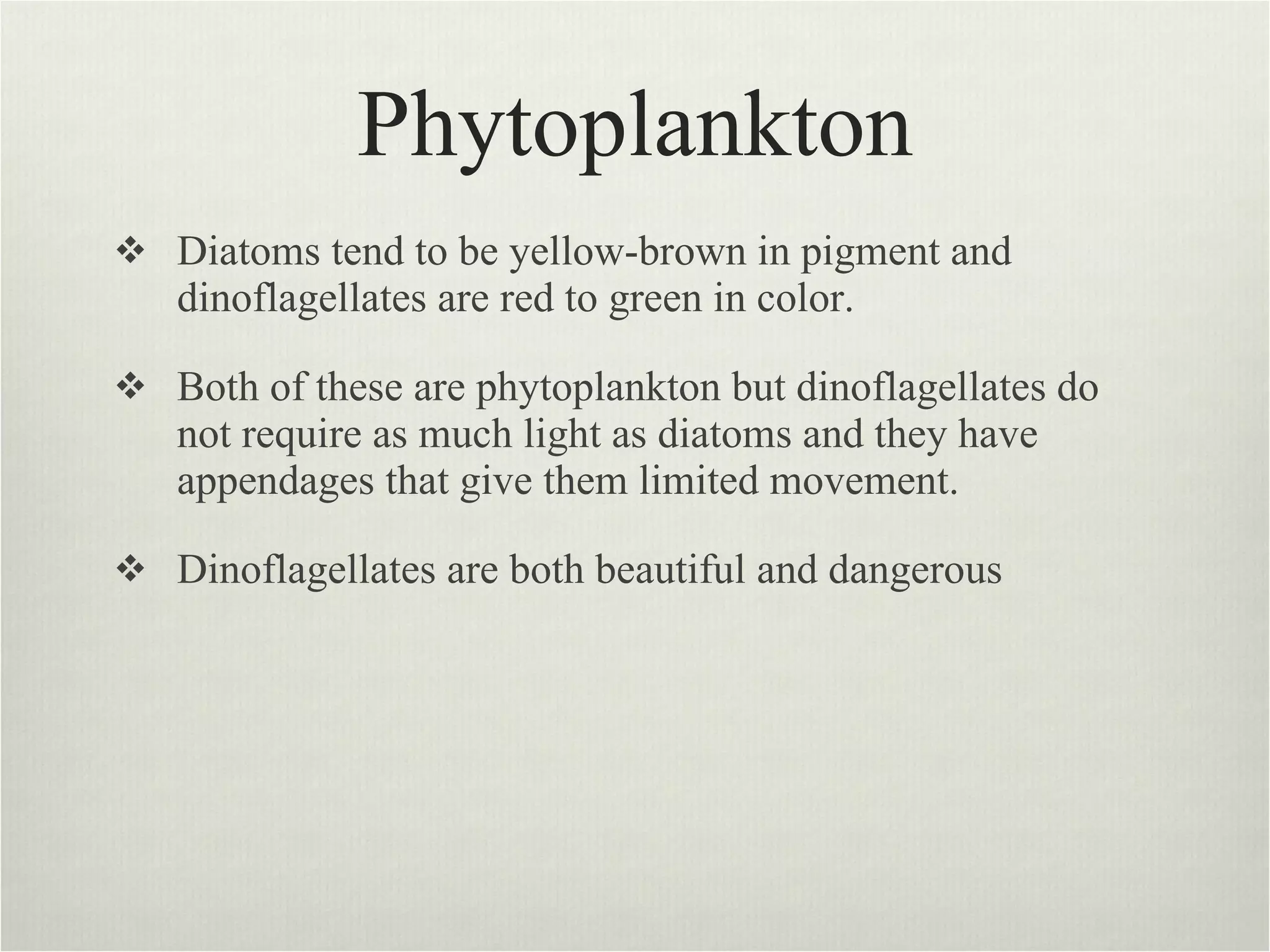
Diatoms
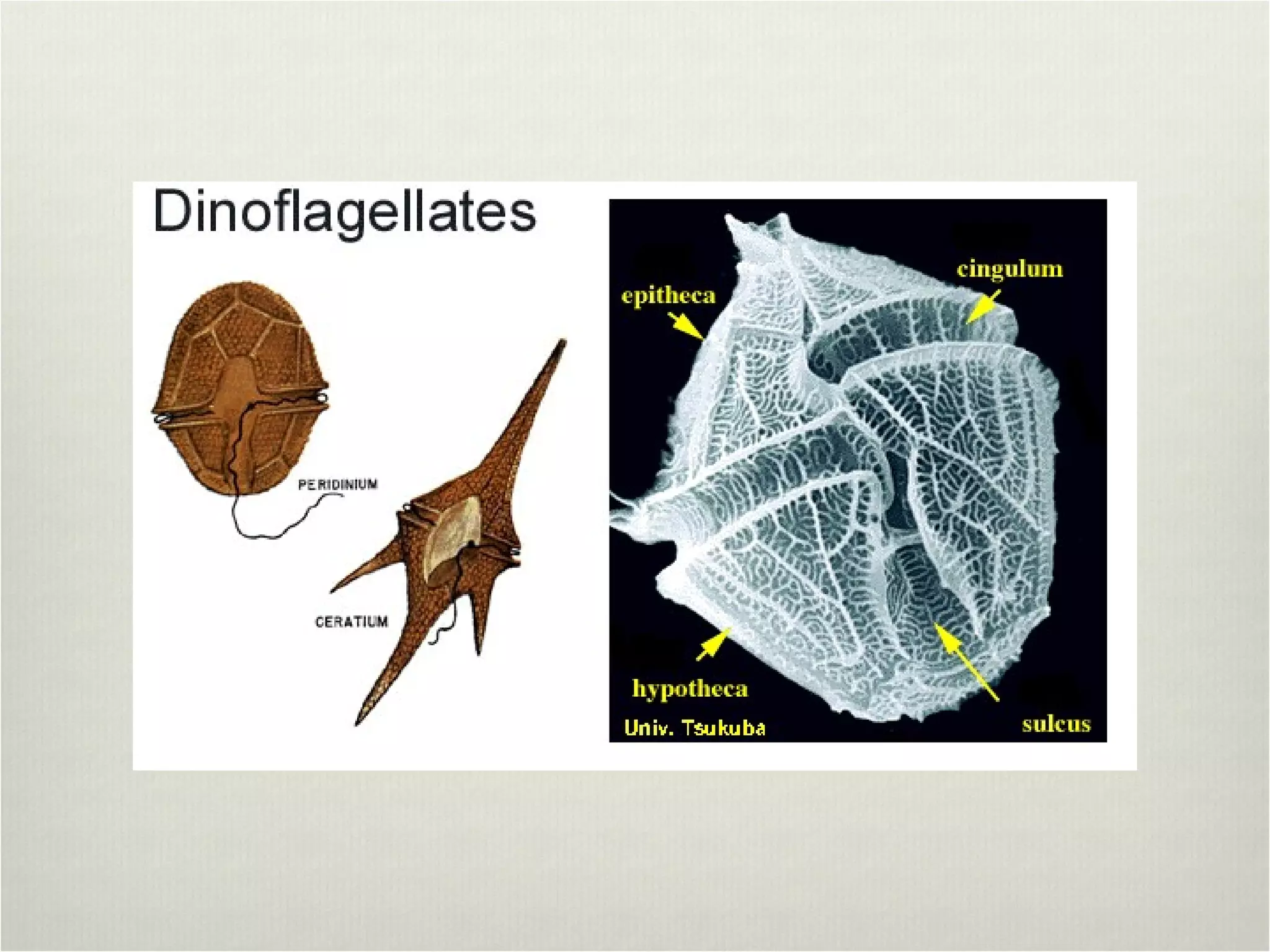
Phytoplankton Diatoms tend to be yellow-brown in pigment and dinoflagellates are red to green in color.  Both of these are phytoplankton but dinoflagellates do not require as much light as diatoms and they have appendages that give them limited movement.  Dinoflagellates are both beautiful and dangerous
 
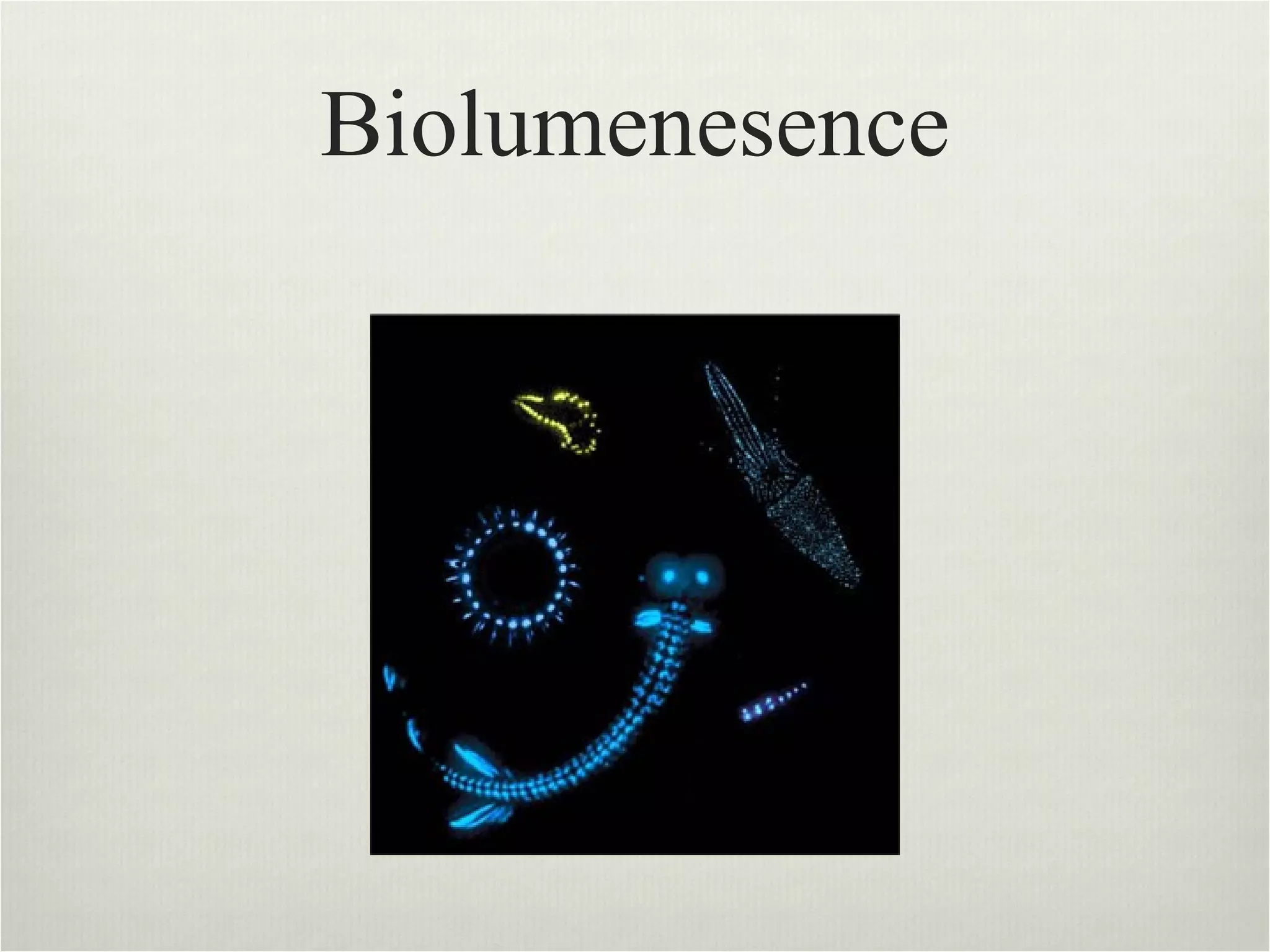
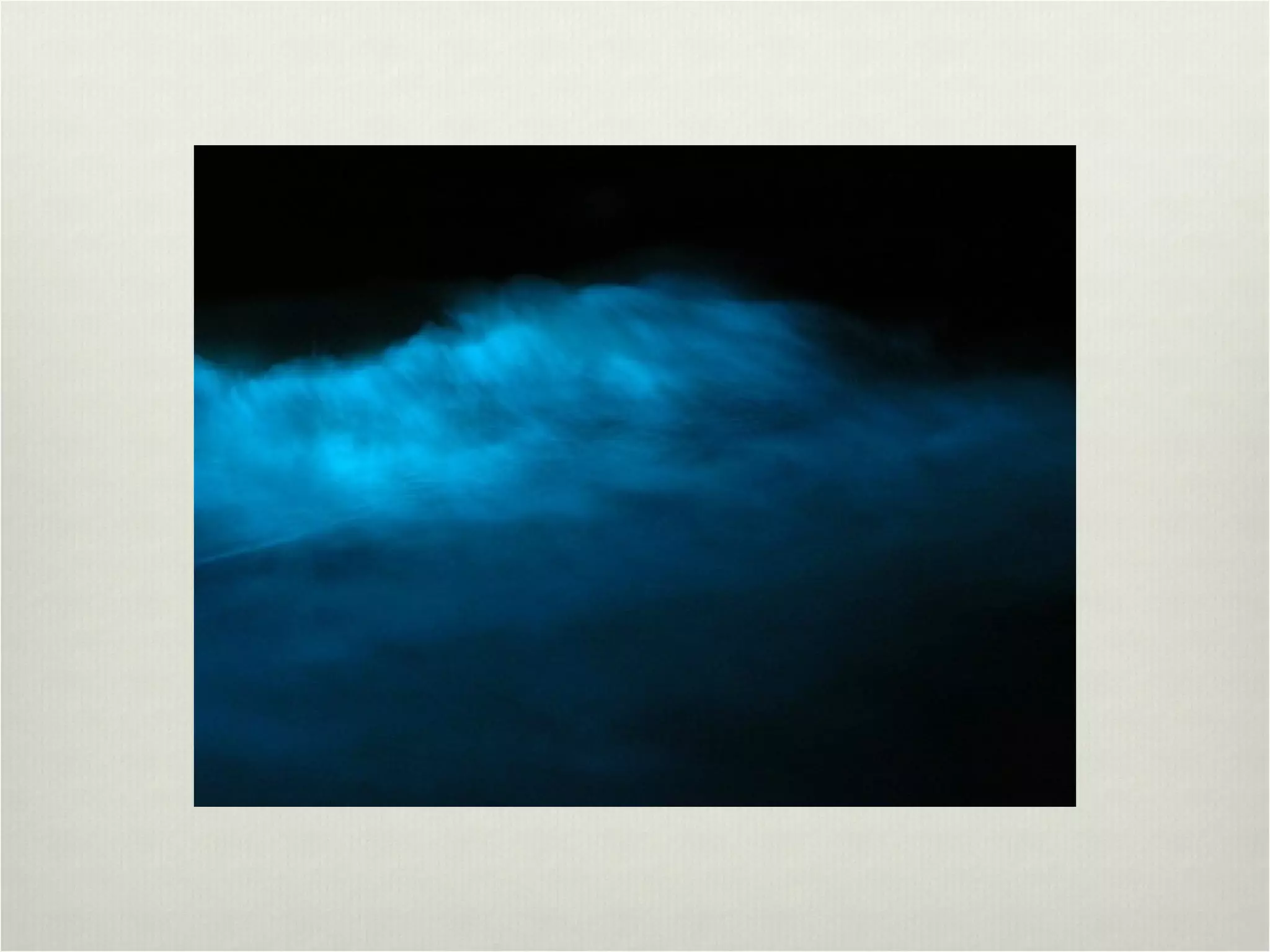
They can bioluminescence (glow) at nighttime but there are species of dinoflagellates that are blamed for the red tide which causes paralytic shellfish poisoning (PSP).  While diatoms are seen as the main primary producers in the ocean, dinoflagellates are the link between primary producers and herbivores (i.e. zooplankton).
Biolumenesence
 
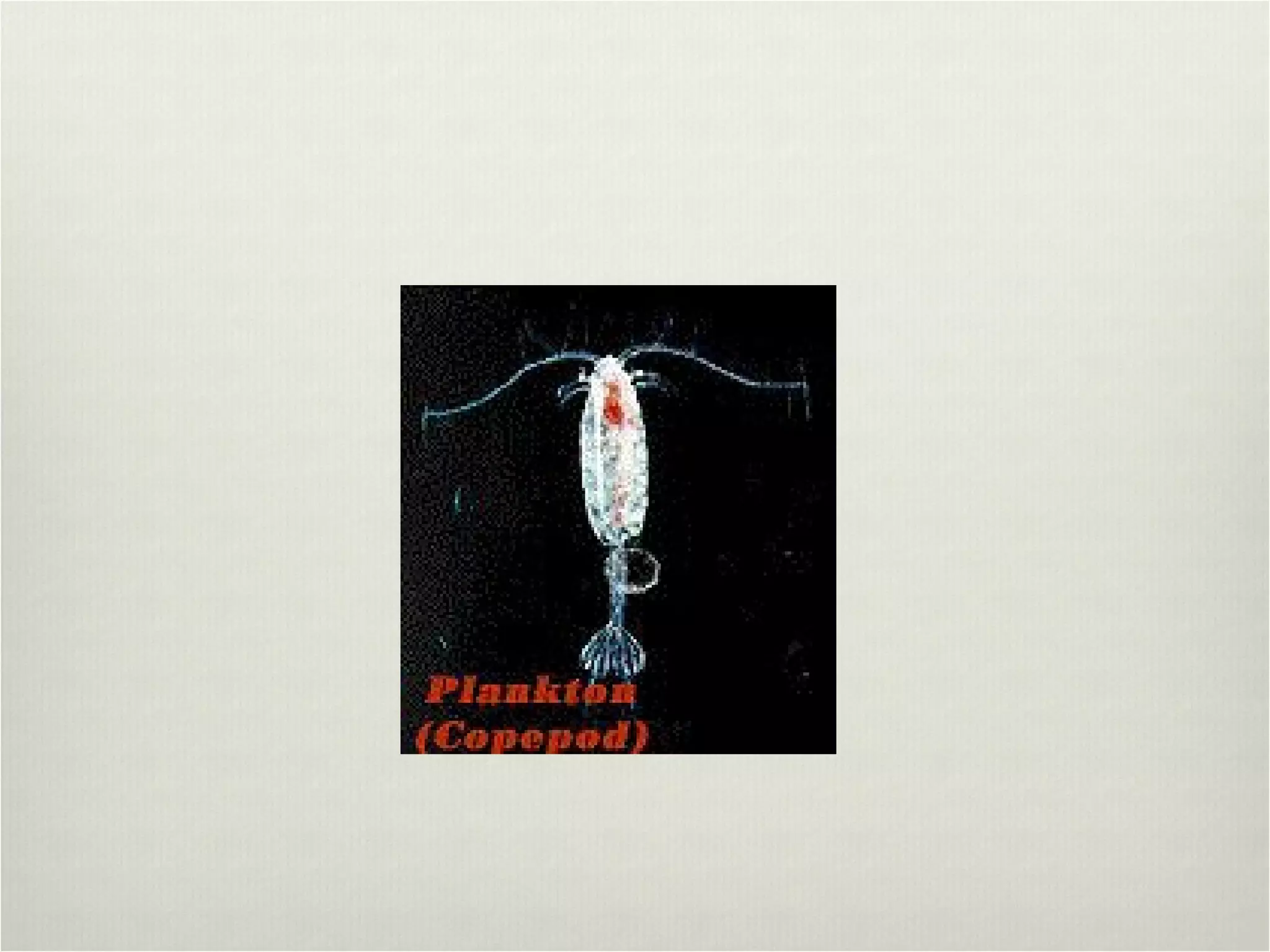
Zooplankton Herbivores include crustaceans, copepods and euphausiids  They represent 60% of all the zooplankton and an important food source for krill which baleen whales and penguin eat Copepods are the main link between the herbivores and the first level of carnivores
 
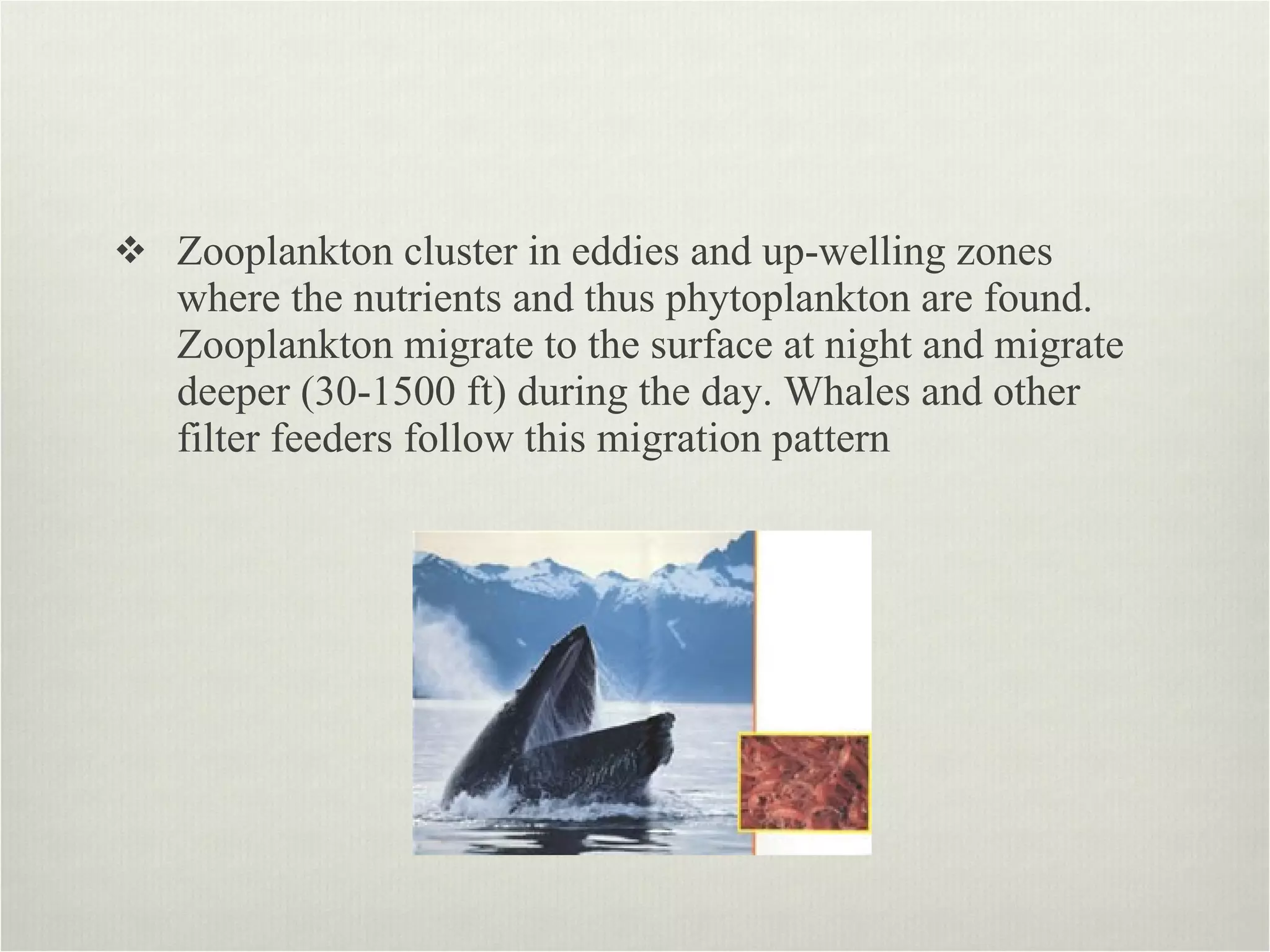
Zooplankton cluster in eddies and up-welling zones where the nutrients and thus phytoplankton are found. Zooplankton migrate to the surface at night and migrate deeper (30-1500 ft) during the day. Whales and other filter feeders follow this migration pattern
 
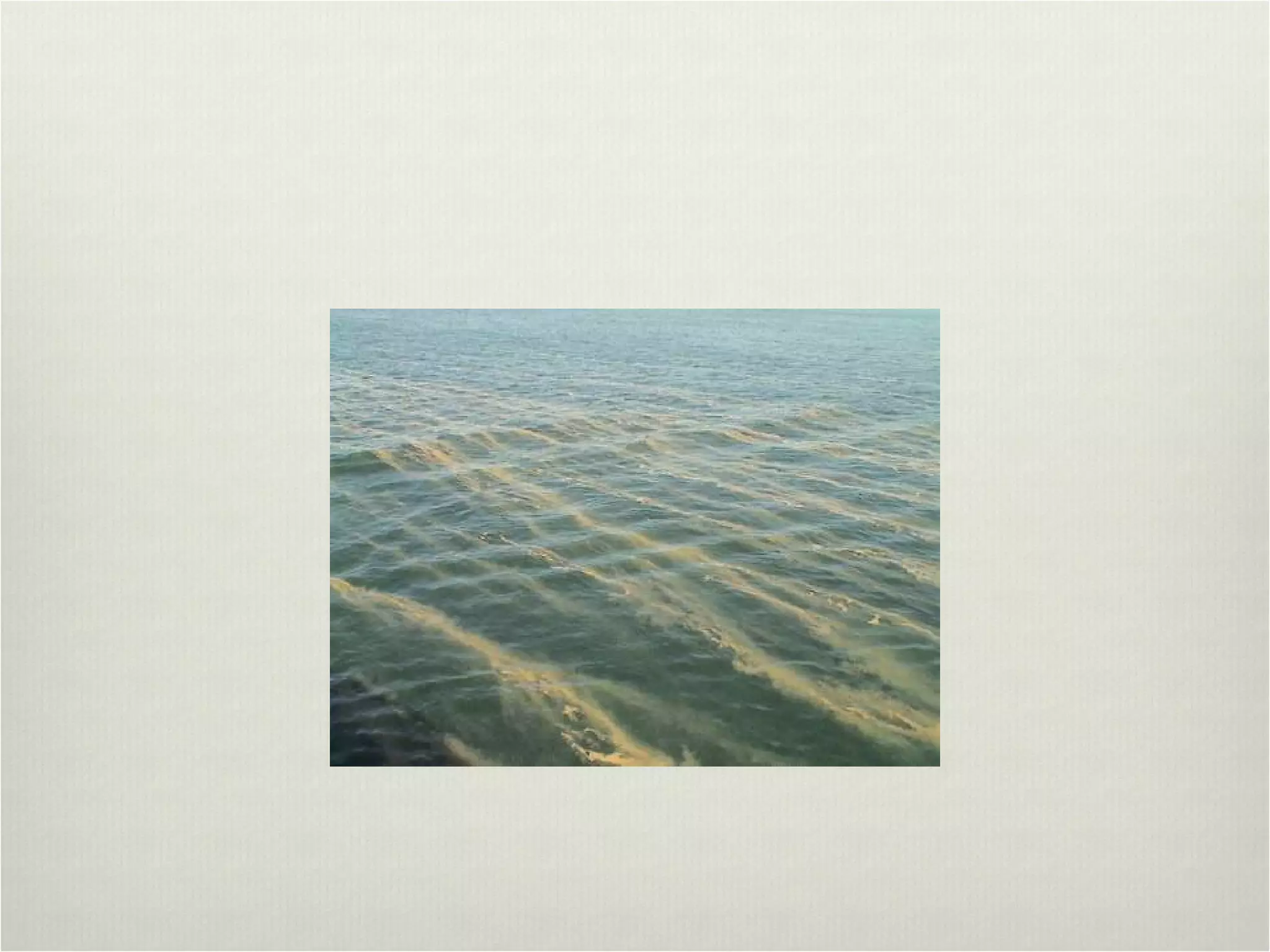
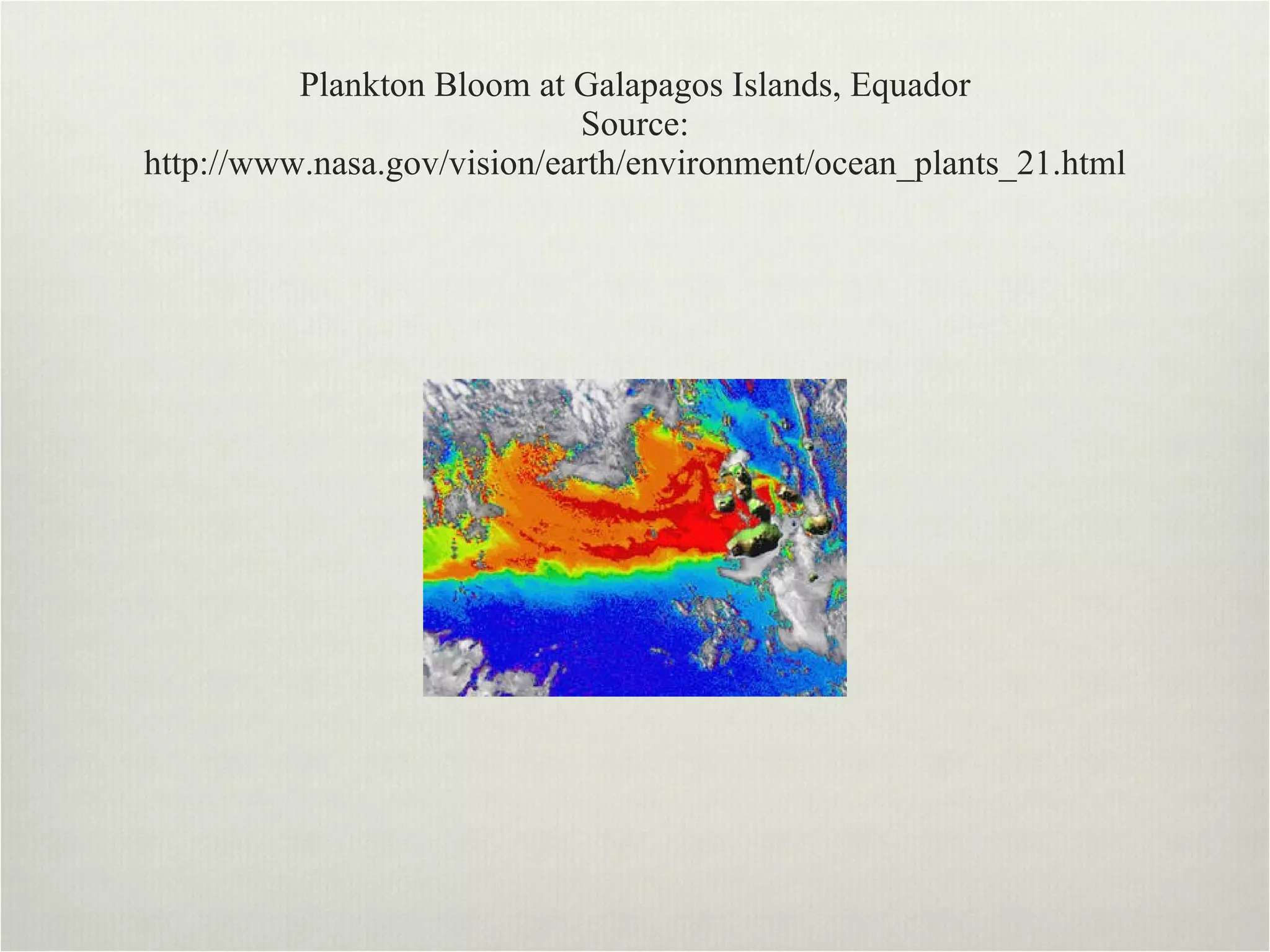
Plankton Bloom at Galapagos Islands, Equador Source: http://www.nasa.gov/vision/earth/environment/ocean_plants_21.html
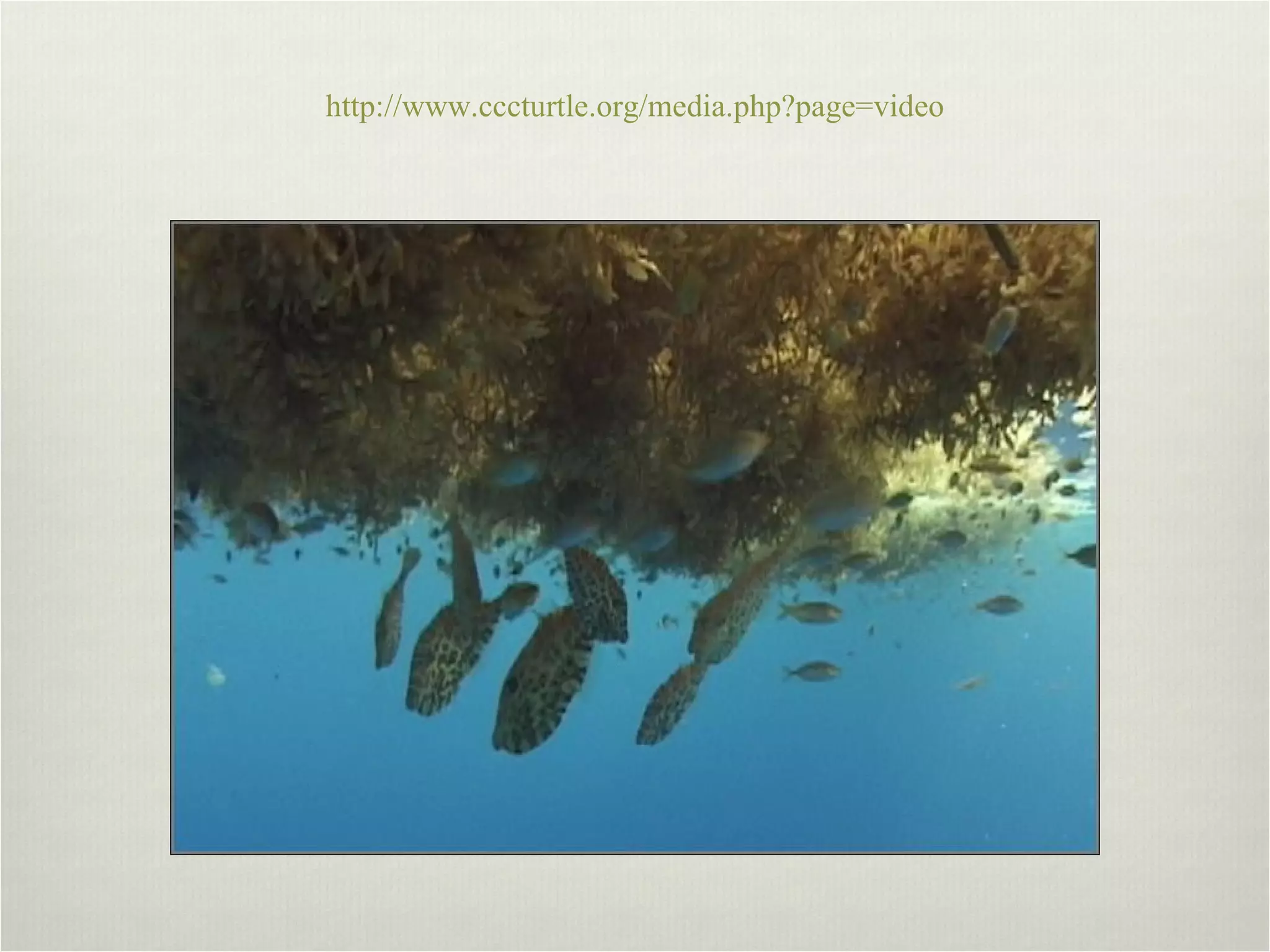
Hatchling sea turtles start out their life as a planktonic organism at the mercy of the currents  Hatchlings (just a few inches long) leave the Southeast coast of the United States and go into a swimming frenzy until they reach the Gulf Current The Gulf Current or Stream goes at an impressive 3 ft/s or 3 knots.  The hatchling turtles drift in this current and end up in an eddy or in the Sargassum Sea in the middle of the Atlantic Ocean where they are protected by the seaweed from larger predators.
http://www.cccturtle.org/media.php?page=video
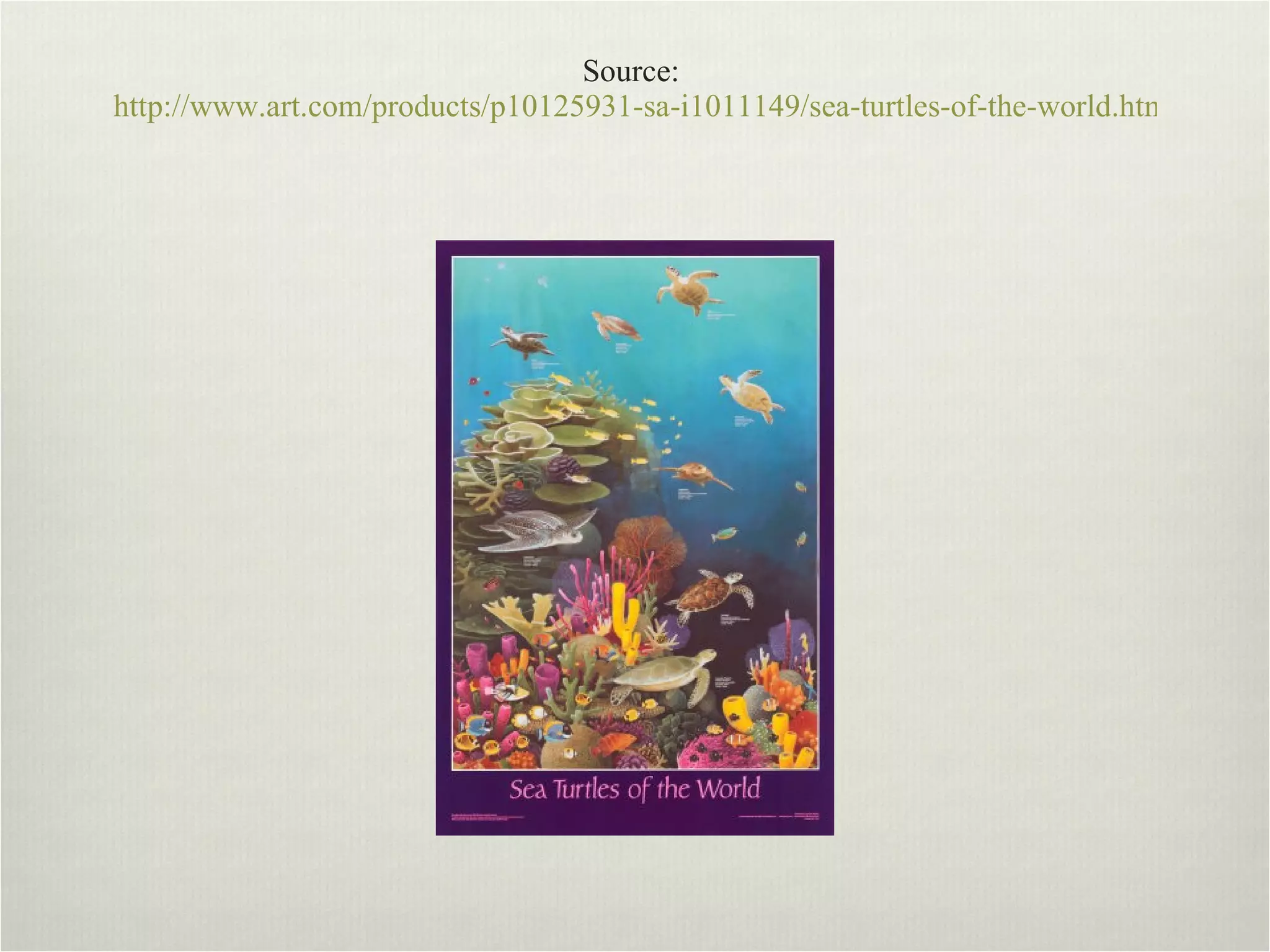
There are eight different species of sea turtles: 1) leatherback, 2) green, 3) black, 4) Australian flat-back, 5) loggerhead, 6) hawksbill, 7) Kemps and 8) olive ridley Their diets vary from green turtles being herbivores to leatherbacks who specialize on seajellies Some are omnivorous like the loggerhead and eat a variety of foods.
Source:  http://www.art.com/products/p10125931-sa-i1011149/sea-turtles-of-the-world.htm
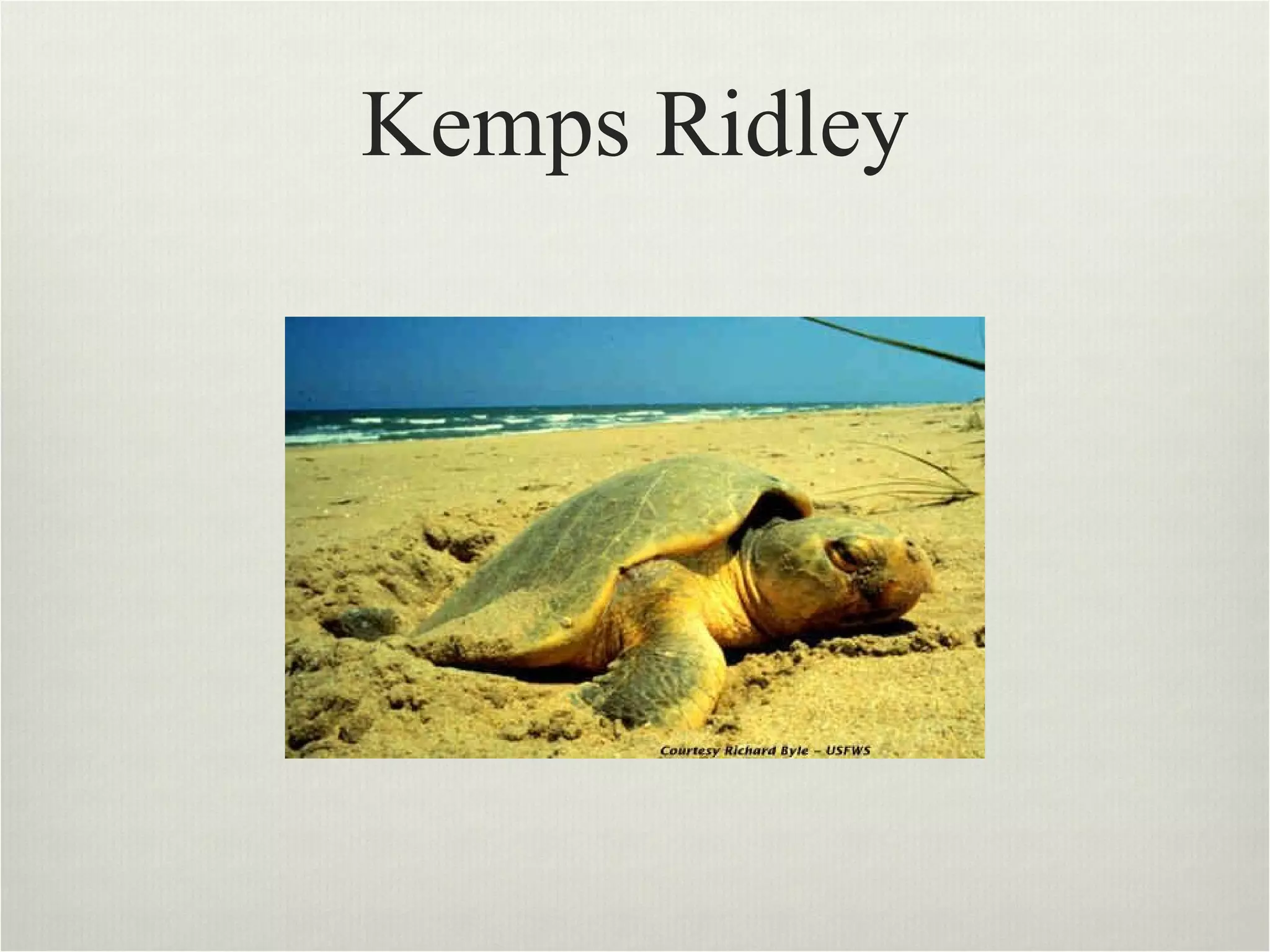
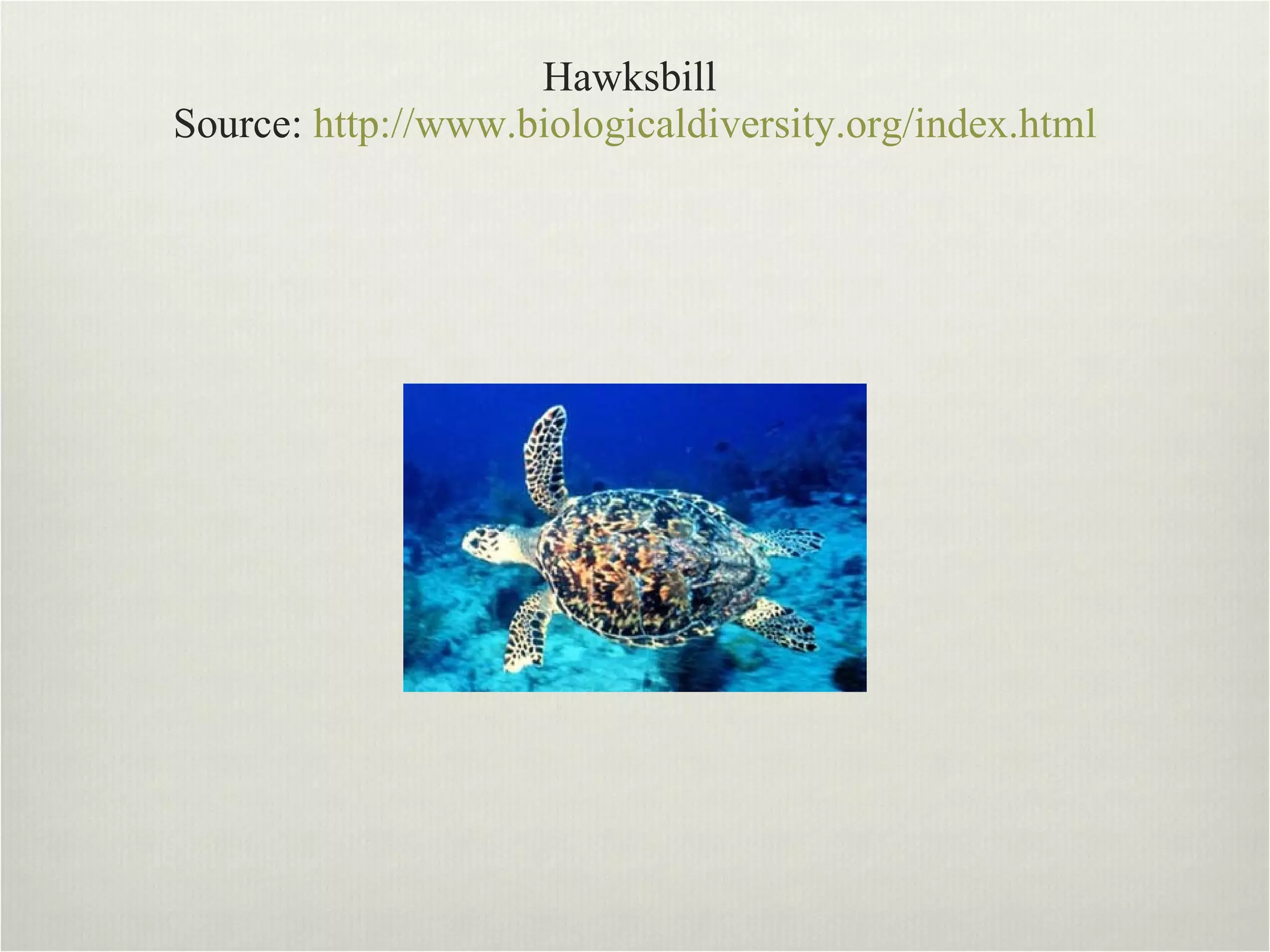
The Kemps Ridley is the most endangered due to the fact that it only nests on one beach in the world  The hawksbill is the second most endangered due to the beautiful “tortoise shell” that is made into jewelry All sea turtle species are protected under the Endangered Species Act (ESA) but some have threatened status and some have endangered status. The U.S. Fish and Wildlife regulates endangered species on land and National Marine Fisheries under NOAA regulates endangered species in the oceans  http://www.fws.gov/endangered/   http://www.nmfs.noaa.gov/pr/species/
Kemps Ridley
Hawksbill  Source:  http://www.biologicaldiversity.org/index.html
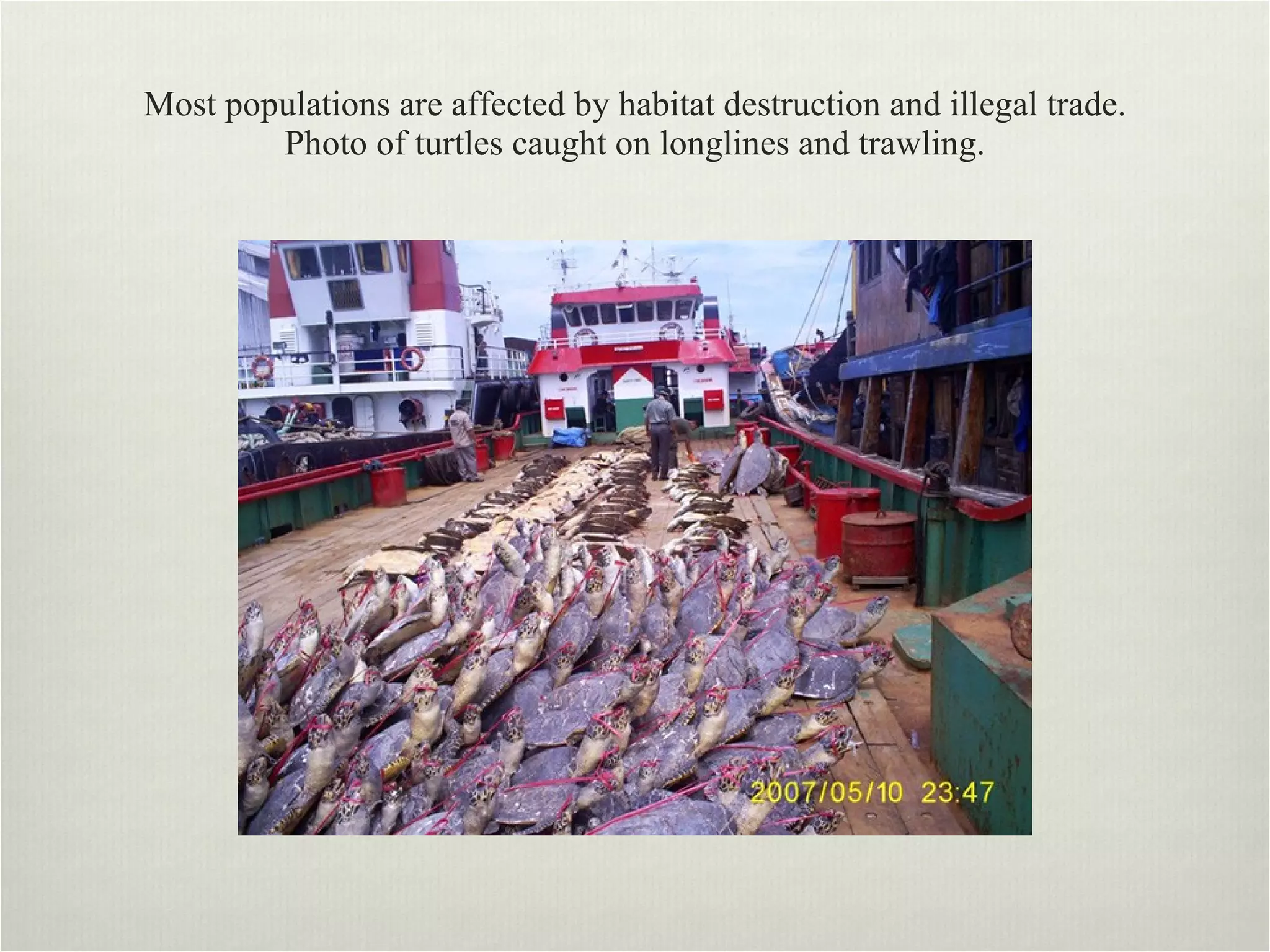
Most populations are affected by habitat destruction and illegal trade. Photo of turtles caught on longlines and trawling.
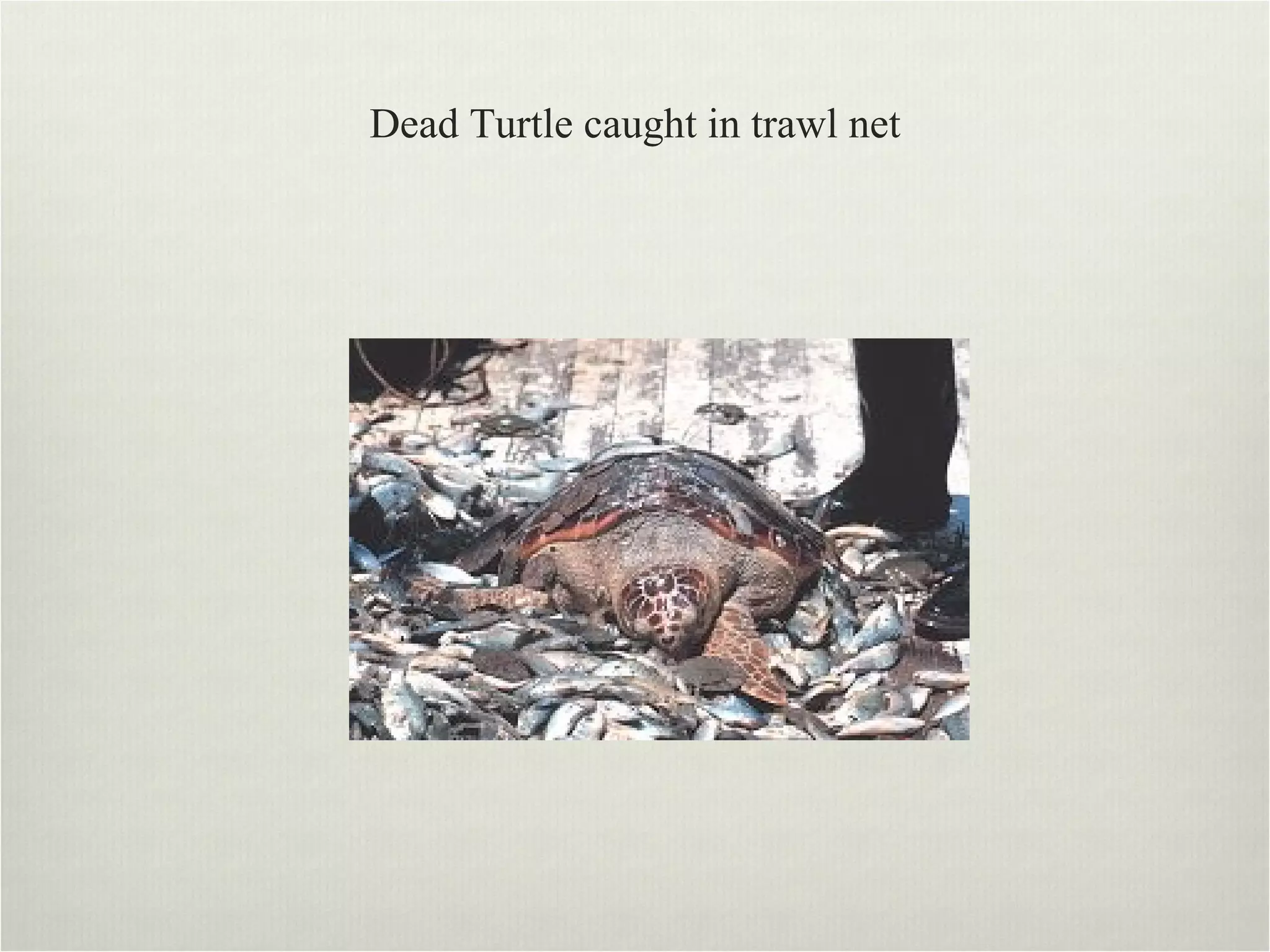
Incidental catch is also a significant problem for turtles nesting on beaches where shrimp trawling is occurring Exhausted females get caught in the nets after laying over 100 eggs and drown United States trawlers are required to use a Turtle Excluder Devise (TED) to exclude sea turtle in their catch. Unfortunately most of the shrimp we eat in restaurants today are either imported (where TEDS are not enforced) or farm-raised
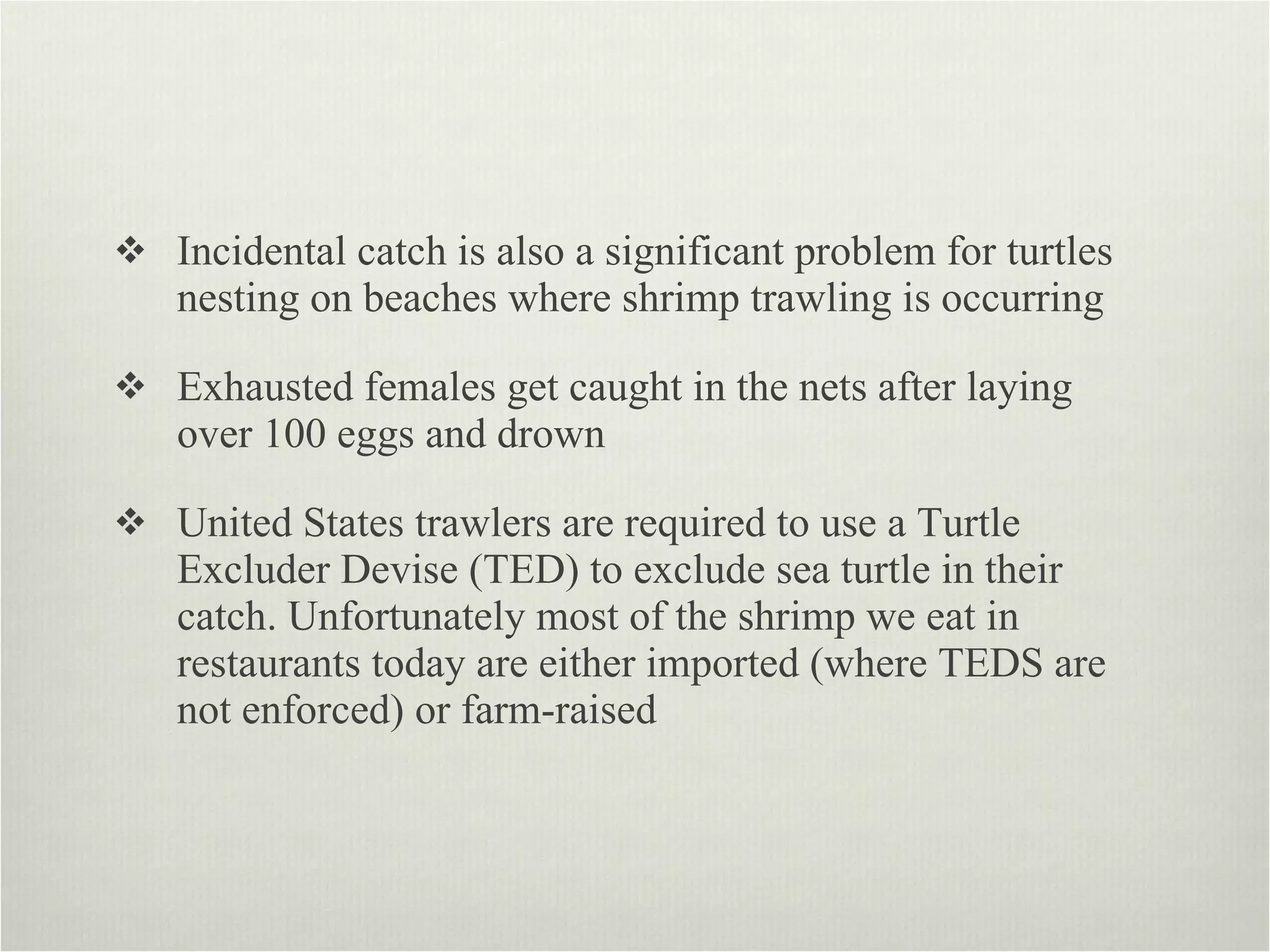
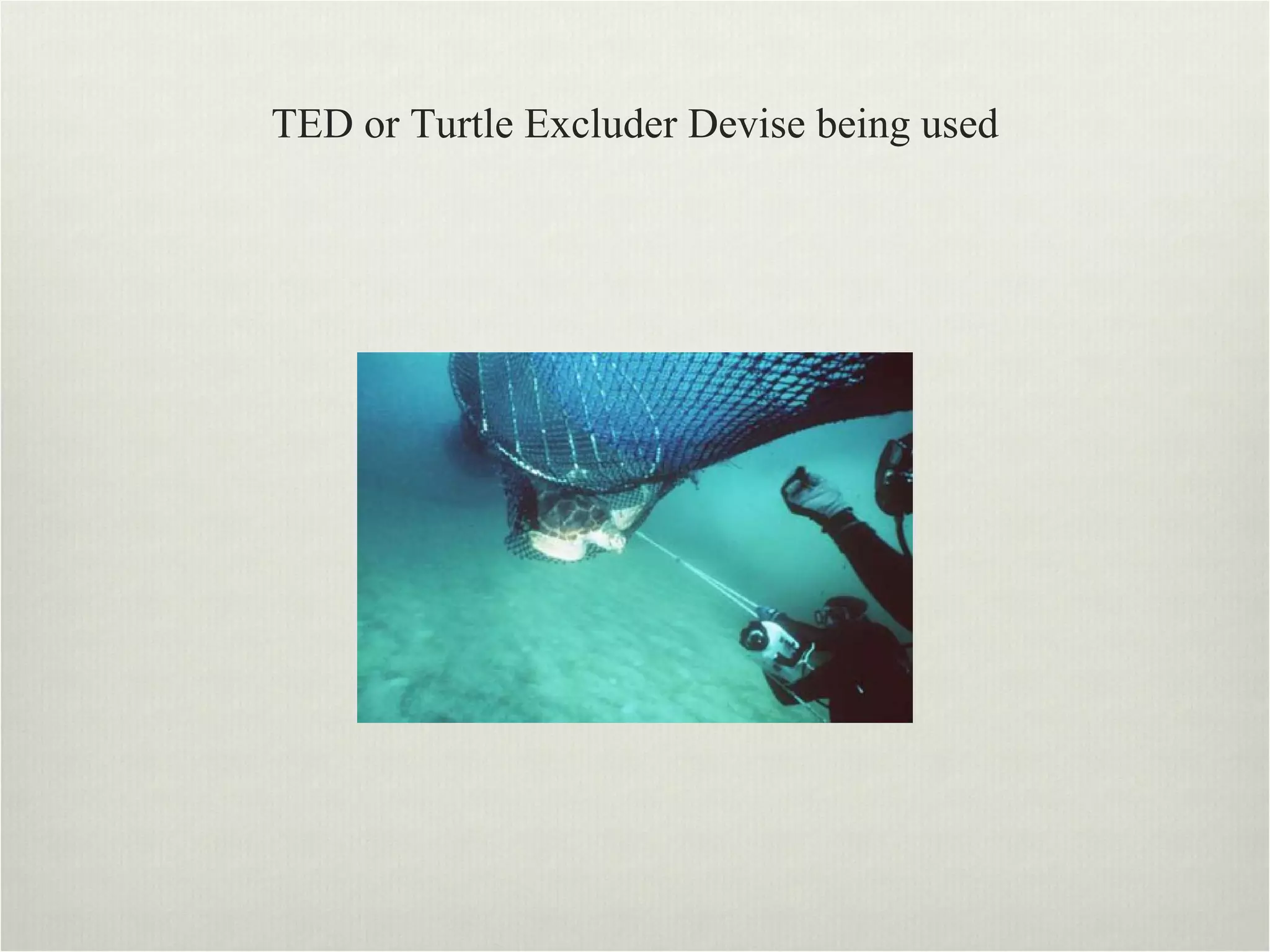
Dead Turtle caught in trawl net
TED or Turtle Excluder Devise being used
Sea Turtle Videos http://www.youtube.com/watch?v=gDV4rI3AlUM
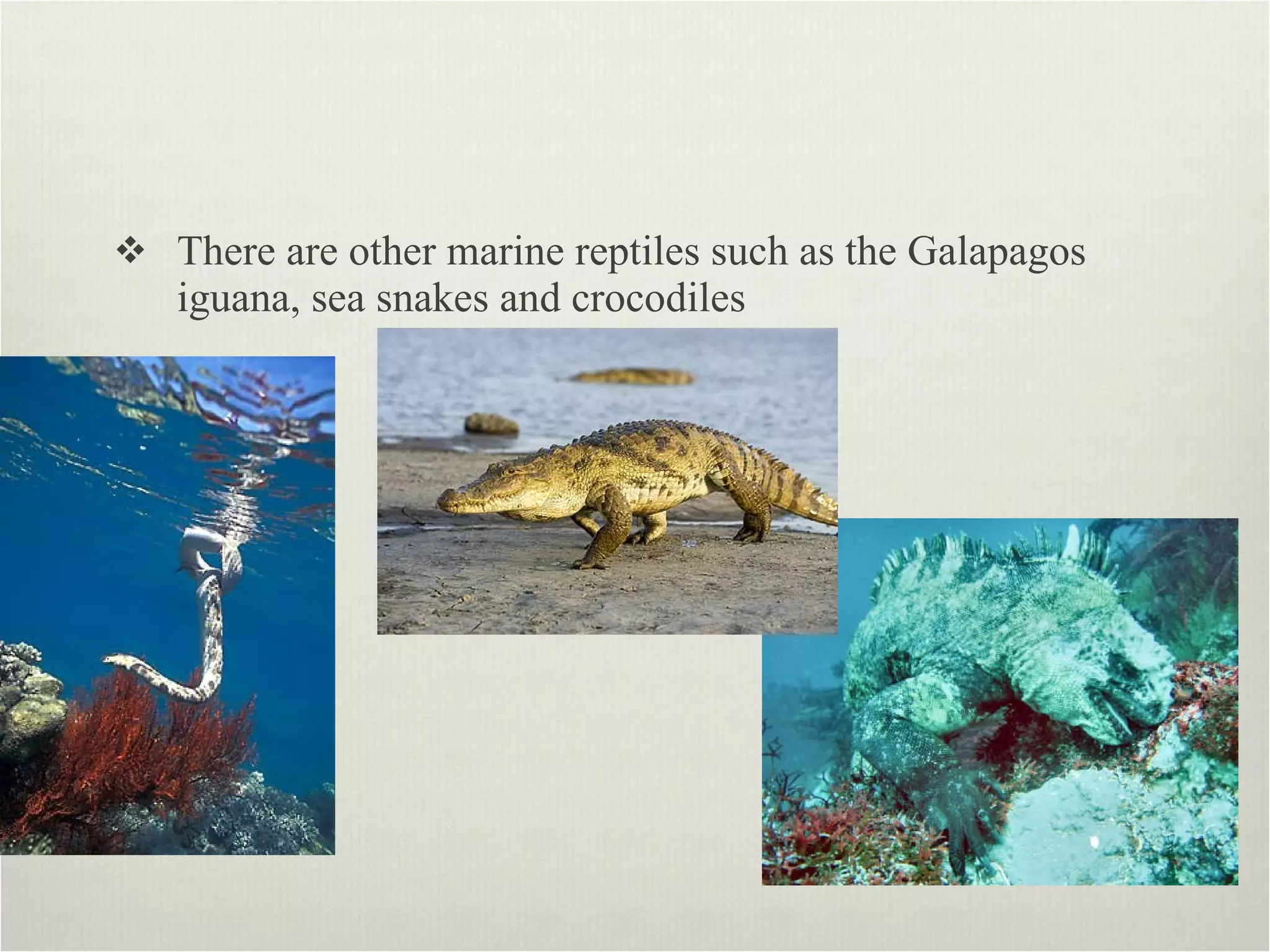
There are other marine reptiles such as the Galapagos iguana, sea snakes and crocodiles
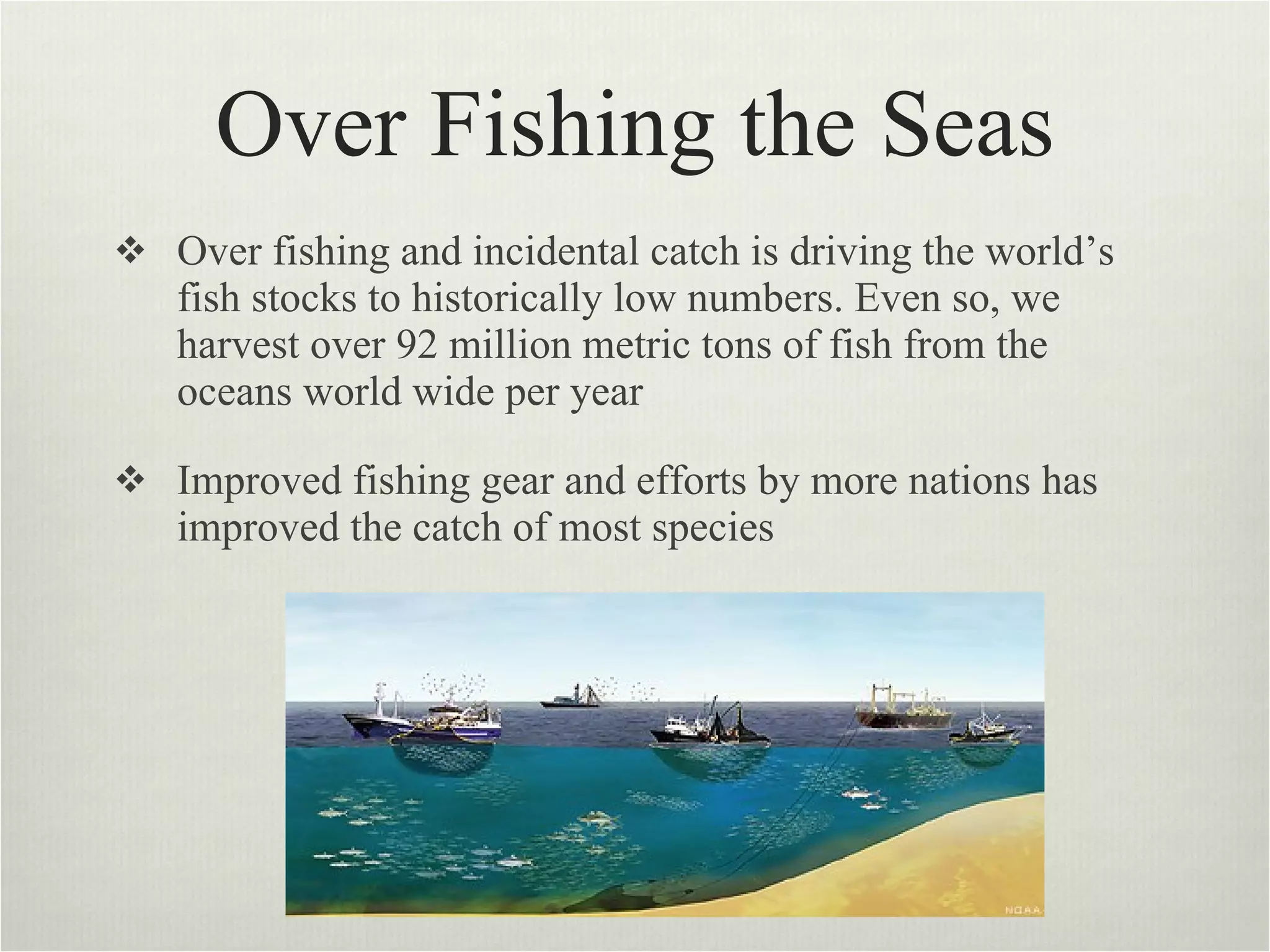
Over Fishing the Seas Over fishing and incidental catch is driving the world’s fish stocks to historically low numbers. Even so, we harvest over 92 million metric tons of fish from the oceans world wide per year  Improved fishing gear and efforts by more nations has improved the catch of most species
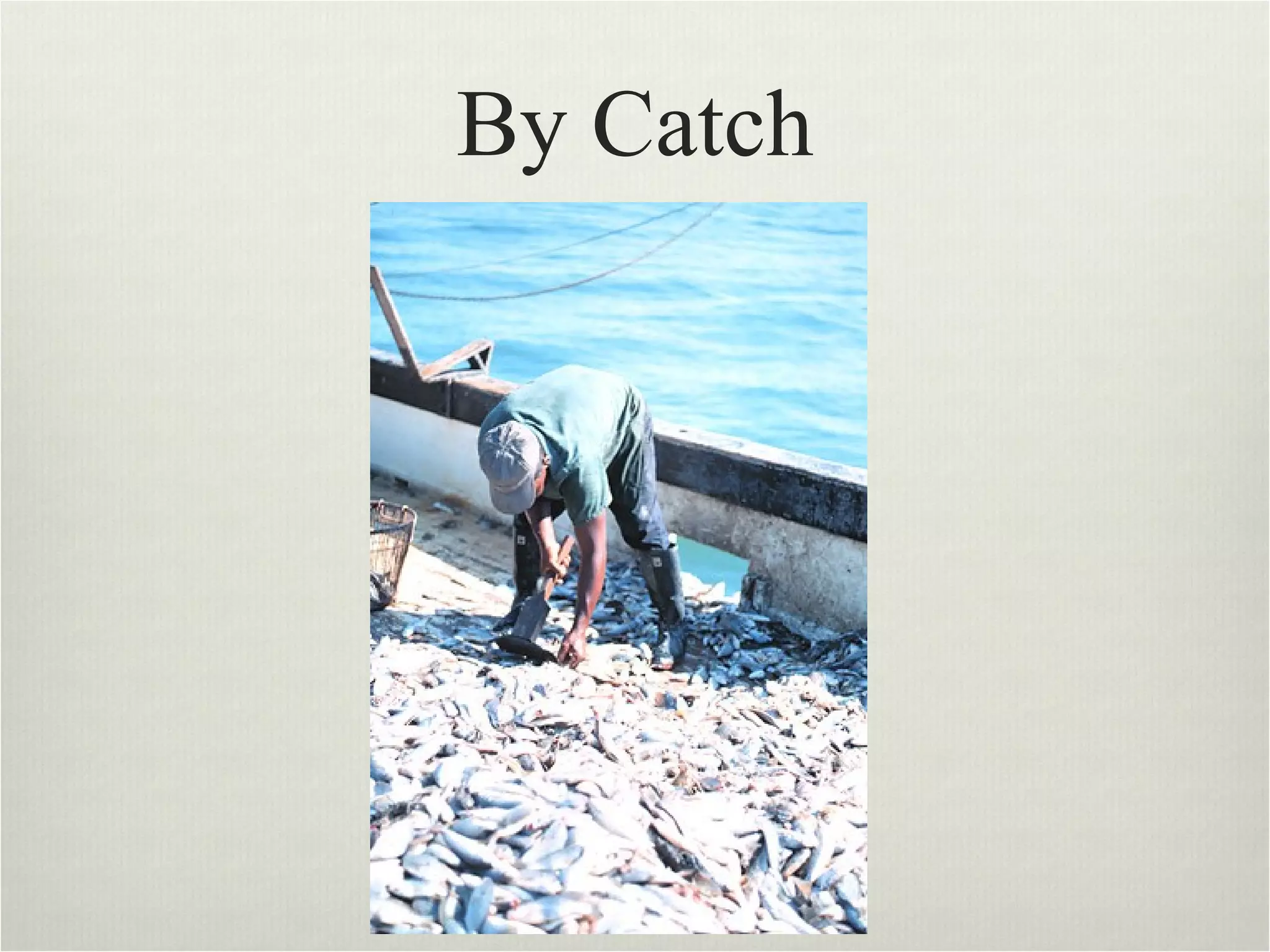
By Catch
Unfortunately, more than 70% of the world’s fish stocks are over fished or depleted  For more information on fish issues in the Northwest go to  http://www.nmfs.noaa.gov/  and click on fish facts  For information on what you are eating! http://www.nmfs.noaa.gov/fishwatch/
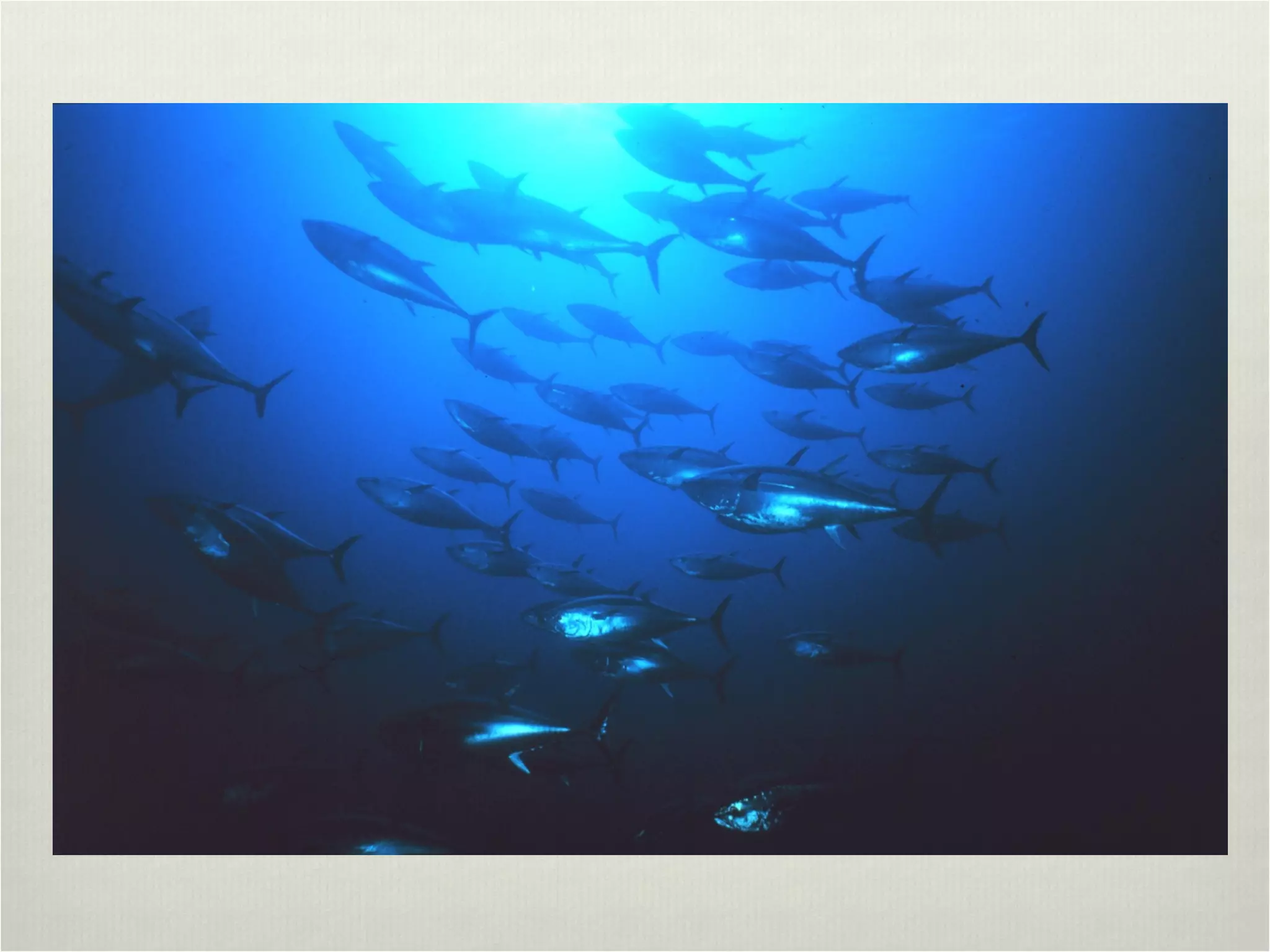
Bluefin Tuna Because bluefin tuna can sell for $90 per pound on the world market it causes the fishermen to fish down in size.  Now many companies catch juvenile bluefin and raise them in pens for the market.  Go to  http://www.pbs.org/emptyoceans/eoen/tuna/index.html   for more information on bluefin, incidental catch and videos.
 
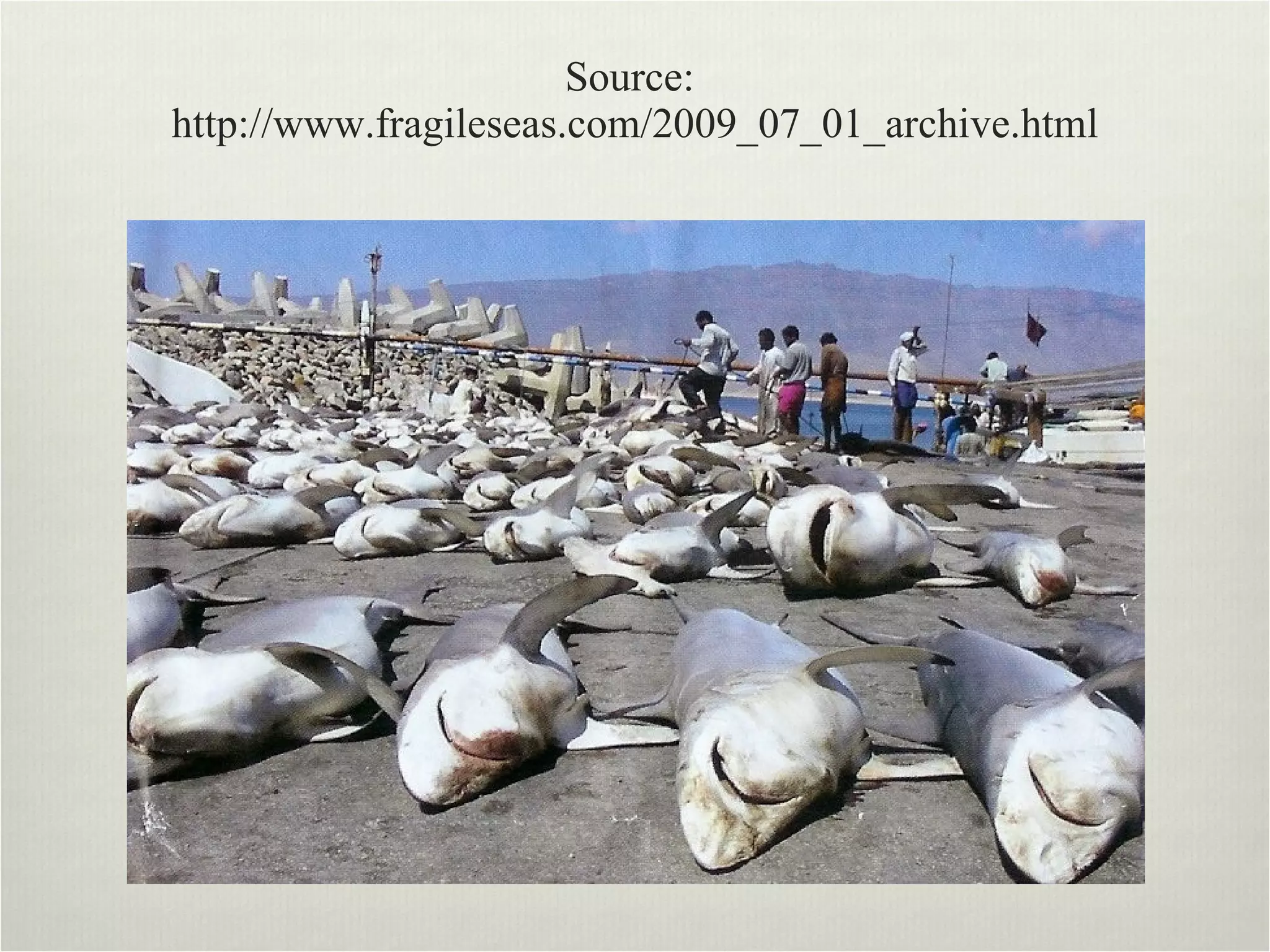
Shark Issues Sharks that have low reproductive rates are declining due to the practice of “finning”.  Asian markets demand shark fins for shark fin soup. In this practice, the fin is taken off and the shark is left to die  http://www.sharktrust.org/content.asp?did=26881   While not many people have sympathy for sharks, they are an important part of the ecosystem  http://www.youtube.com/watch?v=iVSyol-DVh8
Source:  http://www.fragileseas.com/2009_07_01_archive.html
Boney Fish There are two types of fish, boney fish and cartilaginous fish. When you eat fish at a restaurant, you are most likely eating a boney fish  Boney fish have many adaptations depending on where they live. Some of the characteristics of boney fish are schooling, wide angle lense eyes and a lateral line for detecting movement in the water  All of these adaptations are for sensing and escaping predators
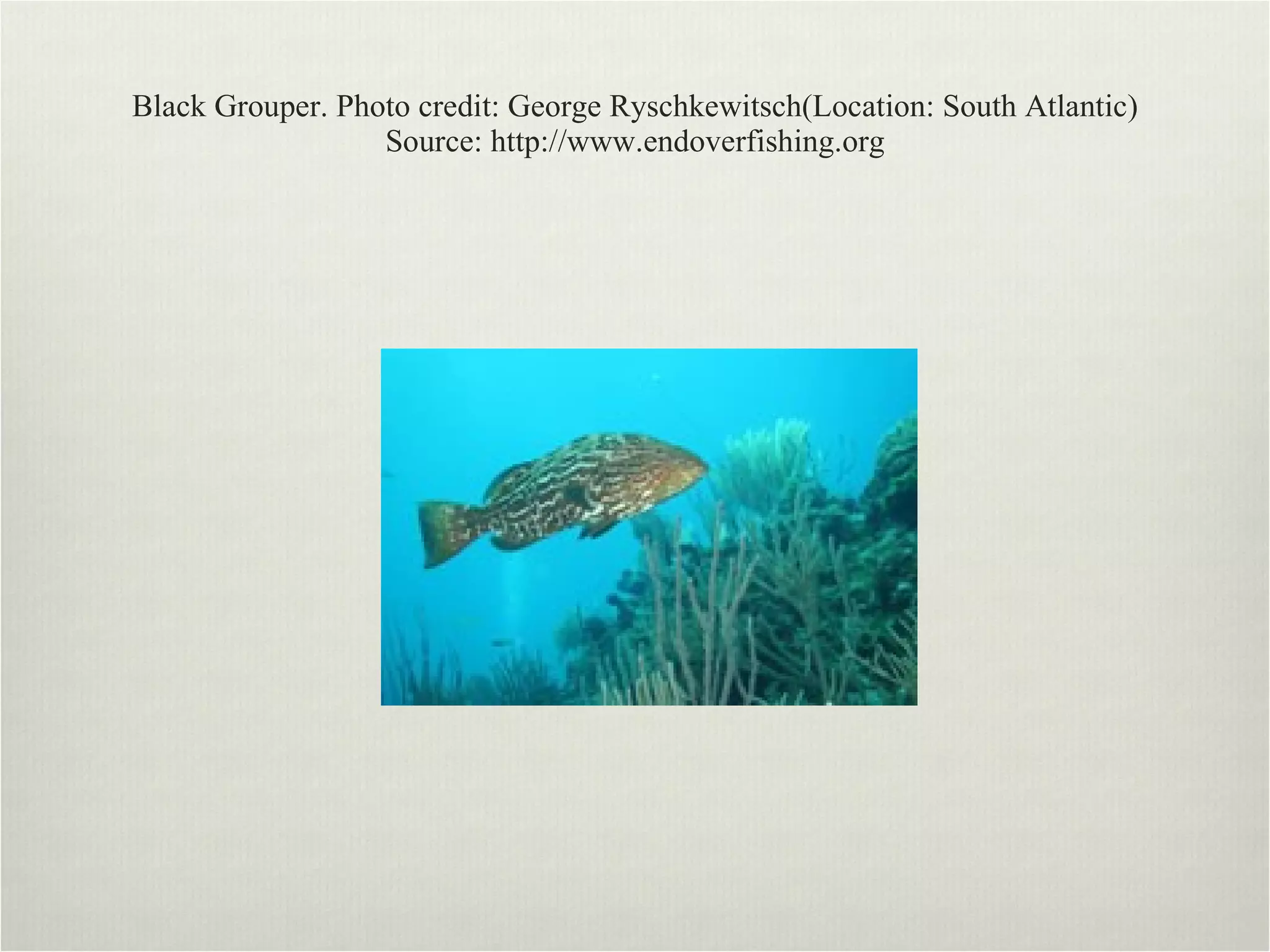
Black Grouper. Photo credit: George Ryschkewitsch

(Location: South Atlantic) Source: http://www.endoverfishing.org
Cartilaginous Fish Sharks (cartilaginous fish) on the other hand, have adaptations for being the perfect predator.  Their skin is rough and made of modified teeth called denticles.  The only boney part of their body is their teeth. They have several layers of teeth so that when one drops out another one pops up.  They can see in the water with very little light and smell one drop of blood in a pool of water.  They are good predators and good scavengers.
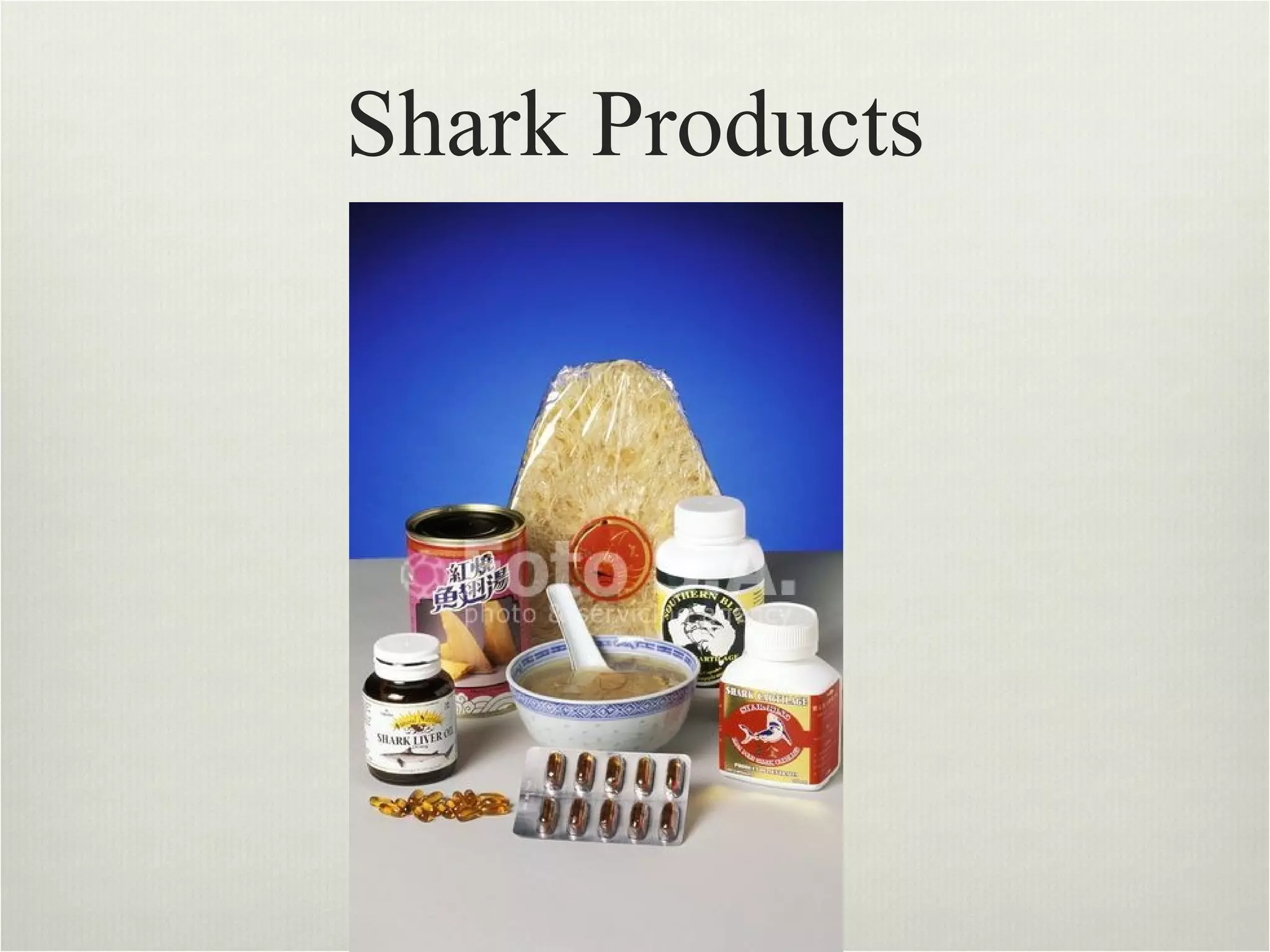
Shark Products

Ch11 slideshow

  • 1.
    Life in theSea Chapter 16 & 17
  • 2.
    Phylogenetic Order King Phillip Comes Over From Germany Sometimes Kingdom Phylum Class Order Family Genus and Species
  • 3.
  • 4.
  • 5.
    Plankton does notonly include phytoplankton (plants) and zooplankton (animals) but other free-floating organisms as well This includes sea jellies (jelly fish), hatchling sea turtles, and the larval stage of many marine organisms Many marine organisms that start out their life as planktonic (i.e. crabs, shrimp, oysters, etc.) and then are able to swim or settle to the bottom are called meroplankton
  • 6.
    Holoplankton spends itswhole life as a planktonic organism (i.e. phytoplankton and zooplankton) Phytoplankton are independent cells where as seaweed is an aggregation of cells. Sargassum seaweed which creates huge mats in the middle of the Atlantic Ocean (in the middle of the N. Atlantic Gyre) is the only multicellular plankton.
  • 7.
  • 8.
    Phytoplankton Diatoms tendto be yellow-brown in pigment and dinoflagellates are red to green in color. Both of these are phytoplankton but dinoflagellates do not require as much light as diatoms and they have appendages that give them limited movement. Dinoflagellates are both beautiful and dangerous
  • 9.
  • 10.
    They can bioluminescence(glow) at nighttime but there are species of dinoflagellates that are blamed for the red tide which causes paralytic shellfish poisoning (PSP). While diatoms are seen as the main primary producers in the ocean, dinoflagellates are the link between primary producers and herbivores (i.e. zooplankton).
  • 11.
  • 12.
  • 13.
    Zooplankton Herbivores includecrustaceans, copepods and euphausiids They represent 60% of all the zooplankton and an important food source for krill which baleen whales and penguin eat Copepods are the main link between the herbivores and the first level of carnivores
  • 14.
  • 15.
    Zooplankton cluster ineddies and up-welling zones where the nutrients and thus phytoplankton are found. Zooplankton migrate to the surface at night and migrate deeper (30-1500 ft) during the day. Whales and other filter feeders follow this migration pattern
  • 16.
  • 17.
    Plankton Bloom atGalapagos Islands, Equador Source: http://www.nasa.gov/vision/earth/environment/ocean_plants_21.html
  • 18.
    Hatchling sea turtlesstart out their life as a planktonic organism at the mercy of the currents Hatchlings (just a few inches long) leave the Southeast coast of the United States and go into a swimming frenzy until they reach the Gulf Current The Gulf Current or Stream goes at an impressive 3 ft/s or 3 knots. The hatchling turtles drift in this current and end up in an eddy or in the Sargassum Sea in the middle of the Atlantic Ocean where they are protected by the seaweed from larger predators.
  • 19.
  • 20.
    There are eightdifferent species of sea turtles: 1) leatherback, 2) green, 3) black, 4) Australian flat-back, 5) loggerhead, 6) hawksbill, 7) Kemps and 8) olive ridley Their diets vary from green turtles being herbivores to leatherbacks who specialize on seajellies Some are omnivorous like the loggerhead and eat a variety of foods.
  • 21.
  • 22.
    The Kemps Ridleyis the most endangered due to the fact that it only nests on one beach in the world The hawksbill is the second most endangered due to the beautiful “tortoise shell” that is made into jewelry All sea turtle species are protected under the Endangered Species Act (ESA) but some have threatened status and some have endangered status. The U.S. Fish and Wildlife regulates endangered species on land and National Marine Fisheries under NOAA regulates endangered species in the oceans http://www.fws.gov/endangered/ http://www.nmfs.noaa.gov/pr/species/
  • 23.
  • 24.
    Hawksbill Source: http://www.biologicaldiversity.org/index.html
  • 25.
    Most populations areaffected by habitat destruction and illegal trade. Photo of turtles caught on longlines and trawling.
  • 26.
    Incidental catch isalso a significant problem for turtles nesting on beaches where shrimp trawling is occurring Exhausted females get caught in the nets after laying over 100 eggs and drown United States trawlers are required to use a Turtle Excluder Devise (TED) to exclude sea turtle in their catch. Unfortunately most of the shrimp we eat in restaurants today are either imported (where TEDS are not enforced) or farm-raised
  • 27.
    Dead Turtle caughtin trawl net
  • 28.
    TED or TurtleExcluder Devise being used
  • 29.
    Sea Turtle Videoshttp://www.youtube.com/watch?v=gDV4rI3AlUM
  • 30.
    There are othermarine reptiles such as the Galapagos iguana, sea snakes and crocodiles
  • 31.
    Over Fishing theSeas Over fishing and incidental catch is driving the world’s fish stocks to historically low numbers. Even so, we harvest over 92 million metric tons of fish from the oceans world wide per year Improved fishing gear and efforts by more nations has improved the catch of most species
  • 32.
  • 33.
    Unfortunately, more than70% of the world’s fish stocks are over fished or depleted For more information on fish issues in the Northwest go to http://www.nmfs.noaa.gov/ and click on fish facts For information on what you are eating! http://www.nmfs.noaa.gov/fishwatch/
  • 34.
    Bluefin Tuna Becausebluefin tuna can sell for $90 per pound on the world market it causes the fishermen to fish down in size. Now many companies catch juvenile bluefin and raise them in pens for the market. Go to http://www.pbs.org/emptyoceans/eoen/tuna/index.html for more information on bluefin, incidental catch and videos.
  • 35.
  • 36.
    Shark Issues Sharksthat have low reproductive rates are declining due to the practice of “finning”. Asian markets demand shark fins for shark fin soup. In this practice, the fin is taken off and the shark is left to die http://www.sharktrust.org/content.asp?did=26881 While not many people have sympathy for sharks, they are an important part of the ecosystem http://www.youtube.com/watch?v=iVSyol-DVh8
  • 37.
  • 38.
    Boney Fish Thereare two types of fish, boney fish and cartilaginous fish. When you eat fish at a restaurant, you are most likely eating a boney fish Boney fish have many adaptations depending on where they live. Some of the characteristics of boney fish are schooling, wide angle lense eyes and a lateral line for detecting movement in the water All of these adaptations are for sensing and escaping predators
  • 39.
    Black Grouper. Photocredit: George Ryschkewitsch

(Location: South Atlantic) Source: http://www.endoverfishing.org
  • 40.
    Cartilaginous Fish Sharks(cartilaginous fish) on the other hand, have adaptations for being the perfect predator. Their skin is rough and made of modified teeth called denticles. The only boney part of their body is their teeth. They have several layers of teeth so that when one drops out another one pops up. They can see in the water with very little light and smell one drop of blood in a pool of water. They are good predators and good scavengers.
  • 41.