TRAUMATIC BRAIN
INJURY
STRATEGIES AND RATIONALE TO DECREASE
SECONDARY BRAIN INJURY
PRESENTER - DR YOGESH RATHOD
MODERATOR – DR SHALINI NAIR
CLASSIFICATION
 Traumatic brain injury (TBI) is a heterogeneous disease.
 There are many different ways to categorize patients
 Clinical severity scores
 GCS based
 13 to 15 Mild injury, 9 to 12 Moderate injury, and 8 or less as severe TBI.
 universally accepted, simple, reproducible and good predictive value for overall prognosis.
(limited by confounding factors such as medical sedation and paralysis, endotracheal intubation, and
intoxication)
 Full Outline of Unresponsiveness (FOUR) Score includes a brainstem examination.
(lacks the long track record of the GCS in predicting prognosis, complicated to perform and difficult for
non-neurologists)
 A 17-point scale (with potential scores ranging from 0 to 16).
 Decreasing FOUR Score is associated with worsening level of consciousness.
 Assesses four domains of neurological function: eye responses, motor responses, brainstem reflexes, and
breathing pattern.
 Neuroimaging scales
 Traumatic brain injury can lead to several pathologic injuries, most of which can be identified
on neuroimaging which are
 Skull fracture
 Epidural hematoma
 Subdural hematoma
 Subarachnoid hemorrhage
 Intraparenchymal hemorrhage
 Cerebral contusion
 Intraventricular hemorrhage
 Focal and diffuse patterns of axonal injury with cerebral edema
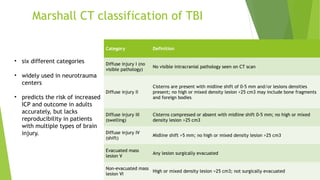
Marshall CT classification of TBI
Category Definition
Diffuse injury I (no
visible pathology)
No visible intracranial pathology seen on CT scan
Diffuse injury II
Cisterns are present with midline shift of 0-5 mm and/or lesions densities
present; no high or mixed density lesion >25 cm3 may include bone fragments
and foreign bodies
Diffuse injury III
(swelling)
Cisterns compressed or absent with midline shift 0-5 mm; no high or mixed
density lesion >25 cm3
Diffuse injury IV
(shift)
Midline shift >5 mm; no high or mixed density lesion >25 cm3
Evacuated mass
lesion V
Any lesion surgically evacuated
Non-evacuated mass
lesion VI
High or mixed density lesion >25 cm3; not surgically evacuated
• six different categories
• widely used in neurotrauma
centers
• predicts the risk of increased
ICP and outcome in adults
accurately, but lacks
reproducibility in patients
with multiple types of brain
injury.
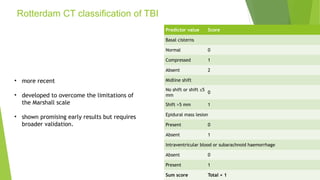
Rotterdam CT classification of TBI
Predictor value Score
Basal cisterns
Normal 0
Compressed 1
Absent 2
Midline shift
No shift or shift ≤5
mm
0
Shift >5 mm 1
Epidural mass lesion
Present 0
Absent 1
Intraventricular blood or subarachnoid haemorrhage
Absent 0
Present 1
Sum score Total + 1
• more recent
• developed to overcome the limitations of
the Marshall scale
• shown promising early results but requires
broader validation.
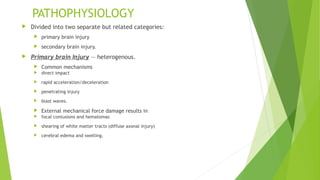
PATHOPHYSIOLOGY
 Divided into two separate but related categories:
 primary brain injury
 secondary brain injury.
 Primary brain Injury — heterogenous.
 Common mechanisms
 direct impact
 rapid acceleration/deceleration
 penetrating injury
 blast waves.
 External mechanical force damage results in
 focal contusions and hematomas
 shearing of white matter tracts (diffuse axonal injury)
 cerebral edema and swelling.
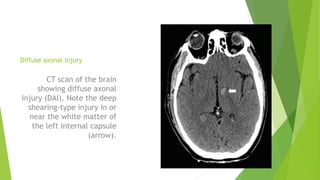
Diffuse axonal injury
CT scan of the brain
showing diffuse axonal
injury (DAI). Note the deep
shearing-type injury in or
near the white matter of
the left internal capsule
(arrow).
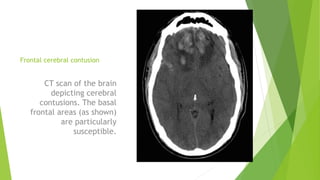
Frontal cerebral contusion
CT scan of the brain
depicting cerebral
contusions. The basal
frontal areas (as shown)
are particularly
susceptible.
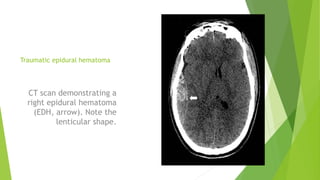
Traumatic epidural hematoma
CT scan demonstrating a
right epidural hematoma
(EDH, arrow). Note the
lenticular shape.
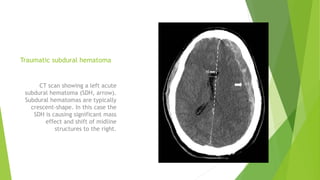
Traumatic subdural hematoma
CT scan showing a left acute
subdural hematoma (SDH, arrow).
Subdural hematomas are typically
crescent-shape. In this case the
SDH is causing significant mass
effect and shift of midline
structures to the right.
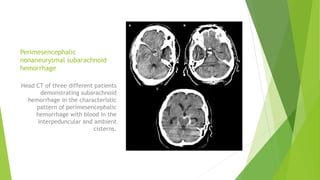
Perimesencephalic
nonaneurysmal subarachnoid
hemorrhage
Head CT of three different patients
demonstrating subarachnoid
hemorrhage in the characteristic
pattern of perimesencephalic
hemorrhage with blood in the
interpeduncular and ambient
cisterns.
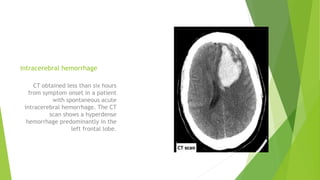
intracerebral hemorrhage
CT obtained less than six hours
from symptom onset in a patient
with spontaneous acute
intracerebral hemorrhage. The CT
scan shows a hyperdense
hemorrhage predominantly in the
left frontal lobe.
 Secondary brain Injury
These mechanisms include:
 Neurotransmitter-mediated excitotoxicity causing glutamate, free-radical injury to cell membranes
 Electrolyte imbalances
 Mitochondrial dysfunction
 Inflammatory responses
 Apoptosis
 Secondary ischemia from vasospasm, focal microvascular occlusion, vascular injury
 Current clinical approaches to the management of TBI center around primary and secondary brain injury
concepts.
STRATEGIES AND RECOMMENDATIONS FOR
TRAUMATIC BRAIN INJURY
TREATMENT RECOMMENDATIONS
 Decompressive craniectomy
 Bifrontal DC is not recommended to improve outcomes as measured by the GOS-E score at 6month
post-injury in severe TBI patients with diffuse injury (without mass lesions), and with ICP
elevation to values 20mmHg for >15 min within 1 hr period that are refractory to first-tier
therapies. However, this procedure has been demonstrated to reduce ICP and to minimize days in
the ICU.
 A large fronto-temporo-parietal DC (not less than 12 x 15 cm or 15 cm diameter) is recommended
over a small FTP DC for reduced mortality and improved neurologic outcomes.
 Ventilation therapies
 Prolonged prophylactic hyperventilation with PaCO2 of 25 mm Hg is not recommended.
 Hyperventilation is recommended as a temporizing measure for the reduction of elevated ICP.
 Hyperventilation avoided during the first 24 h when CBF often is reduced critically.
 If hyperventilation is used, SjO2 or BtpO2 measurements are recommended to monitor oxygen
delivery.
 Prophylactic hypothermia
 Early (within 2.5 h), short-term (48 h post-injury), prophylactic hypothermia is not recommended to
improve outcomes in patients with diffuse injury.
 Hyperosmolar therapy
 Mannitol is effective for control of raised ICP at doses of 0.25 to 1 g/kg body weight. Arterial hypotension
(systolic blood pressure ,90 mm Hg) should be avoided.
 Restrict mannitol use prior to ICP monitoring to patients with signs of transtentorial herniation or
progressive neurologic deterioration not attributable to extracranial causes.
 Cerebrospinal fluid drainage
 An EVD system zeroed at the midbrain with continuous drainage of CSF may be considered to lower ICP
burden more effectively than intermittent use.
 Use of CSF drainage to lower ICP in patients with an initial GCS of 6 or lower during the first 12 h after
injury may be considered.
 Anesthetics, analgesics, and sedatives
 Barbiturates for burst suppression in EEG as prophylaxis against development of intracranial HTN not
recommended.
 High-dose barbiturate recommended to control elevated refractory ICP. Hemodynamic stability essential.
 Propofol is recommended for the control of ICP, but not recommended for improvement in mortality or 6-
month outcomes. Caution is required as high-dose propofol can produce significant morbidity.
 Steroids
 Not recommended for improving outcome or reducing ICP. Rather high dose methylpred was a/w increased
mortality and is contraindicated.
 Nutrition
 Feeding patients to attain basal caloric replacement at least by the 5th day and at most by the 7th day
recommended to decrease mortality.
 Infection prophylaxis
 Early trach recommended to reduce mechanical ventilation days if overall benefit outweighs the complications. No
evidence that early trach reduces mortality or the rate of nosocomial pneumonia.
 PI oral care is not recommended to reduce VAP and may cause an increased risk of ARDS.
 Antimicrobial-impregnated catheters may be considered during EVD to prevent infections.
 DVT Prophylaxis
 LMWH or low-dose unfractionated heparin may be used in combination with mechanical prophylaxis. But an
increased risk for expansion of ICH.
 Compression stockings + pharmacologic prophylaxis may be beneficial.
 Insufficient evidence to support recommendations regarding the preferred agent, dose, or timing of pharmacologic
prophylaxis for DVT.
 Seizure prophylaxis
 Prophylactic use of phenytoin or valproate is not recommended for preventing late PTS.
 Phenytoin is recommended to decrease the incidence of early PTS (within 7 d of injury), when the overall benefit
outweighs the complications. However, early PTS have not been associated with worse outcomes.
 Insufficient evidence to recommend levetiracetam over phenytoin regarding efficacy in preventing early PTS and
toxicity.
 Intracranial pressure monitoring
 Management of severe TBI patients using information from ICP monitoring is recommended to reduce in hospital
and 2-week post-injury mortality.
 Monitored in all salvageable patients with a TBI (GCS 3-8 after resuscitation) and an abnormal CT scans.
 Indicated in patients with severe TBI with a normal CT scan if >2 OR 2 of the following features are noted at
admission:
 age >40 years,
 unilateral or bilateral motor posturing, or
 SBP <90 mm Hg.
 Advanced cerebral monitoring
 Jugular bulb monitoring of AVDO2 may be considered important parameter to reduce mortality and improve
outcomes at 3 and 6 mo post-injury.
 Cerebral perfusion pressure monitoring
 Management of severe TBI patients using guidelines-based recommendations for CPP monitoring is
recommended to decrease 2-wk mortality.
MONITORING RECOMMENDATIONS
 Blood pressure thresholds - Maintaining SBP at >100 mm Hg OR equal for patients 50 to 69 years old
or at >110 mm Hg or equal or above for patients 15 to 49 or >70 years old may be considered to
decrease mortality and improve outcomes.
 Intracranial pressure thresholds - Treating ICP >22 mm Hg is recommended because values above this
level are associated with increased mortality. A combination of ICP values and clinical and brain CT
findings may be used to make management decisions.
 Cerebral perfusion pressure thresholds - The recommended target CPP value for survival and
favorable outcomes is between 60 and 70 mm Hg. Whether 60 or 70 mm Hg is the minimum optimal
CPP threshold is unclear and may depend upon the autoregulatory status of the patient. Avoiding
aggressive attempts to maintain CPP >70 mm Hg with fluids and pressors may be considered because
of the risk of adult respiratory failure.
 Advanced cerebral monitoring thresholds - Jugular venous saturation of <50% may be a threshold to
avoid in order to reduce mortality and improve outcomes.
THRESHOLD RECOMMENDATIONS
SUMMARY
 TBI encompasses a broad range of pathologic injuries of varying clinical severity.
 TBI is universally categorized as mild, moderate, and severe based on GCS.
 The pathophysiology of TBI includes primary and secondary brain injury.
 The pathoanatomical sequelae of primary TBI include intra- and extra parenchymal hemorrhages and
DAI.
 Secondary TBI results from a cascade of molecular injury mechanisms and can be exacerbated by
modifiable systemic events such as hypotension, hypoxia, fever, and seizures
 Surgical treatment of primary brain injury lesions is central to the initial management.
 Likewise, the identification, prevention, and treatment of secondary brain injury is the principle
focus of neurointensive care management.
NO QUESTIONS! JUST SELF HELP!
BRAIN TRAUMA FOUNDATION GUIDELINES 2016
UPTODATE
NEUROTRAUMA TEXTBOOKS

Traumatic brain injury

  • 1.
    TRAUMATIC BRAIN INJURY STRATEGIES ANDRATIONALE TO DECREASE SECONDARY BRAIN INJURY PRESENTER - DR YOGESH RATHOD MODERATOR – DR SHALINI NAIR
  • 2.
    CLASSIFICATION  Traumatic braininjury (TBI) is a heterogeneous disease.  There are many different ways to categorize patients  Clinical severity scores  GCS based  13 to 15 Mild injury, 9 to 12 Moderate injury, and 8 or less as severe TBI.  universally accepted, simple, reproducible and good predictive value for overall prognosis. (limited by confounding factors such as medical sedation and paralysis, endotracheal intubation, and intoxication)  Full Outline of Unresponsiveness (FOUR) Score includes a brainstem examination. (lacks the long track record of the GCS in predicting prognosis, complicated to perform and difficult for non-neurologists)  A 17-point scale (with potential scores ranging from 0 to 16).  Decreasing FOUR Score is associated with worsening level of consciousness.  Assesses four domains of neurological function: eye responses, motor responses, brainstem reflexes, and breathing pattern.
  • 3.
     Neuroimaging scales Traumatic brain injury can lead to several pathologic injuries, most of which can be identified on neuroimaging which are  Skull fracture  Epidural hematoma  Subdural hematoma  Subarachnoid hemorrhage  Intraparenchymal hemorrhage  Cerebral contusion  Intraventricular hemorrhage  Focal and diffuse patterns of axonal injury with cerebral edema
  • 4.
    Marshall CT classificationof TBI Category Definition Diffuse injury I (no visible pathology) No visible intracranial pathology seen on CT scan Diffuse injury II Cisterns are present with midline shift of 0-5 mm and/or lesions densities present; no high or mixed density lesion >25 cm3 may include bone fragments and foreign bodies Diffuse injury III (swelling) Cisterns compressed or absent with midline shift 0-5 mm; no high or mixed density lesion >25 cm3 Diffuse injury IV (shift) Midline shift >5 mm; no high or mixed density lesion >25 cm3 Evacuated mass lesion V Any lesion surgically evacuated Non-evacuated mass lesion VI High or mixed density lesion >25 cm3; not surgically evacuated • six different categories • widely used in neurotrauma centers • predicts the risk of increased ICP and outcome in adults accurately, but lacks reproducibility in patients with multiple types of brain injury.
  • 5.
    Rotterdam CT classificationof TBI Predictor value Score Basal cisterns Normal 0 Compressed 1 Absent 2 Midline shift No shift or shift ≤5 mm 0 Shift >5 mm 1 Epidural mass lesion Present 0 Absent 1 Intraventricular blood or subarachnoid haemorrhage Absent 0 Present 1 Sum score Total + 1 • more recent • developed to overcome the limitations of the Marshall scale • shown promising early results but requires broader validation.
  • 6.
    PATHOPHYSIOLOGY  Divided intotwo separate but related categories:  primary brain injury  secondary brain injury.  Primary brain Injury — heterogenous.  Common mechanisms  direct impact  rapid acceleration/deceleration  penetrating injury  blast waves.  External mechanical force damage results in  focal contusions and hematomas  shearing of white matter tracts (diffuse axonal injury)  cerebral edema and swelling.
  • 7.
    Diffuse axonal injury CTscan of the brain showing diffuse axonal injury (DAI). Note the deep shearing-type injury in or near the white matter of the left internal capsule (arrow).
  • 8.
    Frontal cerebral contusion CTscan of the brain depicting cerebral contusions. The basal frontal areas (as shown) are particularly susceptible.
  • 9.
    Traumatic epidural hematoma CTscan demonstrating a right epidural hematoma (EDH, arrow). Note the lenticular shape.
  • 10.
    Traumatic subdural hematoma CTscan showing a left acute subdural hematoma (SDH, arrow). Subdural hematomas are typically crescent-shape. In this case the SDH is causing significant mass effect and shift of midline structures to the right.
  • 11.
    Perimesencephalic nonaneurysmal subarachnoid hemorrhage Head CTof three different patients demonstrating subarachnoid hemorrhage in the characteristic pattern of perimesencephalic hemorrhage with blood in the interpeduncular and ambient cisterns.
  • 12.
    intracerebral hemorrhage CT obtainedless than six hours from symptom onset in a patient with spontaneous acute intracerebral hemorrhage. The CT scan shows a hyperdense hemorrhage predominantly in the left frontal lobe.
  • 13.
     Secondary brainInjury These mechanisms include:  Neurotransmitter-mediated excitotoxicity causing glutamate, free-radical injury to cell membranes  Electrolyte imbalances  Mitochondrial dysfunction  Inflammatory responses  Apoptosis  Secondary ischemia from vasospasm, focal microvascular occlusion, vascular injury  Current clinical approaches to the management of TBI center around primary and secondary brain injury concepts.
  • 14.
    STRATEGIES AND RECOMMENDATIONSFOR TRAUMATIC BRAIN INJURY
  • 15.
    TREATMENT RECOMMENDATIONS  Decompressivecraniectomy  Bifrontal DC is not recommended to improve outcomes as measured by the GOS-E score at 6month post-injury in severe TBI patients with diffuse injury (without mass lesions), and with ICP elevation to values 20mmHg for >15 min within 1 hr period that are refractory to first-tier therapies. However, this procedure has been demonstrated to reduce ICP and to minimize days in the ICU.  A large fronto-temporo-parietal DC (not less than 12 x 15 cm or 15 cm diameter) is recommended over a small FTP DC for reduced mortality and improved neurologic outcomes.  Ventilation therapies  Prolonged prophylactic hyperventilation with PaCO2 of 25 mm Hg is not recommended.  Hyperventilation is recommended as a temporizing measure for the reduction of elevated ICP.  Hyperventilation avoided during the first 24 h when CBF often is reduced critically.  If hyperventilation is used, SjO2 or BtpO2 measurements are recommended to monitor oxygen delivery.
  • 16.
     Prophylactic hypothermia Early (within 2.5 h), short-term (48 h post-injury), prophylactic hypothermia is not recommended to improve outcomes in patients with diffuse injury.  Hyperosmolar therapy  Mannitol is effective for control of raised ICP at doses of 0.25 to 1 g/kg body weight. Arterial hypotension (systolic blood pressure ,90 mm Hg) should be avoided.  Restrict mannitol use prior to ICP monitoring to patients with signs of transtentorial herniation or progressive neurologic deterioration not attributable to extracranial causes.  Cerebrospinal fluid drainage  An EVD system zeroed at the midbrain with continuous drainage of CSF may be considered to lower ICP burden more effectively than intermittent use.  Use of CSF drainage to lower ICP in patients with an initial GCS of 6 or lower during the first 12 h after injury may be considered.
  • 17.
     Anesthetics, analgesics,and sedatives  Barbiturates for burst suppression in EEG as prophylaxis against development of intracranial HTN not recommended.  High-dose barbiturate recommended to control elevated refractory ICP. Hemodynamic stability essential.  Propofol is recommended for the control of ICP, but not recommended for improvement in mortality or 6- month outcomes. Caution is required as high-dose propofol can produce significant morbidity.  Steroids  Not recommended for improving outcome or reducing ICP. Rather high dose methylpred was a/w increased mortality and is contraindicated.  Nutrition  Feeding patients to attain basal caloric replacement at least by the 5th day and at most by the 7th day recommended to decrease mortality.
  • 18.
     Infection prophylaxis Early trach recommended to reduce mechanical ventilation days if overall benefit outweighs the complications. No evidence that early trach reduces mortality or the rate of nosocomial pneumonia.  PI oral care is not recommended to reduce VAP and may cause an increased risk of ARDS.  Antimicrobial-impregnated catheters may be considered during EVD to prevent infections.  DVT Prophylaxis  LMWH or low-dose unfractionated heparin may be used in combination with mechanical prophylaxis. But an increased risk for expansion of ICH.  Compression stockings + pharmacologic prophylaxis may be beneficial.  Insufficient evidence to support recommendations regarding the preferred agent, dose, or timing of pharmacologic prophylaxis for DVT.  Seizure prophylaxis  Prophylactic use of phenytoin or valproate is not recommended for preventing late PTS.  Phenytoin is recommended to decrease the incidence of early PTS (within 7 d of injury), when the overall benefit outweighs the complications. However, early PTS have not been associated with worse outcomes.  Insufficient evidence to recommend levetiracetam over phenytoin regarding efficacy in preventing early PTS and toxicity.
  • 19.
     Intracranial pressuremonitoring  Management of severe TBI patients using information from ICP monitoring is recommended to reduce in hospital and 2-week post-injury mortality.  Monitored in all salvageable patients with a TBI (GCS 3-8 after resuscitation) and an abnormal CT scans.  Indicated in patients with severe TBI with a normal CT scan if >2 OR 2 of the following features are noted at admission:  age >40 years,  unilateral or bilateral motor posturing, or  SBP <90 mm Hg.  Advanced cerebral monitoring  Jugular bulb monitoring of AVDO2 may be considered important parameter to reduce mortality and improve outcomes at 3 and 6 mo post-injury.  Cerebral perfusion pressure monitoring  Management of severe TBI patients using guidelines-based recommendations for CPP monitoring is recommended to decrease 2-wk mortality. MONITORING RECOMMENDATIONS
  • 20.
     Blood pressurethresholds - Maintaining SBP at >100 mm Hg OR equal for patients 50 to 69 years old or at >110 mm Hg or equal or above for patients 15 to 49 or >70 years old may be considered to decrease mortality and improve outcomes.  Intracranial pressure thresholds - Treating ICP >22 mm Hg is recommended because values above this level are associated with increased mortality. A combination of ICP values and clinical and brain CT findings may be used to make management decisions.  Cerebral perfusion pressure thresholds - The recommended target CPP value for survival and favorable outcomes is between 60 and 70 mm Hg. Whether 60 or 70 mm Hg is the minimum optimal CPP threshold is unclear and may depend upon the autoregulatory status of the patient. Avoiding aggressive attempts to maintain CPP >70 mm Hg with fluids and pressors may be considered because of the risk of adult respiratory failure.  Advanced cerebral monitoring thresholds - Jugular venous saturation of <50% may be a threshold to avoid in order to reduce mortality and improve outcomes. THRESHOLD RECOMMENDATIONS
  • 21.
    SUMMARY  TBI encompassesa broad range of pathologic injuries of varying clinical severity.  TBI is universally categorized as mild, moderate, and severe based on GCS.  The pathophysiology of TBI includes primary and secondary brain injury.  The pathoanatomical sequelae of primary TBI include intra- and extra parenchymal hemorrhages and DAI.  Secondary TBI results from a cascade of molecular injury mechanisms and can be exacerbated by modifiable systemic events such as hypotension, hypoxia, fever, and seizures  Surgical treatment of primary brain injury lesions is central to the initial management.  Likewise, the identification, prevention, and treatment of secondary brain injury is the principle focus of neurointensive care management.
  • 22.
    NO QUESTIONS! JUSTSELF HELP! BRAIN TRAUMA FOUNDATION GUIDELINES 2016 UPTODATE NEUROTRAUMA TEXTBOOKS

Editor's Notes

  • #5 &amp;lt;number&amp;gt;
  • #8 Shearing mechanisms lead to diffuse axonal injury (DAI), which is visualized pathologically and on neuroimaging studies as multiple small lesions seen within white matter tracts . Severe DAI presents with profound coma without elevated ICP, and often have poor outcome. This typically involves the gray-white junction in the hemispheres, with more severe injuries affecting the corpus callosum and/or midbrain. MRI (in particular diffusion tensor imaging) is more sensitive than CT for detecting DAI, and the sensitivity of the test declines if delayed from the time of injury. &amp;lt;number&amp;gt;
  • #9 Focal cerebral contusions are the most frequently encountered lesions. Contusions are commonly seen in the basal frontal and temporal areas, which are susceptible due to direct impact on basal skull surfaces in the setting of acceleration/deceleration injuries. Coalescence of cerebral contusions or a more severe head injury disrupting intraparenchymal blood vessels may result in an intraparenchymal hematoma. &amp;lt;number&amp;gt;
  • #10 Extra-axial (defined as outside the substance of the brain) hematomas are generally encountered when forces are distributed to the cranial vault and the most superficial cerebral layers. These include epidural, subdural, and subarachnoid hemorrhage. In adults, epidural hematomas (EDH) are typically associated with torn dural vessels such as the middle meningeal artery, and are almost always associated with a skull fracture. EDHs are lenticular-shaped and tend not to be associated with underlying brain damage. For this reason, patients who are found to have EDHs only on CT scan may have a better prognosis than individuals with other traumatic hemorrhage types. &amp;lt;number&amp;gt;
  • #11 •Subdural hematomas (SDH) result from damage to bridging veins, which drain the cerebral cortical surfaces to dural venous sinuses, or from the blossoming of superficial cortical contusions. They tend to be crescent-shaped and are often associated with underlying cerebral injury. &amp;lt;number&amp;gt;
  • #12 •Subarachnoid hemorrhage (SAH) can occur with disruption of small pial vessels and commonly occurs in the sylvian fissures and interpeduncular cisterns. Intraventricular hemorrhage or superficial intracerebral hemorrhage may also extend into the subarachnoid space. &amp;lt;number&amp;gt;
  • #13 •Intraventricular hemorrhage is believed to result from tearing of subependymal veins, or by extension from adjacent intraparenchymal or subarachnoid hemorrhage. &amp;lt;number&amp;gt;
  • #14  — A cascade of molecular injury mechanisms that are initiated at the time of initial trauma and continue for hours or days. These lead in turn to neuronal cell death and to cerebral edema with increased ICP that can further exacerbate the brain injury. Mimics like ischemic cascade in acute stroke. These various pathways of cellular injury have been the focus of extensive preclinical work into the development of neuroprotective treatments to prevent secondary brain injury in TBI. No clinical trials of these strategies have demonstrated clear benefit in patients. However, a critical aspect of ameliorating secondary brain injury after TBI is the avoidance of secondary brain insults, which would otherwise be well-tolerated but can exacerbate neuronal injury in cells made vulnerable by the initial TBI. Examples include hypotension and hypoxia (which decrease substrate delivery of oxygen and glucose to injured brain), fever and seizures (which may further increase metabolic demand), and hyperglycemia (which may exacerbate ongoing injury mechanisms). &amp;lt;number&amp;gt;