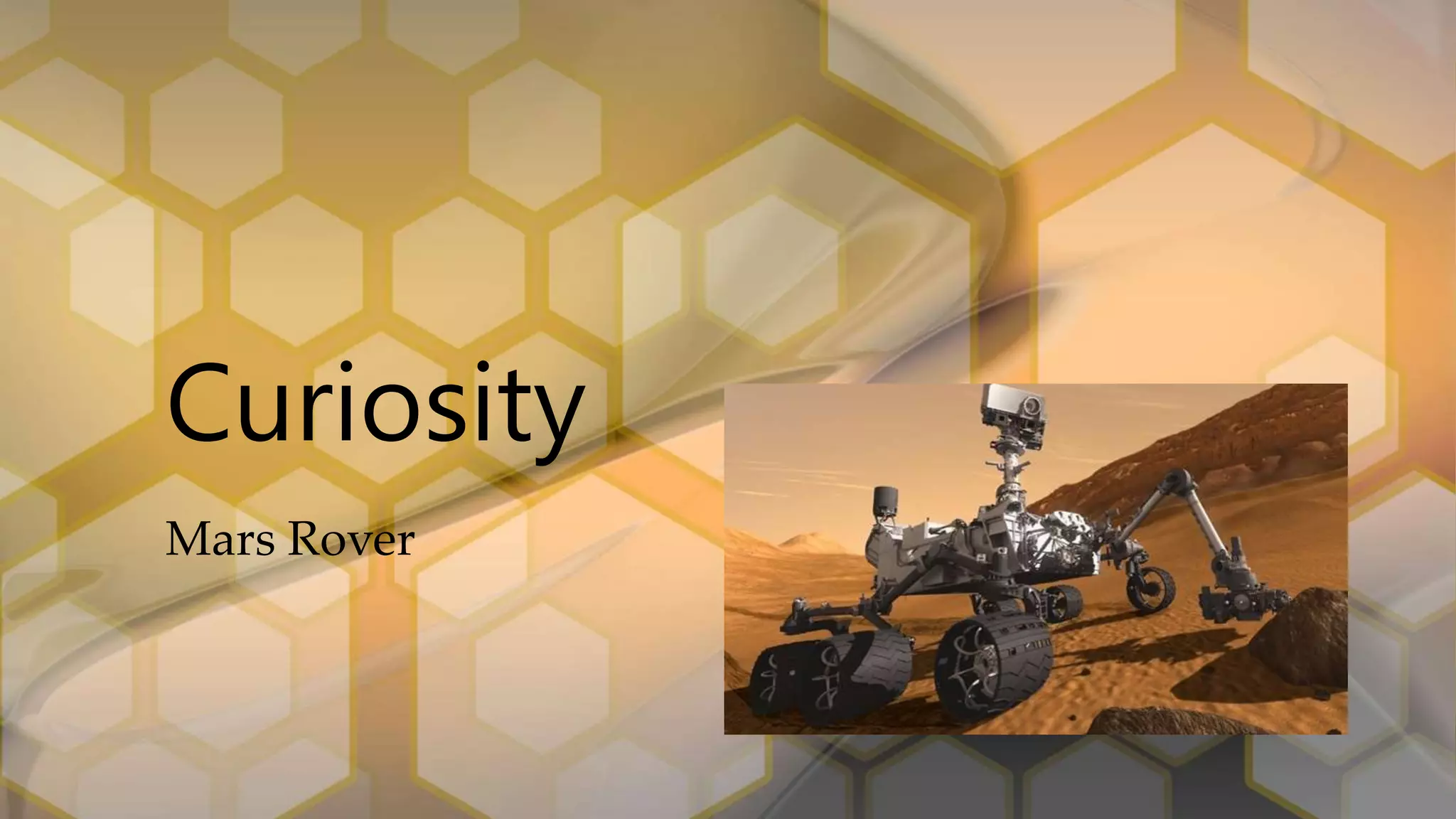
Mars Rover
Curiosity
• Operator : NASA International team
• Website : mars.jpl.nasa.gov/msl/
• Mission duration : 1453 days (as of July 29, 2016)
• Manufacturer : Jet Propulsion Laboratory (JPL), Boeing,
Lockheed Martin
• Dry mass : 899 kg
• Launch date : November 26, 2011, 15:02:00 UTC
• Landing date : August 6, 2012, 05:17:57 UTC
• Dimension : 2.9m (l) x 2.7m (w) x 2.2m (h)
History of Rovers
Name Country Description Date
Lunokhod 0 Russia
(Soviet
Union)
- Intended to be the
first roving remote-
controlled robot on
the Moon
- Crashed during a
failed start
19 February
1969
Name Country Description Date
Lunokhod 1 Russia
(Soviet
Union)
- first roving remote-
controlled robot on
the Moon
- Used to analyse the
lunar soil
17 November
1970 (landed) –
14 September
1971 (last
contacted)
Name Country Description Date
Apollo 15 USA - Apollo Lunar
Roving Vehicle
- Analyses the surface
material of moon
30 July 1971
(landed) – 2
August 1971
(Depart)
Apollo 16 USA 21 April 1972
(landed) – 24
April 1972
(Depart)
Apollo 17 USA 11 December
1972 (landed) –
14 December
1972 (Depart)
Name Country Description Date
Lunokhod 2 Russia - Second roving
remote-controlled
robot on the Moon
- Used to analyse the
lunar soil
15 January 1973
(landed) –
September 1974
(final contact)
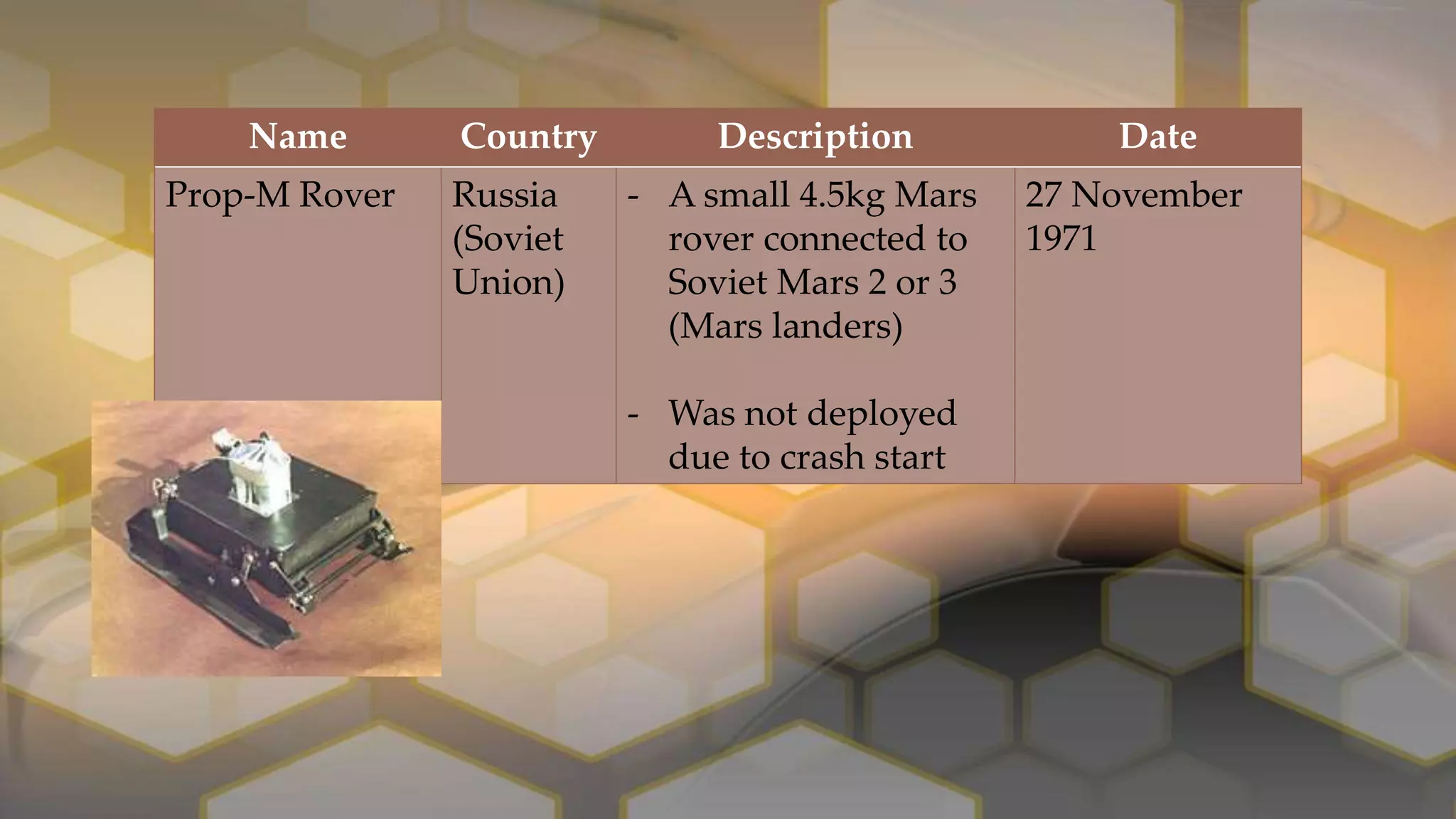
Name Country Description Date
Prop-M Rover Russia
(Soviet
Union)
- A small 4.5kg Mars
rover connected to
Soviet Mars 2 or 3
(Mars landers)
- Was not deployed
due to crash start
27 November
1971
Name Country Description Date
Marsokhod Russia
(Soviet
Union)
- Was a heavy Soviet
rover aimed at Mars
- Supposed to be
launched by a rocket
that never arrived to
fly
1973
Name Country Description Date
Lunokhod 3 Russia
(Soviet
Union)
- Intended to be the
third roving remote-
controlled robot on
the Moon
- Mission was
cancelled due to
lack of funding
1977
Name Country Description Date
Sojourner USA - Part of NASA’s
mission - Mars
Pathfinder
- First rover to
successfully reach
another planet
4 July 1997
(landed) – 27
September 1997
(final data
transmission)
Name Country Description Date
Spirit USA - One of two of
NASA’s Mars
Exploration Rover
Mission
- Became stuck in late
2009
4 January 2004
(landed) – 22
March 2010 (last
communication)
Name Country Description Date
Opportunity USA - Spirit’s twin
- Currently hold’s the
record for longest
distance travelled on
other planet
25 January 2004
(landed) -
current
Name Country Description Date
Curiosity USA - Part of NASA’s Mars
Science Laboratory
- In search for
evidence of past or
present life on Mars
6 August 2012
(landed) -
current
Name Country Description Date
Yutu China - Part of Chinese
Lunar Exploration
Program (Chang’e 3)
- China’s first lunar
rover
14 December
2013 (landed) -
current
Operation of Curiosity
• Powered by electricity produced by the decaying of radioactive
isotopes
• Power source generates 2.5kWh each day and charges two
rechargeable lithium-ion batteries
• Equipped with six 50cm diameter wheels
• Each wheel can be steered independently
• Can withstand a tilt of at least 50° in any direction without
overturning, but automatic sensors will limit the rover from
exceeding 30° tilts
• Capable of climbing slopes up to 12.5°
• Can travel up to 90 metres per hour but average speed is about 30
metres per hour
Capabilities and Functionality
Instruments Description
Mast Camera
(MastCam)
- Provides two cameras – Medium Angle
Camera (MAC) & Narrow Angle Camera
(NAC)
- Captures true-colour images at 1600 x 1200
pixels
- Records 720p video up to 10fps
- MAC has a 34mm focal length with a 15°
field of view
- NAC has a 100mm focal length with a 5.1°
field of view
- Each camera has eight GB of flash memory
Instruments Description
Chemistry and
Camera complex
(ChemCam)
- Consists of Laser-induced Breakdown
Spectroscopy (LIBS) & Remote Micro
Imager (RMI) telescope
- LIBS is used to provide elemental
compositions of rock and soil
- RMI will send images of sampling areas of
rock and soil that LIBS targets
- LIBS able to target samples up to 7m away
- Has the ability to record up to 6144
different wavelengths of light
Instruments Description
Navigation Cameras
(NavCams)
- Has two pairs of black and white
navigation cameras
- Each have a 45° angle of view
- Uses visible light to capture stereoscopic
3D imagery
Instruments Description
Rover Environmental
Monitoring Station
(REMS)
- Comprises instruments to measure the
Mars’ humidity, pressure, temperature,
wind speed, and ultraviolet radiation
Instruments Description
Hazard Avoidance
Cameras (HazCams)
- Has four pairs of black and white
navigation cameras
- Used for safe positioning of the robotic
arm on rocks and soils
- Uses visible light to capture stereoscopic
3D imagery
- Have a 120° field of view
Instruments Description
Mars Hand Lens
Imager (MAHLI)
- A camera situated on the robotic arm
- Acquires microscopic images of rock and
soil
- Able to capture true-colour images at 1600
x 1200 pixels
- Has a 33.8° to 38.5° field of view
Instruments Description
Alpha Particle X-ray
Spectrometer (APXS)
- Irradiates samples with alpha particle and
maps the spectra of X-rays for determining
the composition of samples
Instruments Description
Chemistry and
Mineralogy (CheMin)
- Can identify and quantify the abundance
of the minerals on Mars
- Resulting fine powder from drilled rocks is
poured into the instrument to be examined
via X-rays
Instruments Description
Sample Analysis at
Mars (SAM)
- Analyses organics and gases from
atmosphere and soil
Instruments Description
Dust Removal Tool
(DRT)
- A motorised, wire-bristle brush on the end
of the robotic arm
- Used for cleaning rocks for better
examination
Instruments Description
Radiation Assessment
Detector (RAD)
- To characterise the spectrum of radiation
environment on the surface of Mars
- Also to determine the shielding needs for
potential human explorers
Instruments Description
Dynamic Albedo of
Neutrons (DAN)
- A detector for measuring hydrogen, ice
and water on Martian surface
Instruments Description
Mars Descent Imager
(MARDI)
- Allows the mapping of surrounding of the
landing location
- Able to take colour images at 1600 x 1200
pixels
- Has a 90° circular field of view
- Has eight GB of internal memory
- Capable to store over 4000 raw images
Instruments Description
Robotic Arm - A 2.1m long robotic arm holding five
devices
- Able to spin through a 350° turning range
- Has a mass of 30kg
- Have mechanisms for scooping, sieving,
and portioning samples of rock and soil
Human Machine Interface
(HMI)
• Uses MSLICE (Mars Science Interface) designed by NASA’s Ames
Research Centre, Moffett Field, and Jet Propulsion Laboratory (JPL)
• Built by using Open Source Software (Eclipse, Java, Rhino, etc)
• A collaborative software tool that will enable scientists and
engineers to view data products from Mars, select targets, prepare
rover activities and command sequences
• Ensures that mission scientists can work closely with both rover
and instrument engineers to create a plan that will maximize
scientific data and be safe for the rover to perform
• Generates detailed commands to be send to the rover
Advantages and Disadvantages of
Curiosity (compared with
Opportunity)
Curiosity Terms Opportunity
899 kg Mass 185 kg
Nuclear-powered Power Source Solar-powered
1453 days Mission Duration (as of
July 29, 2016)
4569 days
14 Total Number of
Instruments
9
90m/s Top Speed 5cm/s
6 Types of Camera 4
160 MHz RAD750 CPU 20 MHz RAD6000
50° Maximum Tilt (Without
Overturning)
30°
*Bold = Advantage
State of Research and
Development
• Curiosity has been fully developed and is currently in full working
condition on Mars.
• Curiosity has been on Mars for 1453 total days since landing on
August 6, 2012. (as of July 29, 2016)
• Has a central computer that constantly monitors the health of the
spacecraft, checks to make sure commands are being executed, and
handles communications to and from Earth as well as to spacecraft
orbiting Mars
• Each day, engineers on Earth send a sequence of computer
instructions for the day's activities to the rover

Curiosity (Mars Rover)

  • 1.
  • 2.
    • Operator :NASA International team • Website : mars.jpl.nasa.gov/msl/ • Mission duration : 1453 days (as of July 29, 2016) • Manufacturer : Jet Propulsion Laboratory (JPL), Boeing, Lockheed Martin • Dry mass : 899 kg • Launch date : November 26, 2011, 15:02:00 UTC • Landing date : August 6, 2012, 05:17:57 UTC • Dimension : 2.9m (l) x 2.7m (w) x 2.2m (h)
  • 3.
  • 4.
    Name Country DescriptionDate Lunokhod 0 Russia (Soviet Union) - Intended to be the first roving remote- controlled robot on the Moon - Crashed during a failed start 19 February 1969
  • 5.
    Name Country DescriptionDate Lunokhod 1 Russia (Soviet Union) - first roving remote- controlled robot on the Moon - Used to analyse the lunar soil 17 November 1970 (landed) – 14 September 1971 (last contacted)
  • 6.
    Name Country DescriptionDate Apollo 15 USA - Apollo Lunar Roving Vehicle - Analyses the surface material of moon 30 July 1971 (landed) – 2 August 1971 (Depart) Apollo 16 USA 21 April 1972 (landed) – 24 April 1972 (Depart) Apollo 17 USA 11 December 1972 (landed) – 14 December 1972 (Depart)
  • 7.
    Name Country DescriptionDate Lunokhod 2 Russia - Second roving remote-controlled robot on the Moon - Used to analyse the lunar soil 15 January 1973 (landed) – September 1974 (final contact)
  • 8.
    Name Country DescriptionDate Prop-M Rover Russia (Soviet Union) - A small 4.5kg Mars rover connected to Soviet Mars 2 or 3 (Mars landers) - Was not deployed due to crash start 27 November 1971
  • 9.
    Name Country DescriptionDate Marsokhod Russia (Soviet Union) - Was a heavy Soviet rover aimed at Mars - Supposed to be launched by a rocket that never arrived to fly 1973
  • 10.
    Name Country DescriptionDate Lunokhod 3 Russia (Soviet Union) - Intended to be the third roving remote- controlled robot on the Moon - Mission was cancelled due to lack of funding 1977
  • 11.
    Name Country DescriptionDate Sojourner USA - Part of NASA’s mission - Mars Pathfinder - First rover to successfully reach another planet 4 July 1997 (landed) – 27 September 1997 (final data transmission)
  • 12.
    Name Country DescriptionDate Spirit USA - One of two of NASA’s Mars Exploration Rover Mission - Became stuck in late 2009 4 January 2004 (landed) – 22 March 2010 (last communication)
  • 13.
    Name Country DescriptionDate Opportunity USA - Spirit’s twin - Currently hold’s the record for longest distance travelled on other planet 25 January 2004 (landed) - current
  • 14.
    Name Country DescriptionDate Curiosity USA - Part of NASA’s Mars Science Laboratory - In search for evidence of past or present life on Mars 6 August 2012 (landed) - current
  • 15.
    Name Country DescriptionDate Yutu China - Part of Chinese Lunar Exploration Program (Chang’e 3) - China’s first lunar rover 14 December 2013 (landed) - current
  • 16.
  • 17.
    • Powered byelectricity produced by the decaying of radioactive isotopes • Power source generates 2.5kWh each day and charges two rechargeable lithium-ion batteries • Equipped with six 50cm diameter wheels • Each wheel can be steered independently • Can withstand a tilt of at least 50° in any direction without overturning, but automatic sensors will limit the rover from exceeding 30° tilts • Capable of climbing slopes up to 12.5° • Can travel up to 90 metres per hour but average speed is about 30 metres per hour
  • 18.
  • 20.
    Instruments Description Mast Camera (MastCam) -Provides two cameras – Medium Angle Camera (MAC) & Narrow Angle Camera (NAC) - Captures true-colour images at 1600 x 1200 pixels - Records 720p video up to 10fps - MAC has a 34mm focal length with a 15° field of view - NAC has a 100mm focal length with a 5.1° field of view - Each camera has eight GB of flash memory
  • 21.
    Instruments Description Chemistry and Cameracomplex (ChemCam) - Consists of Laser-induced Breakdown Spectroscopy (LIBS) & Remote Micro Imager (RMI) telescope - LIBS is used to provide elemental compositions of rock and soil - RMI will send images of sampling areas of rock and soil that LIBS targets - LIBS able to target samples up to 7m away - Has the ability to record up to 6144 different wavelengths of light
  • 22.
    Instruments Description Navigation Cameras (NavCams) -Has two pairs of black and white navigation cameras - Each have a 45° angle of view - Uses visible light to capture stereoscopic 3D imagery
  • 23.
    Instruments Description Rover Environmental MonitoringStation (REMS) - Comprises instruments to measure the Mars’ humidity, pressure, temperature, wind speed, and ultraviolet radiation
  • 24.
    Instruments Description Hazard Avoidance Cameras(HazCams) - Has four pairs of black and white navigation cameras - Used for safe positioning of the robotic arm on rocks and soils - Uses visible light to capture stereoscopic 3D imagery - Have a 120° field of view
  • 25.
    Instruments Description Mars HandLens Imager (MAHLI) - A camera situated on the robotic arm - Acquires microscopic images of rock and soil - Able to capture true-colour images at 1600 x 1200 pixels - Has a 33.8° to 38.5° field of view
  • 26.
    Instruments Description Alpha ParticleX-ray Spectrometer (APXS) - Irradiates samples with alpha particle and maps the spectra of X-rays for determining the composition of samples
  • 27.
    Instruments Description Chemistry and Mineralogy(CheMin) - Can identify and quantify the abundance of the minerals on Mars - Resulting fine powder from drilled rocks is poured into the instrument to be examined via X-rays
  • 28.
    Instruments Description Sample Analysisat Mars (SAM) - Analyses organics and gases from atmosphere and soil
  • 29.
    Instruments Description Dust RemovalTool (DRT) - A motorised, wire-bristle brush on the end of the robotic arm - Used for cleaning rocks for better examination
  • 30.
    Instruments Description Radiation Assessment Detector(RAD) - To characterise the spectrum of radiation environment on the surface of Mars - Also to determine the shielding needs for potential human explorers
  • 31.
    Instruments Description Dynamic Albedoof Neutrons (DAN) - A detector for measuring hydrogen, ice and water on Martian surface
  • 32.
    Instruments Description Mars DescentImager (MARDI) - Allows the mapping of surrounding of the landing location - Able to take colour images at 1600 x 1200 pixels - Has a 90° circular field of view - Has eight GB of internal memory - Capable to store over 4000 raw images
  • 33.
    Instruments Description Robotic Arm- A 2.1m long robotic arm holding five devices - Able to spin through a 350° turning range - Has a mass of 30kg - Have mechanisms for scooping, sieving, and portioning samples of rock and soil
  • 34.
  • 35.
    • Uses MSLICE(Mars Science Interface) designed by NASA’s Ames Research Centre, Moffett Field, and Jet Propulsion Laboratory (JPL) • Built by using Open Source Software (Eclipse, Java, Rhino, etc) • A collaborative software tool that will enable scientists and engineers to view data products from Mars, select targets, prepare rover activities and command sequences • Ensures that mission scientists can work closely with both rover and instrument engineers to create a plan that will maximize scientific data and be safe for the rover to perform • Generates detailed commands to be send to the rover
  • 37.
    Advantages and Disadvantagesof Curiosity (compared with Opportunity)
  • 38.
    Curiosity Terms Opportunity 899kg Mass 185 kg Nuclear-powered Power Source Solar-powered 1453 days Mission Duration (as of July 29, 2016) 4569 days 14 Total Number of Instruments 9 90m/s Top Speed 5cm/s 6 Types of Camera 4 160 MHz RAD750 CPU 20 MHz RAD6000 50° Maximum Tilt (Without Overturning) 30° *Bold = Advantage
  • 39.
    State of Researchand Development
  • 40.
    • Curiosity hasbeen fully developed and is currently in full working condition on Mars. • Curiosity has been on Mars for 1453 total days since landing on August 6, 2012. (as of July 29, 2016) • Has a central computer that constantly monitors the health of the spacecraft, checks to make sure commands are being executed, and handles communications to and from Earth as well as to spacecraft orbiting Mars • Each day, engineers on Earth send a sequence of computer instructions for the day's activities to the rover