RAIHANATIQUE
Satellite
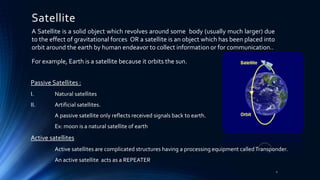
A Satellite is a solid object which revolves around some body (usually much larger) due
to the effect of gravitational forces OR a satellite is an object which has been placed into
orbit around the earth by human endeavor to collect information or for communication..
For example, Earth is a satellite because it orbits the sun.
Passive Satellites :
I. Natural satellites
II. Artificial satellites.
A passive satellite only reflects received signals back to earth.
Ex: moon is a natural satellite of earth
Active satellites
Active satellites are complicated structures having a processing equipment calledTransponder.
An active satellite acts as a REPEATER
2
History of Satellites :
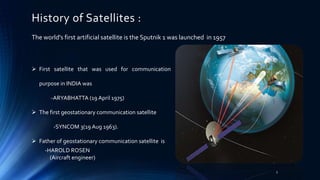
The world's first artificial satellite is the Sputnik 1 was launched in 1957
 First satellite that was used for communication
purpose in INDIA was
-ARYABHATTA (19 April 1975)
 The first geostationary communication satellite
-SYNCOM 3(19 Aug 1963).
 Father of geostationary communication satellite is
-HAROLD ROSEN
(Aircraft engineer)
3
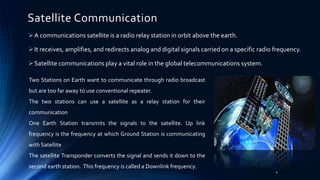
Satellite Communication
A communications satellite is a radio relay station in orbit above the earth.
It receives, amplifies, and redirects analog and digital signals carried on a specific radio frequency.
Satellite communications play a vital role in the global telecommunications system.
Two Stations on Earth want to communicate through radio broadcast
but are too far away to use conventional repeater.
The two stations can use a satellite as a relay station for their
communication
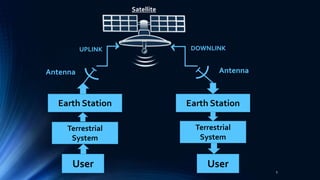
One Earth Station transmits the signals to the satellite. Up link
frequency is the frequency at which Ground Station is communicating
with Satellite
The satellite Transponder converts the signal and sends it down to the
second earth station. This frequency is called a Downlink frequency.
4
Earth Station Earth Station
Terrestrial
System
User
Terrestrial
System
User
Antenna Antenna
UPLINK DOWNLINK
Satellite
5
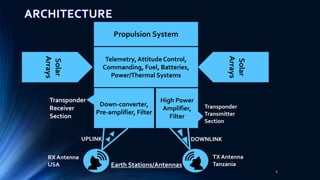
Propulsion System
Telemetry, Attitude Control,
Commanding, Fuel, Batteries,
Power/Thermal Systems
Down-converter,
Pre-amplifier, Filter
High Power
Amplifier,
Filter
Solar
Arrays
Solar
Arrays
Transponder
Receiver
Section
Transponder
Transmitter
Section
RX Antenna
USA
TX Antenna
Tanzania
UPLINK DOWNLINK
Earth Stations/Antennas
6
7
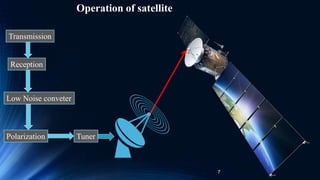
Transmission
Polarization
Low Noise conveter
Reception
Tuner
Operation of satellite
Elements
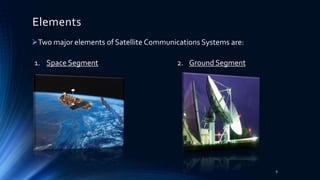
Two major elements of Satellite Communications Systems are:
1. Space Segment 2. Ground Segment
8
Space Segment includes:
Satellite
Means for launching satellite
Electrical Power System
Mechanical structure
Communication transponders
CommunicationAntennas
Attitude and orbit control system
9
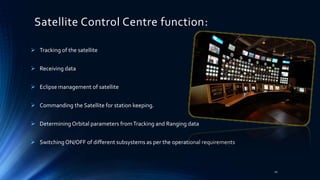
Satellite Control Centre function:
 Tracking of the satellite
 Receiving data
 Eclipse management of satellite
 Commanding the Satellite for station keeping.
 Determining Orbital parameters fromTracking and Ranging data
 Switching ON/OFF of different subsystems as per the operational requirements
10
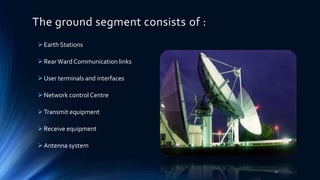
The ground segment consists of :
Earth Stations
RearWard Communication links
User terminals and interfaces
Network control Centre
Transmit equipment
Receive equipment
Antenna system
11
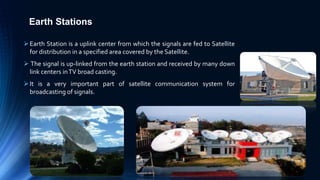
Earth Stations
Earth Station is a uplink center from which the signals are fed to Satellite
for distribution in a specified area covered by the Satellite.
 The signal is up-linked from the earth station and received by many down
link centers inTV broad casting.
It is a very important part of satellite communication system for
broadcasting of signals.
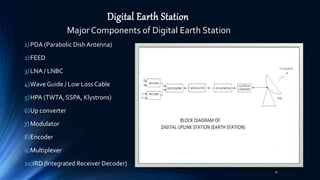
Digital Earth Station
1)PDA (Parabolic DishAntenna)
2)FEED
3)LNA / LNBC
4)Wave Guide / Low Loss Cable
5)HPA (TWTA, SSPA, Klystrons)
6)Up converter
7) Modulator
8)Encoder
9)Multiplexer
10)IRD (Integrated Receiver Decoder)
Major Components of Digital Earth Station
13
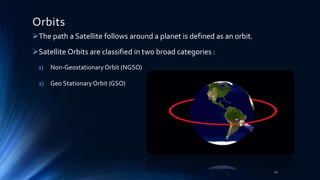
Orbits
The path a Satellite follows around a planet is defined as an orbit.
Satellite Orbits are classified in two broad categories :
1) Non-GeostationaryOrbit (NGSO)
2) Geo StationaryOrbit (GSO)
14
Geo Stationary Orbit(GSO)
There is only one geostationary orbit possible around the earth
• Lying on the earth’s equatorial plane.
• The satellite orbiting at the same speed as the rotational speed of the earth on its axis.
Advantages & Disadvantages of GSO:
Advantages:
Simple ground station tracking.
Nearly constant range
Very small frequency shift
Disadvantages:
Transmission delay of the order of 250 msec.
Large free space loss
No polar coverage
15
Non-Geostationary Orbit (NGSO)
Early ventures with satellite communications used satellites in Non-geostationary low earth
orbits due to the technical limitations of the launch vehicles in placing satellites in higher orbits.
Classification of NGSOs as per the orbital plane are:
 Polar Orbit: In polar orbit the satellite moves from pole to pole and the inclination
is equal to 90 degrees.
 Equatorial Orbit: In equatorial orbit the orbital plane lies in the equatorial plane of
the earth and the inclination is zero or very small.
 Inclined Orbit: All orbits other than polar orbit and equatorial orbit are called
inclined orbit.
16
Advantages & Disadvantages of NGSO:
 Advantages
• Less booster power required
• Less delay in transmission path
• Reduced problem of echo in voice communications
• Suitability for providing service at higher latitude
• Lower cost to build and launch satellites at NGSO
17
 DisAdvantages
• Complex problem of transferring signal from one satellite to another.
• Less expected life of satellites at NGSO
• Requires frequent replacement of satellites compared to satellite in GSO.
• Problem of increasing space trash in the outer space.
• Requirement of a large number of orbiting satellites for global coverage.
• As each low earth orbit satellite covers a small portion of the earth’s surface for a short
time.
18
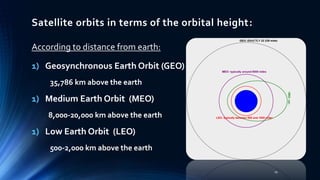
Satellite orbits in terms of the orbital height:
According to distance from earth:
1) Geosynchronous Earth Orbit (GEO)
35,786 km above the earth
1) Medium Earth Orbit (MEO)
8,000-20,000 km above the earth
1) Low Earth Orbit (LEO)
500-2,000 km above the earth
19
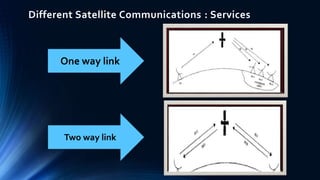
Different Satellite Communications : Services
One way link
Two way link
20
 One-way satellite services are:
 Broadcast Satellite Service: Radio, TV, Data
broadcasting.
 Safety services : Search & Rescue, Disaster Warning
 Radio Determination Satellite Service(Position location)
 Standard frequency and time signal satellite service
 Space Research Service.
 Space operations service.
 Earth Exploration Satellite Service.
21
Two-way satellite services are:
Fixed Satellite Service: Telephone, fax, high bit
rate data etc.
Mobile Satellite Service: Land mobile, Marine time
mobile,Aero-mobile, personal communications.
Satellite News Gathering.
Inter Satellite Service.
22
Advantages OF SATELLITE COMMUNICATION
 Universal: Satellite communications are available virtually everywhere.
 Versatile: Satellites can support all of today's communications needs .
 RELIABLE: Satellite is a proven medium for supporting a company's communications needs.
 SEAMLESS: Satellite's inherent strength as a broadcast medium makes it perfect.
 FAST: Since satellite networks can be set up quickly, companies can be fast-to-market with new services.
 Flexible
 Expandable
 High Quality
 Quick Provision of Services
 Mobile and Emergency Communication
 Suitable for both Digital and AnalogTransmission
23
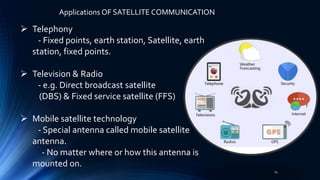
 Telephony
- Fixed points, earth station, Satellite, earth
station, fixed points.
 Television & Radio
- e.g. Direct broadcast satellite
(DBS) & Fixed service satellite (FFS)
 Mobile satellite technology
- Special antenna called mobile satellite
antenna.
- No matter where or how this antenna is
mounted on.
Applications OF SATELLITE COMMUNICATION
24
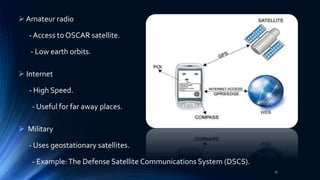
 Amateur radio
- Access to OSCAR satellite.
- Low earth orbits.
 Internet
- High Speed.
- Useful for far away places.
 Military
- Uses geostationary satellites.
- Example:The Defense Satellite Communications System (DSCS).
25
Future
 Future communication satellites will have
 more onboard processing capabilities,
 more power, and
 larger-aperture antennas
 that will enable satellites to handle more bandwidth.
 The demand for more bandwidth will ensure the long-term viability of the commercial
satellite industry well into the 21st century.
In addition, other technical innovations such as low-cost reusable launch vehicles are in
development.
Further improvements in satellites’ propulsion and power systems will increase their service life
to 20–30 years from the current 10–15 years.
26
Conclusion
By going through the above slides we came to know that satellite is
mostly responsible for:
 Telecommunication transmission
 Reception of television signals
 Whether forecasting
Which is very important in our daily life.
27
Thank you
28

Satellite communication

  • 1.
  • 2.
    Satellite A Satellite isa solid object which revolves around some body (usually much larger) due to the effect of gravitational forces OR a satellite is an object which has been placed into orbit around the earth by human endeavor to collect information or for communication.. For example, Earth is a satellite because it orbits the sun. Passive Satellites : I. Natural satellites II. Artificial satellites. A passive satellite only reflects received signals back to earth. Ex: moon is a natural satellite of earth Active satellites Active satellites are complicated structures having a processing equipment calledTransponder. An active satellite acts as a REPEATER 2
  • 3.
    History of Satellites: The world's first artificial satellite is the Sputnik 1 was launched in 1957  First satellite that was used for communication purpose in INDIA was -ARYABHATTA (19 April 1975)  The first geostationary communication satellite -SYNCOM 3(19 Aug 1963).  Father of geostationary communication satellite is -HAROLD ROSEN (Aircraft engineer) 3
  • 4.
    Satellite Communication A communicationssatellite is a radio relay station in orbit above the earth. It receives, amplifies, and redirects analog and digital signals carried on a specific radio frequency. Satellite communications play a vital role in the global telecommunications system. Two Stations on Earth want to communicate through radio broadcast but are too far away to use conventional repeater. The two stations can use a satellite as a relay station for their communication One Earth Station transmits the signals to the satellite. Up link frequency is the frequency at which Ground Station is communicating with Satellite The satellite Transponder converts the signal and sends it down to the second earth station. This frequency is called a Downlink frequency. 4
  • 5.
    Earth Station EarthStation Terrestrial System User Terrestrial System User Antenna Antenna UPLINK DOWNLINK Satellite 5
  • 6.
    Propulsion System Telemetry, AttitudeControl, Commanding, Fuel, Batteries, Power/Thermal Systems Down-converter, Pre-amplifier, Filter High Power Amplifier, Filter Solar Arrays Solar Arrays Transponder Receiver Section Transponder Transmitter Section RX Antenna USA TX Antenna Tanzania UPLINK DOWNLINK Earth Stations/Antennas 6
  • 7.
  • 8.
    Elements Two major elementsof Satellite Communications Systems are: 1. Space Segment 2. Ground Segment 8
  • 9.
    Space Segment includes: Satellite Meansfor launching satellite Electrical Power System Mechanical structure Communication transponders CommunicationAntennas Attitude and orbit control system 9
  • 10.
    Satellite Control Centrefunction:  Tracking of the satellite  Receiving data  Eclipse management of satellite  Commanding the Satellite for station keeping.  Determining Orbital parameters fromTracking and Ranging data  Switching ON/OFF of different subsystems as per the operational requirements 10
  • 11.
    The ground segmentconsists of : Earth Stations RearWard Communication links User terminals and interfaces Network control Centre Transmit equipment Receive equipment Antenna system 11
  • 12.
    Earth Stations Earth Stationis a uplink center from which the signals are fed to Satellite for distribution in a specified area covered by the Satellite.  The signal is up-linked from the earth station and received by many down link centers inTV broad casting. It is a very important part of satellite communication system for broadcasting of signals.
  • 13.
    Digital Earth Station 1)PDA(Parabolic DishAntenna) 2)FEED 3)LNA / LNBC 4)Wave Guide / Low Loss Cable 5)HPA (TWTA, SSPA, Klystrons) 6)Up converter 7) Modulator 8)Encoder 9)Multiplexer 10)IRD (Integrated Receiver Decoder) Major Components of Digital Earth Station 13
  • 14.
    Orbits The path aSatellite follows around a planet is defined as an orbit. Satellite Orbits are classified in two broad categories : 1) Non-GeostationaryOrbit (NGSO) 2) Geo StationaryOrbit (GSO) 14
  • 15.
    Geo Stationary Orbit(GSO) Thereis only one geostationary orbit possible around the earth • Lying on the earth’s equatorial plane. • The satellite orbiting at the same speed as the rotational speed of the earth on its axis. Advantages & Disadvantages of GSO: Advantages: Simple ground station tracking. Nearly constant range Very small frequency shift Disadvantages: Transmission delay of the order of 250 msec. Large free space loss No polar coverage 15
  • 16.
    Non-Geostationary Orbit (NGSO) Earlyventures with satellite communications used satellites in Non-geostationary low earth orbits due to the technical limitations of the launch vehicles in placing satellites in higher orbits. Classification of NGSOs as per the orbital plane are:  Polar Orbit: In polar orbit the satellite moves from pole to pole and the inclination is equal to 90 degrees.  Equatorial Orbit: In equatorial orbit the orbital plane lies in the equatorial plane of the earth and the inclination is zero or very small.  Inclined Orbit: All orbits other than polar orbit and equatorial orbit are called inclined orbit. 16
  • 17.
    Advantages & Disadvantagesof NGSO:  Advantages • Less booster power required • Less delay in transmission path • Reduced problem of echo in voice communications • Suitability for providing service at higher latitude • Lower cost to build and launch satellites at NGSO 17
  • 18.
     DisAdvantages • Complexproblem of transferring signal from one satellite to another. • Less expected life of satellites at NGSO • Requires frequent replacement of satellites compared to satellite in GSO. • Problem of increasing space trash in the outer space. • Requirement of a large number of orbiting satellites for global coverage. • As each low earth orbit satellite covers a small portion of the earth’s surface for a short time. 18
  • 19.
    Satellite orbits interms of the orbital height: According to distance from earth: 1) Geosynchronous Earth Orbit (GEO) 35,786 km above the earth 1) Medium Earth Orbit (MEO) 8,000-20,000 km above the earth 1) Low Earth Orbit (LEO) 500-2,000 km above the earth 19
  • 20.
    Different Satellite Communications: Services One way link Two way link 20
  • 21.
     One-way satelliteservices are:  Broadcast Satellite Service: Radio, TV, Data broadcasting.  Safety services : Search & Rescue, Disaster Warning  Radio Determination Satellite Service(Position location)  Standard frequency and time signal satellite service  Space Research Service.  Space operations service.  Earth Exploration Satellite Service. 21
  • 22.
    Two-way satellite servicesare: Fixed Satellite Service: Telephone, fax, high bit rate data etc. Mobile Satellite Service: Land mobile, Marine time mobile,Aero-mobile, personal communications. Satellite News Gathering. Inter Satellite Service. 22
  • 23.
    Advantages OF SATELLITECOMMUNICATION  Universal: Satellite communications are available virtually everywhere.  Versatile: Satellites can support all of today's communications needs .  RELIABLE: Satellite is a proven medium for supporting a company's communications needs.  SEAMLESS: Satellite's inherent strength as a broadcast medium makes it perfect.  FAST: Since satellite networks can be set up quickly, companies can be fast-to-market with new services.  Flexible  Expandable  High Quality  Quick Provision of Services  Mobile and Emergency Communication  Suitable for both Digital and AnalogTransmission 23
  • 24.
     Telephony - Fixedpoints, earth station, Satellite, earth station, fixed points.  Television & Radio - e.g. Direct broadcast satellite (DBS) & Fixed service satellite (FFS)  Mobile satellite technology - Special antenna called mobile satellite antenna. - No matter where or how this antenna is mounted on. Applications OF SATELLITE COMMUNICATION 24
  • 25.
     Amateur radio -Access to OSCAR satellite. - Low earth orbits.  Internet - High Speed. - Useful for far away places.  Military - Uses geostationary satellites. - Example:The Defense Satellite Communications System (DSCS). 25
  • 26.
    Future  Future communicationsatellites will have  more onboard processing capabilities,  more power, and  larger-aperture antennas  that will enable satellites to handle more bandwidth.  The demand for more bandwidth will ensure the long-term viability of the commercial satellite industry well into the 21st century. In addition, other technical innovations such as low-cost reusable launch vehicles are in development. Further improvements in satellites’ propulsion and power systems will increase their service life to 20–30 years from the current 10–15 years. 26
  • 27.
    Conclusion By going throughthe above slides we came to know that satellite is mostly responsible for:  Telecommunication transmission  Reception of television signals  Whether forecasting Which is very important in our daily life. 27
  • 28.