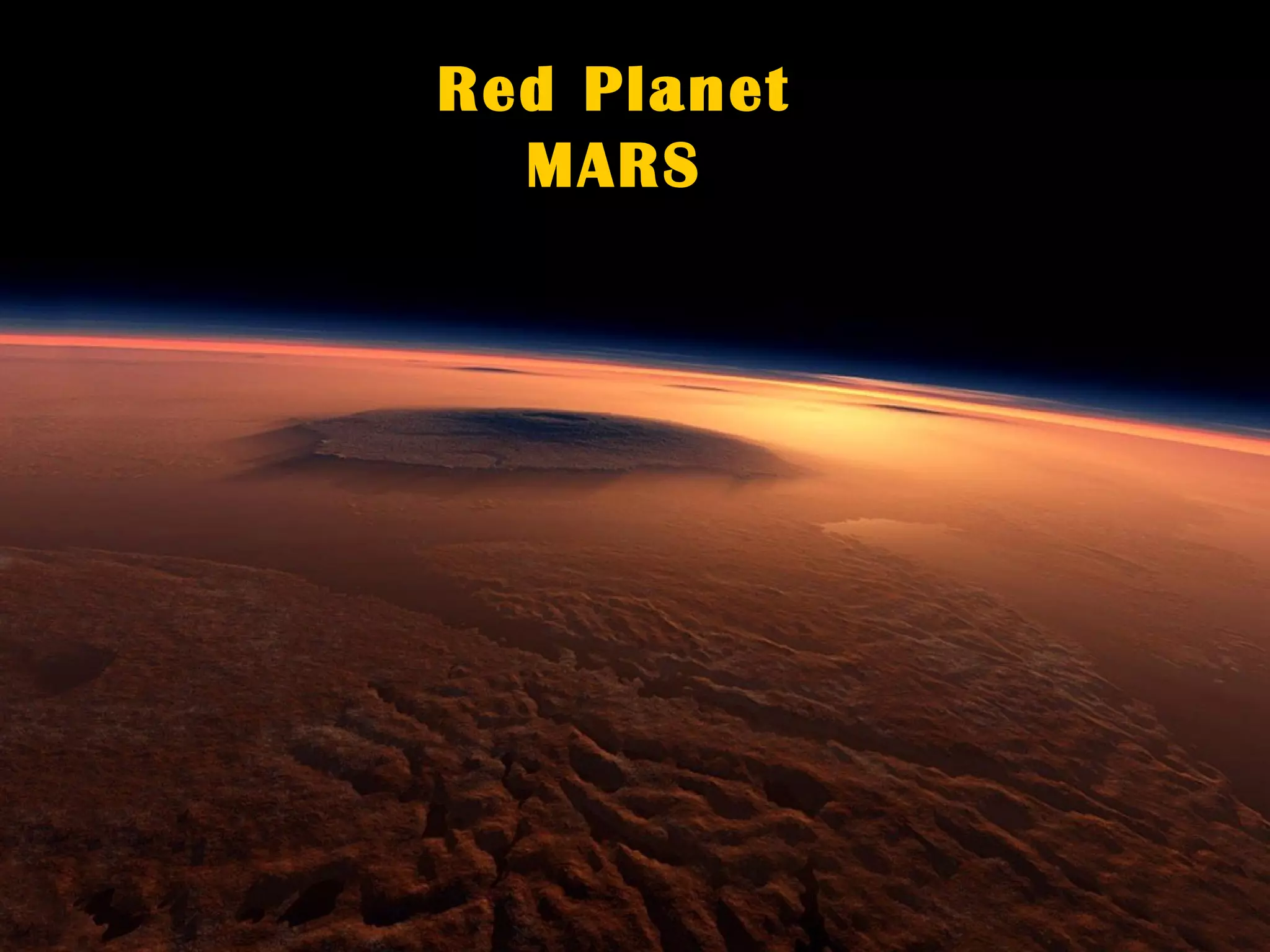
Red Planet
  MARS
NASA’s Mars Exploration Rover Mission (MER) is
   an ongoing robotic space mission involving
  rovers Spirit, Opportunity and now Curiosity,
exploring the planet Mars. It began in 2003 with
    the sending of the two rovers, Spirit and
Opportunity, to explore the Martian surface and
          geology and continues today.

The mission’s scientific objective was to search
for and characterize a wide range of rocks and
 soils that hold clues to past water activity on
    Mars. The mission is part of NASA’s Mars
   Exploration Program, which includes three
  previous successful landers: the two Viking
 program landers in 1976 and Mars Pathfinder
                 probe in 1997.
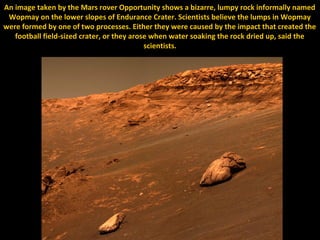
An image taken by the Mars rover Opportunity shows a bizarre, lumpy rock informally named
 Wopmay on the lower slopes of Endurance Crater. Scientists believe the lumps in Wopmay
were formed by one of two processes. Either they were caused by the impact that created the
   football field-sized crater, or they arose when water soaking the rock dried up, said the
                                            scientists.
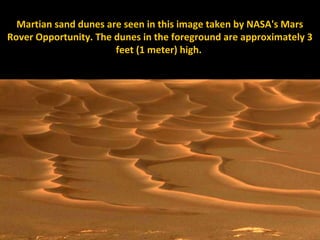
Martian sand dunes are seen in this image taken by NASA's Mars
Rover Opportunity. The dunes in the foreground are approximately 3
                       feet (1 meter) high.
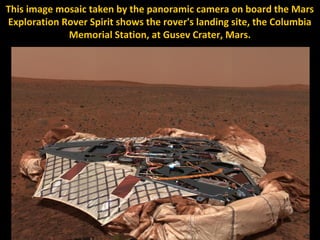
This image mosaic taken by the panoramic camera on board the Mars
Exploration Rover Spirit shows the rover's landing site, the Columbia
             Memorial Station, at Gusev Crater, Mars.
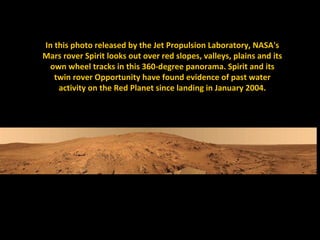
In this photo released by the Jet Propulsion Laboratory, NASA's
Mars rover Spirit looks out over red slopes, valleys, plains and its
 own wheel tracks in this 360-degree panorama. Spirit and its
   twin rover Opportunity have found evidence of past water
    activity on the Red Planet since landing in January 2004.
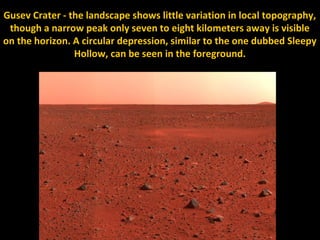
Gusev Crater - the landscape shows little variation in local topography,
 though a narrow peak only seven to eight kilometers away is visible
on the horizon. A circular depression, similar to the one dubbed Sleepy
                Hollow, can be seen in the foreground.
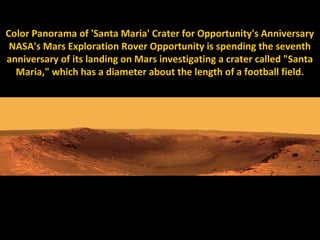
Color Panorama of 'Santa Maria' Crater for Opportunity's Anniversary
 NASA's Mars Exploration Rover Opportunity is spending the seventh
anniversary of its landing on Mars investigating a crater called "Santa
  Maria," which has a diameter about the length of a football field.
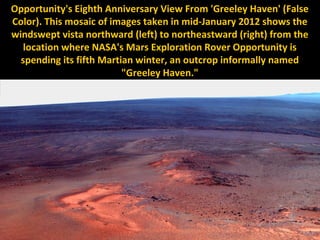
Opportunity's Eighth Anniversary View From 'Greeley Haven' (False
Color). This mosaic of images taken in mid-January 2012 shows the
windswept vista northward (left) to northeastward (right) from the
   location where NASA's Mars Exploration Rover Opportunity is
  spending its fifth Martian winter, an outcrop informally named
                          "Greeley Haven."
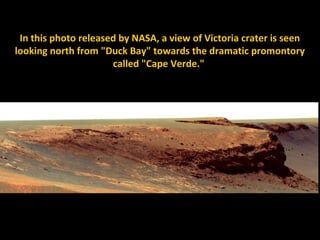
In this photo released by NASA, a view of Victoria crater is seen
looking north from "Duck Bay" towards the dramatic promontory
                      called "Cape Verde."
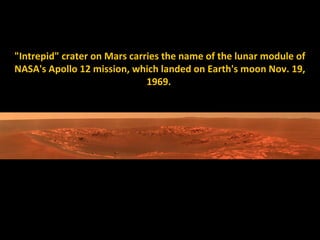
"Intrepid" crater on Mars carries the name of the lunar module of
NASA's Apollo 12 mission, which landed on Earth's moon Nov. 19,
                              1969.
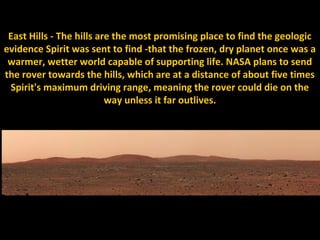
East Hills - The hills are the most promising place to find the geologic
evidence Spirit was sent to find -that the frozen, dry planet once was a
 warmer, wetter world capable of supporting life. NASA plans to send
the rover towards the hills, which are at a distance of about five times
 Spirit's maximum driving range, meaning the rover could die on the
                          way unless it far outlives.
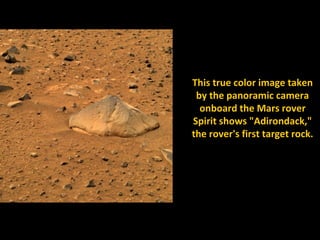
This true color image taken
 by the panoramic camera
  onboard the Mars rover
Spirit shows "Adirondack,"
the rover's first target rock.
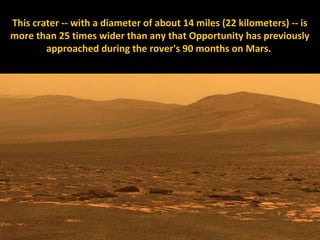
This crater -- with a diameter of about 14 miles (22 kilometers) -- is
more than 25 times wider than any that Opportunity has previously
        approached during the rover's 90 months on Mars.
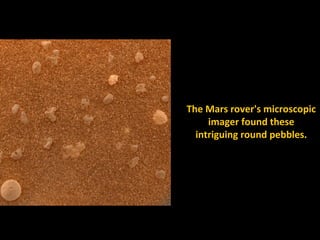
The Mars rover's microscopic
     imager found these
  intriguing round pebbles.
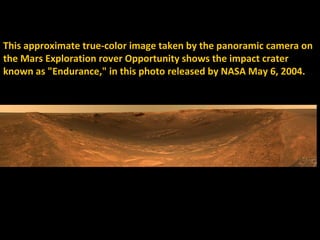
This approximate true-color image taken by the panoramic camera on
the Mars Exploration rover Opportunity shows the impact crater
known as "Endurance," in this photo released by NASA May 6, 2004.
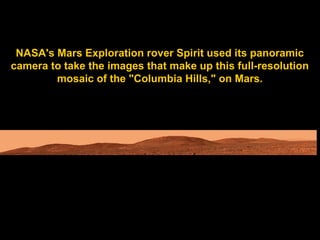
NASA's Mars Exploration rover Spirit used its panoramic
camera to take the images that make up this full-resolution
        mosaic of the "Columbia Hills," on Mars.
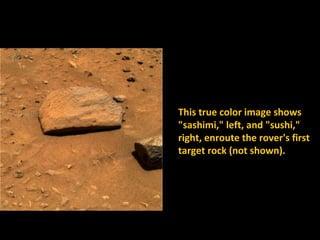
This true color image shows
"sashimi," left, and "sushi,"
right, enroute the rover's first
target rock (not shown).
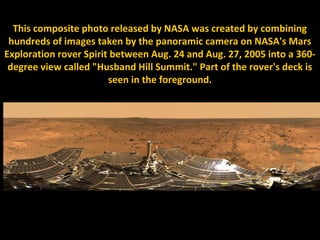
This composite photo released by NASA was created by combining
 hundreds of images taken by the panoramic camera on NASA's Mars
Exploration rover Spirit between Aug. 24 and Aug. 27, 2005 into a 360-
 degree view called "Husband Hill Summit." Part of the rover's deck is
                        seen in the foreground.
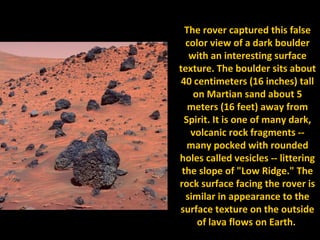
The rover captured this false
  color view of a dark boulder
   with an interesting surface
texture. The boulder sits about
 40 centimeters (16 inches) tall
    on Martian sand about 5
   meters (16 feet) away from
  Spirit. It is one of many dark,
   volcanic rock fragments --
   many pocked with rounded
holes called vesicles -- littering
 the slope of "Low Ridge." The
rock surface facing the rover is
  similar in appearance to the
surface texture on the outside
     of lava flows on Earth.
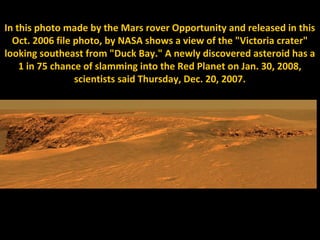
In this photo made by the Mars rover Opportunity and released in this
  Oct. 2006 file photo, by NASA shows a view of the "Victoria crater"
looking southeast from "Duck Bay." A newly discovered asteroid has a
    1 in 75 chance of slamming into the Red Planet on Jan. 30, 2008,
                 scientists said Thursday, Dec. 20, 2007.
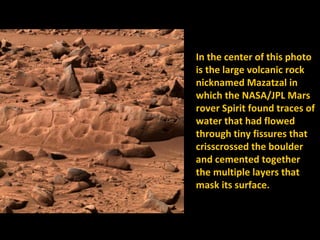
In the center of this photo
is the large volcanic rock
nicknamed Mazatzal in
which the NASA/JPL Mars
rover Spirit found traces of
water that had flowed
through tiny fissures that
crisscrossed the boulder
and cemented together
the multiple layers that
mask its surface.
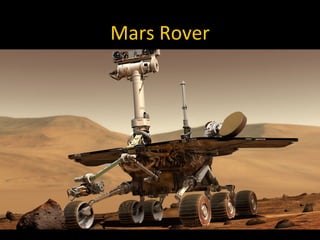
Mars Rover
ENDE

    ALLE RECHTE AN DIESER
     PRÄSENTATION,
INSBESONDERE AUF BEARBEITUNG
UND UMGESTALTUNG LIEGEN BEIM
           AUTOR…


          K & H - PPS

 Fotos:      AP Photo NASA
 Music:       Timeless in Space

               http://
   www.slideshare.net/karinchen51

Red planet mars

  • 1.
  • 2.
    NASA’s Mars ExplorationRover Mission (MER) is an ongoing robotic space mission involving rovers Spirit, Opportunity and now Curiosity, exploring the planet Mars. It began in 2003 with the sending of the two rovers, Spirit and Opportunity, to explore the Martian surface and geology and continues today. The mission’s scientific objective was to search for and characterize a wide range of rocks and soils that hold clues to past water activity on Mars. The mission is part of NASA’s Mars Exploration Program, which includes three previous successful landers: the two Viking program landers in 1976 and Mars Pathfinder probe in 1997.
  • 3.
    An image takenby the Mars rover Opportunity shows a bizarre, lumpy rock informally named Wopmay on the lower slopes of Endurance Crater. Scientists believe the lumps in Wopmay were formed by one of two processes. Either they were caused by the impact that created the football field-sized crater, or they arose when water soaking the rock dried up, said the scientists.
  • 4.
    Martian sand dunesare seen in this image taken by NASA's Mars Rover Opportunity. The dunes in the foreground are approximately 3 feet (1 meter) high.
  • 5.
    This image mosaictaken by the panoramic camera on board the Mars Exploration Rover Spirit shows the rover's landing site, the Columbia Memorial Station, at Gusev Crater, Mars.
  • 6.
    In this photoreleased by the Jet Propulsion Laboratory, NASA's Mars rover Spirit looks out over red slopes, valleys, plains and its own wheel tracks in this 360-degree panorama. Spirit and its twin rover Opportunity have found evidence of past water activity on the Red Planet since landing in January 2004.
  • 7.
    Gusev Crater -the landscape shows little variation in local topography, though a narrow peak only seven to eight kilometers away is visible on the horizon. A circular depression, similar to the one dubbed Sleepy Hollow, can be seen in the foreground.
  • 8.
    Color Panorama of'Santa Maria' Crater for Opportunity's Anniversary NASA's Mars Exploration Rover Opportunity is spending the seventh anniversary of its landing on Mars investigating a crater called "Santa Maria," which has a diameter about the length of a football field.
  • 9.
    Opportunity's Eighth AnniversaryView From 'Greeley Haven' (False Color). This mosaic of images taken in mid-January 2012 shows the windswept vista northward (left) to northeastward (right) from the location where NASA's Mars Exploration Rover Opportunity is spending its fifth Martian winter, an outcrop informally named "Greeley Haven."
  • 10.
    In this photoreleased by NASA, a view of Victoria crater is seen looking north from "Duck Bay" towards the dramatic promontory called "Cape Verde."
  • 11.
    "Intrepid" crater onMars carries the name of the lunar module of NASA's Apollo 12 mission, which landed on Earth's moon Nov. 19, 1969.
  • 12.
    East Hills -The hills are the most promising place to find the geologic evidence Spirit was sent to find -that the frozen, dry planet once was a warmer, wetter world capable of supporting life. NASA plans to send the rover towards the hills, which are at a distance of about five times Spirit's maximum driving range, meaning the rover could die on the way unless it far outlives.
  • 13.
    This true colorimage taken by the panoramic camera onboard the Mars rover Spirit shows "Adirondack," the rover's first target rock.
  • 14.
    This crater --with a diameter of about 14 miles (22 kilometers) -- is more than 25 times wider than any that Opportunity has previously approached during the rover's 90 months on Mars.
  • 15.
    The Mars rover'smicroscopic imager found these intriguing round pebbles.
  • 16.
    This approximate true-colorimage taken by the panoramic camera on the Mars Exploration rover Opportunity shows the impact crater known as "Endurance," in this photo released by NASA May 6, 2004.
  • 17.
    NASA's Mars Explorationrover Spirit used its panoramic camera to take the images that make up this full-resolution mosaic of the "Columbia Hills," on Mars.
  • 18.
    This true colorimage shows "sashimi," left, and "sushi," right, enroute the rover's first target rock (not shown).
  • 19.
    This composite photoreleased by NASA was created by combining hundreds of images taken by the panoramic camera on NASA's Mars Exploration rover Spirit between Aug. 24 and Aug. 27, 2005 into a 360- degree view called "Husband Hill Summit." Part of the rover's deck is seen in the foreground.
  • 20.
    The rover capturedthis false color view of a dark boulder with an interesting surface texture. The boulder sits about 40 centimeters (16 inches) tall on Martian sand about 5 meters (16 feet) away from Spirit. It is one of many dark, volcanic rock fragments -- many pocked with rounded holes called vesicles -- littering the slope of "Low Ridge." The rock surface facing the rover is similar in appearance to the surface texture on the outside of lava flows on Earth.
  • 21.
    In this photomade by the Mars rover Opportunity and released in this Oct. 2006 file photo, by NASA shows a view of the "Victoria crater" looking southeast from "Duck Bay." A newly discovered asteroid has a 1 in 75 chance of slamming into the Red Planet on Jan. 30, 2008, scientists said Thursday, Dec. 20, 2007.
  • 22.
    In the centerof this photo is the large volcanic rock nicknamed Mazatzal in which the NASA/JPL Mars rover Spirit found traces of water that had flowed through tiny fissures that crisscrossed the boulder and cemented together the multiple layers that mask its surface.
  • 23.
  • 24.
    ENDE ALLE RECHTE AN DIESER PRÄSENTATION, INSBESONDERE AUF BEARBEITUNG UND UMGESTALTUNG LIEGEN BEIM AUTOR… K & H - PPS Fotos: AP Photo NASA Music: Timeless in Space http:// www.slideshare.net/karinchen51