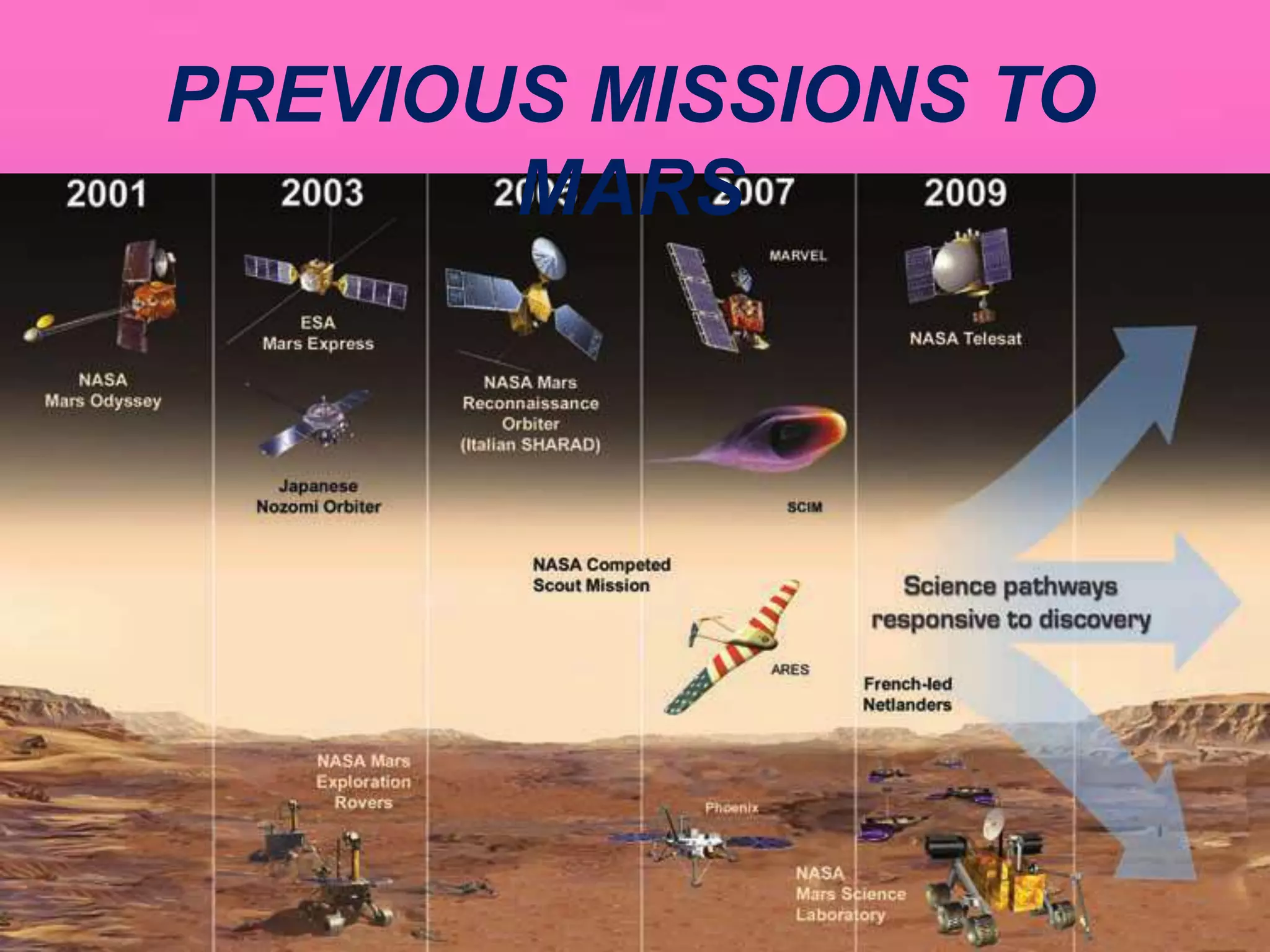
PREVIOUS MISSIONS TO
MARS
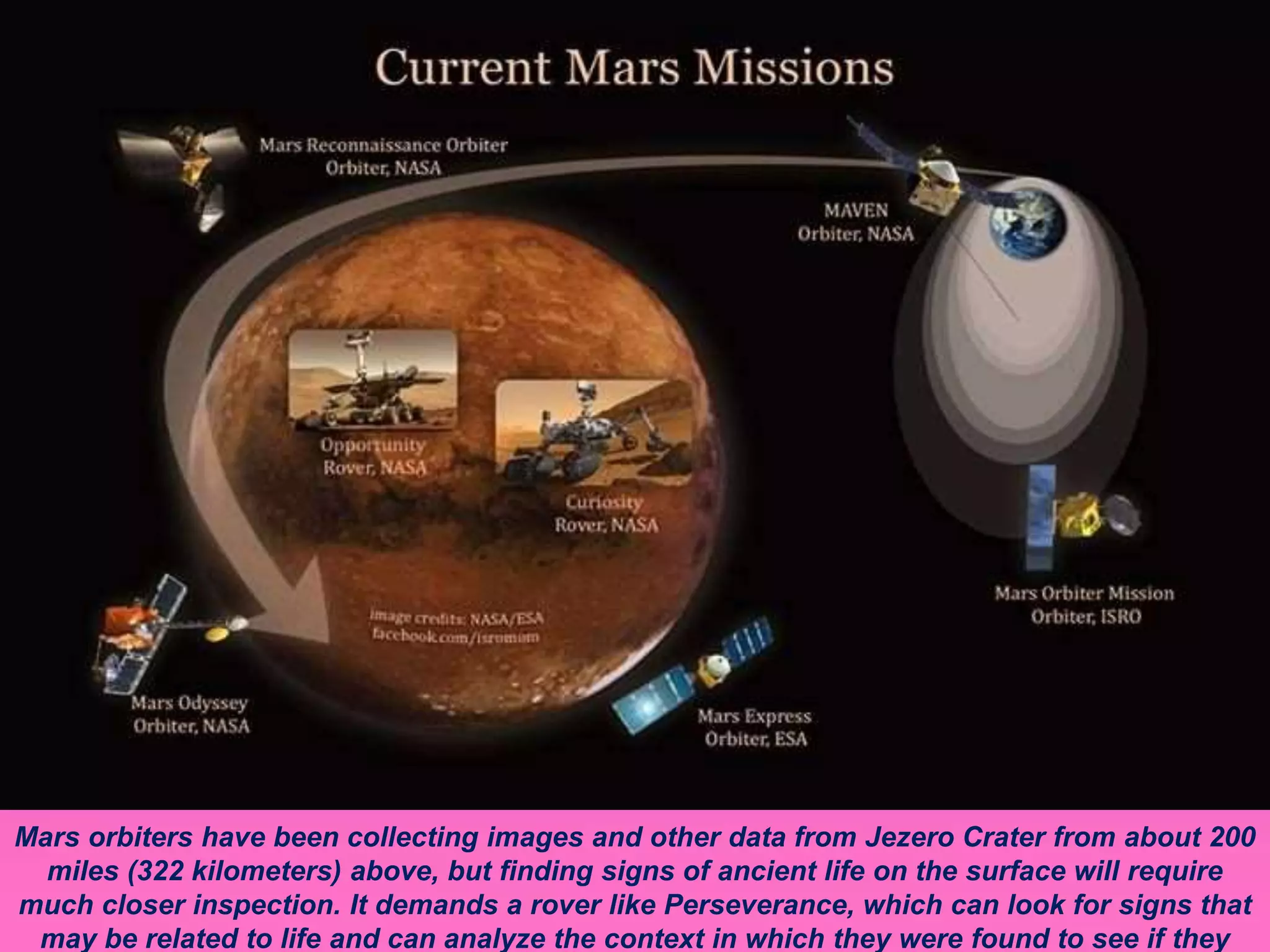
Mars orbiters have been collecting images and other data from Jezero Crater from about 200
miles (322 kilometers) above, but finding signs of ancient life on the surface will require
much closer inspection. It demands a rover like Perseverance, which can look for signs that
may be related to life and can analyze the context in which they were found to see if they
PROGRESS IN THE DESIGN OF MARS
ROVERS
NASA's modest first rover – Sojourner – demonstrated
in 1997 that a robot could rove on the Red Planet.
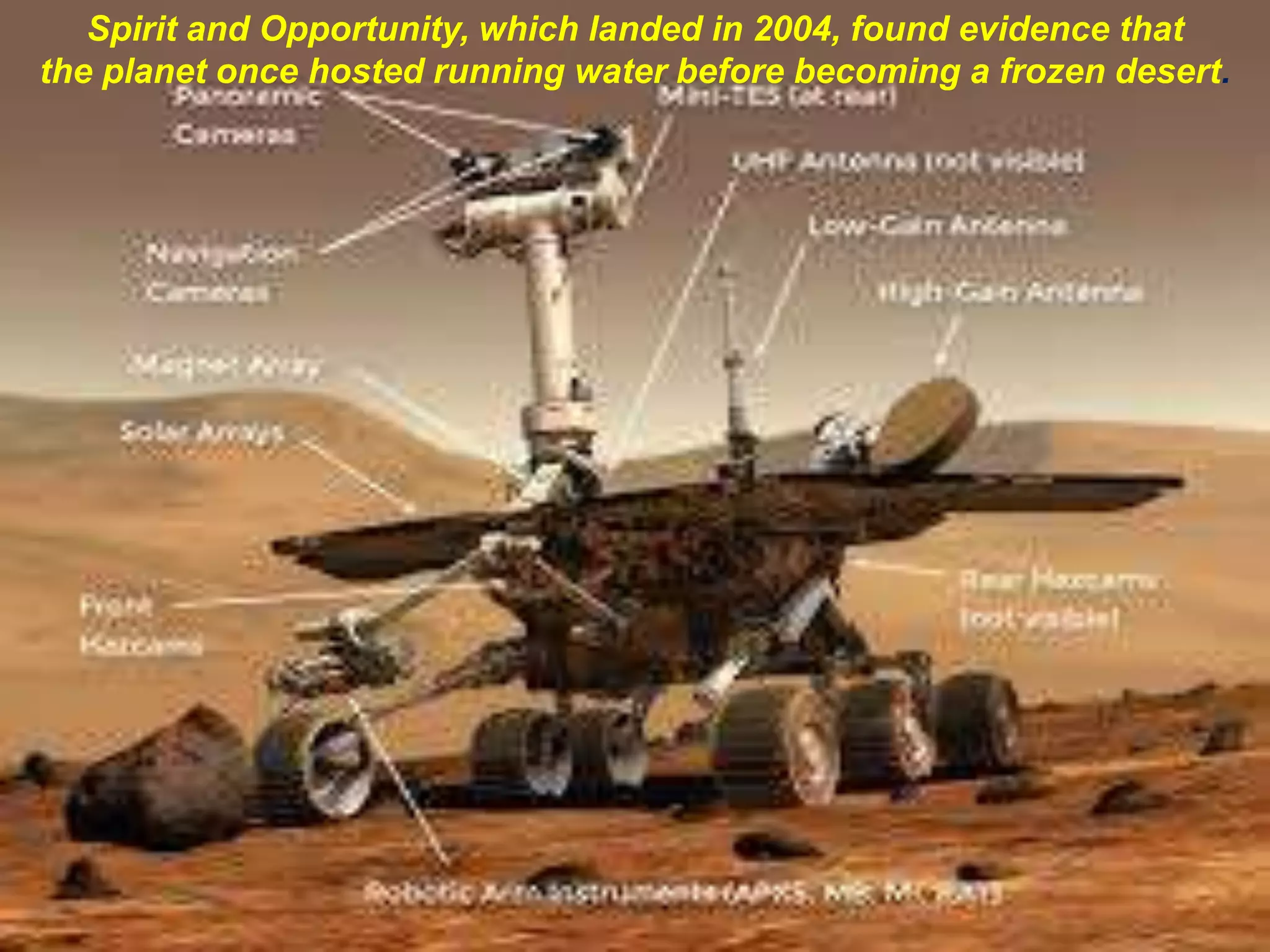
Spirit and Opportunity, which landed in 2004, found evidence that
the planet once hosted running water before becoming a frozen desert.
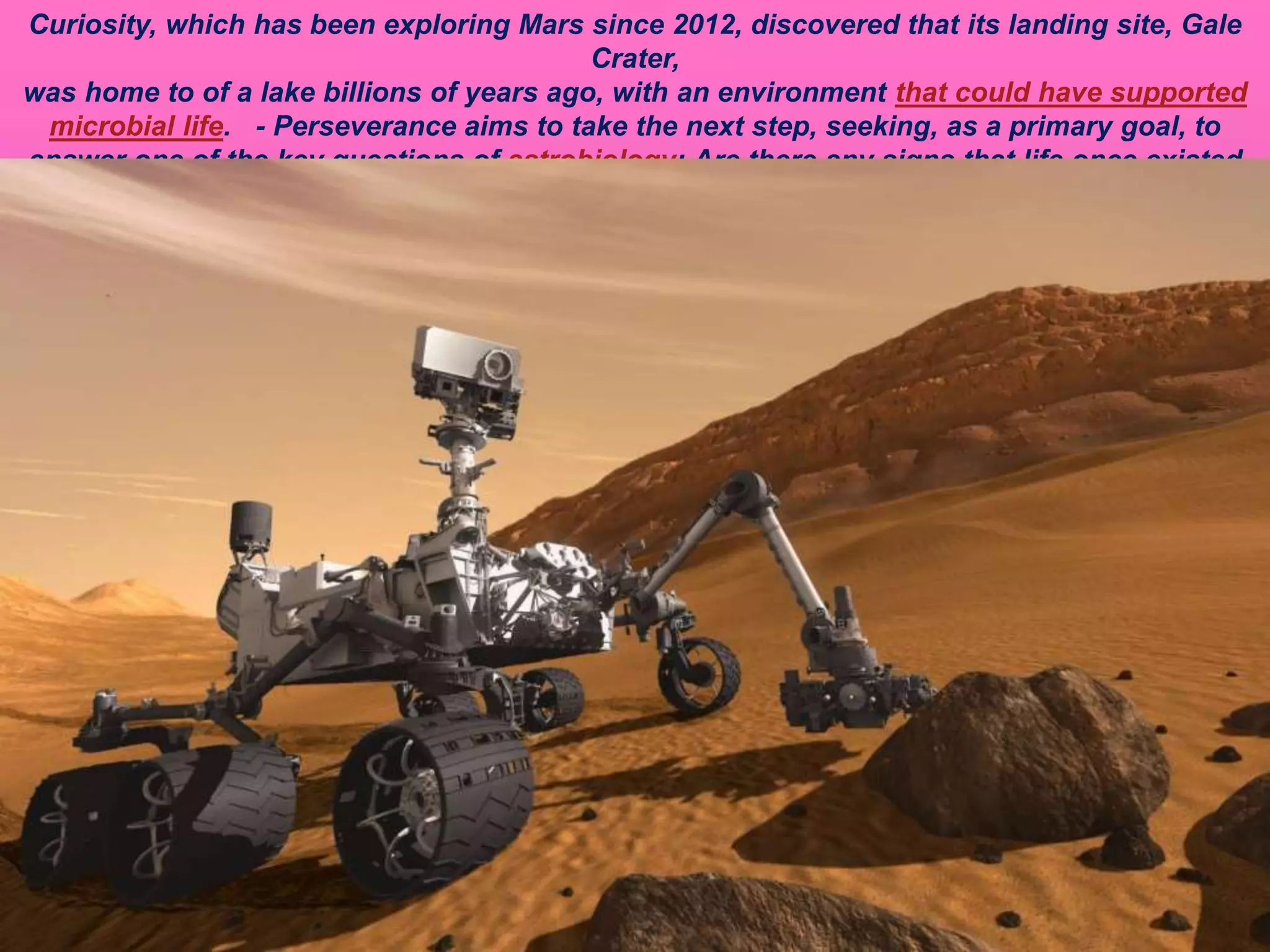
Curiosity, which has been exploring Mars since 2012, discovered that its landing site, Gale
Crater,
was home to of a lake billions of years ago, with an environment that could have supported
microbial life. - Perseverance aims to take the next step, seeking, as a primary goal, to
answer one of the key questions of astrobiology: Are there any signs that life once existed
on Mars?
Curiosity Perseverence
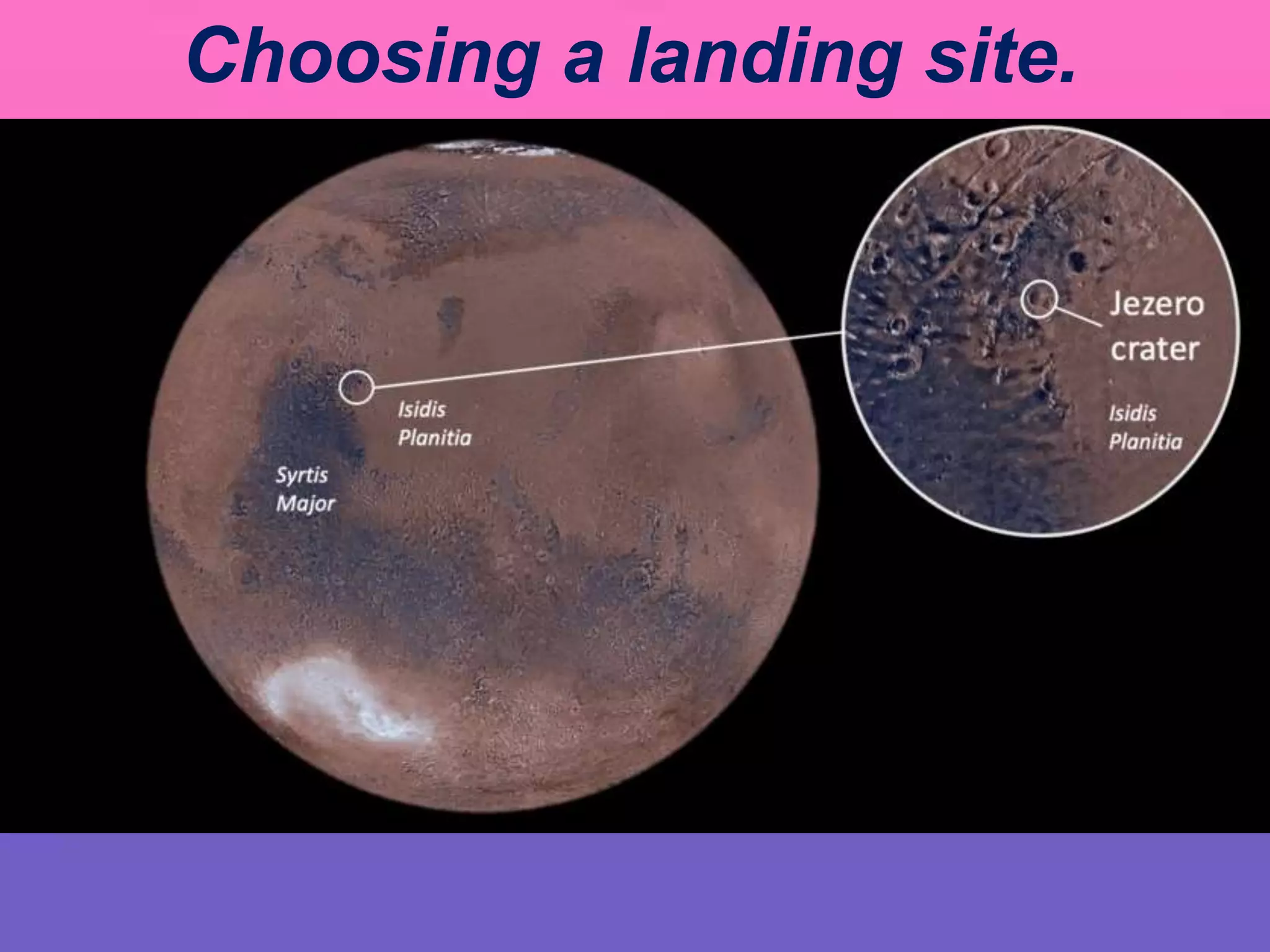
Choosing a landing site.
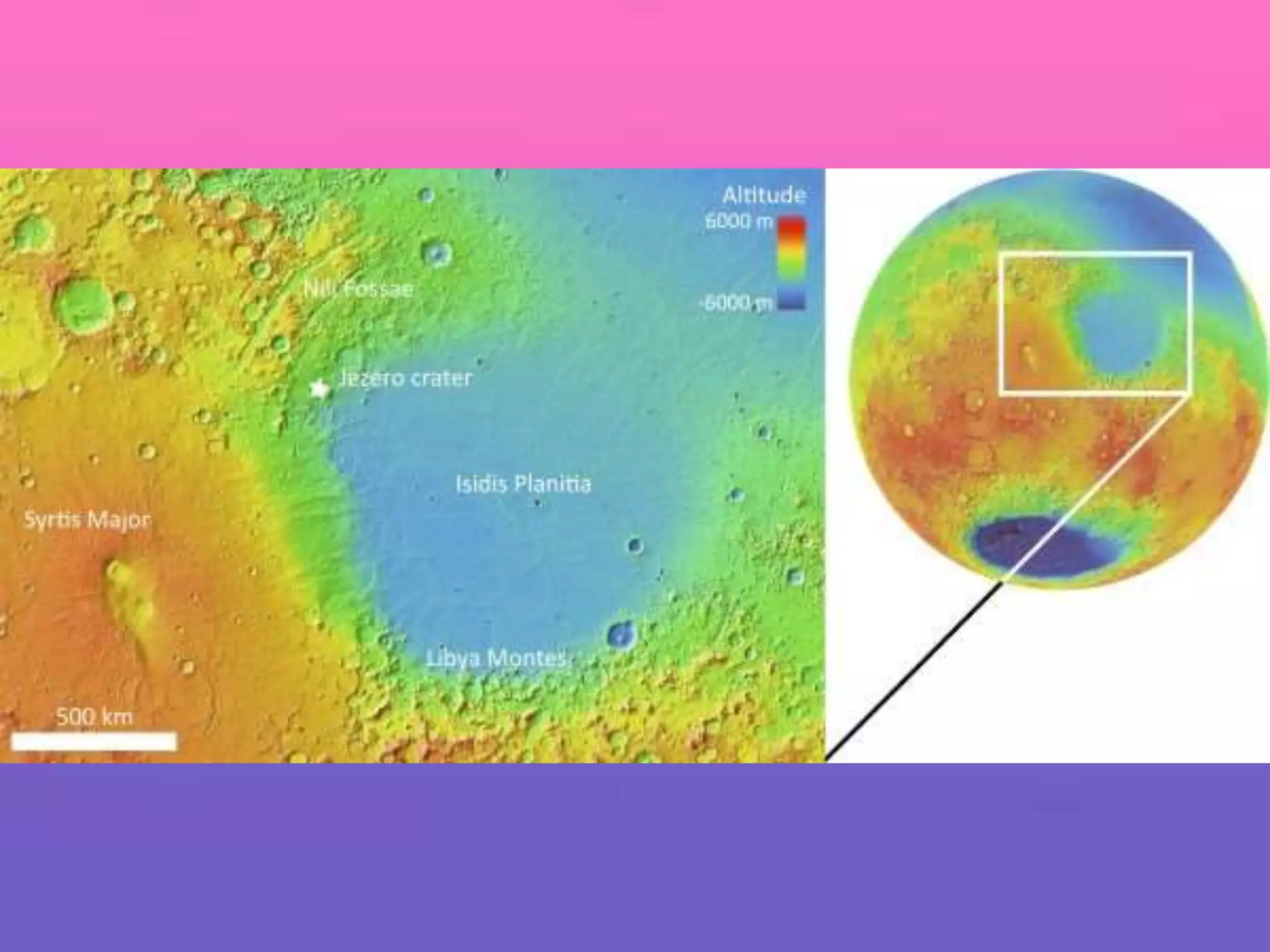
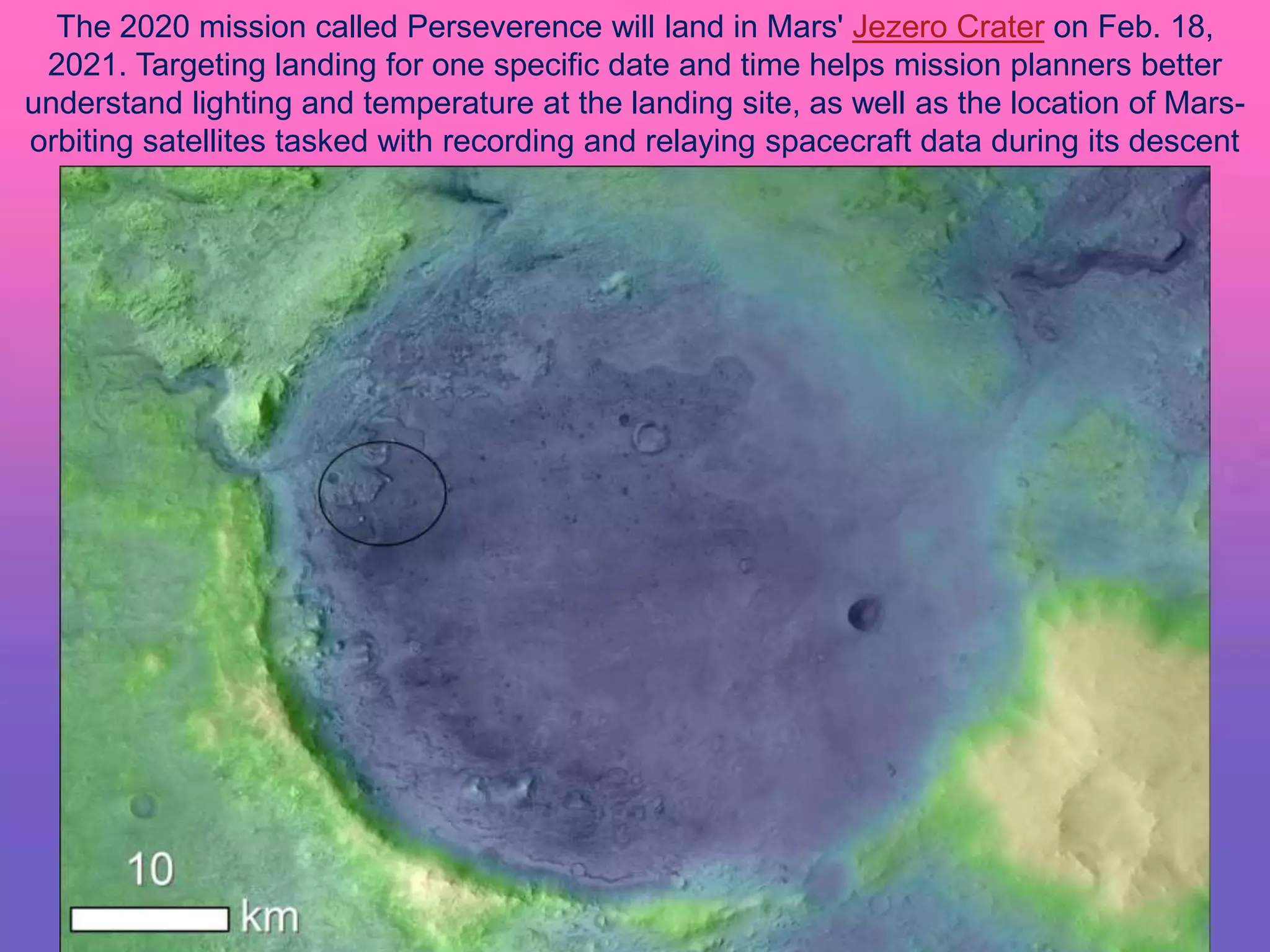
Jezero Crater is 28 miles (45 kilometers) wide and sits on the
western
edge of Isidis Planitia, a giant basin just north of the Martian
equator
dug out long ago when a space rock hit the surface.
Sometime between 3 billion and 4 billion years ago at Jezero,
a river flowed into a body of water the size of Lake Tahoe.
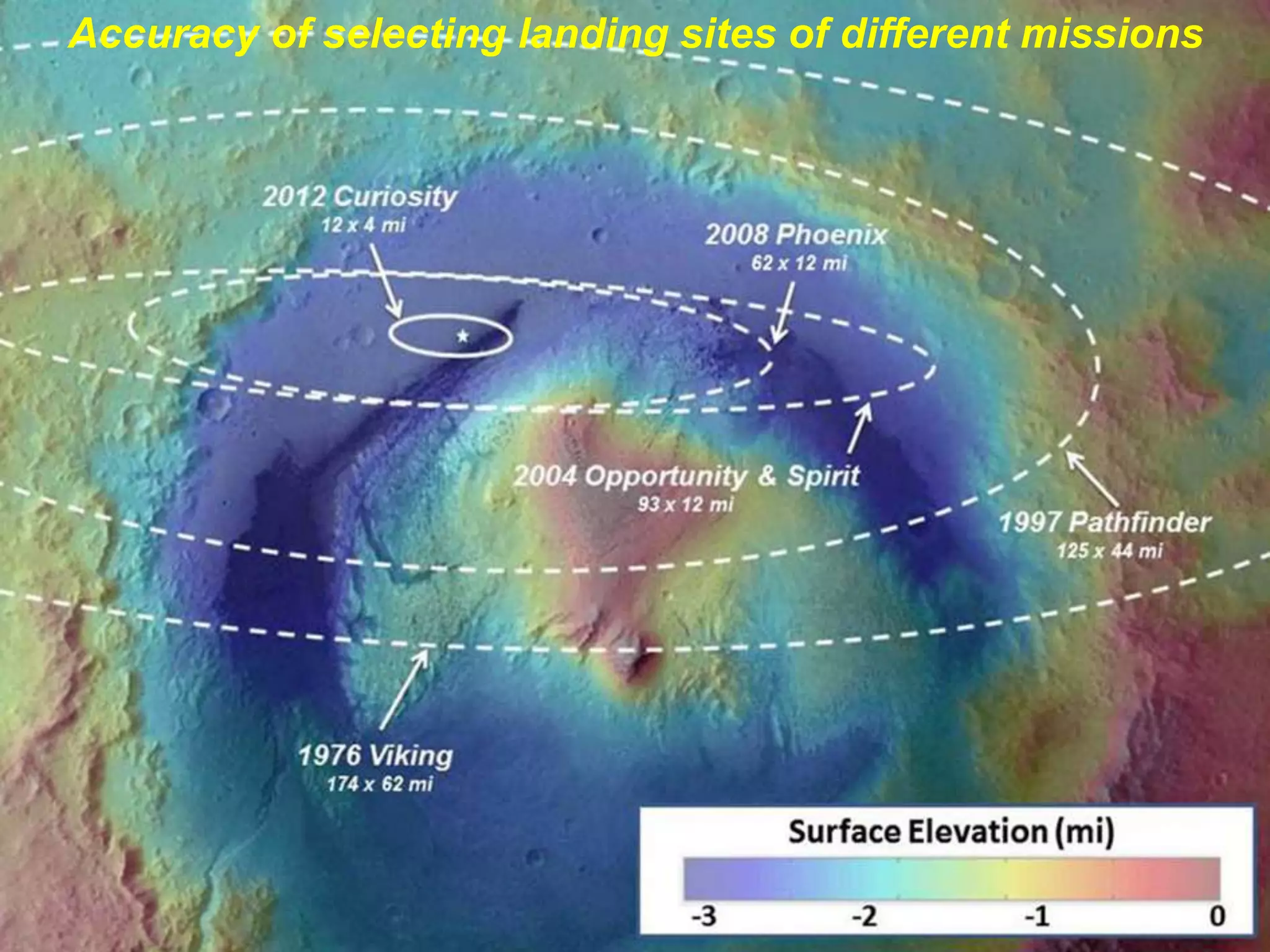
Accuracy of selecting landing sites of different missions
The 2020 mission called Perseverence will land in Mars' Jezero Crater on Feb. 18,
2021. Targeting landing for one specific date and time helps mission planners better
understand lighting and temperature at the landing site, as well as the location of Mars-
orbiting satellites tasked with recording and relaying spacecraft data during its descent
and landing.
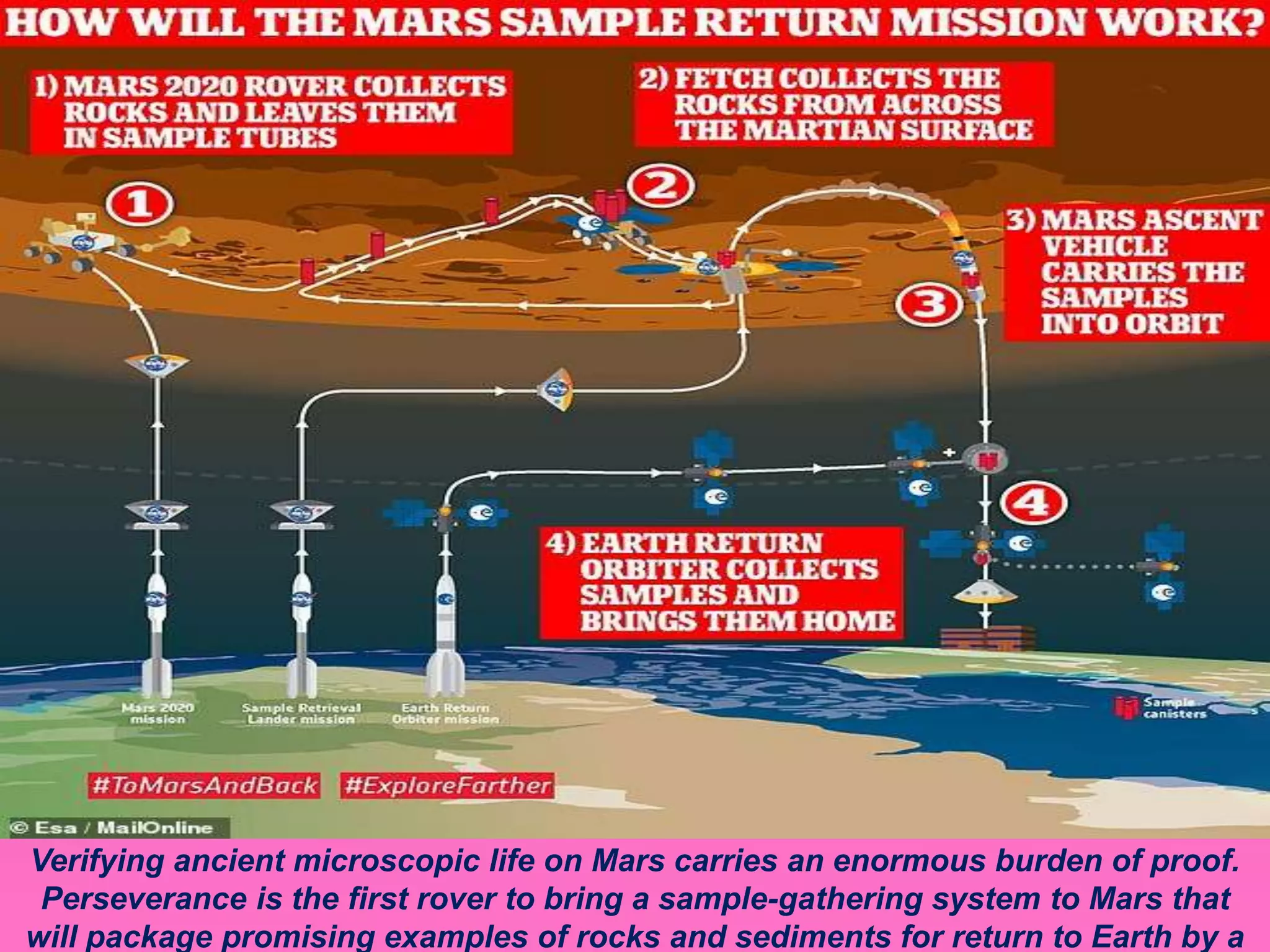
Verifying ancient microscopic life on Mars carries an enormous burden of proof.
Perseverance is the first rover to bring a sample-gathering system to Mars that
will package promising examples of rocks and sediments for return to Earth by a
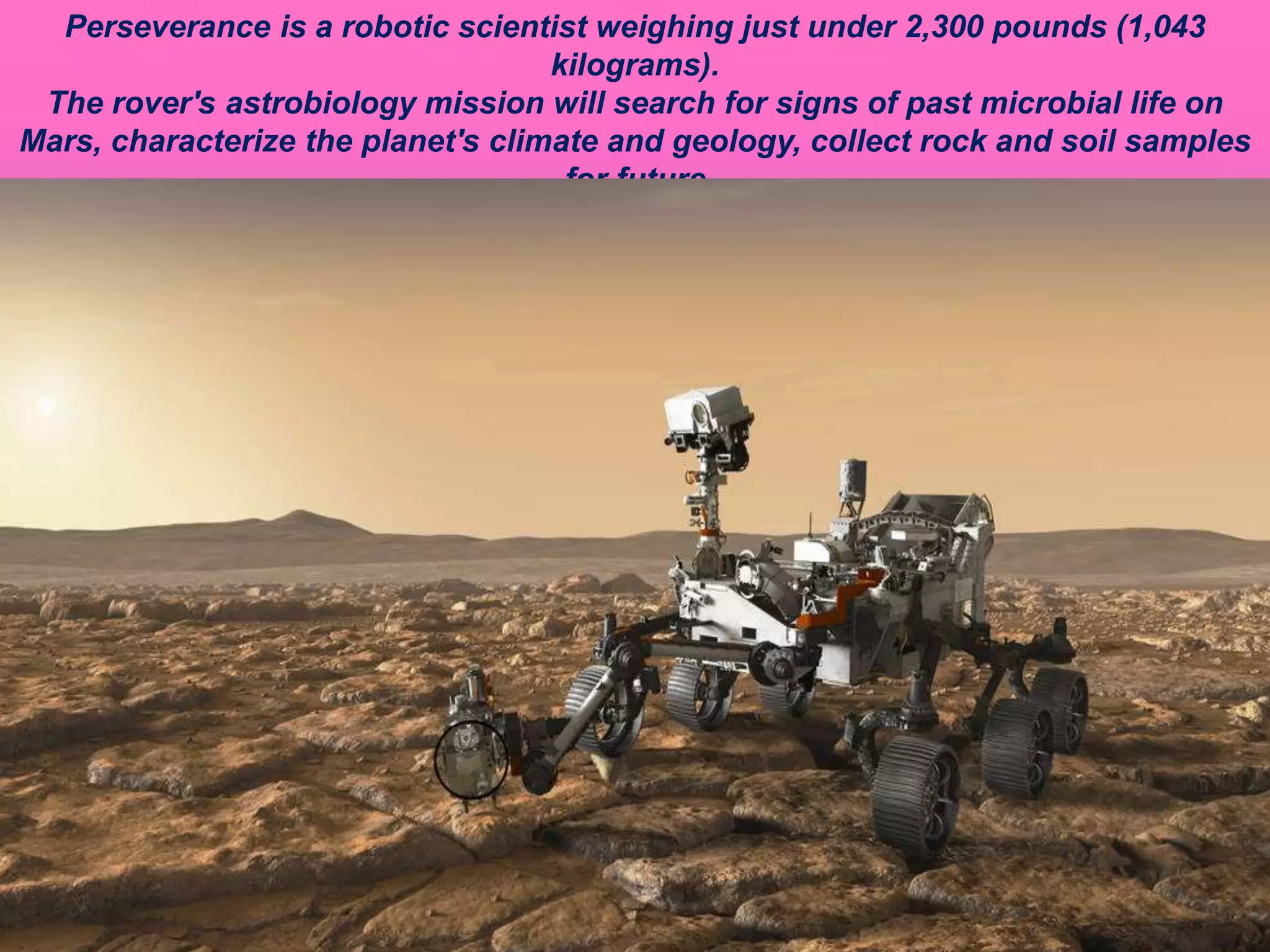
Perseverance is a robotic scientist weighing just under 2,300 pounds (1,043
kilograms).
The rover's astrobiology mission will search for signs of past microbial life on
Mars, characterize the planet's climate and geology, collect rock and soil samples
for future
return to Earth, and pave the way for human exploration of the Red Planet.
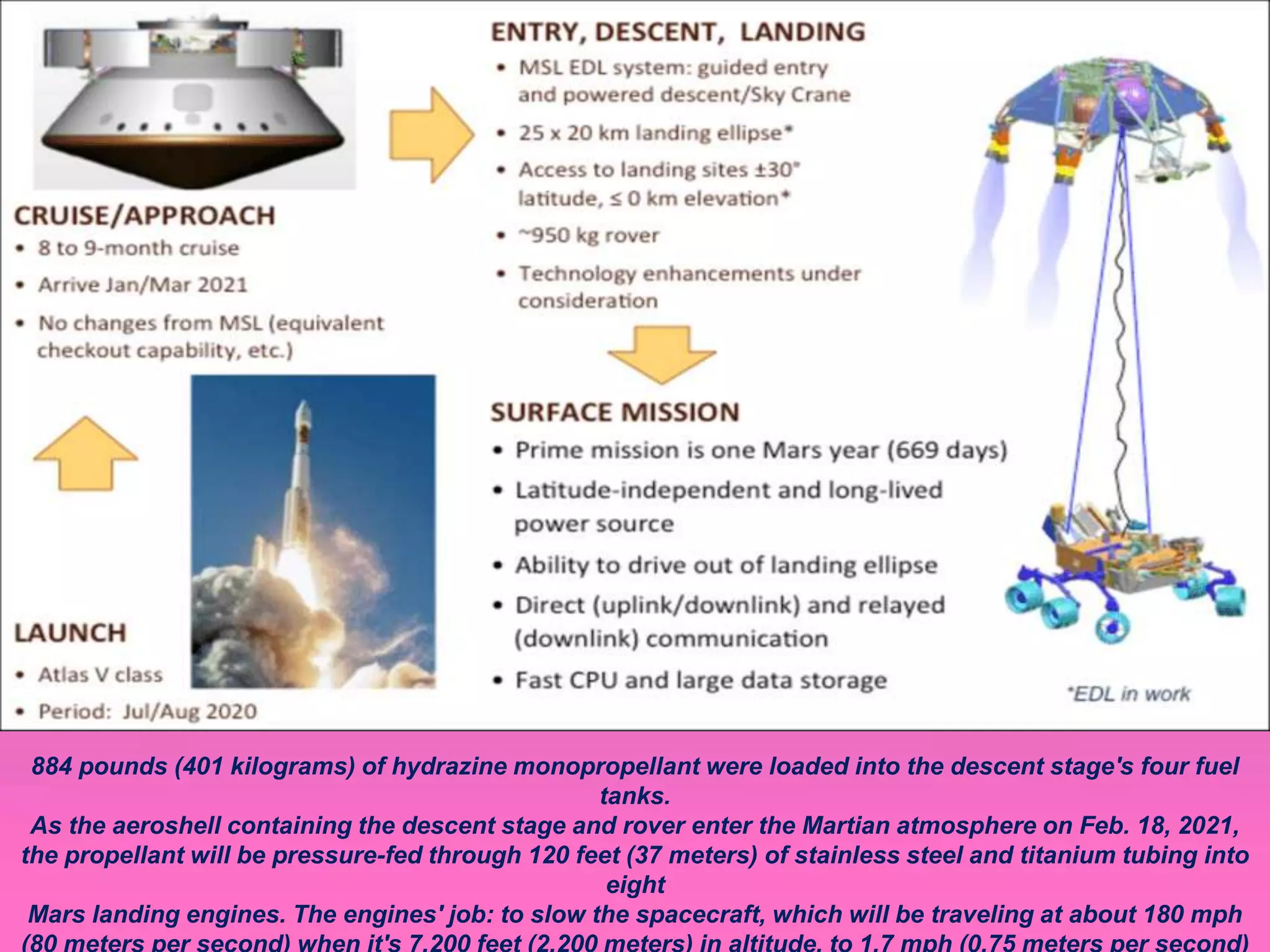
884 pounds (401 kilograms) of hydrazine monopropellant were loaded into the descent stage's four fuel
tanks.
As the aeroshell containing the descent stage and rover enter the Martian atmosphere on Feb. 18, 2021,
the propellant will be pressure-fed through 120 feet (37 meters) of stainless steel and titanium tubing into
eight
Mars landing engines. The engines' job: to slow the spacecraft, which will be traveling at about 180 mph
Encased in the nose
cone that will protect
it during launch, the
rover and the rest of
the Mars 2020
spacecraft – the
aeroshell, cruise
stage, and descent
stage – were affixed
to a United Launch
Alliance Atlas V
booster at Cape
Canaveral Air Force
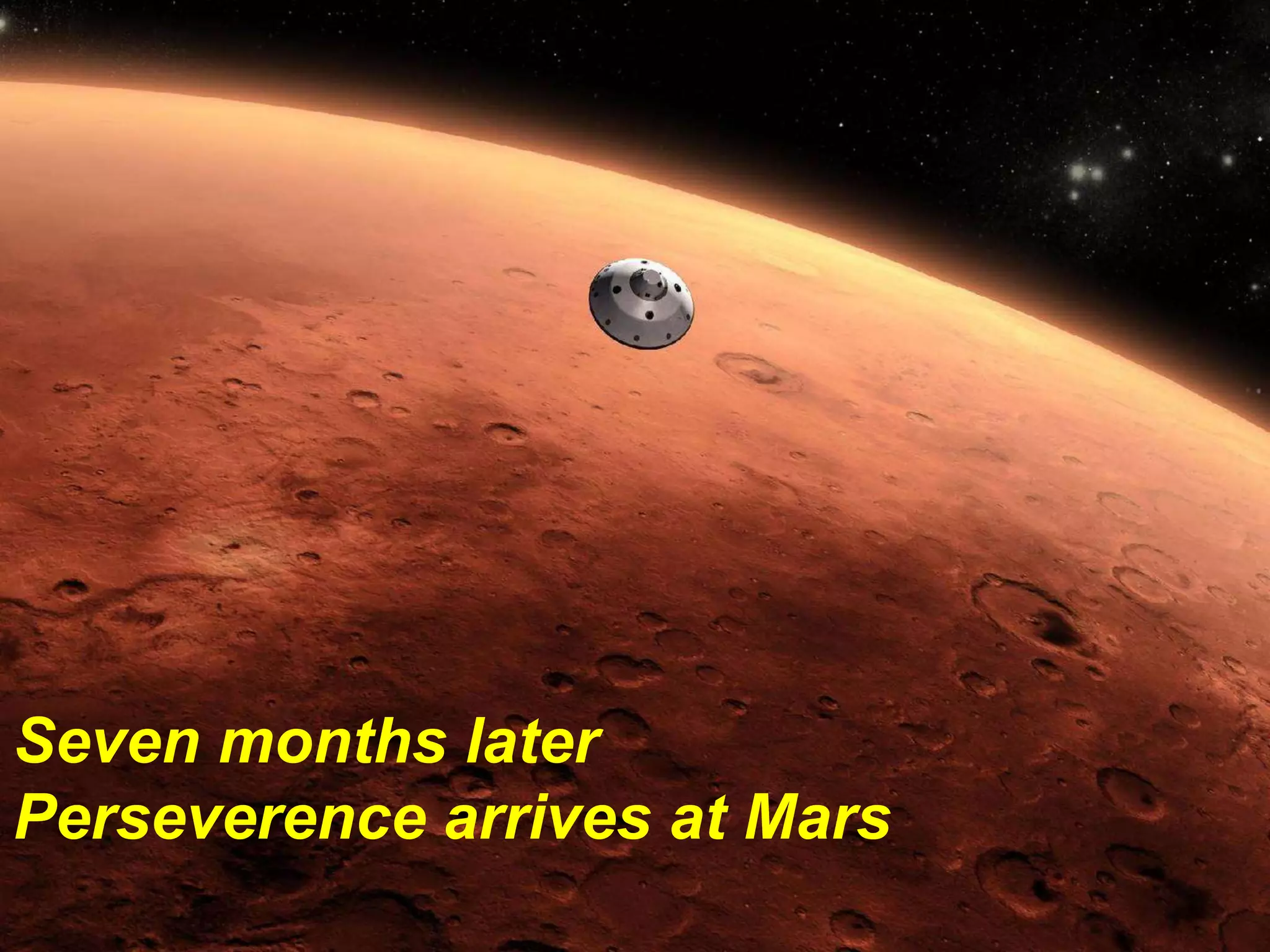
Seven months later
Perseverence arrives at Mars
The Terrain-Relative
Navigation system, which
autonomously helps the
rover avoid hazards during
landing, and the Mars
Science Laboratory Entry,
Descent, and Landing
Instrumentation 2 (MEDLI2)
sensor suite, which gathers
crucial data during the
journey through the Martian
atmosphere, will help future
human missions land more
safely and with larger
payloads on other worlds.
Various
Parachute
designs were
tested to
select the best
option
Maintaining this rate of
descent, the stage will
then perform the
sky crane maneuver:
Nylon cords spool out
to lower the rover 25
feet
(7.6 meters) below
the descent stage;
When the spacecraft
senses touchdown at
Jezero Crater,
the connecting cords
are severed and the
Perseverance is a Mars rover manufactured by the Jet Propulsion Laboratory for use in
NASA's Mars 2020 mission. Nearly identical in design to the Curiosity rover, Perseverance
will carry seven scientific instruments to study the Martian surface at Jezero crater, 23
cameras in total, and two microphones.
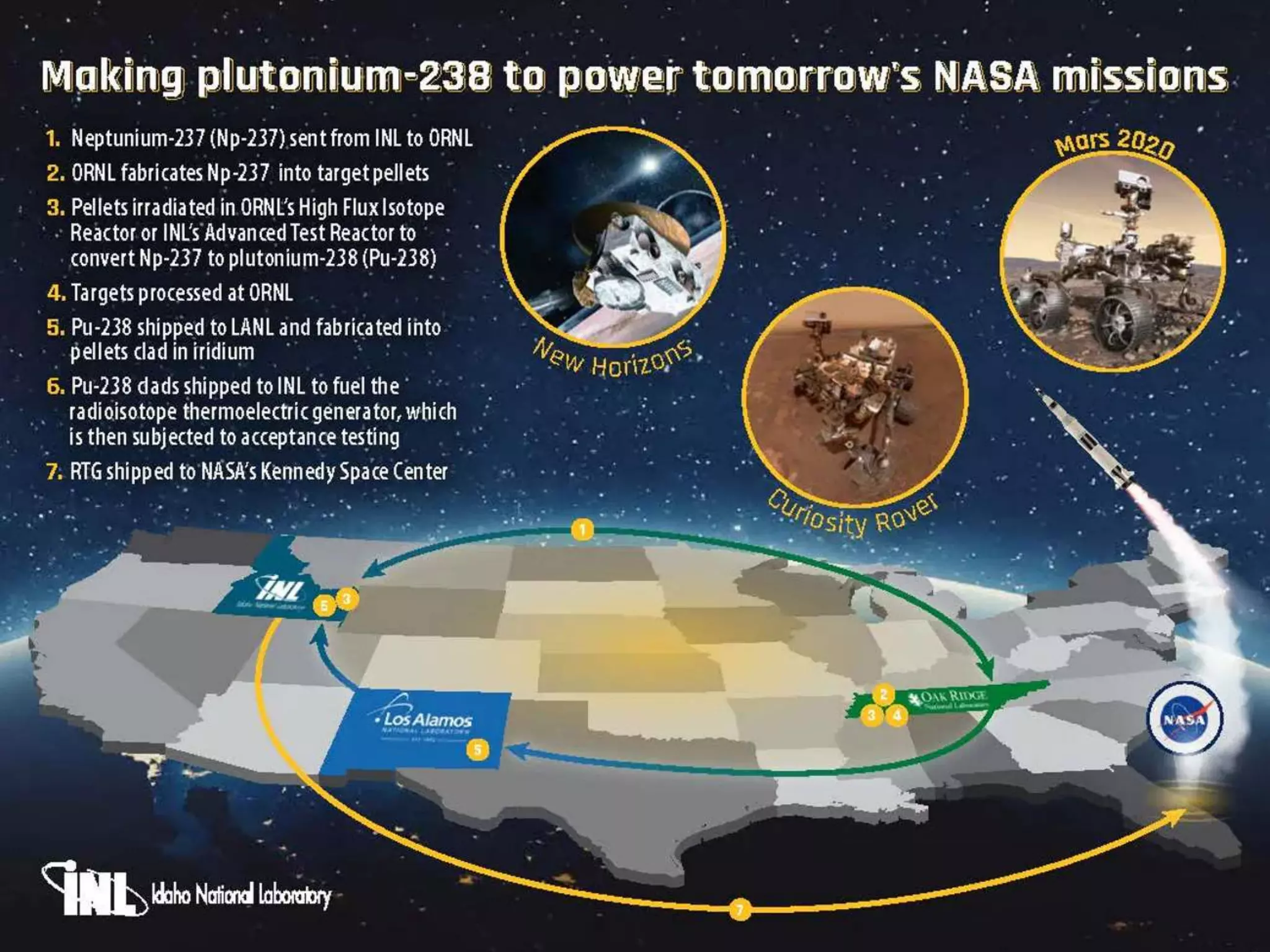
The rover's generator (MMRTG) has
a mass of 45 kilograms (99 lb) and uses
4.8 kilograms (11 lb) of plutonium
dioxide
as the source of steady supply of heat
that
is converted to electricity.The electrical
power generated is approximately 110
watts at launch with little decrease
over the mission time.
Two lithium-ion rechargeable batteries
are included to meet peak demands of
rover activities when the demand
temporarily exceeds the MMRTG's
steady electrical output levels. The
MMRTG offers a 14-year operational
lifetime, and it was provided to NASA
by the US Department of Energy.
Unlike solar panels, the MMRTG
provides engineers with significant
flexibility in operating the rover's
Curiosity's engineering team was involved in the rover's design. Engineers
redesigned
the Perseverance rover wheels to be more robust than Curiosity's wheels, which
have sustained some damage. The rover will have thicker, more durable aluminum
wheels,
with reduced width and a greater diameter (52.5 centimetres (20.7 in)) than
Curiosity's
50 centimetres (20 in) wheels. The aluminum wheels are covered with cleats for
traction
and curved titanium spokes for springy support.The combination of the larger
instrument suite, new Sampling and Caching System, and modified wheels makes
Perseverance heavier than its predecessor, Curiosity, by 17% (899 kg to 1050 kg).
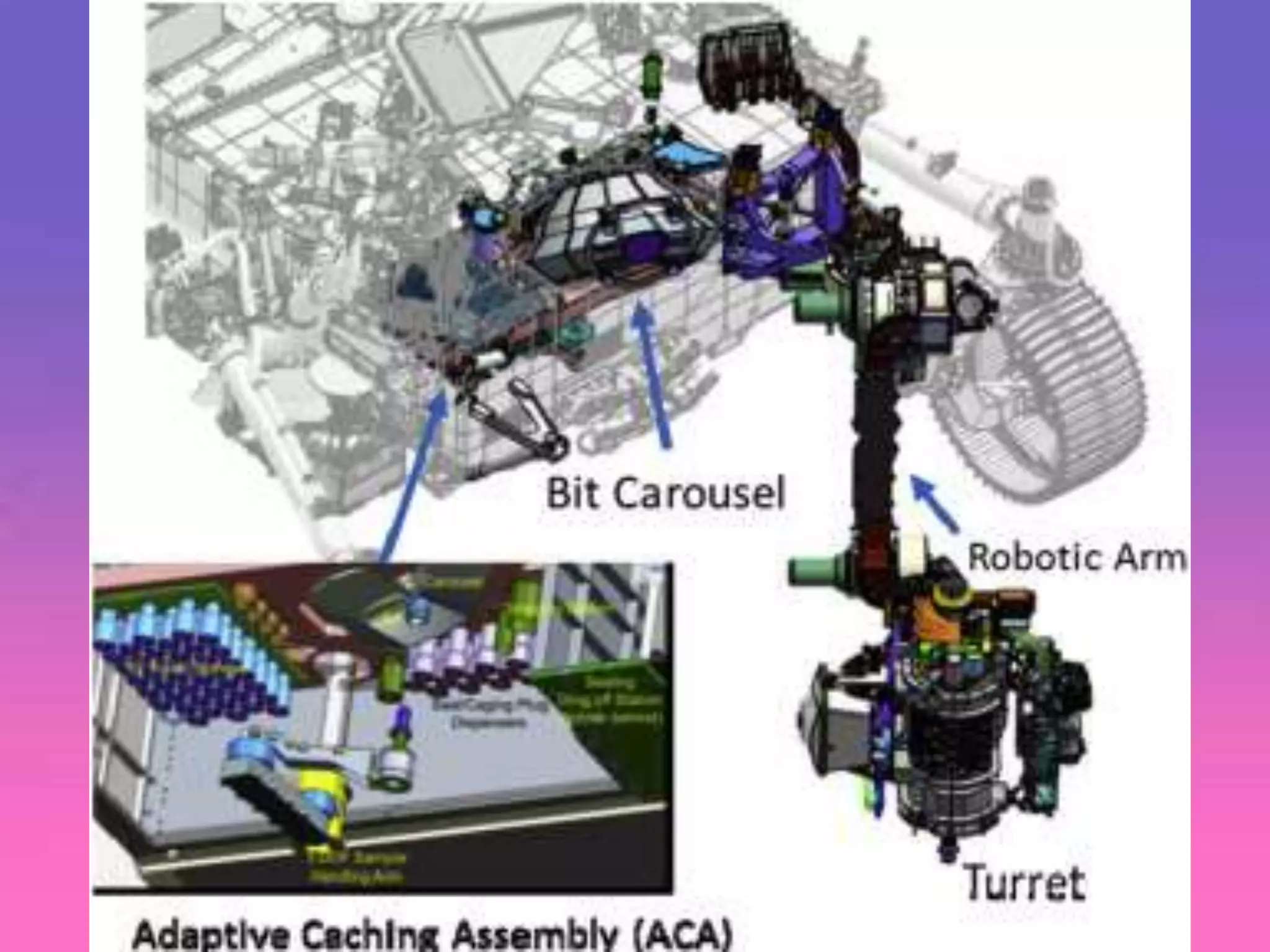
The rover will include a five-jointed robotic arm measuring 2.1 metres (6 ft 11 in)
long. The arm will be used in combination with a turret to analyze geologic
samples from the Martian surface.
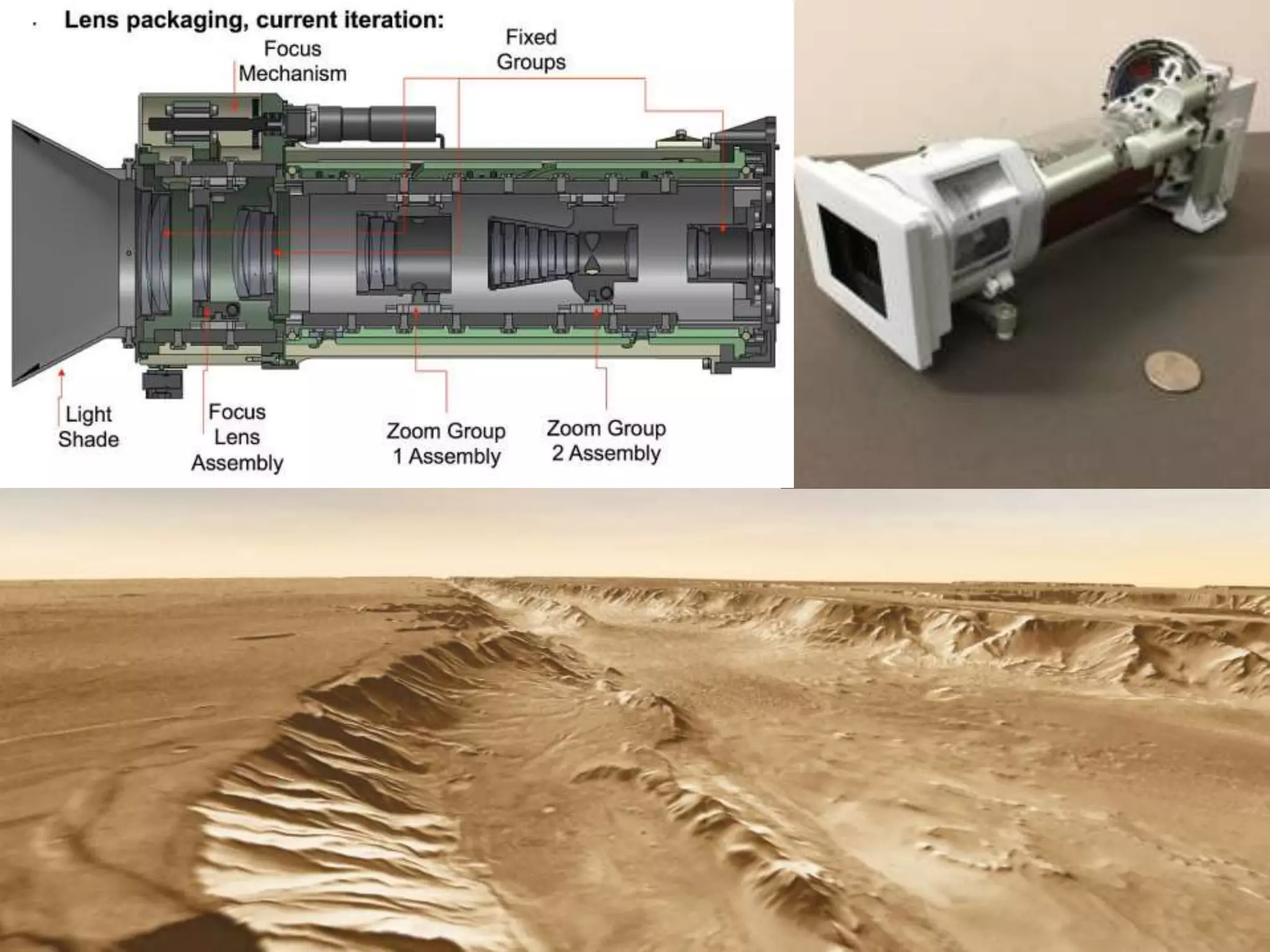
The Perseverance rover and other parts of the Mars 2020 spacecraft feature
23 cameras – more cameras than any interplanetary mission in history. They'll
help engineers put together a high-definition view of the landing process after the
rover safely touches down on Mars on Feb. 18, 2021, and they'll deliver images of
the landscape and scientific specimens in breathtaking detail. And as with
previous Mars missions, this one plans to make raw and processed images
available on the mission's website.
SuperCam, an instrument suite that can provide imaging, chemical composition
analysis, and mineralogy in rocks and regolith from a distance. It is an upgraded
version of the ChemCam on the Curiosity rover but with two lasers and four
spectrometers that will allow
it to remotely identify biosignatures and assess the past habitability. Los Alamos
National Laboratory, the Research Institute in Astrophysics and Planetology
(IRAP) in France,
the French Space Agency (CNES), the University of Hawaii, and the University of
Valladolid
in Spain cooperated in the SuperCam's development and manufacture.[20]
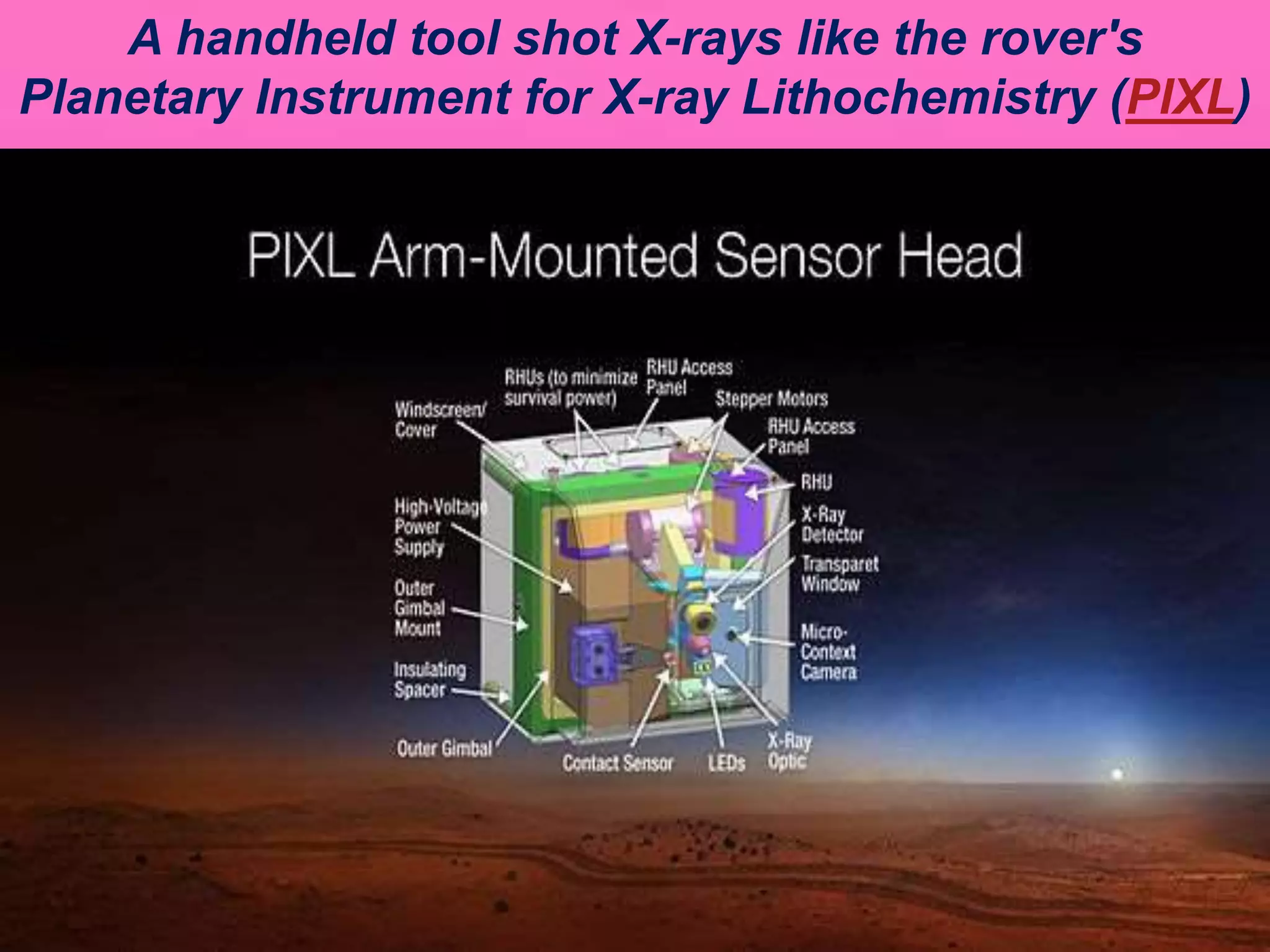
A handheld tool shot X-rays like the rover's
Planetary Instrument for X-ray Lithochemistry (PIXL)
Lazer in action..
Some of
the most
interesting
samples
will be
stored in
caches,
and left on
Mars, for
collecion
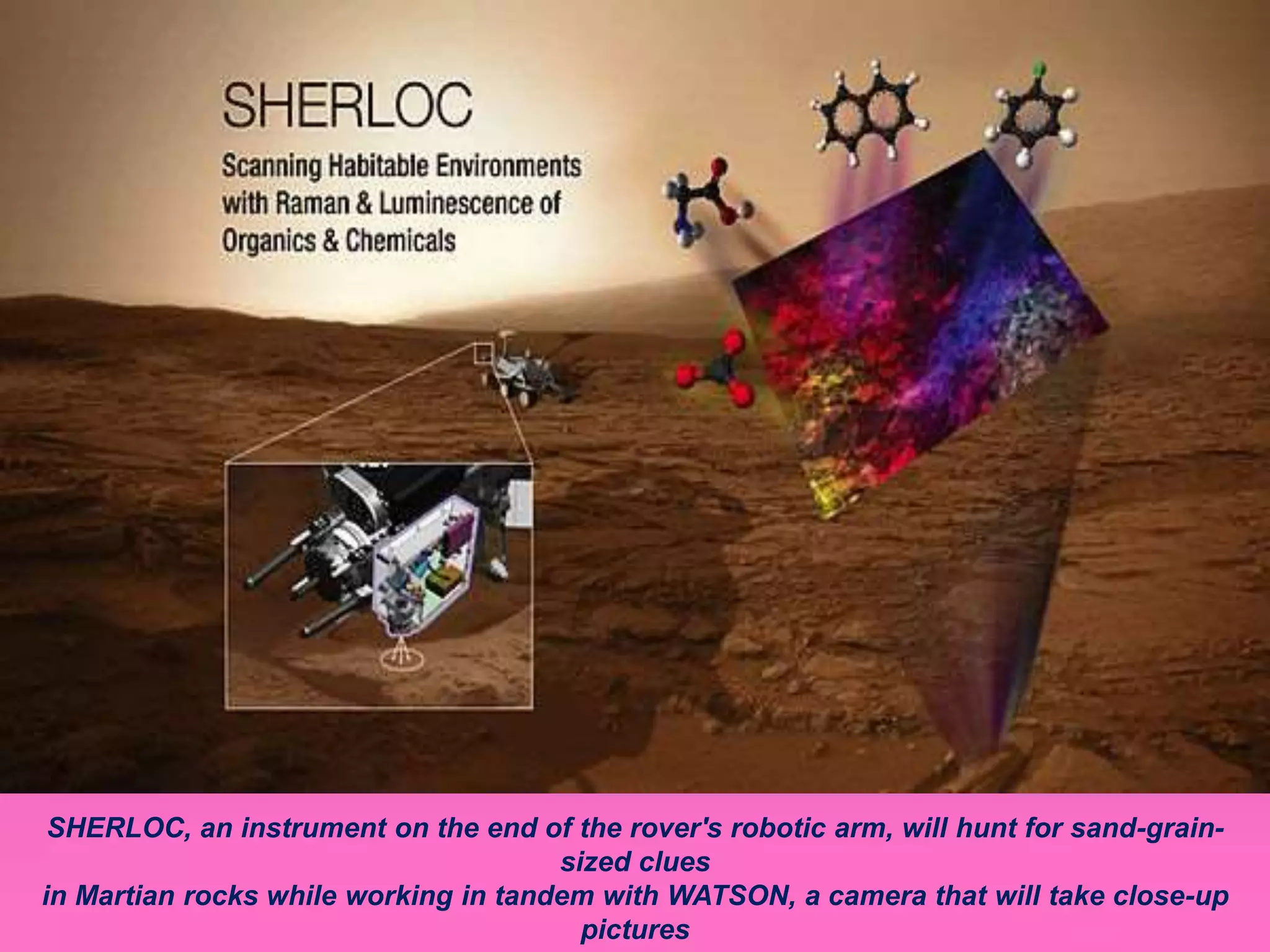
Scanning Habitable
Environments with
Raman and
Luminescence
for Organics and
Chemicals (SHERLOC),
an ultraviolet Raman
spectrometer
that uses fine-scale
imaging and an
ultraviolet (UV) laser to
determine fine-scale
mineralogy and detect
SHERLOC, an instrument on the end of the rover's robotic arm, will hunt for sand-grain-
sized clues
in Martian rocks while working in tandem with WATSON, a camera that will take close-up
pictures
S.H.E.R.L.O.C. = Scanning
Habitable Environments with
Raman & Luminescence for
Organics & Chemicals. "Raman"
refers to Raman spectroscopy, a
scientific technique named after
the Indian physicist C.V. Raman,
who discovered the light-
scattering
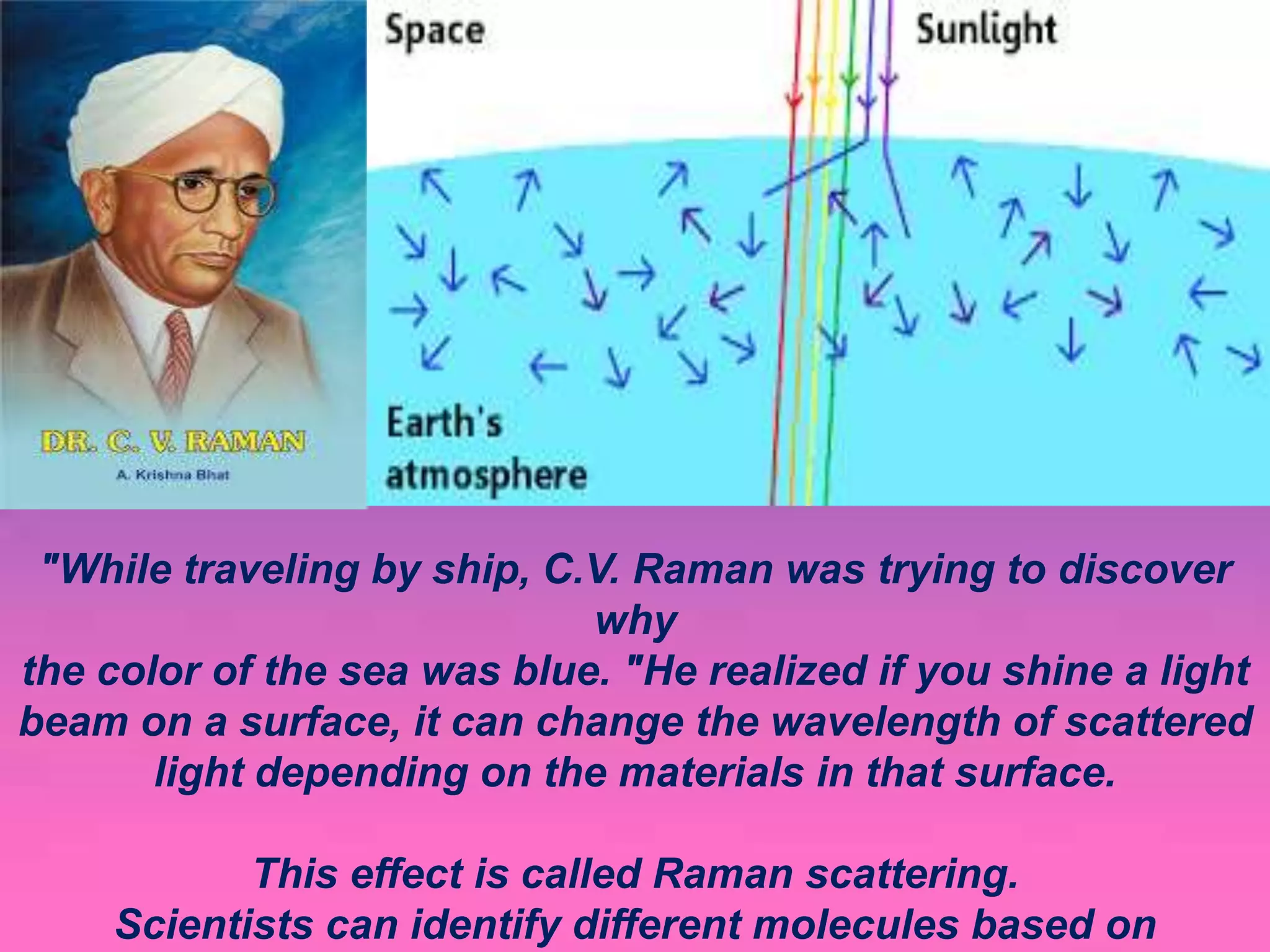
"While traveling by ship, C.V. Raman was trying to discover
why
the color of the sea was blue. "He realized if you shine a light
beam on a surface, it can change the wavelength of scattered
light depending on the materials in that surface.
This effect is called Raman scattering.
Scientists can identify different molecules based on
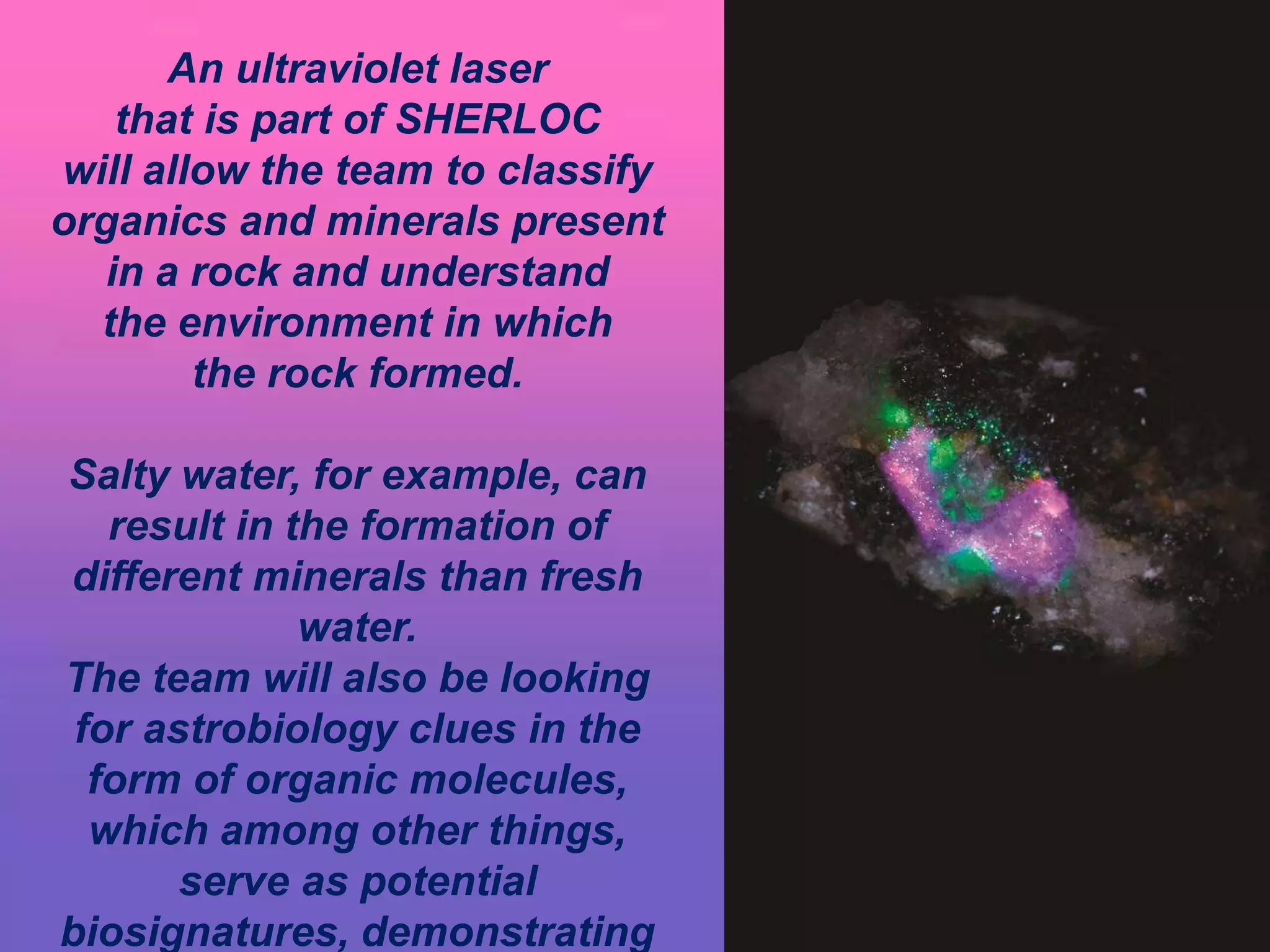
An ultraviolet laser
that is part of SHERLOC
will allow the team to classify
organics and minerals present
in a rock and understand
the environment in which
the rock formed.
Salty water, for example, can
result in the formation of
different minerals than fresh
water.
The team will also be looking
for astrobiology clues in the
form of organic molecules,
which among other things,
serve as potential
biosignatures, demonstrating
"Life is clumpy," –
"If we see organics clumping together
on one part of a rock,
it might be a sign that microbes
thrived there in the past.“
Nonbiological processes can also
form organics, so detecting the
compounds isn't a sure sign that life
formed on Mars.
But organics are crucial to
understanding whether the ancient
environment
could have supported life.
When Beegle and his team spot an interesting rock, they'll scan a quarter-sized area of it with SHERLOC's
laser to tease out the mineral composition and whether organic compounds are present.
Then WATSON (Wide Angle Topographic Sensor for Operations and eNgineering) will take close-up
images of
the sample. It can snap images of Perseverance, too, just as NASA's Curiosity rover uses the same
camera —
called the Mars Hand Lens Imager on that vehicle — for science and for taking selfies.
But combined with SHERLOC, WATSON can do even more: The team can precisely map SHERLOC's
findings over WATSON's images to help reveal how different mineral layers formed and overlap. They can
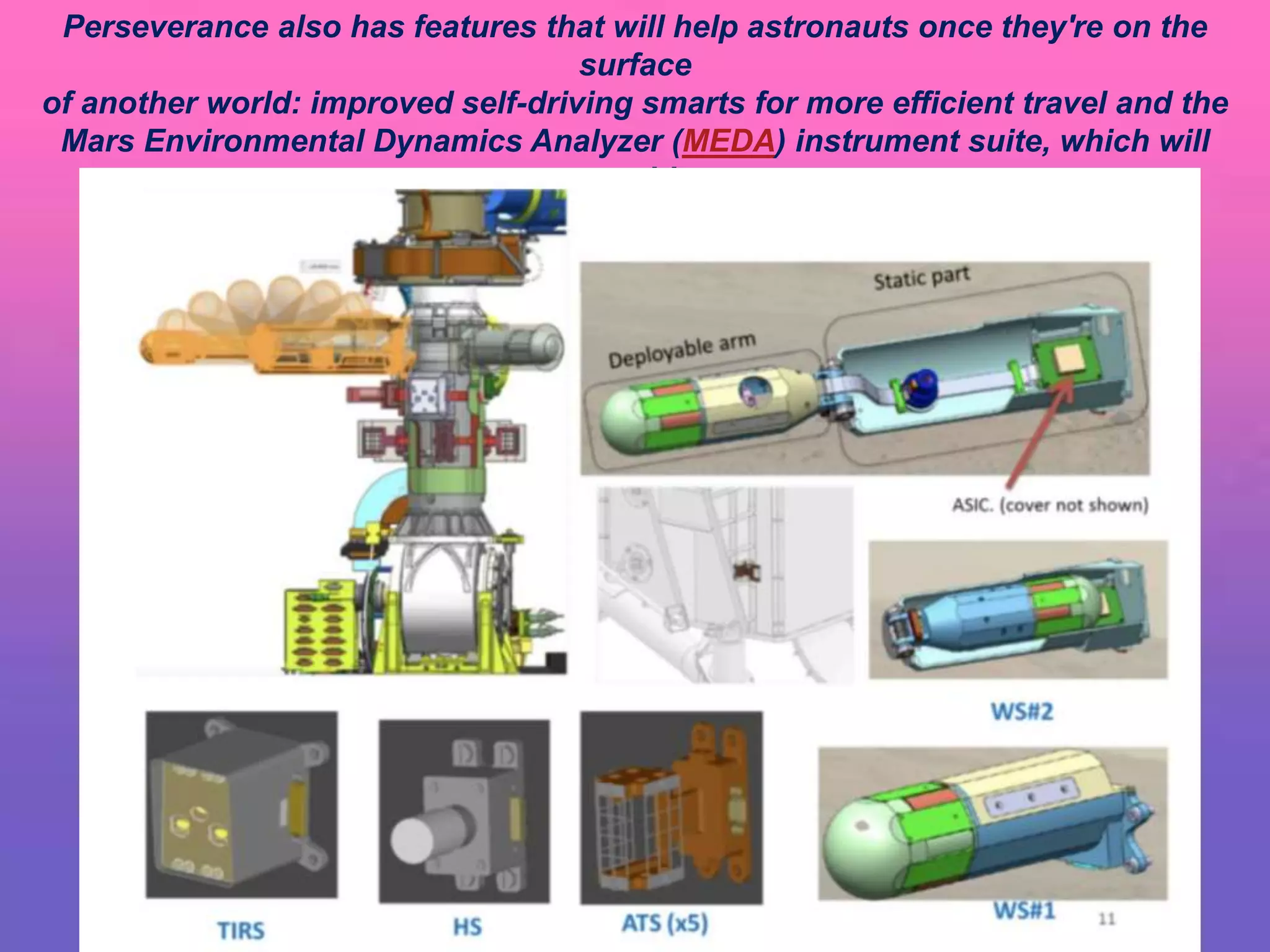
Perseverance also has features that will help astronauts once they're on the
surface
of another world: improved self-driving smarts for more efficient travel and the
Mars Environmental Dynamics Analyzer (MEDA) instrument suite, which will
provide
key information about weather, climate, and dust.
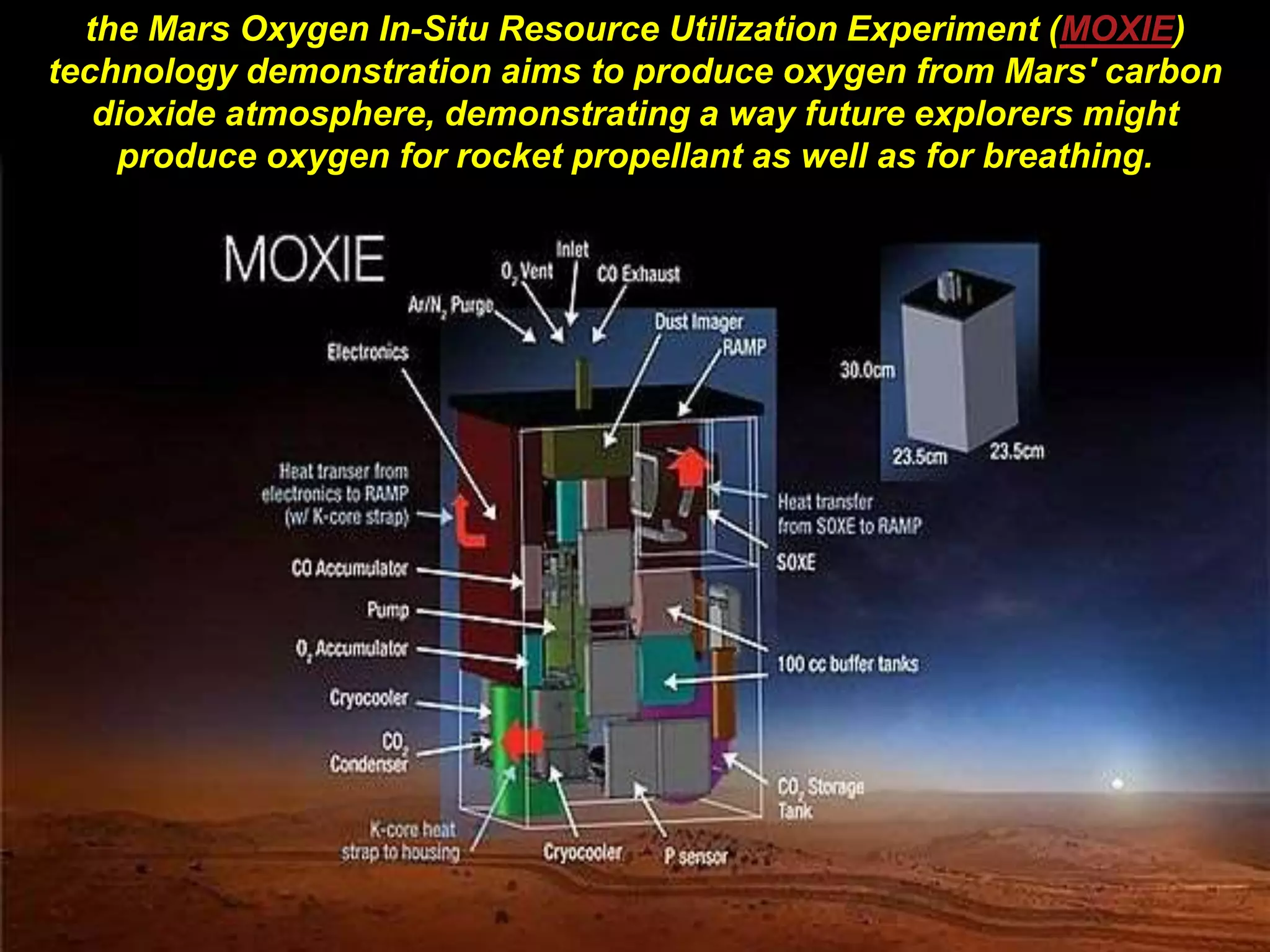
the Mars Oxygen In-Situ Resource Utilization Experiment (MOXIE)
technology demonstration aims to produce oxygen from Mars' carbon
dioxide atmosphere, demonstrating a way future explorers might
produce oxygen for rocket propellant as well as for breathing.
RIMFAX can
make a map
of the
undergrouond.
Mars is much farther away than the ocean floor. Only so many commands can be
sent
to Perseverance each day, and only so much data can be sent back. That's why
every
rover mission has to balance the desire to deepen the team's understanding of
one site
with the need to sample the geologic diversity available down the road.
The helicopter or drone
After the descent stage fueling, the system that will deliver the Mars Helicopter
to the surface of the Red Planet was integrated with Perseverance. The helicopter,
which weighs 4 pounds (1.8 kilograms) and features propellers 4 feet (1.2 meters)
in diameter, is cocooned within the delivery system
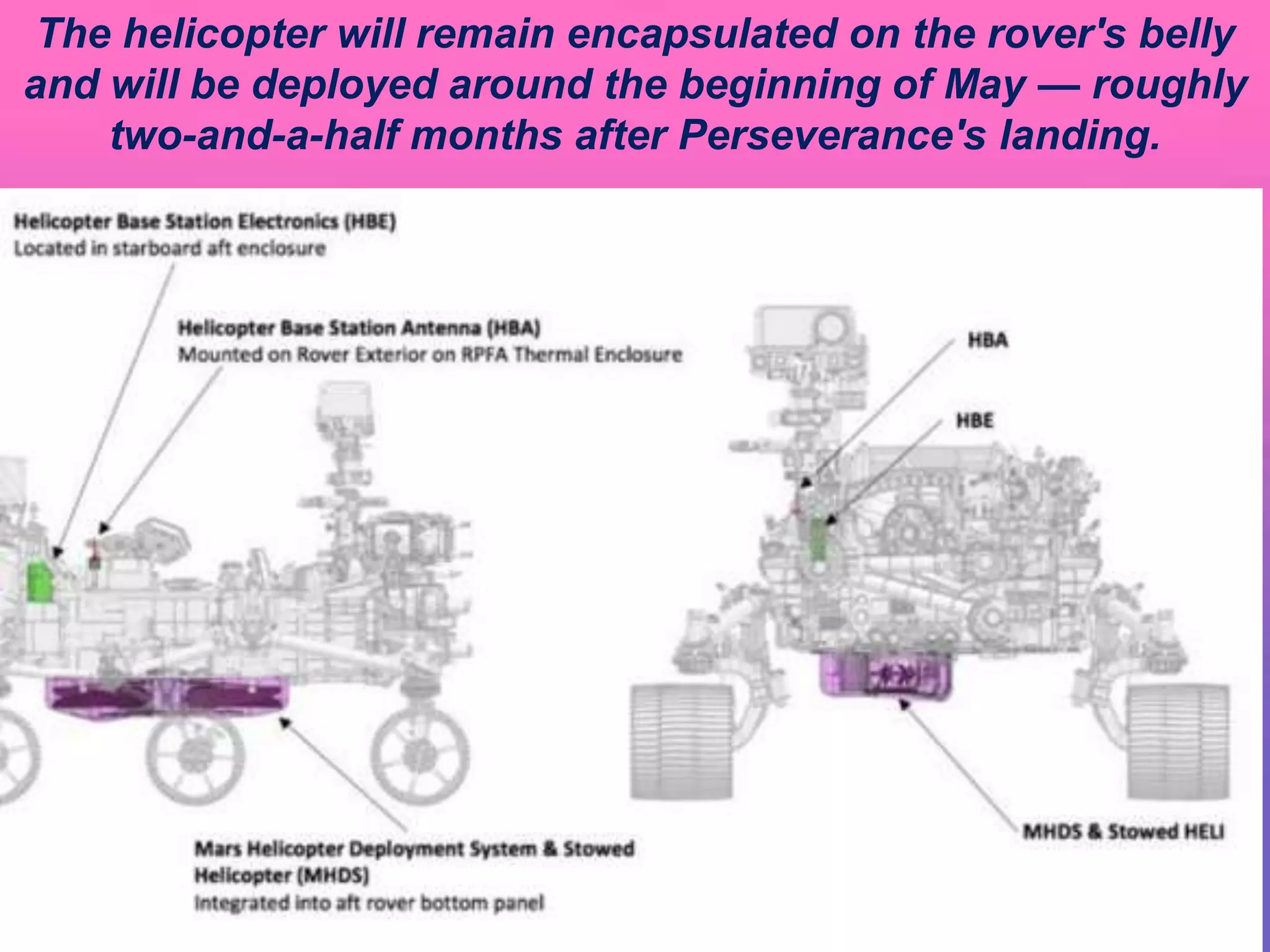
The helicopter will remain encapsulated on the rover's belly
and will be deployed around the beginning of May — roughly
two-and-a-half months after Perseverance's landing.
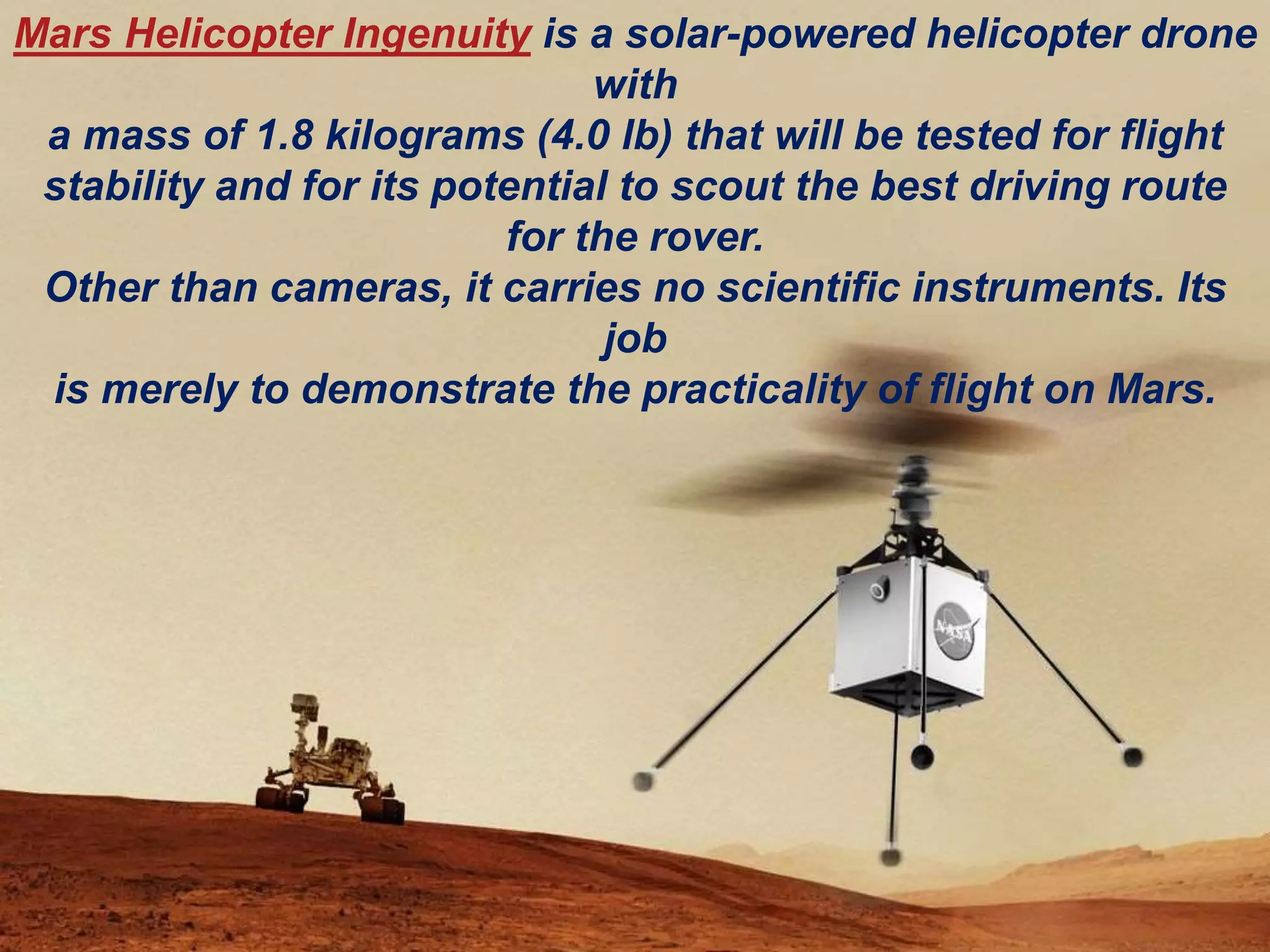
Mars Helicopter Ingenuity is a solar-powered helicopter drone
with
a mass of 1.8 kilograms (4.0 lb) that will be tested for flight
stability and for its potential to scout the best driving route
for the rover.
Other than cameras, it carries no scientific instruments. Its
job
is merely to demonstrate the practicality of flight on Mars.
The small helicopter is expected to fly up to five times during its 30-day
testing
and will fly no more than 3 minutes per day. It is a technology
demonstrator that will form the foundation on which more capable
helicopters can be developed for aerial exploration of Mars and other
planetary targets with an atmosphere.
Before being deployed onto the surface of Jezero Crater, the Mars Helicopter
will rely on the rover for power. Afterward, it will generate its own electrical power
through a solar panel located above its twin counter-rotating propellers.
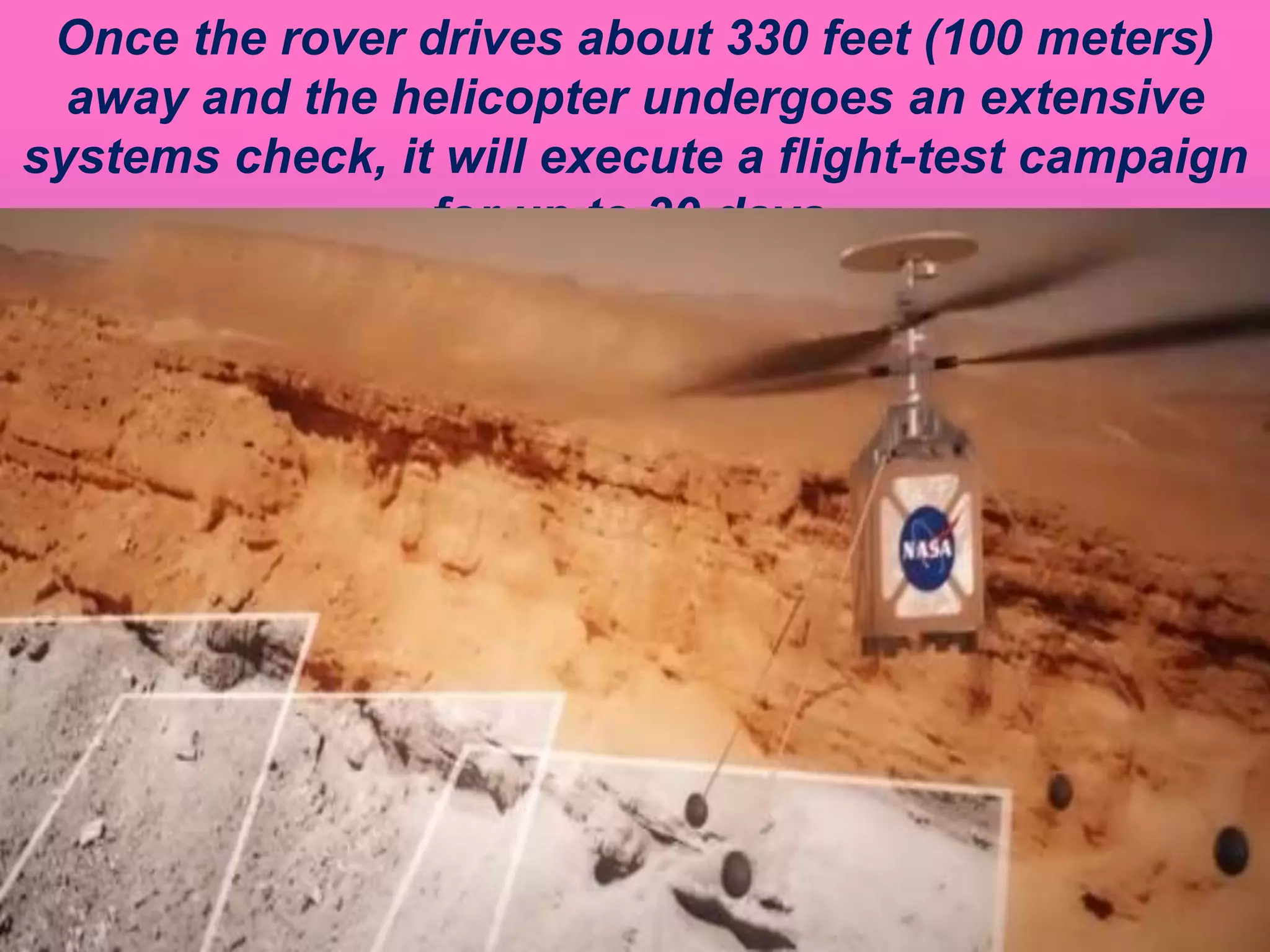
Once the rover drives about 330 feet (100 meters)
away and the helicopter undergoes an extensive
systems check, it will execute a flight-test campaign
for up to 30 days.
Meteorites and Spacesuits
Any science instrument exposed to the Martian environment for long enough is bound
to
change, either from the extreme temperature swings or the radiation from the Sun and
cosmic rays. Scientists occasionally have to calibrate these instruments, which they
do by measuring their readings against calibration targets — essentially, objects with
known
properties selected in advance for cross-checking purposes. (For instance, a penny
serves as
one calibration target aboard Curiosity.) Since they know in advance what the readings
should
be when an instrument is working correctly, scientists can make adjustments
accordingly.
Next to the Martian meteorite are five samples of spacesuit fabric and helmet
material developed by NASA's Johnson Space Center. SHERLOC will take
readings of these
materials as they change in the Martian landscape over time, giving spacesuit
designers a better idea of how they degrade. When the first astronauts step
Follow – up missions – NASA & ESA prepare
to retrieve clay and rock samples from the
surface of Mars and return them to Earth
Fetch Rover named after
Rosalind Franklin who helped
discover ADN
will collect the caches of
samples of Martian rock and
clay.
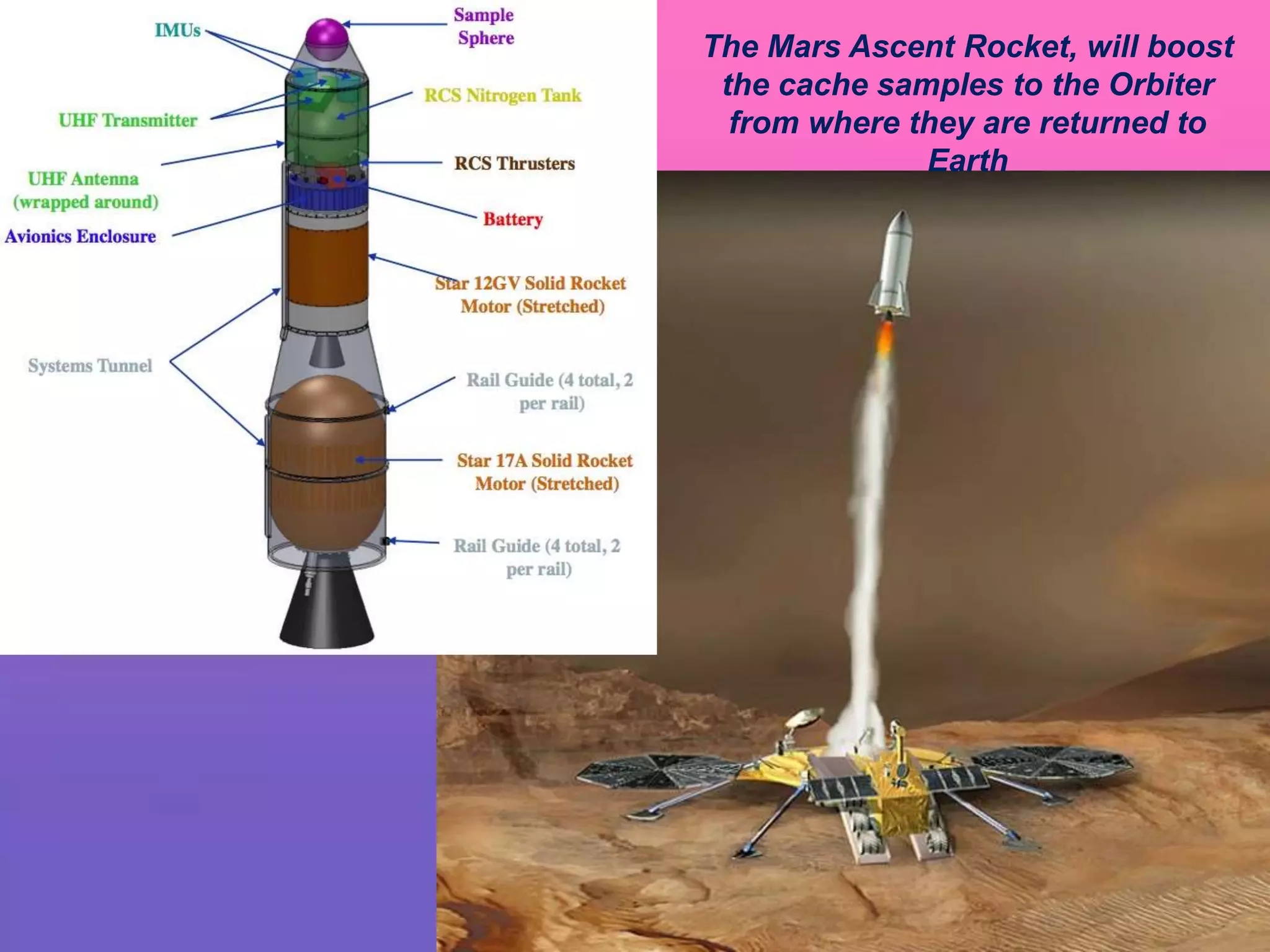
The Mars Ascent Rocket, will boost
the cache samples to the Orbiter
from where they are returned to
Earth
To be continued…..
LIST OF PRESENTATIONS IN ENGLISH
Revised- 15-7-2020
Advent and Christmas – time of hope and peace
Amoris Laetitia – ch 1 – In the Light of the Word
Amoris Laetitia – ch 2 – The Experiences and Challenges of Families
Amoris Laetitia – ch 3 - Looking to Jesus, the Vocation of the Family
Amoris Laetitia – ch 4 - Love in Marriage
Amoris Laetitia – ch 5 – Love made Fruitfuol
Amoris Laetitia – ch 6 – Some Pastoral Perspectives
Amoris Laetitia – ch 7 – Towards a better education of children
Amoris Laetitia – ch 8 – Accompanying, discerning and integrating weaknwss
Amoris Laetitia – ch 9 – The Spirituality of Marriage and the Family
Beloved Amazon 1ª – A Social Dream
Beloved Amazon 2 - A Cultural Dream
Beloved Amazon 3 – An Ecological Dream
Beloved Amazon 4 - An Ecclesiastical Dream
Carnival
Christ is Alive
Familiaris Consortio (FC) 1 – Church and Family today
Familiaris Consortio (FC) 2 - God’s plan for the family
Familiaris Consortio (FC) 3 – 1 – family as a Community
Familiaris Consortio (FC) 3 – 2 – serving life and education
Familiaris Consortio (FC) 3 – 3 – mission of the family in society
Familiaris Consortio (FC) 3 – 4 - Family in the Church
Familiaris Consortio (FC) 4 Pastoral familiar
Football in Spain
Haurietis aquas – devotion to the Sacred Heart by Pius XII
Holidays and Holy Days
Holy Spirit
Holy Week – drawings for children
Holy Week – glmjpses of the last hours of JC
Inauguration of President Donald Trump
Juno explores Jupiter
Laudato si 1 – care for the common home
Laudato si 2 – Gospel of creation
Laudato si 3 – Human roots of the ecological crisis
Laudato si 4 – integral ecology
Laudato si 5 – lines of approach and action
Laudato si 6 – Education y Ecological Spirituality
Love and Marriage 1-
Love and Marriage 2 – growing up to sexual maturity
Love and Marriage 3 – psychological differences and complimentarity
Love and Marriage 4- causes of sexual attraction
Love and Marriage 5- freedom and intimacy
Love and Marriage 6 - human love
Love and Marriage 7 - destiny of human love
Love and Marriage 8- marriage between Christian believers
Love and Marriage 9 – sacrament of marriage
Lumen Fidei – ch 1,2,3,4
Mars Probe – Insight
Mar’s Raver - Perseverence
Medjugore Pilgrimage
Misericordiae Vultus in English
Mother Teresa of Calcuta – Saint
Parker Sun Probe
Pope Franciss in Thailand
Pope Francis in Japan
Pope Francis in Sweden
Pope Francis in America
Pope Francis in the WYD in Poland 2016
Querida Amazonia
Resurrection of Jesus Christ –according to the Gospels
Russian Revolution and Communismo 3 civil war 1918.1921
Russian Revolution and Communism 1
Russian Revolution and Communismo 2
Saint Joseph
Saint Patrick and Ireland
Sunday – day of the Lord
Thanksgiving – History and Customs
The Body, the cult – (Eucharist)
Valentine
Vocation – mconnor@legionaries.org
Way of the Cross – drawings for children
For commentaries – email – mflynn@legionaries.org
Fb – Martin M Flynn
Donations to - Congregación Legionarios de Cristo
IBAN: ES3700491749852910000635
Swift Code (BIC): BSCHESMMXXX
Dirección banco: Plaza de Parma, 8, Montequinto. CP 41700 Dos
Hermanas, Sevilla. España.
LISTA DE PRESENTACIONES EN ESPAÑOL
Revisado 15-7-2020
Abuelos
Adviento y Navidad, tiempo de esperanza
Amor y Matrimonio 1 - 9
Amoris Laetitia – ch 1 – A la luz de la Palabre
Amoris Laetitia – ch 2 – Realidad y Desafíos de las Familias
Amoris Laetitia – ch 3 La mirada puesta en Jesús: Vocación de la Familia
Amoris Laetitia – ch 4 - El Amor en el Matrimonio
Amoris Laetitia – ch 5 – Amor que se vuelve fecundo
Amoris Laetitia – ch 6 – Algunas Perspectivas Pastorales
Amoris Laetitia – ch 7 – Fortalecer la educacion de los hijos
Amoris Laetitia – ch 8 – Acompañar, discernir e integrar la fragilidad
Amoris Laetitia – ch 9 – Espiritualidad Matrimonial y Familiar
Carnaval
Cristo Vive
Domingo – día del Señor
El camino de la cruz de JC en dibujos para niños
El Cuerpo, el culto – (eucarisía)
Espíritu Santo
Familiaris Consortio (FC) 1 – iglesia y familia hoy
Familiaris Consortio (FC) 2 - el plan de Dios para la familia
Familiaris Consortio (FC) 3 – 1 – familia como comunidad
Familiaris Consortio (FC) 3 – 2 – servicio a la vida y educación
Familiaris Consortio (FC) 3 – 3 – misión de la familia en la sociedad
Familiaris Consortio (FC) 3 – 4 - participación de la familia en la iglesia
Familiaris Consortio (FC) 4 Pastoral familiar
Fátima – Historia de las Apariciones de la Virgen
Feria de Sevilla
Haurietis aquas – el culto al Sagrado Corazón
Hermandades y cofradías
Hispanidad
Laudato si 1 – cuidado del hogar común
Laudato si 2 – evangelio de creación
Laudato si 3 – La raíz de la crisis ecológica
Laudato si 4 – ecología integral
Laudato si 5 – líneas de acción
Laudato si 6 – Educación y Espiritualidad Ecológica
Lumen Fidei – cap 1,2,3,4
Madre Teresa de Calcuta – Santa
María y la Biblia
Medjugore peregrinación
Misericordiae Vultus en Español
Papa Francisco en Bulgaria
Papa Francisco en Rumania
Papa Francisco en Marruecos
Papa Francisco en México
Papa Francisco – mensaje para la Jornada Mundial Juventud 2016
Papa Francisco – visita a Chile
Papa Francisco – visita a Perú
Papa Francisco en Colombia 1 + 2
Papa Francisco en Cuba
Papa Francisco en Fátima
Papa Francisco en la JMJ 2016 – Polonia
Queridas Amazoznia 1 un sueños social
Queridas Amazoznia 2 un suepo cultural
Queridas Amazoznia 3 un seuños ecologico
Queridas Amazoznia 4 un sueño eclesial
Resurrección de Jesucristo – según los Evangelios
Revolución Rusa y Comunismo 1
Revolución Rusa y comunismo 2
Revolución Rusa y Comunismo 3
San José
Santiago Apóstol
Semana santa – Vistas de las últimas horas de JC
Vacaciones Cristianas
Valentín
Vocación – www.vocación.org
Para comentarios – email – mflynn@lcegionaries.org
fb – martin m. flynn
Donativos a - Congregación Legionarios de Cristo
IBAN: ES3700491749852910000635
Swift Code (BIC): BSCHESMMXXX
Dirección banco: Plaza de Parma, 8, Montequinto. CP 41700
Dos Hermanas, Sevilla. España.
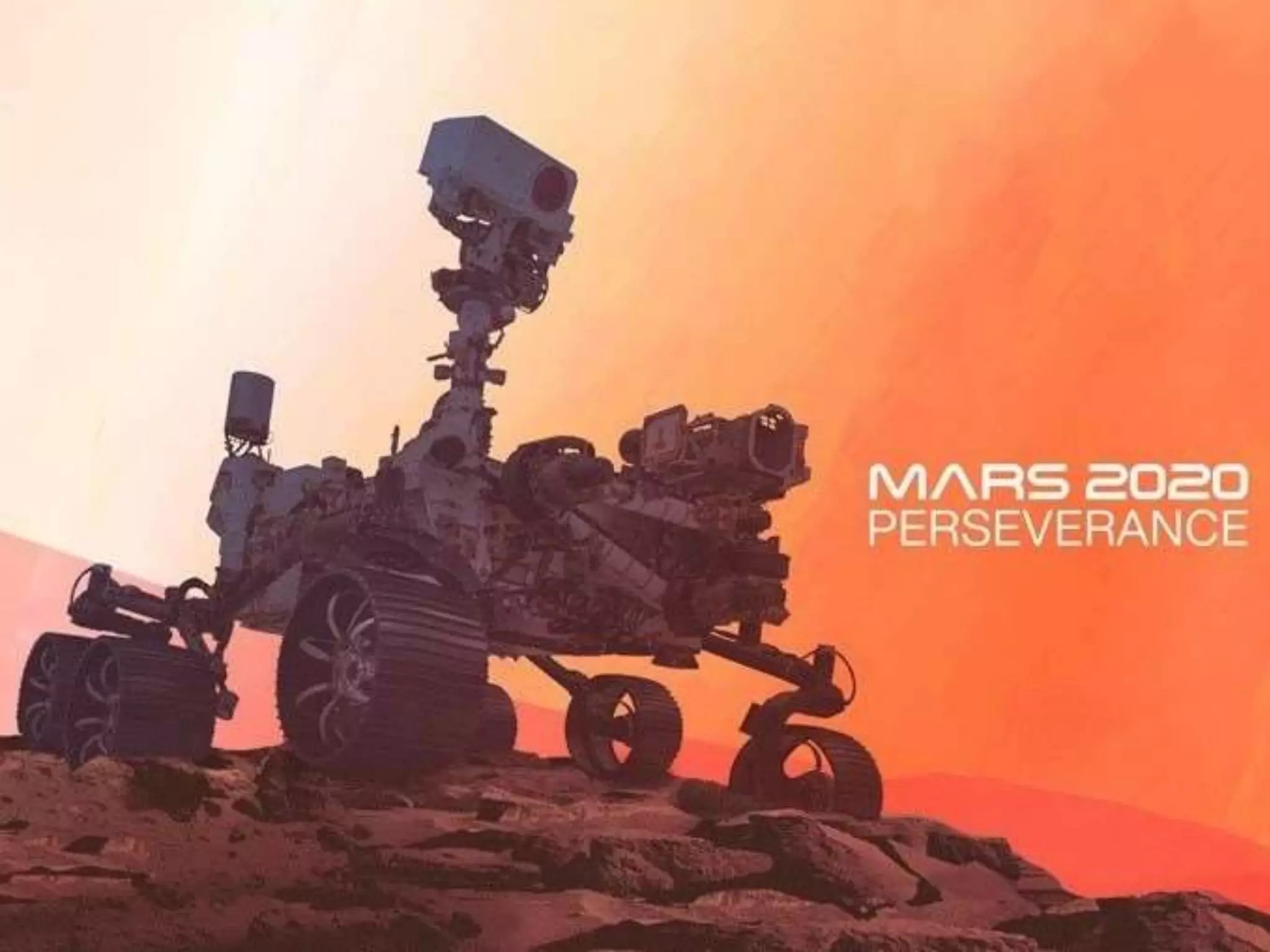
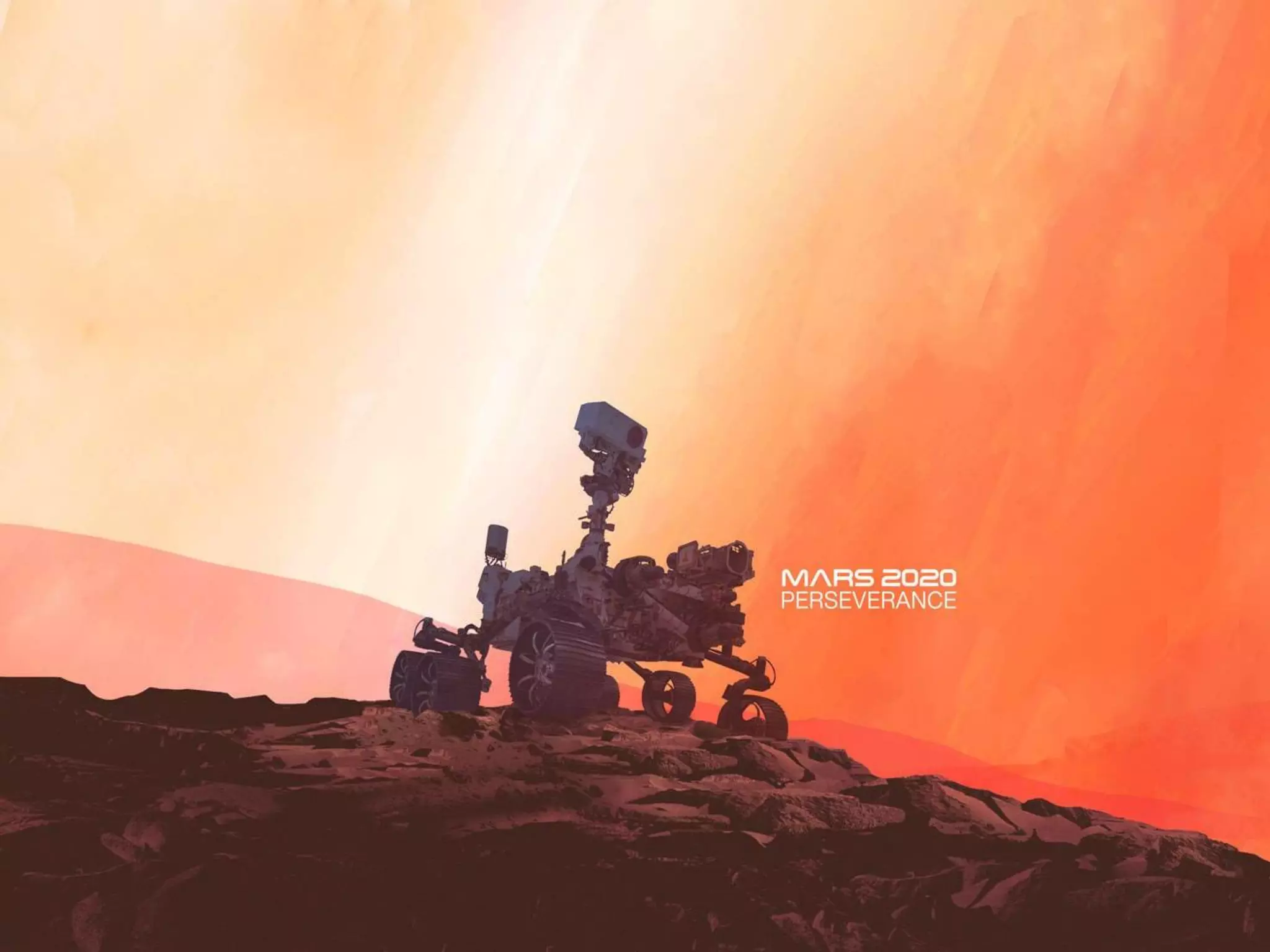
Mars rover perseverence

Mars rover perseverence

  • 2.
  • 6.
    Mars orbiters havebeen collecting images and other data from Jezero Crater from about 200 miles (322 kilometers) above, but finding signs of ancient life on the surface will require much closer inspection. It demands a rover like Perseverance, which can look for signs that may be related to life and can analyze the context in which they were found to see if they
  • 8.
    PROGRESS IN THEDESIGN OF MARS ROVERS
  • 9.
    NASA's modest firstrover – Sojourner – demonstrated in 1997 that a robot could rove on the Red Planet.
  • 10.
    Spirit and Opportunity,which landed in 2004, found evidence that the planet once hosted running water before becoming a frozen desert.
  • 11.
    Curiosity, which hasbeen exploring Mars since 2012, discovered that its landing site, Gale Crater, was home to of a lake billions of years ago, with an environment that could have supported microbial life. - Perseverance aims to take the next step, seeking, as a primary goal, to answer one of the key questions of astrobiology: Are there any signs that life once existed on Mars?
  • 13.
  • 15.
  • 16.
    Jezero Crater is28 miles (45 kilometers) wide and sits on the western edge of Isidis Planitia, a giant basin just north of the Martian equator dug out long ago when a space rock hit the surface. Sometime between 3 billion and 4 billion years ago at Jezero, a river flowed into a body of water the size of Lake Tahoe.
  • 18.
    Accuracy of selectinglanding sites of different missions
  • 19.
    The 2020 missioncalled Perseverence will land in Mars' Jezero Crater on Feb. 18, 2021. Targeting landing for one specific date and time helps mission planners better understand lighting and temperature at the landing site, as well as the location of Mars- orbiting satellites tasked with recording and relaying spacecraft data during its descent and landing.
  • 20.
    Verifying ancient microscopiclife on Mars carries an enormous burden of proof. Perseverance is the first rover to bring a sample-gathering system to Mars that will package promising examples of rocks and sediments for return to Earth by a
  • 22.
    Perseverance is arobotic scientist weighing just under 2,300 pounds (1,043 kilograms). The rover's astrobiology mission will search for signs of past microbial life on Mars, characterize the planet's climate and geology, collect rock and soil samples for future return to Earth, and pave the way for human exploration of the Red Planet.
  • 24.
    884 pounds (401kilograms) of hydrazine monopropellant were loaded into the descent stage's four fuel tanks. As the aeroshell containing the descent stage and rover enter the Martian atmosphere on Feb. 18, 2021, the propellant will be pressure-fed through 120 feet (37 meters) of stainless steel and titanium tubing into eight Mars landing engines. The engines' job: to slow the spacecraft, which will be traveling at about 180 mph
  • 25.
    Encased in thenose cone that will protect it during launch, the rover and the rest of the Mars 2020 spacecraft – the aeroshell, cruise stage, and descent stage – were affixed to a United Launch Alliance Atlas V booster at Cape Canaveral Air Force
  • 28.
  • 30.
    The Terrain-Relative Navigation system,which autonomously helps the rover avoid hazards during landing, and the Mars Science Laboratory Entry, Descent, and Landing Instrumentation 2 (MEDLI2) sensor suite, which gathers crucial data during the journey through the Martian atmosphere, will help future human missions land more safely and with larger payloads on other worlds.
  • 31.
  • 32.
    Maintaining this rateof descent, the stage will then perform the sky crane maneuver: Nylon cords spool out to lower the rover 25 feet (7.6 meters) below the descent stage; When the spacecraft senses touchdown at Jezero Crater, the connecting cords are severed and the
  • 36.
    Perseverance is aMars rover manufactured by the Jet Propulsion Laboratory for use in NASA's Mars 2020 mission. Nearly identical in design to the Curiosity rover, Perseverance will carry seven scientific instruments to study the Martian surface at Jezero crater, 23 cameras in total, and two microphones.
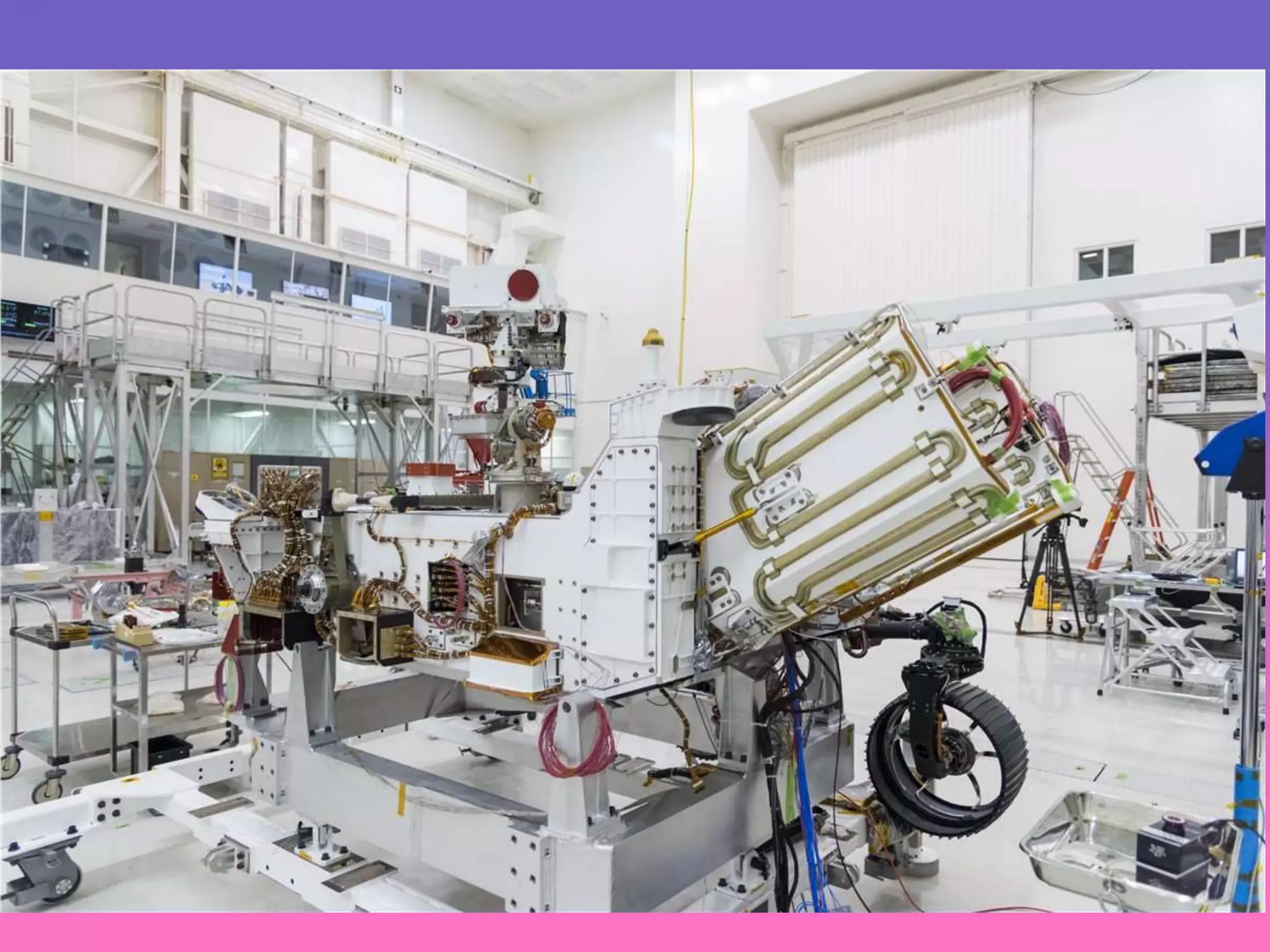
  • 37.
    The rover's generator(MMRTG) has a mass of 45 kilograms (99 lb) and uses 4.8 kilograms (11 lb) of plutonium dioxide as the source of steady supply of heat that is converted to electricity.The electrical power generated is approximately 110 watts at launch with little decrease over the mission time. Two lithium-ion rechargeable batteries are included to meet peak demands of rover activities when the demand temporarily exceeds the MMRTG's steady electrical output levels. The MMRTG offers a 14-year operational lifetime, and it was provided to NASA by the US Department of Energy. Unlike solar panels, the MMRTG provides engineers with significant flexibility in operating the rover's
  • 40.
    Curiosity's engineering teamwas involved in the rover's design. Engineers redesigned the Perseverance rover wheels to be more robust than Curiosity's wheels, which have sustained some damage. The rover will have thicker, more durable aluminum wheels, with reduced width and a greater diameter (52.5 centimetres (20.7 in)) than Curiosity's 50 centimetres (20 in) wheels. The aluminum wheels are covered with cleats for traction and curved titanium spokes for springy support.The combination of the larger instrument suite, new Sampling and Caching System, and modified wheels makes Perseverance heavier than its predecessor, Curiosity, by 17% (899 kg to 1050 kg). The rover will include a five-jointed robotic arm measuring 2.1 metres (6 ft 11 in) long. The arm will be used in combination with a turret to analyze geologic samples from the Martian surface.
  • 41.
    The Perseverance roverand other parts of the Mars 2020 spacecraft feature 23 cameras – more cameras than any interplanetary mission in history. They'll help engineers put together a high-definition view of the landing process after the rover safely touches down on Mars on Feb. 18, 2021, and they'll deliver images of the landscape and scientific specimens in breathtaking detail. And as with previous Mars missions, this one plans to make raw and processed images available on the mission's website.
  • 43.
    SuperCam, an instrumentsuite that can provide imaging, chemical composition analysis, and mineralogy in rocks and regolith from a distance. It is an upgraded version of the ChemCam on the Curiosity rover but with two lasers and four spectrometers that will allow it to remotely identify biosignatures and assess the past habitability. Los Alamos National Laboratory, the Research Institute in Astrophysics and Planetology (IRAP) in France, the French Space Agency (CNES), the University of Hawaii, and the University of Valladolid in Spain cooperated in the SuperCam's development and manufacture.[20]
  • 44.
    A handheld toolshot X-rays like the rover's Planetary Instrument for X-ray Lithochemistry (PIXL)
  • 45.
  • 47.
    Some of the most interesting samples willbe stored in caches, and left on Mars, for collecion
  • 48.
    Scanning Habitable Environments with Ramanand Luminescence for Organics and Chemicals (SHERLOC), an ultraviolet Raman spectrometer that uses fine-scale imaging and an ultraviolet (UV) laser to determine fine-scale mineralogy and detect
  • 50.
    SHERLOC, an instrumenton the end of the rover's robotic arm, will hunt for sand-grain- sized clues in Martian rocks while working in tandem with WATSON, a camera that will take close-up pictures
  • 51.
    S.H.E.R.L.O.C. = Scanning HabitableEnvironments with Raman & Luminescence for Organics & Chemicals. "Raman" refers to Raman spectroscopy, a scientific technique named after the Indian physicist C.V. Raman, who discovered the light- scattering
  • 52.
    "While traveling byship, C.V. Raman was trying to discover why the color of the sea was blue. "He realized if you shine a light beam on a surface, it can change the wavelength of scattered light depending on the materials in that surface. This effect is called Raman scattering. Scientists can identify different molecules based on
  • 53.
    An ultraviolet laser thatis part of SHERLOC will allow the team to classify organics and minerals present in a rock and understand the environment in which the rock formed. Salty water, for example, can result in the formation of different minerals than fresh water. The team will also be looking for astrobiology clues in the form of organic molecules, which among other things, serve as potential biosignatures, demonstrating
  • 54.
    "Life is clumpy,"– "If we see organics clumping together on one part of a rock, it might be a sign that microbes thrived there in the past.“ Nonbiological processes can also form organics, so detecting the compounds isn't a sure sign that life formed on Mars. But organics are crucial to understanding whether the ancient environment could have supported life.
  • 55.
    When Beegle andhis team spot an interesting rock, they'll scan a quarter-sized area of it with SHERLOC's laser to tease out the mineral composition and whether organic compounds are present. Then WATSON (Wide Angle Topographic Sensor for Operations and eNgineering) will take close-up images of the sample. It can snap images of Perseverance, too, just as NASA's Curiosity rover uses the same camera — called the Mars Hand Lens Imager on that vehicle — for science and for taking selfies. But combined with SHERLOC, WATSON can do even more: The team can precisely map SHERLOC's findings over WATSON's images to help reveal how different mineral layers formed and overlap. They can
  • 56.
    Perseverance also hasfeatures that will help astronauts once they're on the surface of another world: improved self-driving smarts for more efficient travel and the Mars Environmental Dynamics Analyzer (MEDA) instrument suite, which will provide key information about weather, climate, and dust.
  • 57.
    the Mars OxygenIn-Situ Resource Utilization Experiment (MOXIE) technology demonstration aims to produce oxygen from Mars' carbon dioxide atmosphere, demonstrating a way future explorers might produce oxygen for rocket propellant as well as for breathing.
  • 59.
    RIMFAX can make amap of the undergrouond.
  • 60.
    Mars is muchfarther away than the ocean floor. Only so many commands can be sent to Perseverance each day, and only so much data can be sent back. That's why every rover mission has to balance the desire to deepen the team's understanding of one site with the need to sample the geologic diversity available down the road.
  • 62.
    The helicopter ordrone After the descent stage fueling, the system that will deliver the Mars Helicopter to the surface of the Red Planet was integrated with Perseverance. The helicopter, which weighs 4 pounds (1.8 kilograms) and features propellers 4 feet (1.2 meters) in diameter, is cocooned within the delivery system
  • 63.
    The helicopter willremain encapsulated on the rover's belly and will be deployed around the beginning of May — roughly two-and-a-half months after Perseverance's landing.
  • 64.
    Mars Helicopter Ingenuityis a solar-powered helicopter drone with a mass of 1.8 kilograms (4.0 lb) that will be tested for flight stability and for its potential to scout the best driving route for the rover. Other than cameras, it carries no scientific instruments. Its job is merely to demonstrate the practicality of flight on Mars.
  • 65.
    The small helicopteris expected to fly up to five times during its 30-day testing and will fly no more than 3 minutes per day. It is a technology demonstrator that will form the foundation on which more capable helicopters can be developed for aerial exploration of Mars and other planetary targets with an atmosphere.
  • 66.
    Before being deployedonto the surface of Jezero Crater, the Mars Helicopter will rely on the rover for power. Afterward, it will generate its own electrical power through a solar panel located above its twin counter-rotating propellers.
  • 67.
    Once the roverdrives about 330 feet (100 meters) away and the helicopter undergoes an extensive systems check, it will execute a flight-test campaign for up to 30 days.
  • 68.
    Meteorites and Spacesuits Anyscience instrument exposed to the Martian environment for long enough is bound to change, either from the extreme temperature swings or the radiation from the Sun and cosmic rays. Scientists occasionally have to calibrate these instruments, which they do by measuring their readings against calibration targets — essentially, objects with known properties selected in advance for cross-checking purposes. (For instance, a penny serves as one calibration target aboard Curiosity.) Since they know in advance what the readings should be when an instrument is working correctly, scientists can make adjustments accordingly.
  • 69.
    Next to theMartian meteorite are five samples of spacesuit fabric and helmet material developed by NASA's Johnson Space Center. SHERLOC will take readings of these materials as they change in the Martian landscape over time, giving spacesuit designers a better idea of how they degrade. When the first astronauts step
  • 72.
    Follow – upmissions – NASA & ESA prepare to retrieve clay and rock samples from the surface of Mars and return them to Earth
  • 73.
    Fetch Rover namedafter Rosalind Franklin who helped discover ADN will collect the caches of samples of Martian rock and clay.
  • 74.
    The Mars AscentRocket, will boost the cache samples to the Orbiter from where they are returned to Earth
  • 75.
  • 77.
    LIST OF PRESENTATIONSIN ENGLISH Revised- 15-7-2020 Advent and Christmas – time of hope and peace Amoris Laetitia – ch 1 – In the Light of the Word Amoris Laetitia – ch 2 – The Experiences and Challenges of Families Amoris Laetitia – ch 3 - Looking to Jesus, the Vocation of the Family Amoris Laetitia – ch 4 - Love in Marriage Amoris Laetitia – ch 5 – Love made Fruitfuol Amoris Laetitia – ch 6 – Some Pastoral Perspectives Amoris Laetitia – ch 7 – Towards a better education of children Amoris Laetitia – ch 8 – Accompanying, discerning and integrating weaknwss Amoris Laetitia – ch 9 – The Spirituality of Marriage and the Family Beloved Amazon 1ª – A Social Dream Beloved Amazon 2 - A Cultural Dream Beloved Amazon 3 – An Ecological Dream Beloved Amazon 4 - An Ecclesiastical Dream Carnival Christ is Alive Familiaris Consortio (FC) 1 – Church and Family today Familiaris Consortio (FC) 2 - God’s plan for the family Familiaris Consortio (FC) 3 – 1 – family as a Community Familiaris Consortio (FC) 3 – 2 – serving life and education Familiaris Consortio (FC) 3 – 3 – mission of the family in society Familiaris Consortio (FC) 3 – 4 - Family in the Church Familiaris Consortio (FC) 4 Pastoral familiar Football in Spain Haurietis aquas – devotion to the Sacred Heart by Pius XII Holidays and Holy Days Holy Spirit Holy Week – drawings for children Holy Week – glmjpses of the last hours of JC Inauguration of President Donald Trump Juno explores Jupiter Laudato si 1 – care for the common home Laudato si 2 – Gospel of creation Laudato si 3 – Human roots of the ecological crisis Laudato si 4 – integral ecology Laudato si 5 – lines of approach and action Laudato si 6 – Education y Ecological Spirituality Love and Marriage 1- Love and Marriage 2 – growing up to sexual maturity Love and Marriage 3 – psychological differences and complimentarity Love and Marriage 4- causes of sexual attraction Love and Marriage 5- freedom and intimacy Love and Marriage 6 - human love Love and Marriage 7 - destiny of human love Love and Marriage 8- marriage between Christian believers Love and Marriage 9 – sacrament of marriage Lumen Fidei – ch 1,2,3,4 Mars Probe – Insight Mar’s Raver - Perseverence Medjugore Pilgrimage Misericordiae Vultus in English Mother Teresa of Calcuta – Saint Parker Sun Probe Pope Franciss in Thailand Pope Francis in Japan Pope Francis in Sweden Pope Francis in America Pope Francis in the WYD in Poland 2016 Querida Amazonia Resurrection of Jesus Christ –according to the Gospels Russian Revolution and Communismo 3 civil war 1918.1921 Russian Revolution and Communism 1 Russian Revolution and Communismo 2 Saint Joseph Saint Patrick and Ireland Sunday – day of the Lord Thanksgiving – History and Customs The Body, the cult – (Eucharist) Valentine Vocation – mconnor@legionaries.org Way of the Cross – drawings for children For commentaries – email – mflynn@legionaries.org Fb – Martin M Flynn Donations to - Congregación Legionarios de Cristo IBAN: ES3700491749852910000635 Swift Code (BIC): BSCHESMMXXX Dirección banco: Plaza de Parma, 8, Montequinto. CP 41700 Dos Hermanas, Sevilla. España.
  • 78.
    LISTA DE PRESENTACIONESEN ESPAÑOL Revisado 15-7-2020 Abuelos Adviento y Navidad, tiempo de esperanza Amor y Matrimonio 1 - 9 Amoris Laetitia – ch 1 – A la luz de la Palabre Amoris Laetitia – ch 2 – Realidad y Desafíos de las Familias Amoris Laetitia – ch 3 La mirada puesta en Jesús: Vocación de la Familia Amoris Laetitia – ch 4 - El Amor en el Matrimonio Amoris Laetitia – ch 5 – Amor que se vuelve fecundo Amoris Laetitia – ch 6 – Algunas Perspectivas Pastorales Amoris Laetitia – ch 7 – Fortalecer la educacion de los hijos Amoris Laetitia – ch 8 – Acompañar, discernir e integrar la fragilidad Amoris Laetitia – ch 9 – Espiritualidad Matrimonial y Familiar Carnaval Cristo Vive Domingo – día del Señor El camino de la cruz de JC en dibujos para niños El Cuerpo, el culto – (eucarisía) Espíritu Santo Familiaris Consortio (FC) 1 – iglesia y familia hoy Familiaris Consortio (FC) 2 - el plan de Dios para la familia Familiaris Consortio (FC) 3 – 1 – familia como comunidad Familiaris Consortio (FC) 3 – 2 – servicio a la vida y educación Familiaris Consortio (FC) 3 – 3 – misión de la familia en la sociedad Familiaris Consortio (FC) 3 – 4 - participación de la familia en la iglesia Familiaris Consortio (FC) 4 Pastoral familiar Fátima – Historia de las Apariciones de la Virgen Feria de Sevilla Haurietis aquas – el culto al Sagrado Corazón Hermandades y cofradías Hispanidad Laudato si 1 – cuidado del hogar común Laudato si 2 – evangelio de creación Laudato si 3 – La raíz de la crisis ecológica Laudato si 4 – ecología integral Laudato si 5 – líneas de acción Laudato si 6 – Educación y Espiritualidad Ecológica Lumen Fidei – cap 1,2,3,4 Madre Teresa de Calcuta – Santa María y la Biblia Medjugore peregrinación Misericordiae Vultus en Español Papa Francisco en Bulgaria Papa Francisco en Rumania Papa Francisco en Marruecos Papa Francisco en México Papa Francisco – mensaje para la Jornada Mundial Juventud 2016 Papa Francisco – visita a Chile Papa Francisco – visita a Perú Papa Francisco en Colombia 1 + 2 Papa Francisco en Cuba Papa Francisco en Fátima Papa Francisco en la JMJ 2016 – Polonia Queridas Amazoznia 1 un sueños social Queridas Amazoznia 2 un suepo cultural Queridas Amazoznia 3 un seuños ecologico Queridas Amazoznia 4 un sueño eclesial Resurrección de Jesucristo – según los Evangelios Revolución Rusa y Comunismo 1 Revolución Rusa y comunismo 2 Revolución Rusa y Comunismo 3 San José Santiago Apóstol Semana santa – Vistas de las últimas horas de JC Vacaciones Cristianas Valentín Vocación – www.vocación.org Para comentarios – email – mflynn@lcegionaries.org fb – martin m. flynn Donativos a - Congregación Legionarios de Cristo IBAN: ES3700491749852910000635 Swift Code (BIC): BSCHESMMXXX Dirección banco: Plaza de Parma, 8, Montequinto. CP 41700 Dos Hermanas, Sevilla. España.