Roving Mars
Red rover red rover
• Mars rovers to date:
• Sojourner
• Spirit
• Opportunity
• Curiosity
Mars Pathfinder
• Launch: December 4, 1996 UTC
• Landing: July 4, 1997
• End of Mission: September 27, 1997
• Rover: Sojourner
• Proof of concept:
• Airbag landing
• Semi-autonomous rover
• Evidence of water
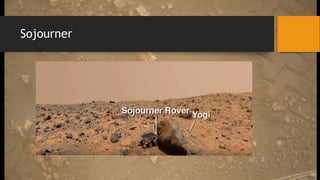
Sojourner
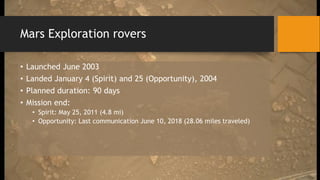
Mars Exploration rovers
• Launched June 2003
• Landed January 4 (Spirit) and 25 (Opportunity), 2004
• Planned duration: 90 days
• Mission end:
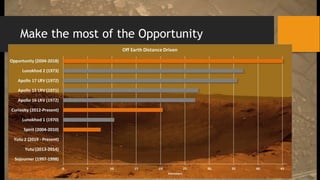
• Spirit: May 25, 2011 (4.8 mi)
• Opportunity: Last communication June 10, 2018 (28.06 miles traveled)
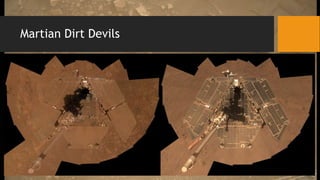
Martian Dirt Devils
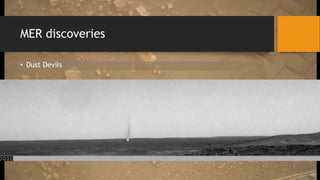
MER discoveries
• Dust Devils
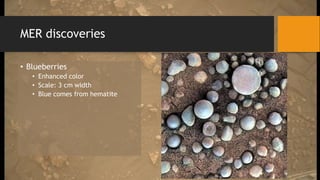
MER discoveries
• Blueberries
• Enhanced color
• Scale: 3 cm width
• Blue comes from hematite
MER discoveries
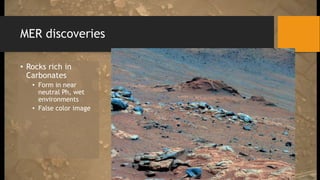
• Rocks rich in
Carbonates
• Form in near
neutral Ph, wet
environments
• False color image
MER discoveries
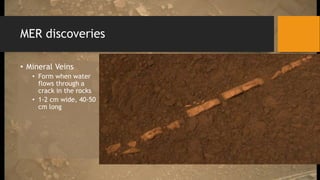
• Mineral Veins
• Form when water
flows through a
crack in the rocks
• 1-2 cm wide, 40-50
cm long
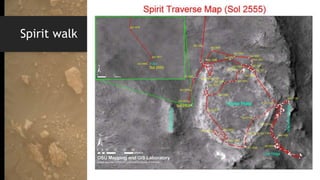
Spirit walk
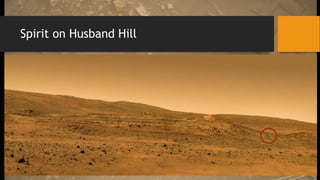
Spirit on Husband Hill
Make the most of the Opportunity
Opportunity to Travel
• Path line is same scale as
Spirit map path
Final Opportunity
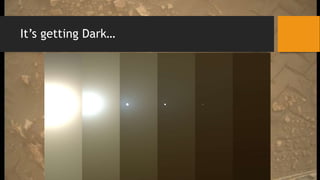
It’s getting Dark…
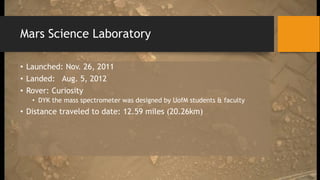
Mars Science Laboratory
• Launched: Nov. 26, 2011
• Landed: Aug. 5, 2012
• Rover: Curiosity
• DYK the mass spectrometer was designed by UofM students & faculty
• Distance traveled to date: 12.59 miles (20.26km)
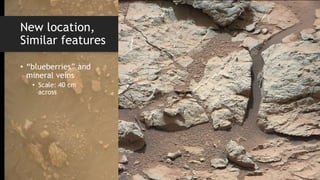
New location,
Similar features
• “blueberries” and
mineral veins
• Scale: 40 cm
across
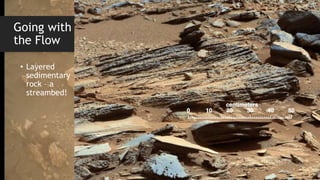
Going with
the Flow
• Layered
sedimentary
rock – a
streambed!
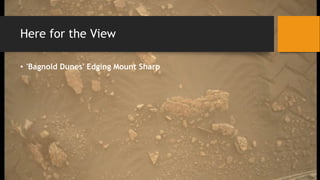
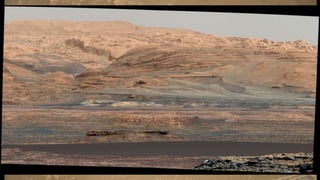
Here for the View
• 'Bagnold Dunes' Edging Mount Sharp
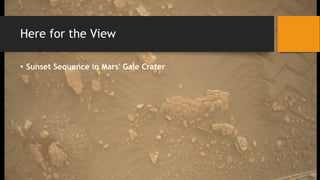
Here for the View
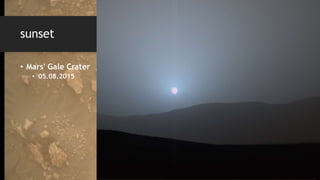
• Sunset Sequence in Mars' Gale Crater
sunset
• Mars' Gale Crater
• 05.08.2015
Curioser…
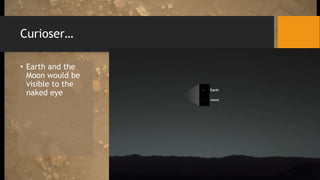
• Earth and the
Moon would be
visible to the
naked eye
And Curioser
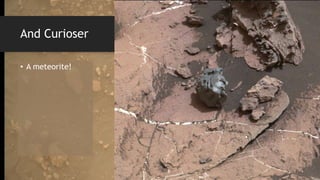
• A meteorite!
What have you
done lately?
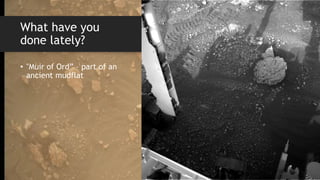
• "Muir of Ord” – part of an
ancient mudflat
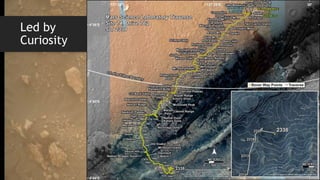
Led by
Curiosity
On Mars now
• Curiosity is still going!
• Last communication – yesterday (3/22/19) ~ 2 PM
• Insight (no roving, but lots of seismology!)
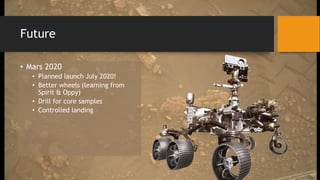
Future
• Mars 2020
• Planned launch July 2020!
• Better wheels (learning from
Spirit & Oppy)
• Drill for core samples
• Controlled landing
Explore for Yourself
• Google earth
• Mars Trek: https://trek.nasa.gov/mars/
• NASA Eyes: https://eyes.nasa.gov/
• Mars home: https://mars.nasa.gov/
• Slideshare.net/aquillam

Roving Mars 2019

Editor's Notes

  • #2 Background for Curiosity https://mars.nasa.gov/msl/multimedia/raw/?rawid=2350MD0009300000201431E01_DXXX&s=2350 Mars Descent Imager (MARDI) onboard NASA's Mars rover Curiosity on Sol 2350 (2019-03-17 23:57:35 UTC). 
  • #3 Rovers are usually part of a larger mission
  • #5 https://www.youtube.com/watch?v=9HGRReKUzfU
  • #6 https://mars.nasa.gov/mer/mission/timeline/
  • #7 https://www.jpl.nasa.gov/spaceimages/details.php?id=PIA18079 Dust devils and similar “wind events” cleaned the solar panels
  • #8 https://www.nasa.gov/mission_pages/mer/images/spirit-sol-1120.html On sol 1120 (February 26, 2007), the navigation camera aboard NASA’s Mars Exploration Rover Spirit captured one of the best dust devils it’s seen in its three-plus year mission. The series of navigation camera images were put together to make a dust devil movie.  The dust devil column is clearly defined and is clearly bent in the down wind direction. Near the end of the movie, the base of the dust devil becomes much wider. The atmospheric science team thinks that this is because the dust devil encountered some sand and therefore produced a "saltation skirt,” an apron of material that is thrown out of the dust devil because it is too large to be carried up into suspension.  Also near the end of the movie the dust devil seems to move faster across the surface. This is because Spirit began taking pictures less frequently, and not because the dust devil sped up. 
  • #9 Image takes April 19, 2004 microscopic imager on Opportunity's robotic arm https://mars.nasa.gov/resources/6944/martian-blueberries/?site=insight
  • #10 https://mars.nasa.gov/resources/4040/carbonate-containing-martian-rocks/ Comanche is the dark reddish mound above the center of the view and  is about 5 meters (16 feet) from left to right from this perspective
  • #11 https://www.nasa.gov/mission_pages/mer/news/mer20111207.html
  • #12 https://mars.nasa.gov/mer/mission/tm-spirit/images/MERA_Sol2555_1_br2.jpg Home plate is a volcanic caldera, with signs of steam vents, possibly similar to the oceanic vents on Earth
  • #13 Credit: NASA / JPL / Cornell / G. Nagle
  • #14 Credit: NASA / JPL / Cornell / G. Nagle Source http://www.planetary.org/explore/space-topics/space-missions/mer-updates/2011/05-26-mer-update.html
  • #15 Twitter: Mike Seibert‏ @mikeseibert  Feb 12
  • #16 https://mars.nasa.gov/mer/mission/tm-opportunity/opportunity-sol4997.html
  • #17 https://www.jpl.nasa.gov/spaceimages/details.php?id=PIA22909 The last pan-cam images Note tracks on right side, just over the antenna, showing where the rover came from.
  • #18 https://mars.nasa.gov/resources/21916/shades-of-martian-darkness/ Last message received from Oppy was a status report including the battery capacity and atmospheric opacity, which was summarized by a NASA engineer (could not find actual attribution) as “My batteries are low, and it’s getting dark.”
  • #19 https://mars.nasa.gov/msl/mission/overview/ http://www.sprl.umich.edu/projects/SAM/index.php
  • #20 https://mars.nasa.gov/msl/multimedia/images/?ImageID=5024
  • #21 https://mars.jpl.nasa.gov/msl/multimedia/images/?ImageID=5027 Strong Crosscutting layers = deposition by flowing water
  • #23 https://www.nasa.gov/image-feature/jpl/glimpse-of-bagnold-dunes-edging-mount-sharp
  • #25 https://mars.nasa.gov/msl/multimedia/images/?ImageID=7188 This should be an animated gif
  • #26 https://mars.nasa.gov/msl/multimedia/images/?ImageID=5970 02.06.2014 Bright 'Evening Star' Seen from Mars is Earth (Annotated) This view of the twilight sky and Martian horizon taken by NASA's Curiosity Mars rover includes Earth as the brightest point of light in the night sky. Earth is a little left of center in the image, and our moon is just below Earth. Two annotated versions of the image are also available. Researchers used the left eye camera of Curiosity's Mast Camera (Mastcam) to capture this scene about 80 minutes after sunset on the 529th Martian day, or sol, of the rover's work on Mars (Jan. 31, 2014). The image has been processed to remove effects of cosmic rays.  A human observer with normal vision, if standing on Mars, could easily see Earth and the moon as two distinct, bright "evening stars."  NASA's Jet Propulsion Laboratory, a division of the California Institute of Technology, Pasadena, manages the Mars Science Laboratory Project for NASA's Science Mission Directorate, Washington. JPL designed and built the project's Curiosity rover. Malin Space Science Systems, San Diego, built and operates the rover's Mastcam.
  • #27 https://mars.nasa.gov/resources/curiosity-rover-finds-and-examines-a-meteorite-on-mars/ November 2, 2016 The dark, smooth-surfaced object at the center of this Oct. 30, 2016, image from the Mast Camera (Mastcam) on NASA's Curiosity Mars rover was examined with laser pulses and confirmed to be an iron-nickel meteorite. The grid of shiny points visible on the object resulted from that laser zapping by Curiosity's Chemistry and Camera (ChemCam) instrument. The meteorite is about the size of a golf ball. It is informally named "Egg Rock," for a site in Maine. Locations around Bar Harbor, Maine, are the naming theme for an area on Mars' Mount Sharp that Curiosity reached in October. Iron-nickel meteorites are a common class of space rocks found on Earth, and previous examples have been found on Mars, but Egg Rock is the first on Mars to be examined with a laser-firing spectrometer. The scene is presented with a color adjustment that approximates white balancing, to resemble how the rocks and sand would appear under daytime lighting conditions on Earth. Figure A includes a scale bar of 5 centimeters (about 2 inches). Malin Space Science Systems, San Diego, built and operates Mastcam. JPL, a division of Caltech, manages the Mars Science Laboratory Project for NASA's Science Mission Directorate, Washington, and built the project's Curiosity rover. For more information about Curiosity, visit http://www.nasa.gov/msl and http://mars.nasa.gov/msl. Credit NASA/JPL-Caltech/MSSS
  • #28 https://mars.nasa.gov/msl/mission/mars-rover-curiosity-mission-updates/?mu=sols-2352-2353-why-are-we-cracking-up Pattern of cracking indicates type of mudflat (seasonal vs shoreline) Data should have come in on the March 22 downlink
  • #29 https://mars.jpl.nasa.gov/msl/mission/whereistherovernow/ Thi image was downloaded on 3/20/19
  • #30 See when the Deep Space Network is communicating with spacecraft https://eyes.nasa.gov/dsn/dsn.html Curiosity home https://mars.nasa.gov/msl/ Insight home https://mars.nasa.gov/insight/
  • #31 https://mars.nasa.gov/mars2020/