DEPARTMENT OF MECHANICAL ENGINEERING.
A TECHNICAL SEMINAR ON

                CURIOSITY ROVER

BY:
P.SAMPATH KUMAR
FINAL YEAR
(09PT1A0328)


GUIDED BY:
A.ASHWINI
(ASSISTANT PROFESSOR)
Contents:
   Introduction to Mars Exploration Rover Mission.
   Introduction to Mars Mission Laboratory.
   Introduction to Mars ROVERs.
   Different kinds of ROVERs.
   Introduction to Curiosity Rover.
   Scientific Achievement’s.
   Instruments.
   Exploration.
   Conclusion.
Introduction to Mars Exploration Rover Mission:


NASA's Mars Exploration Rover Mission (MER) is an ongoing robotic
  space mission involving rovers to explore the planet Mars.


Scientific objectives of the Mars Exploration Rover mission are:
   Search for and characterize a variety of rocks and
    soils that hold clues to past water activity.


   Characterize the mineralogy and Search for geological clues to
    the environmental conditions.


   Assess whether those environments were conducive to life.
Facts about Mars:


   Mars is one of the Terrestrial Planets, the size of Mars is much
    smaller than the size of Earth.


   The diameter of Mars is roughly half the diameter of Earth.


   We know that the mass of Mars is about one tenth the mass of
    Earth.


   This is what is expected if Mars is composed of (very) roughly the
    same constituents as Earth.
Introduction to Mars Mission Laboratory:


Mars Science Laboratory (MSL) is a robotic space probe mission
  to Mars launched by NASA on November 26, 2011.


    Which successfully landed Curiosity, a Mars rover, in Gale
    Crater on August 6, 2012.


   The rover carries a variety of scientific instruments designed by an
    international team.
Introduction to Mars Rovers:


A Mars rover is an automated motor vehicle which propels itself
  across the surface of the planet Mars after landing.


Four science goals of NASA's long-term Mars Exploration Program
  are:
   Determine whether life ever arose on Mars.
   Characterize the climate of Mars.
   Characterize the geology of Mars.
   Prepare for human exploration.
Diffrerent Kinds of Rovers:


There have been four successful robotically operated Mars rovers.:


   The Jet Propulsion Laboratory managed the Mars Pathfinder
    mission and its now inactive: Sojourner rover.


   It currently manages the Mars Exploration Rover mission's
    active Opportunity rover and inactive Spirit rover.


   And as part of the Mars Science
    Laboratory mission, the Curiosity rover.
Rovers have several advantages:


   They examine more territory.


   They can be directed to interesting features.


   They can place themselves in sunny positions to weather winter
    months.


   And they can advance the knowledge of how to perform very
    remote robotic vehicle control.
Introduction to Curiosity Rover:


   Landed on Mars on August 6, 2012.


   Landed in the Aeolis Palus in Gale Crater .


   launched from Cape Canaveral
    November 26, 2011.


   Picture – Curiosity’s launch patch.
Introduction to Curiosity Rover:


   Mission name: Mars Science Laboratory.
About Curiosity Rover:


Launched: Cape Canaveral ,           Landed: Aeolis Palus in Gale Crater
on Mars,                                              7:02 a.m., Nov.
26, 2011        10:32 p.m. , Aug. 5, 2012
About Curiosity Rover:


   Rover name: Curiosity rover.
   Size: About the size of a small SUV -- 10 feet long, 9 feet wide and
    7 feet tall.
About Curiosity Rover:


 Features: Geology lab, rocker-bogie suspension, rock-vaporizing laser
and lots of cameras
 Mission: To search areas of Mars for past or present conditions
favorable for life, and conditions capable of preserving a record of life
Length of mission on Mars: The prime mission will last one Mars year
or about 23 Earth months.
   Arm Reach: About 7 feet (2.2 meters).
   Weight: 900 kilograms (2,000 pounds).
About Curiosity Rover:


   The Mars Rover is built of a variety of different materials with
    different functions.


   The "skeleton" of the rover consists of the body-shell. This body
    shell is made of an aluminum alloy.


   The Teflon or Kapton isolated copper cables resides in this body-
    shell.


   wheel suspension and wheels are made from aluminum alloys with
    fittings made of titanium where ever they are needed.
About Curiosity Rover:


   Power source: Curiosity is powered by a radioisotope
    thermoelectric generator (RTG), Radioisotope power systems
    (RPSs) are generators that produce electricity from the decay
    of radioactive isotopes, such as plutonium-238.


   Communications: Curiosity is equipped with significant
    telecommunication redundancy by several means – an X
    band transmitter and receiver that can communicate directly with
    Earth, and a UHF Electra-Lite software-defined radio for
    communicating with Mars orbiters.
About Curiosity Rover:


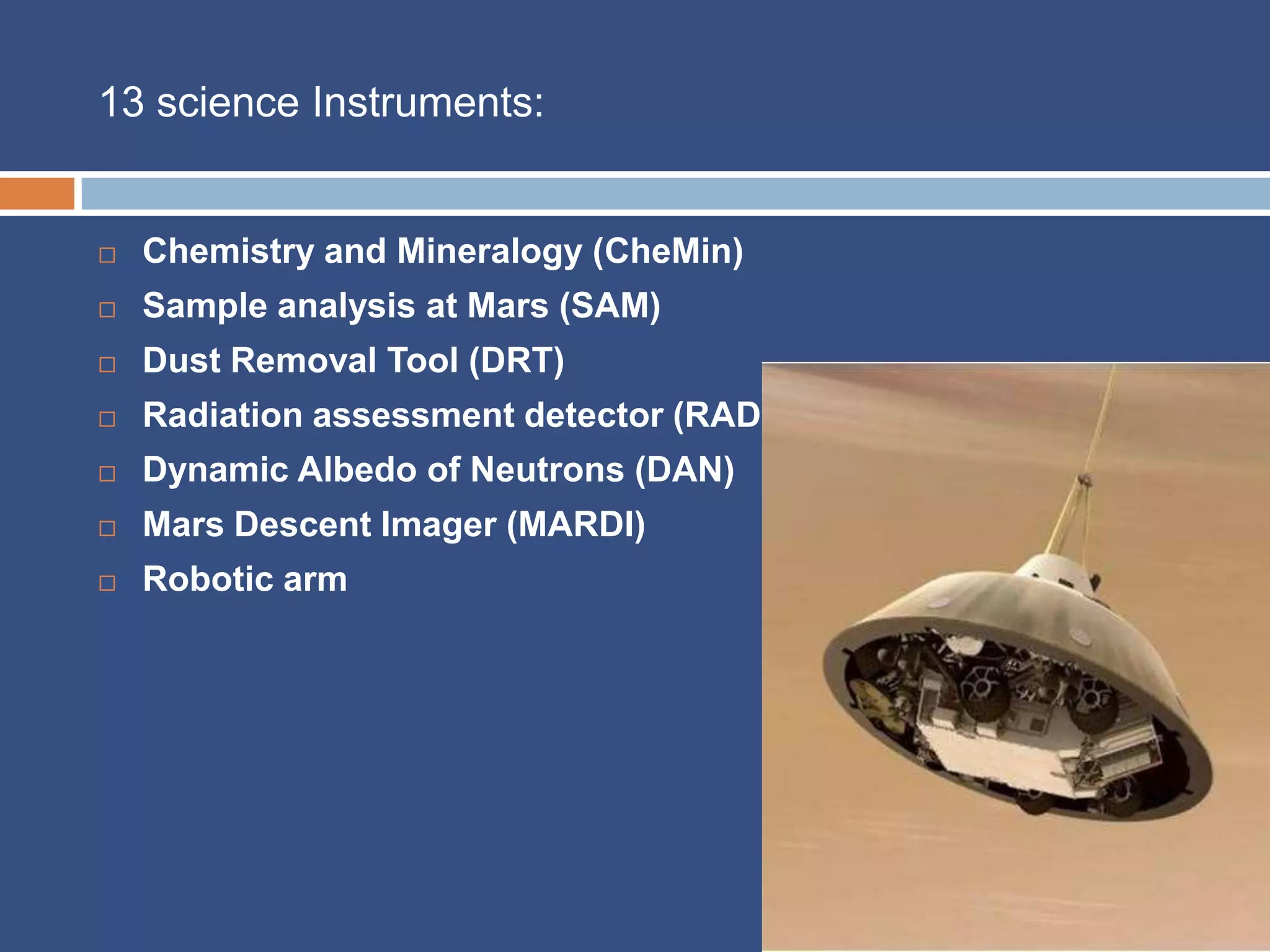
To get to Mars, Curiosity will travel safely tucked inside a Aerospace
   shell.


Cruise stage: Propulsion systems.
Back shell: Parachute systems
Descent stage: Will provide rocket-powered
deceleration to prepare for the rover to
touch down on the surface of mars.
Heat Shield: Will protect rover from heat that
occurs due to the friction of atmosphere.
About Curiosity Rover:


Landing sequence:
About Curiosity Rover:


    Curiosity carries mainly13 science instruments with a total
     mass 15 times as large as Mars rovers Spirit and Opportunity


    Some of the tools are the first of their kind on Mars.


    The rover will use a drill and scoop at the end of its robotic arm
     to gather soil and powdered samples of rock interiors, then
     sieve and parcel out these samples into analytical laboratory
     instruments inside the rover
Purpose of Curiosity Rover:


   Biological: Inventory of organic carbon compounds and building
    blocks of life.


   Geological and geochemical: Investigate the
    chemical, isotopic, mineralogical composition and modified rocks
    and soils.


   Planetary process: Martian atmospheric evolution
    processes, determine cycling of water and carbon dioxide.


   Surface radiation: Characterize the broad spectrum of surface
    radiation.
13 science Instruments:


   Mast Camera (MastCam)
   Chemistry and Camera complex (ChemCam)
   Navigation cameras (navcams)
   Rover Environmental Monitoring Station (REMS)
   Hazard avoidance cameras (hazcams)
   Mars Hand Lens Imager (MAHLI)
   Alpha Particle X-ray Spectrometer (APXS)
13 science Instruments:


   Chemistry and Mineralogy (CheMin)
   Sample analysis at Mars (SAM)
   Dust Removal Tool (DRT)
   Radiation assessment detector (RAD)
   Dynamic Albedo of Neutrons (DAN)
   Mars Descent Imager (MARDI)
   Robotic arm
Instrument Location diagram:
The Exploration now:


   The exploration is on going.


   There is no way of telling how long the
    rovers will last .


   Scientists collect information everyday that
    help us to know more about Mars.
Conclusion: What we have learned


   Although nothing is proven we can be sure that there is a good
    chance that Mars had a wet past.

   Some say Mars will be inhabitable in the future.

   Has helped us to learn more about space and exploration.
THANK YOU!


Curiosity Rover   By: P.Sampath
Kumar

Curiosity rover

  • 1.
  • 2.
    A TECHNICAL SEMINARON CURIOSITY ROVER BY: P.SAMPATH KUMAR FINAL YEAR (09PT1A0328) GUIDED BY: A.ASHWINI (ASSISTANT PROFESSOR)
  • 3.
    Contents:  Introduction to Mars Exploration Rover Mission.  Introduction to Mars Mission Laboratory.  Introduction to Mars ROVERs.  Different kinds of ROVERs.  Introduction to Curiosity Rover.  Scientific Achievement’s.  Instruments.  Exploration.  Conclusion.
  • 4.
    Introduction to MarsExploration Rover Mission: NASA's Mars Exploration Rover Mission (MER) is an ongoing robotic space mission involving rovers to explore the planet Mars. Scientific objectives of the Mars Exploration Rover mission are:  Search for and characterize a variety of rocks and soils that hold clues to past water activity.  Characterize the mineralogy and Search for geological clues to the environmental conditions.  Assess whether those environments were conducive to life.
  • 5.
    Facts about Mars:  Mars is one of the Terrestrial Planets, the size of Mars is much smaller than the size of Earth.  The diameter of Mars is roughly half the diameter of Earth.  We know that the mass of Mars is about one tenth the mass of Earth.  This is what is expected if Mars is composed of (very) roughly the same constituents as Earth.
  • 6.
    Introduction to MarsMission Laboratory: Mars Science Laboratory (MSL) is a robotic space probe mission to Mars launched by NASA on November 26, 2011.  Which successfully landed Curiosity, a Mars rover, in Gale Crater on August 6, 2012.  The rover carries a variety of scientific instruments designed by an international team.
  • 7.
    Introduction to MarsRovers: A Mars rover is an automated motor vehicle which propels itself across the surface of the planet Mars after landing. Four science goals of NASA's long-term Mars Exploration Program are:  Determine whether life ever arose on Mars.  Characterize the climate of Mars.  Characterize the geology of Mars.  Prepare for human exploration.
  • 8.
    Diffrerent Kinds ofRovers: There have been four successful robotically operated Mars rovers.:  The Jet Propulsion Laboratory managed the Mars Pathfinder mission and its now inactive: Sojourner rover.  It currently manages the Mars Exploration Rover mission's active Opportunity rover and inactive Spirit rover.  And as part of the Mars Science Laboratory mission, the Curiosity rover.
  • 9.
    Rovers have severaladvantages:  They examine more territory.  They can be directed to interesting features.  They can place themselves in sunny positions to weather winter months.  And they can advance the knowledge of how to perform very remote robotic vehicle control.
  • 10.
    Introduction to CuriosityRover:  Landed on Mars on August 6, 2012.  Landed in the Aeolis Palus in Gale Crater .  launched from Cape Canaveral November 26, 2011.  Picture – Curiosity’s launch patch.
  • 11.
    Introduction to CuriosityRover:  Mission name: Mars Science Laboratory.
  • 12.
    About Curiosity Rover: Launched:Cape Canaveral , Landed: Aeolis Palus in Gale Crater on Mars, 7:02 a.m., Nov. 26, 2011 10:32 p.m. , Aug. 5, 2012
  • 13.
    About Curiosity Rover:  Rover name: Curiosity rover.  Size: About the size of a small SUV -- 10 feet long, 9 feet wide and 7 feet tall.
  • 14.
    About Curiosity Rover: Features: Geology lab, rocker-bogie suspension, rock-vaporizing laser and lots of cameras  Mission: To search areas of Mars for past or present conditions favorable for life, and conditions capable of preserving a record of life Length of mission on Mars: The prime mission will last one Mars year or about 23 Earth months.  Arm Reach: About 7 feet (2.2 meters).  Weight: 900 kilograms (2,000 pounds).
  • 15.
    About Curiosity Rover:  The Mars Rover is built of a variety of different materials with different functions.  The "skeleton" of the rover consists of the body-shell. This body shell is made of an aluminum alloy.  The Teflon or Kapton isolated copper cables resides in this body- shell.  wheel suspension and wheels are made from aluminum alloys with fittings made of titanium where ever they are needed.
  • 16.
    About Curiosity Rover:  Power source: Curiosity is powered by a radioisotope thermoelectric generator (RTG), Radioisotope power systems (RPSs) are generators that produce electricity from the decay of radioactive isotopes, such as plutonium-238.  Communications: Curiosity is equipped with significant telecommunication redundancy by several means – an X band transmitter and receiver that can communicate directly with Earth, and a UHF Electra-Lite software-defined radio for communicating with Mars orbiters.
  • 17.
    About Curiosity Rover: Toget to Mars, Curiosity will travel safely tucked inside a Aerospace shell. Cruise stage: Propulsion systems. Back shell: Parachute systems Descent stage: Will provide rocket-powered deceleration to prepare for the rover to touch down on the surface of mars. Heat Shield: Will protect rover from heat that occurs due to the friction of atmosphere.
  • 18.
  • 19.
    About Curiosity Rover:  Curiosity carries mainly13 science instruments with a total mass 15 times as large as Mars rovers Spirit and Opportunity  Some of the tools are the first of their kind on Mars.  The rover will use a drill and scoop at the end of its robotic arm to gather soil and powdered samples of rock interiors, then sieve and parcel out these samples into analytical laboratory instruments inside the rover
  • 20.
    Purpose of CuriosityRover:  Biological: Inventory of organic carbon compounds and building blocks of life.  Geological and geochemical: Investigate the chemical, isotopic, mineralogical composition and modified rocks and soils.  Planetary process: Martian atmospheric evolution processes, determine cycling of water and carbon dioxide.  Surface radiation: Characterize the broad spectrum of surface radiation.
  • 21.
    13 science Instruments:  Mast Camera (MastCam)  Chemistry and Camera complex (ChemCam)  Navigation cameras (navcams)  Rover Environmental Monitoring Station (REMS)  Hazard avoidance cameras (hazcams)  Mars Hand Lens Imager (MAHLI)  Alpha Particle X-ray Spectrometer (APXS)
  • 22.
    13 science Instruments:  Chemistry and Mineralogy (CheMin)  Sample analysis at Mars (SAM)  Dust Removal Tool (DRT)  Radiation assessment detector (RAD)  Dynamic Albedo of Neutrons (DAN)  Mars Descent Imager (MARDI)  Robotic arm
  • 23.
  • 24.
    The Exploration now:  The exploration is on going.  There is no way of telling how long the rovers will last .  Scientists collect information everyday that help us to know more about Mars.
  • 25.
    Conclusion: What wehave learned  Although nothing is proven we can be sure that there is a good chance that Mars had a wet past.  Some say Mars will be inhabitable in the future.  Has helped us to learn more about space and exploration.
  • 26.
    THANK YOU! Curiosity Rover By: P.Sampath Kumar