Martian Rovers and Landers
•
•
•
•
•
•
•

Viking 1
Viking 2
Mars Pathfinder and Sojourner Rover
Spirit Rover
Opportunity Rover
Phoenix Lander
Curiosity Rover
Viking 1 & 2
• Performed chemical analysis
• The reaction between the iron rich soil and
atmospheric Oxygen make iron oxide which
gives Mars its color
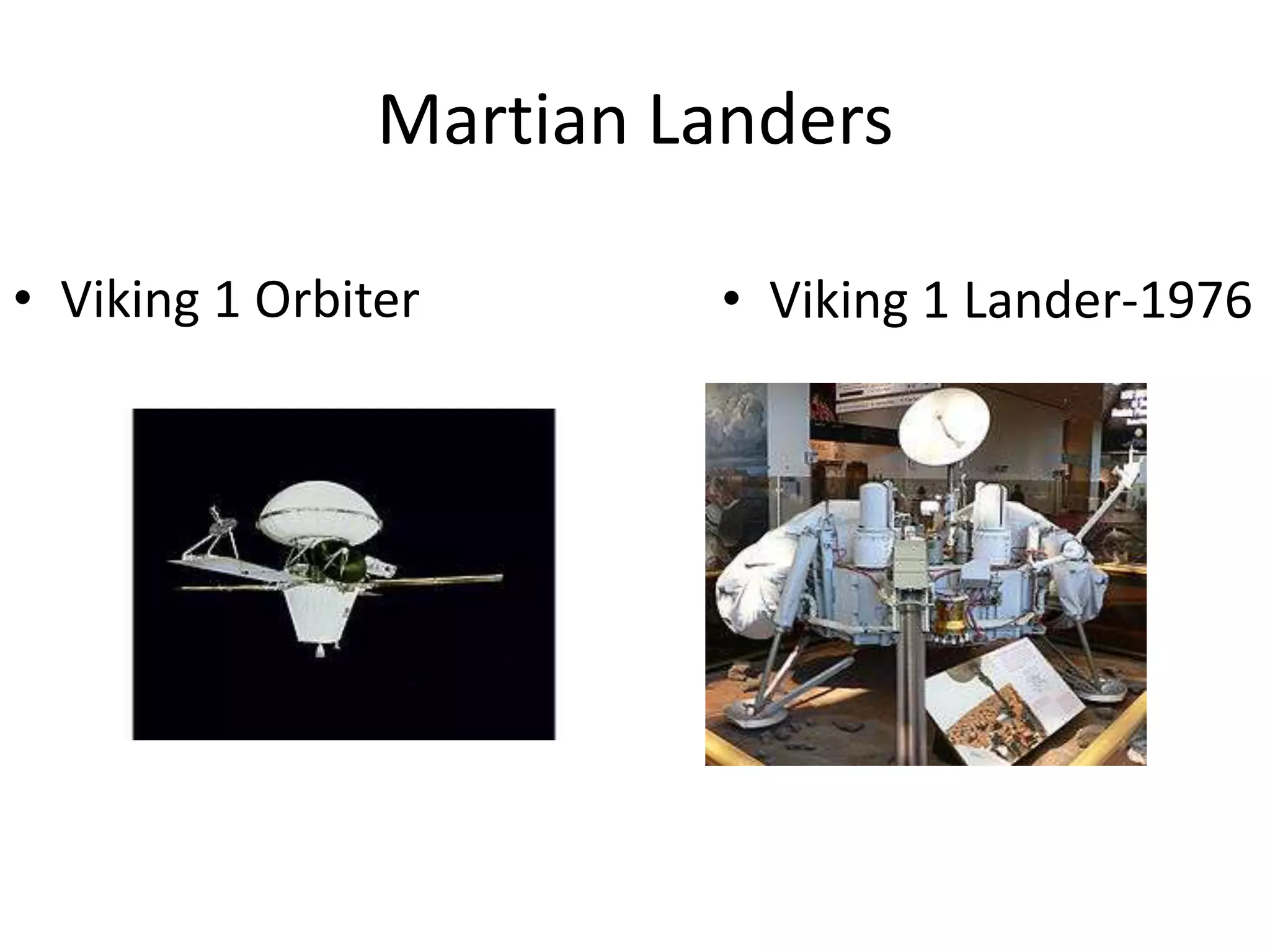
Martian Landers
• Viking 1 Orbiter

• Viking 1 Lander-1976
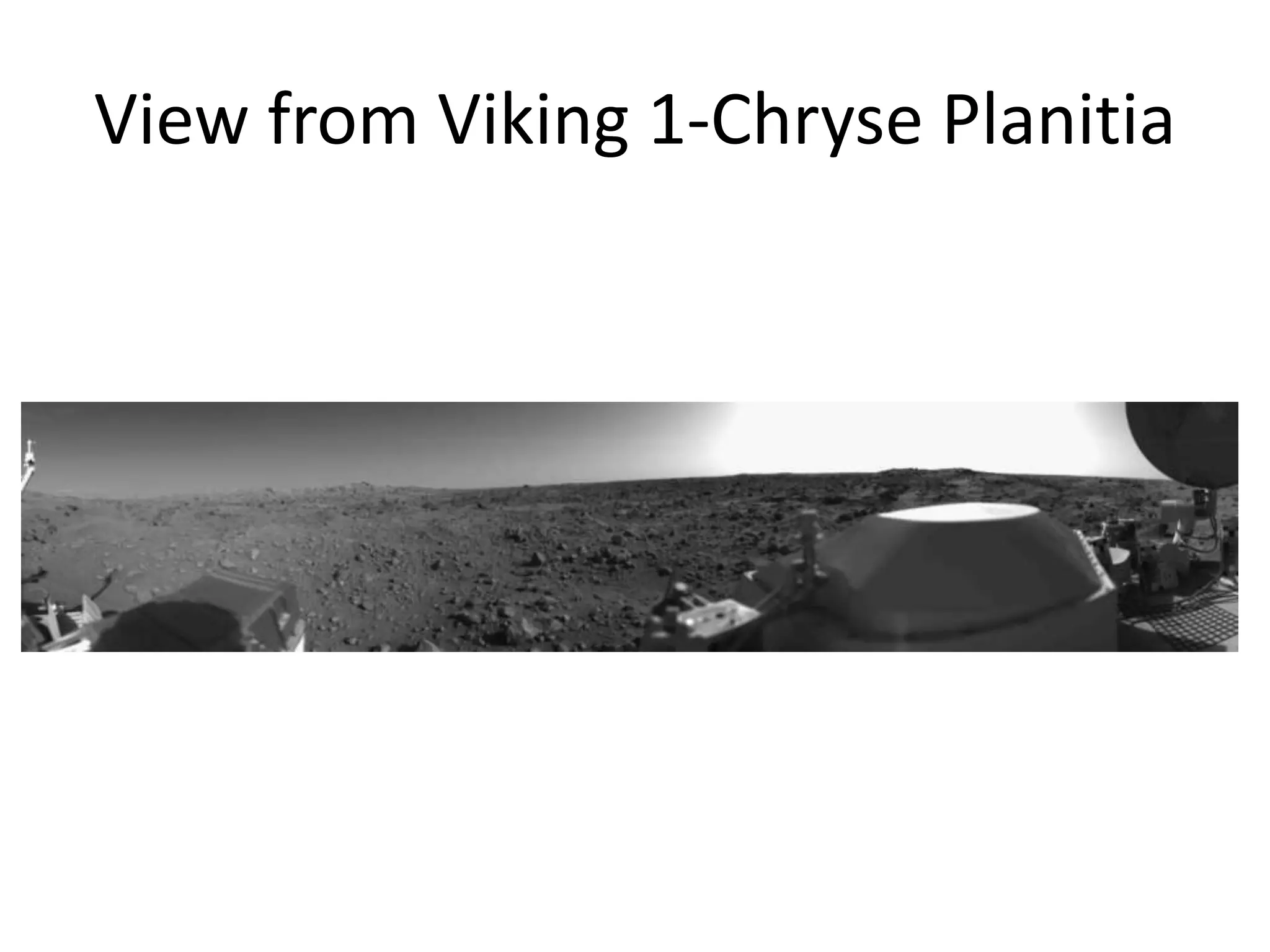
View from Viking 1-Chryse Planitia
Viking Mission
Viking 1
• Launch Date: Aug 20, 1975
• Orbital insertion: June 19,
1976
• Lander reached surface July
20, 1976-Chryse Planitia
• Mission Duration Aug 20,
1975 thru Nov 11, 1982
• Imaged in 2006 on the
surface of Mars by MRO

Lander Scientific Equipment
• 2 cameras
• Analysis tools
– Metabolic
– Photosynthetic
– *Gas-chromatograph mass
spectrometer- identifies
substances in a soil sample
– X-ray fluorescence
spectrometer
– Pressure, temperature, wind
velocity sensor
– A 3 axis seismometer
– Various engineering sensors
Viking 1 Soil Analysis Results
• Soil contained
–
–
–
–
–
–
–
–
–
–

Silicon
Iron
Magnesium
Aluminum
Sulfur
Chlorine
Calcium
Titanium
Potassium
Trace amounts of
• Strontium
• yttrium

• The sulfur and chlorine are
likely the result of
evaporating sea water
• All soil samples heated in
the GCMS gave off water
vapor
• Search for life
– One experiment gave a
positive result for life
– DEBATED to this day!!
– Antarctica’s dry areas have no
detectable organic
compounds-but there are
organisms living in the rocks
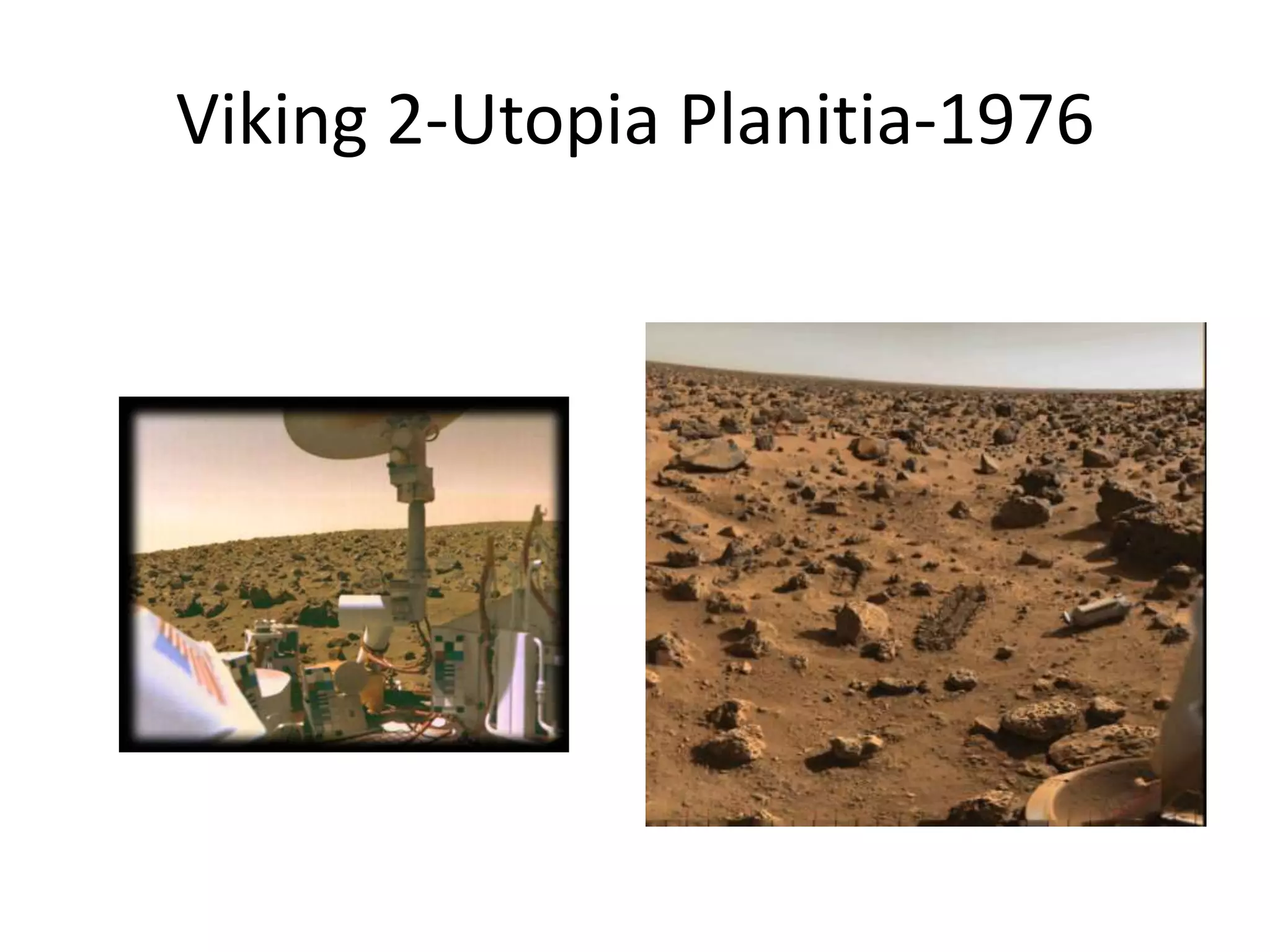
Viking 2-Utopia Planitia-1976
Viking Mission
Viking 2
• Launched Sept 9, 1975
• Orbital insertion August 7,
1976
• Lander reached surface
Sept 3, 1976
• Mission duration Sept
9,1975 thru April 11, 1980

Lander Scientific Equipment
• 2 cameras
• Sampler arm with collector
• Temperature sensor, wind
velocity sensor
• Magnet
• Seismometer
• *High gain antenna-sends info
from the lander/rover to the
orbiter and then back to Earth
• X-ray fluorescence
spectrometer
• Pressure sensor
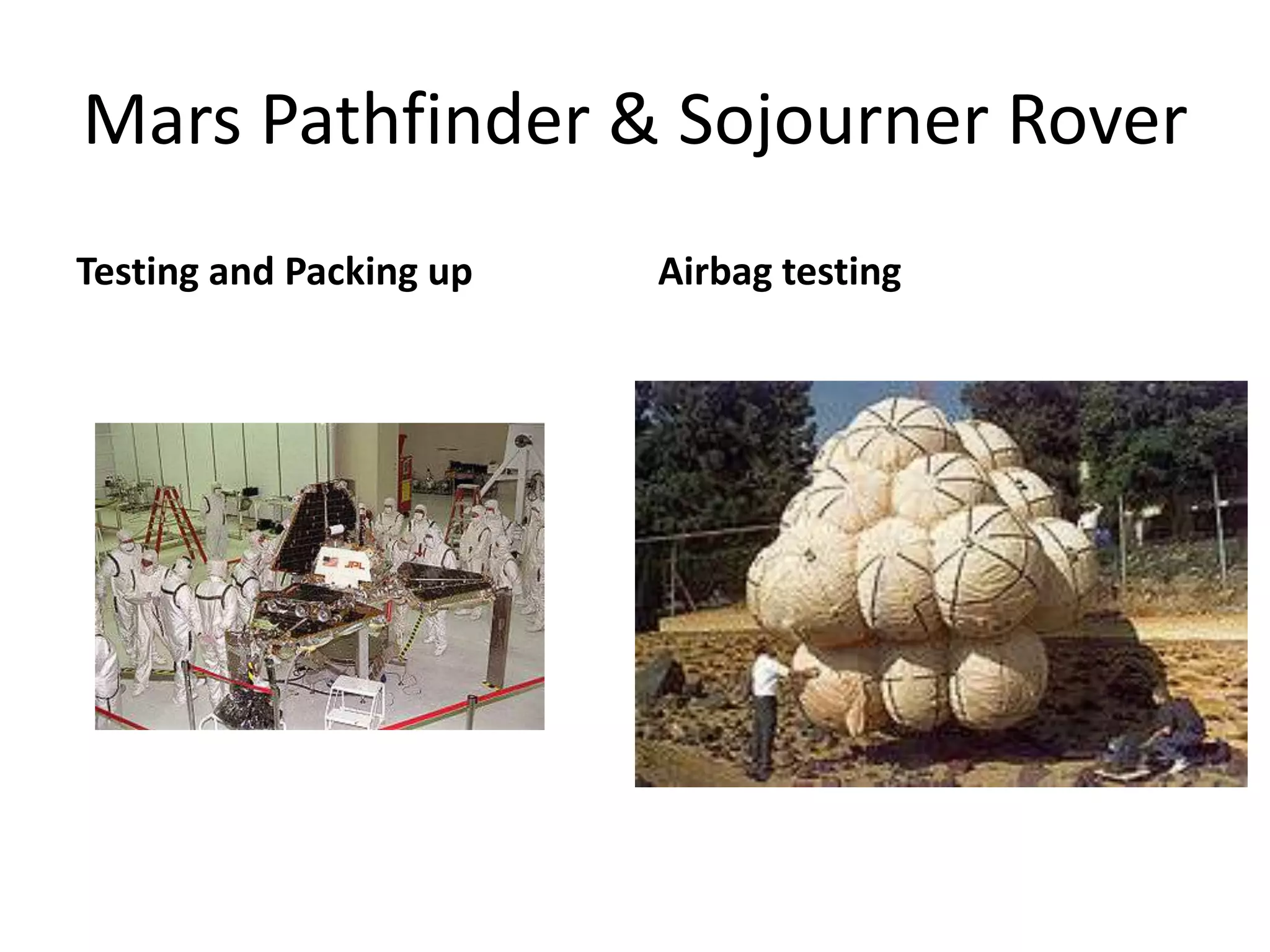
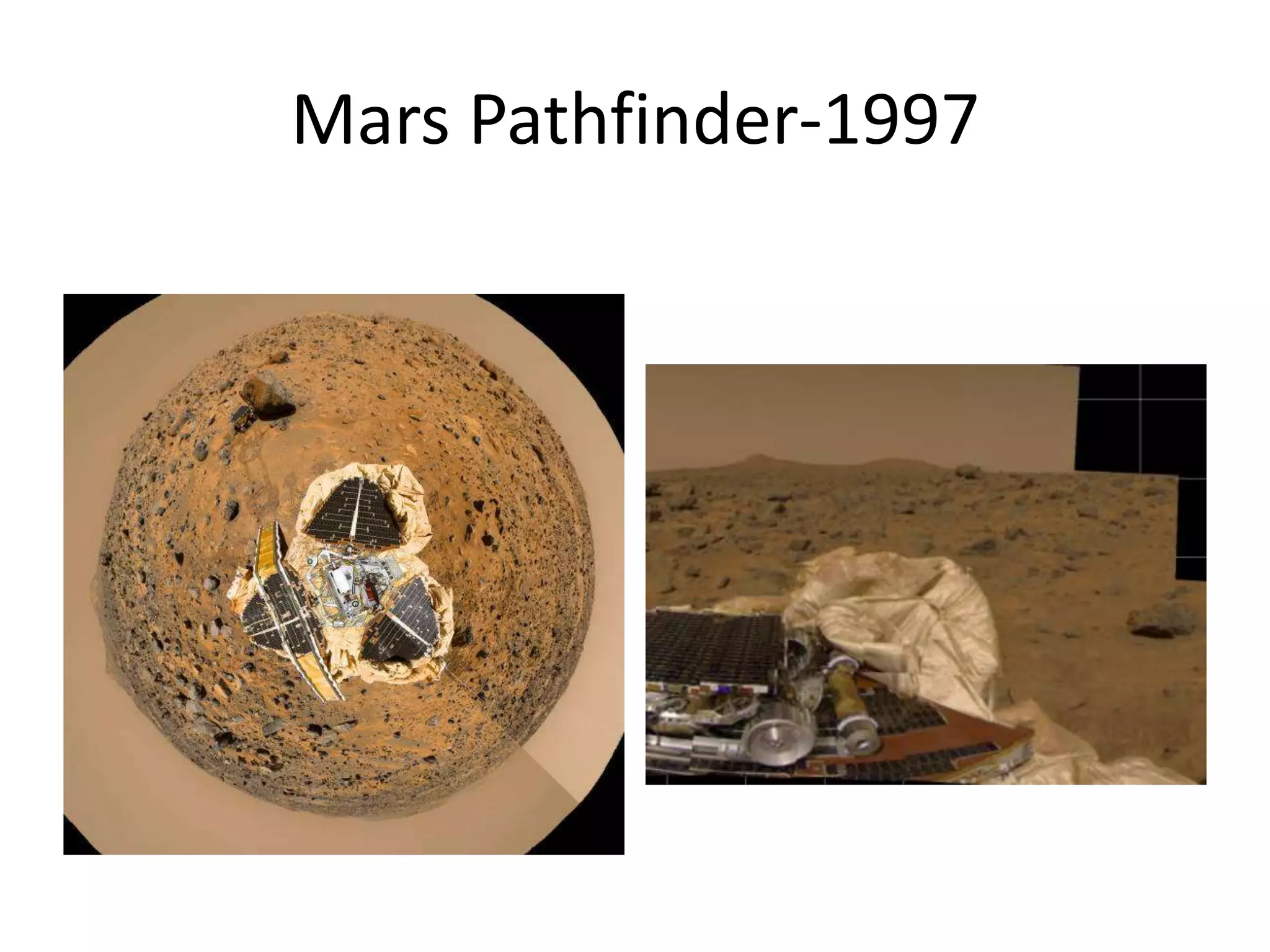
Mars Pathfinder & Sojourner Rover
Testing and Packing up

Airbag testing
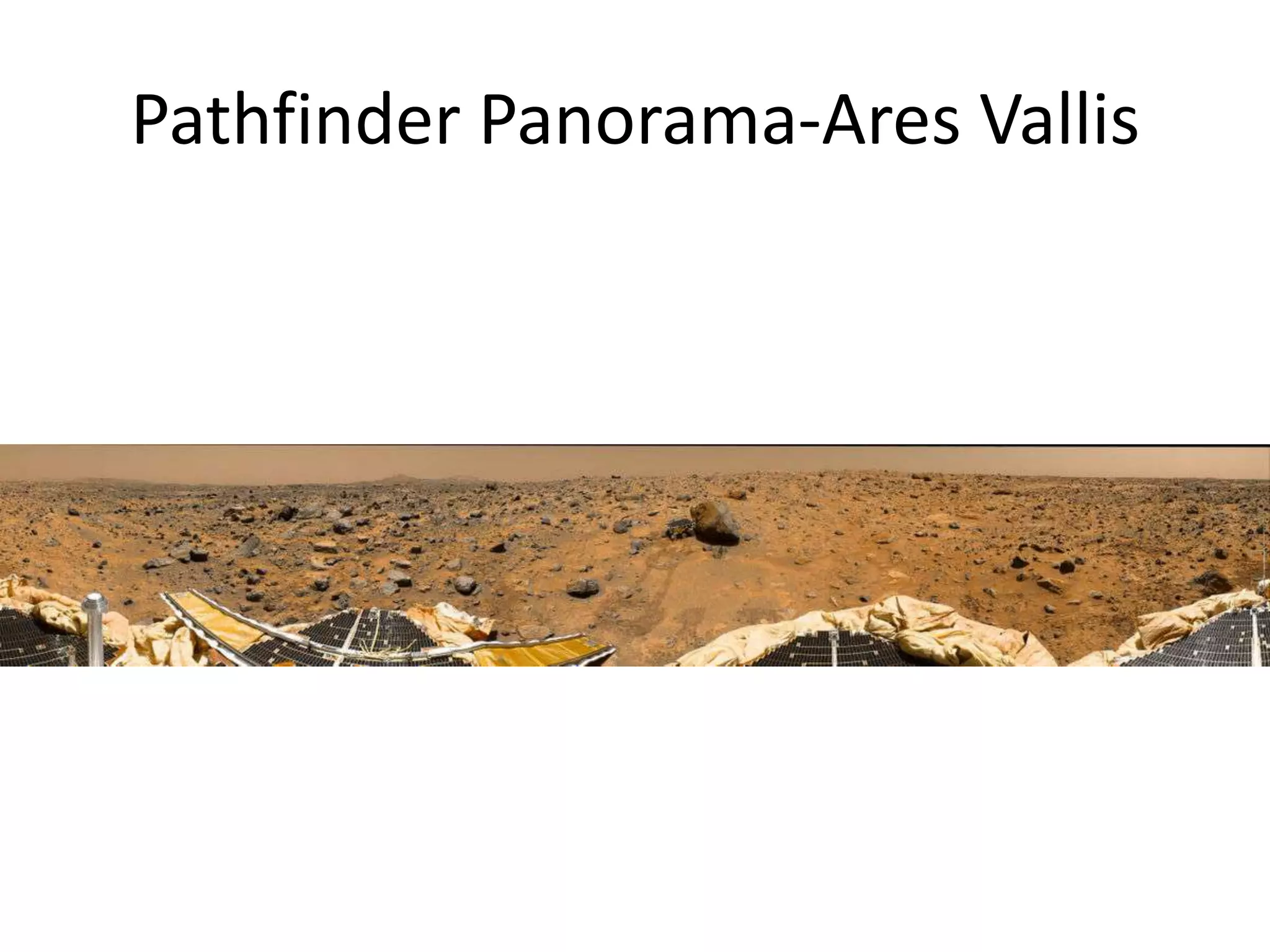
Mars Pathfinder-1997
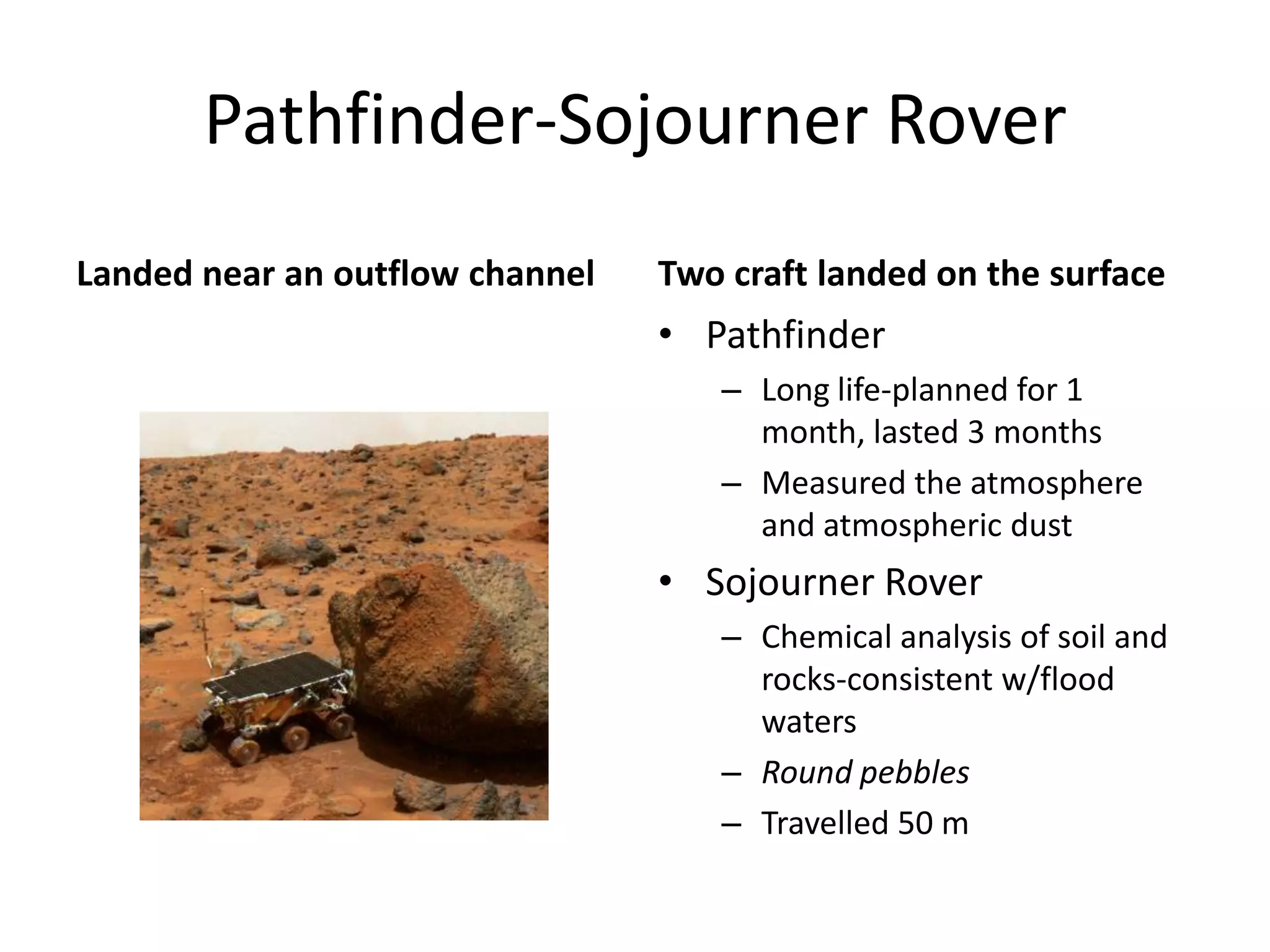
Pathfinder Panorama-Ares Vallis
Pathfinder-Sojourner Rover
Landed near an outflow channel

Two craft landed on the surface

• Pathfinder
– Long life-planned for 1
month, lasted 3 months
– Measured the atmosphere
and atmospheric dust

• Sojourner Rover
– Chemical analysis of soil and
rocks-consistent w/flood
waters
– Round pebbles
– Travelled 50 m
Mars Pathfinder (lander)
• Launch date Dec 4, 1996
• Landed July 4, 1997
• Used the airbag
touchdown
• Consisted of a Lander and
a Rover
• Mission ended Sept 27,
1997
• MRO photographed the
Pathfinder from orbit

• Scientific instruments
– Camera
– Meteorology package
– X-ray Spectrometer

• These instruments
measured:
– Geology
– Geochemistry
– Magnetic and mechanical
properties
– Atmosphere and rotational
dynamics
More Pathfinder results
• Atmospheric particle size= 1 μm (1 millionth of
a meter)
• Soil test indicated a warmer and wetter past
• Magnets determined soil contained
maghemite (not pure magnetite)
• Using Doppler it was determined the core is
solid
Scientific equipment

Findings

• 3 cameras
• Confirmed previous volcanic activity
• Laser striper hazard detection
• Found basaltic rock
system
• Found elements:
• X-ray spectrometer
– Silicon
•

Sojourner Rover (climbed off
– Examines chemical
– Magnesium iron silicate
composition of soil
Pathfinder) ***First rover to be
– Aluminum silicates of
Accelerometers
deployed on another planet***
– Measures proper acceleration

• Potentiometers
– Controls and measures
electrical devices

• Potassium
• Sodium
• Calcium

–
–
–
–

Quartz (silicon dioxide)
Magnetite
Iron sulfide
Calcium phosphates
Magnetite on the Surface of Mars
• Magnetite was an important find on the surface
of Mars because:
– Magnetite (Fe3 O4 )

• can be broken down into FeO. Fe2O3
• one part wustite and one part hematite
• hematite is only formed in the presence of water

– Magnetite is known to be (on Earth) in bacteria,
brains of bees, termites, fish, mollusc teeth, some
birds, and humans
• Used to detect polarity or the inclination of the Earth’s
magnetic field
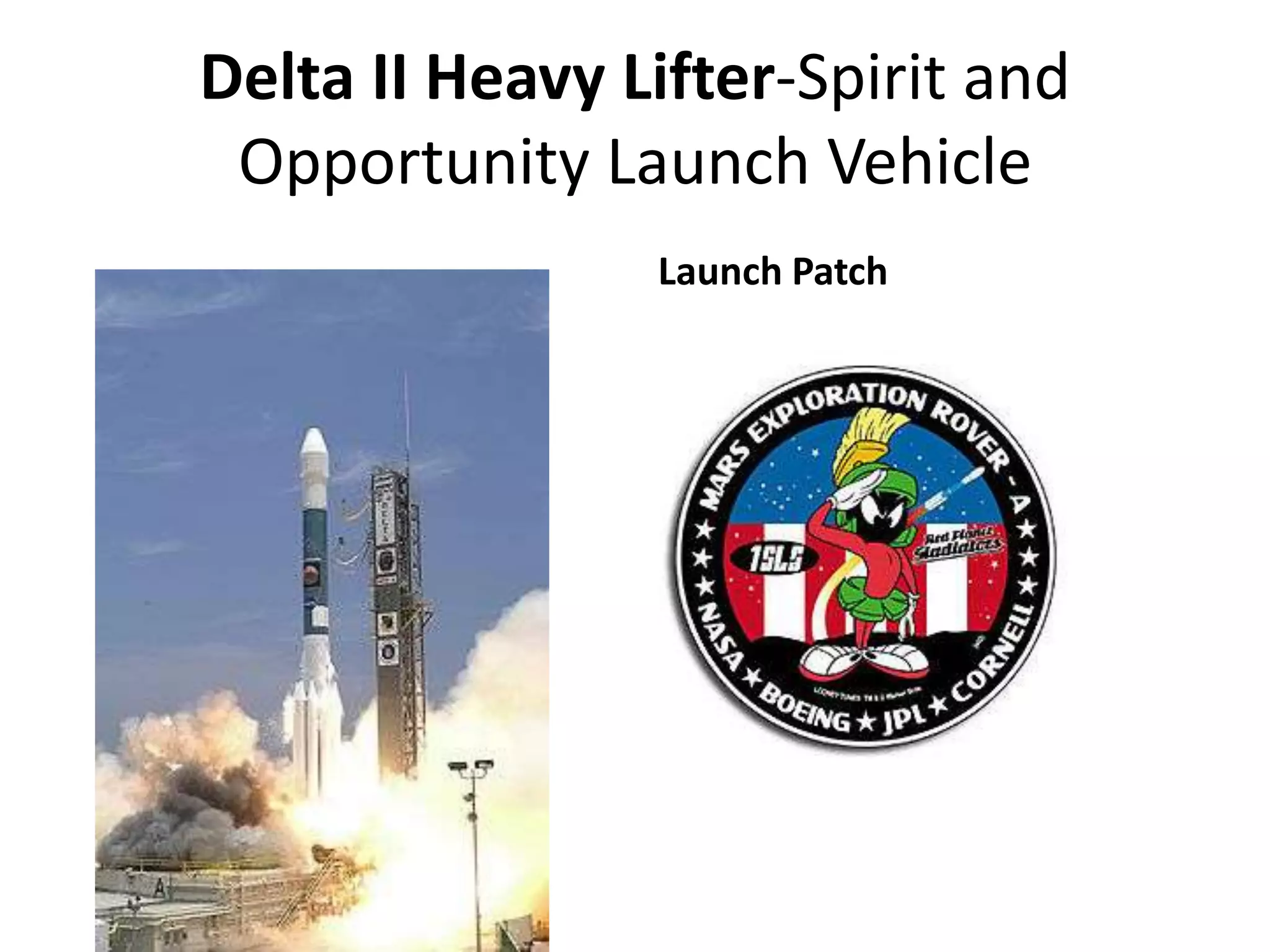
Delta II Heavy Lifter-Spirit and
Opportunity Launch Vehicle
Launch Patch
http://www.youtube.com/watch?v=tm
a2pt0k6UQ
•

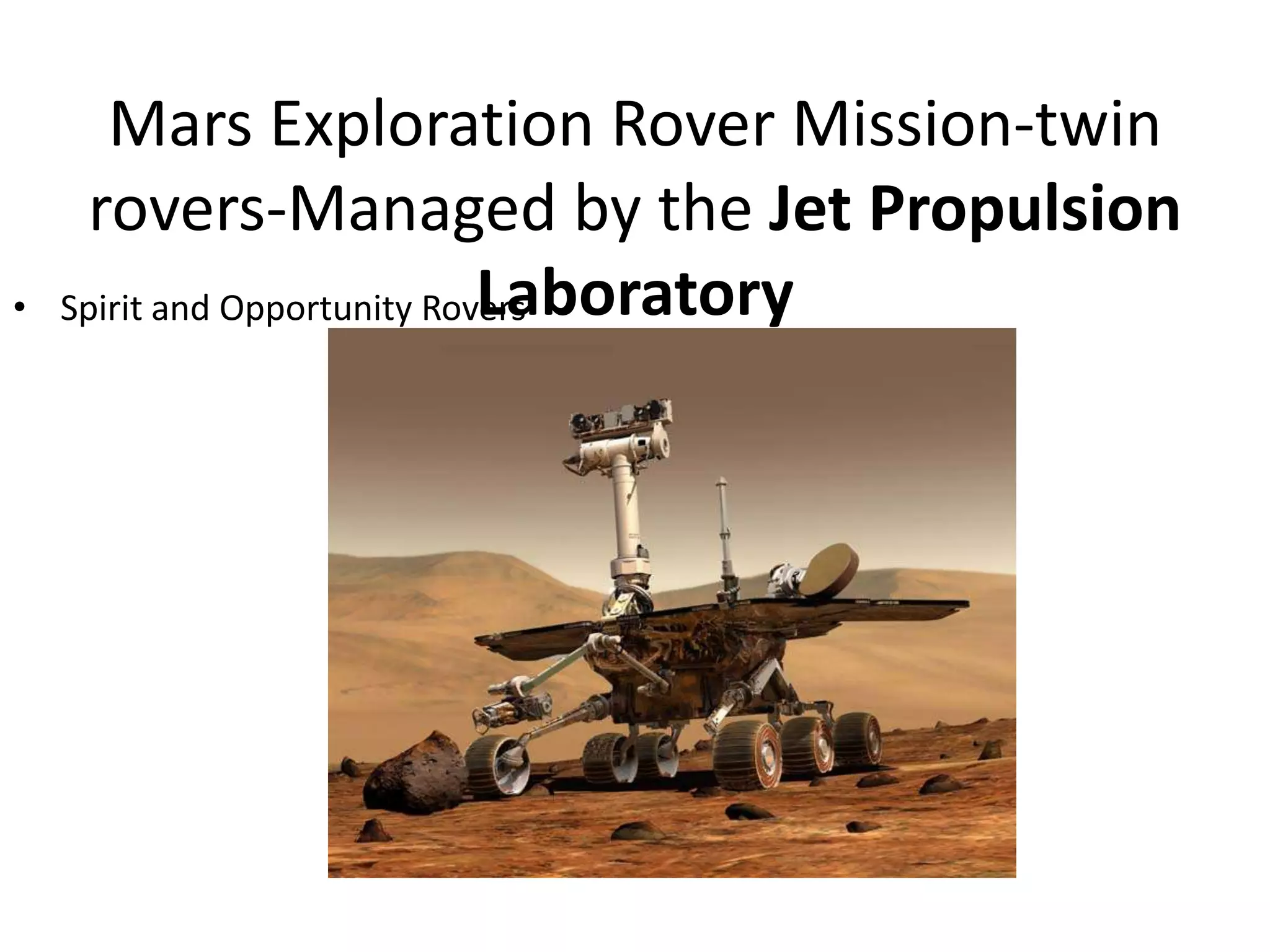
Mars Exploration Rover Mission-twin
rovers-Managed by the Jet Propulsion
Laboratory
Spirit and Opportunity Rovers
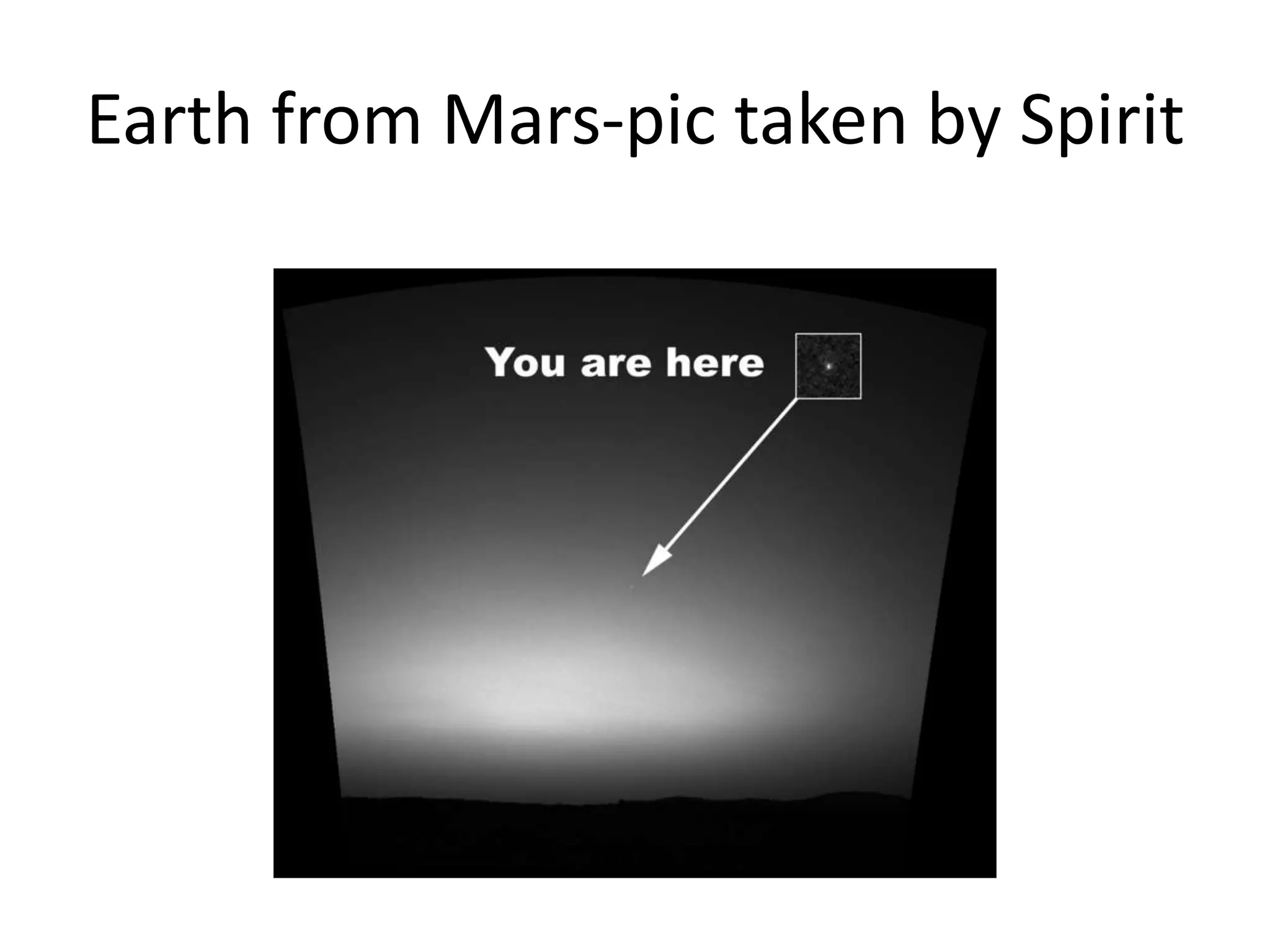
Earth from Mars-pic taken by Spirit
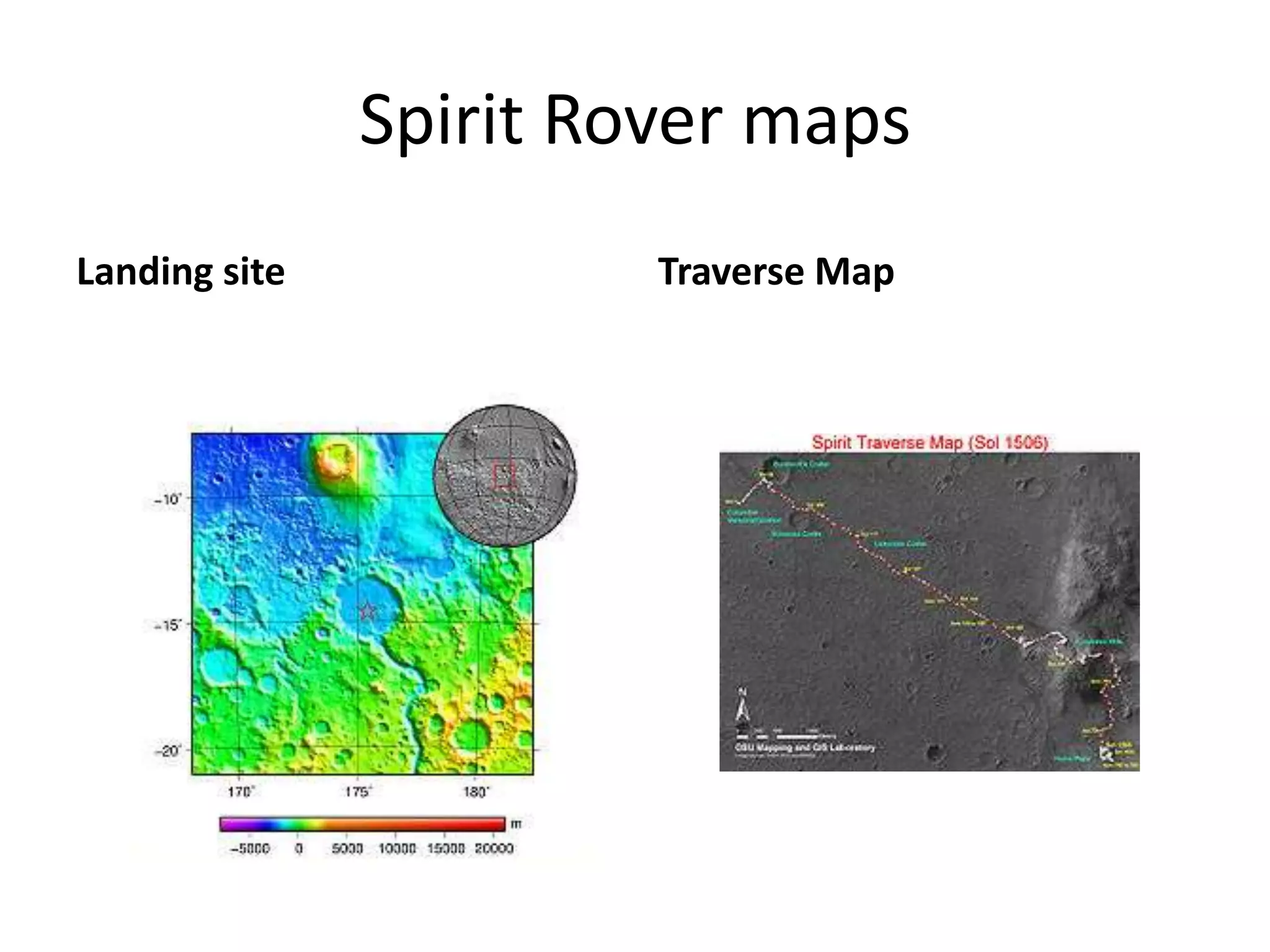
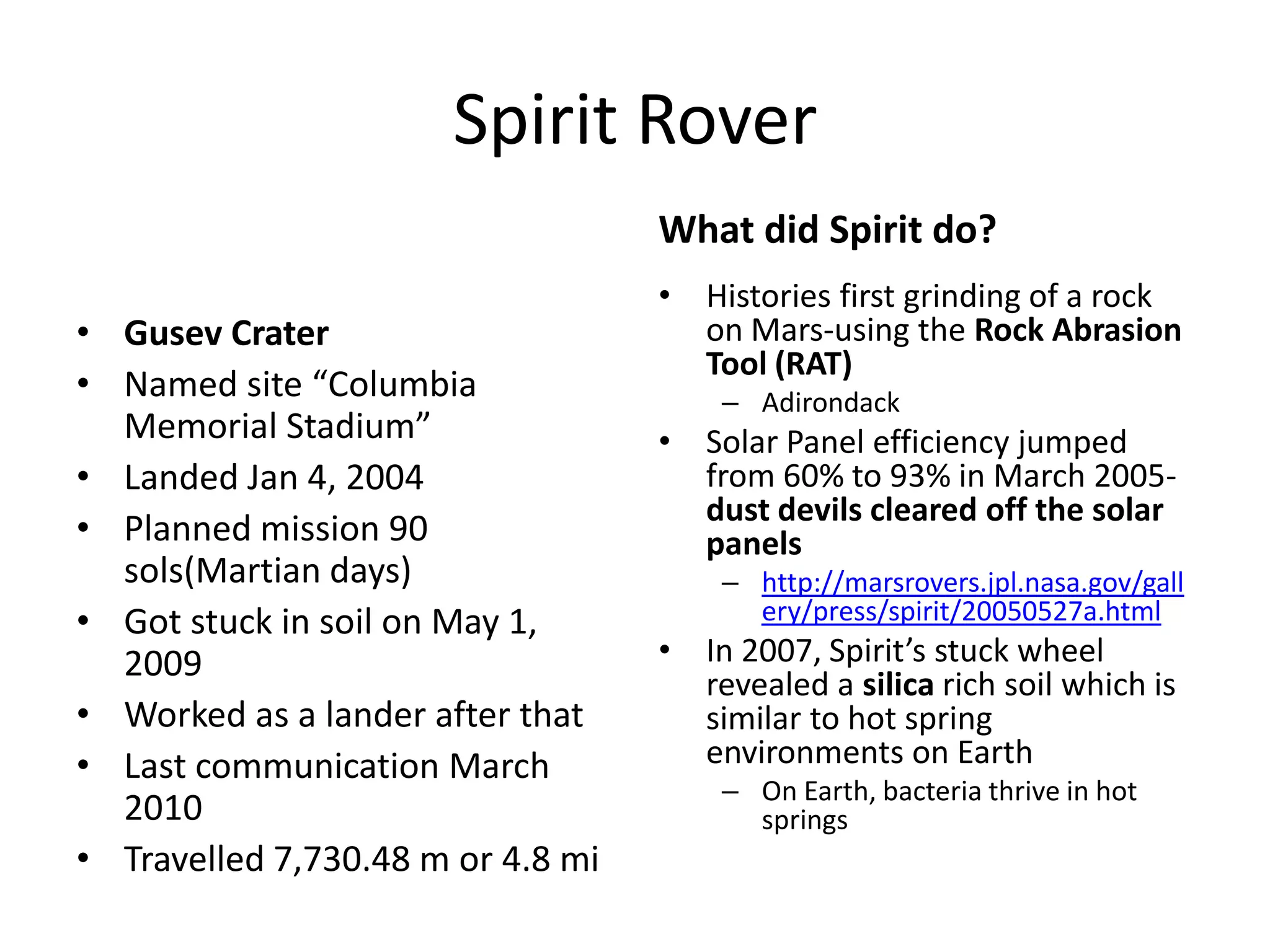
Spirit Rover maps
Landing site

Traverse Map
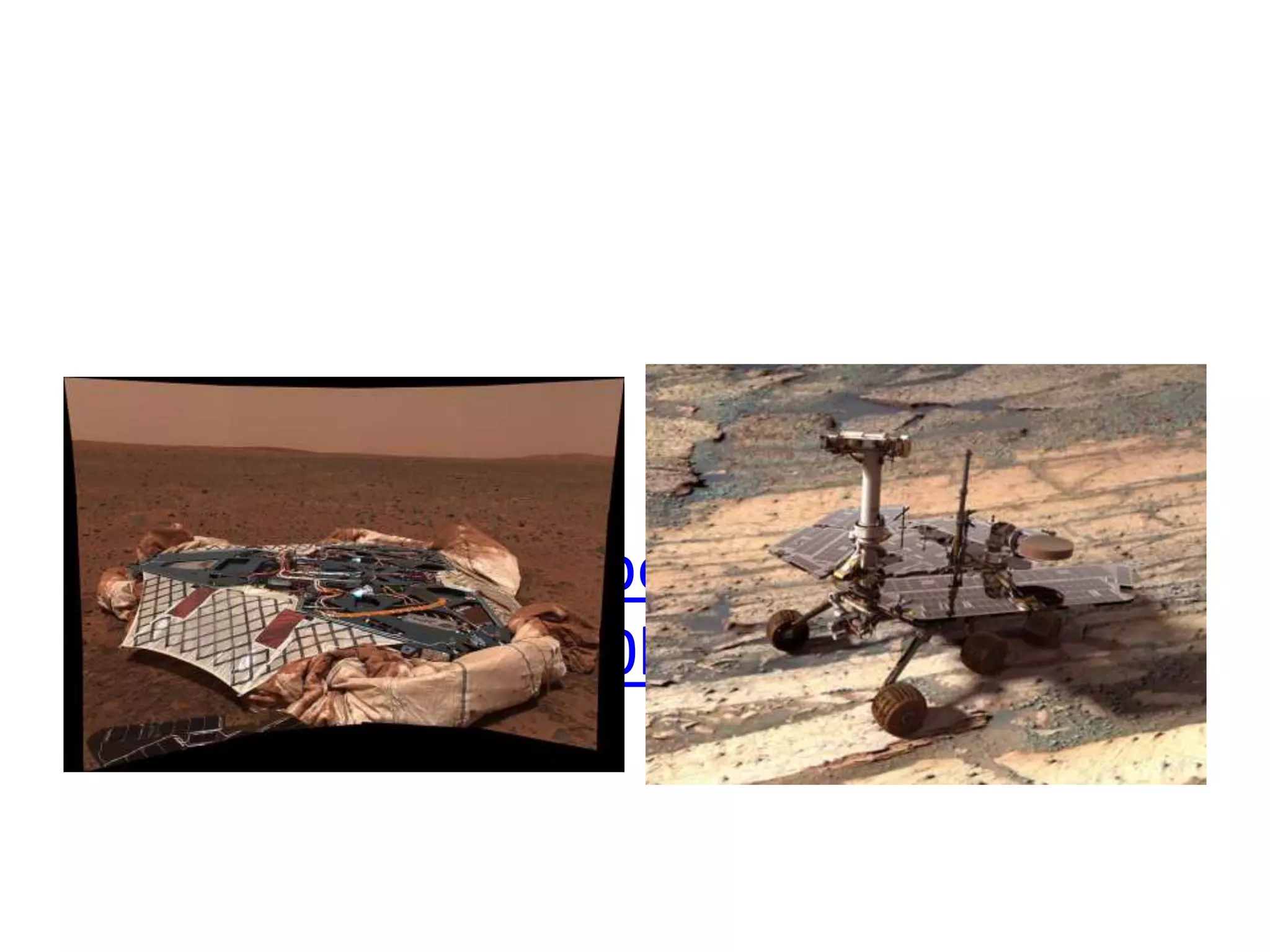
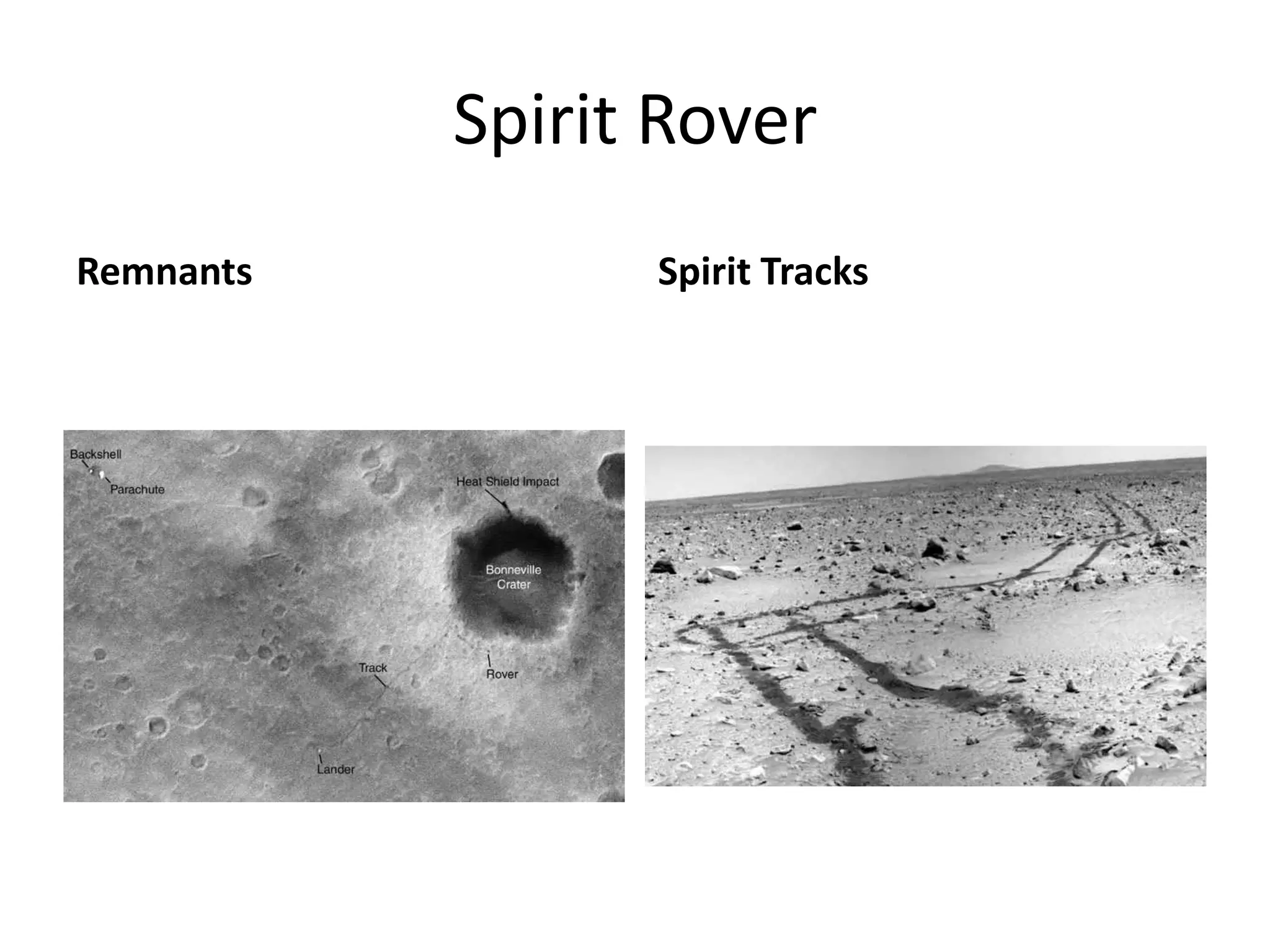
Spirit Rover
Remnants

Spirit Tracks
Spirit Rover
What did Spirit do?
• Gusev Crater
• Named site “Columbia
Memorial Stadium”
• Landed Jan 4, 2004
• Planned mission 90
sols(Martian days)
• Got stuck in soil on May 1,
2009
• Worked as a lander after that
• Last communication March
2010
• Travelled 7,730.48 m or 4.8 mi

• Histories first grinding of a rock
on Mars-using the Rock Abrasion
Tool (RAT)
– Adirondack

• Solar Panel efficiency jumped
from 60% to 93% in March 2005dust devils cleared off the solar
panels
– http://marsrovers.jpl.nasa.gov/gall
ery/press/spirit/20050527a.html

• In 2007, Spirit’s stuck wheel
revealed a silica rich soil which is
similar to hot spring
environments on Earth
– On Earth, bacteria thrive in hot
springs
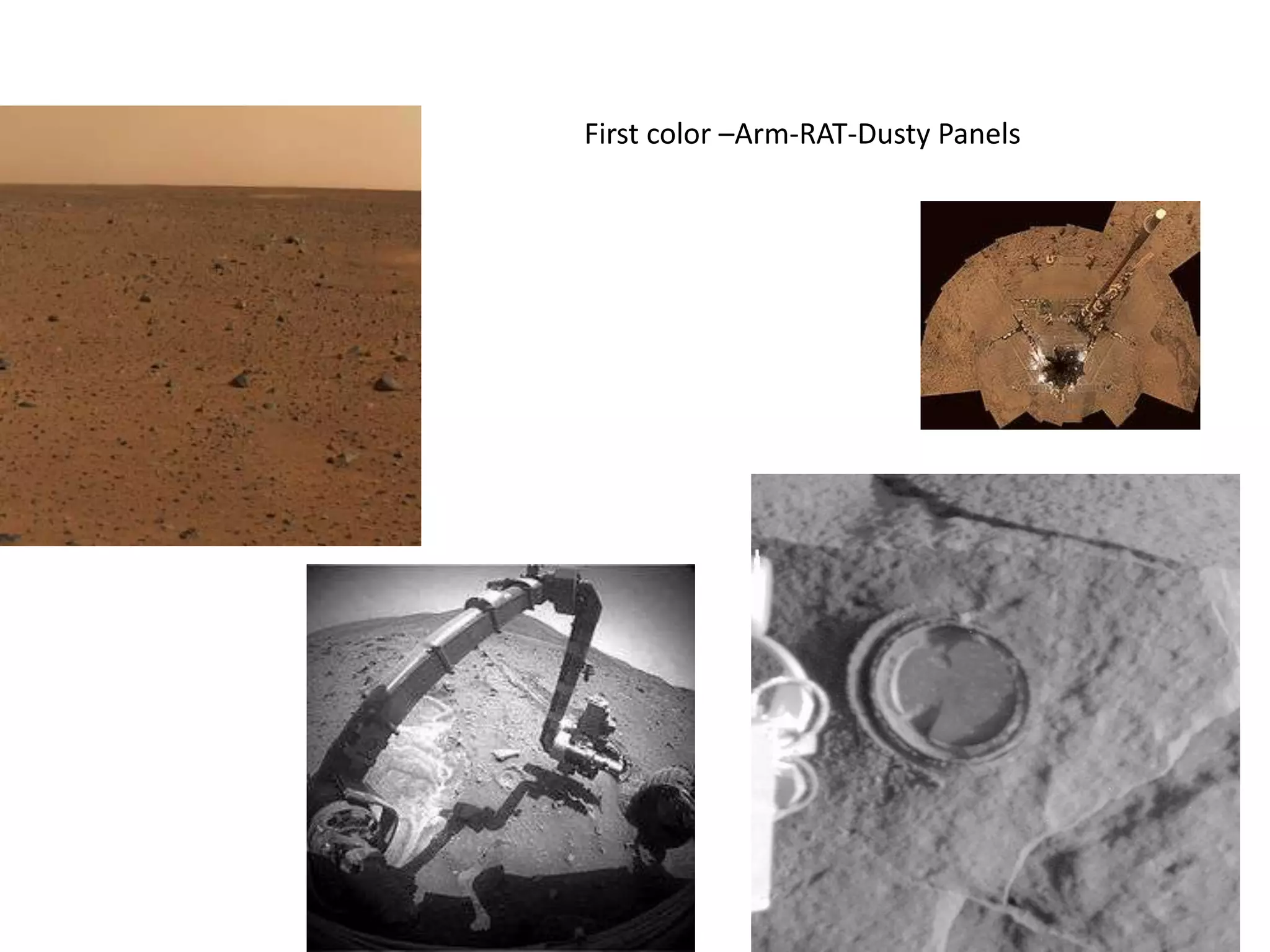
First color –Arm-RAT-Dusty Panels
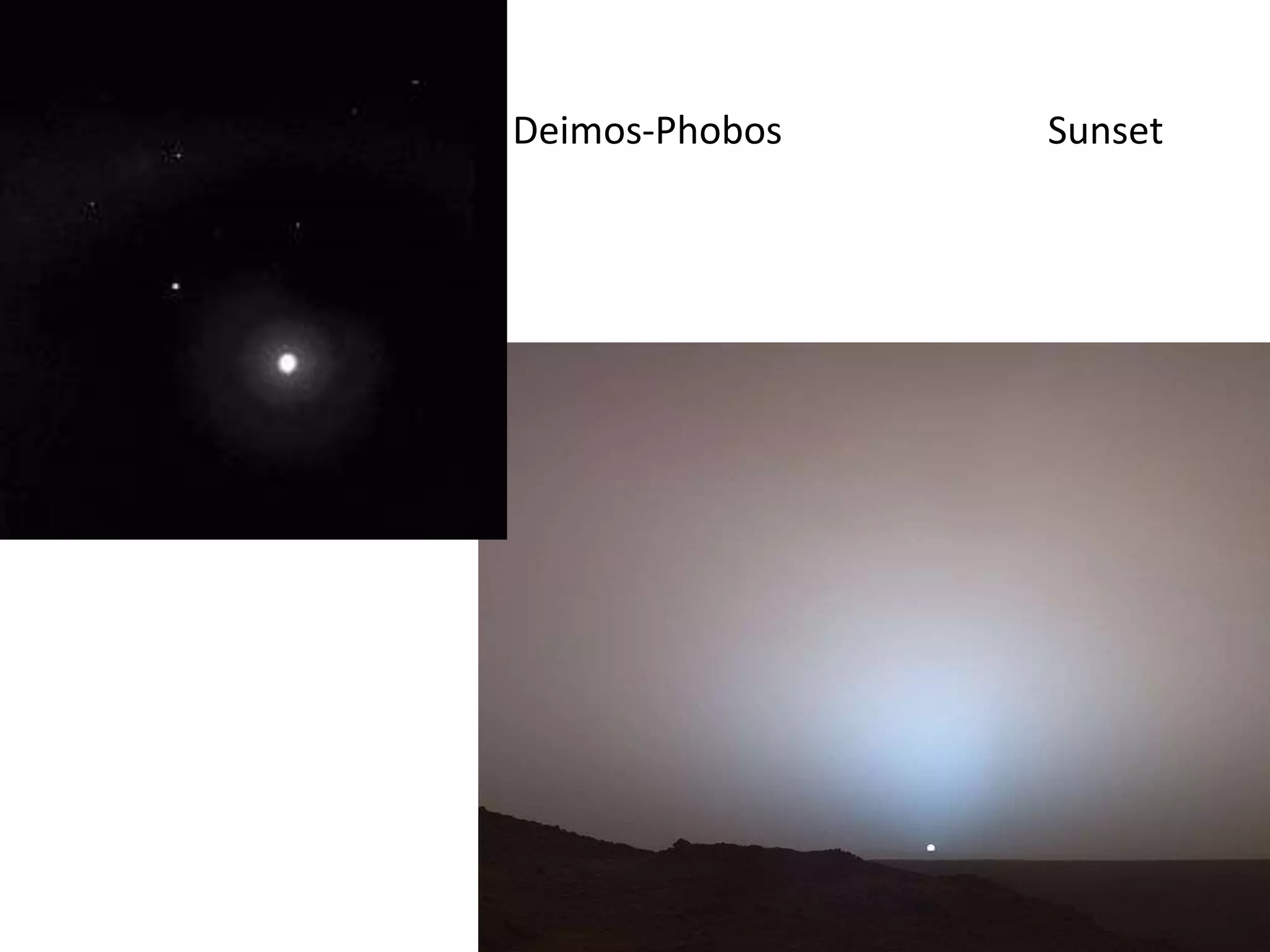
Deimos-Phobos

Sunset
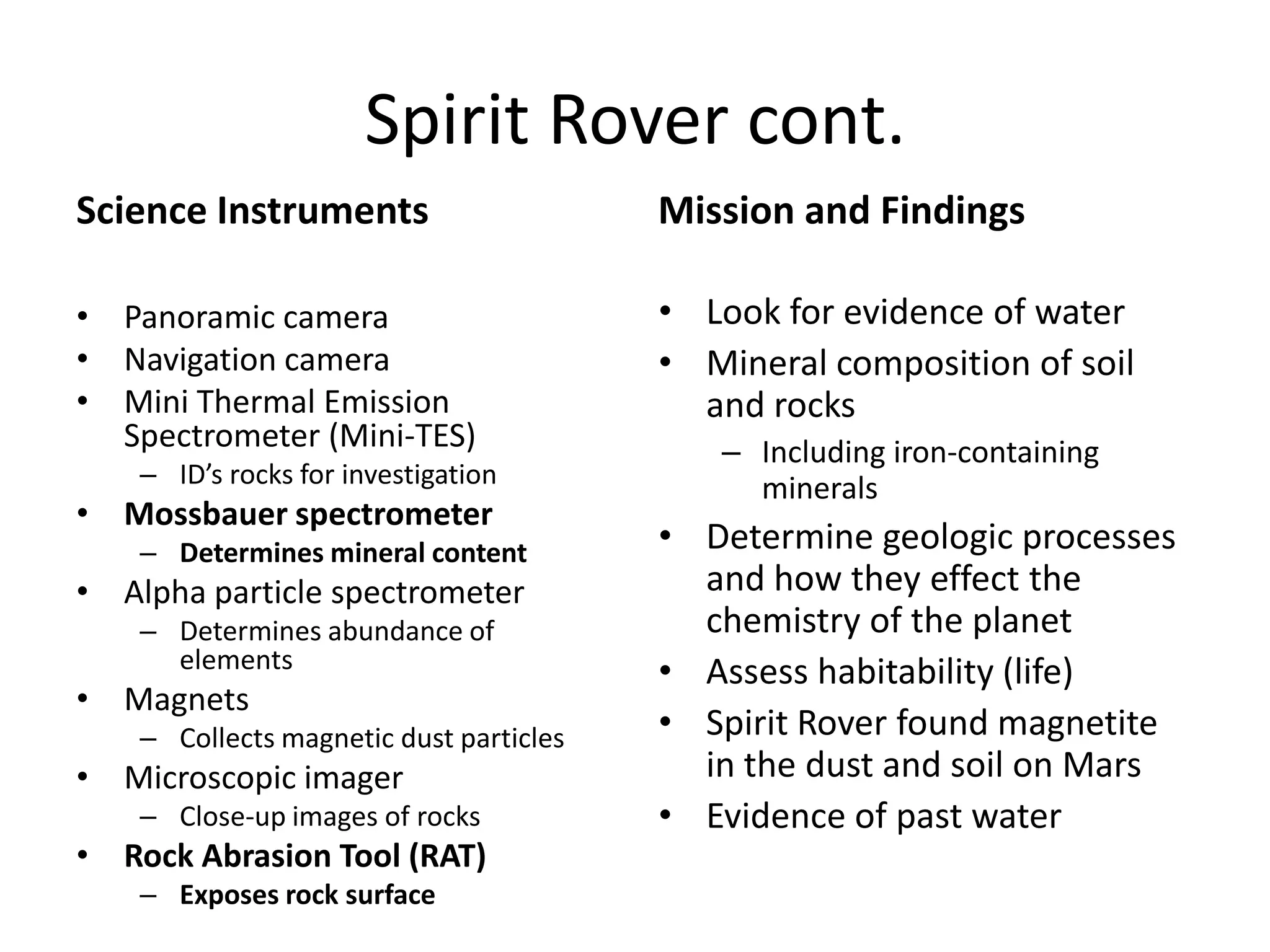
Spirit Rover cont.
Science Instruments

Mission and Findings

• Panoramic camera
• Navigation camera
• Mini Thermal Emission
Spectrometer (Mini-TES)

• Look for evidence of water
• Mineral composition of soil
and rocks

– ID’s rocks for investigation

• Mossbauer spectrometer
– Determines mineral content

• Alpha particle spectrometer
– Determines abundance of
elements

• Magnets
– Collects magnetic dust particles

• Microscopic imager
– Close-up images of rocks

• Rock Abrasion Tool (RAT)
– Exposes rock surface

– Including iron-containing
minerals

• Determine geologic processes
and how they effect the
chemistry of the planet
• Assess habitability (life)
• Spirit Rover found magnetite
in the dust and soil on Mars
• Evidence of past water
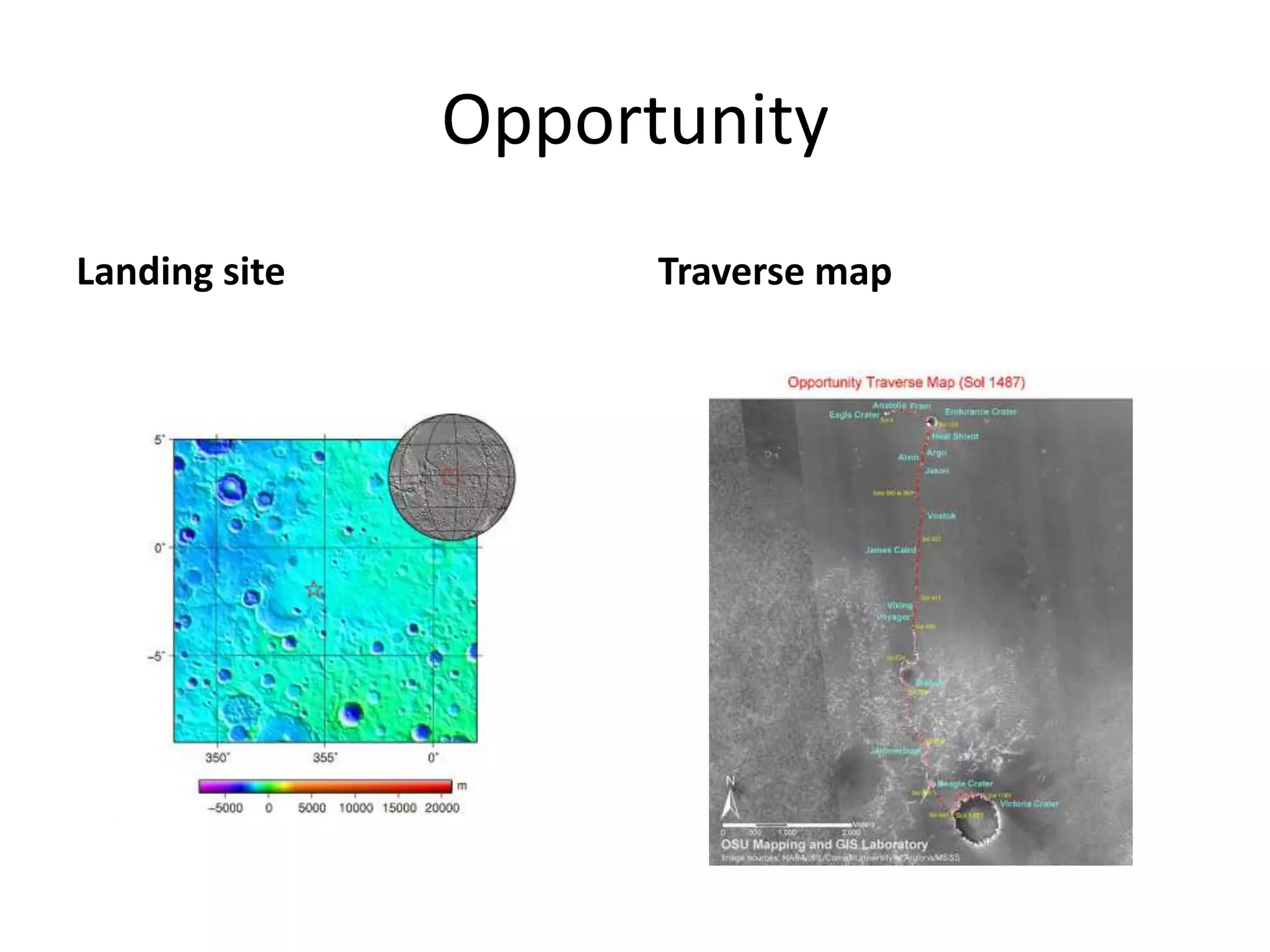
Opportunity
Landing site

Traverse map
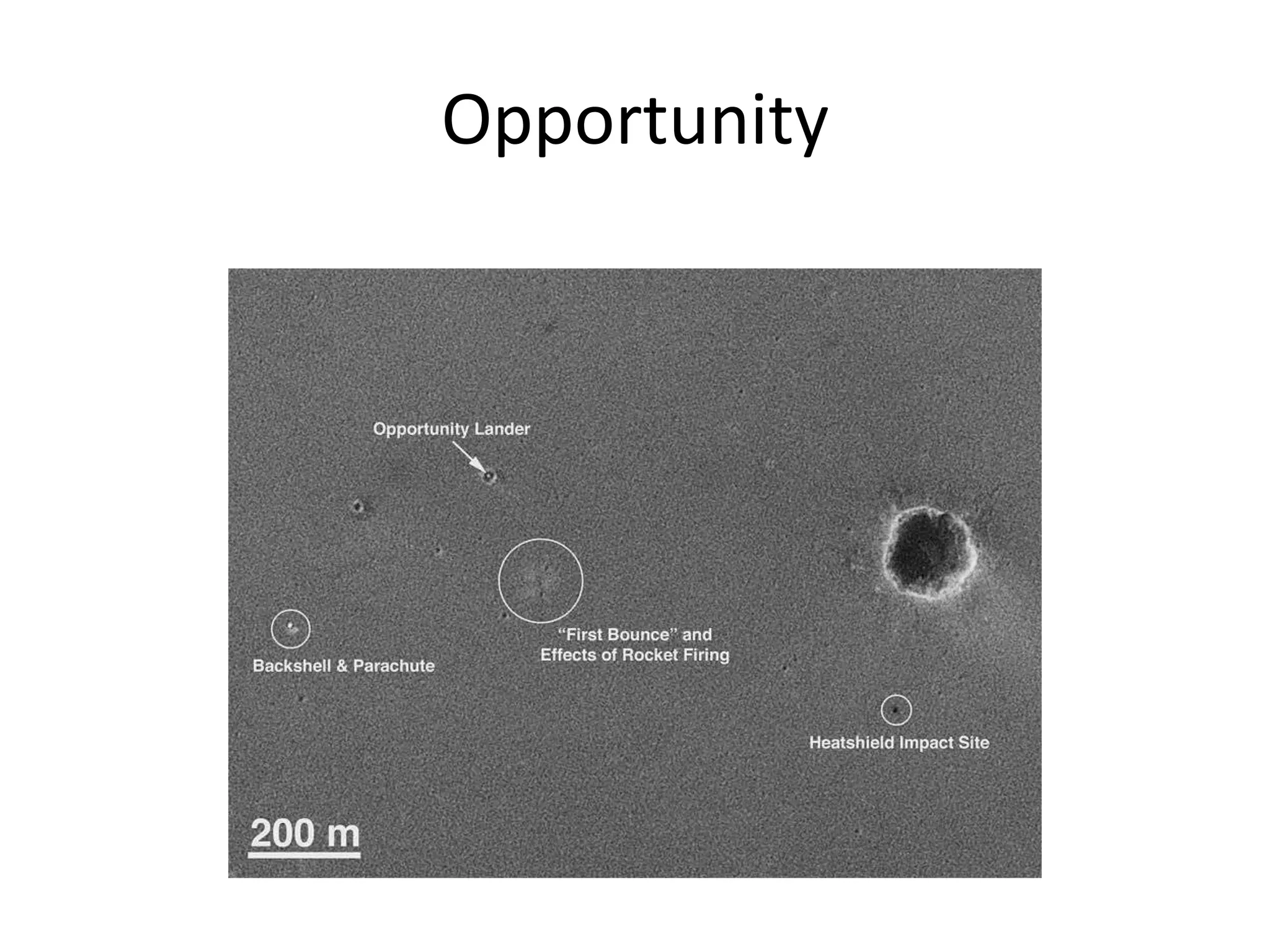
Opportunity
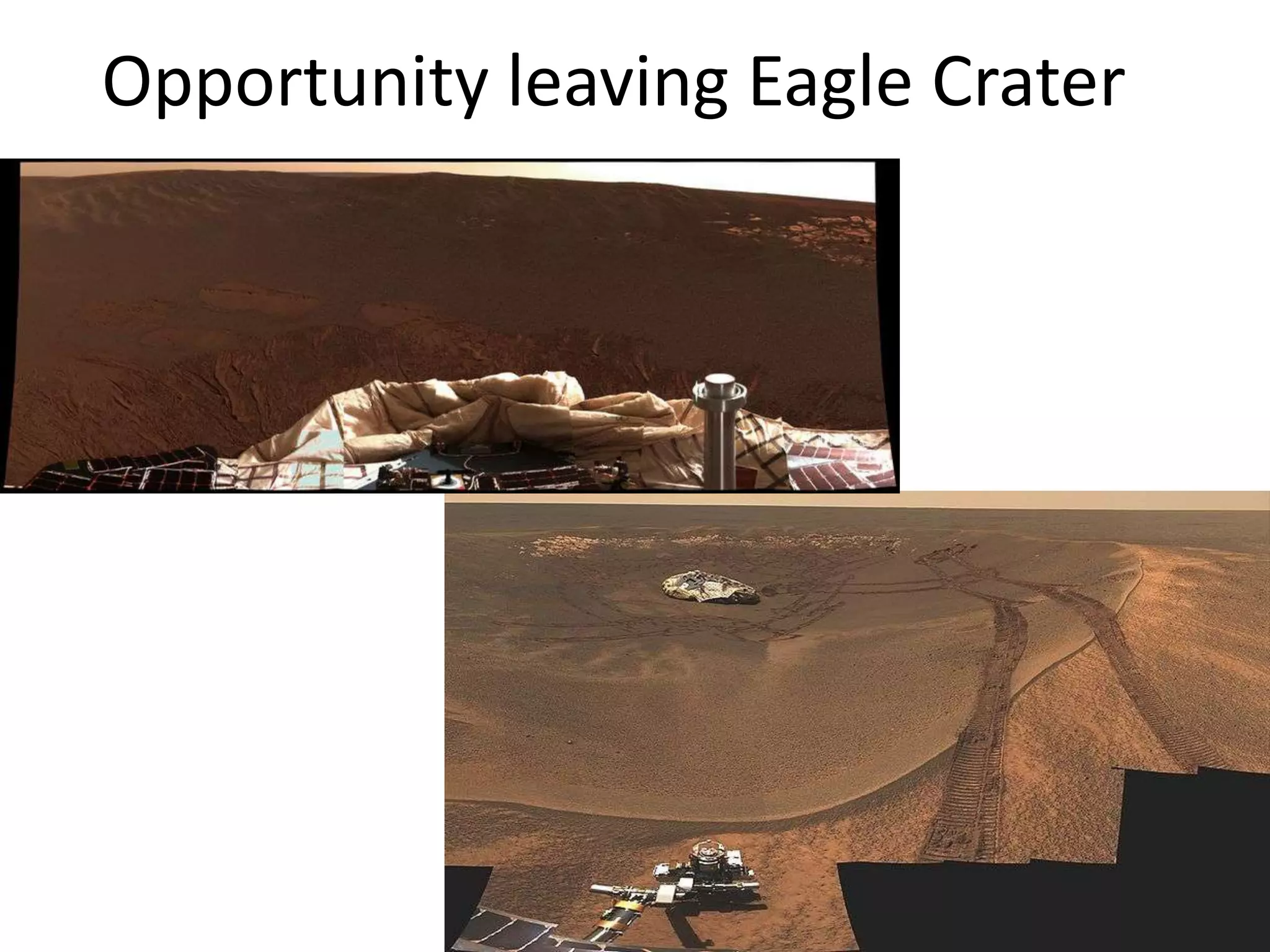
Opportunity leaving Eagle Crater
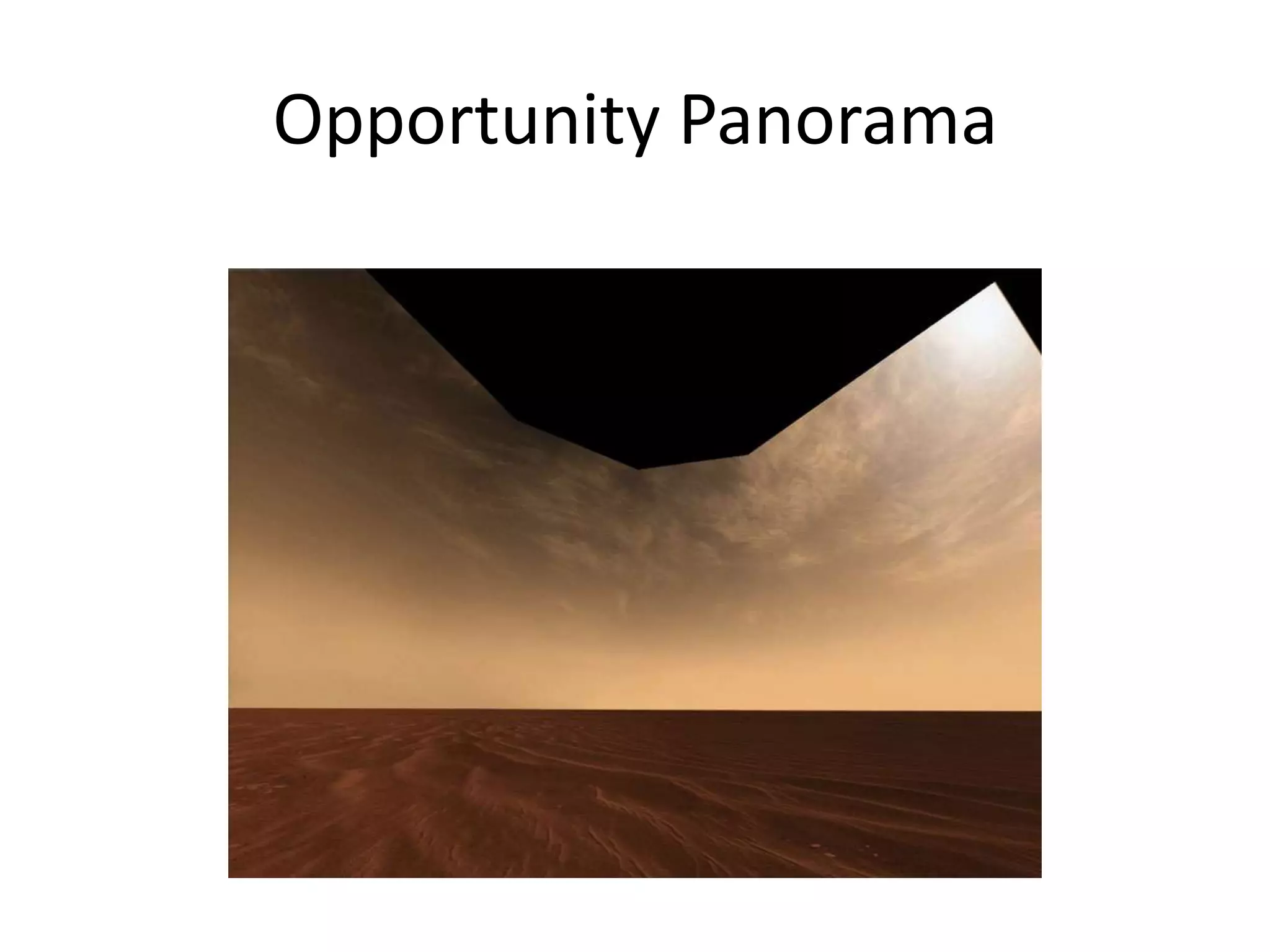
Opportunity Panorama
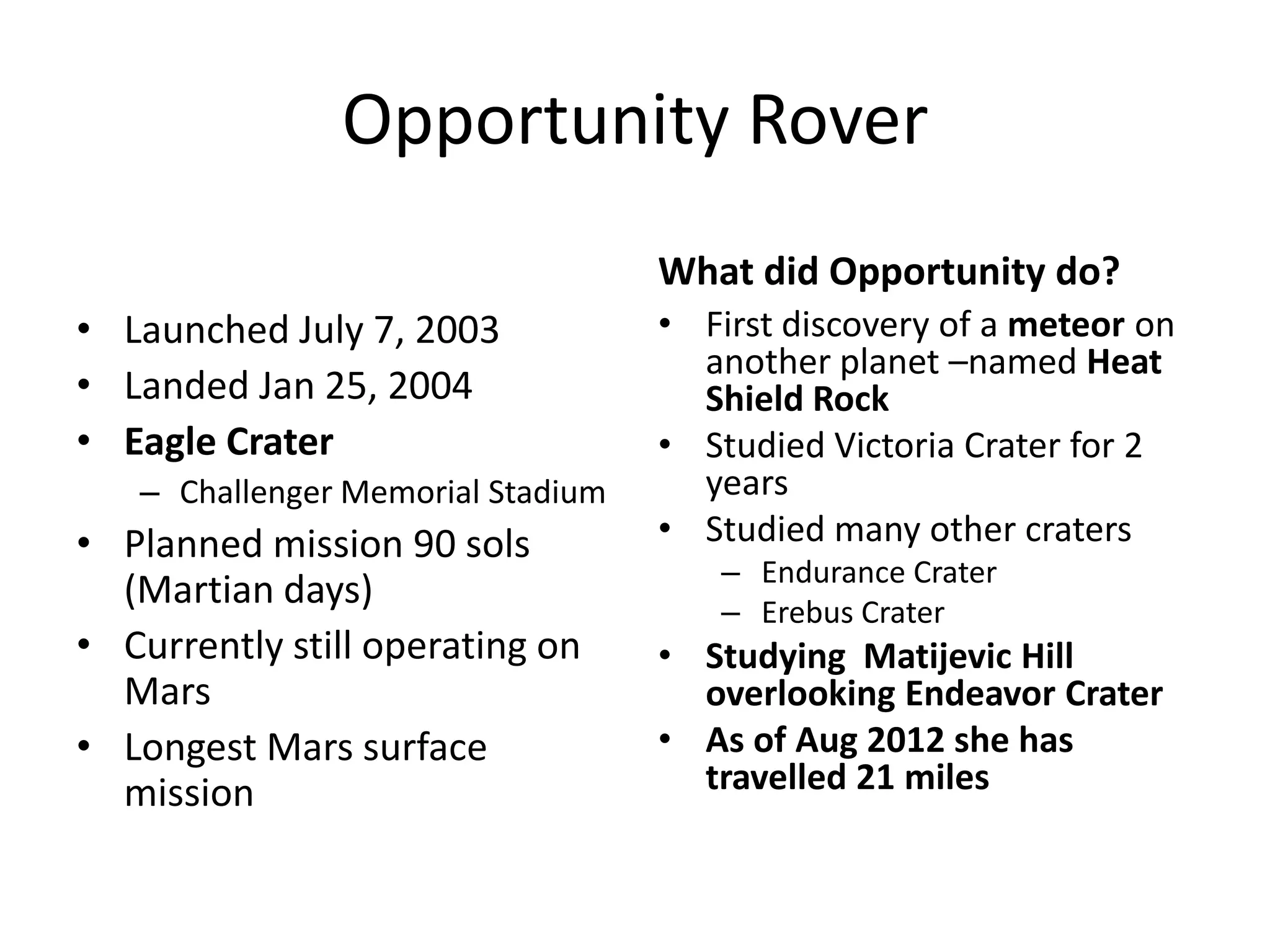
Opportunity Rover
What did Opportunity do?
• Launched July 7, 2003
• Landed Jan 25, 2004
• Eagle Crater
– Challenger Memorial Stadium

• Planned mission 90 sols
(Martian days)
• Currently still operating on
Mars
• Longest Mars surface
mission

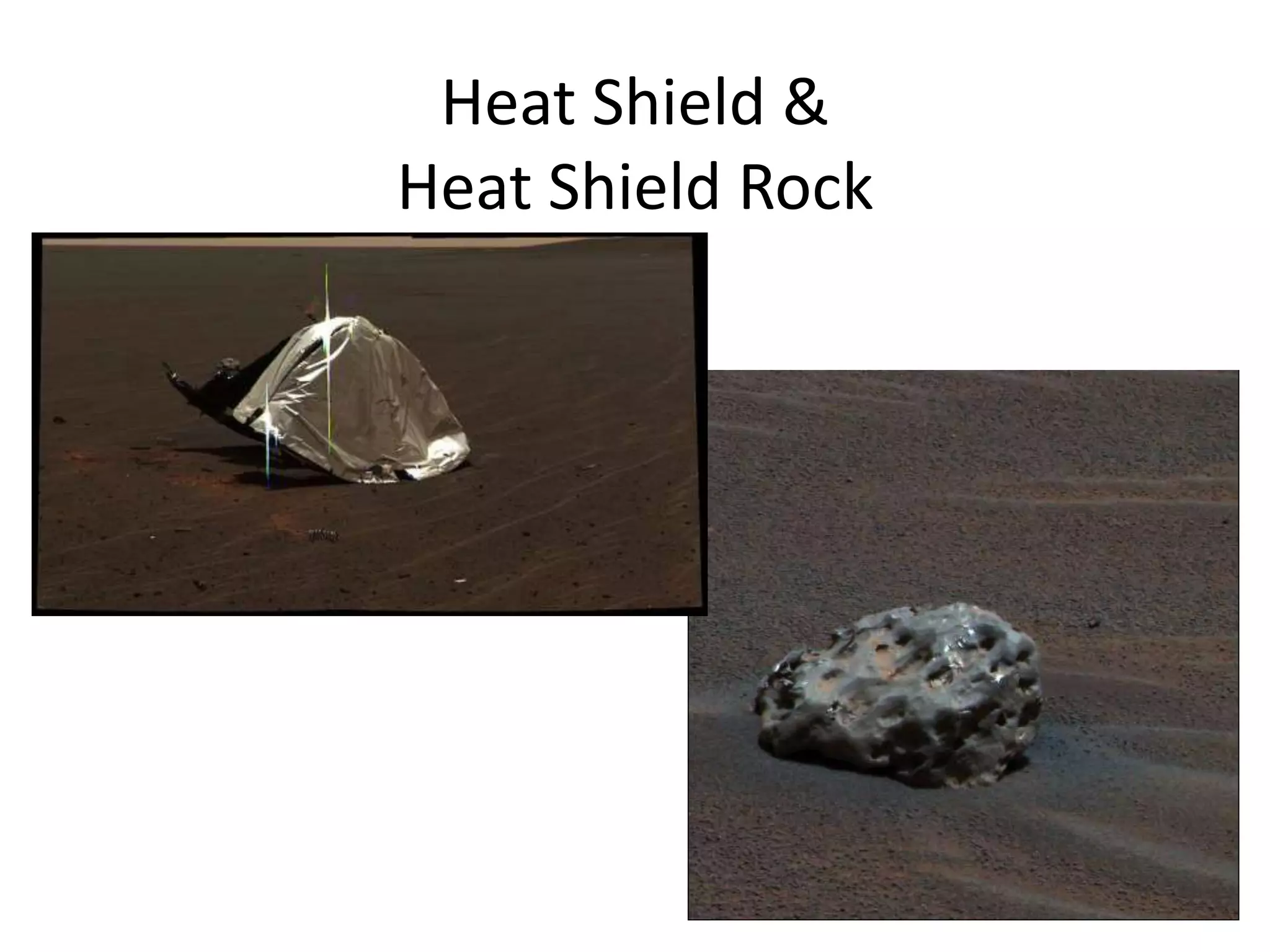
• First discovery of a meteor on
another planet –named Heat
Shield Rock
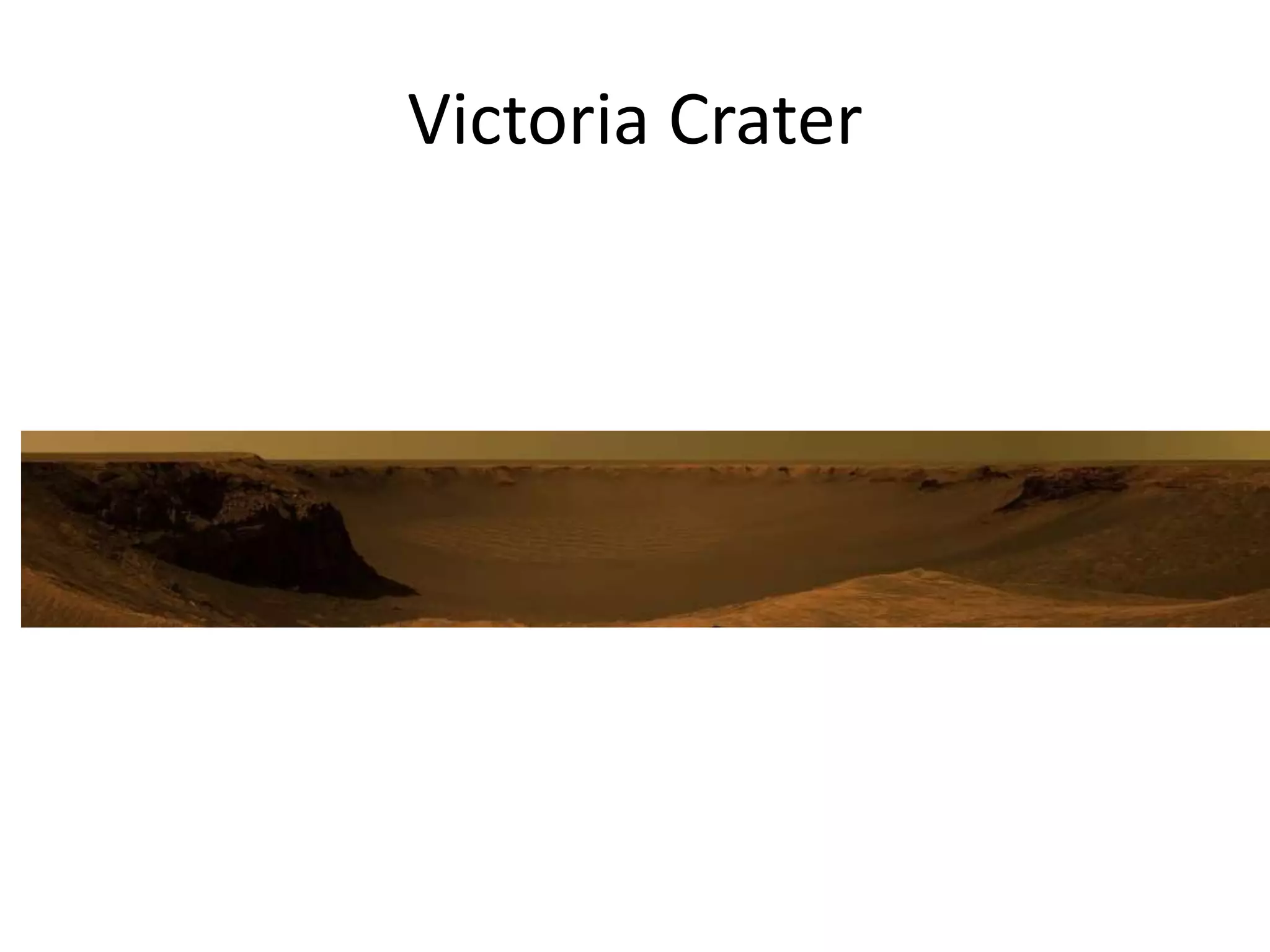
• Studied Victoria Crater for 2
years
• Studied many other craters
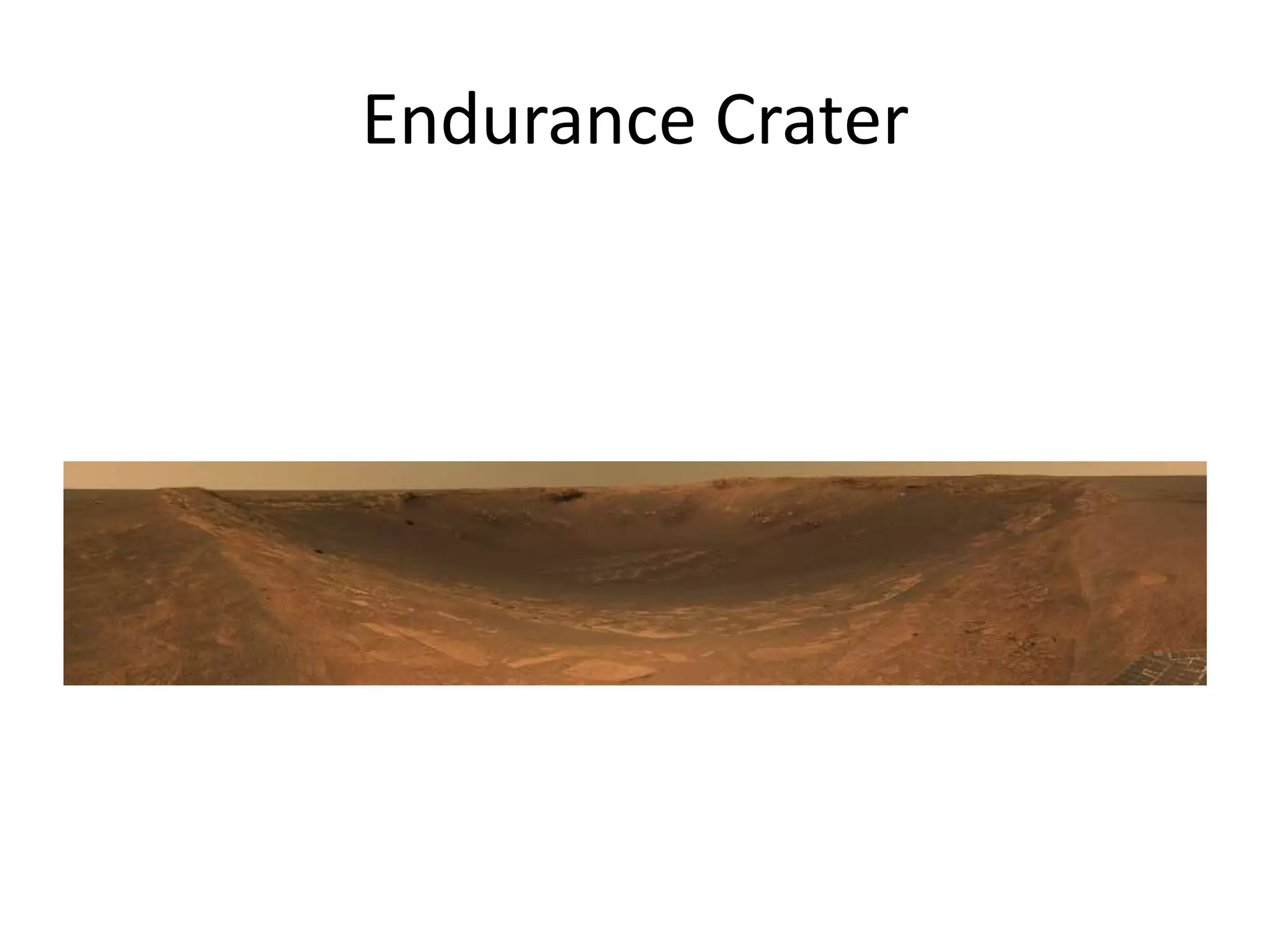
– Endurance Crater
– Erebus Crater

• Studying Matijevic Hill
overlooking Endeavor Crater
• As of Aug 2012 she has
travelled 21 miles
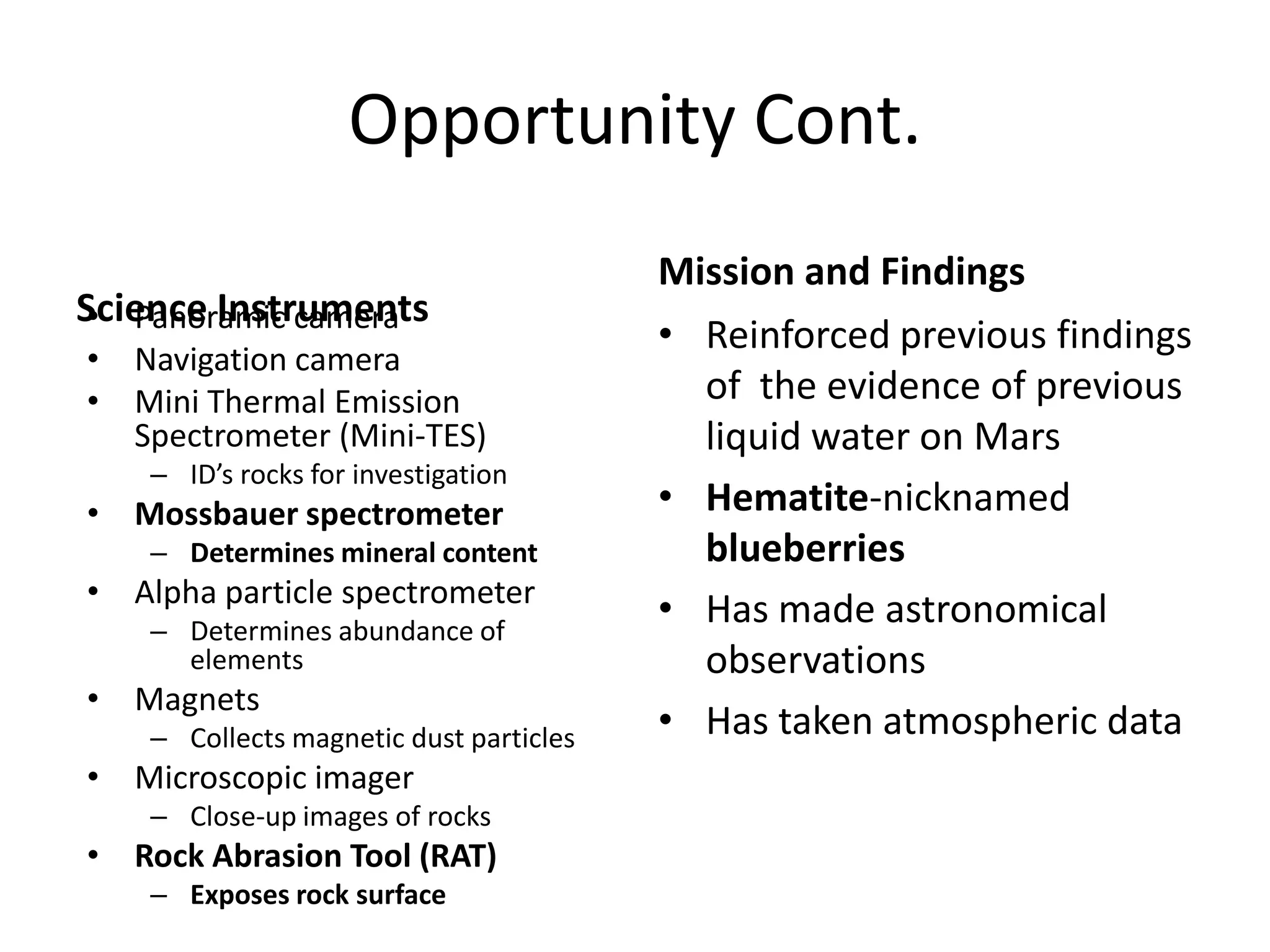
Opportunity Cont.
Science Instruments
• Panoramic camera
• Navigation camera
• Mini Thermal Emission
Spectrometer (Mini-TES)
– ID’s rocks for investigation

• Mossbauer spectrometer
– Determines mineral content

• Alpha particle spectrometer
– Determines abundance of
elements

• Magnets
– Collects magnetic dust particles

• Microscopic imager
– Close-up images of rocks

• Rock Abrasion Tool (RAT)
– Exposes rock surface

Mission and Findings
• Reinforced previous findings
of the evidence of previous
liquid water on Mars
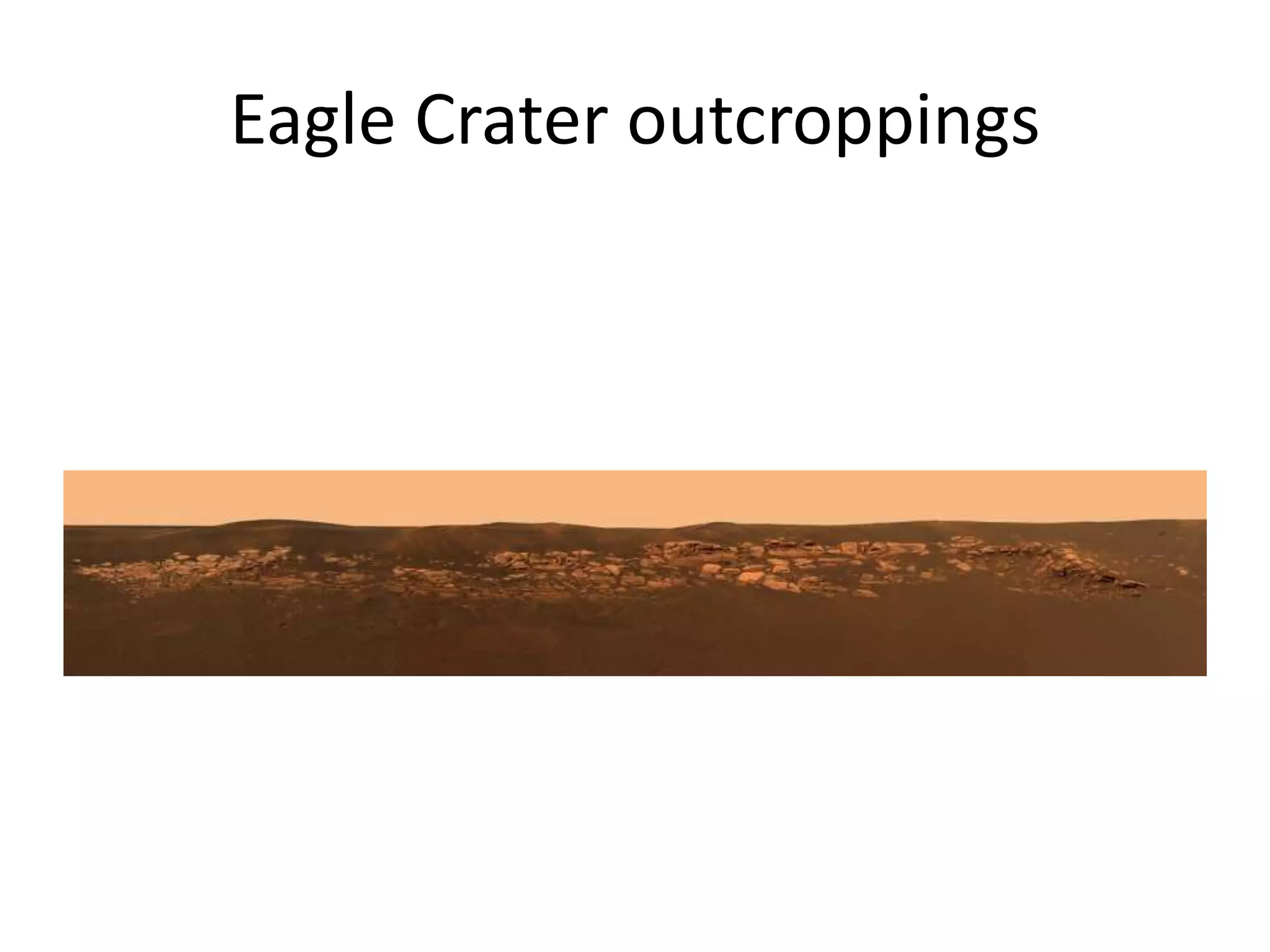
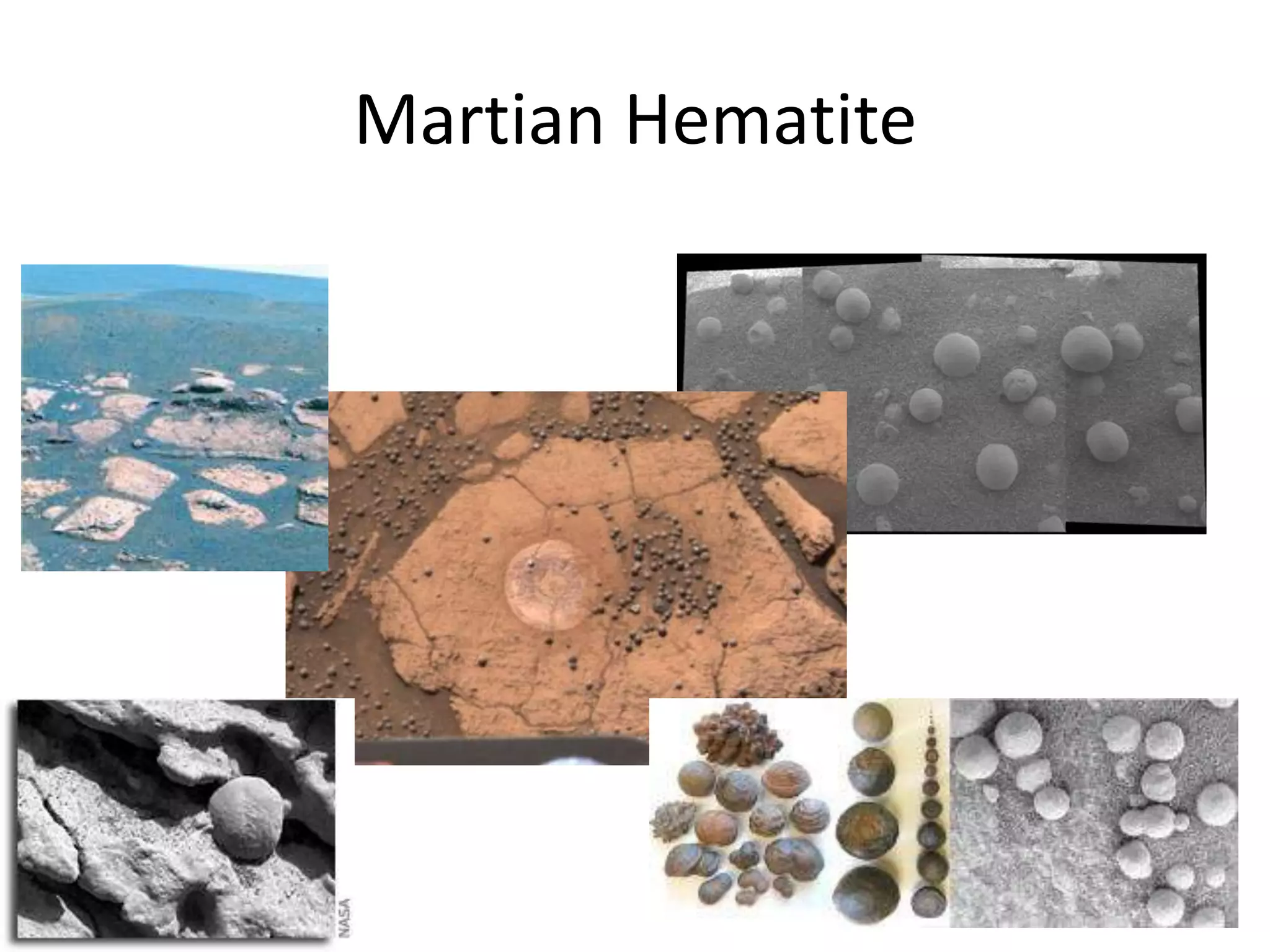
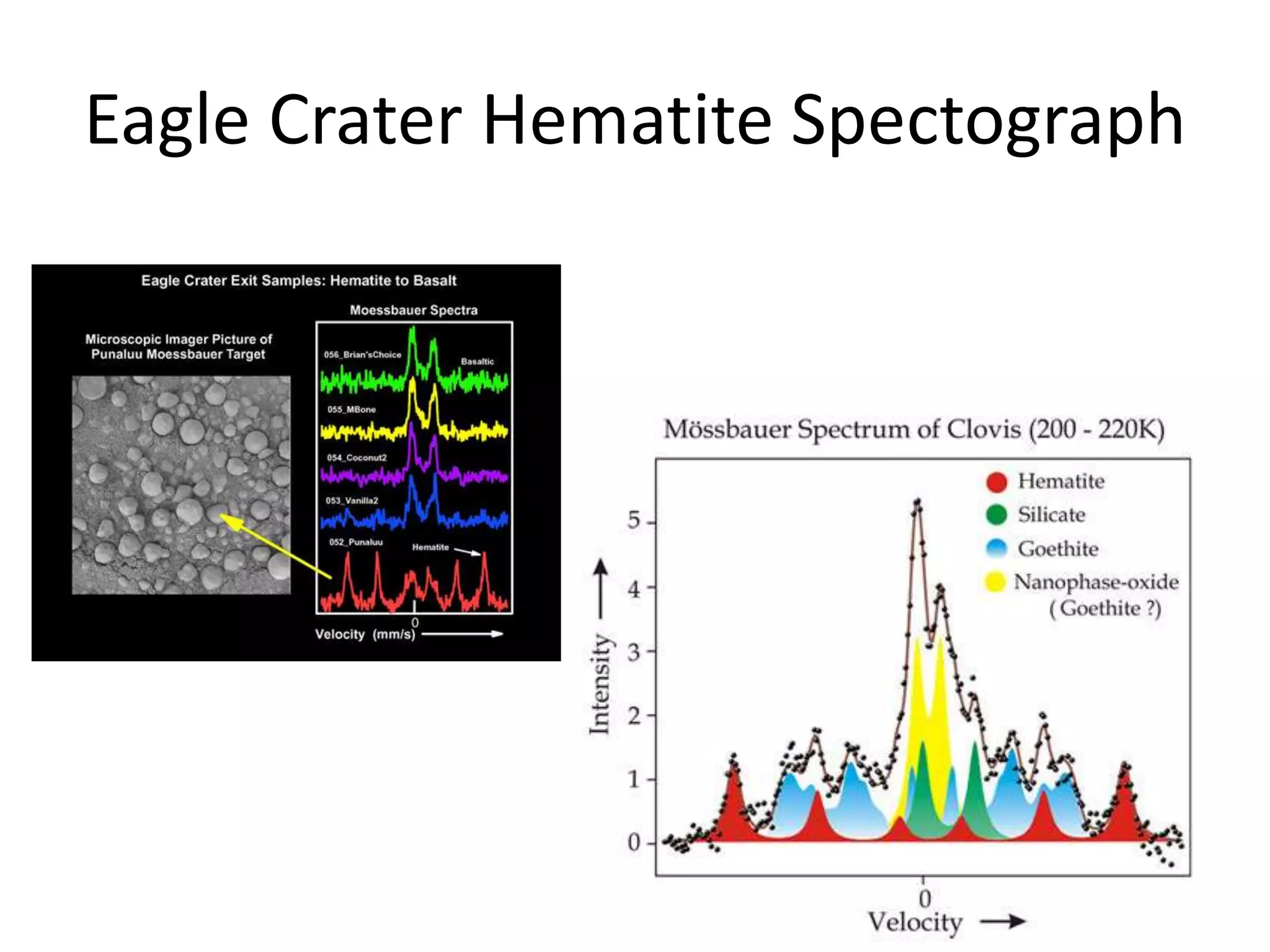
• Hematite-nicknamed
blueberries
• Has made astronomical
observations
• Has taken atmospheric data
Eagle Crater outcroppings
Martian Hematite
Eagle Crater Hematite Spectograph
Victoria Crater
Heat Shield &
Heat Shield Rock
Endurance Crater
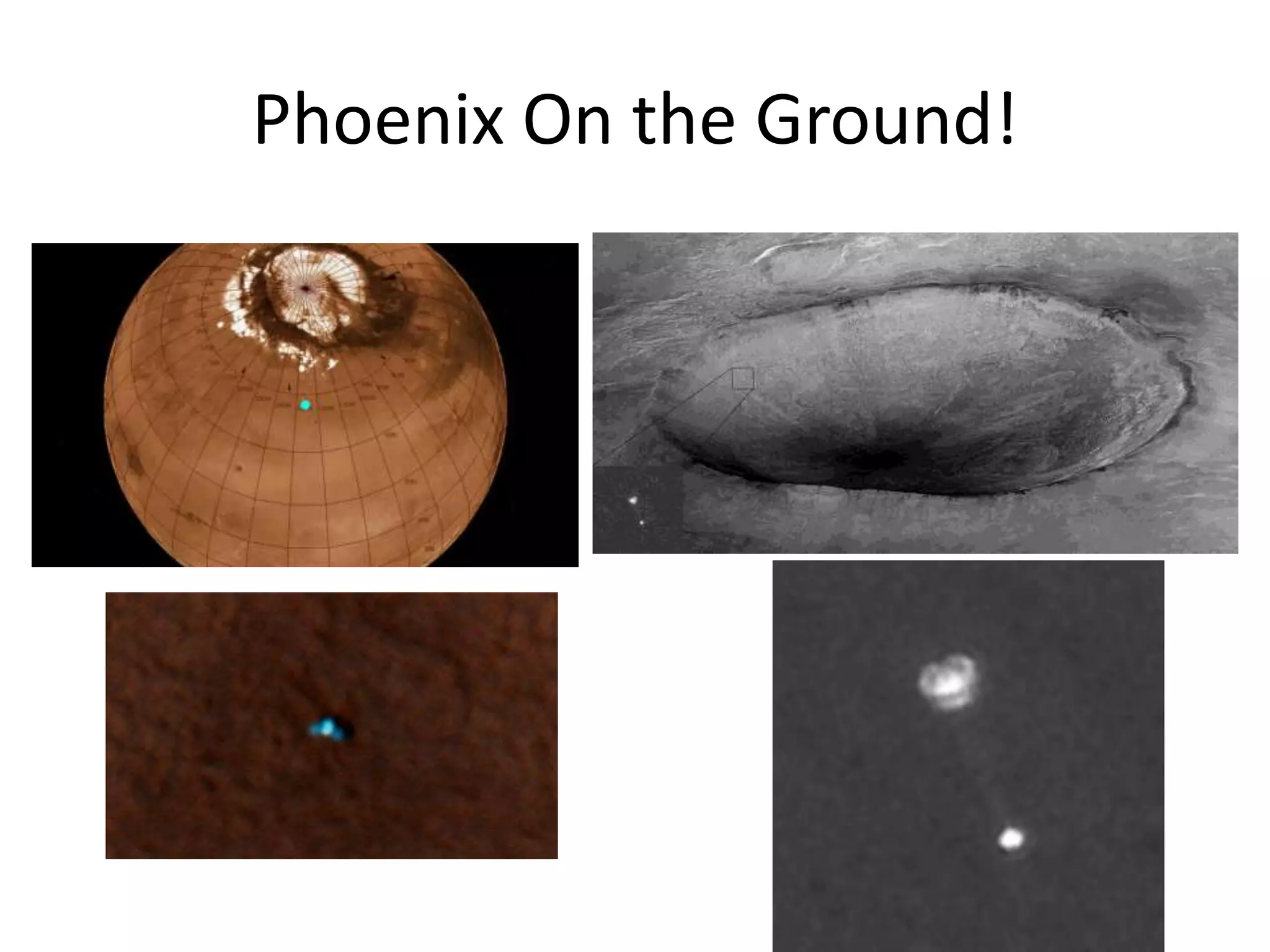
Phoenix On the Ground!
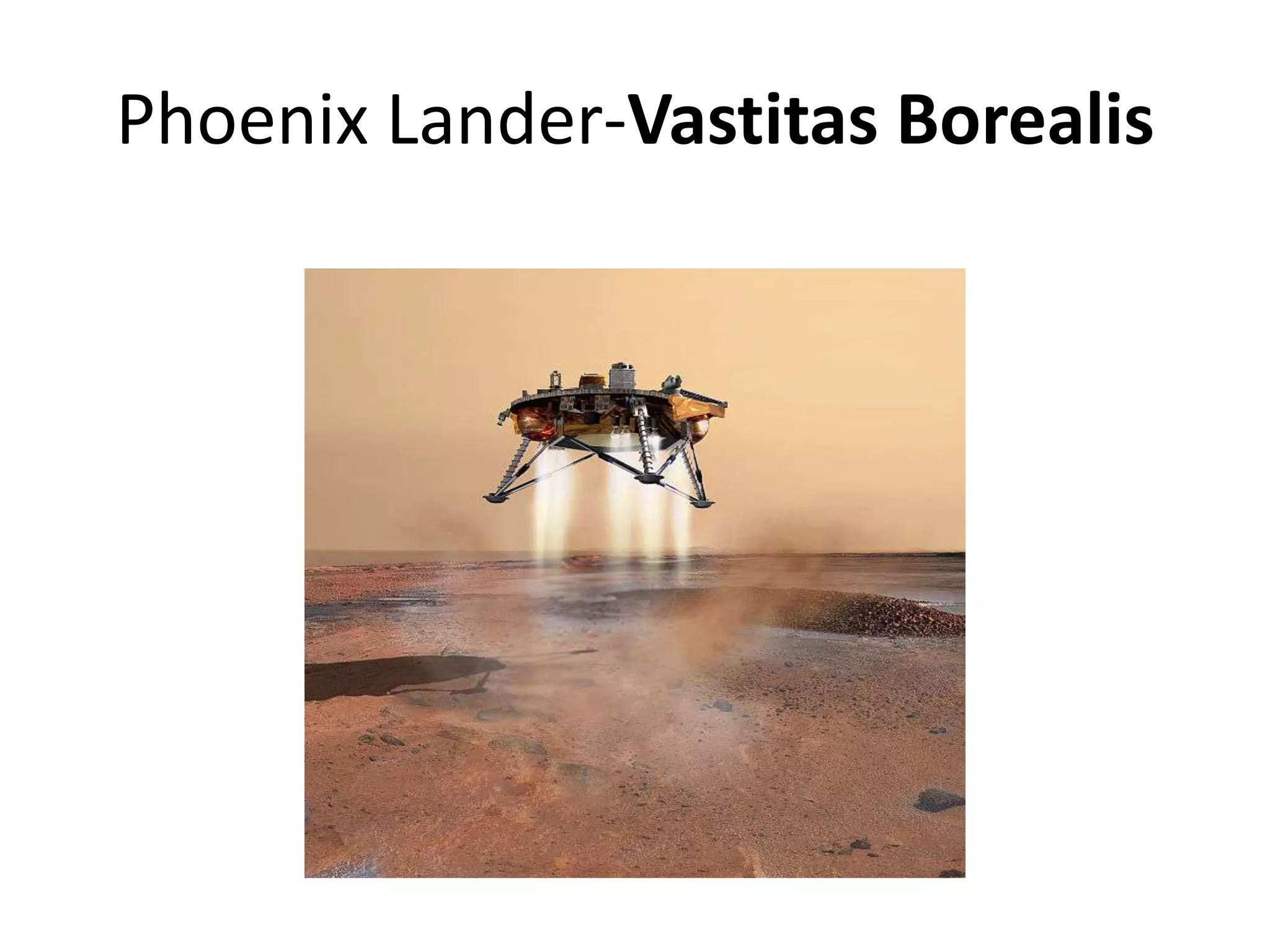
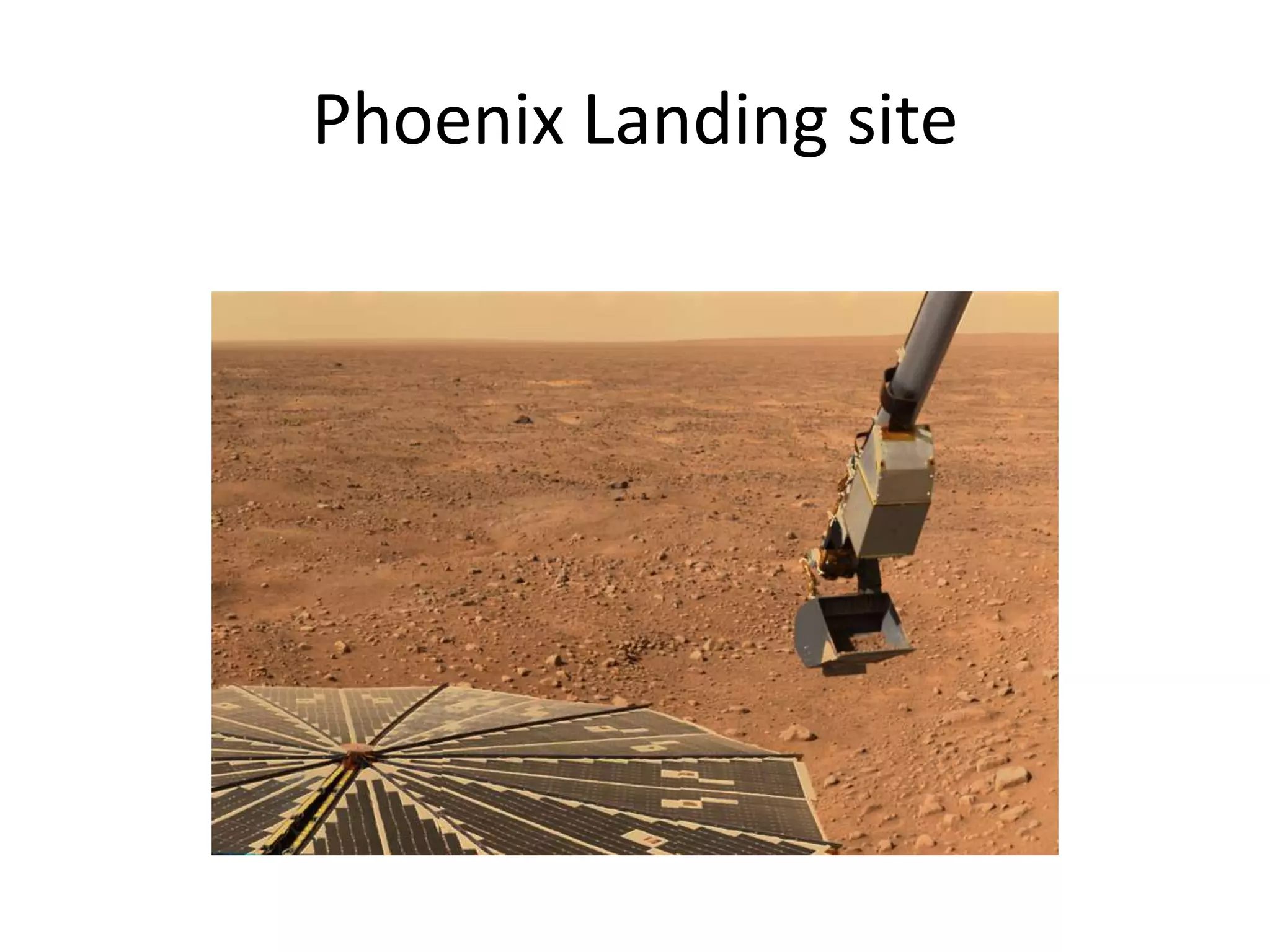
Phoenix Lander-Vastitas Borealis
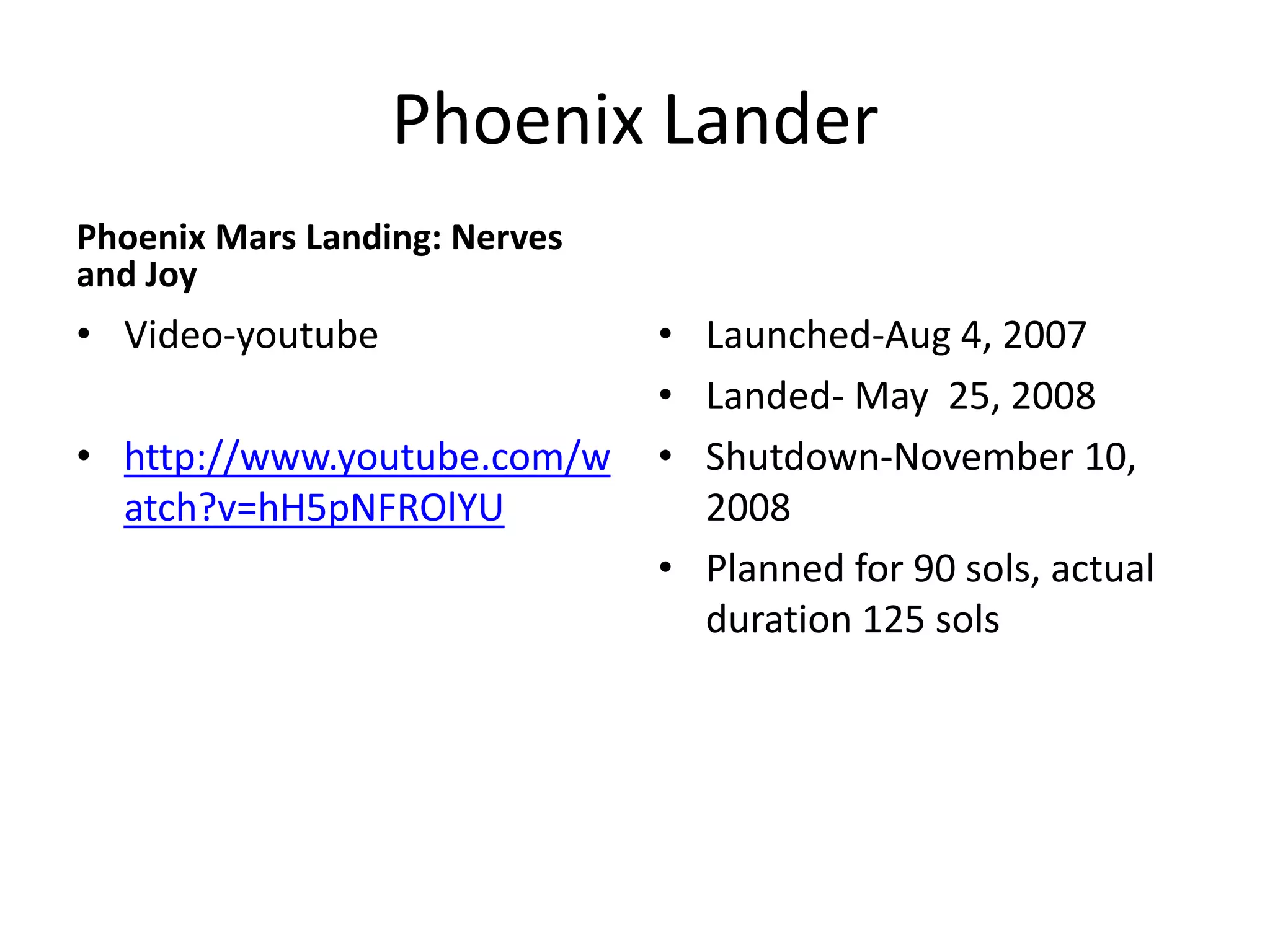
Phoenix Lander
Phoenix Mars Landing: Nerves
and Joy

• Video-youtube

• http://www.youtube.com/w
atch?v=hH5pNFROlYU

• Launched-Aug 4, 2007
• Landed- May 25, 2008
• Shutdown-November 10,
2008
• Planned for 90 sols, actual
duration 125 sols
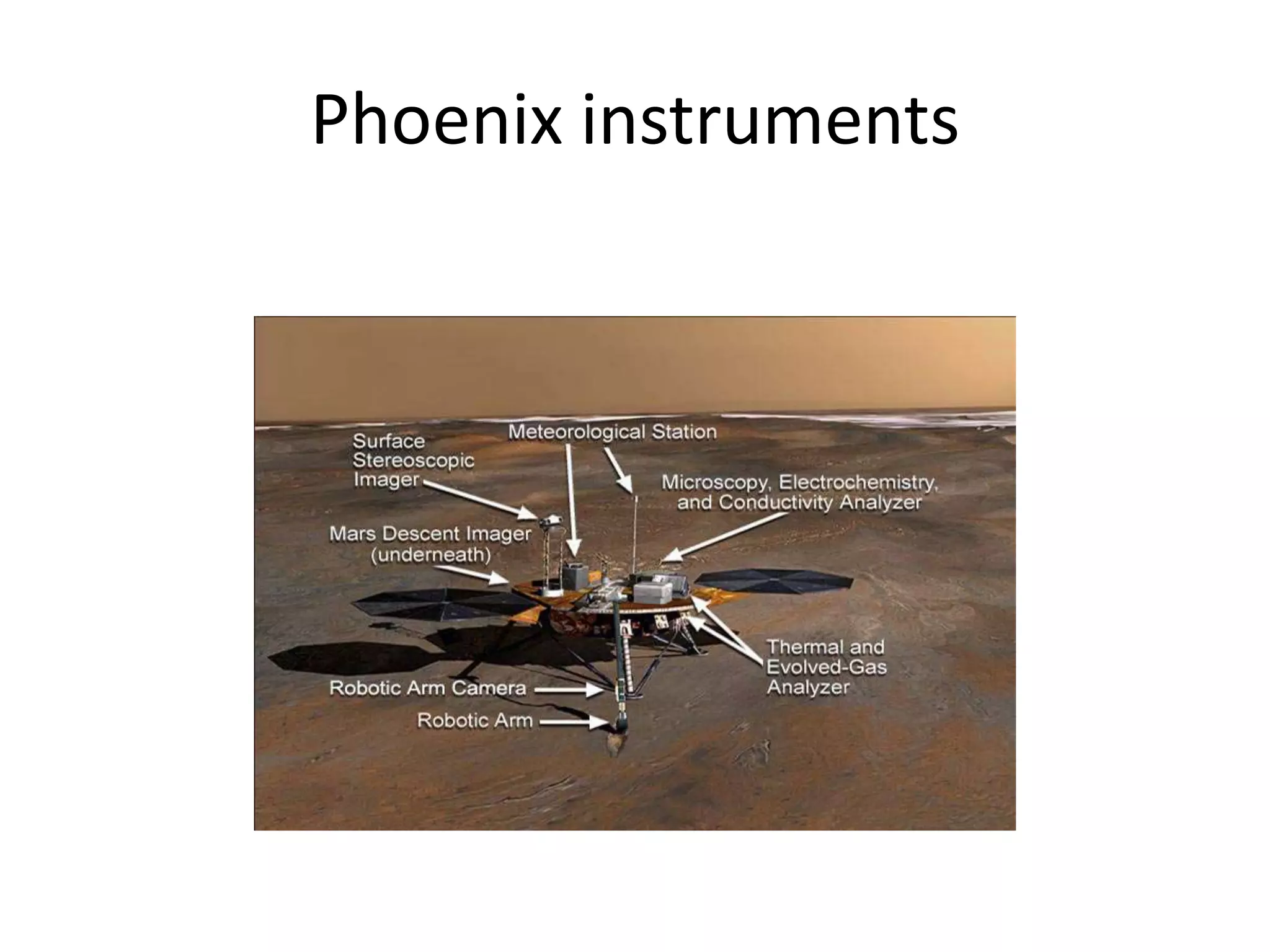
Phoenix instruments
Phoenix Landing site
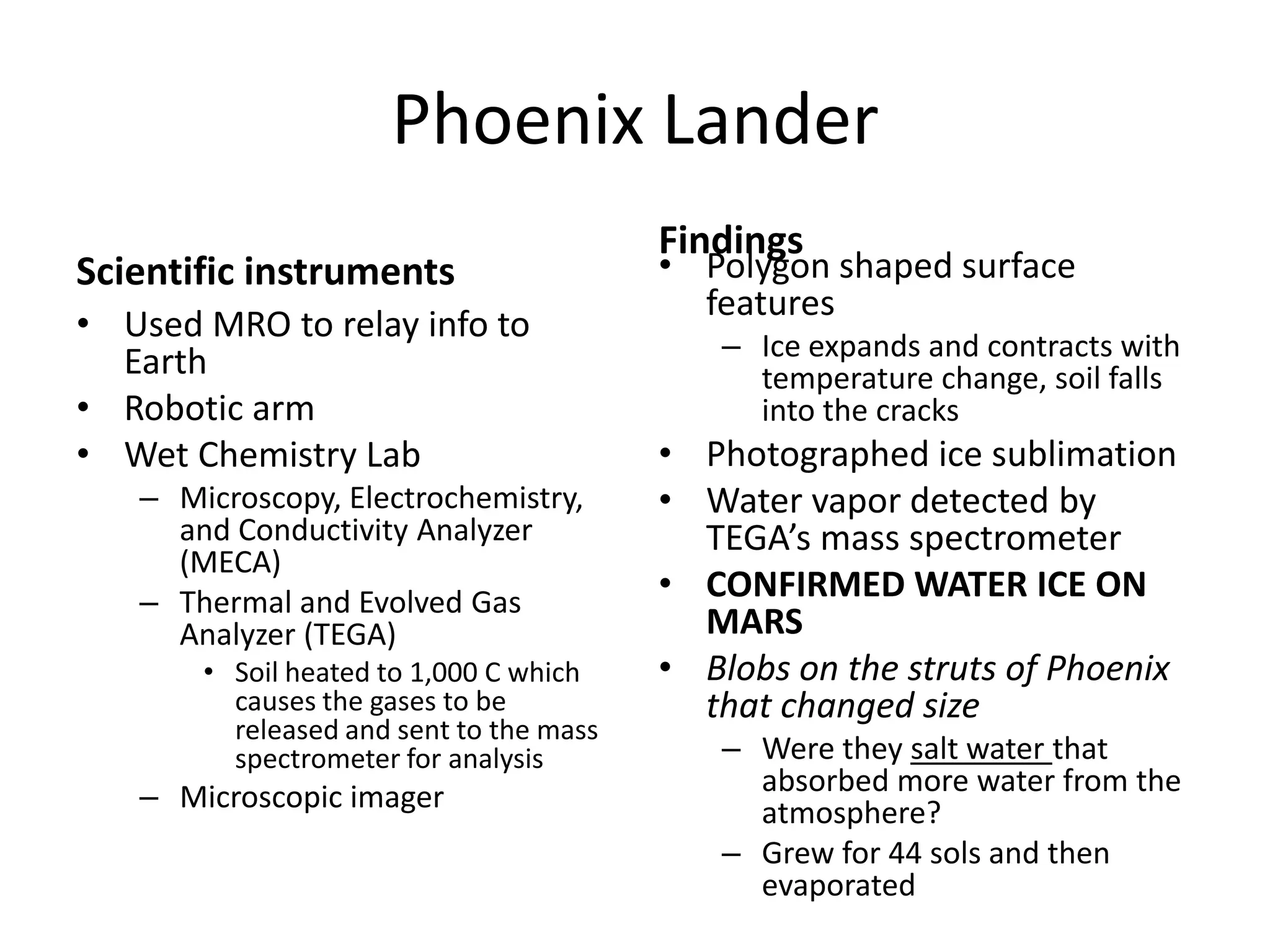
Phoenix Lander
Scientific instruments
• Used MRO to relay info to
Earth
• Robotic arm
• Wet Chemistry Lab
– Microscopy, Electrochemistry,
and Conductivity Analyzer
(MECA)
– Thermal and Evolved Gas
Analyzer (TEGA)
• Soil heated to 1,000 C which
causes the gases to be
released and sent to the mass
spectrometer for analysis

– Microscopic imager

Findings

• Polygon shaped surface
features
– Ice expands and contracts with
temperature change, soil falls
into the cracks

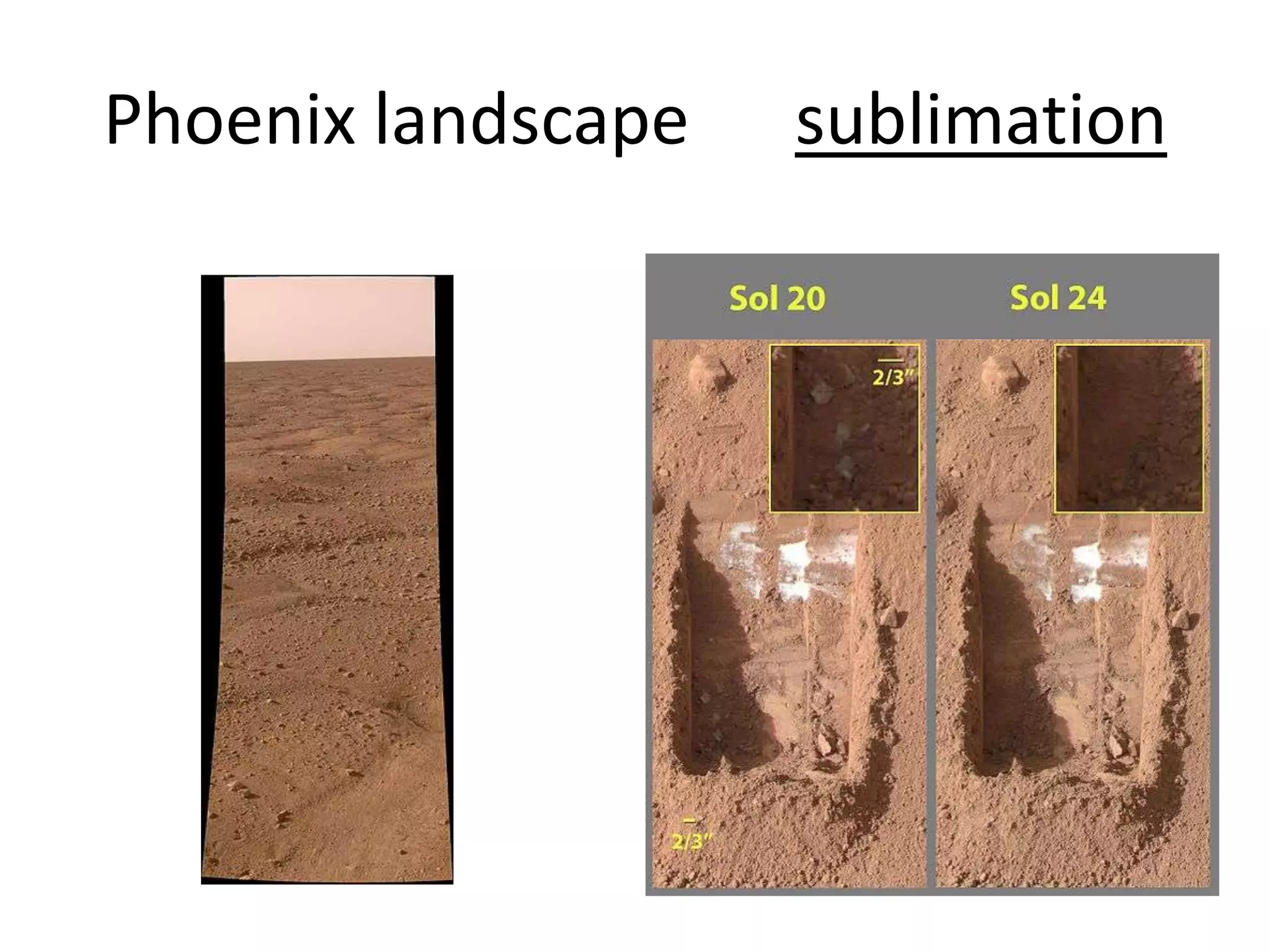
• Photographed ice sublimation
• Water vapor detected by
TEGA’s mass spectrometer
• CONFIRMED WATER ICE ON
MARS
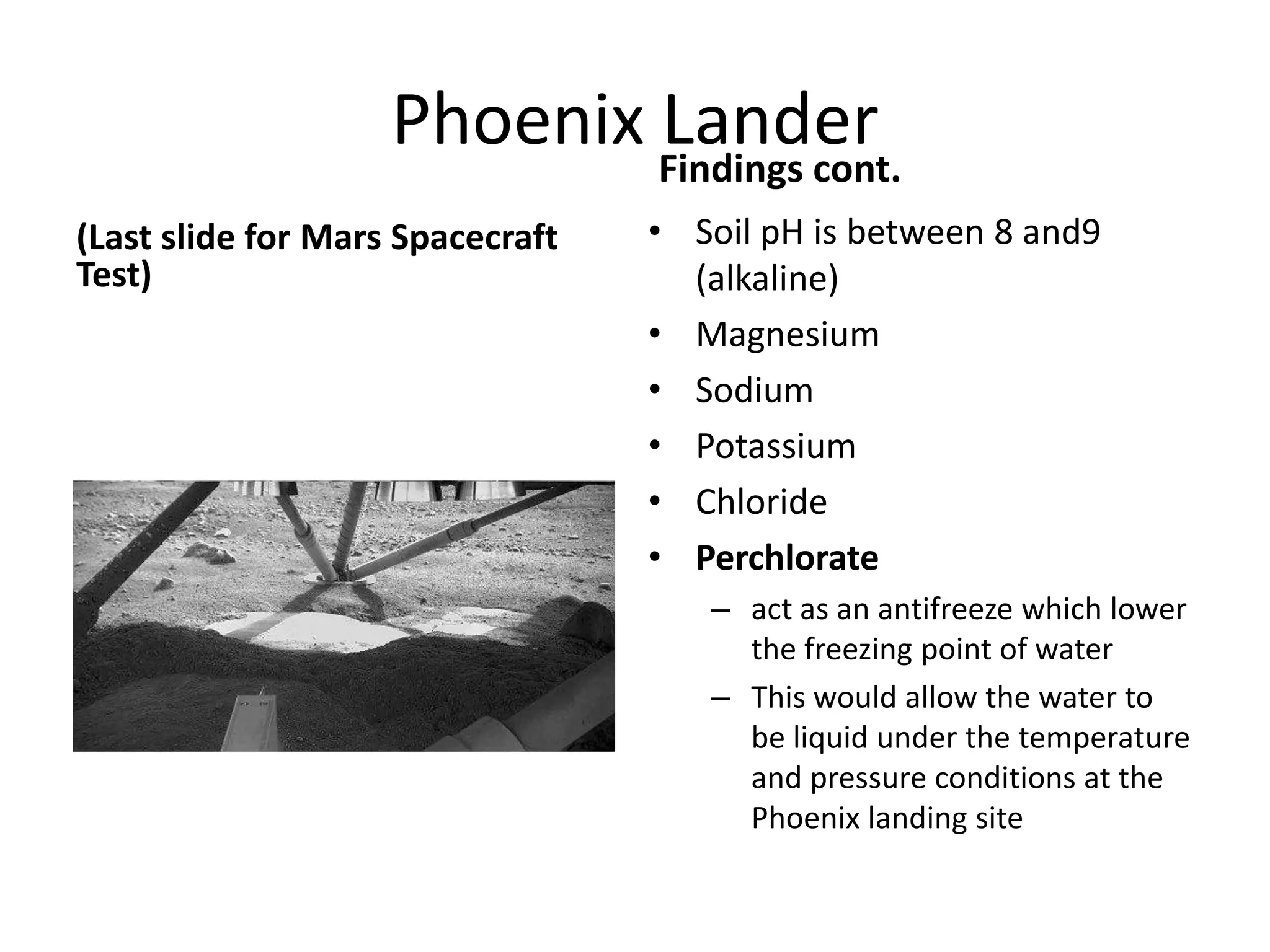
• Blobs on the struts of Phoenix
that changed size
– Were they salt water that
absorbed more water from the
atmosphere?
– Grew for 44 sols and then
evaporated
Phoenix landscape

sublimation
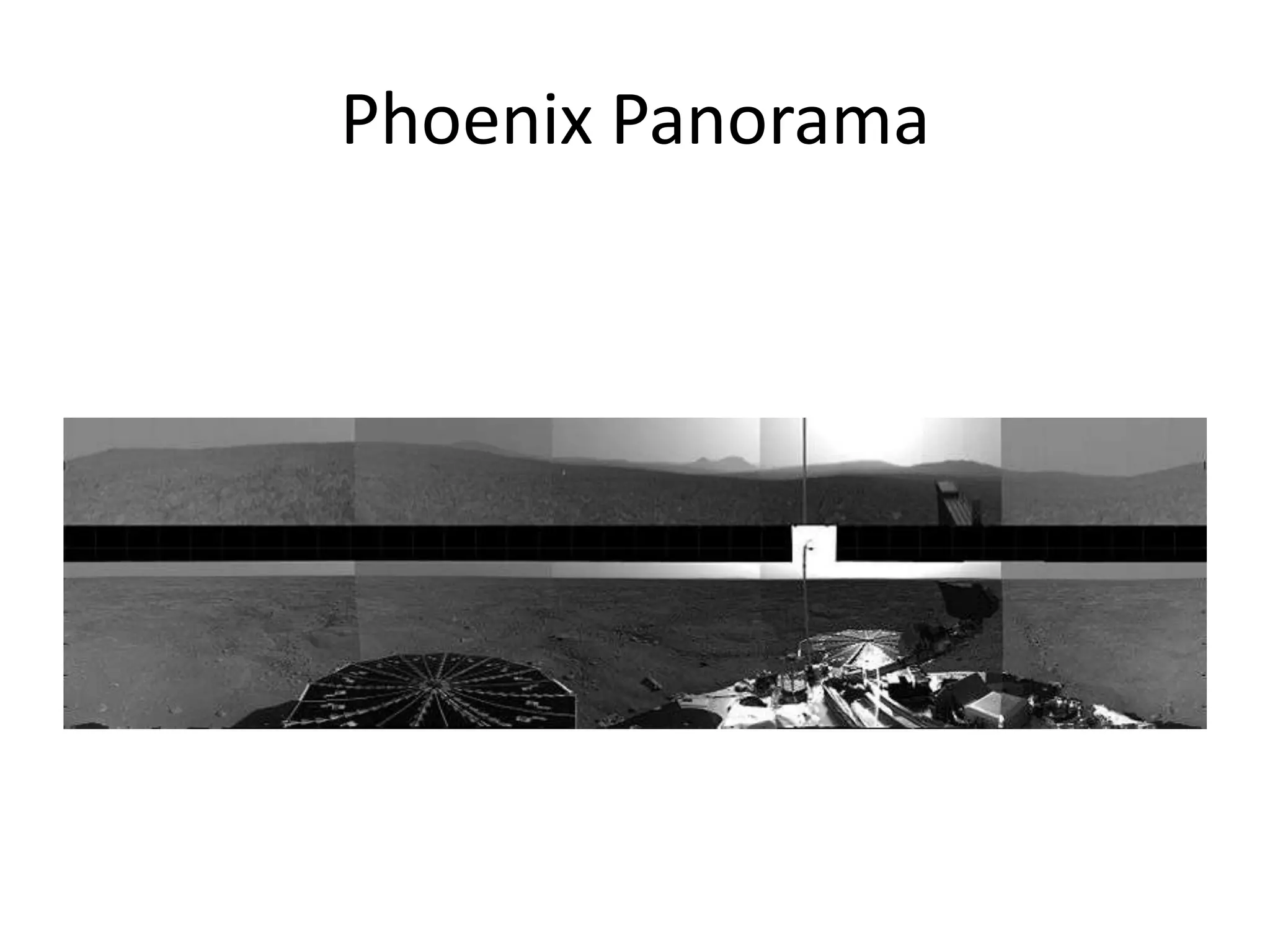
Phoenix Panorama
Phoenix Findings cont.
Lander
(Last slide for Mars Spacecraft
Test)

• Soil pH is between 8 and9
(alkaline)
• Magnesium
• Sodium
• Potassium
• Chloride
• Perchlorate
– act as an antifreeze which lower
the freezing point of water
– This would allow the water to
be liquid under the temperature
and pressure conditions at the
Phoenix landing site

Astronomy mars section 2 student copy

  • 1.
    Martian Rovers andLanders • • • • • • • Viking 1 Viking 2 Mars Pathfinder and Sojourner Rover Spirit Rover Opportunity Rover Phoenix Lander Curiosity Rover
  • 2.
    Viking 1 &2 • Performed chemical analysis • The reaction between the iron rich soil and atmospheric Oxygen make iron oxide which gives Mars its color
  • 3.
    Martian Landers • Viking1 Orbiter • Viking 1 Lander-1976
  • 4.
    View from Viking1-Chryse Planitia
  • 5.
    Viking Mission Viking 1 •Launch Date: Aug 20, 1975 • Orbital insertion: June 19, 1976 • Lander reached surface July 20, 1976-Chryse Planitia • Mission Duration Aug 20, 1975 thru Nov 11, 1982 • Imaged in 2006 on the surface of Mars by MRO Lander Scientific Equipment • 2 cameras • Analysis tools – Metabolic – Photosynthetic – *Gas-chromatograph mass spectrometer- identifies substances in a soil sample – X-ray fluorescence spectrometer – Pressure, temperature, wind velocity sensor – A 3 axis seismometer – Various engineering sensors
  • 6.
    Viking 1 SoilAnalysis Results • Soil contained – – – – – – – – – – Silicon Iron Magnesium Aluminum Sulfur Chlorine Calcium Titanium Potassium Trace amounts of • Strontium • yttrium • The sulfur and chlorine are likely the result of evaporating sea water • All soil samples heated in the GCMS gave off water vapor • Search for life – One experiment gave a positive result for life – DEBATED to this day!! – Antarctica’s dry areas have no detectable organic compounds-but there are organisms living in the rocks
  • 7.
  • 8.
    Viking Mission Viking 2 •Launched Sept 9, 1975 • Orbital insertion August 7, 1976 • Lander reached surface Sept 3, 1976 • Mission duration Sept 9,1975 thru April 11, 1980 Lander Scientific Equipment • 2 cameras • Sampler arm with collector • Temperature sensor, wind velocity sensor • Magnet • Seismometer • *High gain antenna-sends info from the lander/rover to the orbiter and then back to Earth • X-ray fluorescence spectrometer • Pressure sensor
  • 9.
    Mars Pathfinder &Sojourner Rover Testing and Packing up Airbag testing
  • 10.
  • 11.
  • 12.
    Pathfinder-Sojourner Rover Landed nearan outflow channel Two craft landed on the surface • Pathfinder – Long life-planned for 1 month, lasted 3 months – Measured the atmosphere and atmospheric dust • Sojourner Rover – Chemical analysis of soil and rocks-consistent w/flood waters – Round pebbles – Travelled 50 m
  • 13.
    Mars Pathfinder (lander) •Launch date Dec 4, 1996 • Landed July 4, 1997 • Used the airbag touchdown • Consisted of a Lander and a Rover • Mission ended Sept 27, 1997 • MRO photographed the Pathfinder from orbit • Scientific instruments – Camera – Meteorology package – X-ray Spectrometer • These instruments measured: – Geology – Geochemistry – Magnetic and mechanical properties – Atmosphere and rotational dynamics
  • 14.
    More Pathfinder results •Atmospheric particle size= 1 μm (1 millionth of a meter) • Soil test indicated a warmer and wetter past • Magnets determined soil contained maghemite (not pure magnetite) • Using Doppler it was determined the core is solid
  • 15.
    Scientific equipment Findings • 3cameras • Confirmed previous volcanic activity • Laser striper hazard detection • Found basaltic rock system • Found elements: • X-ray spectrometer – Silicon • Sojourner Rover (climbed off – Examines chemical – Magnesium iron silicate composition of soil Pathfinder) ***First rover to be – Aluminum silicates of Accelerometers deployed on another planet*** – Measures proper acceleration • Potentiometers – Controls and measures electrical devices • Potassium • Sodium • Calcium – – – – Quartz (silicon dioxide) Magnetite Iron sulfide Calcium phosphates
  • 16.
    Magnetite on theSurface of Mars • Magnetite was an important find on the surface of Mars because: – Magnetite (Fe3 O4 ) • can be broken down into FeO. Fe2O3 • one part wustite and one part hematite • hematite is only formed in the presence of water – Magnetite is known to be (on Earth) in bacteria, brains of bees, termites, fish, mollusc teeth, some birds, and humans • Used to detect polarity or the inclination of the Earth’s magnetic field
  • 17.
    Delta II HeavyLifter-Spirit and Opportunity Launch Vehicle Launch Patch
  • 18.
  • 19.
    • Mars Exploration RoverMission-twin rovers-Managed by the Jet Propulsion Laboratory Spirit and Opportunity Rovers
  • 20.
    Earth from Mars-pictaken by Spirit
  • 21.
    Spirit Rover maps Landingsite Traverse Map
  • 22.
  • 23.
    Spirit Rover What didSpirit do? • Gusev Crater • Named site “Columbia Memorial Stadium” • Landed Jan 4, 2004 • Planned mission 90 sols(Martian days) • Got stuck in soil on May 1, 2009 • Worked as a lander after that • Last communication March 2010 • Travelled 7,730.48 m or 4.8 mi • Histories first grinding of a rock on Mars-using the Rock Abrasion Tool (RAT) – Adirondack • Solar Panel efficiency jumped from 60% to 93% in March 2005dust devils cleared off the solar panels – http://marsrovers.jpl.nasa.gov/gall ery/press/spirit/20050527a.html • In 2007, Spirit’s stuck wheel revealed a silica rich soil which is similar to hot spring environments on Earth – On Earth, bacteria thrive in hot springs
  • 24.
  • 25.
  • 26.
    Spirit Rover cont. ScienceInstruments Mission and Findings • Panoramic camera • Navigation camera • Mini Thermal Emission Spectrometer (Mini-TES) • Look for evidence of water • Mineral composition of soil and rocks – ID’s rocks for investigation • Mossbauer spectrometer – Determines mineral content • Alpha particle spectrometer – Determines abundance of elements • Magnets – Collects magnetic dust particles • Microscopic imager – Close-up images of rocks • Rock Abrasion Tool (RAT) – Exposes rock surface – Including iron-containing minerals • Determine geologic processes and how they effect the chemistry of the planet • Assess habitability (life) • Spirit Rover found magnetite in the dust and soil on Mars • Evidence of past water
  • 27.
  • 28.
  • 29.
  • 30.
  • 31.
    Opportunity Rover What didOpportunity do? • Launched July 7, 2003 • Landed Jan 25, 2004 • Eagle Crater – Challenger Memorial Stadium • Planned mission 90 sols (Martian days) • Currently still operating on Mars • Longest Mars surface mission • First discovery of a meteor on another planet –named Heat Shield Rock • Studied Victoria Crater for 2 years • Studied many other craters – Endurance Crater – Erebus Crater • Studying Matijevic Hill overlooking Endeavor Crater • As of Aug 2012 she has travelled 21 miles
  • 32.
    Opportunity Cont. Science Instruments •Panoramic camera • Navigation camera • Mini Thermal Emission Spectrometer (Mini-TES) – ID’s rocks for investigation • Mossbauer spectrometer – Determines mineral content • Alpha particle spectrometer – Determines abundance of elements • Magnets – Collects magnetic dust particles • Microscopic imager – Close-up images of rocks • Rock Abrasion Tool (RAT) – Exposes rock surface Mission and Findings • Reinforced previous findings of the evidence of previous liquid water on Mars • Hematite-nicknamed blueberries • Has made astronomical observations • Has taken atmospheric data
  • 33.
  • 34.
  • 35.
  • 36.
  • 37.
    Heat Shield & HeatShield Rock
  • 38.
  • 39.
  • 40.
  • 41.
    Phoenix Lander Phoenix MarsLanding: Nerves and Joy • Video-youtube • http://www.youtube.com/w atch?v=hH5pNFROlYU • Launched-Aug 4, 2007 • Landed- May 25, 2008 • Shutdown-November 10, 2008 • Planned for 90 sols, actual duration 125 sols
  • 42.
  • 43.
  • 44.
    Phoenix Lander Scientific instruments •Used MRO to relay info to Earth • Robotic arm • Wet Chemistry Lab – Microscopy, Electrochemistry, and Conductivity Analyzer (MECA) – Thermal and Evolved Gas Analyzer (TEGA) • Soil heated to 1,000 C which causes the gases to be released and sent to the mass spectrometer for analysis – Microscopic imager Findings • Polygon shaped surface features – Ice expands and contracts with temperature change, soil falls into the cracks • Photographed ice sublimation • Water vapor detected by TEGA’s mass spectrometer • CONFIRMED WATER ICE ON MARS • Blobs on the struts of Phoenix that changed size – Were they salt water that absorbed more water from the atmosphere? – Grew for 44 sols and then evaporated
  • 45.
  • 46.
  • 47.
    Phoenix Findings cont. Lander (Lastslide for Mars Spacecraft Test) • Soil pH is between 8 and9 (alkaline) • Magnesium • Sodium • Potassium • Chloride • Perchlorate – act as an antifreeze which lower the freezing point of water – This would allow the water to be liquid under the temperature and pressure conditions at the Phoenix landing site