ISRO MARS
MISSION
is beneficial or waste of money

Debipriya Patanaik
Prity kumari
Ratan lal Diggi
Niru kumari
Smuriti ranjan parida
Surjojyoti modak
Swayamshiddha panda
INTRODUCTION
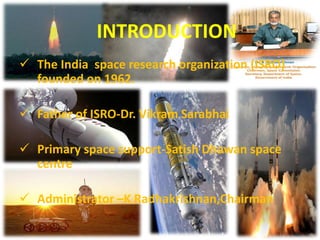
 The India space research organization (ISRO)
founded on 1962.
 Father of ISRO-Dr. Vikram Sarabhai
 Primary space support-Satish Dhawan space
centre
 Administrator –K Radhakrishnan,Chairman
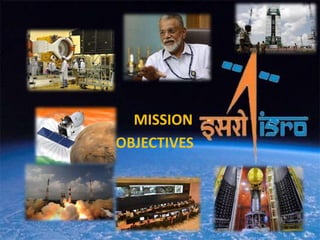
MISSION
INSIGHT &
OBJECTIVES
MISSION
OBJECTIVES
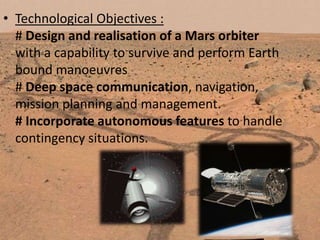
• Technological Objectives :
# Design and realisation of a Mars orbiter
with a capability to survive and perform Earth
bound manoeuvres
# Deep space communication, navigation,
mission planning and management.
# Incorporate autonomous features to handle
contingency situations.
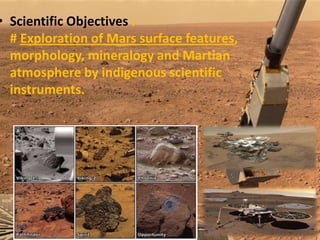
• Scientific Objectives :
# Exploration of Mars surface features,
morphology, mineralogy and Martian
atmosphere by indigenous scientific
instruments.
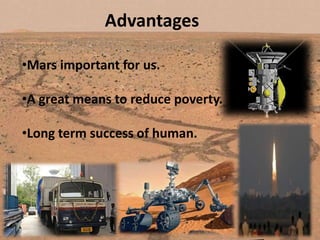
Advantages
•Mars important for us.
•A great means to reduce poverty.

•Long term success of human.
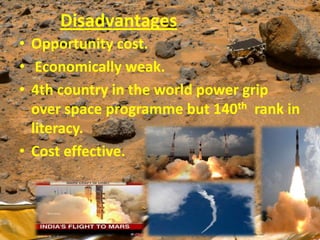
Disadvantages
• Opportunity cost.
• Economically weak.
• 4th country in the world power grip
over space programme but 140th rank in
literacy.
• Cost effective.
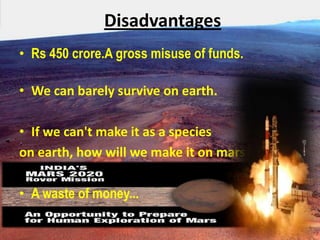
Disadvantages
• Rs 450 crore.A gross misuse of funds.

• We can barely survive on earth.
• If we can't make it as a species
on earth, how will we make it on mars?

• A waste of money...
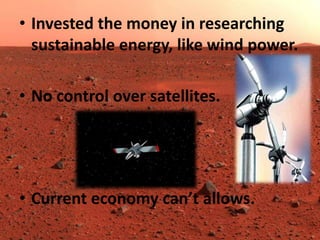
• Invested the money in researching
sustainable energy, like wind power.
• No control over satellites.

• Current economy can’t allows.
Conclusion
• The exploration of Mars has taken place over
hundreds of years, beginning in earnest with
the invention and development of the telescope during
the 1600s. Increasingly, Probes sent from Earth
beginning in the late 20th century have yielded a
dramatic increase in knowledge about the Martian
system, focused primarily on understanding its geology
and possible habitability potential
• And in a concluding note, India’s mars mission can
never be a wastage of money as after successful
completion of this mission it has become a
technological leap that has propelled India ahead of
space rivals china and Japan.
Thank You

Any
Queries….

ISRO MARS MISSION

  • 1.
    ISRO MARS MISSION is beneficialor waste of money Debipriya Patanaik Prity kumari Ratan lal Diggi Niru kumari Smuriti ranjan parida Surjojyoti modak Swayamshiddha panda
  • 3.
    INTRODUCTION  The Indiaspace research organization (ISRO) founded on 1962.  Father of ISRO-Dr. Vikram Sarabhai  Primary space support-Satish Dhawan space centre  Administrator –K Radhakrishnan,Chairman
  • 4.
  • 5.
  • 8.
    • Technological Objectives: # Design and realisation of a Mars orbiter with a capability to survive and perform Earth bound manoeuvres # Deep space communication, navigation, mission planning and management. # Incorporate autonomous features to handle contingency situations.
  • 9.
    • Scientific Objectives: # Exploration of Mars surface features, morphology, mineralogy and Martian atmosphere by indigenous scientific instruments.
  • 10.
    Advantages •Mars important forus. •A great means to reduce poverty. •Long term success of human.
  • 11.
    Disadvantages • Opportunity cost. •Economically weak. • 4th country in the world power grip over space programme but 140th rank in literacy. • Cost effective.
  • 12.
    Disadvantages • Rs 450crore.A gross misuse of funds. • We can barely survive on earth. • If we can't make it as a species on earth, how will we make it on mars? • A waste of money...
  • 13.
    • Invested themoney in researching sustainable energy, like wind power. • No control over satellites. • Current economy can’t allows.
  • 14.
    Conclusion • The explorationof Mars has taken place over hundreds of years, beginning in earnest with the invention and development of the telescope during the 1600s. Increasingly, Probes sent from Earth beginning in the late 20th century have yielded a dramatic increase in knowledge about the Martian system, focused primarily on understanding its geology and possible habitability potential • And in a concluding note, India’s mars mission can never be a wastage of money as after successful completion of this mission it has become a technological leap that has propelled India ahead of space rivals china and Japan.
  • 15.