


“Understand the differences; act on the
commonalities.”
-Andrew Masondo, African National Congress
CROSS CULTURAL
COMMUNICATION
▸ Cultures
▸ Communication
▸ Cultural Differences
▸ Barriers
▸ Tips for effective Cross
Cultural Communication
And cross cultural
bloopers For Fun 
Communication
When Pepsico advertised Pepsi
in Taiwan with the ad "Come
Alive With Pepsi" they had no
idea that it would be translated
into Chinese as "Pepsi brings
your ancestors back from the
dead."
Blooper 1
Cross Culture
Communication is all
about Understanding the
differences &
commonalities between
different cultures and
discriminate accordingly.
Cross Cultural Communication
▸ Globalization
▸ Business Opportunities
▸ Job Opportunities
▸ Sharing of views &
ideas
▸ Talent improvisation
▸ An understanding of
diverse market
Importance??
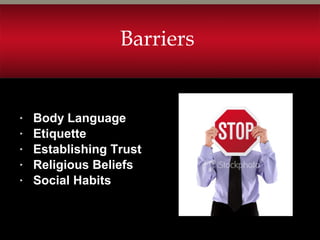
▸ Body Language
▸ Etiquette
▸ Establishing Trust
▸ Religious Beliefs
▸ Social Habits
Barriers
Tips for effective Cross Culture
Communication
 Even when English is the common
language in a cross cultural situation,
this does not mean you should speak at
normal speed.
 Slow down, speak clearly and ensure
your pronunciation is intelligible.
1. Slow Down
2. Separate Questions
 Try not to ask double questions such as, “Do
you want to carry on or shall we stop here?”
 In a cross cultural situation only the first or
second question may have been
comprehended.
 Let your listener answer one question at a
time.
• Many cross cultural communication
misunderstandings have been caused by the use
of negative questions and answers.
• In English we answer ‘yes’ if the answer is
affirmative and ‘no’ if it is negative.
• In other cultures a ‘yes’ or ‘no’ may only be
indicating whether the questioner is right or wrong.
• For example, the response to “Are you not
coming?” may be ‘yes’, meaning ‘Yes, I am not
coming.’
3. Avoid Negative Questions
 Cross cultural communication is enhanced
through taking turns to talk, making a point
and then listening to the response.
4. Take Turns
 If you are unsure whether something has
been understood write it down and
check.
 This can be useful when using large
figures.
 For example, a billion in the USA is
1,000,000,000,000 while in the UK it is
1,000,000,000.
5. Write it down
Effective cross cultural communication
is in essence about being comfortable.
Giving encouragement to those with
weak English gives them confidence,
support and a trust in you.
6. Be Supportive
7. Check Meanings
When communicating across cultures never
assume the other party has understood.
Be an active listener.
Summarize what has been said in order to
verify it.
This is a very effective way of ensuring
accurate cross cultural communication has
taken place.
Blooper 2
In 2002, Umbro the UK sports manufacturer had
to withdraw its new trainers (sneakers) called the
Zyklon. The firm received complaints from many
organisations and individuals as it was the name of
the gas used by the Nazi regime to murder millions
of Jews in concentration camps.
8. Avoid Slangs
Even the most well educated foreigner will not
have a complete knowledge of slang, idioms
and sayings.
The danger is that the words will be
understood but the meaning missed.
▸ The Japanese company Matsushita Electric was promoting a
new Japanese PC for internet users. Panasonic created the new
web browser and had received license to use the cartoon
character Woody Woodpecker as an interactive internet guide.
The day before the huge marketing campaign, Panasonic
realised its error and pulled the plug. Why? The ads for the
new product featured the following slogan:
 "Touch Woody - The Internet Pecker." The company only
realised its cross cultural blunder when an embarrassed
American explain what "touch Woody's pecker" could be
interpreted as!
Blooper 3
In many cultures business is taken very seriously.
Professionalism and protocol are constantly
observed.
Many cultures will not appreciate the use of humor
and jokes in the business context.
When using humor think whether it will be
understood in the other culture.
For example, British sarcasm usually has a negative
effect abroad.
9. Watch the humor
Many cultures have certain etiquette when
communicating.
It is always a good idea to undertake some cross
cultural awareness training or at least do some
research on the target culture.
10. Maintain Etiquette
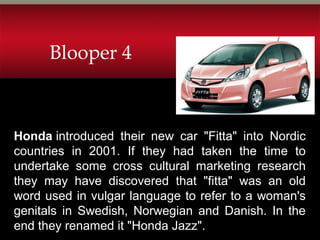
Honda introduced their new car "Fitta" into Nordic
countries in 2001. If they had taken the time to
undertake some cross cultural marketing research
they may have discovered that "fitta" was an old
word used in vulgar language to refer to a woman's
genitals in Swedish, Norwegian and Danish. In the
end they renamed it "Honda Jazz".
Blooper 4
• Cross cultural communication is about dealing
with people from other cultures in a way that
minimizes misunderstandings and maximizes
your potential to create strong cross cultural
relationships.
• The above tips should be seen as a starting point
to greater cross cultural awareness
Conclusion

Cross Cultural Communication

  • 1.
    “Understand the differences;act on the commonalities.” -Andrew Masondo, African National Congress CROSS CULTURAL COMMUNICATION
  • 2.
    ▸ Cultures ▸ Communication ▸Cultural Differences ▸ Barriers ▸ Tips for effective Cross Cultural Communication And cross cultural bloopers For Fun 
  • 5.
  • 6.
    When Pepsico advertisedPepsi in Taiwan with the ad "Come Alive With Pepsi" they had no idea that it would be translated into Chinese as "Pepsi brings your ancestors back from the dead." Blooper 1
  • 7.
    Cross Culture Communication isall about Understanding the differences & commonalities between different cultures and discriminate accordingly. Cross Cultural Communication
  • 8.
    ▸ Globalization ▸ BusinessOpportunities ▸ Job Opportunities ▸ Sharing of views & ideas ▸ Talent improvisation ▸ An understanding of diverse market Importance??
  • 9.
    ▸ Body Language ▸Etiquette ▸ Establishing Trust ▸ Religious Beliefs ▸ Social Habits Barriers
  • 10.
    Tips for effectiveCross Culture Communication
  • 11.
     Even whenEnglish is the common language in a cross cultural situation, this does not mean you should speak at normal speed.  Slow down, speak clearly and ensure your pronunciation is intelligible. 1. Slow Down
  • 12.
    2. Separate Questions Try not to ask double questions such as, “Do you want to carry on or shall we stop here?”  In a cross cultural situation only the first or second question may have been comprehended.  Let your listener answer one question at a time.
  • 13.
    • Many crosscultural communication misunderstandings have been caused by the use of negative questions and answers. • In English we answer ‘yes’ if the answer is affirmative and ‘no’ if it is negative. • In other cultures a ‘yes’ or ‘no’ may only be indicating whether the questioner is right or wrong. • For example, the response to “Are you not coming?” may be ‘yes’, meaning ‘Yes, I am not coming.’ 3. Avoid Negative Questions
  • 14.
     Cross culturalcommunication is enhanced through taking turns to talk, making a point and then listening to the response. 4. Take Turns
  • 15.
     If youare unsure whether something has been understood write it down and check.  This can be useful when using large figures.  For example, a billion in the USA is 1,000,000,000,000 while in the UK it is 1,000,000,000. 5. Write it down
  • 16.
    Effective cross culturalcommunication is in essence about being comfortable. Giving encouragement to those with weak English gives them confidence, support and a trust in you. 6. Be Supportive
  • 17.
    7. Check Meanings Whencommunicating across cultures never assume the other party has understood. Be an active listener. Summarize what has been said in order to verify it. This is a very effective way of ensuring accurate cross cultural communication has taken place.
  • 18.
    Blooper 2 In 2002,Umbro the UK sports manufacturer had to withdraw its new trainers (sneakers) called the Zyklon. The firm received complaints from many organisations and individuals as it was the name of the gas used by the Nazi regime to murder millions of Jews in concentration camps.
  • 19.
    8. Avoid Slangs Eventhe most well educated foreigner will not have a complete knowledge of slang, idioms and sayings. The danger is that the words will be understood but the meaning missed.
  • 20.
    ▸ The Japanesecompany Matsushita Electric was promoting a new Japanese PC for internet users. Panasonic created the new web browser and had received license to use the cartoon character Woody Woodpecker as an interactive internet guide. The day before the huge marketing campaign, Panasonic realised its error and pulled the plug. Why? The ads for the new product featured the following slogan:  "Touch Woody - The Internet Pecker." The company only realised its cross cultural blunder when an embarrassed American explain what "touch Woody's pecker" could be interpreted as! Blooper 3
  • 21.
    In many culturesbusiness is taken very seriously. Professionalism and protocol are constantly observed. Many cultures will not appreciate the use of humor and jokes in the business context. When using humor think whether it will be understood in the other culture. For example, British sarcasm usually has a negative effect abroad. 9. Watch the humor
  • 22.
    Many cultures havecertain etiquette when communicating. It is always a good idea to undertake some cross cultural awareness training or at least do some research on the target culture. 10. Maintain Etiquette
  • 23.
    Honda introduced theirnew car "Fitta" into Nordic countries in 2001. If they had taken the time to undertake some cross cultural marketing research they may have discovered that "fitta" was an old word used in vulgar language to refer to a woman's genitals in Swedish, Norwegian and Danish. In the end they renamed it "Honda Jazz". Blooper 4
  • 24.
    • Cross culturalcommunication is about dealing with people from other cultures in a way that minimizes misunderstandings and maximizes your potential to create strong cross cultural relationships. • The above tips should be seen as a starting point to greater cross cultural awareness Conclusion

Editor's Notes

  • #4 Culture is a group which shapes a person’s value & identity. Above mentioned are the cultural identities of a person or a group.
  • #5 Culture is a filter set in everyone’s mind through which one thinks, acts & interacts. It is a central to what you see, how you make sense of what you see and how you express yourself.
  • #6 Communication is the act or process of using words, sounds, signs or behaviors to express or exchange information or to express your ideas, thoughts, feelings etc. to someone else with least possible loss of meaning.