





Factors Influencing Instructor Success in Online CoursesPhil Ice, Ed.D.SALT, Washington Interactive Technologies Conference2009
What Factors Influence Instructor Success in Online Courses?
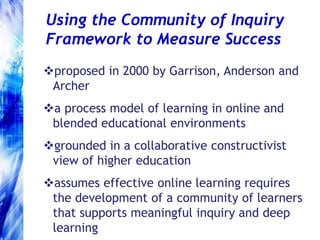
Using the Community of Inquiry Framework to Measure Successproposed in 2000 by Garrison, Anderson and Archer
a process model of learning in online and blended educational environments
grounded in a collaborative constructivist view of higher education
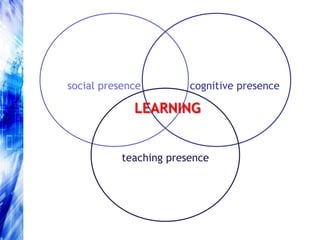
assumes effective online learning requires the development of a community of learners that supports meaningful inquiry and deep learningsocial presencecognitive presenceLEARNINGteaching presence
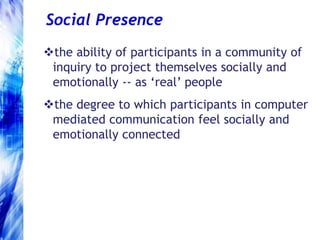
Social Presencethe ability of participants in a community of inquiry to project themselves socially and emotionally -- as ‘real’ people
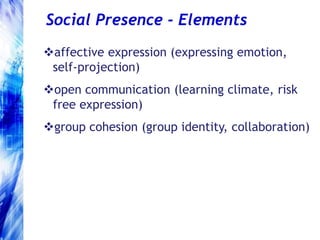
the degree to which participants in computer mediated communication feel socially and emotionally connected Social Presence - Elementsaffective expression (expressing emotion, self-projection)
open communication (learning climate, risk free expression)
group cohesion (group identity, collaboration)Cognitive Presencethe extent to which learners are able to construct and confirm meaning through sustained reflection and discourse in a critical community of inquiry Cognitive Presence - Elementstriggering event (sense of puzzlement)
exploration (sharing information & ideas)
integration (connecting ideas)
resolution (synthesizing & applying new ideas)Teaching Presencethe design, facilitation and direction of cognitive and social processes for the purpose of realizing personally meaningful and educationally worthwhile learning outcomesTeaching Presence - Elementsdesign and organization (setting curriculum & activities)
 facilitation (shaping constructive discourse)
 direct instruction (focusing & resolving issues)Community of Inquiry Survey9 social presence items (3 affective expression, 3 open communication, 3 group cohesion)
12 cognitive presence items (3 triggering, 3 exploration, 3 integration, 3 resolution)
13 teaching presence items (4 design & facilitation, 6 facilitation of discourse, 3 direct instruction)CoI Survey Validationtested in graduate courses at four institutions in the US and Canada
principal component factor analysis
three factor model predicted by CoI framework confirmed
Arbaugh, Cleveland-Innes, Diaz, Garrison, Ice, Richardson, Shea & Swan – 2008
now the most frequently cited process model in the literature (over 350 citations – Google Scholar)Commonly Accepted FactorsCourses Previously TaughtInstitutional TrainingTechnical Support	Pedagogical Guidance Origin of DegreeDegree Level
Study 1West Virginia University
Impact of Pedagogical Training and Technical Support (n = 18 instructor and 512 students)
Training and Support hours regressed on Teaching Presence Subscales of Facilitation of Discourse and Direct Instruction
Number of courses previously taught was treated as a co-variableStudy 1The equation was significant - HOWEVER
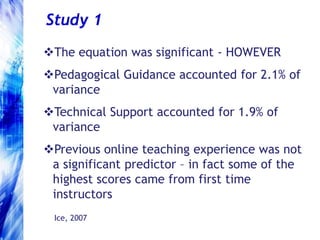
Pedagogical Guidance accounted for 2.1% of variance
Technical Support accounted for 1.9% of variance
Previous online teaching experience was not a significant predictor – in fact some of the highest scores came from first time instructorsIce, 2007
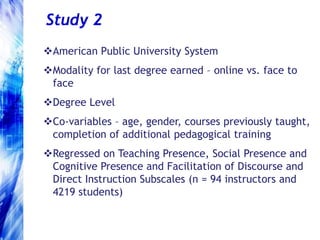
Study 2American Public University System

SALT 2009 - Faculty Success

  • 1.
    Factors Influencing InstructorSuccess in Online CoursesPhil Ice, Ed.D.SALT, Washington Interactive Technologies Conference2009
  • 2.
    What Factors InfluenceInstructor Success in Online Courses?
  • 3.
    Using the Communityof Inquiry Framework to Measure Successproposed in 2000 by Garrison, Anderson and Archer
  • 4.
    a process modelof learning in online and blended educational environments
  • 5.
    grounded in acollaborative constructivist view of higher education
  • 6.
    assumes effective onlinelearning requires the development of a community of learners that supports meaningful inquiry and deep learningsocial presencecognitive presenceLEARNINGteaching presence
  • 7.
    Social Presencethe abilityof participants in a community of inquiry to project themselves socially and emotionally -- as ‘real’ people
  • 8.
    the degree towhich participants in computer mediated communication feel socially and emotionally connected Social Presence - Elementsaffective expression (expressing emotion, self-projection)
  • 9.
    open communication (learningclimate, risk free expression)
  • 10.
    group cohesion (groupidentity, collaboration)Cognitive Presencethe extent to which learners are able to construct and confirm meaning through sustained reflection and discourse in a critical community of inquiry Cognitive Presence - Elementstriggering event (sense of puzzlement)
  • 11.
  • 12.
  • 13.
    resolution (synthesizing &applying new ideas)Teaching Presencethe design, facilitation and direction of cognitive and social processes for the purpose of realizing personally meaningful and educationally worthwhile learning outcomesTeaching Presence - Elementsdesign and organization (setting curriculum & activities)
  • 14.
    facilitation (shapingconstructive discourse)
  • 15.
    direct instruction(focusing & resolving issues)Community of Inquiry Survey9 social presence items (3 affective expression, 3 open communication, 3 group cohesion)
  • 16.
    12 cognitive presenceitems (3 triggering, 3 exploration, 3 integration, 3 resolution)
  • 17.
    13 teaching presenceitems (4 design & facilitation, 6 facilitation of discourse, 3 direct instruction)CoI Survey Validationtested in graduate courses at four institutions in the US and Canada
  • 18.
  • 19.
    three factor modelpredicted by CoI framework confirmed
  • 20.
    Arbaugh, Cleveland-Innes, Diaz,Garrison, Ice, Richardson, Shea & Swan – 2008
  • 21.
    now the mostfrequently cited process model in the literature (over 350 citations – Google Scholar)Commonly Accepted FactorsCourses Previously TaughtInstitutional TrainingTechnical Support Pedagogical Guidance Origin of DegreeDegree Level
  • 22.
  • 23.
    Impact of PedagogicalTraining and Technical Support (n = 18 instructor and 512 students)
  • 24.
    Training and Supporthours regressed on Teaching Presence Subscales of Facilitation of Discourse and Direct Instruction
  • 25.
    Number of coursespreviously taught was treated as a co-variableStudy 1The equation was significant - HOWEVER
  • 26.
    Pedagogical Guidance accountedfor 2.1% of variance
  • 27.
    Technical Support accountedfor 1.9% of variance
  • 28.
    Previous online teachingexperience was not a significant predictor – in fact some of the highest scores came from first time instructorsIce, 2007
  • 29.
    Study 2American PublicUniversity System