PGCAP > DAPP
http://www.celt.mmu.ac.uk/ @mmu_celt #dapp162
Chrissi Nerantzi @chrissinerantzi
http://theatre.univ-montp3.fr/sites/default/files/pictures/water-373780_960_7201.jpg
DAPP
Reflection
The UK PSF
Observations of Teaching
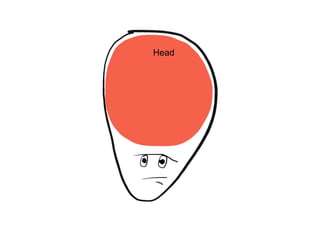
Can I take a picture of you like this?
Head
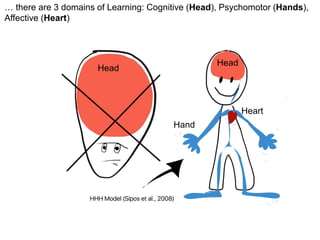
Head
Head
Heart
Hand
… there are 3 domains of Learning: Cognitive (Head), Psychomotor (Hands),
Affective (Heart)
"The Teacher and the book are no longer the
only instructors; the hands, the eyes, the ears,
in fact the whole body, become sources of
information, while teacher and textbook
become respectively the starter and the
tester. No book or map is a substitute for
personal experience; they cannot take the place
of the actual journey" (Dewey, Schools of To-
morrow 1915, 74).
intended learning outcomes
By the end of this theme, you will have had the opportunity
to:
• introduce yourselves
• discuss the DAPP unit including assessment
• discuss experiential learning and learning through
reflection to enhance practice
• recognise the importance of observation of teaching and
discuss key characteristics of how to conduct effective
observations
• examine the UK Professional Standards Framework (PSF)
and recognise its importance for own professional
development
6
Introductions
http://theatre.univ-montp3.fr/sites/default/files/pictures/water-373780_960_7201.jpg
DAPP and assessment
http://theatre.univ-montp3.fr/sites/default/files/pictures/water-373780_960_7201.jpg
Unit learning outcomes
• On successful completion of this unit students will be able to:
• Critically apply appropriate theories to the design and teaching of an episode of inclusive learning.
• Design and teach constructively aligned sessions to a diverse student community.
• Engage with key institutional and national strategic drivers appropriate to their professional practice
• Critically analyse and reflect on observations of practice (including assessment), using an appropriate model of
reflection, in order to enhance personal professional development.
Assessment
Negotiated reflective narrative in a portfolio that directly links to your teaching/supporting students practice and meets
the above learning outcomes. 2500 words
• Start in your portfolio what was agreed with your tutor
• Use a reflective model
• Observe and be observed (twice is ok)
• Think about diversity, inclusivity, the learning environment, institutional and national drivers
• Link to the PSF throughout
• Consider a digital portfolio, also useful for FLEX, Creativity units
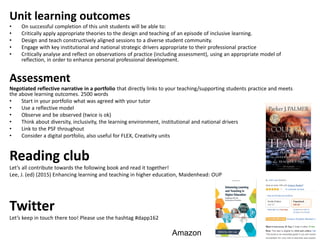
Reading club
Let’s all contribute towards the following book and read it together!
Lee, J. (ed) (2015) Enhancing learning and teaching in higher education, Maidenhead: OUP
Twitter
Let’s keep in touch there too! Please use the hashtag #dapp162
Amazon
http://theatre.univ-montp3.fr/sites/default/files/pictures/water-373780_960_7201.jpg
Reflection
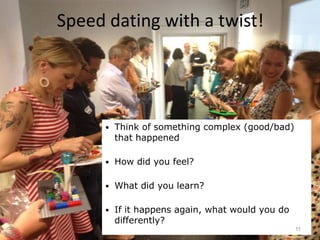
Speed dating with a twist!
 Think of something complex (good/bad)
that happened
 How did you feel?
 What did you learn?
 If it happens again, what would you do
differently?
11
What is reflection?
“Reflection is a form of mental processing – like a form of thinking – that we
may use to fulfil a purpose or to achieve some anticipated outcome or we
may simply ‘be reflective’ and then an outcome can be unexpected.
Reflection is applied to relatively complicated, ill-structured ideas for which
there is not an obvious solution and is largely based on the further
processing of knowledge and understanding that we already possess.”
Moon (2004, p. 82)
12
What 3 words in this quote stand
out as most important to you?
“If…
… I want to teach well, it is essential that I explore
my inner terrain. But I can get lost in there,
practising self-delusion and running in self-serving
circles. So I need the guidance that a community of
collegial discourse provides – to say nothing of the
support such a community can offer to sustain me
in the trials about this craft that can be found in
every faculty worth its salt.”
Palmer, P J (2007) The Courage to teach. Exploring the inner landscape of a teacher’s life, San Francisco: Jossey-Bass, p.
146.
13
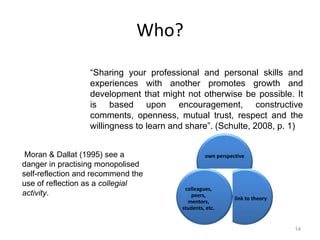
Who?
own perspective
link to theory
colleagues,
peers,
mentors,
students, etc.
14
“Sharing your professional and personal skills and
experiences with another promotes growth and
development that might not otherwise be possible. It
is based upon encouragement, constructive
comments, openness, mutual trust, respect and the
willingness to learn and share”. (Schulte, 2008, p. 1)
Moran & Dallat (1995) see a
danger in practising monopolised
self-reflection and recommend the
use of reflection as a collegial
activity.
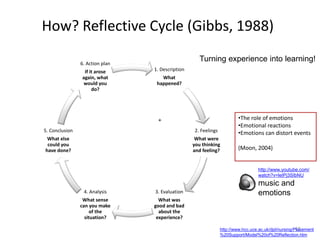
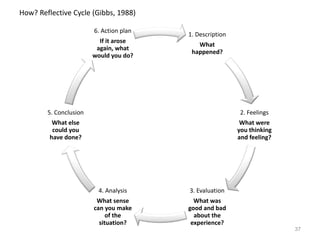
How? Reflective Cycle (Gibbs, 1988)
15
1. Description
What
happened?
2. Feelings
What were
you thinking
and feeling?
3. Evaluation
What was
good and bad
about the
experience?
4. Analysis
What sense
can you make
of the
situation?
5. Conclusion
What else
could you
have done?
6. Action plan
If it arose
again, what
would you
do?
Turning experience into learning!
http://www.hcc.uce.ac.uk/dpl/nursing/Placement
%20Support/Model%20of%20Reflection.htm
•The role of emotions
•Emotional reactions
•Emotions can distort events
(Moon, 2004)
http://www.youtube.com/
watch?v=leIPj3SIbNU
music and
emotions
16
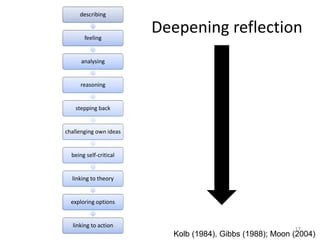
Deepening reflection
17
describing
feeling
analysing
reasoning
stepping back
challenging own ideas
being self-critical
linking to theory
exploring options
linking to action
Kolb (1984), Gibbs (1988); Moon (2004)
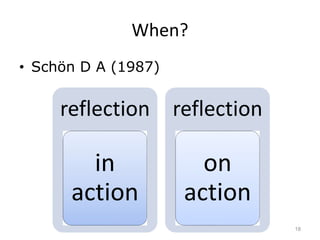
When?
• Schön D A (1987)
18
reflectionreflection
in
action
reflectionreflection
on
action
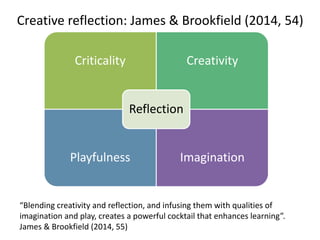
Creative reflection: James & Brookfield (2014, 54)
Criticality Creativity
Playfulness Imagination
Reflection
“Blending creativity and reflection, and infusing them with qualities of
imagination and play, creates a powerful cocktail that enhances learning”.
James & Brookfield (2014, 55)
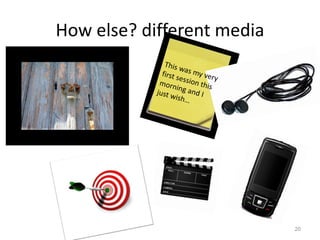
How else? different media
20
Activity in 4s.
• Read on a recent session.
• Use/adapt a reflect model.
• Share with your group.
• Discuss.
21
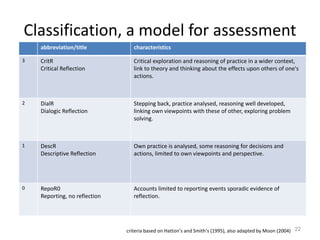
Classification, a model for assessment
22
abbreviation/title characteristics
3 CritR
Critical Reflection
Critical exploration and reasoning of practice in a wider context,
link to theory and thinking about the effects upon others of one's
actions.
2 DialR
Dialogic Reflection
Stepping back, practice analysed, reasoning well developed,
linking own viewpoints with these of other, exploring problem
solving.
1 DescR
Descriptive Reflection
Own practice is analysed, some reasoning for decisions and
actions, limited to own viewpoints and perspective.
0 RepoR0
Reporting, no reflection
Accounts limited to reporting events sporadic evidence of
reflection.
criteria based on Hatton’s and Smith’s (1995), also adapted by Moon (2004)
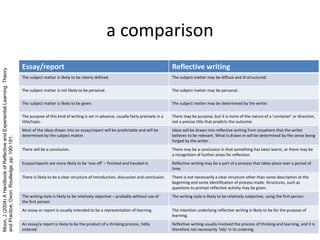
a comparison
23
Essay/report Reflective writing
The subject matter is likely to be clearly defined. The subject matter may be diffuse and ill-structured.
The subject matter is not likely to be personal. The subject matter may be personal.
The subject matter is likely to be given. The subject matter may be determined by the writer.
The purpose of this kind of writing is set in advance, usually fairly precisely in a
title/topic.
There may be purpose, but it is more of the nature of a ‘container’ or direction,
not a precise title that predicts the outcome.
Most of the ideas drawn into an essay/report will be predictable and will be
determined by the subject matter.
Ideas will be drawn into reflective writing from anywhere that the writer
believes to be relevant. What is drawn in will be determined by the sense being
forged by the writer.
There will be a conclusion. There may be a conclusion in that something has been learnt, or there may be
a recognition of further areas for reflection.
Essays/reports are more likely to be ‘one off’ – finished and handed in. Reflective writing may be a part of a process that takes place over a period of
time.
There is likely to be a clear structure of introduction, discussion and conclusion. There is not necessarily a clear structure other than some description at the
beginning and some identification of process made. Structures, such as
questions to prompt reflective activity may be given.
The writing style is likely to be relatively objective – probably without use of
the first person.
The writing style is likely to be relatively subjective, using the first person.
An essay or report is usually intended to be a representation of learning. The intention underlying reflective writing is likely to be for the purpose of
learning.
An essay/a report is likely to be the product of a thinking process, tidily
ordered.
Reflective writing usually involved the process of thinking and learning, and it is
therefore not necessarily ‘tidy’ in its ordering.
Moon,J(2004)AHandbookofReflectiveandExperientialLearning.Theory
andPractice,Oxon:Routledge,pp.190-191.
Your portfolio
• digital, online, mobile
• reflect on your journey
• use/create media-rich
artefacts
• share with tutor and peers
• commenting
• assessed
• receive feedback throughout
The same portfolio for the whole
PgCert
24
Dr Sam Illingworth
http://classroombeing.tumblr.com/post/92718631419/flex-1-exploring-the-role-of-the-expert
Start capturing your educational autobiography and outline your understanding of your own
approach to learning, your own learning journey and experiences. Your teaching philosophy will
emerge through your educational autobiography. Include a needs analysis and an action plan:
to describe existing skills and areas for further development through the module (eg from an
analysis aligned to the unit’s learning outcomes).
• You might ask yourself the following questions:
• What personal learning experiences have influenced my thoughts about teaching?
• How do I learn?
• How do my students learn?
• What does university teaching and learning mean to me?
• What do I want my students to learn?
• What do I love about teaching?
• What are my strengths as a teacher?
• What areas do I need to develop further?
• What will I do and by when?
25
Complete this by the end
of theme 1
Making a start with your portfolio:
capture your educational autobiography and
teaching philosophy
The UK PSF
http://theatre.univ-montp3.fr/sites/default/files/pictures/water-373780_960_7201.jpg
UK Professional Standards Framework
(UK PSF)
• A framework for standards!
• for teaching and supporting learning in HE
• proposed in the White Paper The Future of Higher Education (2003)
• Introduced in 2006
• Reviewed in 2011
• areas of activity, core knowledge and professional values derived from the Higher
Education Academy’s existing Accreditation Scheme
• professionalisation of teaching and supporting learning in HE
• for Fellowship of HEA & PgCert need to engage effectively with all of these
http://www.heacademy.ac.uk/assets/documents/ukpsf/ukpsf.pdf
27
The PgCert and the UK PSF
28
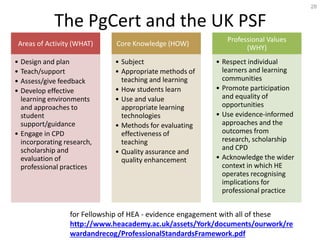
Areas of Activity (WHAT)
• Design and plan
• Teach/support
• Assess/give feedback
• Develop effective
learning environments
and approaches to
student
support/guidance
• Engage in CPD
incorporating research,
scholarship and
evaluation of
professional practices
Core Knowledge (HOW)
• Subject
• Appropriate methods of
teaching and learning
• How students learn
• Use and value
appropriate learning
technologies
• Methods for evaluating
effectiveness of
teaching
• Quality assurance and
quality enhancement
Professional Values
(WHY)
• Respect individual
learners and learning
communities
• Promote participation
and equality of
opportunities
• Use evidence-informed
approaches and the
outcomes from
research, scholarship
and CPD
• Acknowledge the wider
context in which HE
operates recognising
implications for
professional practice
for Fellowship of HEA - evidence engagement with all of these
http://www.heacademy.ac.uk/assets/York/documents/ourwork/re
wardandrecog/ProfessionalStandardsFramework.pdf
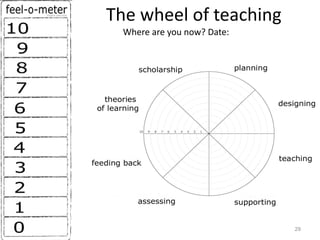
The wheel of teaching
Where are you now? Date:
29
observations of teaching/
supporting learning
http://theatre.univ-montp3.fr/sites/default/files/pictures/water-373780_960_7201.jpg
“When we walk into our workplace, the classroom, we close the
door on our colleagues. When we emerge, we rarely talk about
what happened or what needs to happen next, for we have no
shared experience to talk about. Then, instead of calling this the
isolationism it is and trying to overcome it, we claim it as a virtue
called ‘academic freedom’: my classroom is my castle, and the
sovereigns of other fiefdoms are not welcome here.”
Palmer, P J (2007) The Courage to teach. Exploring the inner landscape of a teacher’s
life, San Francisco: Jossey-Bass, p. 147.
31
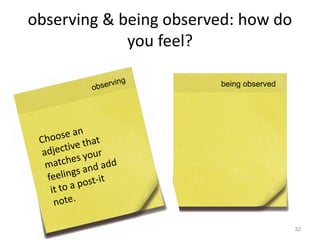
observing & being observed: how do
you feel?
32
being observed
Preparing for an observation
34
Work in small groups and come up with your top
10 tips and share with the whole class.
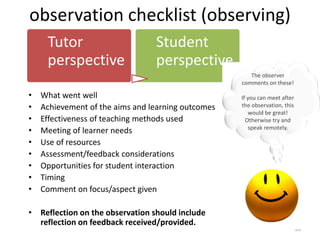
observation checklist (observing)
• What went well
• Achievement of the aims and learning outcomes
• Effectiveness of teaching methods used
• Meeting of learner needs
• Use of resources
• Assessment/feedback considerations
• Opportunities for student interaction
• Timing
• Comment on focus/aspect given
• Reflection on the observation should include
reflection on feedback received/provided.
35
Tutor
perspective
Student
perspective
The observer
comments on these!
If you can meet after
the observation, this
would be great!
Otherwise try and
speak remotely.
How? Reflective Cycle (Gibbs, 1988)
37
1. Description
What
happened?
2. Feelings
What were
you thinking
and feeling?
3. Evaluation
What was
good and bad
about the
experience?
4. Analysis
What sense
can you make
of the
situation?
5. Conclusion
What else
could you
have done?
6. Action plan
If it arose
again, what
would you do?
intended learning outcomes
By the end of this theme, you will have had the opportunity
to:
• introduce yourselves
• discuss the DAPP unit including assessment
• discuss experiential learning and learning through
reflection to enhance practice
• recognise the importance of observation of teaching and
discuss key characteristics of how to conduct effective
observations
• examine the UK Professional Standards Framework (PSF)
and recognise its importance for own professional
development
39
references
 Brown M, Fry H & Marshall S (2006) Reflective Practice, in: Fry H, Ketteridge S & Marshall S (2006) A Handbook for Teaching & Learning in Higher Education.
Enhancing Academic Practice, Oxon: RoutledgeFalmer, pp. 215-225.
 Ghaye T & Lillyman S (1997) Learning Journals and Critical Incidents: Reflective Practice for Health Care Professionals, London: Mark Allan Publishing.
 Gibbs G (1988) Learning by Doing: A guide to teaching and learning methods, Further Education Unit, Oxford: Oxford Brookes University.
 Hatton, N & Smith, D (1995) Reflection in teacher education – towards definition and implementation, Teaching and Teacher Education,11 (1), pp 33-49.
• Imel, S (1992) Reflective Practice in Adult Education, Columbus OH: ERIC Clearinghouse on Adult Career and Vocational Education, ERIC Digest No. 122
• James, A. & Brookfield S. (2014) Engaging Imagination. Helping Students become creative and reflective thinkers, San Francisco, CA: Jossey-Bass
• Kolb D A (1984) Experiential Learning, Prentice Hall, New Jersey: Englewood Cliffs.
 Lisewski, B & Cove, G (2007) Peer Observation for Teaching Code of Conduct University of Salford.
 McFarlane, B & Gourlay, L (2009) The reflection game: enacting the penitent self, Teaching in Higher Education 14/4, pp. 455-459.
 Moon, J (2005) Learning through Reflection, available at
http://www.heacademy.ac.uk/resources/detail/resource_database/id69_guide_for_busy_academics_no4_moon [accessed 15 September 2010]
 Moon, J (2004) A Handbook of Reflective and Experiential Learning. Theory and Practice, Oxon: Routledge.
 Moon, J (2004a) Reflection and employability, available at http://www.heacademy.ac.uk/resources/detail/resource_database/id331_Reflection_and_employability
[accessed 15 September 2010]
 Moran A & Dallat J (1995) Promoting reflective practice in initial teacher training, International Journal of Educational Management, MCB University Press Limited,
Vol. 9 No. 5, pp. 20-26.
 Palmer, P J (2007) The Courage to teach. Exploring the inner landscape of a teacher’s life, San Francisco: Jossey-Bass
 Peel, D (2005) Peer Observation as a Transformatory Tool? Teaching in Higher Education, 10 (4) 489-504
 Ramsden, P (1992) Learning to Teach in Higher Education London: Routledge.
 Schön D A (1987) ‘Educating the Reflective Practitioner’ , San Francisco: Jossey Bass.
 Schön, D A )1983= The Reflective Practitioner: How professionals think in action, Ashgate.
 Schulte, J (2008) Give Back – Be a Mentor!, www.ezinearticles.com [accessed 10 September 2010]
 UK Professional Standards Framework, HEA available at
http://www.heacademy.ac.uk/assets/York/documents/ourwork/rewardandrecog/ProfessionalStandardsFramework.pdf [accessed 9 Sep 2010]

2016 #DAPP162 Reflection, UK PSF, Observations >>> week 1

  • 1.
    PGCAP > DAPP http://www.celt.mmu.ac.uk/@mmu_celt #dapp162 Chrissi Nerantzi @chrissinerantzi http://theatre.univ-montp3.fr/sites/default/files/pictures/water-373780_960_7201.jpg DAPP Reflection The UK PSF Observations of Teaching
  • 2.
    Can I takea picture of you like this?
  • 3.
  • 4.
    Head Head Heart Hand … there are3 domains of Learning: Cognitive (Head), Psychomotor (Hands), Affective (Heart)
  • 5.
    "The Teacher andthe book are no longer the only instructors; the hands, the eyes, the ears, in fact the whole body, become sources of information, while teacher and textbook become respectively the starter and the tester. No book or map is a substitute for personal experience; they cannot take the place of the actual journey" (Dewey, Schools of To- morrow 1915, 74).
  • 6.
    intended learning outcomes Bythe end of this theme, you will have had the opportunity to: • introduce yourselves • discuss the DAPP unit including assessment • discuss experiential learning and learning through reflection to enhance practice • recognise the importance of observation of teaching and discuss key characteristics of how to conduct effective observations • examine the UK Professional Standards Framework (PSF) and recognise its importance for own professional development 6
  • 7.
  • 8.
  • 9.
    Unit learning outcomes •On successful completion of this unit students will be able to: • Critically apply appropriate theories to the design and teaching of an episode of inclusive learning. • Design and teach constructively aligned sessions to a diverse student community. • Engage with key institutional and national strategic drivers appropriate to their professional practice • Critically analyse and reflect on observations of practice (including assessment), using an appropriate model of reflection, in order to enhance personal professional development. Assessment Negotiated reflective narrative in a portfolio that directly links to your teaching/supporting students practice and meets the above learning outcomes. 2500 words • Start in your portfolio what was agreed with your tutor • Use a reflective model • Observe and be observed (twice is ok) • Think about diversity, inclusivity, the learning environment, institutional and national drivers • Link to the PSF throughout • Consider a digital portfolio, also useful for FLEX, Creativity units Reading club Let’s all contribute towards the following book and read it together! Lee, J. (ed) (2015) Enhancing learning and teaching in higher education, Maidenhead: OUP Twitter Let’s keep in touch there too! Please use the hashtag #dapp162 Amazon
  • 10.
  • 11.
    Speed dating witha twist!  Think of something complex (good/bad) that happened  How did you feel?  What did you learn?  If it happens again, what would you do differently? 11
  • 12.
    What is reflection? “Reflectionis a form of mental processing – like a form of thinking – that we may use to fulfil a purpose or to achieve some anticipated outcome or we may simply ‘be reflective’ and then an outcome can be unexpected. Reflection is applied to relatively complicated, ill-structured ideas for which there is not an obvious solution and is largely based on the further processing of knowledge and understanding that we already possess.” Moon (2004, p. 82) 12 What 3 words in this quote stand out as most important to you?
  • 13.
    “If… … I wantto teach well, it is essential that I explore my inner terrain. But I can get lost in there, practising self-delusion and running in self-serving circles. So I need the guidance that a community of collegial discourse provides – to say nothing of the support such a community can offer to sustain me in the trials about this craft that can be found in every faculty worth its salt.” Palmer, P J (2007) The Courage to teach. Exploring the inner landscape of a teacher’s life, San Francisco: Jossey-Bass, p. 146. 13
  • 14.
    Who? own perspective link totheory colleagues, peers, mentors, students, etc. 14 “Sharing your professional and personal skills and experiences with another promotes growth and development that might not otherwise be possible. It is based upon encouragement, constructive comments, openness, mutual trust, respect and the willingness to learn and share”. (Schulte, 2008, p. 1) Moran & Dallat (1995) see a danger in practising monopolised self-reflection and recommend the use of reflection as a collegial activity.
  • 15.
    How? Reflective Cycle(Gibbs, 1988) 15 1. Description What happened? 2. Feelings What were you thinking and feeling? 3. Evaluation What was good and bad about the experience? 4. Analysis What sense can you make of the situation? 5. Conclusion What else could you have done? 6. Action plan If it arose again, what would you do? Turning experience into learning! http://www.hcc.uce.ac.uk/dpl/nursing/Placement %20Support/Model%20of%20Reflection.htm •The role of emotions •Emotional reactions •Emotions can distort events (Moon, 2004) http://www.youtube.com/ watch?v=leIPj3SIbNU music and emotions
  • 16.
  • 17.
    Deepening reflection 17 describing feeling analysing reasoning stepping back challengingown ideas being self-critical linking to theory exploring options linking to action Kolb (1984), Gibbs (1988); Moon (2004)
  • 18.
    When? • Schön DA (1987) 18 reflectionreflection in action reflectionreflection on action
  • 19.
    Creative reflection: James& Brookfield (2014, 54) Criticality Creativity Playfulness Imagination Reflection “Blending creativity and reflection, and infusing them with qualities of imagination and play, creates a powerful cocktail that enhances learning”. James & Brookfield (2014, 55)
  • 20.
  • 21.
    Activity in 4s. •Read on a recent session. • Use/adapt a reflect model. • Share with your group. • Discuss. 21
  • 22.
    Classification, a modelfor assessment 22 abbreviation/title characteristics 3 CritR Critical Reflection Critical exploration and reasoning of practice in a wider context, link to theory and thinking about the effects upon others of one's actions. 2 DialR Dialogic Reflection Stepping back, practice analysed, reasoning well developed, linking own viewpoints with these of other, exploring problem solving. 1 DescR Descriptive Reflection Own practice is analysed, some reasoning for decisions and actions, limited to own viewpoints and perspective. 0 RepoR0 Reporting, no reflection Accounts limited to reporting events sporadic evidence of reflection. criteria based on Hatton’s and Smith’s (1995), also adapted by Moon (2004)
  • 23.
    a comparison 23 Essay/report Reflectivewriting The subject matter is likely to be clearly defined. The subject matter may be diffuse and ill-structured. The subject matter is not likely to be personal. The subject matter may be personal. The subject matter is likely to be given. The subject matter may be determined by the writer. The purpose of this kind of writing is set in advance, usually fairly precisely in a title/topic. There may be purpose, but it is more of the nature of a ‘container’ or direction, not a precise title that predicts the outcome. Most of the ideas drawn into an essay/report will be predictable and will be determined by the subject matter. Ideas will be drawn into reflective writing from anywhere that the writer believes to be relevant. What is drawn in will be determined by the sense being forged by the writer. There will be a conclusion. There may be a conclusion in that something has been learnt, or there may be a recognition of further areas for reflection. Essays/reports are more likely to be ‘one off’ – finished and handed in. Reflective writing may be a part of a process that takes place over a period of time. There is likely to be a clear structure of introduction, discussion and conclusion. There is not necessarily a clear structure other than some description at the beginning and some identification of process made. Structures, such as questions to prompt reflective activity may be given. The writing style is likely to be relatively objective – probably without use of the first person. The writing style is likely to be relatively subjective, using the first person. An essay or report is usually intended to be a representation of learning. The intention underlying reflective writing is likely to be for the purpose of learning. An essay/a report is likely to be the product of a thinking process, tidily ordered. Reflective writing usually involved the process of thinking and learning, and it is therefore not necessarily ‘tidy’ in its ordering. Moon,J(2004)AHandbookofReflectiveandExperientialLearning.Theory andPractice,Oxon:Routledge,pp.190-191.
  • 24.
    Your portfolio • digital,online, mobile • reflect on your journey • use/create media-rich artefacts • share with tutor and peers • commenting • assessed • receive feedback throughout The same portfolio for the whole PgCert 24 Dr Sam Illingworth http://classroombeing.tumblr.com/post/92718631419/flex-1-exploring-the-role-of-the-expert
  • 25.
    Start capturing youreducational autobiography and outline your understanding of your own approach to learning, your own learning journey and experiences. Your teaching philosophy will emerge through your educational autobiography. Include a needs analysis and an action plan: to describe existing skills and areas for further development through the module (eg from an analysis aligned to the unit’s learning outcomes). • You might ask yourself the following questions: • What personal learning experiences have influenced my thoughts about teaching? • How do I learn? • How do my students learn? • What does university teaching and learning mean to me? • What do I want my students to learn? • What do I love about teaching? • What are my strengths as a teacher? • What areas do I need to develop further? • What will I do and by when? 25 Complete this by the end of theme 1 Making a start with your portfolio: capture your educational autobiography and teaching philosophy
  • 26.
  • 27.
    UK Professional StandardsFramework (UK PSF) • A framework for standards! • for teaching and supporting learning in HE • proposed in the White Paper The Future of Higher Education (2003) • Introduced in 2006 • Reviewed in 2011 • areas of activity, core knowledge and professional values derived from the Higher Education Academy’s existing Accreditation Scheme • professionalisation of teaching and supporting learning in HE • for Fellowship of HEA & PgCert need to engage effectively with all of these http://www.heacademy.ac.uk/assets/documents/ukpsf/ukpsf.pdf 27
  • 28.
    The PgCert andthe UK PSF 28 Areas of Activity (WHAT) • Design and plan • Teach/support • Assess/give feedback • Develop effective learning environments and approaches to student support/guidance • Engage in CPD incorporating research, scholarship and evaluation of professional practices Core Knowledge (HOW) • Subject • Appropriate methods of teaching and learning • How students learn • Use and value appropriate learning technologies • Methods for evaluating effectiveness of teaching • Quality assurance and quality enhancement Professional Values (WHY) • Respect individual learners and learning communities • Promote participation and equality of opportunities • Use evidence-informed approaches and the outcomes from research, scholarship and CPD • Acknowledge the wider context in which HE operates recognising implications for professional practice for Fellowship of HEA - evidence engagement with all of these http://www.heacademy.ac.uk/assets/York/documents/ourwork/re wardandrecog/ProfessionalStandardsFramework.pdf
  • 29.
    The wheel ofteaching Where are you now? Date: 29
  • 30.
    observations of teaching/ supportinglearning http://theatre.univ-montp3.fr/sites/default/files/pictures/water-373780_960_7201.jpg
  • 31.
    “When we walkinto our workplace, the classroom, we close the door on our colleagues. When we emerge, we rarely talk about what happened or what needs to happen next, for we have no shared experience to talk about. Then, instead of calling this the isolationism it is and trying to overcome it, we claim it as a virtue called ‘academic freedom’: my classroom is my castle, and the sovereigns of other fiefdoms are not welcome here.” Palmer, P J (2007) The Courage to teach. Exploring the inner landscape of a teacher’s life, San Francisco: Jossey-Bass, p. 147. 31
  • 32.
    observing & beingobserved: how do you feel? 32 being observed
  • 33.
    Preparing for anobservation 34 Work in small groups and come up with your top 10 tips and share with the whole class.
  • 34.
    observation checklist (observing) •What went well • Achievement of the aims and learning outcomes • Effectiveness of teaching methods used • Meeting of learner needs • Use of resources • Assessment/feedback considerations • Opportunities for student interaction • Timing • Comment on focus/aspect given • Reflection on the observation should include reflection on feedback received/provided. 35 Tutor perspective Student perspective The observer comments on these! If you can meet after the observation, this would be great! Otherwise try and speak remotely.
  • 35.
    How? Reflective Cycle(Gibbs, 1988) 37 1. Description What happened? 2. Feelings What were you thinking and feeling? 3. Evaluation What was good and bad about the experience? 4. Analysis What sense can you make of the situation? 5. Conclusion What else could you have done? 6. Action plan If it arose again, what would you do?
  • 37.
    intended learning outcomes Bythe end of this theme, you will have had the opportunity to: • introduce yourselves • discuss the DAPP unit including assessment • discuss experiential learning and learning through reflection to enhance practice • recognise the importance of observation of teaching and discuss key characteristics of how to conduct effective observations • examine the UK Professional Standards Framework (PSF) and recognise its importance for own professional development 39
  • 38.
    references  Brown M,Fry H & Marshall S (2006) Reflective Practice, in: Fry H, Ketteridge S & Marshall S (2006) A Handbook for Teaching & Learning in Higher Education. Enhancing Academic Practice, Oxon: RoutledgeFalmer, pp. 215-225.  Ghaye T & Lillyman S (1997) Learning Journals and Critical Incidents: Reflective Practice for Health Care Professionals, London: Mark Allan Publishing.  Gibbs G (1988) Learning by Doing: A guide to teaching and learning methods, Further Education Unit, Oxford: Oxford Brookes University.  Hatton, N & Smith, D (1995) Reflection in teacher education – towards definition and implementation, Teaching and Teacher Education,11 (1), pp 33-49. • Imel, S (1992) Reflective Practice in Adult Education, Columbus OH: ERIC Clearinghouse on Adult Career and Vocational Education, ERIC Digest No. 122 • James, A. & Brookfield S. (2014) Engaging Imagination. Helping Students become creative and reflective thinkers, San Francisco, CA: Jossey-Bass • Kolb D A (1984) Experiential Learning, Prentice Hall, New Jersey: Englewood Cliffs.  Lisewski, B & Cove, G (2007) Peer Observation for Teaching Code of Conduct University of Salford.  McFarlane, B & Gourlay, L (2009) The reflection game: enacting the penitent self, Teaching in Higher Education 14/4, pp. 455-459.  Moon, J (2005) Learning through Reflection, available at http://www.heacademy.ac.uk/resources/detail/resource_database/id69_guide_for_busy_academics_no4_moon [accessed 15 September 2010]  Moon, J (2004) A Handbook of Reflective and Experiential Learning. Theory and Practice, Oxon: Routledge.  Moon, J (2004a) Reflection and employability, available at http://www.heacademy.ac.uk/resources/detail/resource_database/id331_Reflection_and_employability [accessed 15 September 2010]  Moran A & Dallat J (1995) Promoting reflective practice in initial teacher training, International Journal of Educational Management, MCB University Press Limited, Vol. 9 No. 5, pp. 20-26.  Palmer, P J (2007) The Courage to teach. Exploring the inner landscape of a teacher’s life, San Francisco: Jossey-Bass  Peel, D (2005) Peer Observation as a Transformatory Tool? Teaching in Higher Education, 10 (4) 489-504  Ramsden, P (1992) Learning to Teach in Higher Education London: Routledge.  Schön D A (1987) ‘Educating the Reflective Practitioner’ , San Francisco: Jossey Bass.  Schön, D A )1983= The Reflective Practitioner: How professionals think in action, Ashgate.  Schulte, J (2008) Give Back – Be a Mentor!, www.ezinearticles.com [accessed 10 September 2010]  UK Professional Standards Framework, HEA available at http://www.heacademy.ac.uk/assets/York/documents/ourwork/rewardandrecog/ProfessionalStandardsFramework.pdf [accessed 9 Sep 2010]