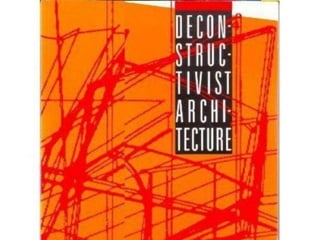
Deconstructivism
by
Ar. M. Senthil
Deconstructivism

Prepared by

Ar. M. Senthil
Deconstructivism
Started in1980s
“A movement in architecture”
About Deconstructivism:
•Started in the 1980’s
•It views architecture in bits and pieces.
•have no visual logic
•Buildings may appear to be made up of abstract
forms.
•More than we say free flow of forms
•Ideas were borrowed from the French
philosopher, Jacques Derrida.
DECONSTRUCTIVISM IN
ARCHITECTURE
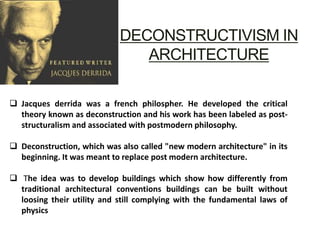
 Jacques derrida was a french philospher. He developed the critical
theory known as deconstruction and his work has been labeled as poststructuralism and associated with postmodern philosophy.

 Deconstruction, which was also called "new modern architecture" in its
beginning. It was meant to replace post modern architecture.
 The idea was to develop buildings which show how differently from
traditional architectural conventions buildings can be built without
loosing their utility and still complying with the fundamental laws of
physics
Modernism and postmodernism
Deconstructivism in contemporary architecture is opposed to
the ordered rationality of Modernism and Postmodernism.
Robert Venturi's Complexity and Contradiction in architecture
, argues against the purity, clarity and simplicity of modernism.
With its publication, functionalism and rationalism, the two
main branches of modernism, were overturned as paradigms
Some Postmodern architects endeavored to reapply ornament
even to economical and minimal buildings, described by
Venturi as "the decorated shed.“
Contemporary art
•Two strains of modern art, minimalisn and cubism
, have had an influence on deconstructivism.
•A synchronicity of disjoined space is evident in
many of the works of Frank Gehry and Bernard
Tschumi.
Mark Wigley and Phillip Johnson curated the 1988 Museum
of Modern Art exhibition Deconstructivist architecture,
which crystallized the movement, and brought fame and
notoriety to its key practitioners.
The architects presented at the exhibition were
Peter Eisenman,
Frank Gehry,
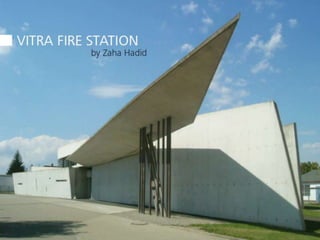
Zaha Hadid,
Coop Himmelblau,
Rem Koolhaas,
Daniel Libeskind, and
Bernard Tschumi.
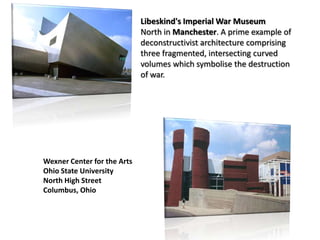
Libeskind's Imperial War Museum
North in Manchester. A prime example of
deconstructivist architecture comprising
three fragmented, intersecting curved
volumes which symbolise the destruction
of war.

Wexner Center for the Arts
Ohio State University
North High Street
Columbus, Ohio
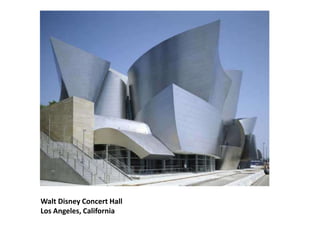
Walt Disney Concert Hall
Los Angeles, California
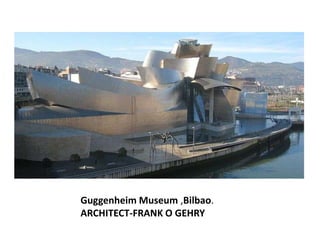
Guggenheim Museum ,Bilbao.
ARCHITECT-FRANK O GEHRY
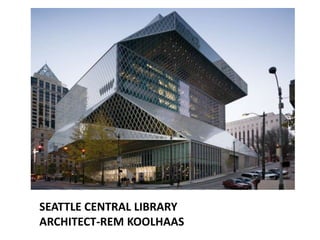
SEATTLE CENTRAL LIBRARY
ARCHITECT-REM KOOLHAAS
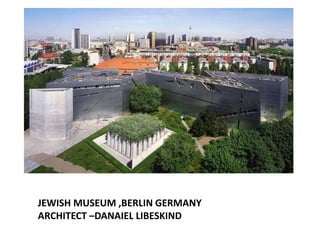
JEWISH MUSEUM ,BERLIN GERMANY
ARCHITECT –DANAIEL LIBESKIND
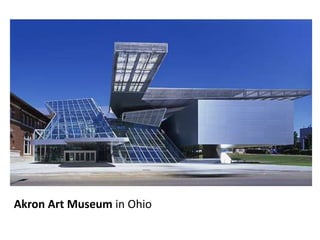
Akron Art Museum in Ohio
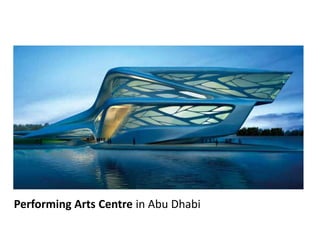
Performing Arts Centre in Abu Dhabi
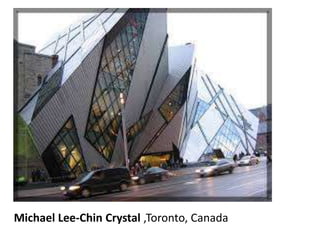
Michael Lee-Chin Crystal ,Toronto, Canada
Conclusion
We explored a bit of the history of Deconstructivism and the
artists and concepts that make up this postmodern art
movement.
"Deconstructing" is about disturbing the way we think about
form and ultimately, it is about the discovery of new
relationships.

Deconstructivism

  • 1.
  • 2.
  • 3.
  • 4.
    About Deconstructivism: •Started inthe 1980’s •It views architecture in bits and pieces. •have no visual logic •Buildings may appear to be made up of abstract forms. •More than we say free flow of forms •Ideas were borrowed from the French philosopher, Jacques Derrida.
  • 5.
    DECONSTRUCTIVISM IN ARCHITECTURE  Jacquesderrida was a french philospher. He developed the critical theory known as deconstruction and his work has been labeled as poststructuralism and associated with postmodern philosophy.  Deconstruction, which was also called "new modern architecture" in its beginning. It was meant to replace post modern architecture.  The idea was to develop buildings which show how differently from traditional architectural conventions buildings can be built without loosing their utility and still complying with the fundamental laws of physics
  • 6.
    Modernism and postmodernism Deconstructivismin contemporary architecture is opposed to the ordered rationality of Modernism and Postmodernism. Robert Venturi's Complexity and Contradiction in architecture , argues against the purity, clarity and simplicity of modernism. With its publication, functionalism and rationalism, the two main branches of modernism, were overturned as paradigms Some Postmodern architects endeavored to reapply ornament even to economical and minimal buildings, described by Venturi as "the decorated shed.“
  • 7.
    Contemporary art •Two strainsof modern art, minimalisn and cubism , have had an influence on deconstructivism. •A synchronicity of disjoined space is evident in many of the works of Frank Gehry and Bernard Tschumi.
  • 8.
    Mark Wigley andPhillip Johnson curated the 1988 Museum of Modern Art exhibition Deconstructivist architecture, which crystallized the movement, and brought fame and notoriety to its key practitioners. The architects presented at the exhibition were Peter Eisenman, Frank Gehry, Zaha Hadid, Coop Himmelblau, Rem Koolhaas, Daniel Libeskind, and Bernard Tschumi.
  • 9.
    Libeskind's Imperial WarMuseum North in Manchester. A prime example of deconstructivist architecture comprising three fragmented, intersecting curved volumes which symbolise the destruction of war. Wexner Center for the Arts Ohio State University North High Street Columbus, Ohio
  • 10.
    Walt Disney ConcertHall Los Angeles, California
  • 11.
  • 12.
  • 13.
    JEWISH MUSEUM ,BERLINGERMANY ARCHITECT –DANAIEL LIBESKIND
  • 14.
  • 15.
  • 16.
    Michael Lee-Chin Crystal,Toronto, Canada
  • 18.
    Conclusion We explored abit of the history of Deconstructivism and the artists and concepts that make up this postmodern art movement. "Deconstructing" is about disturbing the way we think about form and ultimately, it is about the discovery of new relationships.