By Kristina Pavlovska
T-2-10
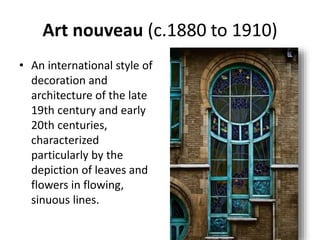
Art nouveau (c.1880 to 1910)
• An international style of
decoration and
architecture of the late
19th century and early
20th centuries,
characterized
particularly by the
depiction of leaves and
flowers in flowing,
sinuous lines.
• Organic and dynamic forms
• Curving design
• Writhing plant forms
• Strict avoidance of historical traits
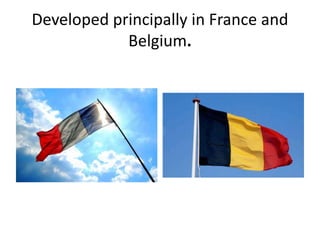
Developed principally in France and
Belgium.
Leading practitioners:
• Britain- the architecture of Rennie Mackintosh
• France - Guimard’s famous glass and iron
Metro designs; the glassware of Lalique (1860-
1945).
• Spain - Gaudi in Barcelona.
• Vienna - Gustav Klimt
• US- Louis Comfort Tiffany; Louis Sullivan.
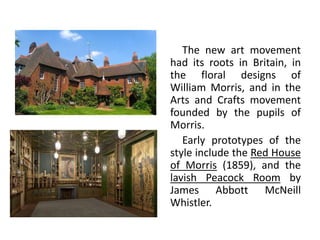
The new art movement
had its roots in Britain, in
the floral designs of
William Morris, and in the
Arts and Crafts movement
founded by the pupils of
Morris.
Early prototypes of the
style include the Red House
of Morris (1859), and the
lavish Peacock Room by
James Abbott McNeill
Whistler.
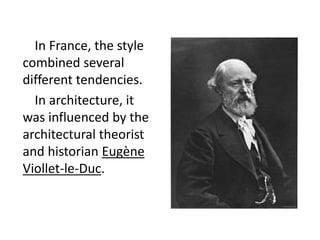
In France, the style
combined several
different tendencies.
In architecture, it
was influenced by the
architectural theorist
and historian Eugène
Viollet-le-Duc.
Art Nouveau buildings have many of
these features:
• Asymmetrical shapes
• Extensive use of arches and curved forms
• Curved glass
• Curving, plant-like embellishments
• Mosaics
• Stained glass
• Japanese motifs
Understanding Art Nouveau
Architecture through Gaudi’s Work
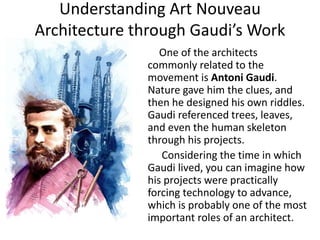
One of the architects
commonly related to the
movement is Antoni Gaudi.
Nature gave him the clues, and
then he designed his own riddles.
Gaudi referenced trees, leaves,
and even the human skeleton
through his projects.
Considering the time in which
Gaudi lived, you can imagine how
his projects were practically
forcing technology to advance,
which is probably one of the most
important roles of an architect.
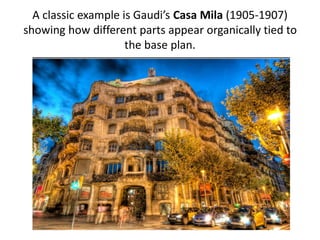
A classic example is Gaudi’s Casa Mila (1905-1907)
showing how different parts appear organically tied to
the base plan.
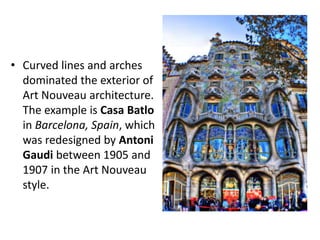
• Curved lines and arches
dominated the exterior of
Art Nouveau architecture.
The example is Casa Batlo
in Barcelona, Spain, which
was redesigned by Antoni
Gaudi between 1905 and
1907 in the Art Nouveau
style.
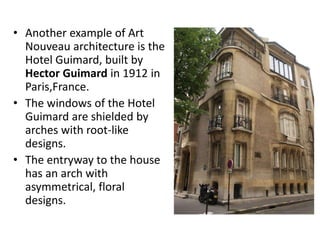
• Another example of Art
Nouveau architecture is the
Hotel Guimard, built by
Hector Guimard in 1912 in
Paris,France.
• The windows of the Hotel
Guimard are shielded by
arches with root-like
designs.
• The entryway to the house
has an arch with
asymmetrical, floral
designs.
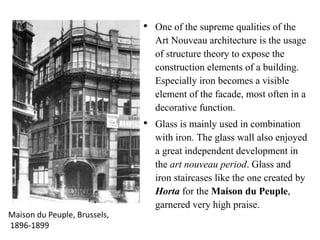
• One of the supreme qualities of the
Art Nouveau architecture is the usage
of structure theory to expose the
construction elements of a building.
Especially iron becomes a visible
element of the facade, most often in a
decorative function.
• Glass is mainly used in combination
with iron. The glass wall also enjoyed
a great independent development in
the art nouveau period. Glass and
iron staircases like the one created by
Horta for the Maison du Peuple,
garnered very high praise.
Maison du Peuple, Brussels,
1896-1899
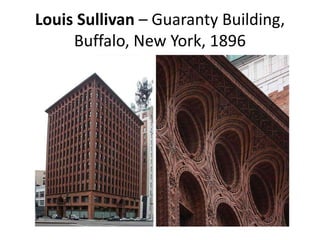
Louis Sullivan – Guaranty Building,
Buffalo, New York, 1896
• The Art Nouveau designers selected and
modernized some of the abstract elements of
the Rococo style, such as shell and flame
textures and they also advocated the use of
very stylized organic forms as a source of
inspiration in their artworks. Thus, many
elements came in the shape of grass, insects,
seaweed and the like.
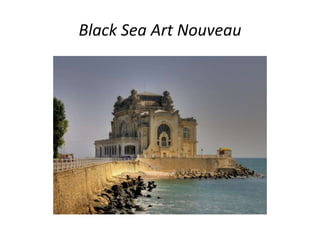
Black Sea Art Nouveau
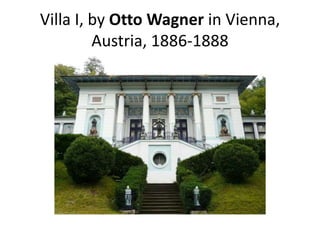
Villa I, by Otto Wagner in Vienna,
Austria, 1886-1888
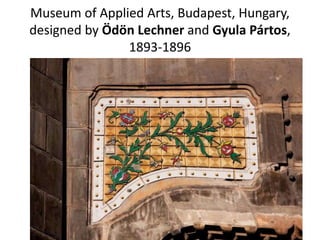
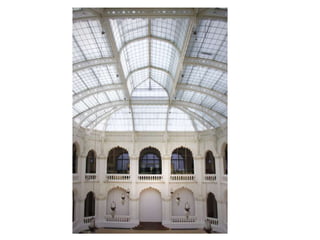
Museum of Applied Arts, Budapest, Hungary,
designed by Ödön Lechner and Gyula Pártos,
1893-1896
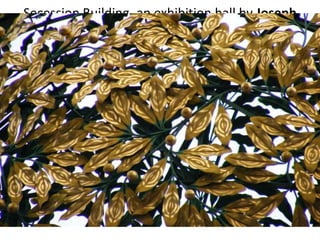
Secession Building, an exhibition hall by Joseph
Maria Olbrich in Vienna, Austria, 1897-1898
Thank you
for attention!

Art nouveau style

  • 1.
  • 2.
    Art nouveau (c.1880to 1910) • An international style of decoration and architecture of the late 19th century and early 20th centuries, characterized particularly by the depiction of leaves and flowers in flowing, sinuous lines.
  • 3.
    • Organic anddynamic forms • Curving design • Writhing plant forms • Strict avoidance of historical traits
  • 4.
    Developed principally inFrance and Belgium.
  • 5.
    Leading practitioners: • Britain-the architecture of Rennie Mackintosh • France - Guimard’s famous glass and iron Metro designs; the glassware of Lalique (1860- 1945). • Spain - Gaudi in Barcelona. • Vienna - Gustav Klimt • US- Louis Comfort Tiffany; Louis Sullivan.
  • 6.
    The new artmovement had its roots in Britain, in the floral designs of William Morris, and in the Arts and Crafts movement founded by the pupils of Morris. Early prototypes of the style include the Red House of Morris (1859), and the lavish Peacock Room by James Abbott McNeill Whistler.
  • 7.
    In France, thestyle combined several different tendencies. In architecture, it was influenced by the architectural theorist and historian Eugène Viollet-le-Duc.
  • 8.
    Art Nouveau buildingshave many of these features: • Asymmetrical shapes • Extensive use of arches and curved forms • Curved glass • Curving, plant-like embellishments • Mosaics • Stained glass • Japanese motifs
  • 9.
    Understanding Art Nouveau Architecturethrough Gaudi’s Work One of the architects commonly related to the movement is Antoni Gaudi. Nature gave him the clues, and then he designed his own riddles. Gaudi referenced trees, leaves, and even the human skeleton through his projects. Considering the time in which Gaudi lived, you can imagine how his projects were practically forcing technology to advance, which is probably one of the most important roles of an architect.
  • 10.
    A classic exampleis Gaudi’s Casa Mila (1905-1907) showing how different parts appear organically tied to the base plan.
  • 11.
    • Curved linesand arches dominated the exterior of Art Nouveau architecture. The example is Casa Batlo in Barcelona, Spain, which was redesigned by Antoni Gaudi between 1905 and 1907 in the Art Nouveau style.
  • 12.
    • Another exampleof Art Nouveau architecture is the Hotel Guimard, built by Hector Guimard in 1912 in Paris,France. • The windows of the Hotel Guimard are shielded by arches with root-like designs. • The entryway to the house has an arch with asymmetrical, floral designs.
  • 13.
    • One ofthe supreme qualities of the Art Nouveau architecture is the usage of structure theory to expose the construction elements of a building. Especially iron becomes a visible element of the facade, most often in a decorative function. • Glass is mainly used in combination with iron. The glass wall also enjoyed a great independent development in the art nouveau period. Glass and iron staircases like the one created by Horta for the Maison du Peuple, garnered very high praise. Maison du Peuple, Brussels, 1896-1899
  • 14.
    Louis Sullivan –Guaranty Building, Buffalo, New York, 1896
  • 15.
    • The ArtNouveau designers selected and modernized some of the abstract elements of the Rococo style, such as shell and flame textures and they also advocated the use of very stylized organic forms as a source of inspiration in their artworks. Thus, many elements came in the shape of grass, insects, seaweed and the like.
  • 16.
  • 17.
    Villa I, byOtto Wagner in Vienna, Austria, 1886-1888
  • 18.
    Museum of AppliedArts, Budapest, Hungary, designed by Ödön Lechner and Gyula Pártos, 1893-1896
  • 20.
    Secession Building, anexhibition hall by Joseph Maria Olbrich in Vienna, Austria, 1897-1898
  • 21.