• The cubism started in France in the early 20th century (around 1907), but its
ideas and concepts have continued to influence art today.
• The early 20th century was a time of change in the art world in France, yet
cubism was still highly rejected. Many people said it was ugly and they could
not understand it.
• The scientific and philosophical changes at the time influenced the subject
matter within cubist artwork and peoples ability to accept the changes cubism
was making.
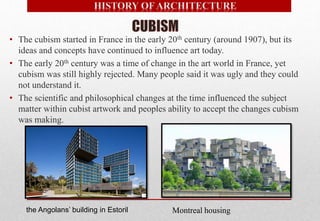
the Angolans’ building in Estoril Montreal housing
• The name cubism was suggested by Henri Matisse in 1909.He observed
that the pictures themselves consisted of “nothing but little cubes”.
• The idea behind cubism is to show the essence of an object by displaying it
from many angles and points of views at the same time..
• Architectural interest in Cubism centered on the dissolution and
reconstitution of three-dimensional form, using simple geometric shapes
• The cubist pallet was restricted to a narrow, almost monochromatic scale,
dominated by grays and browns.
• The subjects were represented in the form of basic geometric shapes (cube ,
sphere , cylinder and the cone).
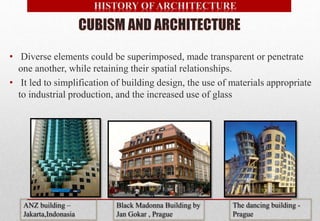
• Diverse elements could be superimposed, made transparent or penetrate
one another, while retaining their spatial relationships.
• It led to simplification of building design, the use of materials appropriate
to industrial production, and the increased use of glass
ANZ building –
Jakarta,Indonasia
Black Madonna Building by
Jan Gokar , Prague
The dancing building -
Prague
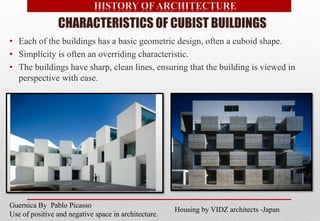
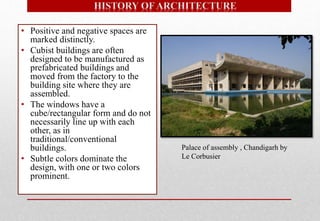
• Each of the buildings has a basic geometric design, often a cuboid shape.
• Simplicity is often an overriding characteristic.
• The buildings have sharp, clean lines, ensuring that the building is viewed in
perspective with ease.
Guernica By Pablo Picasso
Use of positive and negative space in architecture.
Housing by VIDZ architects -Japan
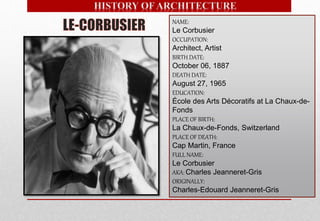
• Positive and negative spaces are
marked distinctly.
• Cubist buildings are often
designed to be manufactured as
prefabricated buildings and
moved from the factory to the
building site where they are
assembled.
• The windows have a
cube/rectangular form and do not
necessarily line up with each
other, as in
traditional/conventional
buildings.
• Subtle colors dominate the
design, with one or two colors
prominent.
Palace of assembly , Chandigarh by
Le Corbusier
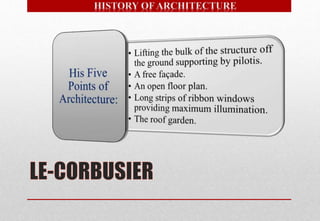
NAME:
Le Corbusier
OCCUPATION:
Architect, Artist
BIRTH DATE:
October 06, 1887
DEATH DATE:
August 27, 1965
EDUCATION:
École des Arts Décoratifs at La Chaux-de-
Fonds
PLACE OF BIRTH:
La Chaux-de-Fonds, Switzerland
PLACE OF DEATH:
Cap Martin, France
FULL NAME:
Le Corbusier
AKA: Charles Jeanneret-Gris
ORIGINALLY:
Charles-Edouard Jeanneret-Gris
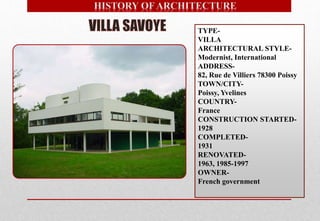
TYPE-
VILLA
ARCHITECTURAL STYLE-
Modernist, International
ADDRESS-
82, Rue de Villiers 78300 Poissy
TOWN/CITY-
Poissy, Yvelines
COUNTRY-
France
CONSTRUCTION STARTED-
1928
COMPLETED-
1931
RENOVATED-
1963, 1985-1997
OWNER-
French government
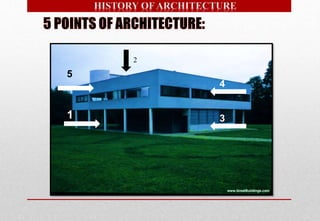
2
4
31
5
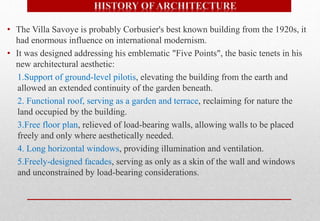
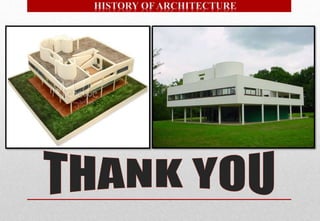
• The Villa Savoye is probably Corbusier's best known building from the 1920s, it
had enormous influence on international modernism.
• It was designed addressing his emblematic "Five Points", the basic tenets in his
new architectural aesthetic:
1.Support of ground-level pilotis, elevating the building from the earth and
allowed an extended continuity of the garden beneath.
2. Functional roof, serving as a garden and terrace, reclaiming for nature the
land occupied by the building.
3.Free floor plan, relieved of load-bearing walls, allowing walls to be placed
freely and only where aesthetically needed.
4. Long horizontal windows, providing illumination and ventilation.
5.Freely-designed facades, serving as only as a skin of the wall and windows
and unconstrained by load-bearing considerations.
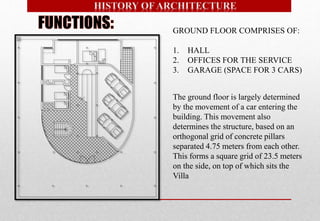
GROUND FLOOR COMPRISES OF:
1. HALL
2. OFFICES FOR THE SERVICE
3. GARAGE (SPACE FOR 3 CARS)
The ground floor is largely determined
by the movement of a car entering the
building. This movement also
determines the structure, based on an
orthogonal grid of concrete pillars
separated 4.75 meters from each other.
This forms a square grid of 23.5 meters
on the side, on top of which sits the
Villa
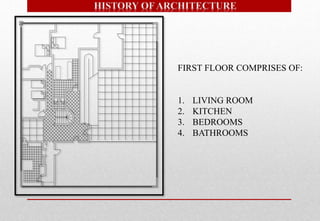
FIRST FLOOR COMPRISES OF:
1. LIVING ROOM
2. KITCHEN
3. BEDROOMS
4. BATHROOMS
• Unlike his earlier town villas Corbusier was able to carefully
design all four sides of the Villa Savoye in response to the view
and the orientation of the sun.
• On the ground floor he placed the main entrance hall, ramp and
stairs, garage, chauffeur and maids rooms.
• At first floor the master bedroom, the son's bedroom, guest
bedroom, kitchen, salon and external terraces.
• The salon was orientated to the north west whilst the terrace
faced the south.
• The son's bedroom faced the south east and the kitchen and
service terrace were on the north east.
• At second floor level were a series of sculpted spaces that
formed a solarium.
Cubism & le corbusier

Cubism & le corbusier

  • 2.
    • The cubismstarted in France in the early 20th century (around 1907), but its ideas and concepts have continued to influence art today. • The early 20th century was a time of change in the art world in France, yet cubism was still highly rejected. Many people said it was ugly and they could not understand it. • The scientific and philosophical changes at the time influenced the subject matter within cubist artwork and peoples ability to accept the changes cubism was making. the Angolans’ building in Estoril Montreal housing
  • 3.
    • The namecubism was suggested by Henri Matisse in 1909.He observed that the pictures themselves consisted of “nothing but little cubes”. • The idea behind cubism is to show the essence of an object by displaying it from many angles and points of views at the same time.. • Architectural interest in Cubism centered on the dissolution and reconstitution of three-dimensional form, using simple geometric shapes • The cubist pallet was restricted to a narrow, almost monochromatic scale, dominated by grays and browns. • The subjects were represented in the form of basic geometric shapes (cube , sphere , cylinder and the cone).
  • 4.
    • Diverse elementscould be superimposed, made transparent or penetrate one another, while retaining their spatial relationships. • It led to simplification of building design, the use of materials appropriate to industrial production, and the increased use of glass ANZ building – Jakarta,Indonasia Black Madonna Building by Jan Gokar , Prague The dancing building - Prague
  • 5.
    • Each ofthe buildings has a basic geometric design, often a cuboid shape. • Simplicity is often an overriding characteristic. • The buildings have sharp, clean lines, ensuring that the building is viewed in perspective with ease. Guernica By Pablo Picasso Use of positive and negative space in architecture. Housing by VIDZ architects -Japan
  • 6.
    • Positive andnegative spaces are marked distinctly. • Cubist buildings are often designed to be manufactured as prefabricated buildings and moved from the factory to the building site where they are assembled. • The windows have a cube/rectangular form and do not necessarily line up with each other, as in traditional/conventional buildings. • Subtle colors dominate the design, with one or two colors prominent. Palace of assembly , Chandigarh by Le Corbusier
  • 7.
    NAME: Le Corbusier OCCUPATION: Architect, Artist BIRTHDATE: October 06, 1887 DEATH DATE: August 27, 1965 EDUCATION: École des Arts Décoratifs at La Chaux-de- Fonds PLACE OF BIRTH: La Chaux-de-Fonds, Switzerland PLACE OF DEATH: Cap Martin, France FULL NAME: Le Corbusier AKA: Charles Jeanneret-Gris ORIGINALLY: Charles-Edouard Jeanneret-Gris
  • 9.
    TYPE- VILLA ARCHITECTURAL STYLE- Modernist, International ADDRESS- 82,Rue de Villiers 78300 Poissy TOWN/CITY- Poissy, Yvelines COUNTRY- France CONSTRUCTION STARTED- 1928 COMPLETED- 1931 RENOVATED- 1963, 1985-1997 OWNER- French government
  • 10.
  • 11.
    • The VillaSavoye is probably Corbusier's best known building from the 1920s, it had enormous influence on international modernism. • It was designed addressing his emblematic "Five Points", the basic tenets in his new architectural aesthetic: 1.Support of ground-level pilotis, elevating the building from the earth and allowed an extended continuity of the garden beneath. 2. Functional roof, serving as a garden and terrace, reclaiming for nature the land occupied by the building. 3.Free floor plan, relieved of load-bearing walls, allowing walls to be placed freely and only where aesthetically needed. 4. Long horizontal windows, providing illumination and ventilation. 5.Freely-designed facades, serving as only as a skin of the wall and windows and unconstrained by load-bearing considerations.
  • 12.
    GROUND FLOOR COMPRISESOF: 1. HALL 2. OFFICES FOR THE SERVICE 3. GARAGE (SPACE FOR 3 CARS) The ground floor is largely determined by the movement of a car entering the building. This movement also determines the structure, based on an orthogonal grid of concrete pillars separated 4.75 meters from each other. This forms a square grid of 23.5 meters on the side, on top of which sits the Villa
  • 13.
    FIRST FLOOR COMPRISESOF: 1. LIVING ROOM 2. KITCHEN 3. BEDROOMS 4. BATHROOMS
  • 14.
    • Unlike hisearlier town villas Corbusier was able to carefully design all four sides of the Villa Savoye in response to the view and the orientation of the sun. • On the ground floor he placed the main entrance hall, ramp and stairs, garage, chauffeur and maids rooms. • At first floor the master bedroom, the son's bedroom, guest bedroom, kitchen, salon and external terraces. • The salon was orientated to the north west whilst the terrace faced the south. • The son's bedroom faced the south east and the kitchen and service terrace were on the north east. • At second floor level were a series of sculpted spaces that formed a solarium.