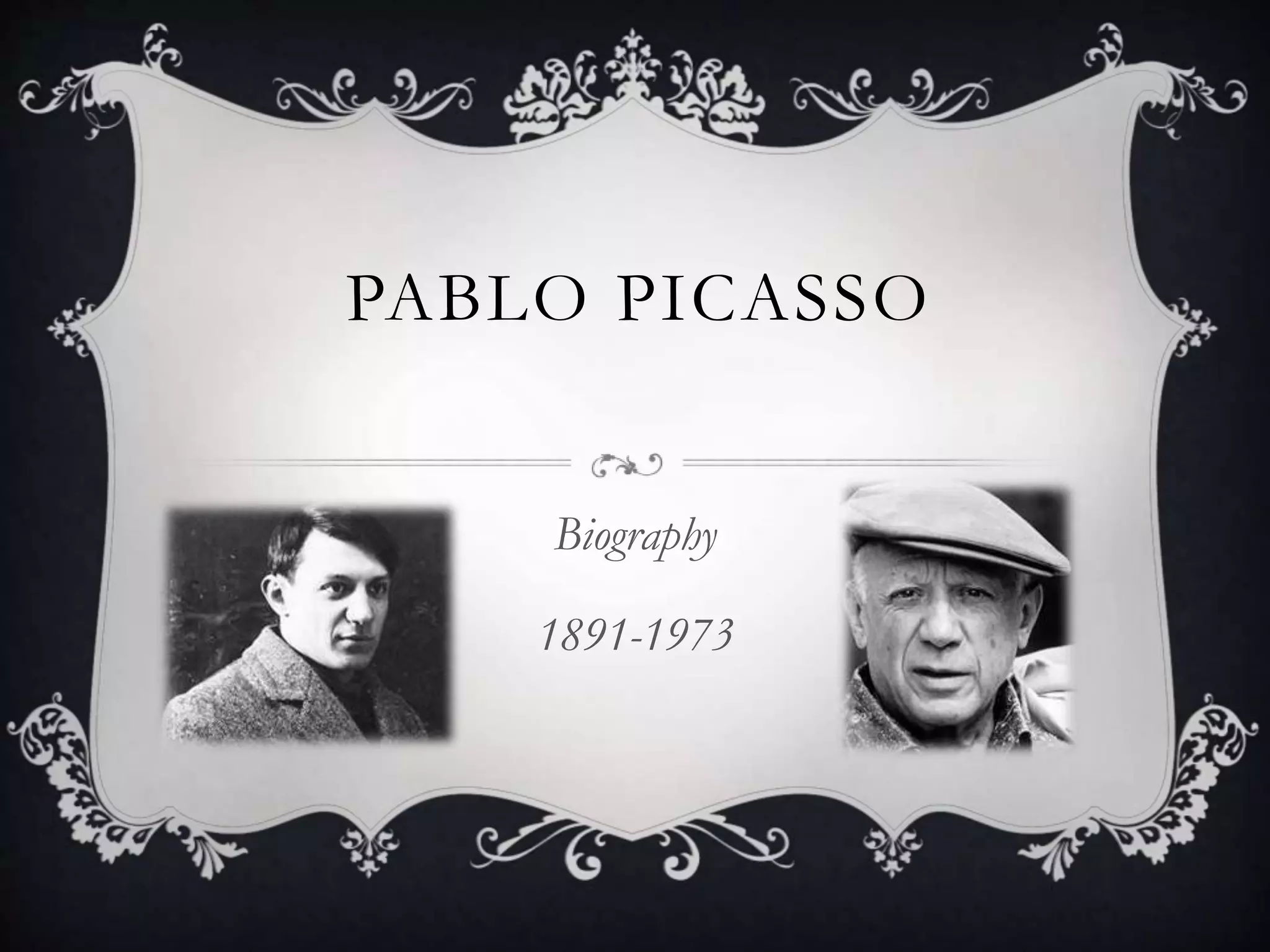
PABLO PICASSO
Biography
1891-1973
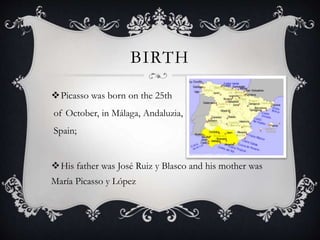
BIRTH
Picasso was born on the 25th
of October, in Málaga, Andaluzia,
Spain;
His father was José Ruiz y Blasco and his mother was
María Picasso y López
UPBRINGING
Picasso´s father influenced him to start drawing.
When he was 12 he started working (artistically) under
his father’s guidance;
At the age of 14 Picasso started having classes in La
Lonja in Barcelona, and was praised greatly in the
admission exams.
SCHOOL LIFE IN
BARCELONA
 In 1895, Picasso and his family moved to Barcelona, Spain;
 Picasso applied to the city’s renown School Of Fine Arts,
and even though the school usually only accepted students
much older than him, his entrance exam was so
extraordinary that they made an exception and accepted
him.
SCHOOL LIFE IN
MADRID
At the age of 16, Picasso moved to Madrid, to
attend the Royal Academy of San Fernando;
Soon after school starting, Picasso began skipping
classes, like he had done in Barcelona, to roam the
city’s streets and paint what he saw.
MADRID
His stay in the Royal Academy was shortened by
disease (scarlet fever)
PARIS AND FRANCE
Picasso made his first trip to Paris, then the art
capital of Europe, in 1900.
He lived in France for several years. It was there
that he met Georges Braque with whom he created
the cubism.
ARTISTIC VIEWS
Even though he was a great painter, no one
understood why Picasso did different paintings, that
parted away from the realistic works of other artists;
He was the co-founder of cubism and introduced
a lot of new elements in his works.
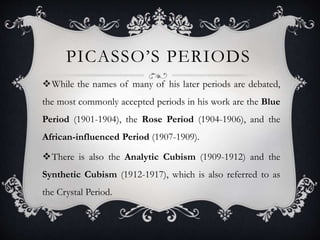
PICASSO’S PERIODS
While the names of many of his later periods are debated,
the most commonly accepted periods in his work are the Blue
Period (1901-1904), the Rose Period (1904-1906), and the
African-influenced Period (1907-1909).
There is also the Analytic Cubism (1909-1912) and the
Synthetic Cubism (1912-1917), which is also referred to as
the Crystal Period.
SOME IMPORTANT
WORKS
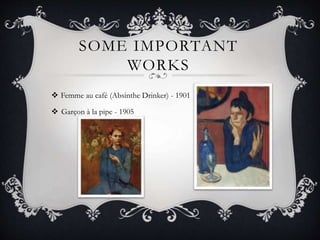
 Femme au café (Absinthe Drinker) - 1901
 Garçon à la pipe - 1905
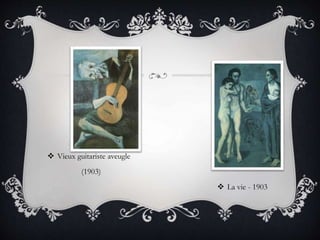
 Vieux guitariste aveugle
(1903)
 La vie - 1903
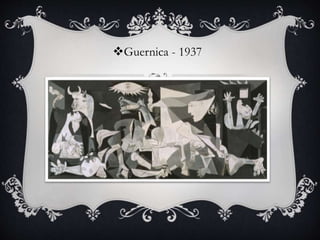
Guernica - 1937
GUERNICA- 1937
Guernica is a town in Spain that was bombed by
German air force during the Spanish Civil War. This
painting is mostly in black and white and it shows the
pain and the horror of the war. Picasso said that he only
allowed that the painting was given to Spain if there was
a Democracy. Meanwhile Guernica stayed in USA.
PICASSO’S PERIODS
(BLUE PERIOD)
Picasso’s Blue Period is of monochromatic blue and green
works, with a rare use of other colors.
During his Blue Period Picasso was severely depressed, one
of the reasons being the suicide of his friend Carlos Casagemas,
that’s why his paintings seem cheerless and have some hurtful
themes (prostitutes, beggars and drunkyards were frequently
painted).
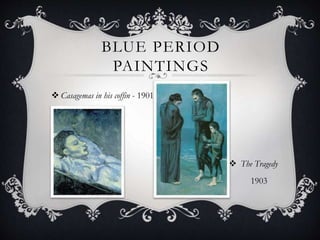
BLUE PERIOD
PAINTINGS
 Casagemas in his coffin - 1901
 The Tragedy
1903
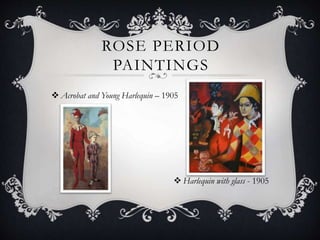
PICASSO’S ROSE PERIOD
 In this Period’s paintings, Picasso chooses more cheerful
themes, and brighter, warmer colours;
 Harlequins, circus performers and clowns appear frequently
in the Rose Period and populated Picasso's paintings at various
stages throughout the rest of his long career. The harlequin, a
comedic character usually depicted in checkered patterned
clothing, became a personal symbol for Picasso.
ROSE PERIOD
PAINTINGS
 Acrobat and Young Harlequin – 1905
 Harlequin with glass - 1905
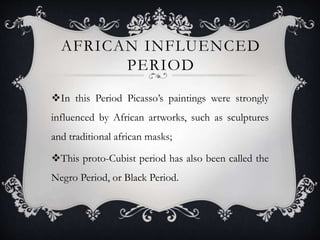
AFRICAN INFLUENCED
PERIOD
In this Period Picasso’s paintings were strongly
influenced by African artworks, such as sculptures
and traditional african masks;
This proto-Cubist period has also been called the
Negro Period, or Black Period.
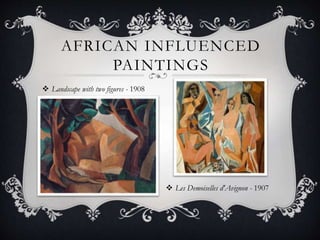
AFRICAN INFLUENCED
PAINTINGS
 Landscape with two figures - 1908
 Les Demoiselles d'Avignon - 1907
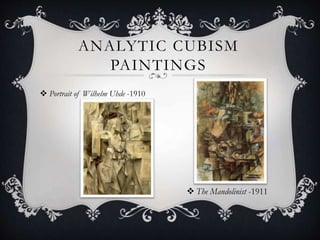
ANALYTIC CUBISM
During the Analytical Cubism movement, the works
produced by Picasso and Braque shared stylistic similarities.
In contrast to Synthetic cubism, Analytic cubism "analyzes"
natural forms and reduces the forms into basic geometric parts
on the two-dimensional picture plane.
His paintings in this period are monochromatic, with brown
and warm colours.
ANALYTIC CUBISM
PAINTINGS
 Portrait of Wilhelm Uhde -1910
 The Mandolinist -1911
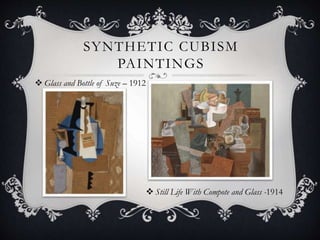
SYNTHETIC CUBISM
 The invention of collage, which integrated signs and fragments
of real things, is one aspect of Synthetic Cubism.
 Real pieces of paper replaced painted flat depictions of paper.
Real scores of music replaced drawn musical notation. Fragments of
newspaper, cigarette packs, and advertisements that were either real
or painted interacted on the flat plane of the canvas as the artists
tried to achieve a total interpenetration of life and art.
SYNTHETIC CUBISM
PAINTINGS
 Glass and Bottle of Suze – 1912
 Still Life With Compote and Glass -1914
CONCLUSION
Picasso was a painter, a sculptor, a film maker, a
ceramist, a poet and a dramatist who is now known
worldwide as the co-founder of the cubist movement.
He is one of the most influential artists of the
twentieth century, and he made a very deep impression
in art history.
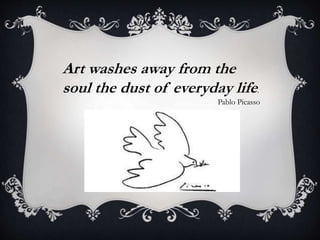
Art washes away from the
soul the dust of everyday life.
Pablo Picasso
THE AUTHORS OF THIS
WORK
Agrupamento de Escolas Augusto Cabrita
Barreiro
Portugal
Erasmus +
Romania december 2015

Picasso Romania 2015_Portugal

  • 1.
  • 2.
    BIRTH Picasso was bornon the 25th of October, in Málaga, Andaluzia, Spain; His father was José Ruiz y Blasco and his mother was María Picasso y López
  • 3.
    UPBRINGING Picasso´s father influencedhim to start drawing. When he was 12 he started working (artistically) under his father’s guidance; At the age of 14 Picasso started having classes in La Lonja in Barcelona, and was praised greatly in the admission exams.
  • 4.
    SCHOOL LIFE IN BARCELONA In 1895, Picasso and his family moved to Barcelona, Spain;  Picasso applied to the city’s renown School Of Fine Arts, and even though the school usually only accepted students much older than him, his entrance exam was so extraordinary that they made an exception and accepted him.
  • 5.
    SCHOOL LIFE IN MADRID Atthe age of 16, Picasso moved to Madrid, to attend the Royal Academy of San Fernando; Soon after school starting, Picasso began skipping classes, like he had done in Barcelona, to roam the city’s streets and paint what he saw.
  • 6.
    MADRID His stay inthe Royal Academy was shortened by disease (scarlet fever)
  • 7.
    PARIS AND FRANCE Picassomade his first trip to Paris, then the art capital of Europe, in 1900. He lived in France for several years. It was there that he met Georges Braque with whom he created the cubism.
  • 8.
    ARTISTIC VIEWS Even thoughhe was a great painter, no one understood why Picasso did different paintings, that parted away from the realistic works of other artists; He was the co-founder of cubism and introduced a lot of new elements in his works.
  • 9.
    PICASSO’S PERIODS While thenames of many of his later periods are debated, the most commonly accepted periods in his work are the Blue Period (1901-1904), the Rose Period (1904-1906), and the African-influenced Period (1907-1909). There is also the Analytic Cubism (1909-1912) and the Synthetic Cubism (1912-1917), which is also referred to as the Crystal Period.
  • 10.
    SOME IMPORTANT WORKS  Femmeau café (Absinthe Drinker) - 1901  Garçon à la pipe - 1905
  • 11.
     Vieux guitaristeaveugle (1903)  La vie - 1903
  • 12.
  • 13.
    GUERNICA- 1937 Guernica isa town in Spain that was bombed by German air force during the Spanish Civil War. This painting is mostly in black and white and it shows the pain and the horror of the war. Picasso said that he only allowed that the painting was given to Spain if there was a Democracy. Meanwhile Guernica stayed in USA.
  • 14.
    PICASSO’S PERIODS (BLUE PERIOD) Picasso’sBlue Period is of monochromatic blue and green works, with a rare use of other colors. During his Blue Period Picasso was severely depressed, one of the reasons being the suicide of his friend Carlos Casagemas, that’s why his paintings seem cheerless and have some hurtful themes (prostitutes, beggars and drunkyards were frequently painted).
  • 15.
    BLUE PERIOD PAINTINGS  Casagemasin his coffin - 1901  The Tragedy 1903
  • 16.
    PICASSO’S ROSE PERIOD In this Period’s paintings, Picasso chooses more cheerful themes, and brighter, warmer colours;  Harlequins, circus performers and clowns appear frequently in the Rose Period and populated Picasso's paintings at various stages throughout the rest of his long career. The harlequin, a comedic character usually depicted in checkered patterned clothing, became a personal symbol for Picasso.
  • 17.
    ROSE PERIOD PAINTINGS  Acrobatand Young Harlequin – 1905  Harlequin with glass - 1905
  • 18.
    AFRICAN INFLUENCED PERIOD In thisPeriod Picasso’s paintings were strongly influenced by African artworks, such as sculptures and traditional african masks; This proto-Cubist period has also been called the Negro Period, or Black Period.
  • 19.
    AFRICAN INFLUENCED PAINTINGS  Landscapewith two figures - 1908  Les Demoiselles d'Avignon - 1907
  • 20.
    ANALYTIC CUBISM During theAnalytical Cubism movement, the works produced by Picasso and Braque shared stylistic similarities. In contrast to Synthetic cubism, Analytic cubism "analyzes" natural forms and reduces the forms into basic geometric parts on the two-dimensional picture plane. His paintings in this period are monochromatic, with brown and warm colours.
  • 21.
    ANALYTIC CUBISM PAINTINGS  Portraitof Wilhelm Uhde -1910  The Mandolinist -1911
  • 22.
    SYNTHETIC CUBISM  Theinvention of collage, which integrated signs and fragments of real things, is one aspect of Synthetic Cubism.  Real pieces of paper replaced painted flat depictions of paper. Real scores of music replaced drawn musical notation. Fragments of newspaper, cigarette packs, and advertisements that were either real or painted interacted on the flat plane of the canvas as the artists tried to achieve a total interpenetration of life and art.
  • 23.
    SYNTHETIC CUBISM PAINTINGS  Glassand Bottle of Suze – 1912  Still Life With Compote and Glass -1914
  • 24.
    CONCLUSION Picasso was apainter, a sculptor, a film maker, a ceramist, a poet and a dramatist who is now known worldwide as the co-founder of the cubist movement. He is one of the most influential artists of the twentieth century, and he made a very deep impression in art history.
  • 25.
    Art washes awayfrom the soul the dust of everyday life. Pablo Picasso
  • 26.
    THE AUTHORS OFTHIS WORK Agrupamento de Escolas Augusto Cabrita Barreiro Portugal Erasmus + Romania december 2015