Compressive Strength of Concrete
Hardened Concrete - 1Hardened Concrete - 1
G.Sivakumar
sivakumar@icomat.in
+91 9790 777000
Compressive Strength of Concrete
R.C.C.Structures
Modern Day construction utilizes the efficiency of Reinforced
Cement Concrete (R.C.C) to a great extent
Technological Advances in R.C.C contribute to Construction of
Mega and High Rise Structures across the Globe
Compressive Strength of Concrete is an important element in designing
R.C.C Structure
R.C.C.Structures
Compressive Strength of Concrete
Consequently Quality of concrete manufactured is often measured by
its Compressive Strength
Compressive Strength of Concrete
Characteristic Strength = Grade of Concrete
Defined as compressive strength of concrete specimen
after 28 days of curing
M25, M30, M35, M40, etc., ………
Characteristic Strength vs Design Strength
M25, M30, M35, M40, etc., ………
Is Characteristic Strength = Design Strength ?
No
Compressive Strength of Concrete
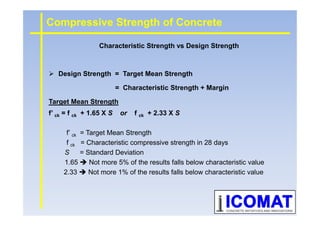
Design Strength = Target Mean Strength
= Characteristic Strength + Margin
Target Mean Strength
f’ ck = f ck + 1.65 X S or f ck + 2.33 X S
Characteristic Strength vs Design Strength
f’ ck = f ck + 1.65 X S or f ck + 2.33 X S
f’ ck = Target Mean Strength
f ck = Characteristic compressive strength in 28 days
S = Standard Deviation
1.65 Not more 5% of the results falls below characteristic value
2.33 Not more 1% of the results falls below characteristic value
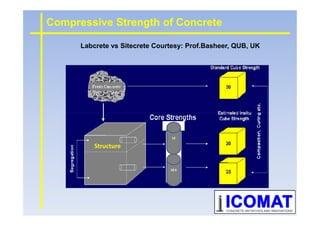
Labcrete vs Sitecrete Courtesy: Prof.Basheer, QUB, UK
Compressive Strength of Concrete
16
18.5
Structure
150mm X 150mm X 150mm – IS, BS EN, SS
100mm X 100mm X 100mm (for MSA<20mm) – IS, BS EN, SS
Sampling as per IS 1199:1959 & IS 4926:2003
Compressive Strength of Concrete
Sampling and Testing of Cube Specimen
Making Cube Specimen as per IS 516:1959
Curing Cube Specimen as per IS 516:1959
Testing Cube Specimen as per IS 516:1959
Compressive Strength of Concrete
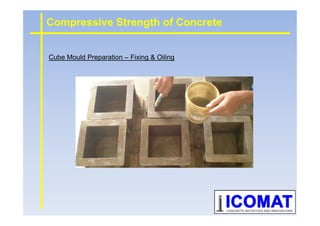
Cube Mould Preparation – Fixing & Oiling
Compressive Strength of Concrete
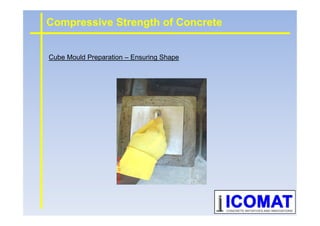
Cube Mould Preparation – Ensuring Shape
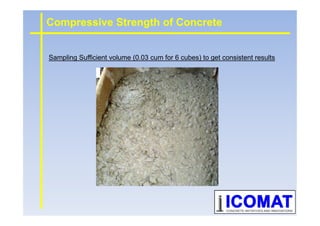
Sampling Sufficient volume (0.03 cum for 6 cubes) to get consistent results
Compressive Strength of Concrete
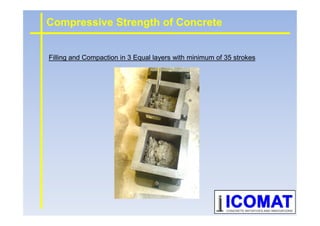
Filling and Compaction in 3 Equal layers with minimum of 35 strokes
Compressive Strength of Concrete
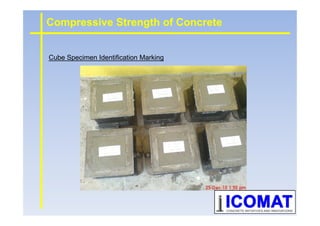
Cube Specimen Identification Marking
Compressive Strength of Concrete
De-moulding specimens
It must be ensured that concrete has attained hardened state before de-
moulding
Compressive Strength of Concrete
De-moulding shall be done with utmost care to prevent any damage, external
and internal, to the specimen
One day old specimen is like a “New Born Baby”
Compressive Strength of Concrete
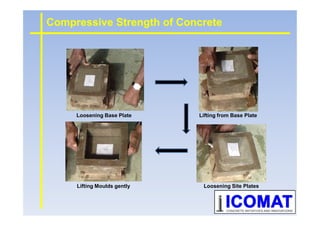
Loosening Base Plate Lifting from Base PlateLoosening Base Plate Lifting from Base Plate
Loosening Site PlatesLifting Moulds gently
Curing to prevent loss of moisture
The test specimen shall be stored at the site in a place free from vibration,
under damp matting, sacks or other similar material for 24 hours ± ½ hour from
the time of adding the water to the other ingredients
Compressive Strength of Concrete
Lifting and leading shall be done with proper care to avoid impact on
specimen
The specimen shall be stored in water at a temperature of 27°± 2°C until the
time of test
Curing to prevent loss of moisture
Compressive Strength of Concrete
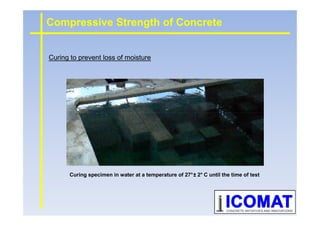
Curing specimen in water at a temperature of 27°± 2° C until the time of test
Transportation of test specimens
Avoid loss of moisture and deviations from the required temperature at all
stages of transport, by, for example,
packing the hardened test specimens in wet sand or wet sawdust or wet
cloths, or sealed in plastic bags containing water
Compressive Strength of Concrete
cloths, or sealed in plastic bags containing water
Avoid vibration to specimen while lifting and transportation
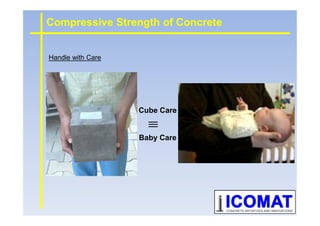
Handle with Care
Compressive Strength of Concrete
Cube CareCube Care
Baby Care
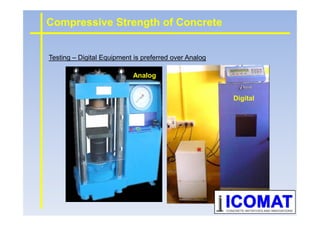
Testing – Digital Equipment is preferred over Analog
Analog
Digital
Compressive Strength of Concrete
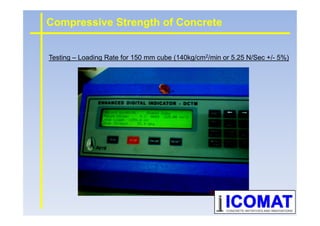
Testing – Loading Rate for 150 mm cube (140kg/cm2/min or 5.25 N/Sec +/- 5%)
Compressive Strength of Concrete
Interpretation of Test Results
Compressive Strength of Concrete
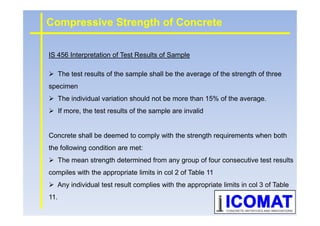
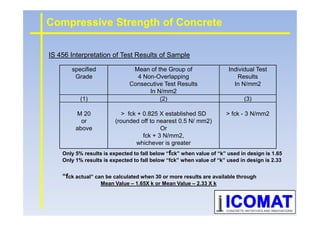
IS 456 Interpretation of Test Results of Sample
The test results of the sample shall be the average of the strength of three
specimen
The individual variation should not be more than 15% of the average.
If more, the test results of the sample are invalidIf more, the test results of the sample are invalid
Concrete shall be deemed to comply with the strength requirements when both
the following condition are met:
The mean strength determined from any group of four consecutive test results
compiles with the appropriate limits in col 2 of Table 11
Any individual test result complies with the appropriate limits in col 3 of Table
11.
Compressive Strength of Concrete
IS 456 Interpretation of Test Results of Sample
specified
Grade
Mean of the Group of
4 Non-Overlapping
Consecutive Test Results
In N/mm2
Individual Test
Results
In N/mm2
(1) (2) (3)
M 20 > fck + 0.825 X established SD > fck - 3 N/mm2M 20
or
above
> fck + 0.825 X established SD
(rounded off to nearest 0.5 N/ mm2)
Or
fck + 3 N/mm2,
whichever is greater
> fck - 3 N/mm2
Only 5% results is expected to fall below “fck” when value of “k” used in design is 1.65
Only 1% results is expected to fall below “fck” when value of “k” used in design is 2.33
“fck actual” can be calculated when 30 or more results are available through
Mean Value – 1.65X k or Mean Value – 2.33 X k
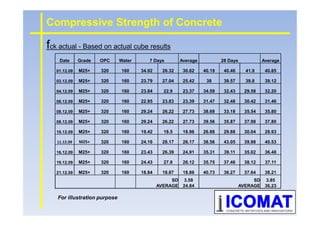
Date Grade OPC Water 7 Days Average 28 Days Average
01.12.09 M25+ 320 160 34.92 26.32 30.62 40.19 40.46 41.9 40.85
03.12.09 M25+ 320 160 23.79 27.04 25.42 38 39.57 39.8 39.12
04.12.09 M25+ 320 160 23.84 22.9 23.37 34.59 32.43 29.58 32.20
06.12.09 M25+ 320 160 22.95 23.83 23.39 31.47 32.48 30.42 31.46
08.12.09 M25+ 320 160 29.24 26.22 27.73 38.68 33.18 35.54 35.80
Compressive Strength of Concrete
fck actual - Based on actual cube results
08.12.09 M25+ 320 160 29.24 26.22 27.73 38.68 33.18 35.54 35.80
08.12.09 M25+ 320 160 29.24 26.22 27.73 39.56 35.87 37.98 37.80
10.12.09 M25+ 320 160 19.42 18.5 18.96 26.88 29.88 30.04 28.93
11.12.09 M25+ 320 160 24.16 28.17 26.17 38.56 43.05 39.98 40.53
16.12.09 M25+ 320 160 23.43 26.39 24.91 35.31 39.11 35.02 36.48
19.12.09 M25+ 320 160 24.43 27.8 26.12 35.75 37.46 38.12 37.11
21.12.09 M25+ 320 160 18.84 18.87 18.86 40.73 36.27 37.64 38.21
SD 3.58 SD 3.85
AVERAGE 24.84 AVERAGE 36.23
For illustration purpose
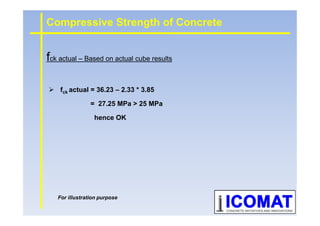
fck actual = 36.23 – 2.33 * 3.85
= 27.25 MPa > 25 MPa
Compressive Strength of Concrete
fck actual – Based on actual cube results
hence OK
For illustration purpose
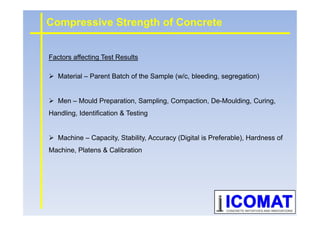
Factors affecting Test Results
Material – Parent Batch of the Sample (w/c, bleeding, segregation)
Men – Mould Preparation, Sampling, Compaction, De-Moulding, Curing,
Handling, Identification & Testing
Compressive Strength of Concrete
Handling, Identification & Testing
Machine – Capacity, Stability, Accuracy (Digital is Preferable), Hardness of
Machine, Platens & Calibration
Simple Mistakes can reduce the strength of Concrete cubes
So
Compressive Strength of Concrete
So
“Do it right the first time”
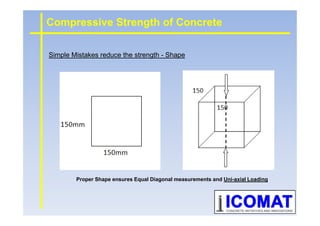
Simple Mistakes reduce the strength - Shape
Compressive Strength of Concrete
Proper Shape ensures Equal Diagonal measurements and Uni-axial Loading
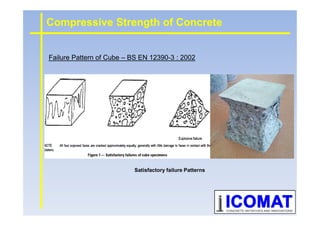
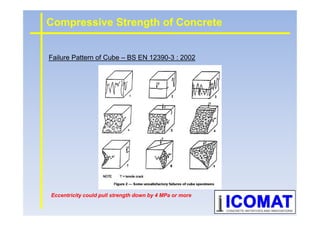
Failure Pattern of Cube – BS EN 12390-3 : 2002
Compressive Strength of Concrete
Satisfactory failure Patterns
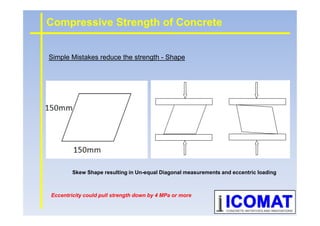
Simple Mistakes reduce the strength - Shape
Compressive Strength of Concrete
Skew Shape resulting in Un-equal Diagonal measurements and eccentric loading
Eccentricity could pull strength down by 4 MPa or more
Failure Pattern of Cube – BS EN 12390-3 : 2002
Compressive Strength of Concrete
Eccentricity could pull strength down by 4 MPa or more
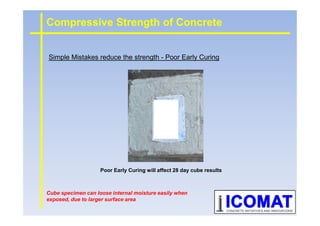
Simple Mistakes reduce the strength - Poor Early Curing
Compressive Strength of Concrete
Poor Early Curing will affect 28 day cube results
Cube specimen can loose internal moisture easily when
exposed, due to larger surface area
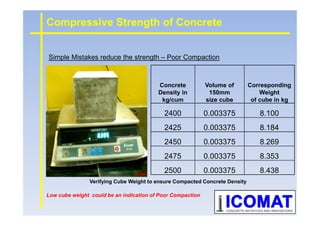
Simple Mistakes reduce the strength – Poor Compaction
Compressive Strength of Concrete
Concrete
Density in
kg/cum
Volume of
150mm
size cube
Corresponding
Weight
of cube in kg
2400 0.003375 8.100
Verifying Cube Weight to ensure Compacted Concrete Density
Low cube weight could be an indication of Poor Compaction
2400 0.003375 8.100
2425 0.003375 8.184
2450 0.003375 8.269
2475 0.003375 8.353
2500 0.003375 8.438
Thank You
Compressive Strength of Concrete
Thank You
G.Sivakumar
sivakumar@icomat.in
+91 9790 777000

Compressivestrength concrete

  • 1.
    Compressive Strength ofConcrete Hardened Concrete - 1Hardened Concrete - 1 G.Sivakumar sivakumar@icomat.in +91 9790 777000
  • 2.
    Compressive Strength ofConcrete R.C.C.Structures Modern Day construction utilizes the efficiency of Reinforced Cement Concrete (R.C.C) to a great extent Technological Advances in R.C.C contribute to Construction of Mega and High Rise Structures across the Globe
  • 3.
    Compressive Strength ofConcrete is an important element in designing R.C.C Structure R.C.C.Structures Compressive Strength of Concrete Consequently Quality of concrete manufactured is often measured by its Compressive Strength
  • 4.
    Compressive Strength ofConcrete Characteristic Strength = Grade of Concrete Defined as compressive strength of concrete specimen after 28 days of curing M25, M30, M35, M40, etc., ……… Characteristic Strength vs Design Strength M25, M30, M35, M40, etc., ……… Is Characteristic Strength = Design Strength ? No
  • 5.
    Compressive Strength ofConcrete Design Strength = Target Mean Strength = Characteristic Strength + Margin Target Mean Strength f’ ck = f ck + 1.65 X S or f ck + 2.33 X S Characteristic Strength vs Design Strength f’ ck = f ck + 1.65 X S or f ck + 2.33 X S f’ ck = Target Mean Strength f ck = Characteristic compressive strength in 28 days S = Standard Deviation 1.65 Not more 5% of the results falls below characteristic value 2.33 Not more 1% of the results falls below characteristic value
  • 6.
    Labcrete vs SitecreteCourtesy: Prof.Basheer, QUB, UK Compressive Strength of Concrete 16 18.5 Structure
  • 7.
    150mm X 150mmX 150mm – IS, BS EN, SS 100mm X 100mm X 100mm (for MSA<20mm) – IS, BS EN, SS Sampling as per IS 1199:1959 & IS 4926:2003 Compressive Strength of Concrete Sampling and Testing of Cube Specimen Making Cube Specimen as per IS 516:1959 Curing Cube Specimen as per IS 516:1959 Testing Cube Specimen as per IS 516:1959
  • 8.
    Compressive Strength ofConcrete Cube Mould Preparation – Fixing & Oiling
  • 9.
    Compressive Strength ofConcrete Cube Mould Preparation – Ensuring Shape
  • 10.
    Sampling Sufficient volume(0.03 cum for 6 cubes) to get consistent results Compressive Strength of Concrete
  • 11.
    Filling and Compactionin 3 Equal layers with minimum of 35 strokes Compressive Strength of Concrete
  • 12.
    Cube Specimen IdentificationMarking Compressive Strength of Concrete
  • 13.
    De-moulding specimens It mustbe ensured that concrete has attained hardened state before de- moulding Compressive Strength of Concrete De-moulding shall be done with utmost care to prevent any damage, external and internal, to the specimen One day old specimen is like a “New Born Baby”
  • 14.
    Compressive Strength ofConcrete Loosening Base Plate Lifting from Base PlateLoosening Base Plate Lifting from Base Plate Loosening Site PlatesLifting Moulds gently
  • 15.
    Curing to preventloss of moisture The test specimen shall be stored at the site in a place free from vibration, under damp matting, sacks or other similar material for 24 hours ± ½ hour from the time of adding the water to the other ingredients Compressive Strength of Concrete Lifting and leading shall be done with proper care to avoid impact on specimen The specimen shall be stored in water at a temperature of 27°± 2°C until the time of test
  • 16.
    Curing to preventloss of moisture Compressive Strength of Concrete Curing specimen in water at a temperature of 27°± 2° C until the time of test
  • 17.
    Transportation of testspecimens Avoid loss of moisture and deviations from the required temperature at all stages of transport, by, for example, packing the hardened test specimens in wet sand or wet sawdust or wet cloths, or sealed in plastic bags containing water Compressive Strength of Concrete cloths, or sealed in plastic bags containing water Avoid vibration to specimen while lifting and transportation
  • 18.
    Handle with Care CompressiveStrength of Concrete Cube CareCube Care Baby Care
  • 19.
    Testing – DigitalEquipment is preferred over Analog Analog Digital Compressive Strength of Concrete
  • 20.
    Testing – LoadingRate for 150 mm cube (140kg/cm2/min or 5.25 N/Sec +/- 5%) Compressive Strength of Concrete
  • 21.
    Interpretation of TestResults Compressive Strength of Concrete
  • 22.
    Compressive Strength ofConcrete IS 456 Interpretation of Test Results of Sample The test results of the sample shall be the average of the strength of three specimen The individual variation should not be more than 15% of the average. If more, the test results of the sample are invalidIf more, the test results of the sample are invalid Concrete shall be deemed to comply with the strength requirements when both the following condition are met: The mean strength determined from any group of four consecutive test results compiles with the appropriate limits in col 2 of Table 11 Any individual test result complies with the appropriate limits in col 3 of Table 11.
  • 23.
    Compressive Strength ofConcrete IS 456 Interpretation of Test Results of Sample specified Grade Mean of the Group of 4 Non-Overlapping Consecutive Test Results In N/mm2 Individual Test Results In N/mm2 (1) (2) (3) M 20 > fck + 0.825 X established SD > fck - 3 N/mm2M 20 or above > fck + 0.825 X established SD (rounded off to nearest 0.5 N/ mm2) Or fck + 3 N/mm2, whichever is greater > fck - 3 N/mm2 Only 5% results is expected to fall below “fck” when value of “k” used in design is 1.65 Only 1% results is expected to fall below “fck” when value of “k” used in design is 2.33 “fck actual” can be calculated when 30 or more results are available through Mean Value – 1.65X k or Mean Value – 2.33 X k
  • 24.
    Date Grade OPCWater 7 Days Average 28 Days Average 01.12.09 M25+ 320 160 34.92 26.32 30.62 40.19 40.46 41.9 40.85 03.12.09 M25+ 320 160 23.79 27.04 25.42 38 39.57 39.8 39.12 04.12.09 M25+ 320 160 23.84 22.9 23.37 34.59 32.43 29.58 32.20 06.12.09 M25+ 320 160 22.95 23.83 23.39 31.47 32.48 30.42 31.46 08.12.09 M25+ 320 160 29.24 26.22 27.73 38.68 33.18 35.54 35.80 Compressive Strength of Concrete fck actual - Based on actual cube results 08.12.09 M25+ 320 160 29.24 26.22 27.73 38.68 33.18 35.54 35.80 08.12.09 M25+ 320 160 29.24 26.22 27.73 39.56 35.87 37.98 37.80 10.12.09 M25+ 320 160 19.42 18.5 18.96 26.88 29.88 30.04 28.93 11.12.09 M25+ 320 160 24.16 28.17 26.17 38.56 43.05 39.98 40.53 16.12.09 M25+ 320 160 23.43 26.39 24.91 35.31 39.11 35.02 36.48 19.12.09 M25+ 320 160 24.43 27.8 26.12 35.75 37.46 38.12 37.11 21.12.09 M25+ 320 160 18.84 18.87 18.86 40.73 36.27 37.64 38.21 SD 3.58 SD 3.85 AVERAGE 24.84 AVERAGE 36.23 For illustration purpose
  • 25.
    fck actual =36.23 – 2.33 * 3.85 = 27.25 MPa > 25 MPa Compressive Strength of Concrete fck actual – Based on actual cube results hence OK For illustration purpose
  • 26.
    Factors affecting TestResults Material – Parent Batch of the Sample (w/c, bleeding, segregation) Men – Mould Preparation, Sampling, Compaction, De-Moulding, Curing, Handling, Identification & Testing Compressive Strength of Concrete Handling, Identification & Testing Machine – Capacity, Stability, Accuracy (Digital is Preferable), Hardness of Machine, Platens & Calibration
  • 27.
    Simple Mistakes canreduce the strength of Concrete cubes So Compressive Strength of Concrete So “Do it right the first time”
  • 28.
    Simple Mistakes reducethe strength - Shape Compressive Strength of Concrete Proper Shape ensures Equal Diagonal measurements and Uni-axial Loading
  • 29.
    Failure Pattern ofCube – BS EN 12390-3 : 2002 Compressive Strength of Concrete Satisfactory failure Patterns
  • 30.
    Simple Mistakes reducethe strength - Shape Compressive Strength of Concrete Skew Shape resulting in Un-equal Diagonal measurements and eccentric loading Eccentricity could pull strength down by 4 MPa or more
  • 31.
    Failure Pattern ofCube – BS EN 12390-3 : 2002 Compressive Strength of Concrete Eccentricity could pull strength down by 4 MPa or more
  • 32.
    Simple Mistakes reducethe strength - Poor Early Curing Compressive Strength of Concrete Poor Early Curing will affect 28 day cube results Cube specimen can loose internal moisture easily when exposed, due to larger surface area
  • 33.
    Simple Mistakes reducethe strength – Poor Compaction Compressive Strength of Concrete Concrete Density in kg/cum Volume of 150mm size cube Corresponding Weight of cube in kg 2400 0.003375 8.100 Verifying Cube Weight to ensure Compacted Concrete Density Low cube weight could be an indication of Poor Compaction 2400 0.003375 8.100 2425 0.003375 8.184 2450 0.003375 8.269 2475 0.003375 8.353 2500 0.003375 8.438
  • 34.
    Thank You Compressive Strengthof Concrete Thank You G.Sivakumar sivakumar@icomat.in +91 9790 777000