ASTM STANDARDS, APPARATUSES/EQUIPMENT
NEEDED, AND PROCEDURES/STEPS IN
PERFORMING LABORATORY TEST FOR
AGGREGATES
SUBMITTED BY:
- ANLICAO, ANTHONY
-ABADAY, JUANITO
-LUCMAN, ABDUL HANNAN
-PECORE, EARLAN
-SINONTAO, JOBERT
ASSIGNMENT IN CONSTRUCTION
MATERIALS AND TESTING CE312
ASTM test weights range from Class 000 – 7, the tolerances
and specifications for these weights are outlined in ASTM
E617-13. Classes 000-4 are considered “high class” meaning
that they are highly accurate. To handle these weights, one
must wear gloves and/or use tweezers to avoid direct skin
contact. This is because they are so precise that even the oil
from your hands could cause them to be out of tolerance.
They are also very sensitive to ambient temperature and
humidity. For this reason, they should be allowed to “soak” in
the room with the device under test before being used, and
generally are not taken out into the field. ASTM Class 5-7
weights are more comparable to NIST Class F weights.
A. SPECIFIC WEIGHT
• Handling Test Weights
• How you handle, clean and store your test weights can make a big
difference to their accuracy and also the effect on your weighing
process. Any time you use your weights the handling and storage are
critical – especially on very high accuracy weights of class F2 and
above.
•Skin acids and oils disrupt a weights surface – use protective gloves and tweezers
•.
•Not placing a weight with care on a balance can cause micro-abrasions on the test
weight – use appropriate lifting handles on larger weights.
•Cleaning with caustic or abrasive substances can damage the outer surface – only
use specially designed brushes, microfibre cloths or rubber bellows.
Finally – Do not forget periodic calibration of your test weights
Even when test weights are handled with care, they experience wear. Your QMS
may detail the schedules and type of calibration required for your test weights, but
you should also structure these schedules around the use that your weights get and
the critical importance of them to your weighing process.
10 Practical Tips For Correct Weight Handling
• Store weights near the balance
• Store in original packaging
• Use specialised handles for bigger weights
• Do not use a weight with dust or water on its surface
• Handle with care
• Do not forget periodic recalibration
• Do not clean with abrasive or caustic chemicals
• Clean according to OIML/ASTM recommendations
• Inspect for damage prior to use
• Do not touch weights with bare hands
For Coarse Aggregates
Objective:
This test method is used to determine the
density of the essentially solid portion of a
large number of aggregate particles and
provides an average value representing the
sample. ASTM Standards ASTM C127-07 -
Standard Test Method for Density, Relative
Density (Specific Gravity), and Absorption
of Coarse Aggregate
Specific Weight (Gravity) Laboratory Test for Coarse
Aggregates
Apparatuses/
Equipment
needed:
- Balance
-Sample
-Container
-Water Tank
- Sieves
-Oven
1.) Dry the test sample in the oven to constant mass at a temperature of 110 6 5 °C, cool in air at
room temperature for 1 to 3 h for test samples of 37.5-mm (11⁄2-in.) nominal maximum size, or longer for larger
sizes until the aggregate has cooled to a temperature that is comfortable to handle (approximately 50 °C).
Subsequently immerse the aggregate in water at room temperature for a period of 24 6 4 h.
2.) Where the absorption and relative density (specific gravity) values are to be used in proportioning concrete
mixtures in which the aggregates will be in their naturally moist condition, the requirement in 8.1 for initial
drying is optional, and, if the surfaces of the particles in the sample have been kept continuously wet until
tested, the requirement in 8.1 for 24 6 4 h soaking is also optional. Note: Values for absorption and relative
density (specific gravity) (SSD) may be significantly higher for aggregate not oven dried before soaking than for
the same aggregate treated in accordance with 8.1. This is especially true of particles larger than 75 mm since
the water may not be able to penetrate the pores to the center of the particle in the prescribed soaking period.
3.) Remove the test sample from the water and roll it in a large absorbent cloth until all visible films of water
are removed. Wipe the larger particles individually. A moving stream of air is permitted to assist in the drying
operation. Take care to avoid evaporation of water from aggregate pores during the surface-drying operation.
Determine the mass of the test sample in the saturated surface-dry condition. Record this and all subsequent
masses to the nearest 0.5 g or 0.05 % of the sample mass, whichever is greater.
4.) After determining the mass in air, immediately place the saturated-surface-dry test sample in the sample
container and determine its apparent mass in water at 23 6 2.0 °C. Take care to remove all entrapped air
before determining its mass by shaking the container while immersed. Note: The difference between the mass
in air and the mass when the sample is submerged in water equals the mass of water displaced by the sample.
The container should be immersed to a depth sufficient to cover it and the test sample while determining the
apparent mass in water. Wire suspending the container should be of the smallest practical size to minimize any
possible effects of a variable immersed length.
5.) Dry the test sample in the oven to constant mass at a temperature of 110 6 5 °C, cool in air at room
temperature 1 to 3 h, or until the aggregate has cooled to a temperature that is comfortable to handle
(approximately 50 °C), and determine the mass.
Procedures/Steps
For Coarse Aggregates
Objective:
This test method is used to determine the
density of the essentially solid portion of a
large number of aggregate particles and
provides an average value representing the
sample.
ASTM Standard ASTM C128 - 01 Standard
Test Method for Density, Relative Density
(Specific Gravity), and Absorption of Fine
Aggregate
Specific Weight (Gravity) Laboratory Test for Fine
Aggregates
Apparatuses/
Equipment
needed:
-Balance
- Pycnometer (for Use with
Gravimetric Procedure)
- Flask (for Use with
Volumetric Procedure)
- Mold and Tamper for
Surface Moisture Test
1.) Test by either the gravimetric procedure in 2.2 or the
volumetric procedure in 2.3. Make all determinations of mass to 0.1 g.
2.1. Gravimetric (Pycnometer) Procedure: 2.2 Partially fill the
pycnometer with water. Introduce into the pycnometer 500 6 10 g of
saturated surface-dry fine aggregate prepared as described in Section
8, and fill with additional water to approximately 90 % of capacity.
Agitate the pycnometer as described in 2.2.1.1 (manually) or 2.2.1.2
(mechanically). 2.2.1.1 Manually roll, invert, and agitate the
pycnometer to eliminate all air bubbles. Note: About 15 to 20 min are
normally required to eliminate the air bubbles by manual methods.
Dipping the tip of a paper towel into the pycnometer has been found
to be useful in dispersing the foam that sometimes builds up when
eliminating the air bubbles. Optionally, a small amount of isopropyl
alcohol may be used to disperse the foam.
Procedures/Steps
2.2.1.2 Mechanically agitate the pycnometer by external vibration in a
manner that will not degrade the sample. A level of agitation adjusted to just set
individual particles in motion is sufficient to promote de-airing without degradation. A
mechanical agitator shall be considered acceptable for use if comparison tests for each
six-month period of use show variations less that the acceptable range of two results
(d2s) indicated in Table 1 from the results of manual agitation on the same material.
2.2.2 After eliminating all air bubbles, adjust the temperature of the pycnometer and its
contents to 23.0 6 2.0°C if necessary by partial immersion in circulating water, and bring
the water level in the pycnometer to its calibrated capacity. Determine the total mass of
the pycnometer, specimen, and water 2.2.3 Remove the fine aggregate from the
pycnometer, dry to constant mass at a temperature of 110 6 5°C, cool in air at room
temperature for 1 6 1⁄2h, and determine the mass. 2.2.4 Determine the mass of the
pycnometer filled to its calibrated capacity with water at 23.0 6 2.0°C. 2.3 Volumetric
(Le Chatelier Flask) Procedure: 2.3.1 Fill the flask initially with water to a point on the
stem between the 0 and the 1-mL mark. Record this initial reading with flask and
contents within the temperature range of 23.0 6 2.0°C. Add 55 6 5 g of fine aggregate in
the saturated surface-dry condition (or other measured quantity as necessary). After all
fine aggregate has been introduced, place the stopper in the flask and roll the flask in
an inclined position, or gently whirl it in a horizontal circle so as to dislodge all
entrapped air, continuing until no further bubbles rise to the surface (Note ). Take a final
reading with the flask and contents within 1°C of the original temperature.
Procedures/Steps
Note
• A small measured amount (not to exceed
1 mL) of isopropyl alcohol may be used to
eliminate foam appearing on the water
surface.
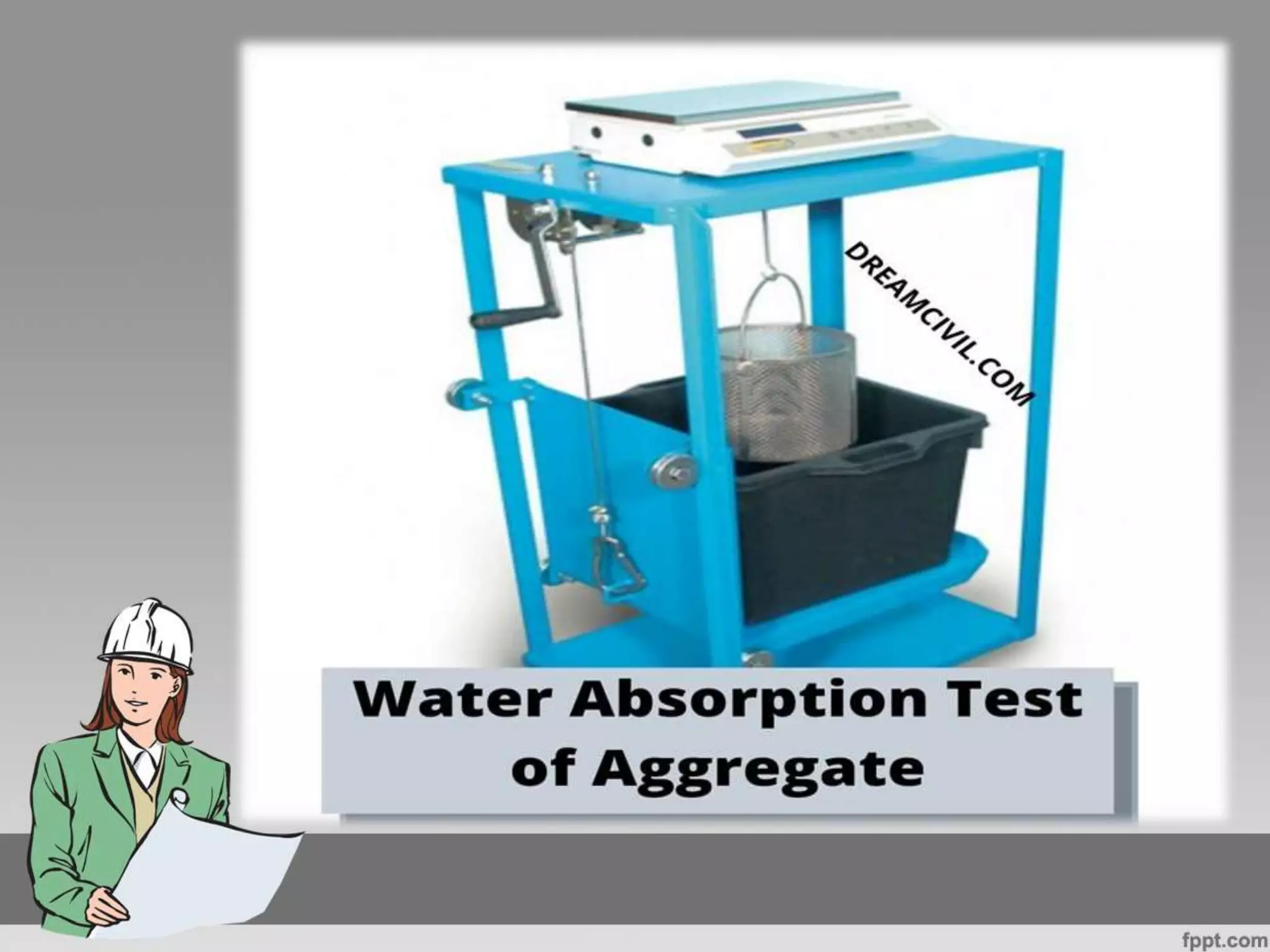
The water absorption test of aggregate is carried out to calculate the
water absorption capacity of Aggregate. The aggregate use in this
test should be dust-free.
The main aim of this test is to,
a. To calculate the strength and quality of the aggregate.
b. To calculate the water absorption capacity of aggregate.
Apparatus Required
a. Weighing Balance
b. Thermostatically controlled oven
c. Wire basket
d. Container
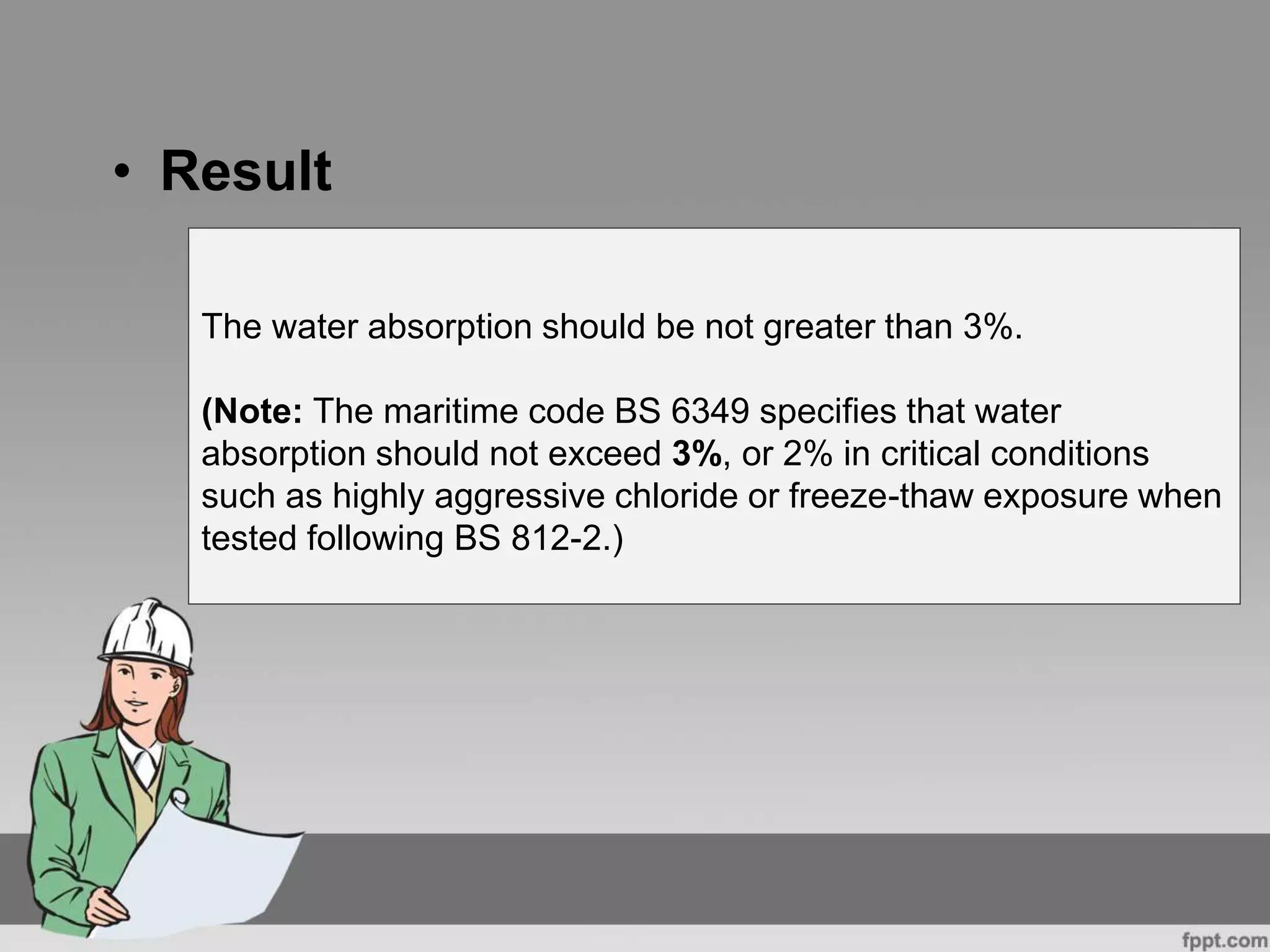
e. Shallow tray and two absorbent clothes
B. WATER ABSORPTION TEST
• Procedure
a. A sample of 2 kg of aggregate is used for conducting the test.
The sample must be washed completely to remove finer particles and dust and
then kept in the wire basket, and immersed in the distilled water at a temperature
between 22 to 32°C.
b. After sinking, the entrapped air must be separated by lifting the basket 25mm
above the surface and permitting it to drop 25 times in 25 seconds. The basket
and sample should be immersed for a period of 24 ± 0.5 hours afterward.
c. The basket and aggregate should then be separated from the water, permitted
to drain off water for a few minutes, after which the aggregate should be slowly
emptied from the basket and placed onto the water-absorbing cloth, and slowly
surface is dried with the cloth.
d. The aggregate should be scattered on the second cloth and open to
the atmosphere away from direct sunlight till it completely appears to be
surface dry. Now, the aggregate should be weighted (Weight A) by using
a weighing balance.
e. The aggregate should then be kept in an oven at a temperature of
about 100-110°C for 24 hours. Then the dry weight (Weighted B) of
aggregates is taken.
Water Absorption = (A-B)/B x100%.
• Result
The water absorption should be not greater than 3%.
(Note: The maritime code BS 6349 specifies that water
absorption should not exceed 3%, or 2% in critical conditions
such as highly aggressive chloride or freeze-thaw exposure when
tested following BS 812-2.)
• Precautions
• a. The sample must be washed completely to
separate finer particles and dust.
• b. Multiple dry cloths should be used to clean
aggregates surface.
• Advantages
• a. Knowing the water absorption capacity of
aggregates can help us to determine whether to use
it as a construction material or not.
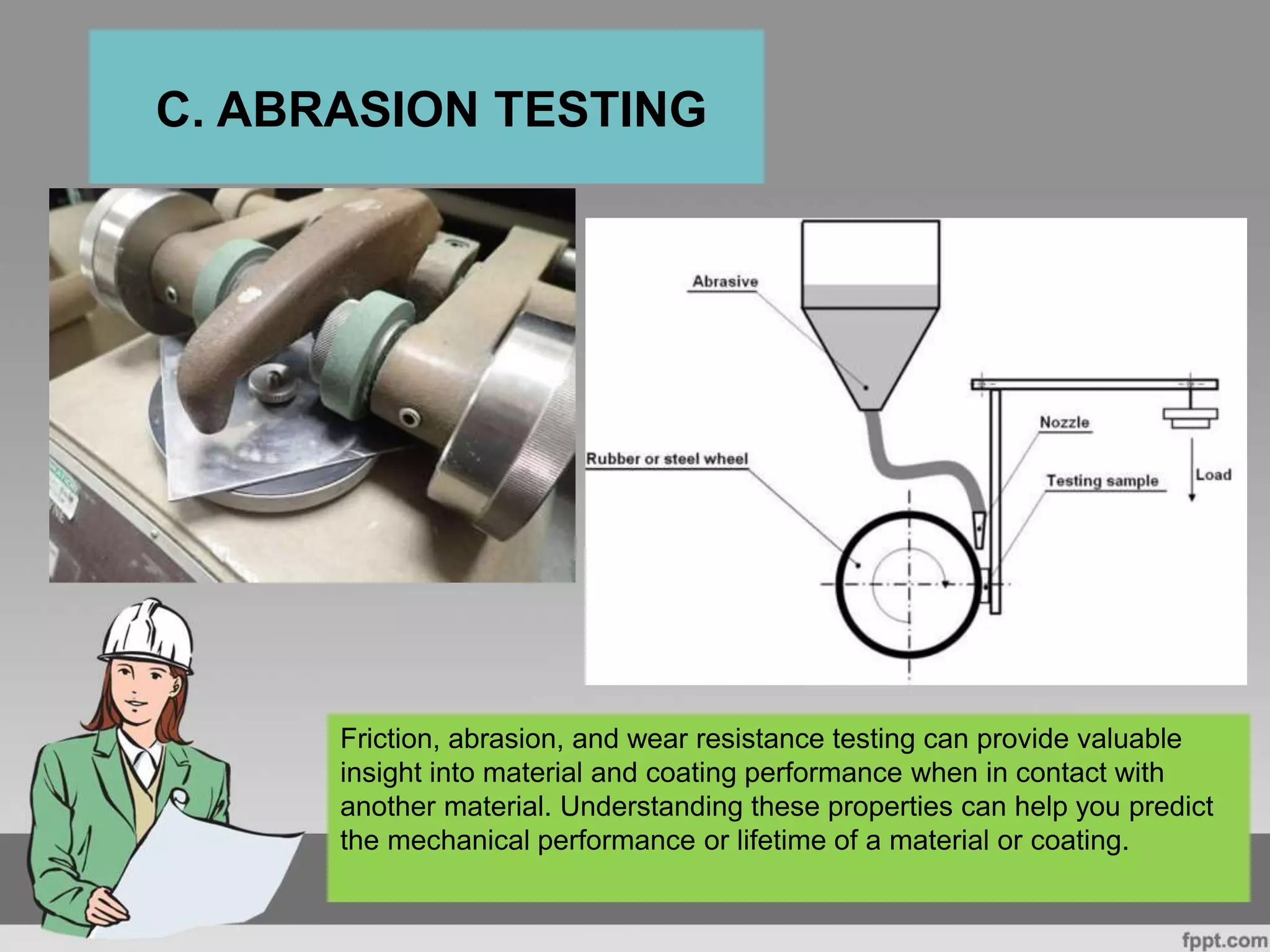
C. ABRASION TESTING
Friction, abrasion, and wear resistance testing can provide valuable
insight into material and coating performance when in contact with
another material. Understanding these properties can help you predict
the mechanical performance or lifetime of a material or coating.
The coefficient of friction (COF) is a value that shows
the relationship between the force of friction between two
objects and the normal reaction between the objects that are
involved. The COF can be determined for static and dynamic
values under wet and dry conditions.
Abrasion testing is used to test the abrasive resistance
of metals, composites, ceramics, weld overlays, and thermal
spray coatings. Abrasion testing can provide data on material
resistance to scratching abrasion under laboratory controlled
conditions.
ABRASION TESTING
1.)The testing machine must consist of a hollow steel cylinder, closed at
both ends, with an inside diameter of 28 in. ± 0.2 in. and an inside length of 20 in. ±
0.2 in. The steel cylinder must be mounted on stub shafts attached to the ends of
the cylinder but not entering it, and must be mounted in such a manner that it may
be rotated about its axis in a horizontal position. An opening in the cylinder must be
provided for the introduction of the test sample. The opening must be closed with a
dust-tight cover that is easily re moved. The cover must be so designed as to
maintain the cylindrical contour of the interior surface unless the shelf is so located
that the charge will not fall on the cover or come in contact with it during the test. A
removable steel shelf projecting radically 3.5 in. ± 0.1 in. into the cylinder and
extending its full length must be mounted along one element of the interior surface
of the cylinder. The shelf must be of such thickness and be mounted, by bolts or
other approved means, so as to be firm and rigid. The position of the shelf must be
such that the distance from the shelf to the opening, measured along the
circumference of the cylinder in the direction of rotation, is not less than 50 in.
The shelf may also be mounted on the inside of the cover plate. The shelf
must be made of wear-resistant steel and must be rectangular in crosssection. The
Los Angeles Abrasion Testing Machine must be driven and counter balanced so as
to maintain 100 revolutions in 190 s ± 10 s. The machine must be equipped with an
adjustable counter, which can be set to stop the machine at the required number of
revolutions.
APPARATUS: Los Angeles Abrasion Testing
Machine
2. Balance: a balance having a capacity of at least
5500 g sensitive to 0.1 g or less.
3. Sieves: No. 4 and No. 12 woven wire sieves
conforming to AASHTO M 92. These sieves should be at least
12 in. in diameter.
4. Abrasive Charge:
a. Each abrasive charge must consist of a solid, steel
sphere having a weight between 390 g and 445 g. A solid,
steel sphere with a diameter of 1¾ in. ± 1 16 in. typically
meets this requirement.
b. The abrasive charge, depending upon the grading
of the test specimen as described under Section D.
1. Prepare the sample in accordance with California Test 201. When
necessary, blend the natural material and the material obtained from crushing the
oversized particles in accordance with California Test 201, Section H.
2. Wash dirty or coated aggregate and dry to constant weight in
accordance with California Test 226 at 230 F ± 9 F. Cool the aggregate to room
temperature before preparing the test specimen.
3. Select the grading from Table 1 most nearly representative of the
aggregate furnished for the work. Separate the aggregate on the required sieve
sizes. Prepare the test specimen using the weight of each sieve size fraction
specified for the grading selected. Determine and record the weight of the
prepared test specimen to the nearest 1 g. If the coarse aggregate has been
separated into 2 or more sieve sizes, select the grading from Table 1 most nearly
representative of the combined aggregate mix to be furnished.
PREPARATION OF TEST SPECIMEN
1. Place the test specimen and abrasive charge in the Los Angeles
Abrasive Testing Machine and close the opening with the dust-tight cover.
2. Start the testing machine and run it for the required number of
revolutions.
3. When the testing machine has completed the required number of
revolutions, remove the cover and carefully empty the entire contents into a pan.
Remove the abrasive charge from the pan.
4. Separate the test specimen on the No. 4 sieve and sieve the passing
No. 4 material on the No. 12 sieve. Combine the material retained on the No. 4
and No. 12 sieves in accordance with California Test 202. Weigh and record these
values to the nearest 1 g.
5. If the weight of material retained on the No. 12 sieve was determined
after 100 revolutions, return the entire test specimen, including the material
passing the No. 12 sieve, to the testing machine. Close the opening in the testing
machine and operate for the required number of additional revolutions, then repeat
Steps 3 and 4.
TEST PROCEDURE
1. It is essential that the entire test specimen, including the passing No.
12 sieve portion, be returned to the testing machine after determining the loss at
100 revolutions. Loss of fines during this phase of the operation will generally
cause a higher than normal percent wear at 500 revolutions.
2. Backlash or slip in the driving mechanism is very likely to result in
erroneous test results. Occasionally, check machine for worn gears, improperly
tensioned belts, worn bearings, etc., to reduce possibility of improper operations.
3. The shelf of the Los Angeles Abrasion Testing Machine should be
inspected periodically for wear and distortion. California Test 211 May 2010 -4- If
the shelf is bent, either lengthwise or from its normal radial position with respect to
the cylinder, it should be repaired or replaced before further abrasion tests are
made. If a ridge develops on the working surface of the shelf, it should be ground
off if its height exceeds 0.1 in
PRECAUTIONS
It is the responsibility of the user of this test method to
establish appropriate safety and health practices and determine the
applicability of regulatory limitations prior to use. Prior to handling,
testing or disposing of any materials, testers must be knowledgeable
about safe laboratory practices, hazards and exposure, chemical
procurement and storage, and personal protective apparel and
equipment.
HEALTH AND SAFETY
The bulk density and void percentage of aggregate can be
evaluated using standard test methods of applicable codes such as
ASTM C 29/C29M-17a, IS: 2386 (Part 3) – 1963, or BS 812-2:1995.
The procedure provided in this article is based on the specification of
ASTM standard ( ASTM C 29/C29M-17a). The bulk density or unit
weight is the weight per unit volume (mass per unit volume or
density). Voids in unit volume of aggregate are the space between
particles in an aggregate mass not occupied by solid minerals.
The bulk density values determined based on this test can
be used for many methods of selecting proportions for concrete
mixtures. Added to that, the evaluation of the percentage of voids
between particles in fine, coarse, or mixed aggregates is dependent
on the bulk density. It is worth knowing that, aggregates in stockpiles
contain absorbed and surface moisture (the latter affecting bulking),
while this test method determines the bulk density on a dry basis
D. DENSITY OF AGGREGATE
. Balance
A balance sensitive to 0.5% of the weight of the sample to be
weighed.
Apparatus
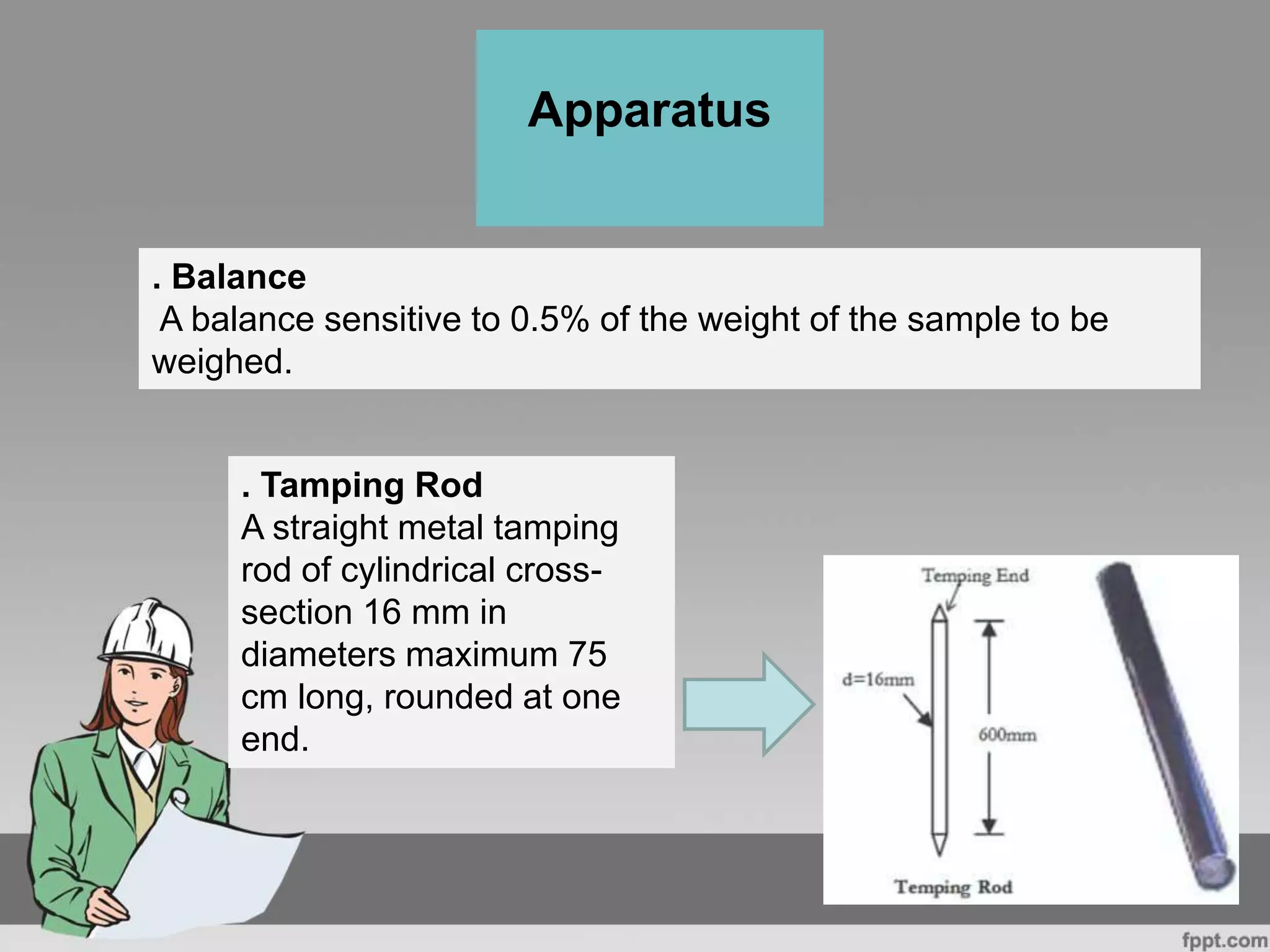
. Tamping Rod
A straight metal tamping
rod of cylindrical cross-
section 16 mm in
diameters maximum 75
cm long, rounded at one
end.
Cylindrical Metal Measure
Apparatus
. The capacity of cylindrical
metal measure conforms to
the specifications of Table 1.
Table 1 Capacity of Measures
Nominal
Maximum Size of
Aggregate, mm
Capacity of
Measure, m^3 (L)
12.5 0.0028 (2.8)
25 0.0093 (9.3)
37.5 0.014 (14)
75 0.028 (28)
100 0.070 (70)
125 0.100 [100]
Cylindrical Measures of Different Sizes
Shovel or Scoop
A shovel or scoop of convenient size for filling the
measure with aggregate.
Equipment for Measuring Volume of Measure
It includes plate glass, grease, and thermometer, and
balance.
Apparatus
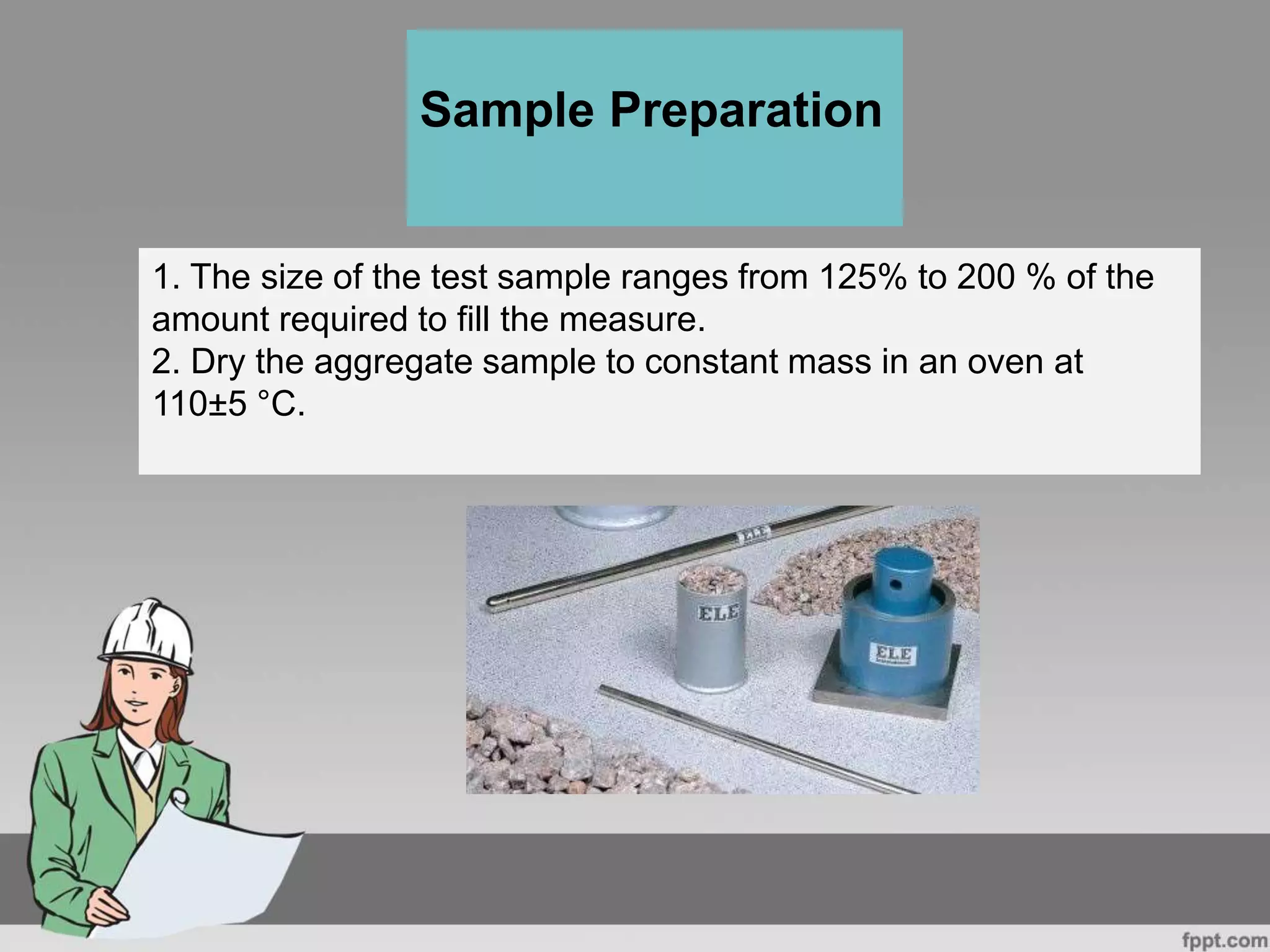
1. The size of the test sample ranges from 125% to 200 % of the
amount required to fill the measure.
2. Dry the aggregate sample to constant mass in an oven at
110±5 °C.
Sample Preparation
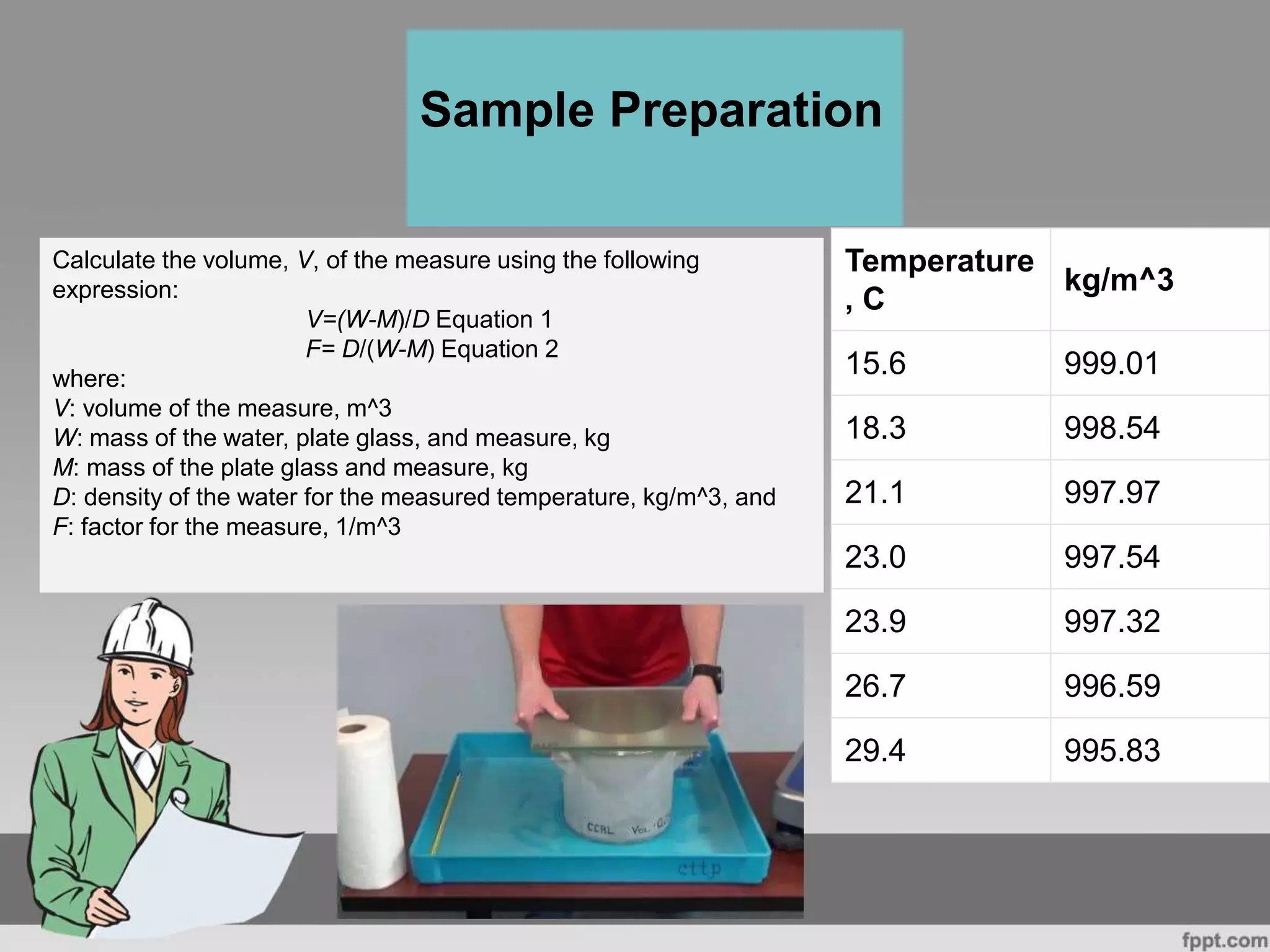
Determination of Volume of Measure
1.Evaluate the mass of the plate glass and measure the nearest
0.05 kg.
2.Place a thin layer of grease on the rim of the measure to
prevent leakage of water.
3.Fill the measure with water and cover it with the plate glass in
a manner to remove bubbles and excess water.
4.Determine the mass of the water, plate glass, and measure to
the nearest 0.05 kg.
5.Measure the temperature of the water to the nearest 0.5 °C
and specify its density from Table 2.
Sample Preparation
Calculate the volume, V, of the measure using the following
expression:
V=(W-M)/D Equation 1
F= D/(W-M) Equation 2
where:
V: volume of the measure, m^3
W: mass of the water, plate glass, and measure, kg
M: mass of the plate glass and measure, kg
D: density of the water for the measured temperature, kg/m^3, and
F: factor for the measure, 1/m^3
Sample Preparation
Temperature
, C
kg/m^3
15.6 999.01
18.3 998.54
21.1 997.97
23.0 997.54
23.9 997.32
26.7 996.59
29.4 995.83
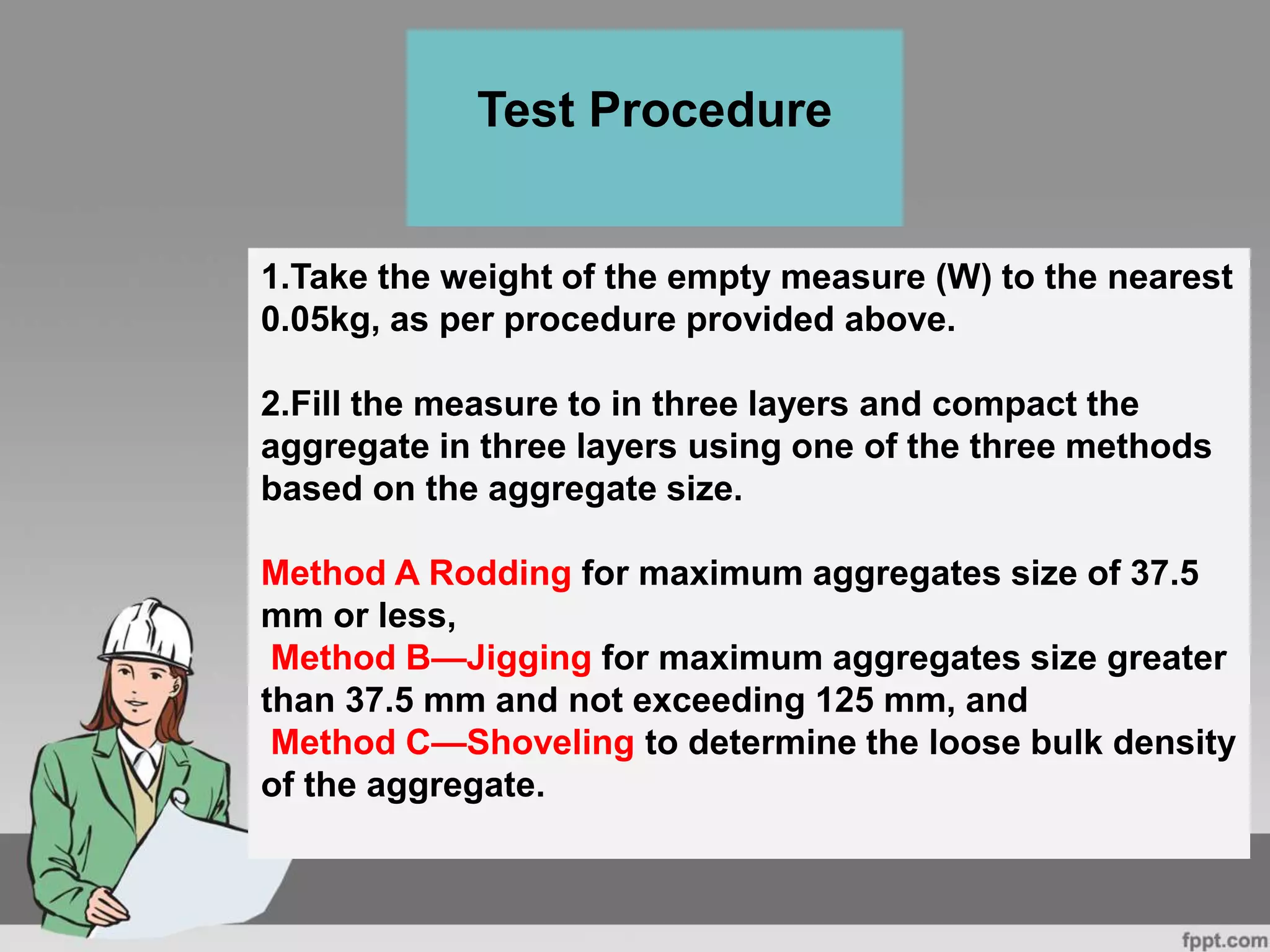
1.Take the weight of the empty measure (W) to the nearest
0.05kg, as per procedure provided above.
2.Fill the measure to in three layers and compact the
aggregate in three layers using one of the three methods
based on the aggregate size.
Method A Rodding for maximum aggregates size of 37.5
mm or less,
Method B—Jigging for maximum aggregates size greater
than 37.5 mm and not exceeding 125 mm, and
Method C—Shoveling to determine the loose bulk density
of the aggregate.
Test Procedure
1. Calculation of Compacted Bulk Density of aggregate
Bulk density (M)= (G-T) / V Equation 3
Or
Bulk density (M)= (G-T) / F Equation 4
where:
M: bulk density of the aggregate, kg/m^3,
G: mass of the aggregate plus the measure, kg,
T: mass of the measure, kg,
V: volume of the measure, m^3,
F: factor for measure, m^3, computed from equation 2.
The bulk density determined by this test method is for aggregate in an
oven-dry condition. If the bulk density in terms of saturated-surface-dry
(SSD) condition is required, it can be computed using the following
formula:
Mssd= M[1+(A/100)] Equation 5
where:
MSSD : bulk density in SSD condition, kg/m^3.
A: % absorption,
Calculations
2. Void Content
Calculate the void content in the aggregate using the bulk
density determined by either the rodding, jigging, or shoveling
procedure, as follows:
%Voids= 100[(SxW)-M]/ (SxW) Equation 6
where:
M: bulk density of the aggregate, kg/m^3,
S: bulk specific gravity
W: density of water, 998 kg/m^3
Calculations
REFERENCE
• https://dot.ca.gov/-/media/dot-
media/programs/engineering/documents/califor
niatestmethods-ctm/ctm-211-a11y.pdf
• https://theconstructor.org/practical-guide/bulk-
density-percentage-voids-aggregates/2251/
• https://www.binabarutama.com/aggregate/speci
fic-gravity-absorption-of-coarse-fine/
• https://toaz.info/doc-view
• https://ensayosdelaboratoriosuelos.files.wordpr
ess.com

ASTM STANDARDS IN PERFORMING LABORATORY TEST FOR AGGREGATES

  • 1.
    ASTM STANDARDS, APPARATUSES/EQUIPMENT NEEDED,AND PROCEDURES/STEPS IN PERFORMING LABORATORY TEST FOR AGGREGATES SUBMITTED BY: - ANLICAO, ANTHONY -ABADAY, JUANITO -LUCMAN, ABDUL HANNAN -PECORE, EARLAN -SINONTAO, JOBERT ASSIGNMENT IN CONSTRUCTION MATERIALS AND TESTING CE312
  • 2.
    ASTM test weightsrange from Class 000 – 7, the tolerances and specifications for these weights are outlined in ASTM E617-13. Classes 000-4 are considered “high class” meaning that they are highly accurate. To handle these weights, one must wear gloves and/or use tweezers to avoid direct skin contact. This is because they are so precise that even the oil from your hands could cause them to be out of tolerance. They are also very sensitive to ambient temperature and humidity. For this reason, they should be allowed to “soak” in the room with the device under test before being used, and generally are not taken out into the field. ASTM Class 5-7 weights are more comparable to NIST Class F weights. A. SPECIFIC WEIGHT
  • 3.
    • Handling TestWeights • How you handle, clean and store your test weights can make a big difference to their accuracy and also the effect on your weighing process. Any time you use your weights the handling and storage are critical – especially on very high accuracy weights of class F2 and above. •Skin acids and oils disrupt a weights surface – use protective gloves and tweezers •. •Not placing a weight with care on a balance can cause micro-abrasions on the test weight – use appropriate lifting handles on larger weights. •Cleaning with caustic or abrasive substances can damage the outer surface – only use specially designed brushes, microfibre cloths or rubber bellows. Finally – Do not forget periodic calibration of your test weights Even when test weights are handled with care, they experience wear. Your QMS may detail the schedules and type of calibration required for your test weights, but you should also structure these schedules around the use that your weights get and the critical importance of them to your weighing process.
  • 4.
    10 Practical TipsFor Correct Weight Handling • Store weights near the balance • Store in original packaging • Use specialised handles for bigger weights • Do not use a weight with dust or water on its surface • Handle with care • Do not forget periodic recalibration • Do not clean with abrasive or caustic chemicals • Clean according to OIML/ASTM recommendations • Inspect for damage prior to use • Do not touch weights with bare hands
  • 5.
    For Coarse Aggregates Objective: Thistest method is used to determine the density of the essentially solid portion of a large number of aggregate particles and provides an average value representing the sample. ASTM Standards ASTM C127-07 - Standard Test Method for Density, Relative Density (Specific Gravity), and Absorption of Coarse Aggregate Specific Weight (Gravity) Laboratory Test for Coarse Aggregates Apparatuses/ Equipment needed: - Balance -Sample -Container -Water Tank - Sieves -Oven
  • 6.
    1.) Dry thetest sample in the oven to constant mass at a temperature of 110 6 5 °C, cool in air at room temperature for 1 to 3 h for test samples of 37.5-mm (11⁄2-in.) nominal maximum size, or longer for larger sizes until the aggregate has cooled to a temperature that is comfortable to handle (approximately 50 °C). Subsequently immerse the aggregate in water at room temperature for a period of 24 6 4 h. 2.) Where the absorption and relative density (specific gravity) values are to be used in proportioning concrete mixtures in which the aggregates will be in their naturally moist condition, the requirement in 8.1 for initial drying is optional, and, if the surfaces of the particles in the sample have been kept continuously wet until tested, the requirement in 8.1 for 24 6 4 h soaking is also optional. Note: Values for absorption and relative density (specific gravity) (SSD) may be significantly higher for aggregate not oven dried before soaking than for the same aggregate treated in accordance with 8.1. This is especially true of particles larger than 75 mm since the water may not be able to penetrate the pores to the center of the particle in the prescribed soaking period. 3.) Remove the test sample from the water and roll it in a large absorbent cloth until all visible films of water are removed. Wipe the larger particles individually. A moving stream of air is permitted to assist in the drying operation. Take care to avoid evaporation of water from aggregate pores during the surface-drying operation. Determine the mass of the test sample in the saturated surface-dry condition. Record this and all subsequent masses to the nearest 0.5 g or 0.05 % of the sample mass, whichever is greater. 4.) After determining the mass in air, immediately place the saturated-surface-dry test sample in the sample container and determine its apparent mass in water at 23 6 2.0 °C. Take care to remove all entrapped air before determining its mass by shaking the container while immersed. Note: The difference between the mass in air and the mass when the sample is submerged in water equals the mass of water displaced by the sample. The container should be immersed to a depth sufficient to cover it and the test sample while determining the apparent mass in water. Wire suspending the container should be of the smallest practical size to minimize any possible effects of a variable immersed length. 5.) Dry the test sample in the oven to constant mass at a temperature of 110 6 5 °C, cool in air at room temperature 1 to 3 h, or until the aggregate has cooled to a temperature that is comfortable to handle (approximately 50 °C), and determine the mass. Procedures/Steps
  • 7.
    For Coarse Aggregates Objective: Thistest method is used to determine the density of the essentially solid portion of a large number of aggregate particles and provides an average value representing the sample. ASTM Standard ASTM C128 - 01 Standard Test Method for Density, Relative Density (Specific Gravity), and Absorption of Fine Aggregate Specific Weight (Gravity) Laboratory Test for Fine Aggregates Apparatuses/ Equipment needed: -Balance - Pycnometer (for Use with Gravimetric Procedure) - Flask (for Use with Volumetric Procedure) - Mold and Tamper for Surface Moisture Test
  • 8.
    1.) Test byeither the gravimetric procedure in 2.2 or the volumetric procedure in 2.3. Make all determinations of mass to 0.1 g. 2.1. Gravimetric (Pycnometer) Procedure: 2.2 Partially fill the pycnometer with water. Introduce into the pycnometer 500 6 10 g of saturated surface-dry fine aggregate prepared as described in Section 8, and fill with additional water to approximately 90 % of capacity. Agitate the pycnometer as described in 2.2.1.1 (manually) or 2.2.1.2 (mechanically). 2.2.1.1 Manually roll, invert, and agitate the pycnometer to eliminate all air bubbles. Note: About 15 to 20 min are normally required to eliminate the air bubbles by manual methods. Dipping the tip of a paper towel into the pycnometer has been found to be useful in dispersing the foam that sometimes builds up when eliminating the air bubbles. Optionally, a small amount of isopropyl alcohol may be used to disperse the foam. Procedures/Steps
  • 9.
    2.2.1.2 Mechanically agitatethe pycnometer by external vibration in a manner that will not degrade the sample. A level of agitation adjusted to just set individual particles in motion is sufficient to promote de-airing without degradation. A mechanical agitator shall be considered acceptable for use if comparison tests for each six-month period of use show variations less that the acceptable range of two results (d2s) indicated in Table 1 from the results of manual agitation on the same material. 2.2.2 After eliminating all air bubbles, adjust the temperature of the pycnometer and its contents to 23.0 6 2.0°C if necessary by partial immersion in circulating water, and bring the water level in the pycnometer to its calibrated capacity. Determine the total mass of the pycnometer, specimen, and water 2.2.3 Remove the fine aggregate from the pycnometer, dry to constant mass at a temperature of 110 6 5°C, cool in air at room temperature for 1 6 1⁄2h, and determine the mass. 2.2.4 Determine the mass of the pycnometer filled to its calibrated capacity with water at 23.0 6 2.0°C. 2.3 Volumetric (Le Chatelier Flask) Procedure: 2.3.1 Fill the flask initially with water to a point on the stem between the 0 and the 1-mL mark. Record this initial reading with flask and contents within the temperature range of 23.0 6 2.0°C. Add 55 6 5 g of fine aggregate in the saturated surface-dry condition (or other measured quantity as necessary). After all fine aggregate has been introduced, place the stopper in the flask and roll the flask in an inclined position, or gently whirl it in a horizontal circle so as to dislodge all entrapped air, continuing until no further bubbles rise to the surface (Note ). Take a final reading with the flask and contents within 1°C of the original temperature. Procedures/Steps
  • 10.
    Note • A smallmeasured amount (not to exceed 1 mL) of isopropyl alcohol may be used to eliminate foam appearing on the water surface.
  • 11.
    The water absorptiontest of aggregate is carried out to calculate the water absorption capacity of Aggregate. The aggregate use in this test should be dust-free. The main aim of this test is to, a. To calculate the strength and quality of the aggregate. b. To calculate the water absorption capacity of aggregate. Apparatus Required a. Weighing Balance b. Thermostatically controlled oven c. Wire basket d. Container e. Shallow tray and two absorbent clothes B. WATER ABSORPTION TEST
  • 13.
    • Procedure a. Asample of 2 kg of aggregate is used for conducting the test. The sample must be washed completely to remove finer particles and dust and then kept in the wire basket, and immersed in the distilled water at a temperature between 22 to 32°C. b. After sinking, the entrapped air must be separated by lifting the basket 25mm above the surface and permitting it to drop 25 times in 25 seconds. The basket and sample should be immersed for a period of 24 ± 0.5 hours afterward. c. The basket and aggregate should then be separated from the water, permitted to drain off water for a few minutes, after which the aggregate should be slowly emptied from the basket and placed onto the water-absorbing cloth, and slowly surface is dried with the cloth.
  • 14.
    d. The aggregateshould be scattered on the second cloth and open to the atmosphere away from direct sunlight till it completely appears to be surface dry. Now, the aggregate should be weighted (Weight A) by using a weighing balance. e. The aggregate should then be kept in an oven at a temperature of about 100-110°C for 24 hours. Then the dry weight (Weighted B) of aggregates is taken. Water Absorption = (A-B)/B x100%.
  • 15.
    • Result The waterabsorption should be not greater than 3%. (Note: The maritime code BS 6349 specifies that water absorption should not exceed 3%, or 2% in critical conditions such as highly aggressive chloride or freeze-thaw exposure when tested following BS 812-2.)
  • 16.
    • Precautions • a.The sample must be washed completely to separate finer particles and dust. • b. Multiple dry cloths should be used to clean aggregates surface. • Advantages • a. Knowing the water absorption capacity of aggregates can help us to determine whether to use it as a construction material or not.
  • 17.
    C. ABRASION TESTING Friction,abrasion, and wear resistance testing can provide valuable insight into material and coating performance when in contact with another material. Understanding these properties can help you predict the mechanical performance or lifetime of a material or coating.
  • 18.
    The coefficient offriction (COF) is a value that shows the relationship between the force of friction between two objects and the normal reaction between the objects that are involved. The COF can be determined for static and dynamic values under wet and dry conditions. Abrasion testing is used to test the abrasive resistance of metals, composites, ceramics, weld overlays, and thermal spray coatings. Abrasion testing can provide data on material resistance to scratching abrasion under laboratory controlled conditions. ABRASION TESTING
  • 19.
    1.)The testing machinemust consist of a hollow steel cylinder, closed at both ends, with an inside diameter of 28 in. ± 0.2 in. and an inside length of 20 in. ± 0.2 in. The steel cylinder must be mounted on stub shafts attached to the ends of the cylinder but not entering it, and must be mounted in such a manner that it may be rotated about its axis in a horizontal position. An opening in the cylinder must be provided for the introduction of the test sample. The opening must be closed with a dust-tight cover that is easily re moved. The cover must be so designed as to maintain the cylindrical contour of the interior surface unless the shelf is so located that the charge will not fall on the cover or come in contact with it during the test. A removable steel shelf projecting radically 3.5 in. ± 0.1 in. into the cylinder and extending its full length must be mounted along one element of the interior surface of the cylinder. The shelf must be of such thickness and be mounted, by bolts or other approved means, so as to be firm and rigid. The position of the shelf must be such that the distance from the shelf to the opening, measured along the circumference of the cylinder in the direction of rotation, is not less than 50 in. The shelf may also be mounted on the inside of the cover plate. The shelf must be made of wear-resistant steel and must be rectangular in crosssection. The Los Angeles Abrasion Testing Machine must be driven and counter balanced so as to maintain 100 revolutions in 190 s ± 10 s. The machine must be equipped with an adjustable counter, which can be set to stop the machine at the required number of revolutions. APPARATUS: Los Angeles Abrasion Testing Machine
  • 20.
    2. Balance: abalance having a capacity of at least 5500 g sensitive to 0.1 g or less. 3. Sieves: No. 4 and No. 12 woven wire sieves conforming to AASHTO M 92. These sieves should be at least 12 in. in diameter. 4. Abrasive Charge: a. Each abrasive charge must consist of a solid, steel sphere having a weight between 390 g and 445 g. A solid, steel sphere with a diameter of 1¾ in. ± 1 16 in. typically meets this requirement. b. The abrasive charge, depending upon the grading of the test specimen as described under Section D.
  • 21.
    1. Prepare thesample in accordance with California Test 201. When necessary, blend the natural material and the material obtained from crushing the oversized particles in accordance with California Test 201, Section H. 2. Wash dirty or coated aggregate and dry to constant weight in accordance with California Test 226 at 230 F ± 9 F. Cool the aggregate to room temperature before preparing the test specimen. 3. Select the grading from Table 1 most nearly representative of the aggregate furnished for the work. Separate the aggregate on the required sieve sizes. Prepare the test specimen using the weight of each sieve size fraction specified for the grading selected. Determine and record the weight of the prepared test specimen to the nearest 1 g. If the coarse aggregate has been separated into 2 or more sieve sizes, select the grading from Table 1 most nearly representative of the combined aggregate mix to be furnished. PREPARATION OF TEST SPECIMEN
  • 22.
    1. Place thetest specimen and abrasive charge in the Los Angeles Abrasive Testing Machine and close the opening with the dust-tight cover. 2. Start the testing machine and run it for the required number of revolutions. 3. When the testing machine has completed the required number of revolutions, remove the cover and carefully empty the entire contents into a pan. Remove the abrasive charge from the pan. 4. Separate the test specimen on the No. 4 sieve and sieve the passing No. 4 material on the No. 12 sieve. Combine the material retained on the No. 4 and No. 12 sieves in accordance with California Test 202. Weigh and record these values to the nearest 1 g. 5. If the weight of material retained on the No. 12 sieve was determined after 100 revolutions, return the entire test specimen, including the material passing the No. 12 sieve, to the testing machine. Close the opening in the testing machine and operate for the required number of additional revolutions, then repeat Steps 3 and 4. TEST PROCEDURE
  • 23.
    1. It isessential that the entire test specimen, including the passing No. 12 sieve portion, be returned to the testing machine after determining the loss at 100 revolutions. Loss of fines during this phase of the operation will generally cause a higher than normal percent wear at 500 revolutions. 2. Backlash or slip in the driving mechanism is very likely to result in erroneous test results. Occasionally, check machine for worn gears, improperly tensioned belts, worn bearings, etc., to reduce possibility of improper operations. 3. The shelf of the Los Angeles Abrasion Testing Machine should be inspected periodically for wear and distortion. California Test 211 May 2010 -4- If the shelf is bent, either lengthwise or from its normal radial position with respect to the cylinder, it should be repaired or replaced before further abrasion tests are made. If a ridge develops on the working surface of the shelf, it should be ground off if its height exceeds 0.1 in PRECAUTIONS
  • 24.
    It is theresponsibility of the user of this test method to establish appropriate safety and health practices and determine the applicability of regulatory limitations prior to use. Prior to handling, testing or disposing of any materials, testers must be knowledgeable about safe laboratory practices, hazards and exposure, chemical procurement and storage, and personal protective apparel and equipment. HEALTH AND SAFETY
  • 25.
    The bulk densityand void percentage of aggregate can be evaluated using standard test methods of applicable codes such as ASTM C 29/C29M-17a, IS: 2386 (Part 3) – 1963, or BS 812-2:1995. The procedure provided in this article is based on the specification of ASTM standard ( ASTM C 29/C29M-17a). The bulk density or unit weight is the weight per unit volume (mass per unit volume or density). Voids in unit volume of aggregate are the space between particles in an aggregate mass not occupied by solid minerals. The bulk density values determined based on this test can be used for many methods of selecting proportions for concrete mixtures. Added to that, the evaluation of the percentage of voids between particles in fine, coarse, or mixed aggregates is dependent on the bulk density. It is worth knowing that, aggregates in stockpiles contain absorbed and surface moisture (the latter affecting bulking), while this test method determines the bulk density on a dry basis D. DENSITY OF AGGREGATE
  • 26.
    . Balance A balancesensitive to 0.5% of the weight of the sample to be weighed. Apparatus . Tamping Rod A straight metal tamping rod of cylindrical cross- section 16 mm in diameters maximum 75 cm long, rounded at one end.
  • 27.
    Cylindrical Metal Measure Apparatus .The capacity of cylindrical metal measure conforms to the specifications of Table 1. Table 1 Capacity of Measures Nominal Maximum Size of Aggregate, mm Capacity of Measure, m^3 (L) 12.5 0.0028 (2.8) 25 0.0093 (9.3) 37.5 0.014 (14) 75 0.028 (28) 100 0.070 (70) 125 0.100 [100] Cylindrical Measures of Different Sizes
  • 28.
    Shovel or Scoop Ashovel or scoop of convenient size for filling the measure with aggregate. Equipment for Measuring Volume of Measure It includes plate glass, grease, and thermometer, and balance. Apparatus
  • 29.
    1. The sizeof the test sample ranges from 125% to 200 % of the amount required to fill the measure. 2. Dry the aggregate sample to constant mass in an oven at 110±5 °C. Sample Preparation
  • 30.
    Determination of Volumeof Measure 1.Evaluate the mass of the plate glass and measure the nearest 0.05 kg. 2.Place a thin layer of grease on the rim of the measure to prevent leakage of water. 3.Fill the measure with water and cover it with the plate glass in a manner to remove bubbles and excess water. 4.Determine the mass of the water, plate glass, and measure to the nearest 0.05 kg. 5.Measure the temperature of the water to the nearest 0.5 °C and specify its density from Table 2. Sample Preparation
  • 31.
    Calculate the volume,V, of the measure using the following expression: V=(W-M)/D Equation 1 F= D/(W-M) Equation 2 where: V: volume of the measure, m^3 W: mass of the water, plate glass, and measure, kg M: mass of the plate glass and measure, kg D: density of the water for the measured temperature, kg/m^3, and F: factor for the measure, 1/m^3 Sample Preparation Temperature , C kg/m^3 15.6 999.01 18.3 998.54 21.1 997.97 23.0 997.54 23.9 997.32 26.7 996.59 29.4 995.83
  • 32.
    1.Take the weightof the empty measure (W) to the nearest 0.05kg, as per procedure provided above. 2.Fill the measure to in three layers and compact the aggregate in three layers using one of the three methods based on the aggregate size. Method A Rodding for maximum aggregates size of 37.5 mm or less, Method B—Jigging for maximum aggregates size greater than 37.5 mm and not exceeding 125 mm, and Method C—Shoveling to determine the loose bulk density of the aggregate. Test Procedure
  • 33.
    1. Calculation ofCompacted Bulk Density of aggregate Bulk density (M)= (G-T) / V Equation 3 Or Bulk density (M)= (G-T) / F Equation 4 where: M: bulk density of the aggregate, kg/m^3, G: mass of the aggregate plus the measure, kg, T: mass of the measure, kg, V: volume of the measure, m^3, F: factor for measure, m^3, computed from equation 2. The bulk density determined by this test method is for aggregate in an oven-dry condition. If the bulk density in terms of saturated-surface-dry (SSD) condition is required, it can be computed using the following formula: Mssd= M[1+(A/100)] Equation 5 where: MSSD : bulk density in SSD condition, kg/m^3. A: % absorption, Calculations
  • 34.
    2. Void Content Calculatethe void content in the aggregate using the bulk density determined by either the rodding, jigging, or shoveling procedure, as follows: %Voids= 100[(SxW)-M]/ (SxW) Equation 6 where: M: bulk density of the aggregate, kg/m^3, S: bulk specific gravity W: density of water, 998 kg/m^3 Calculations
  • 35.
    REFERENCE • https://dot.ca.gov/-/media/dot- media/programs/engineering/documents/califor niatestmethods-ctm/ctm-211-a11y.pdf • https://theconstructor.org/practical-guide/bulk- density-percentage-voids-aggregates/2251/ •https://www.binabarutama.com/aggregate/speci fic-gravity-absorption-of-coarse-fine/ • https://toaz.info/doc-view • https://ensayosdelaboratoriosuelos.files.wordpr ess.com