DUCTOGRAPHY
By Prof J Venkat
Professor in Radiography
Chennai India
+919444923675 WhatsApp
venkatdgr8@gmail.com
SPECIAL PROCEDURE SERIES IN RADIOGRAPHY
OBJECTIVE
• Definition
• Anatomy
• Indications
• Contraindications
• Equipment needed
• Materials needed
• Contrast media
• Preparation
• Procedure
• Filming
• Positive findings
• Complications
• Post procedural
care/Instructions
By Prof J Venkat
Professor in Radiography
Chennai India
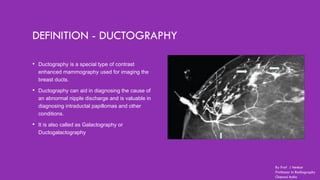
• Ductography is a special type of contrast
enhanced mammography used for imaging the
breast ducts.
• Ductography can aid in diagnosing the cause of
an abnormal nipple discharge and is valuable in
diagnosing intraductal papillomas and other
conditions.
• It is also called as Galactography or
Ductogalactography
DEFINITION - DUCTOGRAPHY
By Prof J Venkat
Professor in Radiography
Chennai India
ANATOMY
• Each breast has 15 to 20 sections, called lobes.
• Each lobe has many smaller structures called
lobules. These end in dozens of tiny bulbs that
can produce milk.
• The lobes, lobules, and bulbs are all linked by
thin tubes called ducts.
• These ducts lead to the nipple in the center of a
dark area of skin called the areola.
• Fat fills the spaces between lobules and ducts.
• There are no muscles in the breast, but muscles
lie under each breast and cover the ribs.
By Prof J Venkat
Professor in Radiography
Chennai India
INDICATIONS
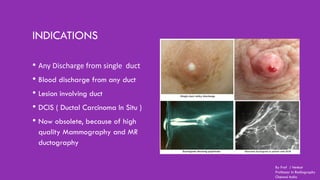
• Any Discharge from single duct
• Blood discharge from any duct
• Lesion involving duct
• DCIS ( Ductal Carcinoma In Situ )
• Now obsolete, because of high
quality Mammography and MR
ductography
By Prof J Venkat
Professor in Radiography
Chennai India
CONTRAINDICATIONS
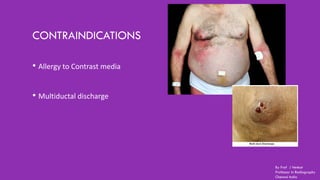
• Allergy to Contrast media
• Multiductal discharge
By Prof J Venkat
Professor in Radiography
Chennai India
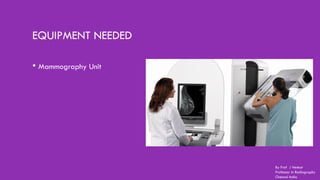
EQUIPMENT NEEDED
• Mammography Unit
By Prof J Venkat
Professor in Radiography
Chennai India
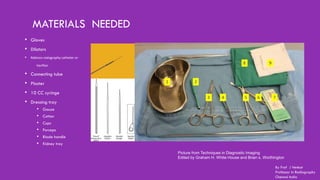
MATERIALS NEEDED
• Gloves
• Dilators
• Rabinov sialography catheter or
Venflon
• Connecting tube
• Plaster
• 10 CC syringe
• Dressing tray
• Gauze
• Cotton
• Cups
• Forceps
• Blade handle
• Kidney tray
Picture from Techniques in Diagnostic Imaging
Edited by Graham H. White House and Brian s. Worthington
By Prof J Venkat
Professor in Radiography
Chennai India
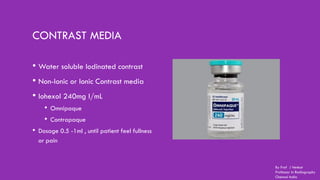
CONTRAST MEDIA
• Water soluble Iodinated contrast
• Non-Ionic or Ionic Contrast media
• Iohexol 240mg I/mL
• Omnipaque
• Contrapaque
• Dosage 0.5 -1ml , until patient feel fullness
or pain
By Prof J Venkat
Professor in Radiography
Chennai India
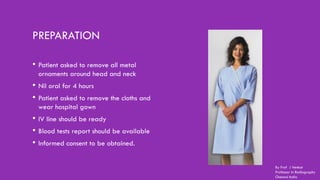
PREPARATION
• Patient asked to remove all metal
ornaments around head and neck
• Nil oral for 4 hours
• Patient asked to remove the cloths and
wear hospital gown
• IV line should be ready
• Blood tests report should be available
• Informed consent to be obtained.
By Prof J Venkat
Professor in Radiography
Chennai India
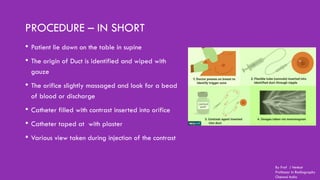
PROCEDURE – IN SHORT
• Patient lie down on the table in supine
• The origin of Duct is identified and wiped with
gauze
• The orifice slightly massaged and look for a bead
of blood or discharge
• Catheter filled with contrast inserted into orifice
• Catheter taped at with plaster
• Various view taken during injection of the contrast
By Prof J Venkat
Professor in Radiography
Chennai India
PROCEDURE
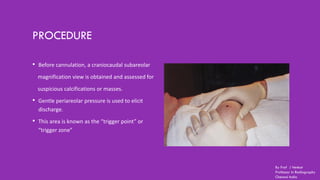
• Before cannulation, a craniocaudal subareolar
magnification view is obtained and assessed for
suspicious calcifications or masses.
• Gentle periareolar pressure is used to elicit
discharge.
• This area is known as the “trigger point” or
“trigger zone”
By Prof J Venkat
Professor in Radiography
Chennai India
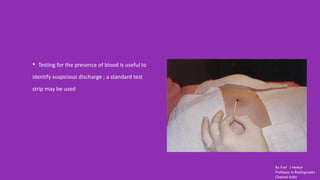
• Testing for the presence of blood is useful to
identify suspicious discharge ; a standard test
strip may be used
By Prof J Venkat
Professor in Radiography
Chennai India
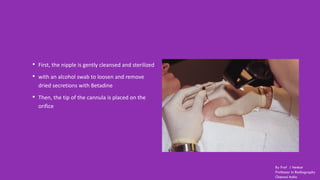
• First, the nipple is gently cleansed and sterilized
• with an alcohol swab to loosen and remove
dried secretions with Betadine
• Then, the tip of the cannula is placed on the
orifice
By Prof J Venkat
Professor in Radiography
Chennai India
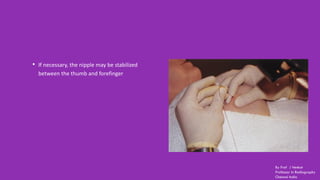
• If necessary, the nipple may be stabilized
between the thumb and forefinger
By Prof J Venkat
Professor in Radiography
Chennai India
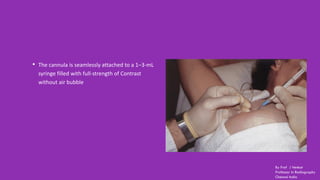
• The cannula is seamlessly attached to a 1–3-mL
syringe filled with full-strength of Contrast
without air bubble
By Prof J Venkat
Professor in Radiography
Chennai India
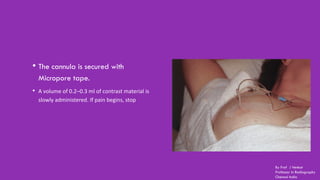
• The cannula is secured with
Micropore tape.
• A volume of 0.2–0.3 ml of contrast material is
slowly administered. If pain begins, stop
By Prof J Venkat
Professor in Radiography
Chennai India
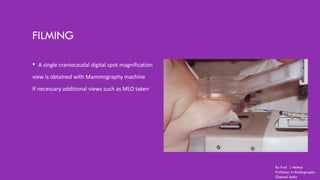
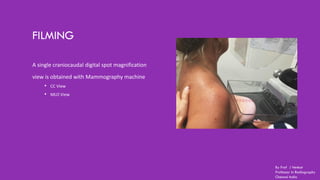
FILMING
• A single craniocaudal digital spot magnification
view is obtained with Mammography machine
If necessary additional views such as MLO taken
By Prof J Venkat
Professor in Radiography
Chennai India
FILMING
A single craniocaudal digital spot magnification
view is obtained with Mammography machine
• CC View
• MLO View
By Prof J Venkat
Professor in Radiography
Chennai India
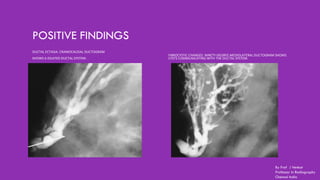
POSITIVE FINDINGS
DUCTAL ECTASIA. CRANIOCAUDAL DUCTOGRAM
SHOWS A DILATED DUCTAL SYSTEM.
FIBROCYSTIC CHANGES. NINETY-DEGREE MEDIOLATERAL DUCTOGRAM SHOWS
CYSTS COMMUNICATING WITH THE DUCTAL SYSTEM.
By Prof J Venkat
Professor in Radiography
Chennai India
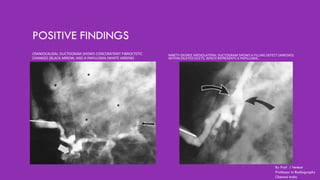
POSITIVE FINDINGS
CRANIOCAUDAL DUCTOGRAM SHOWS CONCOMITANT FIBROCYSTIC
CHANGES (BLACK ARROW, AND A PAPILLOMA (WHITE ARROW)
NINETY-DEGREE MEDIOLATERAL DUCTOGRAM SHOWS A FILLING DEFECT (ARROWS)
WITHIN DILATED DUCTS, WHICH REPRESENTS A PAPILLOMA..
By Prof J Venkat
Professor in Radiography
Chennai India
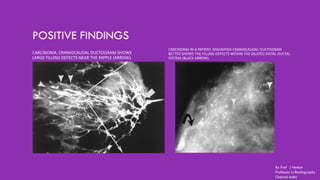
POSITIVE FINDINGS
CARCINOMA. CRANIOCAUDAL DUCTOGRAM SHOWS
LARGE FILLING DEFECTS NEAR THE NIPPLE (ARROW).
CARCINOMA IN A PATIENT, MAGNIFIED CRANIOCAUDAL DUCTOGRAM
BETTER SHOWS THE FILLING DEFECTS WITHIN THE DILATED DISTAL DUCTAL
SYSTEM (BLACK ARROW)
By Prof J Venkat
Professor in Radiography
Chennai India
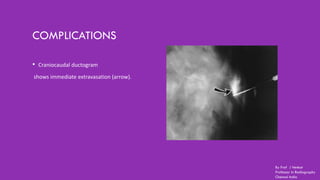
COMPLICATIONS
• Craniocaudal ductogram
shows immediate extravasation (arrow).
By Prof J Venkat
Professor in Radiography
Chennai India
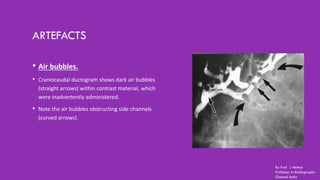
ARTEFACTS
• Air bubbles.
• Craniocaudal ductogram shows dark air bubbles
(straight arrows) within contrast material, which
were inadvertently administered.
• Note the air bubbles obstructing side channels
(curved arrows).
By Prof J Venkat
Professor in Radiography
Chennai India
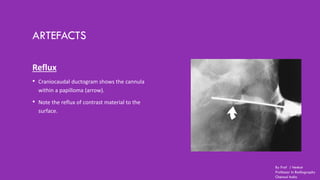
ARTEFACTS
Reflux
• Craniocaudal ductogram shows the cannula
within a papilloma (arrow).
• Note the reflux of contrast material to the
surface.
By Prof J Venkat
Professor in Radiography
Chennai India
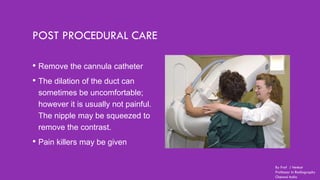
POST PROCEDURAL CARE
• Remove the cannula catheter
• The dilation of the duct can
sometimes be uncomfortable;
however it is usually not painful.
The nipple may be squeezed to
remove the contrast.
• Pain killers may be given
By Prof J Venkat
Professor in Radiography
Chennai India
THANK YOU
• References
• Radiological Procedures - A Guideline
Edited by Dr Bhushan N. Lakhakar
• A Guide to Radiological Procedures
Edited by Stephen Chapman
• Fundamentals of Special Radiographic Procedures
Edited by ALBERT M. SNOPEK
• Clark’s Positioning in Radiography By Kathleen C Clark (1896-1968)
• Techniques in Diagnostic Imaging
Edited by Graham H. White House and Brian s. Worthington
• Wikipedia, The Free Encyclopedia
• Ductography: How To and What If S. Horatio Slawson, MD • Bradley A. Johnson, MD
By Prof J Venkat
Professor in Radiography
Chennai India
+919444923675 WhatsApp
venkatdgr8@gmail.com

Ductography by prof j venkat

  • 1.
    DUCTOGRAPHY By Prof JVenkat Professor in Radiography Chennai India +919444923675 WhatsApp venkatdgr8@gmail.com SPECIAL PROCEDURE SERIES IN RADIOGRAPHY
  • 2.
    OBJECTIVE • Definition • Anatomy •Indications • Contraindications • Equipment needed • Materials needed • Contrast media • Preparation • Procedure • Filming • Positive findings • Complications • Post procedural care/Instructions By Prof J Venkat Professor in Radiography Chennai India
  • 3.
    • Ductography isa special type of contrast enhanced mammography used for imaging the breast ducts. • Ductography can aid in diagnosing the cause of an abnormal nipple discharge and is valuable in diagnosing intraductal papillomas and other conditions. • It is also called as Galactography or Ductogalactography DEFINITION - DUCTOGRAPHY By Prof J Venkat Professor in Radiography Chennai India
  • 4.
    ANATOMY • Each breasthas 15 to 20 sections, called lobes. • Each lobe has many smaller structures called lobules. These end in dozens of tiny bulbs that can produce milk. • The lobes, lobules, and bulbs are all linked by thin tubes called ducts. • These ducts lead to the nipple in the center of a dark area of skin called the areola. • Fat fills the spaces between lobules and ducts. • There are no muscles in the breast, but muscles lie under each breast and cover the ribs. By Prof J Venkat Professor in Radiography Chennai India
  • 5.
    INDICATIONS • Any Dischargefrom single duct • Blood discharge from any duct • Lesion involving duct • DCIS ( Ductal Carcinoma In Situ ) • Now obsolete, because of high quality Mammography and MR ductography By Prof J Venkat Professor in Radiography Chennai India
  • 6.
    CONTRAINDICATIONS • Allergy toContrast media • Multiductal discharge By Prof J Venkat Professor in Radiography Chennai India
  • 7.
    EQUIPMENT NEEDED • MammographyUnit By Prof J Venkat Professor in Radiography Chennai India
  • 8.
    MATERIALS NEEDED • Gloves •Dilators • Rabinov sialography catheter or Venflon • Connecting tube • Plaster • 10 CC syringe • Dressing tray • Gauze • Cotton • Cups • Forceps • Blade handle • Kidney tray Picture from Techniques in Diagnostic Imaging Edited by Graham H. White House and Brian s. Worthington By Prof J Venkat Professor in Radiography Chennai India
  • 9.
    CONTRAST MEDIA • Watersoluble Iodinated contrast • Non-Ionic or Ionic Contrast media • Iohexol 240mg I/mL • Omnipaque • Contrapaque • Dosage 0.5 -1ml , until patient feel fullness or pain By Prof J Venkat Professor in Radiography Chennai India
  • 10.
    PREPARATION • Patient askedto remove all metal ornaments around head and neck • Nil oral for 4 hours • Patient asked to remove the cloths and wear hospital gown • IV line should be ready • Blood tests report should be available • Informed consent to be obtained. By Prof J Venkat Professor in Radiography Chennai India
  • 11.
    PROCEDURE – INSHORT • Patient lie down on the table in supine • The origin of Duct is identified and wiped with gauze • The orifice slightly massaged and look for a bead of blood or discharge • Catheter filled with contrast inserted into orifice • Catheter taped at with plaster • Various view taken during injection of the contrast By Prof J Venkat Professor in Radiography Chennai India
  • 12.
    PROCEDURE • Before cannulation,a craniocaudal subareolar magnification view is obtained and assessed for suspicious calcifications or masses. • Gentle periareolar pressure is used to elicit discharge. • This area is known as the “trigger point” or “trigger zone” By Prof J Venkat Professor in Radiography Chennai India
  • 13.
    • Testing forthe presence of blood is useful to identify suspicious discharge ; a standard test strip may be used By Prof J Venkat Professor in Radiography Chennai India
  • 14.
    • First, thenipple is gently cleansed and sterilized • with an alcohol swab to loosen and remove dried secretions with Betadine • Then, the tip of the cannula is placed on the orifice By Prof J Venkat Professor in Radiography Chennai India
  • 15.
    • If necessary,the nipple may be stabilized between the thumb and forefinger By Prof J Venkat Professor in Radiography Chennai India
  • 16.
    • The cannulais seamlessly attached to a 1–3-mL syringe filled with full-strength of Contrast without air bubble By Prof J Venkat Professor in Radiography Chennai India
  • 17.
    • The cannulais secured with Micropore tape. • A volume of 0.2–0.3 ml of contrast material is slowly administered. If pain begins, stop By Prof J Venkat Professor in Radiography Chennai India
  • 18.
    FILMING • A singlecraniocaudal digital spot magnification view is obtained with Mammography machine If necessary additional views such as MLO taken By Prof J Venkat Professor in Radiography Chennai India
  • 19.
    FILMING A single craniocaudaldigital spot magnification view is obtained with Mammography machine • CC View • MLO View By Prof J Venkat Professor in Radiography Chennai India
  • 20.
    POSITIVE FINDINGS DUCTAL ECTASIA.CRANIOCAUDAL DUCTOGRAM SHOWS A DILATED DUCTAL SYSTEM. FIBROCYSTIC CHANGES. NINETY-DEGREE MEDIOLATERAL DUCTOGRAM SHOWS CYSTS COMMUNICATING WITH THE DUCTAL SYSTEM. By Prof J Venkat Professor in Radiography Chennai India
  • 21.
    POSITIVE FINDINGS CRANIOCAUDAL DUCTOGRAMSHOWS CONCOMITANT FIBROCYSTIC CHANGES (BLACK ARROW, AND A PAPILLOMA (WHITE ARROW) NINETY-DEGREE MEDIOLATERAL DUCTOGRAM SHOWS A FILLING DEFECT (ARROWS) WITHIN DILATED DUCTS, WHICH REPRESENTS A PAPILLOMA.. By Prof J Venkat Professor in Radiography Chennai India
  • 22.
    POSITIVE FINDINGS CARCINOMA. CRANIOCAUDALDUCTOGRAM SHOWS LARGE FILLING DEFECTS NEAR THE NIPPLE (ARROW). CARCINOMA IN A PATIENT, MAGNIFIED CRANIOCAUDAL DUCTOGRAM BETTER SHOWS THE FILLING DEFECTS WITHIN THE DILATED DISTAL DUCTAL SYSTEM (BLACK ARROW) By Prof J Venkat Professor in Radiography Chennai India
  • 23.
    COMPLICATIONS • Craniocaudal ductogram showsimmediate extravasation (arrow). By Prof J Venkat Professor in Radiography Chennai India
  • 24.
    ARTEFACTS • Air bubbles. •Craniocaudal ductogram shows dark air bubbles (straight arrows) within contrast material, which were inadvertently administered. • Note the air bubbles obstructing side channels (curved arrows). By Prof J Venkat Professor in Radiography Chennai India
  • 25.
    ARTEFACTS Reflux • Craniocaudal ductogramshows the cannula within a papilloma (arrow). • Note the reflux of contrast material to the surface. By Prof J Venkat Professor in Radiography Chennai India
  • 26.
    POST PROCEDURAL CARE •Remove the cannula catheter • The dilation of the duct can sometimes be uncomfortable; however it is usually not painful. The nipple may be squeezed to remove the contrast. • Pain killers may be given By Prof J Venkat Professor in Radiography Chennai India
  • 27.
    THANK YOU • References •Radiological Procedures - A Guideline Edited by Dr Bhushan N. Lakhakar • A Guide to Radiological Procedures Edited by Stephen Chapman • Fundamentals of Special Radiographic Procedures Edited by ALBERT M. SNOPEK • Clark’s Positioning in Radiography By Kathleen C Clark (1896-1968) • Techniques in Diagnostic Imaging Edited by Graham H. White House and Brian s. Worthington • Wikipedia, The Free Encyclopedia • Ductography: How To and What If S. Horatio Slawson, MD • Bradley A. Johnson, MD By Prof J Venkat Professor in Radiography Chennai India +919444923675 WhatsApp venkatdgr8@gmail.com