CT CALCIUM
CT CALCIUM
SCORING
SCORING
Background
• Approximately 50% of acute MI occur in people without any
Approximately 50% of acute MI occur in people without any
history of CAD.
history of CAD.
• Coronary atherosclerosis is a slow progressive disease that
Coronary atherosclerosis is a slow progressive disease that
often goes unrecognized until the person develops symptoms.
• What is needed is a way to identify asymptomatic people who
What is needed is a way to identify asymptomatic people who
are at high risk for CV events early in their disease process.
• MI usually occurs in patients who have a
MI usually occurs in patients who have a
mild or moderate CA stenosis that
develops plaque rupture & leads to an
acute thrombosis.
acute thrombosis.
• These mild to moderate coronary lesions
These mild to moderate coronary lesions
may not cause symptoms and/or may not
cause enough ischemia to be picked up
during a routine stress test.
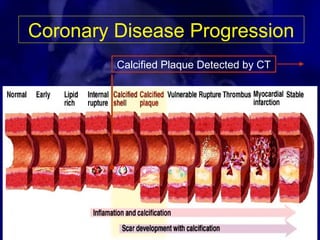
• During the early stages of coronary
During the early stages of coronary
atherosclerosis calcium starts to
accumulate within the plaque.
• As the atherosclerotic process progresses
As the atherosclerotic process progresses
the amount of calcification increases.
• During the advanced stages of
During the advanced stages of
atherosclerosis a large amount of
coronary calcification may be present.
Coronary Disease Progression
Calcified Plaque Detected by CT
• Atherosclerosis is the only disease
Atherosclerosis is the only disease
process known to cause calcium to
deposit in coronary artery walls.
• Calcification is not a degenerative
Calcification is not a degenerative
disease, it is not a part of the “normal”
aging process.
aging process.
• Calcium is not found in normal CA.
Calcium is not found in normal CA.
• Since calcium deposits start to develop
Since calcium deposits start to develop
during the early stages of atherosclerosis
and if we are able to identify the
presence of calcium we are able to
identify preclinical coronary artery
disease during the asymptomatic stage.
• This can allow for the implementation of
This can allow for the implementation of
early aggressive risk factor reduction.
• Calcification can be seen with fluoroscopy
Calcification can be seen with fluoroscopy
and on chest x-ray.
and on chest x-ray.
• Computed tomography allows
Computed tomography allows
quantification of this calcium.
• The amount of calcium deposited in coronary
The amount of calcium deposited in coronary
arteries is added up and a “score” is given.
• The amount of calcium in the coronary
The amount of calcium in the coronary
arteries varies considerably with age and
gender.
gender.
• For this reason, coronary calcium scores are
For this reason, coronary calcium scores are
presented as percentile scores that can tell
how much calcium you have compared to
other men or women of your age.
• higher than the 75th percentile is
higher than the 75th percentile is
considered high risk, irrespective of the
score, and indicates premature
atherosclerosis.
atherosclerosis.
• Unlike global risk scores such as the
Unlike global risk scores such as the
Framingham Risk Score, which provide cardio-
vascular risk estimates based on mean risk factor
distributions across a population, the CCS is a
direct marker of atherosclerosis in an individual
patient.
patient.
• As such, it provides an assessment of the burden
As such, it provides an assessment of the burden
of coronary atherosclerosis, reflecting the
integrated lifetime effect of all risk factors in an
individual patient.
individual patient.
CCS Protocol
• CAC is detected using a standardized protocol
CAC is detected using a standardized protocol
involving :
involving :
• Prospective ECG-triggered axial scanning, with
Prospective ECG-triggered axial scanning, with
a slice thickness of 3mm.
• Standard tube voltage is 120 kV, with tube
Standard tube voltage is 120 kV, with tube
current set at 120 to 150 mAs, which should
result in acceptably low levels of radiation
exposure (1 to 2 mSv).
Methods
Methods
• Agatston Score :
Agatston Score :Traditional method
Traditional method
(EBCT : MDCT)
(EBCT : MDCT)
• Volume Score :
Volume Score : Plaque area x slice
Plaque area x slice
thickness (mm
thickness (mm³
³)
)
• Mass Score :
Mass Score : Plaque volume x mean
Plaque volume x mean
plaque density .
plaque density .
• The method is based on the maximum x-ray
attenuation coefficient, or CT number
(measured in Hounsfield units [HU]), and
the area of calcium deposits.
• First, calcified lesions are identified on CT
images by applying a threshold of 130 HU
to the entire image set; tissues with
densities equal to or greater than the
threshold are considered to correspond to
calcium.
Agatston Score
Agatston Score
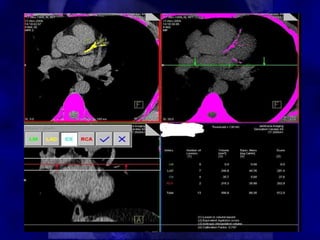
• For each coronary artery, i, a region of
interest (ROI) is drawn around each
calcified lesion, j.
• The maximum CT number, CTmax ij , of
the ROI is determined and used to assign
a weighting factor, wij.
• The area, Aij, of the ROI is also
determined.
• The Agatston score, Sij, is computed as
the product of the weighting factor and
the area:
Sij = wij x Aij
Where :
• w ij = 1 if CTijmax 130 - 199 HU
2 if CTijmax 200 - 299 HU
3 if CTijmax 300 - 399 HU
4 if CTijmax > 400 HU
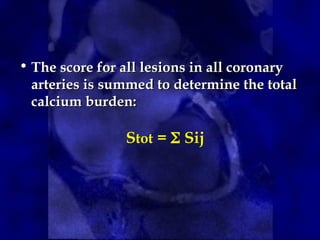
• The score for all lesions in all coronary
arteries is summed to determine the total
calcium burden:
Stot =  Sij
The Calcium Scale
The Calcium Scale
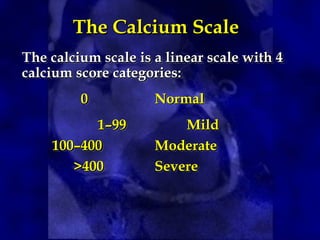
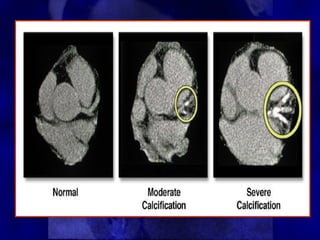
The calcium scale is a linear scale with 4
calcium score categories:
0
0 Normal
Normal
1–99
1–99 Mild
Mild
100–400
100–400 Moderate
Moderate
>400
>400 Severe
Severe
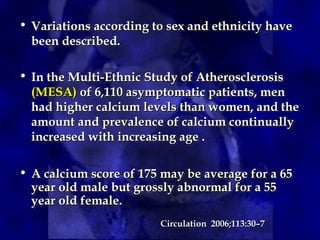
• Variations according to sex and ethnicity have
Variations according to sex and ethnicity have
been described.
been described.
• In the Multi-Ethnic Study of Atherosclerosis
In the Multi-Ethnic Study of Atherosclerosis
(MESA)
(MESA) of 6,110 asymptomatic patients, men
of 6,110 asymptomatic patients, men
had higher calcium levels than women, and the
amount and prevalence of calcium continually
increased with increasing age .
• A calcium score of 175 may be average for a 65
A calcium score of 175 may be average for a 65
year old male but grossly abnormal for a 55
year old female.
year old female.
Circulation 2006;113:30–7
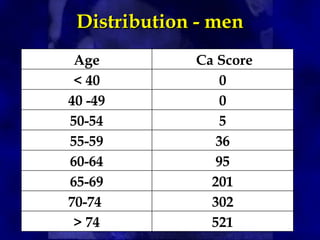
Distribution - men
Distribution - men
Age Ca Score
< 40 0
40 -49 0
50-54 5
55-59 36
60-64 95
65-69 201
70-74 302
> 74 521
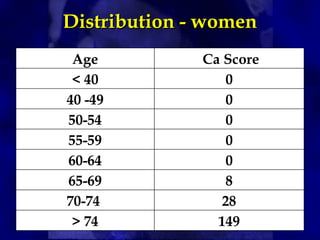
Distribution - women
Age Ca Score
< 40 0
40 -49 0
50-54 0
55-59 0
60-64 0
65-69 8
70-74 28
> 74 149
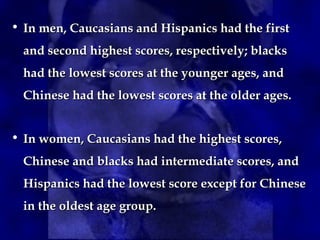
• In men, Caucasians and Hispanics had the first
In men, Caucasians and Hispanics had the first
and second highest scores, respectively; blacks
had the lowest scores at the younger ages, and
Chinese had the lowest scores at the older ages.
• In women, Caucasians had the highest scores,
In women, Caucasians had the highest scores,
Chinese and blacks had intermediate scores, and
Hispanics had the lowest score except for Chinese
in the oldest age group.
•What does CCS “0” mean?
• One may still have non-calcified
One may still have non-calcified
atherosclerotic plaque .
• Multiple studies have shown only a 0.11 %
Multiple studies have shown only a 0.11 %
annual event rate and 1.1% 10 year risk in
asymptomatic patients with 0 CCS.
•Advantages of CCS
• Rapid .
Rapid .
• Does not require contrast.
Does not require contrast.
• Low radiation dose .
Low radiation dose .
• Reproducible.
Reproducible.
• Powerful prognostic data.
Powerful prognostic data.
• Disadvantages of CCS :
Disadvantages of CCS :
• Cost
Cost
• Radiation exposure
Radiation exposure
Coronary Calcium and Clinical Outcomes
• OVERALL:
OVERALL:
– 15 studies published
15 studies published
– Age range 41- 85 years old
Age range 41- 85 years old
– Approximately 15,000 patients
Approximately 15,000 patients
– All studies have reported that coronary
All studies have reported that coronary
calcium predicts CV disease events
independently of and more accurately than
traditional risk factors.
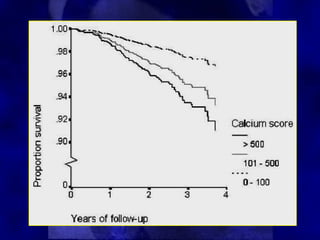
• At 2004 a study was carried out in
At 2004 a study was carried out in
Netherlands:
Netherlands:
• From 2,032 people ages 55 to 85, with a
From 2,032 people ages 55 to 85, with a
mean age of 77, who underwent CT
calcium scoring between 1997 and 2000
• 0 -100 : 47%
0 -100 : 47%
• 100 -500 : 26%
100 -500 : 26%
• >500 : 27%
>500 : 27%
• The mean duration of follow-up was 2.7
The mean duration of follow-up was 2.7
years, during which time 92 subjects died
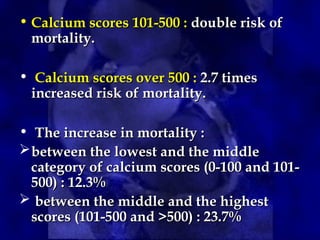
• Calcium scores 101-500 :
Calcium scores 101-500 : double risk of
double risk of
mortality.
mortality.
• Calcium scores over 500 :
Calcium scores over 500 : 2.7 times
2.7 times
increased risk of mortality.
• The increase in mortality :
The increase in mortality :
between the lowest and the middle
between the lowest and the middle
category of calcium scores (0-100 and 101-
500) : 12.3%
500) : 12.3%
 between the middle and the highest
between the middle and the highest
scores (101-500 and >500) : 23.7%
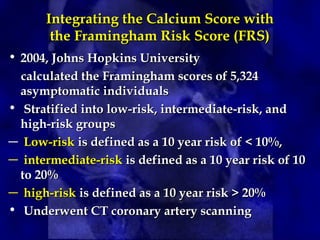
Integrating the Calcium Score with
the Framingham Risk Score (FRS)
• 2004, Johns Hopkins University
2004, Johns Hopkins University
calculated the Framingham scores of 5,324
asymptomatic individuals
• Stratified into low-risk, intermediate-risk, and
Stratified into low-risk, intermediate-risk, and
high-risk groups
high-risk groups
― Low-risk
Low-risk is defined as a 10 year risk of < 10%,
is defined as a 10 year risk of < 10%,
― intermediate-risk
intermediate-risk is defined as a 10 year risk of 10
is defined as a 10 year risk of 10
to 20%
to 20%
― high-risk
high-risk is defined as a 10 year risk > 20%
is defined as a 10 year risk > 20%
• Underwent CT coronary artery scanning
Underwent CT coronary artery scanning
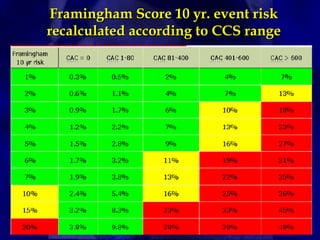
Framingham Score 10 yr. event risk
recalculated according to CCS range
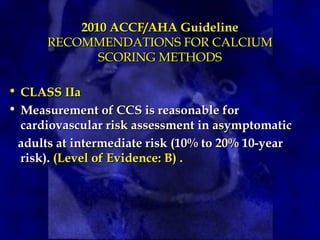
• CLASS IIa
CLASS IIa
• Measurement of CCS is reasonable for
Measurement of CCS is reasonable for
cardiovascular risk assessment in asymptomatic
adults at intermediate risk (10% to 20% 10-year
risk).
risk). (Level of Evidence: B) .
(Level of Evidence: B) .
2010 ACCF/AHA Guideline
RECOMMENDATIONS FOR CALCIUM
SCORING METHODS
SCORING METHODS
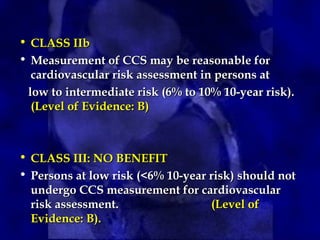
• CLASS IIb
CLASS IIb
• Measurement of CCS may be reasonable for
Measurement of CCS may be reasonable for
cardiovascular risk assessment in persons at
low to intermediate risk (6% to 10% 10-year risk).
(Level of Evidence: B)
• CLASS III: NO BENEFIT
CLASS III: NO BENEFIT
• Persons at low risk (<6% 10-year risk) should not
Persons at low risk (<6% 10-year risk) should not
undergo CCS measurement for cardiovascular
risk assessment.
risk assessment. (Level of
(Level of
Evidence: B).
Evidence: B).
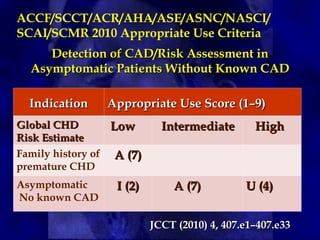
Detection of CAD/Risk Assessment in
Asymptomatic Patients Without Known CAD
Indication
Indication Appropriate Use Score (1–9)
Appropriate Use Score (1–9)
Global CHD
Global CHD
Risk Estimate
Risk Estimate
Low
Low Intermediate
Intermediate High
High
Family history of
premature CHD
A (7)
A (7)
Asymptomatic
No known CAD
I (2)
I (2) A (7)
A (7) U (4)
U (4)
JCCT (2010) 4, 407.e1–407.e33
ACCF/SCCT/ACR/AHA/ASE/ASNC/NASCI/
SCAI/SCMR 2010 Appropriate Use Criteria
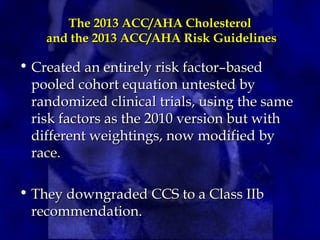
The 2013 ACC/AHA Cholesterol
and the 2013 ACC/AHA Risk Guidelines
• Created an entirely risk factor–based
Created an entirely risk factor–based
pooled cohort equation untested by
randomized clinical trials, using the same
risk factors as the 2010 version but with
different weightings, now modified by
race.
race.
• They downgraded CCS to a Class IIb
They downgraded CCS to a Class IIb
recommendation.
recommendation.
Conclusion
Conclusion
• Despite the remarkable data supporting the prime
role of CCS in risk assessment of the
intermediate-risk population & considering it a
more potent predictor of CAD than risk factors for
atherosclerosis , CCS has not been incorporated
into the mainstream of clinical cardiology and has
been downgraded in the 2013 guidelines.
• As the data continue to accumulate with follow-
up periods up to 15 years, accompanied by
increasing public & physician awareness, the
importance of CCS will be more universally
accepted
Thank you
Thank you

CT Calcium Scoring Lecture Overview Powerpoint

  • 1.
  • 2.
    Background • Approximately 50%of acute MI occur in people without any Approximately 50% of acute MI occur in people without any history of CAD. history of CAD. • Coronary atherosclerosis is a slow progressive disease that Coronary atherosclerosis is a slow progressive disease that often goes unrecognized until the person develops symptoms. often goes unrecognized until the person develops symptoms. • What is needed is a way to identify asymptomatic people who What is needed is a way to identify asymptomatic people who are at high risk for CV events early in their disease process. are at high risk for CV events early in their disease process.
  • 3.
    • MI usuallyoccurs in patients who have a MI usually occurs in patients who have a mild or moderate CA stenosis that mild or moderate CA stenosis that develops plaque rupture & leads to an develops plaque rupture & leads to an acute thrombosis. acute thrombosis. • These mild to moderate coronary lesions These mild to moderate coronary lesions may not cause symptoms and/or may not may not cause symptoms and/or may not cause enough ischemia to be picked up cause enough ischemia to be picked up during a routine stress test. during a routine stress test.
  • 4.
    • During theearly stages of coronary During the early stages of coronary atherosclerosis calcium starts to atherosclerosis calcium starts to accumulate within the plaque. accumulate within the plaque. • As the atherosclerotic process progresses As the atherosclerotic process progresses the amount of calcification increases. the amount of calcification increases. • During the advanced stages of During the advanced stages of atherosclerosis a large amount of atherosclerosis a large amount of coronary calcification may be present. coronary calcification may be present.
  • 5.
  • 6.
    • Atherosclerosis isthe only disease Atherosclerosis is the only disease process known to cause calcium to process known to cause calcium to deposit in coronary artery walls. deposit in coronary artery walls. • Calcification is not a degenerative Calcification is not a degenerative disease, it is not a part of the “normal” disease, it is not a part of the “normal” aging process. aging process. • Calcium is not found in normal CA. Calcium is not found in normal CA.
  • 7.
    • Since calciumdeposits start to develop Since calcium deposits start to develop during the early stages of atherosclerosis during the early stages of atherosclerosis and if we are able to identify the and if we are able to identify the presence of calcium we are able to presence of calcium we are able to identify preclinical coronary artery identify preclinical coronary artery disease during the asymptomatic stage. disease during the asymptomatic stage. • This can allow for the implementation of This can allow for the implementation of early aggressive risk factor reduction. early aggressive risk factor reduction.
  • 8.
    • Calcification canbe seen with fluoroscopy Calcification can be seen with fluoroscopy and on chest x-ray. and on chest x-ray. • Computed tomography allows Computed tomography allows quantification of this calcium. quantification of this calcium.
  • 9.
    • The amountof calcium deposited in coronary The amount of calcium deposited in coronary arteries is added up and a “score” is given. arteries is added up and a “score” is given. • The amount of calcium in the coronary The amount of calcium in the coronary arteries varies considerably with age and arteries varies considerably with age and gender. gender. • For this reason, coronary calcium scores are For this reason, coronary calcium scores are presented as percentile scores that can tell presented as percentile scores that can tell how much calcium you have compared to how much calcium you have compared to other men or women of your age. other men or women of your age.
  • 10.
    • higher thanthe 75th percentile is higher than the 75th percentile is considered high risk, irrespective of the considered high risk, irrespective of the score, and indicates premature score, and indicates premature atherosclerosis. atherosclerosis.
  • 11.
    • Unlike globalrisk scores such as the Unlike global risk scores such as the Framingham Risk Score, which provide cardio- Framingham Risk Score, which provide cardio- vascular risk estimates based on mean risk factor vascular risk estimates based on mean risk factor distributions across a population, the CCS is a distributions across a population, the CCS is a direct marker of atherosclerosis in an individual direct marker of atherosclerosis in an individual patient. patient. • As such, it provides an assessment of the burden As such, it provides an assessment of the burden of coronary atherosclerosis, reflecting the of coronary atherosclerosis, reflecting the integrated lifetime effect of all risk factors in an integrated lifetime effect of all risk factors in an individual patient. individual patient.
  • 12.
    CCS Protocol • CACis detected using a standardized protocol CAC is detected using a standardized protocol involving : involving : • Prospective ECG-triggered axial scanning, with Prospective ECG-triggered axial scanning, with a slice thickness of 3mm. a slice thickness of 3mm. • Standard tube voltage is 120 kV, with tube Standard tube voltage is 120 kV, with tube current set at 120 to 150 mAs, which should current set at 120 to 150 mAs, which should result in acceptably low levels of radiation result in acceptably low levels of radiation exposure (1 to 2 mSv). exposure (1 to 2 mSv).
  • 13.
    Methods Methods • Agatston Score: Agatston Score :Traditional method Traditional method (EBCT : MDCT) (EBCT : MDCT) • Volume Score : Volume Score : Plaque area x slice Plaque area x slice thickness (mm thickness (mm³ ³) ) • Mass Score : Mass Score : Plaque volume x mean Plaque volume x mean plaque density . plaque density .
  • 14.
    • The methodis based on the maximum x-ray attenuation coefficient, or CT number (measured in Hounsfield units [HU]), and the area of calcium deposits. • First, calcified lesions are identified on CT images by applying a threshold of 130 HU to the entire image set; tissues with densities equal to or greater than the threshold are considered to correspond to calcium. Agatston Score Agatston Score
  • 15.
    • For eachcoronary artery, i, a region of interest (ROI) is drawn around each calcified lesion, j. • The maximum CT number, CTmax ij , of the ROI is determined and used to assign a weighting factor, wij. • The area, Aij, of the ROI is also determined.
  • 16.
    • The Agatstonscore, Sij, is computed as the product of the weighting factor and the area: Sij = wij x Aij Where : • w ij = 1 if CTijmax 130 - 199 HU 2 if CTijmax 200 - 299 HU 3 if CTijmax 300 - 399 HU 4 if CTijmax > 400 HU
  • 17.
    • The scorefor all lesions in all coronary arteries is summed to determine the total calcium burden: Stot =  Sij
  • 19.
    The Calcium Scale TheCalcium Scale The calcium scale is a linear scale with 4 The calcium scale is a linear scale with 4 calcium score categories: calcium score categories: 0 0 Normal Normal 1–99 1–99 Mild Mild 100–400 100–400 Moderate Moderate >400 >400 Severe Severe
  • 21.
    • Variations accordingto sex and ethnicity have Variations according to sex and ethnicity have been described. been described. • In the Multi-Ethnic Study of Atherosclerosis In the Multi-Ethnic Study of Atherosclerosis (MESA) (MESA) of 6,110 asymptomatic patients, men of 6,110 asymptomatic patients, men had higher calcium levels than women, and the had higher calcium levels than women, and the amount and prevalence of calcium continually amount and prevalence of calcium continually increased with increasing age . increased with increasing age . • A calcium score of 175 may be average for a 65 A calcium score of 175 may be average for a 65 year old male but grossly abnormal for a 55 year old male but grossly abnormal for a 55 year old female. year old female. Circulation 2006;113:30–7 Circulation 2006;113:30–7
  • 22.
    Distribution - men Distribution- men Age Ca Score < 40 0 40 -49 0 50-54 5 55-59 36 60-64 95 65-69 201 70-74 302 > 74 521
  • 23.
    Distribution - women Distribution- women Age Ca Score < 40 0 40 -49 0 50-54 0 55-59 0 60-64 0 65-69 8 70-74 28 > 74 149
  • 24.
    • In men,Caucasians and Hispanics had the first In men, Caucasians and Hispanics had the first and second highest scores, respectively; blacks and second highest scores, respectively; blacks had the lowest scores at the younger ages, and had the lowest scores at the younger ages, and Chinese had the lowest scores at the older ages. Chinese had the lowest scores at the older ages. • In women, Caucasians had the highest scores, In women, Caucasians had the highest scores, Chinese and blacks had intermediate scores, and Chinese and blacks had intermediate scores, and Hispanics had the lowest score except for Chinese Hispanics had the lowest score except for Chinese in the oldest age group. in the oldest age group.
  • 25.
    •What does CCS“0” mean? • One may still have non-calcified One may still have non-calcified atherosclerotic plaque . atherosclerotic plaque . • Multiple studies have shown only a 0.11 % Multiple studies have shown only a 0.11 % annual event rate and 1.1% 10 year risk in annual event rate and 1.1% 10 year risk in asymptomatic patients with 0 CCS. asymptomatic patients with 0 CCS.
  • 26.
    •Advantages of CCS •Rapid . Rapid . • Does not require contrast. Does not require contrast. • Low radiation dose . Low radiation dose . • Reproducible. Reproducible. • Powerful prognostic data. Powerful prognostic data. • Disadvantages of CCS : Disadvantages of CCS : • Cost Cost • Radiation exposure Radiation exposure
  • 27.
    Coronary Calcium andClinical Outcomes Coronary Calcium and Clinical Outcomes • OVERALL: OVERALL: – 15 studies published 15 studies published – Age range 41- 85 years old Age range 41- 85 years old – Approximately 15,000 patients Approximately 15,000 patients – All studies have reported that coronary All studies have reported that coronary calcium predicts CV disease events calcium predicts CV disease events independently of and more accurately than independently of and more accurately than traditional risk factors. traditional risk factors.
  • 28.
    • At 2004a study was carried out in At 2004 a study was carried out in Netherlands: Netherlands: • From 2,032 people ages 55 to 85, with a From 2,032 people ages 55 to 85, with a mean age of 77, who underwent CT mean age of 77, who underwent CT calcium scoring between 1997 and 2000 calcium scoring between 1997 and 2000 • 0 -100 : 47% 0 -100 : 47% • 100 -500 : 26% 100 -500 : 26% • >500 : 27% >500 : 27% • The mean duration of follow-up was 2.7 The mean duration of follow-up was 2.7 years, during which time 92 subjects died years, during which time 92 subjects died
  • 30.
    • Calcium scores101-500 : Calcium scores 101-500 : double risk of double risk of mortality. mortality. • Calcium scores over 500 : Calcium scores over 500 : 2.7 times 2.7 times increased risk of mortality. increased risk of mortality. • The increase in mortality : The increase in mortality : between the lowest and the middle between the lowest and the middle category of calcium scores (0-100 and 101- category of calcium scores (0-100 and 101- 500) : 12.3% 500) : 12.3%  between the middle and the highest between the middle and the highest scores (101-500 and >500) : 23.7% scores (101-500 and >500) : 23.7%
  • 31.
    Integrating the CalciumScore with Integrating the Calcium Score with the Framingham Risk Score (FRS) the Framingham Risk Score (FRS) • 2004, Johns Hopkins University 2004, Johns Hopkins University calculated the Framingham scores of 5,324 calculated the Framingham scores of 5,324 asymptomatic individuals asymptomatic individuals • Stratified into low-risk, intermediate-risk, and Stratified into low-risk, intermediate-risk, and high-risk groups high-risk groups ― Low-risk Low-risk is defined as a 10 year risk of < 10%, is defined as a 10 year risk of < 10%, ― intermediate-risk intermediate-risk is defined as a 10 year risk of 10 is defined as a 10 year risk of 10 to 20% to 20% ― high-risk high-risk is defined as a 10 year risk > 20% is defined as a 10 year risk > 20% • Underwent CT coronary artery scanning Underwent CT coronary artery scanning
  • 32.
    Framingham Score 10yr. event risk Framingham Score 10 yr. event risk recalculated according to CCS range recalculated according to CCS range
  • 33.
    • CLASS IIa CLASSIIa • Measurement of CCS is reasonable for Measurement of CCS is reasonable for cardiovascular risk assessment in asymptomatic cardiovascular risk assessment in asymptomatic adults at intermediate risk (10% to 20% 10-year adults at intermediate risk (10% to 20% 10-year risk). risk). (Level of Evidence: B) . (Level of Evidence: B) . 2010 ACCF/AHA Guideline 2010 ACCF/AHA Guideline RECOMMENDATIONS FOR CALCIUM RECOMMENDATIONS FOR CALCIUM SCORING METHODS SCORING METHODS
  • 34.
    • CLASS IIb CLASSIIb • Measurement of CCS may be reasonable for Measurement of CCS may be reasonable for cardiovascular risk assessment in persons at cardiovascular risk assessment in persons at low to intermediate risk (6% to 10% 10-year risk). low to intermediate risk (6% to 10% 10-year risk). (Level of Evidence: B) (Level of Evidence: B) • CLASS III: NO BENEFIT CLASS III: NO BENEFIT • Persons at low risk (<6% 10-year risk) should not Persons at low risk (<6% 10-year risk) should not undergo CCS measurement for cardiovascular undergo CCS measurement for cardiovascular risk assessment. risk assessment. (Level of (Level of Evidence: B). Evidence: B).
  • 35.
    Detection of CAD/RiskAssessment in Detection of CAD/Risk Assessment in Asymptomatic Patients Without Known CAD Asymptomatic Patients Without Known CAD Indication Indication Appropriate Use Score (1–9) Appropriate Use Score (1–9) Global CHD Global CHD Risk Estimate Risk Estimate Low Low Intermediate Intermediate High High Family history of premature CHD A (7) A (7) Asymptomatic No known CAD I (2) I (2) A (7) A (7) U (4) U (4) JCCT (2010) 4, 407.e1–407.e33 JCCT (2010) 4, 407.e1–407.e33 ACCF/SCCT/ACR/AHA/ASE/ASNC/NASCI/ SCAI/SCMR 2010 Appropriate Use Criteria
  • 36.
    The 2013 ACC/AHACholesterol The 2013 ACC/AHA Cholesterol and the 2013 ACC/AHA Risk Guidelines and the 2013 ACC/AHA Risk Guidelines • Created an entirely risk factor–based Created an entirely risk factor–based pooled cohort equation untested by pooled cohort equation untested by randomized clinical trials, using the same randomized clinical trials, using the same risk factors as the 2010 version but with risk factors as the 2010 version but with different weightings, now modified by different weightings, now modified by race. race. • They downgraded CCS to a Class IIb They downgraded CCS to a Class IIb recommendation. recommendation.
  • 37.
    Conclusion Conclusion • Despite theremarkable data supporting the prime role of CCS in risk assessment of the intermediate-risk population & considering it a more potent predictor of CAD than risk factors for atherosclerosis , CCS has not been incorporated into the mainstream of clinical cardiology and has been downgraded in the 2013 guidelines. • As the data continue to accumulate with follow- up periods up to 15 years, accompanied by increasing public & physician awareness, the importance of CCS will be more universally accepted
  • 38.