Metasploit & Windows Kernel Exploitation
Spencer (@zeroSteiner) McIntyre BSides Cleveland Saturday June 20th, 2015
Agenda
• Agenda
• Kernel Exploitation Overview & Basics
• Common Vulnerability Classes
• Executing Code
• Mitigation Technologies
• Kernel Exploits in MSF
• Writing Windows Kernel exploits for MSF
• Common Techniques Employed By MSF Modules
• Improving Reliability
About Me
• Spencer McIntyre
• Work at SecureState
• Research, Development, “Special” Projects
• BSOD-inducer
• Avid open source contributor
• Metasploit among others
• Python enthusiast
• I can haz acronyms?
• OSCP, OSEE
BSOD Warning
• BSODs are imminent
• None of the solutions here are fit-all
• Just aggregated from personal experience
Bug check from MS14-040 due to corrupted structures
Windows Kernel Exploitation Basics
Overview
• Why Kernel Exploitation?
• Downward trend of RCE over last couple years
• Last “Great” RCE MS08-067
• New RCE are generally in 3rd party software / libraries
• The kernel is always there
• Upward trend of client side exploitation as a foothold
• Social engineering
• Some great vulnerabilities coming from Pwn2Own and the wild
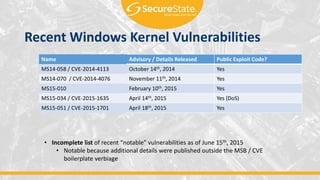
Recent Windows Kernel Vulnerabilities
Name Advisory / Details Released Public Exploit Code?
MS14-058 / CVE-2014-4113 October 14th, 2014 Yes
MS14-070 / CVE-2014-4076 November 11th, 2014 Yes
MS15-010 February 10th, 2015 Yes
MS15-034 / CVE-2015-1635 April 14th, 2015 Yes (DoS)
MS15-051 / CVE-2015-1701 April 18th, 2015 Yes
• Incomplete list of recent “notable” vulnerabilities as of June 15th, 2015
• Notable because additional details were published outside the MSB / CVE
boilerplate verbiage
Common Vulnerability Classes
• Write-What-Where
• NULL Pointer Dereference
• Use After Free (UAF)
• Honorable Mention: Stack Buffer Overflow
• Exist, but not particularly common in Kernel land
Write-What-Where
• (Sometimes) Controlled data can be written to an attacker-
controlled location
• nt!HalDispatchTable is a popular target
• Exploitation is often stable
• Commonly exploited with IOCTL routines using
NtDeviceIoControlFile
• Also more common than other classes in third party drivers
• Example exploits:
• MS11-080
• MS14-070
NULL Pointer Dereference
• Occurs when a NULL pointer is referred to as an object
• Exploitation is often stable
• NULL page can not always be mapped, mitigations exist
• Sometimes negative numbers from error statuses are used as pointers
• MS14-058 / CVE-2014-4113 for example
• Can be beneficial on 64-bit systems if truncated to a 32-bit number (resulting in
0x00000000ffffffff being used)
• Example Exploits:
• MS13-081
• MS14-058
Use After Free
• Pointer to an object is used after it has been freed
• Successful exploitation often requires re-allocating the freed object
• Not always reliable, depends on successful reallocation
• Examples:
• MS15-020
Vulnerability To Code Execution
• Techniques dependent on class
• Write-What-Where
• Well documented, overwrite nt!HalDispatchTable+0x4
• HalDispatchTable can be resolved from the ntkrnlpa.exe
• Triggered on demand with NtQueryIntervalProfile
• NULL Pointer Dereference & UAF
• Similar in the sense that they are object-dependent
• UAF is more difficult to set up the object (not in user-land address space)
NULL Pointer Dereference / UAF
• An object is corrupted
• For UAF a replacement object is created
• No easy way to determine a suitable object
• Object size, layout and destination heap all must be considered
• Object needs to provide a primitive
• Generally Write-What-Where or Call
Useful Object: tagWND (Window)
• win32k!tagWND
• Pretty common object (CVE-2014-4113)
• Set two values for kernel code execution
• bServerSideWindowProc (Bit flag)
• lpfnWndProc (Pointer)
• Callback function can be triggered on demand
Mitigation Technologies
• Commonly encountered on modern systems
• The days of jmp-esp died with XP
• Address Space Layout Randomization (ASLR)
• Only a semi-issue due to already having code execution
• Only need to worry about kernel addresses
• Driver bases can be determined
• Memory leaks or read primitives can disclose additional kernel addresses
• LoadLibrary & GetProcAddress are your friends
• Data Execution Prevention (DEP)
• NtAllocateVirtualMemory, VirtualProtect
• SMEP can be an issue (more on this later)
Mitigation Technologies
• NULL Page Mapping
• One of the oldest protections in EMET
• Pre-Allocate and squat on the page, mark with PAGE_NOACCESS
• Get around it by avoiding it (migrate into an unprotected process if
possible)
• Supervisor Mode Execution Protection (SMEP)
• Prevents user-land addresses from being executed from the Kernel
context
• Originally developed by Intel
• Support added to Windows 8
SMEP Exception
Disabling SMEP
• Some well-documented techniques
• See the “Further Reading & Resources” slide
• Use a ROP gadget in nt!KiConfigureDynamicProcessor to clear the
SMEP bit in the CR4 register
• Resolve the kernel address of the ROP gadget
• A few drawbacks to this approach
• Can’t be resolved with GetProcAddress like nt!HalDispatchTable
• Its in the PAGELK section on Windows 8.1
• Requires running in the native architecture, i.e. not WOW64
• If the kernel can’t be loaded (WOW64 or sandbox) a read primitive
needs to be available for resolution
Windows Kernel Exploits In Metasploit
Metasploit Windows Kernel Modules
• Divided into two categories based on implementation
• Ruby (relying heavily on RailGun)
• C (implemented as a Reflectively-loadable DLL)
• Don’t have to be local privilege escalation but almost all are
• Almost all directly steal / duplicate the token
• An alternative approach is to “clear” the ACL of a SYSTEM process to
inject into (e.g. ms13_053_schlamperei)
• Msf::Exploit::Local::WindowsKernel mixin for convenience
methods
Ruby Implementations
• Might be eventually deprecated in favor of RDLL1
• Well suited for simple NtDeviceIoControlFile-centric exploits
• e.g. MS11-080, MS14-002, MS14-070
• Benefits are that the exploit is a self-contained ruby file
• Failed attempts result in a lost session due to self-corruption
1 Details in issue #4715 https://github.com/rapid7/metasploit-framework/issues/4715
C Implementations
• Much more flexible
• Threads can be used
• Can be faster to write if extensive Windows API calls are necessary
• PoC exploits can be developed as standalone executables
• Primary benefit is the exploit can be injected into a dummy
process
• Results in stability if the exploit fails without a BSOD
Writing a Kernel Exploit for Metasploit
• C / Reflective DLL style is preferred
• General Steps:
1. Environment detection
• Is the session a meterpreter or running as SYSTEM?
2. Vulnerability check
• Often implemented in the “check” function, result is verified
• Checks are often for the file version and running services
3. Start a dummy process to host the malicious DLL
• If in a sandbox, load the DLL in the session process
4. The RDLL will (hopefully) exploit the vulnerability successfully and open
a new session
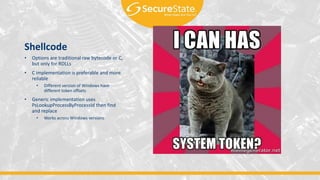
Shellcode
• Options are traditional raw bytecode or C,
but only for RDLLs
• C implementation is preferable and more
reliable
• Different version of Windows have
different token offsets
• Generic implementation uses
PsLookupProcessByProcessId then find
and replace
• Works across Windows versions
Exploit Reliability
Sources of Instability
• Corrupted structures
• Token reference count
• Returning control after elevation
Corrupted Structures
• Certain objects are in a shared region between user & kernel lands1
• Handle table information without a system call for efficiency
• user32!gSharedInfo is available since Windows 7
• Region is read-only
• Back it up
• Read-only so restore from within the shellcode
• If structures are corrupted and code execution does not occur a BSOD
is imminent without a reliable write primitive
• nt!HalDispatchTable
1https://media.blackhat.com/bh-us-11/Mandt/BH_US_11_Mandt_win32k_WP.pdf
Token Reference Count
• “Stealing” the token can cause issues
• Token object has a reference count
• Possible workarounds
• Clear an ACL from a process
• Process still might die and cause instability
• Duplicate the token
• Not practical from raw shellcode
• Backup original token, Steal the token, Spawn a new shell, Restore the token
• Is practical from raw shellcode
• Exploit must be reliably triggered twice
Returning Control
• What to do if process dies after elevation?
• Find a suitable location to return control to
• Unwind the stack via assembly
• Microsoft uses a standard calling convention
• Not applicable in every situation, depends on the call
• Trivial to differentiate a user-land address vs kernel-land
Returning Control
• Last call in user-land ntdll!KiFastSystemCallRet
• First call in kernel-land nt!KiSystemServicePostCall
• KiSystemServicePostCall performs cleanup
operations and restores the user-mode context
• Can not directly return to user-land
• System call will probably fail but the status can be
set
• Be careful about allowing it to succeed
Returning Control
• Resulting shellcode is 29-bytes
• Not that size matters when
dealing with a local
64-bit Exploitation
• Starting to pick up
• Exploits being written in C to support both architectures
• x64 uses one calling convention, only one
• WOW64 complicates things
• For Metasploit, migrate into or spawn a native process
• Check for pointer truncation
• Might help, might not
Closing Thoughts
• Kernel exploitation is flexible
• Code execution ahead of time can be leveraged
• Size matters not
• Hypothesis: Kernel exploitation is going to stick around for a while
Questions? Ask them.
Further Reading & Resources
• Kernel Attacks Through User-Mode Callbacks
• Tarjei Mandt, Black Hat USA 2011
• https://media.blackhat.com/bh-us-11/Mandt/BH_US_11_Mandt_win32k_WP.pdf
• SMEP: What is it, and how to beat it on Windows
• Mateusz ‘j00ru’ Jurczyk & Gynvael Coldwind
• http://j00ru.vexillium.org/?p=783
• Windows Kernel Exploitation Basics - Part 2 : Arbitrary Memory Overwrite
exploitation using HalDispatchTable
• dimanche , July 17th, 2011
• http://poppopret.blogspot.com/2011/07/windows-kernel-exploitation-basics-part.html
• Polishing Chrome for Fun and Profit
• Nils & Jon, August 29th, 2013
• https://labs.mwrinfosecurity.com/system/assets/538/original/mwri_polishing-chrome-
slides-nsc_2013-09-06.pdf
Further Reading & Resources
• Pwn2Own 2014: AFD.sys Dangling Pointer Vulnerability
• Sebastian Apelt, July 11th, 2014
• http://www.siberas.de/papers/Pwn2Own_2014_AFD.sys_privilege_escalation
.pdf
• One-Bit To Rule Them All: Bypassing Windows’ 10 Protections using a
Single Bit
• Udi Yavo, Februrary 10th, 2015
• http://breakingmalware.com/vulnerabilities/one-bit-rule-bypassing-windows-
10-protections-using-single-bit/
• Spencer McIntyre
• Twitter: @zeroSteiner
• Checkout “Phishing Without Ruby”
• I’ll be co-presenting with Brandan Geise
• Downstairs at 4PM
Thank You For Your Time!

Metasploit & Windows Kernel Exploitation

  • 1.
    Metasploit & WindowsKernel Exploitation Spencer (@zeroSteiner) McIntyre BSides Cleveland Saturday June 20th, 2015
  • 2.
    Agenda • Agenda • KernelExploitation Overview & Basics • Common Vulnerability Classes • Executing Code • Mitigation Technologies • Kernel Exploits in MSF • Writing Windows Kernel exploits for MSF • Common Techniques Employed By MSF Modules • Improving Reliability
  • 3.
    About Me • SpencerMcIntyre • Work at SecureState • Research, Development, “Special” Projects • BSOD-inducer • Avid open source contributor • Metasploit among others • Python enthusiast • I can haz acronyms? • OSCP, OSEE
  • 4.
    BSOD Warning • BSODsare imminent • None of the solutions here are fit-all • Just aggregated from personal experience Bug check from MS14-040 due to corrupted structures
  • 5.
  • 6.
    Overview • Why KernelExploitation? • Downward trend of RCE over last couple years • Last “Great” RCE MS08-067 • New RCE are generally in 3rd party software / libraries • The kernel is always there • Upward trend of client side exploitation as a foothold • Social engineering • Some great vulnerabilities coming from Pwn2Own and the wild
  • 7.
    Recent Windows KernelVulnerabilities Name Advisory / Details Released Public Exploit Code? MS14-058 / CVE-2014-4113 October 14th, 2014 Yes MS14-070 / CVE-2014-4076 November 11th, 2014 Yes MS15-010 February 10th, 2015 Yes MS15-034 / CVE-2015-1635 April 14th, 2015 Yes (DoS) MS15-051 / CVE-2015-1701 April 18th, 2015 Yes • Incomplete list of recent “notable” vulnerabilities as of June 15th, 2015 • Notable because additional details were published outside the MSB / CVE boilerplate verbiage
  • 8.
    Common Vulnerability Classes •Write-What-Where • NULL Pointer Dereference • Use After Free (UAF) • Honorable Mention: Stack Buffer Overflow • Exist, but not particularly common in Kernel land
  • 9.
    Write-What-Where • (Sometimes) Controlleddata can be written to an attacker- controlled location • nt!HalDispatchTable is a popular target • Exploitation is often stable • Commonly exploited with IOCTL routines using NtDeviceIoControlFile • Also more common than other classes in third party drivers • Example exploits: • MS11-080 • MS14-070
  • 10.
    NULL Pointer Dereference •Occurs when a NULL pointer is referred to as an object • Exploitation is often stable • NULL page can not always be mapped, mitigations exist • Sometimes negative numbers from error statuses are used as pointers • MS14-058 / CVE-2014-4113 for example • Can be beneficial on 64-bit systems if truncated to a 32-bit number (resulting in 0x00000000ffffffff being used) • Example Exploits: • MS13-081 • MS14-058
  • 11.
    Use After Free •Pointer to an object is used after it has been freed • Successful exploitation often requires re-allocating the freed object • Not always reliable, depends on successful reallocation • Examples: • MS15-020
  • 12.
    Vulnerability To CodeExecution • Techniques dependent on class • Write-What-Where • Well documented, overwrite nt!HalDispatchTable+0x4 • HalDispatchTable can be resolved from the ntkrnlpa.exe • Triggered on demand with NtQueryIntervalProfile • NULL Pointer Dereference & UAF • Similar in the sense that they are object-dependent • UAF is more difficult to set up the object (not in user-land address space)
  • 13.
    NULL Pointer Dereference/ UAF • An object is corrupted • For UAF a replacement object is created • No easy way to determine a suitable object • Object size, layout and destination heap all must be considered • Object needs to provide a primitive • Generally Write-What-Where or Call
  • 14.
    Useful Object: tagWND(Window) • win32k!tagWND • Pretty common object (CVE-2014-4113) • Set two values for kernel code execution • bServerSideWindowProc (Bit flag) • lpfnWndProc (Pointer) • Callback function can be triggered on demand
  • 15.
    Mitigation Technologies • Commonlyencountered on modern systems • The days of jmp-esp died with XP • Address Space Layout Randomization (ASLR) • Only a semi-issue due to already having code execution • Only need to worry about kernel addresses • Driver bases can be determined • Memory leaks or read primitives can disclose additional kernel addresses • LoadLibrary & GetProcAddress are your friends • Data Execution Prevention (DEP) • NtAllocateVirtualMemory, VirtualProtect • SMEP can be an issue (more on this later)
  • 16.
    Mitigation Technologies • NULLPage Mapping • One of the oldest protections in EMET • Pre-Allocate and squat on the page, mark with PAGE_NOACCESS • Get around it by avoiding it (migrate into an unprotected process if possible) • Supervisor Mode Execution Protection (SMEP) • Prevents user-land addresses from being executed from the Kernel context • Originally developed by Intel • Support added to Windows 8
  • 17.
  • 18.
    Disabling SMEP • Somewell-documented techniques • See the “Further Reading & Resources” slide • Use a ROP gadget in nt!KiConfigureDynamicProcessor to clear the SMEP bit in the CR4 register • Resolve the kernel address of the ROP gadget • A few drawbacks to this approach • Can’t be resolved with GetProcAddress like nt!HalDispatchTable • Its in the PAGELK section on Windows 8.1 • Requires running in the native architecture, i.e. not WOW64 • If the kernel can’t be loaded (WOW64 or sandbox) a read primitive needs to be available for resolution
  • 19.
  • 20.
    Metasploit Windows KernelModules • Divided into two categories based on implementation • Ruby (relying heavily on RailGun) • C (implemented as a Reflectively-loadable DLL) • Don’t have to be local privilege escalation but almost all are • Almost all directly steal / duplicate the token • An alternative approach is to “clear” the ACL of a SYSTEM process to inject into (e.g. ms13_053_schlamperei) • Msf::Exploit::Local::WindowsKernel mixin for convenience methods
  • 21.
    Ruby Implementations • Mightbe eventually deprecated in favor of RDLL1 • Well suited for simple NtDeviceIoControlFile-centric exploits • e.g. MS11-080, MS14-002, MS14-070 • Benefits are that the exploit is a self-contained ruby file • Failed attempts result in a lost session due to self-corruption 1 Details in issue #4715 https://github.com/rapid7/metasploit-framework/issues/4715
  • 22.
    C Implementations • Muchmore flexible • Threads can be used • Can be faster to write if extensive Windows API calls are necessary • PoC exploits can be developed as standalone executables • Primary benefit is the exploit can be injected into a dummy process • Results in stability if the exploit fails without a BSOD
  • 23.
    Writing a KernelExploit for Metasploit • C / Reflective DLL style is preferred • General Steps: 1. Environment detection • Is the session a meterpreter or running as SYSTEM? 2. Vulnerability check • Often implemented in the “check” function, result is verified • Checks are often for the file version and running services 3. Start a dummy process to host the malicious DLL • If in a sandbox, load the DLL in the session process 4. The RDLL will (hopefully) exploit the vulnerability successfully and open a new session
  • 24.
    Shellcode • Options aretraditional raw bytecode or C, but only for RDLLs • C implementation is preferable and more reliable • Different version of Windows have different token offsets • Generic implementation uses PsLookupProcessByProcessId then find and replace • Works across Windows versions
  • 25.
  • 26.
    Sources of Instability •Corrupted structures • Token reference count • Returning control after elevation
  • 27.
    Corrupted Structures • Certainobjects are in a shared region between user & kernel lands1 • Handle table information without a system call for efficiency • user32!gSharedInfo is available since Windows 7 • Region is read-only • Back it up • Read-only so restore from within the shellcode • If structures are corrupted and code execution does not occur a BSOD is imminent without a reliable write primitive • nt!HalDispatchTable 1https://media.blackhat.com/bh-us-11/Mandt/BH_US_11_Mandt_win32k_WP.pdf
  • 28.
    Token Reference Count •“Stealing” the token can cause issues • Token object has a reference count • Possible workarounds • Clear an ACL from a process • Process still might die and cause instability • Duplicate the token • Not practical from raw shellcode • Backup original token, Steal the token, Spawn a new shell, Restore the token • Is practical from raw shellcode • Exploit must be reliably triggered twice
  • 29.
    Returning Control • Whatto do if process dies after elevation? • Find a suitable location to return control to • Unwind the stack via assembly • Microsoft uses a standard calling convention • Not applicable in every situation, depends on the call • Trivial to differentiate a user-land address vs kernel-land
  • 30.
    Returning Control • Lastcall in user-land ntdll!KiFastSystemCallRet • First call in kernel-land nt!KiSystemServicePostCall • KiSystemServicePostCall performs cleanup operations and restores the user-mode context • Can not directly return to user-land • System call will probably fail but the status can be set • Be careful about allowing it to succeed
  • 31.
    Returning Control • Resultingshellcode is 29-bytes • Not that size matters when dealing with a local
  • 32.
    64-bit Exploitation • Startingto pick up • Exploits being written in C to support both architectures • x64 uses one calling convention, only one • WOW64 complicates things • For Metasploit, migrate into or spawn a native process • Check for pointer truncation • Might help, might not
  • 33.
    Closing Thoughts • Kernelexploitation is flexible • Code execution ahead of time can be leveraged • Size matters not • Hypothesis: Kernel exploitation is going to stick around for a while
  • 34.
  • 35.
    Further Reading &Resources • Kernel Attacks Through User-Mode Callbacks • Tarjei Mandt, Black Hat USA 2011 • https://media.blackhat.com/bh-us-11/Mandt/BH_US_11_Mandt_win32k_WP.pdf • SMEP: What is it, and how to beat it on Windows • Mateusz ‘j00ru’ Jurczyk & Gynvael Coldwind • http://j00ru.vexillium.org/?p=783 • Windows Kernel Exploitation Basics - Part 2 : Arbitrary Memory Overwrite exploitation using HalDispatchTable • dimanche , July 17th, 2011 • http://poppopret.blogspot.com/2011/07/windows-kernel-exploitation-basics-part.html • Polishing Chrome for Fun and Profit • Nils & Jon, August 29th, 2013 • https://labs.mwrinfosecurity.com/system/assets/538/original/mwri_polishing-chrome- slides-nsc_2013-09-06.pdf
  • 36.
    Further Reading &Resources • Pwn2Own 2014: AFD.sys Dangling Pointer Vulnerability • Sebastian Apelt, July 11th, 2014 • http://www.siberas.de/papers/Pwn2Own_2014_AFD.sys_privilege_escalation .pdf • One-Bit To Rule Them All: Bypassing Windows’ 10 Protections using a Single Bit • Udi Yavo, Februrary 10th, 2015 • http://breakingmalware.com/vulnerabilities/one-bit-rule-bypassing-windows- 10-protections-using-single-bit/
  • 37.
    • Spencer McIntyre •Twitter: @zeroSteiner • Checkout “Phishing Without Ruby” • I’ll be co-presenting with Brandan Geise • Downstairs at 4PM Thank You For Your Time!