Don't	Trust	Your	Eye:	
Apple	Graphics	Is	Compromised!
Liang	Chen	 (@chenliang0817)
Marco	Grassi (@marcograss)
Qidan He	 (@flanker_hqd)
CanSecWest Vancouver	2016
About	Us
• Liang	Chen
• Senior	Security	Researcher	@	Tencent KEEN	Security	Lab
• Main	focus:	Browser	exploitation,	OS	X/iOS	sandbox	escape
• Marco	Grassi
• Senior	Security	Researcher	@	Tencent KEEN	Security	Lab
• Main	focus:	Vulnerability	Research,	OS	X/iOS,	Android,	Sandboxes
• Qidan He
• Senior	Security	Researcher	@	Tencent KEEN	Security	Lab
• Main	focus:	Vulnerability	auditing/fuzzing,	OS
Tencent KEEN	Security	Lab
• Previously	known	as	KeenTeam
• All	researchers	moved	to	Tencent because	of	business	requirement
• New	name:	TencentKEEN	Security	Lab
• Yesterday	our	union	team	with	TencentPC	Manager	(Tencent Security	
Team	Sniper)	won	“Master	of	Pwn”	in	Pwn2Own	2016
Agenda
• Apple	graphics	overview
• Fuzzing	strategy
• Case	study
• Summary
Apple	graphics	overview
Why	attack	the	graphic	drivers
• This	part	of	the	graphic	stacks	is	reachable	from	the	browser	sandbox	
and	resides	in	the	kernel.
• Achieving	kernel	code	execution	will	give	us	pretty	much	unrestricted	
access	to	the	target	machine.
• Especially	true	now	that	OS	X	introduced	“System	Integrity	
Protection”,	often	gaining	userspace root	is	not	the	end	of	the	
exploitation	kill	chain,	you	have	to	compromise	the	kernel	to	disable	
“SIP”.
• Compromising	the	kernel	before	was	a	necessity	only	on	iOS,	now	it’s	
starting	to	become	more	relevant	also	on	OS	X.
Safari	WebProcess sandbox	attack	surface
• You	can	find	the	”com.apple.WebProcess.sb”	sandbox	profile	and	see	
what	is	reachable	(and	the	imported	“system.sb”).
• (allow	iokit-open								
• (iokit-connection	"IOAccelerator")								
• (iokit-user-client-class	"IOAccelerationUserClient")								
• (iokit-user-client-class	"IOSurfaceRootUserClient")
• iokit-connection	allows	the	sandboxed	process	to	open	all	the	
userclient under	the	target	IOService(much	less	restrictive	than	iokit-
user-client-class	)
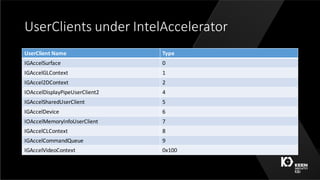
UserClients under	IntelAccelerator
UserClient Name Type
IGAccelSurface 0
IGAccelGLContext 1
IGAccel2DContext	 2
IOAccelDisplayPipeUserClient2	 4
IGAccelSharedUserClient 5
IGAccelDevice 6
IOAccelMemoryInfoUserClient 7
IGAccelCLContext 8
IGAccelCommandQueue 9
IGAccelVideoContext 0x100
UserClients under	IntelAccelerator
• Each	userclient has	a	IOService points	to	IntelAccelerator object	
• IntelAccelerator object	is	global	unique
• Created	upon	booting
• Most	operation	on	the	IntelAccelerator requires	Lock	(otherwise	vulnerable	to	race	condition	attack)
• Except	for	some	read	operations
UserClient Interface
• Implemented	by	different	Kexts
• For	example:	IGAccelGLContext
• Method	0x200	– 0x206
• Class	IGAccelGLContext in	AppleIntelBDWGraphics
• Method	0x100	– 0x105
• Class	IOAccelGLContext in	IOAcceleratorFamily2
• Method	0x0	– 0x7
• Class	IOAccelContxt2	in	IOAcceleratorFamily2
• Even	within	method	calls,	its	child	class’s	method	can	be	called	because	of	polymorphism	
• Any	problems?
• Problem	1:	Does	the	developer	fully	understand	what	their	parent’s	implementation	is?
• Problem	2:	Does	the	method	implementer	know	which	function	call	him,	what	check	is	performed?
• If	not,	vulnerabilities	are	introduced
IGAccelGLContext IOAccelGLContext2 IOAccelContext2
AppleIntelHD5000Graphics IOAcceleratorFamily2 IOAcceleratorFamily2
Fuzzing	strategy
Passive	Fuzzing
• Load	some	2D	or	3D	game/App
• Write	a	dylib to	hook	IOKit APIs:
• IOConnectMapMemory/IOConnectUnmapMemory
• IOConnectCallMethod/IOConnectCallScalarMethod
• Randomly	change	the	content	of	the	parameters
• Ian	Beer	from	Google	Project	Zero	did	it	2	years	ago.
• Found	several	bugs	in	processing	sideband	buffers	in	
GLContext/CLContext::submit_data_buffers
Passive	Fuzzing	– Pros	and	Cons
• Pros:
• Easy	to	implement
• Even	for	random	fuzzing,	it	is	effective
• Cons:
• Hard	to	reproduce	the	issue
• Cannot	cover	all	the	interface
Active	fuzzing
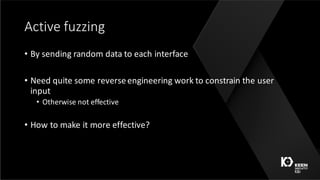
• By	sending	random	data	to	each	interface
• Need	quite	some	reverse	engineering	work	to	constrain	the	user	
input	
• Otherwise	not	effective
• How	to	make	it	more	effective?
Active	fuzzing	– How	to	make	more	effective	TIPS	1
• Ideal	target	for	fuzzing	:	IGAccelSurface
• Not	too	much	parameter	check	before	perform	complicated	operation
• Is	majorly	called	by	WindowServer process:
• Not	suppose	to	be	frequently	used	by	Safari/User	Apps
• Many	situations	are	not	well	considered	when	being	called	from	Safari/User	
Apps	directly.
• Several	crashes	by	fuzzing	with	this	single	userclient.
Active	fuzzing	– How	to	make	more	effective	TIPS	2
• Use	similar	approach	for	IGAccelGLContext will	not	generate	
any	crashes,	why?
• The	userclient is	better	tested.
• GL	context	is	not	initialized	by	just	calling	
IOServiceOpen
• We	must	make	its	m_context to	non-NULL
• Two	approaches:
• Initialize	the	GL	context	by	running	some	hello	world	
OpenGL	apps,	then	find	the	mach_port of	the	opened	
GLContext userclient
• Call	IOConnectAddClient to	add	a	
IGAccelSharedUserClient to	the	newly	created	
IGAccelGLContext
• Will	set	the	m_context field
Active	fuzzing	– How	to	make	more	effective	TIPS	3
• User	clients	are	inter-connected
• For	example
• If	a	IGAccelSurface user	client	is	created,	it	will	be	added	to	IntelAccelerator::IOAccelSurfaceList
• Each	IGAccelSurface has	a	unique	surface	ID,	there	are	system	created	IGAccelSurface (with	Surface	ID	1,	2,	0xffffffe0)
• User	created	IGAccelSurface ranges	its	surface	ID	from	0x3	– 0xffffffff	
• Can	be	obtained	by	calling	IOAccelDevice2::get_surface_info to	brute	force	enumerate	the	IDs
• These	IDs	can	be	used	to	fuzz	interfaces	in	other	userclients (such	as	IOAccel2DContext2::set_surface)
• Creating	a	lot	of	user	clients	with	such	rules	built,	will	increase	the	effectiveness	a	lot.
Hybrid	fuzzing	– combine	active	and	passive	fuzzing
• Use	dylid hook	to	record	the	IOConnect call
• For	each	call,	dump	the	mapped	memory	(for	example,	memory	type	0,	1	,	2	for	
IGAccelGLContext)
• During	active	fuzzing,	give	possibility	to	use	the	recorded	parameter
• Got	several	crashes
Case	Study
IOKit vulnerability:	CVE-????-????	
• Race	condition	in	an	externalMethod in	AppleIntelBDWGraphics.
• Affects	every	recent	Mac	with	Intel	Broadwell CPU/Graphics.
• Discovered	by	code	auditing	when	looking	for	sandbox	escapes	into	
IOKit UserClients reachable	from	the	Safari	WebProcess sandbox.
• Unfortunately	it	got	partially	patched	1-2	weeks	before	pwn2own!	
LLL .	A	replacement	was	needed.	L
• Unpatched	in	OSX	10.11.3,	only	partial	fix	in	10.11.4	beta6.
• Reliably	exploitable.
• Wrong/partial	fix	mistake	responsibly	disclosed	to	Apple.
IOKit vulnerability:	CVE-????-????	
• IGAccelCLContext and	
IGAccelGLContext are	2	UserClients
that	can	be	reached	from	the	
WebProcess Safari	sandbox.
• The	locking	mechanisms	in	these	
UserClients is	not	too	good,	some	
methods	expects	only	a	well	
behaved	single	threaded	access.
• First	we	targeted	
unmap_user_memory
IOKit vulnerability:	some	unsafe	code
Race	condition	– How	to	trigger	it?
1. Open	your	target	UserClient (IGAccelCLContext)
2. Call	map_user_memory to	insert	one	element	into	the	IGHashTable
3. Call	with	2	racing	threads	unmap_user_memory.
4. Repeat	2	and	3	until	you	are	able	to	exploit	the	race	window.
5. Double	free	on	first	hand
6. PROFIT!
Chance	of	stable	exploit?
• The	unmap race	is	not	stable
• Easy	to	trigger	null	pointer	dereference	if	we’re	removing	*same*	
element
• Both	threads	passes	IGHashtable::contains
• One	thread	removes	and	when	another	do	gets,	NULL	is	returned
• No	check	on	return	value
• Actually	a	good	null-pointer-dereference	bug
• But	cannot	bypass	SMAP	and	cannot	used	as	Sandbox	bypass
• Double	free	window	is	small
Chance	of	stable	exploit?
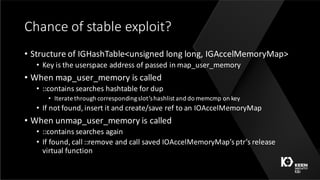
• Structure	of	IGHashTable<unsigned	long	long,	IGAccelMemoryMap>
• Key	is	the	userspace address	of	passed	in	map_user_memory
• When	map_user_memory is	called
• ::contains	searches	hashtable for	dup
• Iterate	through	corresponding	slot’s	hashlist and	do	memcmp on	key	
• If	not	found,	insert	it	and	create/save	ref	to	an	IOAccelMemoryMap
• When	unmap_user_memory is	called
• ::contains	searches	again
• If	found,	call	::remove	and	call	saved	IOAccelMemoryMap’s ptr’s release	
virtual	function
IGHashTable structure	
• struct IGVector
• Int64	currentSize
• Int64	capacity
• Void*	storage
• struct IGElement (or	whatever	name	your	like)
• Vm_address_t address
• IOAccelMemoryMap*	memory
• IGElement*	next
• IGElement*	prevs
IGHashTable structure	(cont.)	
• struct IGHashTable::Slot
• IGElement*	elementHead
• void*	tail
• Size_t linkedListSize
• When	the	hashtable is	empty…	init with	16	slots
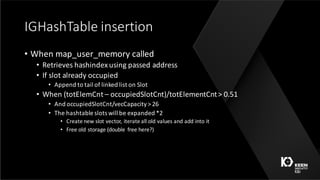
IGHashTable insertion
• When	map_user_memory called
• Retrieves	hashindex using	passed	address
• If	slot	already	occupied
• Append	to	tail	of	linked	list	on	Slot
• When	(totElemCnt – occupiedSlotCnt)/totElementCnt>	0.51	
• And	occupiedSlotCnt/vecCapacity>	26
• The	hashtable slots	will	be	expanded	*2
• Create	new	slot	vector,	iterate	all	old	values	and	add	into	it
• Free	old	storage	(double	 free	here?)
IGHashTable example	figure
• When	element	is	inserted
• Slot	is	located	using	hash	function
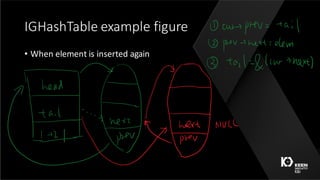
IGHashTable example	figure
• When	element	is	inserted	again
IGHashTable example	figure
• When	element	is	removed
• Locate	slot	using	hash	index	function
• Iterate	all	items	on	list,	compare	for	value	(head	Qword)
• When	match,	do	remove
IGHashTable example	figure
• When	element	is	removed
• Locate	slot	using	hash	index	function
• Iterate	all	items	on	list,	compare	for	value	(head	Qword)
• When	match,	do	remove
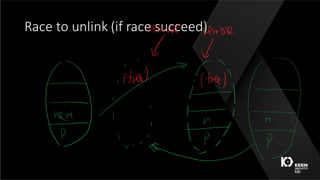
Race	to	unlink
• Call	two	threads	to	continuously	remove	two	*adjacent*	*different*	
elements
• If	the	remove	finished	normally	
• Just	try	again,	nothing	bad	will	happened
• If	the	remove	finished	*abnormally*
• We’ll	have	a	freed	kalloc.32	element	on	list!	
• Next->prev =	prev;
• *prev =	next;	(prev->next	=	next)
Race	to	unlink
Race	to	unlink
Race	to	unlink
Race	to	unlink	(if	race	failed)
Race	to	unlink	(if	race	suceed)
• When	begins	list	is:
• ele1->ele2->ele3->ele4
• ele2->prev =	ele3
• ele3->prev =	ele4
• ele1->next	=	ele3
• ele2->next	=	ele4
• Now	list	is	(searching	using	next	ptr):
• ele1->ele3->ele4
• However	ele3	is	freed	actually!
Race	to	unlink	(if	race	succeed)
Turning	into	UAF
• Filling	freed	holes	using	io_service_open_extended
• Call	unmap_user_memory with	tail	address	after	each	race	to	detect
• If	race	failed,	nothing	happens	as	list	is	intact
• If	race	succeeded,	contains	and	get	will	use	our	corrupted	element!
• Traverse	the	list	and	trigger	virtual	call
• Unmap_user_memory
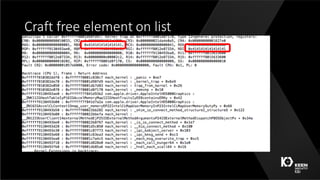
Craft	free	element	on	list
Crash	with	0x4141414141414141
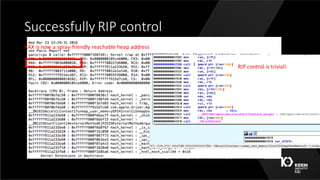
Next:	control	RAX	then	Successfully	RIP	
control
RAX	is	now	a	spray-friendly	address
Successfully	RIP	control
RAX	is	now	a	spray-friendly	reachable	heap	address
RIP	control	is	trivial!
Race	condition	– the	partial	fix
• By	reversing	OS	X	10.11.4	around	beta	5	we	sadly	noticed	that	Apple	
introduced	some	additional	locks.	L
POC/EXP	soon	available	on	github
• https://github.com/flankerhqd/unmap_poc
Race	condition	– the	partial	fix
• Unfortunately	for	Apple,	this	fix	is	incomplete	in	10.11.4	betaX
• Who	says	we	can	only	race	unmap_user_memory?
• This	“add”	operation	inside	map_user_memory is	outside	any	lock!
• We	can	race	with	1	thread unmap_user_memory and	with	another	
map_user_memory for	example,	to	corrupt	the	IGHashTable!
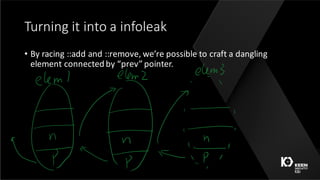
Turning	it	into	a	infoleak
• By	racing	::add	and	::remove,	we’re	possible	to	craft	a	dangling	
element	connected	by	“prev”	pointer.
• Add	Operation
• cur->prev =	*tail
• Prev->next	=	cur
• *tail	=	cur
• Remove	Operation	on	tail
• cur->prev->next	=	0
• *tail	=	cur->prev
Turning	it	into	a	infoleak
• By	racing	::add	and	::remove,	we’re	possible	to	craft	a	dangling	
element	connected	by	“prev”	pointer.
Turning	it	into	a	infoleak
• By	racing	::add	and	::remove,	we’re	possible	to	craft	a	dangling	
element	connected	by	“prev”	pointer.
Turning	it	into	an	infoleak (CVE-2016-????)
• The	window	is	small	but	still	has	success	rate
• Roughly	after	10	secs	we	can	get	a	panic
• “A	freed	zone	has	been	modified	at	offset	0x10	blabla….”	(the	“next”	location)
• POC	will	be	also	available	at	flankerhqd/unmap_poc
• We	can	get	a	heap	address	if	we	can	fill	in	the	freed	zone	then	read	
out
• Using	open_extendedproperties	and	read	out	properties
• Or	more?	Use	imagination!
Turning	it	into	an	infoleak (CVE-2016-????)
• The	window	is	small	but	still	has	success	rate
• Roughly	after	10	secs	we	can	get	a	panic
• “A	freed	zone	has	been	modified	at	offset	0x10	blabla….”	(the	“next”	location)
• POC	will	be	also	available	at	flankerhqd/unmap_poc
• We	can	get	a	heap	address	if	we	can	fill	in	the	freed	zone
• Using	open_extendedproperties	and	read	out	properties
• Or	more?	Use	imagination!
kASLR infoleak:	CVE-????-????
• OS	X	kernel	implements	kernel	Address	Space	Layout	Randomization.
• In	order	to	do	kernel	ROP	for	our	sandbox	escape,	and	bypass	
SMEP/SMAP	mitigations	we	must	know	the	kASLR slide.
• A	infoleak was	needed!
• Fortunately	Intel	BDW	graphic	driver	is	very	generous,	and	offers	also	
a	kASLR infoleak vulnerability!
• Still	unpatched	in	10.11.3	and	10.11.4	betas,	responsibly	disclosed	to	
Apple.
kASLR infoleak:	CVE-????-????
• This	time	we	will	look	at	another	KEXT	in	BDW	graphic	driver	stack:	
AppleIntelBDWGraphicsFramebuffer
• It	affects	the	same	Mac	models	as	the	race	discussed	before.
• This	particular	IOKit driver	is	leaking	information	inside	the	IOKit
registry,	that	will	help	us	to	guess	the	kASLR slide
• This	code	simply	will	set	the	“fInterruptCallback”	property	in	IO	registry	as	
the	POINTER	v3+3176.
• This	is	not	a	TEXT	pointer	as	we	will	see,	but	that	allocation	is	done	very	
early	in	the	boot	process,	this	will	allow	us	to	guess	the	kASLR slide	anyway	
even	without	an	exact	information.
• This	information	can	be	leaked	from	the	WebProcess Safari	sandbox	so	it’s	
perfect	to	help	in	a	kernel	based	sandbox	escape.
kASLR infoleak:	some	tests	and	experiments
• We	will	retrieve	the	
“fInterruptCallbacks”	pointer	several	
times	after	reboot,	in	order	to	get	
different	kernel	randomization	
offsets.
• We	will	retrieve	the	real	kASLR slide	
every	time,	by	disabling	SIP	and	
running	as	root	a	program	that	
leverages	“kas_info”	system	call,	that	
allows	you	to	get	the	kASLR slide	if	
you	run	as	root	and	SIP	is	off.
Testbed:
Focus	on	the	red	lines	columns,	this	is	the	“band”	of	interest	for	kASLR slide,	the	other	parts	of	the	difference
Is	irrelevant	to	our	purposes.
As	you	can	see	we	have	only	3	outcomes	in	the	difference	between	the	leak	and	kASLR slide,	0x9e7,0x9e8,	0x9e9
kASLR infoleak:	outcomes
• With	just	a	quick	analysis,	thanks	to	this	infoleak,	we	have	improved	
our	chances	to	predict	the	kASLR slide	from	around	1	in	256	values	(a	
full	byte	of	possible	kASLR random	slides)	to	just	1	in	3.
• It	can	be	probably	be	even	improved	statistically	since	those	3	values	
seems	to	don’t	have	a	equally	distributed	probability.
Summary
• Graphic	drivers	offer	a	big	attack	surface	reachable	from	the	browser	
sandbox.
• Race	conditions	in	XNU	are	only	starting	to	get	attention	by	the	
security	community	now.
• OS	X	deploys	several	effective	mitigations	(think	about	SMAP,	not	yet	
widespread	on	other	Oses),	but	good	exploitation	techniques	and	
good	vulnerabilities	can	bypass	them.
Acknowledgments
• Qoobee
• Wushi
Questions?
Twitter:	@keen_lab
Csw2016 chen grassi-he-apple_graphics_is_compromised

Csw2016 chen grassi-he-apple_graphics_is_compromised