CSF RHINORRHOEA
Dr. Parth Rajdev
MMIMSR
Mullana (Ambala)
CSF BASICS
Cerebrospinal fluid (CSF) is a clear,
colorless body fluid found in the brain and
spine. It is produced in the choroid plexuses of
the ventricles of the brain.
• It acts as a cushion or buffer for the
brain's cortex, providing basic mechanical
and immunological protection to the brain
inside the skull.
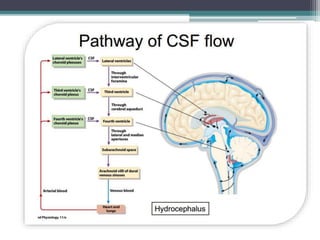
CSF BASICS : CIRCULATION
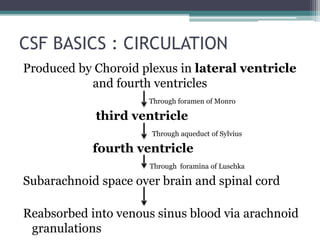
Produced by Choroid plexus in lateral ventricle
and fourth ventricles
Through foramen of Monro
third ventricle
Through aqueduct of Sylvius
fourth ventricle
Through foramina of Luschka
Subarachnoid space over brain and spinal cord
Reabsorbed into venous sinus blood via arachnoid
granulations
CSF BASICS
 Total volume of CSF varies from 90 to 150 m.l.
 It is secreted at the rate of about 20ml/h (300-
350 ml/day)
 Therefore total CSF is replaced 3-5 times a day.
 Normal CSF pressure at lumbar puncture is
50-150 mm H2O
 It rises on coughing, sneezing, nose blowing,
straining on stools or lifting heavy weight.
CSF RHINORRHOEA
• Leakage of CSF into nose.
• It may be clear fluid or mixed with blood.
Aetiology
 Trauma : Most common cause. It can be either
accidental or surgical.
 SURGICAL TRAUMA includes:-
 Endoscopic sinus surgery.
 Trans-sphenoidal hypophysectomy
 Nasal polypectomy.
 Skull base surgery.
INFLAMMATIONS :
 Mucoceles of sinuses.
 Sinunasal polyposis. Erode bone and
 Fungal infections of sinuses. dura.
 Osteomyelitis.
NEOPLASMS: Both benign and malignant, invading
the skull base.
CONGENITAL LESIONS:
 Meningocoele
 Meningoencephalocoele
 Gliomas.
IDIOPATHIC CAUSES
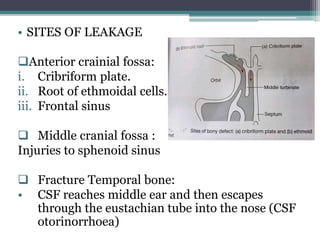
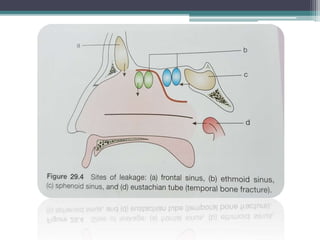
• SITES OF LEAKAGE
Anterior crainial fossa:
i. Cribriform plate.
ii. Root of ethmoidal cells.
iii. Frontal sinus
 Middle cranial fossa :
Injuries to sphenoid sinus
 Fracture Temporal bone:
• CSF reaches middle ear and then escapes
through the eustachian tube into the nose (CSF
otorinorrhoea)
DIAGNOSIS
• History of clear watery discharge from nose
on bending the head or straining.
• It may be seen on rising in the morning when
the patient bends his head (reservoir sign – fluid
which had collected in the sinuses, particularly
sphenoid, empties into the nose)
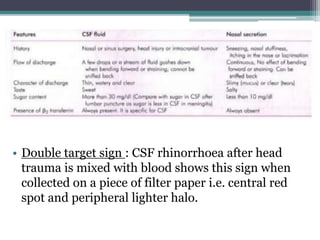
• It should be differentiated from nasal discharge
of allergic or vasomotor rhinitis.
• Nasal discharge, stiffens the handkerchief
because of its mucus content.
• Double target sign : CSF rhinorrhoea after head
trauma is mixed with blood shows this sign when
collected on a piece of filter paper i.e. central red
spot and peripheral lighter halo.
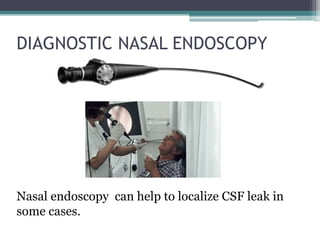
DIAGNOSTIC NASAL ENDOSCOPY
Nasal endoscopy can help to localize CSF leak in
some cases.
LABORATORY TESTS
oBeta-2 transferrin : a protein seen in CSF and
not in nasal dischrge, it’s presence is specific and
sensitive test.
• Requires only a few drops of CSF.
• Perilymph and aqueous are the only other fluids
which contain this protein.
oBeta trace protein : also specific for CSF ,
secreted my meninges and choroid plexus.
LOCALIZATION OF SITE
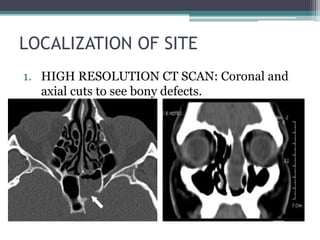
1. HIGH RESOLUTION CT SCAN: Coronal and
axial cuts to see bony defects.
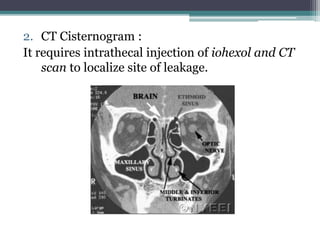
2. CT Cisternogram :
It requires intrathecal injection of iohexol and CT
scan to localize site of leakage.
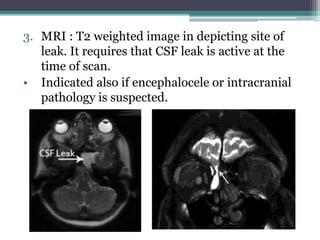
3. MRI : T2 weighted image in depicting site of
leak. It requires that CSF leak is active at the
time of scan.
• Indicated also if encephalocele or intracranial
pathology is suspected.
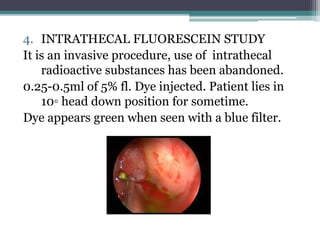
4. INTRATHECAL FLUORESCEIN STUDY
It is an invasive procedure, use of intrathecal
radioactive substances has been abandoned.
0.25-0.5ml of 5% fl. Dye injected. Patient lies in
10◦ head down position for sometime.
Dye appears green when seen with a blue filter.
TREATMENT
Early cases of post-traumatic CSF leak can be
managed by conservative measures such as bed
rest, elevation of the head of the bed, stool
softners, and avoidance of nose blowing,
sneezing and straining.
Prophylactic antibiotics can be used to prevent
meningitis.
These measures can be combined with lumbar
drainage.
Surgical Repair
A. Neurosurgical intracranial approach.
B. Extradural approaches :
• External ethhmoidectomy for cribriform plate
and ethmoid area.
• Trans-septal approach for sphenoid.
• Osteoplastic flap approach for frontal sinus
leak.
C. Transnasal endoscopic approach :
Most of the leaks from anterior cranial fossa and
sphenoid sinus can be managed endoscopically
Principles of repair:
• Defining the site of leak.
• Preparation of graft site.
• Underlay grafting of fascia extradurally
followed by placement of mucosa.
• If bony defect>2cm, it is repaired with
cartilage.
• Placement of surgical and gelfoam further
strengthens area.
TYPES OF GRAFTS
 It depends on the size and location of the defect,
 If the defect is large it can be fixed with bone or
cartilage graft taken usually from nasal
turbinates.
 If the defect is small, it can be repaired with
fascia lata grafts, temporalis fascia.
 Fibrin glue, surgicel, gelfoam is used to stabilize
the graft
• High antibiotic smeared nasal packing.
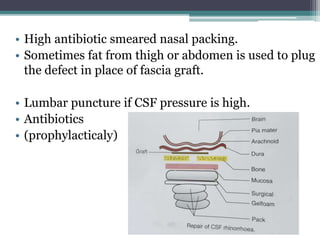
• Sometimes fat from thigh or abdomen is used to plug
the defect in place of fascia graft.
• Lumbar puncture if CSF pressure is high.
• Antibiotics
• (prophylacticaly)
Csf rhinorrhoea

Csf rhinorrhoea

  • 1.
    CSF RHINORRHOEA Dr. ParthRajdev MMIMSR Mullana (Ambala)
  • 2.
    CSF BASICS Cerebrospinal fluid(CSF) is a clear, colorless body fluid found in the brain and spine. It is produced in the choroid plexuses of the ventricles of the brain. • It acts as a cushion or buffer for the brain's cortex, providing basic mechanical and immunological protection to the brain inside the skull.
  • 3.
    CSF BASICS :CIRCULATION Produced by Choroid plexus in lateral ventricle and fourth ventricles Through foramen of Monro third ventricle Through aqueduct of Sylvius fourth ventricle Through foramina of Luschka Subarachnoid space over brain and spinal cord Reabsorbed into venous sinus blood via arachnoid granulations
  • 5.
    CSF BASICS  Totalvolume of CSF varies from 90 to 150 m.l.  It is secreted at the rate of about 20ml/h (300- 350 ml/day)  Therefore total CSF is replaced 3-5 times a day.  Normal CSF pressure at lumbar puncture is 50-150 mm H2O  It rises on coughing, sneezing, nose blowing, straining on stools or lifting heavy weight.
  • 6.
    CSF RHINORRHOEA • Leakageof CSF into nose. • It may be clear fluid or mixed with blood.
  • 7.
    Aetiology  Trauma :Most common cause. It can be either accidental or surgical.  SURGICAL TRAUMA includes:-  Endoscopic sinus surgery.  Trans-sphenoidal hypophysectomy  Nasal polypectomy.  Skull base surgery.
  • 8.
    INFLAMMATIONS :  Mucocelesof sinuses.  Sinunasal polyposis. Erode bone and  Fungal infections of sinuses. dura.  Osteomyelitis. NEOPLASMS: Both benign and malignant, invading the skull base. CONGENITAL LESIONS:  Meningocoele  Meningoencephalocoele  Gliomas. IDIOPATHIC CAUSES
  • 9.
    • SITES OFLEAKAGE Anterior crainial fossa: i. Cribriform plate. ii. Root of ethmoidal cells. iii. Frontal sinus  Middle cranial fossa : Injuries to sphenoid sinus  Fracture Temporal bone: • CSF reaches middle ear and then escapes through the eustachian tube into the nose (CSF otorinorrhoea)
  • 11.
    DIAGNOSIS • History ofclear watery discharge from nose on bending the head or straining. • It may be seen on rising in the morning when the patient bends his head (reservoir sign – fluid which had collected in the sinuses, particularly sphenoid, empties into the nose) • It should be differentiated from nasal discharge of allergic or vasomotor rhinitis. • Nasal discharge, stiffens the handkerchief because of its mucus content.
  • 12.
    • Double targetsign : CSF rhinorrhoea after head trauma is mixed with blood shows this sign when collected on a piece of filter paper i.e. central red spot and peripheral lighter halo.
  • 13.
    DIAGNOSTIC NASAL ENDOSCOPY Nasalendoscopy can help to localize CSF leak in some cases.
  • 14.
    LABORATORY TESTS oBeta-2 transferrin: a protein seen in CSF and not in nasal dischrge, it’s presence is specific and sensitive test. • Requires only a few drops of CSF. • Perilymph and aqueous are the only other fluids which contain this protein. oBeta trace protein : also specific for CSF , secreted my meninges and choroid plexus.
  • 15.
    LOCALIZATION OF SITE 1.HIGH RESOLUTION CT SCAN: Coronal and axial cuts to see bony defects.
  • 16.
    2. CT Cisternogram: It requires intrathecal injection of iohexol and CT scan to localize site of leakage.
  • 17.
    3. MRI :T2 weighted image in depicting site of leak. It requires that CSF leak is active at the time of scan. • Indicated also if encephalocele or intracranial pathology is suspected.
  • 18.
    4. INTRATHECAL FLUORESCEINSTUDY It is an invasive procedure, use of intrathecal radioactive substances has been abandoned. 0.25-0.5ml of 5% fl. Dye injected. Patient lies in 10◦ head down position for sometime. Dye appears green when seen with a blue filter.
  • 19.
    TREATMENT Early cases ofpost-traumatic CSF leak can be managed by conservative measures such as bed rest, elevation of the head of the bed, stool softners, and avoidance of nose blowing, sneezing and straining. Prophylactic antibiotics can be used to prevent meningitis. These measures can be combined with lumbar drainage.
  • 20.
    Surgical Repair A. Neurosurgicalintracranial approach. B. Extradural approaches : • External ethhmoidectomy for cribriform plate and ethmoid area. • Trans-septal approach for sphenoid. • Osteoplastic flap approach for frontal sinus leak.
  • 21.
    C. Transnasal endoscopicapproach : Most of the leaks from anterior cranial fossa and sphenoid sinus can be managed endoscopically Principles of repair: • Defining the site of leak. • Preparation of graft site. • Underlay grafting of fascia extradurally followed by placement of mucosa. • If bony defect>2cm, it is repaired with cartilage. • Placement of surgical and gelfoam further strengthens area.
  • 22.
    TYPES OF GRAFTS It depends on the size and location of the defect,  If the defect is large it can be fixed with bone or cartilage graft taken usually from nasal turbinates.  If the defect is small, it can be repaired with fascia lata grafts, temporalis fascia.  Fibrin glue, surgicel, gelfoam is used to stabilize the graft
  • 23.
    • High antibioticsmeared nasal packing. • Sometimes fat from thigh or abdomen is used to plug the defect in place of fascia graft. • Lumbar puncture if CSF pressure is high. • Antibiotics • (prophylacticaly)