






MM207
Group 11
Atishay Jain(120100018)
Aakash Patel(120100004)
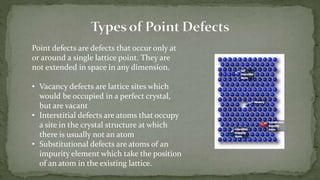
Point defects are defects that occur only at
or around a single lattice point. They are
not extended in space in any dimension.
• Vacancy defects are lattice sites which
would be occupied in a perfect crystal,
but are vacant
• Interstitial defects are atoms that occupy
a site in the crystal structure at which
there is usually not an atom
• Substitutional defects are atoms of an
impurity element which take the position
of an atom in the existing lattice.
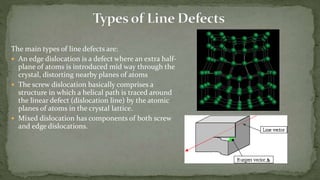
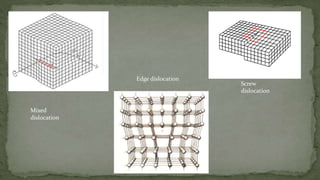
The main types of line defects are:
 An edge dislocation is a defect where an extra half-
plane of atoms is introduced mid way through the
crystal, distorting nearby planes of atoms
 The screw dislocation basically comprises a
structure in which a helical path is traced around
the linear defect (dislocation line) by the atomic
planes of atoms in the crystal lattice.
 Mixed dislocation has components of both screw
and edge dislocations.
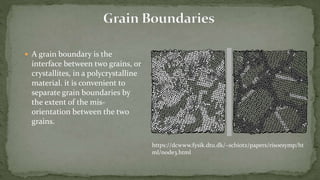
 A grain boundary is the
interface between two grains, or
crystallites, in a polycrystalline
material. it is convenient to
separate grain boundaries by
the extent of the mis-
orientation between the two
grains.
https://dcwww.fysik.dtu.dk/~schiotz/papers/risoesymp/ht
ml/node3.html
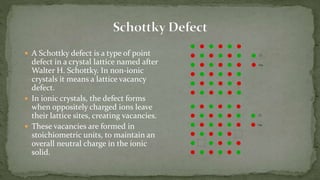
 A Schottky defect is a type of point
defect in a crystal lattice named after
Walter H. Schottky. In non-ionic
crystals it means a lattice vacancy
defect.
 In ionic crystals, the defect forms
when oppositely charged ions leave
their lattice sites, creating vacancies.
 These vacancies are formed in
stoichiometric units, to maintain an
overall neutral charge in the ionic
solid.
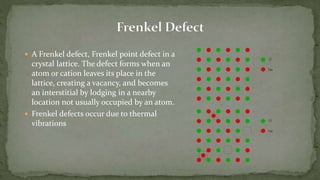
 A Frenkel defect, Frenkel point defect in a
crystal lattice. The defect forms when an
atom or cation leaves its place in the
lattice, creating a vacancy, and becomes
an interstitial by lodging in a nearby
location not usually occupied by an atom.
 Frenkel defects occur due to thermal
vibrations
Vaibhav Ojha(120100055)
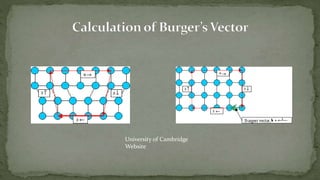
 The Burgers vector, named after Dutch physicist Jan Burgers, is a vector, often
denoted b, that represents the magnitude and direction of the lattice distortion
of dislocation in a crystal lattice.
 The burgers vector is found using a burgers circuit such that it encircles the
dislocation.
 In edge dislocations, the Burgers vector and dislocation line are at right angles to
one another. In screw dislocations, they are parallel.
University of Cambridge
Website
 If a dislocation branches out, sum of Burger
vectors of the new dislocations is same as that of
the original dislocation, i.e., conservation of
burgers vector.
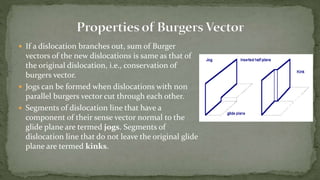
 Jogs can be formed when dislocations with non
parallel burgers vector cut through each other.
 Segments of dislocation line that have a
component of their sense vector normal to the
glide plane are termed jogs. Segments of
dislocation line that do not leave the original glide
plane are termed kinks.
Mixed
dislocation
Screw
dislocation
Edge dislocation
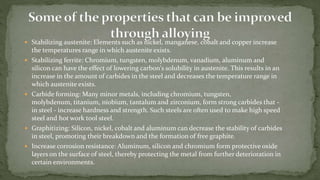
 Stabilizing austenite: Elements such as nickel, manganese, cobalt and copper increase
the temperatures range in which austenite exists.
 Stabilizing ferrite: Chromium, tungsten, molybdenum, vanadium, aluminum and
silicon can have the effect of lowering carbon's solubility in austenite. This results in an
increase in the amount of carbides in the steel and decreases the temperature range in
which austenite exists.
 Carbide forming: Many minor metals, including chromium, tungsten,
molybdenum, titanium, niobium, tantalum and zirconium, form strong carbides that -
in steel - increase hardness and strength. Such steels are often used to make high speed
steel and hot work tool steel.
 Graphitizing: Silicon, nickel, cobalt and aluminum can decrease the stability of carbides
in steel, promoting their breakdown and the formation of free graphite.
 Increase corrosion resistance: Aluminum, silicon and chromium form protective oxide
layers on the surface of steel, thereby protecting the metal from further deterioration in
certain environments.
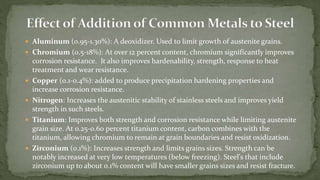
 Aluminum (0.95-1.30%): A deoxidizer. Used to limit growth of austenite grains.
 Chromium (0.5-18%): At over 12 percent content, chromium significantly improves
corrosion resistance. It also improves hardenability, strength, response to heat
treatment and wear resistance.
 Copper (0.1-0.4%): added to produce precipitation hardening properties and
increase corrosion resistance.
 Nitrogen: Increases the austenitic stability of stainless steels and improves yield
strength in such steels.
 Titanium: Improves both strength and corrosion resistance while limiting austenite
grain size. At 0.25-0.60 percent titanium content, carbon combines with the
titanium, allowing chromium to remain at grain boundaries and resist oxidization.
 Zirconium (0.1%): Increases strength and limits grains sizes. Strength can be
notably increased at very low temperatures (below freezing). Steel's that include
zirconium up to about 0.1% content will have smaller grains sizes and resist fracture.
 Strengthening due to strain hardening is not always desirable, especially if the
material is being heavily formed since ductility will be lowered.
 Heat treatment can be used to remove effects of strain hardening
 Three things can occur during this
 Recovery
 Recrystallization
 Growth
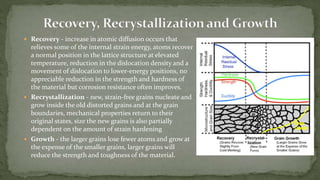
 Recovery - increase in atomic diffusion occurs that
relieves some of the internal strain energy, atoms recover
a normal position in the lattice structure at elevated
temperature, reduction in the dislocation density and a
movement of dislocation to lower-energy positions, no
appreciable reduction in the strength and hardness of
the material but corrosion resistance often improves.
 Recrystallization - new, strain-free grains nucleate and
grow inside the old distorted grains and at the grain
boundaries, mechanical properties return to their
original states, size the new grains is also partially
dependent on the amount of strain hardening
 Growth - the larger grains lose fewer atoms and grow at
the expense of the smaller grains, larger grains will
reduce the strength and toughness of the material.
Girish Chandani(120100053)
Shubham Khandelwal(120100030)
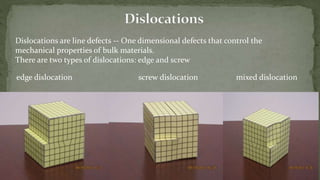
Dislocations are line defects -- One dimensional defects that control the
mechanical properties of bulk materials.
There are two types of dislocations: edge and screw
edge dislocation screw dislocation mixed dislocation
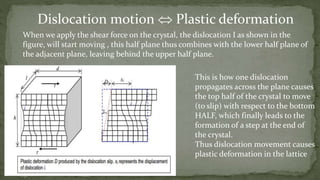
Dislocation motion  Plastic deformation
This is how one dislocation
propagates across the plane causes
the top half of the crystal to move
(to slip) with respect to the bottom
HALF, which finally leads to the
formation of a step at the end of
the crystal.
Thus dislocation movement causes
plastic deformation in the lattice
When we apply the shear force on the crystal, the dislocation I as shown in the
figure, will start moving , this half plane thus combines with the lower half plane of
the adjacent plane, leaving behind the upper half plane.
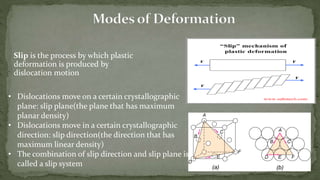
Slip is the process by which plastic
deformation is produced by
dislocation motion
• Dislocations move on a certain crystallographic
plane: slip plane(the plane that has maximum
planar density)
• Dislocations move in a certain crystallographic
direction: slip direction(the direction that has
maximum linear density)
• The combination of slip direction and slip plane is
called a slip system
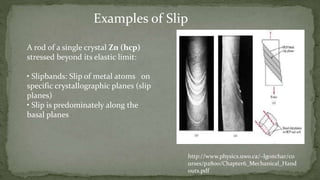
A rod of a single crystal Zn (hcp)
stressed beyond its elastic limit:
• Slipbands: Slip of metal atoms on
specific crystallographic planes (slip
planes)
• Slip is predominately along the
basal planes
Examples of Slip
http://www.physics.uwo.ca/~lgonchar/co
urses/p2800/Chapter6_Mechanical_Hand
outs.pdf
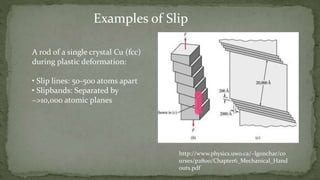
A rod of a single crystal Cu (fcc)
during plastic deformation:
• Slip lines: 50-500 atoms apart
• Slipbands: Separated by
~>10,000 atomic planes
Examples of Slip
http://www.physics.uwo.ca/~lgonchar/co
urses/p2800/Chapter6_Mechanical_Hand
outs.pdf
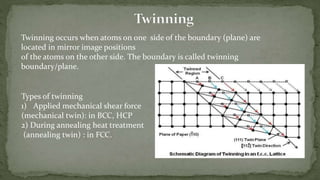
Twinning occurs when atoms on one side of the boundary (plane) are
located in mirror image positions
of the atoms on the other side. The boundary is called twinning
boundary/plane.
Types of twinning
1) Applied mechanical shear force
(mechanical twin): in BCC, HCP
2) During annealing heat treatment
(annealing twin) : in FCC.
• Slip occurs when the shear stress exceeds a critical value. Blocks of
the crystal slide over one another along slip planes. The atoms moves an integral
number of atomic distances along slip planes.
• Twinning results when a portion of the crystal takes up an orientation that is
related to the orientation of the untwinned lattice in a definite, symmetrical
way. The twin portion of the crystal is a mirror image of the parent crystal.
Major Differences between
slipping and twinning
• Slip is usually considered to occur in discrete multiples of the atomic spacings,
while in twinning the atom movements are much less than an atomic distance.
• In slip, the orientation of the crystal above and below the slip plane is the same
after deformation as before, while twinning results in an orientation difference
across the twin plane
• Slip occurs on relatively widely spread planes, but in the twinned region of a
crystal every atomic plane is involved in the deformation
Major Differences between
slipping and twinning
Deepak Dilipkumar(120100089)
Ashrith Reddy(120100014)
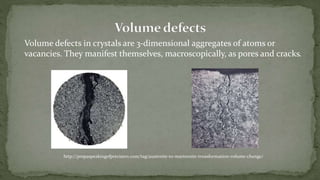
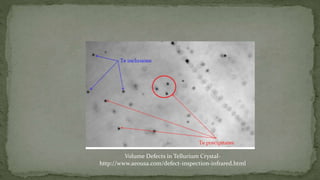
Volume defects in crystals are 3-dimensional aggregates of atoms or
vacancies. They manifest themselves, macroscopically, as pores and cracks.
http://pmpaspeakingofprecision.com/tag/austenite-to-martensite-trnasformation-volume-change/
Volume Defects in Tellurium Crystal-
http://www.aeousa.com/defect-inspection-infrared.html
 While the definition of volume defects is clear enough, there is no hard
and fast rule for classifying them
 We have to decide on some properties that we are specifically interested
in. Here, we want to study the effect of volume defects on material
properties.
 So, based on the size of the defects, and the effect they have on the
properties of the crystal, we can classify volume defects into four main
categories.
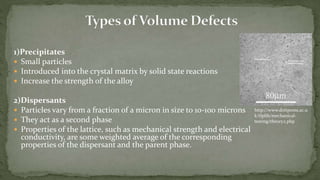
1)Precipitates
 Small particles
 Introduced into the crystal matrix by solid state reactions
 Increase the strength of the alloy
2)Dispersants
 Particles vary from a fraction of a micron in size to 10-100 microns
 They act as a second phase
 Properties of the lattice, such as mechanical strength and electrical
conductivity, are some weighted average of the corresponding
properties of the dispersant and the parent phase.
http://www.doitpoms.ac.u
k/tlplib/mechanical-
testing/theory2.php
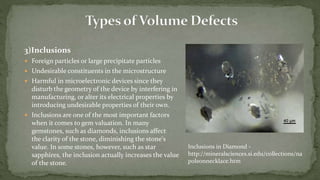
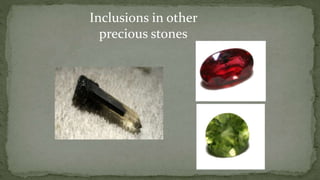
3)Inclusions
 Foreign particles or large precipitate particles
 Undesirable constituents in the microstructure
 Harmful in microelectronic devices since they
disturb the geometry of the device by interfering in
manufacturing, or alter its electrical properties by
introducing undesirable properties of their own.
 Inclusions are one of the most important factors
when it comes to gem valuation. In many
gemstones, such as diamonds, inclusions affect
the clarity of the stone, diminishing the stone's
value. In some stones, however, such as star
sapphires, the inclusion actually increases the value
of the stone.
Inclusions in Diamond -
http://mineralsciences.si.edu/collections/na
poleonnecklace.htm
Inclusions in other
precious stones
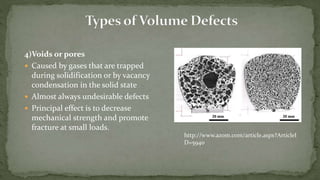
4)Voids or pores
 Caused by gases that are trapped
during solidification or by vacancy
condensation in the solid state
 Almost always undesirable defects
 Principal effect is to decrease
mechanical strength and promote
fracture at small loads.
http://www.azom.com/article.aspx?ArticleI
D=5940
Ujjwal Bahare(120100062)
Apurva Gupta(120100058)
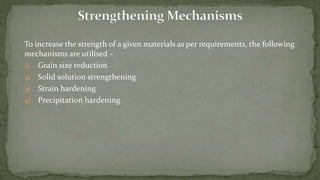
To increase the strength of a given materials as per requirements, the following
mechanisms are utilised –
1) Grain size reduction
2) Solid solution strengthening
3) Strain hardening
4) Precipitation hardening
http://oregonstate.edu/instruct/engr3
22/Homework/AllHomework/S06/EN
GR322HW3.html
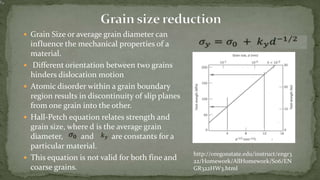
 Grain Size or average grain diameter can
influence the mechanical properties of a
material.
 Different orientation between two grains
hinders dislocation motion
 Atomic disorder within a grain boundary
region results in discontinuity of slip planes
from one grain into the other.
 Hall-Petch equation relates strength and
grain size, where d is the average grain
diameter, and are constants for a
particular material.
 This equation is not valid for both fine and
coarse grains.
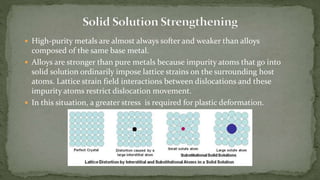
 High-purity metals are almost always softer and weaker than alloys
composed of the same base metal.
 Alloys are stronger than pure metals because impurity atoms that go into
solid solution ordinarily impose lattice strains on the surrounding host
atoms. Lattice strain field interactions between dislocations and these
impurity atoms restrict dislocation movement.
 In this situation, a greater stress is required for plastic deformation.
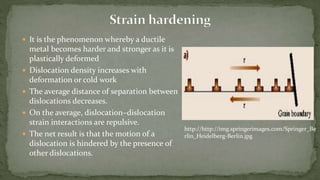
 It is the phenomenon whereby a ductile
metal becomes harder and stronger as it is
plastically deformed
 Dislocation density increases with
deformation or cold work
 The average distance of separation between
dislocations decreases.
 On the average, dislocation–dislocation
strain interactions are repulsive.
 The net result is that the motion of a
dislocation is hindered by the presence of
other dislocations.
http://http://img.springerimages.com/Springer_Be
rlin_Heidelberg-Berlin.jpg
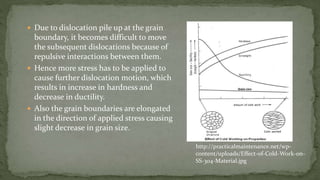
 Due to dislocation pile up at the grain
boundary, it becomes difficult to move
the subsequent dislocations because of
repulsive interactions between them.
 Hence more stress has to be applied to
cause further dislocation motion, which
results in increase in hardness and
decrease in ductility.
 Also the grain boundaries are elongated
in the direction of applied stress causing
slight decrease in grain size.
http://practicalmaintenance.net/wp-
content/uploads/Effect-of-Cold-Work-on-
SS-304-Material.jpg
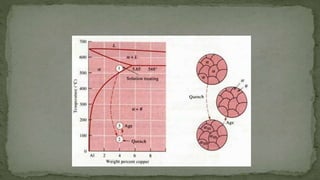
 Precipitation hardening, also called age hardening, is a heat treatment
technique used to increase the yield strength of malleable materials, including
most structural alloys of aluminium, magnesium, nickel, titanium.
 First an alloy of required composition is made and heated to particular
temperature where it exists in some phase .
 It is in its natural phase. If this is cooled suddenly then there would be phase
change but there is no time for atoms to separate. This would result in a super
saturated solid-solution.
 Second the solid solution obtained is heated a little. Then the precipitate starts
forming and strengthens the material. In course of time the atoms slowly
diffuses and the material weakens. This is called "aging“.
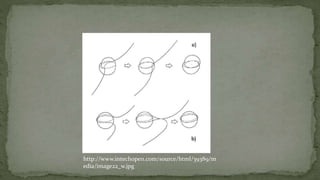
Cutting
 Molt and Nabarro considered that
a dislocation would take on a
smoothly curved form when
moving through lattice instead of
moving as a straight line . But
bending increases dislocation line
length which cost energy.
 Energy here is directly
proportional to radius of
precipitate
 Orwon suggested that dislocation
line travels in straight line forming
a loop around the particles in its
way.
 Energy needed here is inversely
proportional to the radius of
precipitate.
Bowing (Orwon Looping)
http://www.intechopen.com/source/html/39389/m
edia/image22_w.jpg
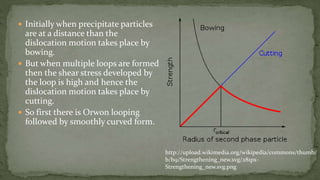
 Initially when precipitate particles
are at a distance than the
dislocation motion takes place by
bowing.
 But when multiple loops are formed
then the shear stress developed by
the loop is high and hence the
dislocation motion takes place by
cutting.
 So first there is Orwon looping
followed by smoothly curved form.
http://upload.wikimedia.org/wikipedia/commons/thumb/
b/b9/Strengthening_new.svg/281px-
Strengthening_new.svg.png
Alan John Maniamkot(120100091)
A perfect crystal, with every atom of the same type in the correct position, does
not exist. All crystals have some defects. Defects contribute to the mechanical
properties of metals.
Though read as ‘defects’, these features are commonly intentionally used to
manipulate the mechanical properties of a material.
Nevertheless, the term “defect” will be used. We should, however, keep in mind
that crystalline defects are not necessarily “bad”.
 The presence of defects subtly alters all of a material’s properties.
 Chemical reactivity
 Mechanical strength
 Optical absorption and
 Electronic transport, all vary with defect concentration.
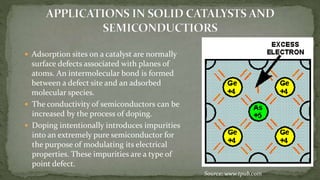
 Adsorption sites on a catalyst are normally
surface defects associated with planes of
atoms. An intermolecular bond is formed
between a defect site and an adsorbed
molecular species.
 The conductivity of semiconductors can be
increased by the process of doping.
 Doping intentionally introduces impurities
into an extremely pure semiconductor for
the purpose of modulating its electrical
properties. These impurities are a type of
point defect.
Source: www.tpub.com
 Alloys are instances of repeatedly occuring substitutional or interstitial
defects depending upon the size of the impurity atoms and the positions
occupied by them in the parent metal lattice.
 They Prevent corrosion, improve appearance, make parent material harder.
 Alloys of Gold and Silver are used in the preparation of jewellery. White
Gold, which is an alloy of Gold, Silver, Palladium, and Nickel is used as cheap
alternative of Platinum. A wide selection of alloys is used in welding
applications by numerous industries.
 Nickel-Chromium, Nickel-Chromium-Iron, and Iron-Chromium-Aluminium
alloys have been used for high-temperature heating elements.
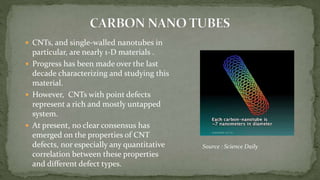
 CNTs, and single-walled nanotubes in
particular, are nearly 1-D materials .
 Progress has been made over the last
decade characterizing and studying this
material.
 However, CNTs with point defects
represent a rich and mostly untapped
system.
 At present, no clear consensus has
emerged on the properties of CNT
defects, nor especially any quantitative
correlation between these properties
and different defect types.
Source : Science Daily
 Defects can lower the tensile strength by up to 85%.
 Lowered conductivity is observed through the defective region of the
tube.
 Single monatomic vacancies induce magnetic properties.
 Defects strongly affect the tube's thermal properties. Such defects lead
to phonon scattering, which in turn increases the relaxation rate of the
phonons.
 This reduces the mean free path and reduces the thermal conductivity of
nanotube structures.
 William Callister - Materials Science and Engineering
 George Dieter – Mechanical Metallurgy
 Thomas H. Courtney – Mechanical Behaviour of Materials
 University of Cambridge Website
 Oregon State University Website
 Berkeley Material Sciences Website
 Science Daily
 Wikipedia

3

  • 1.
  • 2.
  • 3.
    Point defects aredefects that occur only at or around a single lattice point. They are not extended in space in any dimension. • Vacancy defects are lattice sites which would be occupied in a perfect crystal, but are vacant • Interstitial defects are atoms that occupy a site in the crystal structure at which there is usually not an atom • Substitutional defects are atoms of an impurity element which take the position of an atom in the existing lattice.
  • 4.
    The main typesof line defects are:  An edge dislocation is a defect where an extra half- plane of atoms is introduced mid way through the crystal, distorting nearby planes of atoms  The screw dislocation basically comprises a structure in which a helical path is traced around the linear defect (dislocation line) by the atomic planes of atoms in the crystal lattice.  Mixed dislocation has components of both screw and edge dislocations.
  • 5.
     A grainboundary is the interface between two grains, or crystallites, in a polycrystalline material. it is convenient to separate grain boundaries by the extent of the mis- orientation between the two grains. https://dcwww.fysik.dtu.dk/~schiotz/papers/risoesymp/ht ml/node3.html
  • 6.
     A Schottkydefect is a type of point defect in a crystal lattice named after Walter H. Schottky. In non-ionic crystals it means a lattice vacancy defect.  In ionic crystals, the defect forms when oppositely charged ions leave their lattice sites, creating vacancies.  These vacancies are formed in stoichiometric units, to maintain an overall neutral charge in the ionic solid.
  • 7.
     A Frenkeldefect, Frenkel point defect in a crystal lattice. The defect forms when an atom or cation leaves its place in the lattice, creating a vacancy, and becomes an interstitial by lodging in a nearby location not usually occupied by an atom.  Frenkel defects occur due to thermal vibrations
  • 8.
  • 9.
     The Burgersvector, named after Dutch physicist Jan Burgers, is a vector, often denoted b, that represents the magnitude and direction of the lattice distortion of dislocation in a crystal lattice.  The burgers vector is found using a burgers circuit such that it encircles the dislocation.  In edge dislocations, the Burgers vector and dislocation line are at right angles to one another. In screw dislocations, they are parallel.
  • 10.
  • 11.
     If adislocation branches out, sum of Burger vectors of the new dislocations is same as that of the original dislocation, i.e., conservation of burgers vector.  Jogs can be formed when dislocations with non parallel burgers vector cut through each other.  Segments of dislocation line that have a component of their sense vector normal to the glide plane are termed jogs. Segments of dislocation line that do not leave the original glide plane are termed kinks.
  • 12.
  • 13.
     Stabilizing austenite:Elements such as nickel, manganese, cobalt and copper increase the temperatures range in which austenite exists.  Stabilizing ferrite: Chromium, tungsten, molybdenum, vanadium, aluminum and silicon can have the effect of lowering carbon's solubility in austenite. This results in an increase in the amount of carbides in the steel and decreases the temperature range in which austenite exists.  Carbide forming: Many minor metals, including chromium, tungsten, molybdenum, titanium, niobium, tantalum and zirconium, form strong carbides that - in steel - increase hardness and strength. Such steels are often used to make high speed steel and hot work tool steel.  Graphitizing: Silicon, nickel, cobalt and aluminum can decrease the stability of carbides in steel, promoting their breakdown and the formation of free graphite.  Increase corrosion resistance: Aluminum, silicon and chromium form protective oxide layers on the surface of steel, thereby protecting the metal from further deterioration in certain environments.
  • 14.
     Aluminum (0.95-1.30%):A deoxidizer. Used to limit growth of austenite grains.  Chromium (0.5-18%): At over 12 percent content, chromium significantly improves corrosion resistance. It also improves hardenability, strength, response to heat treatment and wear resistance.  Copper (0.1-0.4%): added to produce precipitation hardening properties and increase corrosion resistance.  Nitrogen: Increases the austenitic stability of stainless steels and improves yield strength in such steels.  Titanium: Improves both strength and corrosion resistance while limiting austenite grain size. At 0.25-0.60 percent titanium content, carbon combines with the titanium, allowing chromium to remain at grain boundaries and resist oxidization.  Zirconium (0.1%): Increases strength and limits grains sizes. Strength can be notably increased at very low temperatures (below freezing). Steel's that include zirconium up to about 0.1% content will have smaller grains sizes and resist fracture.
  • 15.
     Strengthening dueto strain hardening is not always desirable, especially if the material is being heavily formed since ductility will be lowered.  Heat treatment can be used to remove effects of strain hardening  Three things can occur during this  Recovery  Recrystallization  Growth
  • 16.
     Recovery -increase in atomic diffusion occurs that relieves some of the internal strain energy, atoms recover a normal position in the lattice structure at elevated temperature, reduction in the dislocation density and a movement of dislocation to lower-energy positions, no appreciable reduction in the strength and hardness of the material but corrosion resistance often improves.  Recrystallization - new, strain-free grains nucleate and grow inside the old distorted grains and at the grain boundaries, mechanical properties return to their original states, size the new grains is also partially dependent on the amount of strain hardening  Growth - the larger grains lose fewer atoms and grow at the expense of the smaller grains, larger grains will reduce the strength and toughness of the material.
  • 17.
  • 18.
    Dislocations are linedefects -- One dimensional defects that control the mechanical properties of bulk materials. There are two types of dislocations: edge and screw edge dislocation screw dislocation mixed dislocation
  • 19.
    Dislocation motion Plastic deformation This is how one dislocation propagates across the plane causes the top half of the crystal to move (to slip) with respect to the bottom HALF, which finally leads to the formation of a step at the end of the crystal. Thus dislocation movement causes plastic deformation in the lattice When we apply the shear force on the crystal, the dislocation I as shown in the figure, will start moving , this half plane thus combines with the lower half plane of the adjacent plane, leaving behind the upper half plane.
  • 20.
    Slip is theprocess by which plastic deformation is produced by dislocation motion • Dislocations move on a certain crystallographic plane: slip plane(the plane that has maximum planar density) • Dislocations move in a certain crystallographic direction: slip direction(the direction that has maximum linear density) • The combination of slip direction and slip plane is called a slip system
  • 21.
    A rod ofa single crystal Zn (hcp) stressed beyond its elastic limit: • Slipbands: Slip of metal atoms on specific crystallographic planes (slip planes) • Slip is predominately along the basal planes Examples of Slip http://www.physics.uwo.ca/~lgonchar/co urses/p2800/Chapter6_Mechanical_Hand outs.pdf
  • 22.
    A rod ofa single crystal Cu (fcc) during plastic deformation: • Slip lines: 50-500 atoms apart • Slipbands: Separated by ~>10,000 atomic planes Examples of Slip http://www.physics.uwo.ca/~lgonchar/co urses/p2800/Chapter6_Mechanical_Hand outs.pdf
  • 23.
    Twinning occurs whenatoms on one side of the boundary (plane) are located in mirror image positions of the atoms on the other side. The boundary is called twinning boundary/plane. Types of twinning 1) Applied mechanical shear force (mechanical twin): in BCC, HCP 2) During annealing heat treatment (annealing twin) : in FCC.
  • 24.
    • Slip occurswhen the shear stress exceeds a critical value. Blocks of the crystal slide over one another along slip planes. The atoms moves an integral number of atomic distances along slip planes. • Twinning results when a portion of the crystal takes up an orientation that is related to the orientation of the untwinned lattice in a definite, symmetrical way. The twin portion of the crystal is a mirror image of the parent crystal. Major Differences between slipping and twinning
  • 25.
    • Slip isusually considered to occur in discrete multiples of the atomic spacings, while in twinning the atom movements are much less than an atomic distance. • In slip, the orientation of the crystal above and below the slip plane is the same after deformation as before, while twinning results in an orientation difference across the twin plane • Slip occurs on relatively widely spread planes, but in the twinned region of a crystal every atomic plane is involved in the deformation Major Differences between slipping and twinning
  • 26.
  • 27.
    Volume defects incrystals are 3-dimensional aggregates of atoms or vacancies. They manifest themselves, macroscopically, as pores and cracks. http://pmpaspeakingofprecision.com/tag/austenite-to-martensite-trnasformation-volume-change/
  • 28.
    Volume Defects inTellurium Crystal- http://www.aeousa.com/defect-inspection-infrared.html
  • 29.
     While thedefinition of volume defects is clear enough, there is no hard and fast rule for classifying them  We have to decide on some properties that we are specifically interested in. Here, we want to study the effect of volume defects on material properties.  So, based on the size of the defects, and the effect they have on the properties of the crystal, we can classify volume defects into four main categories.
  • 30.
    1)Precipitates  Small particles Introduced into the crystal matrix by solid state reactions  Increase the strength of the alloy 2)Dispersants  Particles vary from a fraction of a micron in size to 10-100 microns  They act as a second phase  Properties of the lattice, such as mechanical strength and electrical conductivity, are some weighted average of the corresponding properties of the dispersant and the parent phase. http://www.doitpoms.ac.u k/tlplib/mechanical- testing/theory2.php
  • 31.
    3)Inclusions  Foreign particlesor large precipitate particles  Undesirable constituents in the microstructure  Harmful in microelectronic devices since they disturb the geometry of the device by interfering in manufacturing, or alter its electrical properties by introducing undesirable properties of their own.  Inclusions are one of the most important factors when it comes to gem valuation. In many gemstones, such as diamonds, inclusions affect the clarity of the stone, diminishing the stone's value. In some stones, however, such as star sapphires, the inclusion actually increases the value of the stone. Inclusions in Diamond - http://mineralsciences.si.edu/collections/na poleonnecklace.htm
  • 32.
  • 33.
    4)Voids or pores Caused by gases that are trapped during solidification or by vacancy condensation in the solid state  Almost always undesirable defects  Principal effect is to decrease mechanical strength and promote fracture at small loads. http://www.azom.com/article.aspx?ArticleI D=5940
  • 34.
  • 35.
    To increase thestrength of a given materials as per requirements, the following mechanisms are utilised – 1) Grain size reduction 2) Solid solution strengthening 3) Strain hardening 4) Precipitation hardening
  • 36.
    http://oregonstate.edu/instruct/engr3 22/Homework/AllHomework/S06/EN GR322HW3.html  Grain Sizeor average grain diameter can influence the mechanical properties of a material.  Different orientation between two grains hinders dislocation motion  Atomic disorder within a grain boundary region results in discontinuity of slip planes from one grain into the other.  Hall-Petch equation relates strength and grain size, where d is the average grain diameter, and are constants for a particular material.  This equation is not valid for both fine and coarse grains.
  • 37.
     High-purity metalsare almost always softer and weaker than alloys composed of the same base metal.  Alloys are stronger than pure metals because impurity atoms that go into solid solution ordinarily impose lattice strains on the surrounding host atoms. Lattice strain field interactions between dislocations and these impurity atoms restrict dislocation movement.  In this situation, a greater stress is required for plastic deformation.
  • 38.
     It isthe phenomenon whereby a ductile metal becomes harder and stronger as it is plastically deformed  Dislocation density increases with deformation or cold work  The average distance of separation between dislocations decreases.  On the average, dislocation–dislocation strain interactions are repulsive.  The net result is that the motion of a dislocation is hindered by the presence of other dislocations. http://http://img.springerimages.com/Springer_Be rlin_Heidelberg-Berlin.jpg
  • 39.
     Due todislocation pile up at the grain boundary, it becomes difficult to move the subsequent dislocations because of repulsive interactions between them.  Hence more stress has to be applied to cause further dislocation motion, which results in increase in hardness and decrease in ductility.  Also the grain boundaries are elongated in the direction of applied stress causing slight decrease in grain size. http://practicalmaintenance.net/wp- content/uploads/Effect-of-Cold-Work-on- SS-304-Material.jpg
  • 40.
     Precipitation hardening,also called age hardening, is a heat treatment technique used to increase the yield strength of malleable materials, including most structural alloys of aluminium, magnesium, nickel, titanium.  First an alloy of required composition is made and heated to particular temperature where it exists in some phase .  It is in its natural phase. If this is cooled suddenly then there would be phase change but there is no time for atoms to separate. This would result in a super saturated solid-solution.  Second the solid solution obtained is heated a little. Then the precipitate starts forming and strengthens the material. In course of time the atoms slowly diffuses and the material weakens. This is called "aging“.
  • 42.
    Cutting  Molt andNabarro considered that a dislocation would take on a smoothly curved form when moving through lattice instead of moving as a straight line . But bending increases dislocation line length which cost energy.  Energy here is directly proportional to radius of precipitate  Orwon suggested that dislocation line travels in straight line forming a loop around the particles in its way.  Energy needed here is inversely proportional to the radius of precipitate. Bowing (Orwon Looping)
  • 43.
  • 44.
     Initially whenprecipitate particles are at a distance than the dislocation motion takes place by bowing.  But when multiple loops are formed then the shear stress developed by the loop is high and hence the dislocation motion takes place by cutting.  So first there is Orwon looping followed by smoothly curved form. http://upload.wikimedia.org/wikipedia/commons/thumb/ b/b9/Strengthening_new.svg/281px- Strengthening_new.svg.png
  • 45.
  • 46.
    A perfect crystal,with every atom of the same type in the correct position, does not exist. All crystals have some defects. Defects contribute to the mechanical properties of metals. Though read as ‘defects’, these features are commonly intentionally used to manipulate the mechanical properties of a material. Nevertheless, the term “defect” will be used. We should, however, keep in mind that crystalline defects are not necessarily “bad”.
  • 47.
     The presenceof defects subtly alters all of a material’s properties.  Chemical reactivity  Mechanical strength  Optical absorption and  Electronic transport, all vary with defect concentration.
  • 48.
     Adsorption siteson a catalyst are normally surface defects associated with planes of atoms. An intermolecular bond is formed between a defect site and an adsorbed molecular species.  The conductivity of semiconductors can be increased by the process of doping.  Doping intentionally introduces impurities into an extremely pure semiconductor for the purpose of modulating its electrical properties. These impurities are a type of point defect. Source: www.tpub.com
  • 49.
     Alloys areinstances of repeatedly occuring substitutional or interstitial defects depending upon the size of the impurity atoms and the positions occupied by them in the parent metal lattice.  They Prevent corrosion, improve appearance, make parent material harder.  Alloys of Gold and Silver are used in the preparation of jewellery. White Gold, which is an alloy of Gold, Silver, Palladium, and Nickel is used as cheap alternative of Platinum. A wide selection of alloys is used in welding applications by numerous industries.  Nickel-Chromium, Nickel-Chromium-Iron, and Iron-Chromium-Aluminium alloys have been used for high-temperature heating elements.
  • 50.
     CNTs, andsingle-walled nanotubes in particular, are nearly 1-D materials .  Progress has been made over the last decade characterizing and studying this material.  However, CNTs with point defects represent a rich and mostly untapped system.  At present, no clear consensus has emerged on the properties of CNT defects, nor especially any quantitative correlation between these properties and different defect types. Source : Science Daily
  • 51.
     Defects canlower the tensile strength by up to 85%.  Lowered conductivity is observed through the defective region of the tube.  Single monatomic vacancies induce magnetic properties.  Defects strongly affect the tube's thermal properties. Such defects lead to phonon scattering, which in turn increases the relaxation rate of the phonons.  This reduces the mean free path and reduces the thermal conductivity of nanotube structures.
  • 52.
     William Callister- Materials Science and Engineering  George Dieter – Mechanical Metallurgy  Thomas H. Courtney – Mechanical Behaviour of Materials  University of Cambridge Website  Oregon State University Website  Berkeley Material Sciences Website  Science Daily  Wikipedia