LINE DEFECT
Definition:
Line imperfections (one-dimensional defects) are also called dislocations. They are abrupt changes in the regular ordering of atoms along
a line (dislocation line) in the solid. They occur in high densities and strongly influence.
 The mechanical properties of material.
 They are characterized by the burgers vector.
(B), whose direction and magnitude can be determined by constructing a loop around the disrupted region and noticing the extra
inter-atomic spacing needed to close the loop. The burgers vector in metals points in a close packed lattice direction. It is unique to a
dislocation.
TYPES OF LINE DEFECT
Dislocations occur when an extra incomplete plane is inserted. The dislocation line is at the end of the plane. Dislocations can be best
understood by referring to two limiting cases
 Edge dislocation
 screw dislocation
EDGE DISLOCATION
Edge dislocation or taylor-orowan dislocation is characterized by a burger’s vector that is perpendicular to the dislocation line. It may be described as an edge of an extra
plane of atoms within a crystal structure. Thus regions of compression and tension are associated with an edge dislocation. Because of extra incomplete plane of atoms, the
atoms above the dislocation line are squeezed together and are in state of compression whereas atoms below are pulled apart and experience tensile stresses.
Edge dislocation is considered positive :when compressive stresses present above the dislocation line.
Represented by ┴. if the stress state is opposite i.E.
Edge dislocation is considered as negative : when compressive stresses exist below the dislocation line.
It is represented by ┬.
A schematic view of edge dislocations :
Edge dislocations.
A pure edge dislocation can glide or slip in a direction perpendicular to its length i.E. Along its burger’s vector in the slip plane (made of b and t vectors), on which
dislocation moves by slip while conserving number of atoms in the incomplete plane. It may move vertically by a process known as climb, if diffusion of atoms or
vacancies can take place at appropriate rate. Atoms are added to the incomplete plane for negative climb i.E. The incomplete plane increases in extent downwards, and
vice versa. Thus climb motion is considered as non-conservative, the movement by climb is controlled by diffusion process.
SCREW DISLOCATION
Definition:
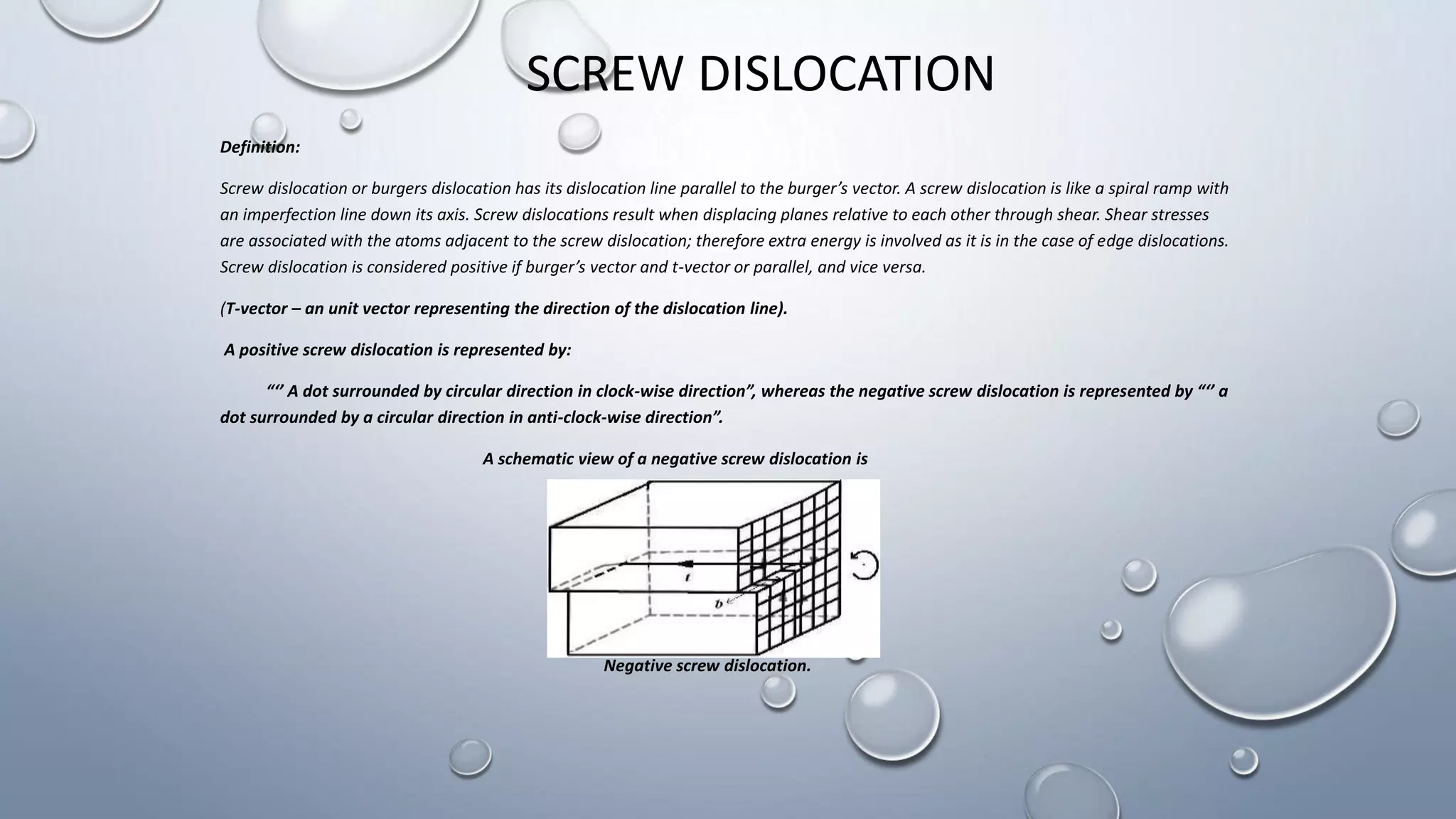
Screw dislocation or burgers dislocation has its dislocation line parallel to the burger’s vector. A screw dislocation is like a spiral ramp with
an imperfection line down its axis. Screw dislocations result when displacing planes relative to each other through shear. Shear stresses
are associated with the atoms adjacent to the screw dislocation; therefore extra energy is involved as it is in the case of edge dislocations.
Screw dislocation is considered positive if burger’s vector and t-vector or parallel, and vice versa.
(T-vector – an unit vector representing the direction of the dislocation line).
A positive screw dislocation is represented by:
“‘’ A dot surrounded by circular direction in clock-wise direction”, whereas the negative screw dislocation is represented by “‘’ a
dot surrounded by a circular direction in anti-clock-wise direction”.
A schematic view of a negative screw dislocation is
Negative screw dislocation.
DIFFERENCE
 Screw dislocation does not have A preferred slip plane, as an edge dislocation has.
 The motion of a screw dislocation is less restricted than the motion of an edge dislocation.
As there is no preferred slip plane, screw dislocation can cross-slip on to another plane, and can continue its glide under favorable
stress conditions.
Screw dislocation can not move by climb process, whereas edge dislocations can not cross-slip.
ORIGINATION OF SCREW DISLOCATION
Dislocations more commonly originate during plastic deformation, during solidification, and as a consequence of thermal stresses that
result from rapid cooling.
Edge dislocation arises when there is a slight mismatch in the orientation of adjacent parts of the growing crystal. A screw dislocation
allows easy crystal growth because additional atoms can be added to the ‘step’ of the screw. Thus the term screw is apt, because the step
swings around the axis as growth proceeds. Unlike point defects, these are not thermodynamically stable. They can be removed by
heating to high temperatures where they cancel each other or move out through the crystal to its surface. Virtually all crystalline
materials contain some dislocations.
“The density of dislocations in a crystal is measures by counting the number of points at which they intersect a random cross-section of
the crystal. These points, called etch-pits, can be seen under microscope”.
In an annealed crystal, the dislocation density is the range of 108-1010 m-2.
COMBINATION OF EDGE AND SCREW DISLOCATION
Any dislocation in a crystal is a combination of edge and screw types, having varying degrees of edge and screw character.
Depicts a schematic picture of a common dislocation.
Typical dislocation in a crystal.
The burger’s vector will have the same magnitude and direction over the whole length of dislocation irrespective of the character of the dislocation (edge, screw, or mixed) i.E.
Burger’s vector is invariant.
Geometrical characteristics of dislocations are:
Vectorial sum of burger’s vectors of dislocations meeting at a point, called node, must be zero.
T-vectors of all the dislocations meeting at a node must either point towards it or away from it.
A dislocation line can not end abruptly within the crystal. It can close on itself as a loop, or ends either at a node or at the surface.
Dislocations have distortional energy associated with them as is evident from the presence of tensile/compressive/shear stresses around a dislocation line. Strains can be expected
to be in the elastic range, and thus stored elastic energy per unit length of the dislocation can be obtained from the following equation:
22gbe≅
Where G – shear modulus and b – burger’s vector.
DISLOCATION IN REAL CRYSTAL
Dislocations in the real crystal can be classified into two groups based on their geometry.
 Full dislocations
 Partial dislocations
Partial dislocation’s burger’s vector will be a fraction of a lattice translation.
Full dislocation’s burger’s vector is an integral multiple of a lattice translation.
As mentioned above, elastic energy associated with a dislocation is proportional to square of its burger’s vector; dislocation will tend to
have as small a burger’s vector as possible. This explains the reason for separation of dislocations that tend to stay away from each other!
POINT DEFECT
Defects exists any all solid materials. For ease of their characterization, defects are classified on the basis of their geometry, which is
realistic as defects are disrupted region in a volume of a solid.
Defects are:
 point defects (zero-dimensional)
 line defects (single dimensional)
Surface defects (two dimensional)
 volume defects (three dimensional)

Defects

  • 1.
    LINE DEFECT Definition: Line imperfections(one-dimensional defects) are also called dislocations. They are abrupt changes in the regular ordering of atoms along a line (dislocation line) in the solid. They occur in high densities and strongly influence.  The mechanical properties of material.  They are characterized by the burgers vector. (B), whose direction and magnitude can be determined by constructing a loop around the disrupted region and noticing the extra inter-atomic spacing needed to close the loop. The burgers vector in metals points in a close packed lattice direction. It is unique to a dislocation.
  • 2.
    TYPES OF LINEDEFECT Dislocations occur when an extra incomplete plane is inserted. The dislocation line is at the end of the plane. Dislocations can be best understood by referring to two limiting cases  Edge dislocation  screw dislocation
  • 3.
    EDGE DISLOCATION Edge dislocationor taylor-orowan dislocation is characterized by a burger’s vector that is perpendicular to the dislocation line. It may be described as an edge of an extra plane of atoms within a crystal structure. Thus regions of compression and tension are associated with an edge dislocation. Because of extra incomplete plane of atoms, the atoms above the dislocation line are squeezed together and are in state of compression whereas atoms below are pulled apart and experience tensile stresses. Edge dislocation is considered positive :when compressive stresses present above the dislocation line. Represented by ┴. if the stress state is opposite i.E. Edge dislocation is considered as negative : when compressive stresses exist below the dislocation line. It is represented by ┬. A schematic view of edge dislocations : Edge dislocations. A pure edge dislocation can glide or slip in a direction perpendicular to its length i.E. Along its burger’s vector in the slip plane (made of b and t vectors), on which dislocation moves by slip while conserving number of atoms in the incomplete plane. It may move vertically by a process known as climb, if diffusion of atoms or vacancies can take place at appropriate rate. Atoms are added to the incomplete plane for negative climb i.E. The incomplete plane increases in extent downwards, and vice versa. Thus climb motion is considered as non-conservative, the movement by climb is controlled by diffusion process.
  • 4.
    SCREW DISLOCATION Definition: Screw dislocationor burgers dislocation has its dislocation line parallel to the burger’s vector. A screw dislocation is like a spiral ramp with an imperfection line down its axis. Screw dislocations result when displacing planes relative to each other through shear. Shear stresses are associated with the atoms adjacent to the screw dislocation; therefore extra energy is involved as it is in the case of edge dislocations. Screw dislocation is considered positive if burger’s vector and t-vector or parallel, and vice versa. (T-vector – an unit vector representing the direction of the dislocation line). A positive screw dislocation is represented by: “‘’ A dot surrounded by circular direction in clock-wise direction”, whereas the negative screw dislocation is represented by “‘’ a dot surrounded by a circular direction in anti-clock-wise direction”. A schematic view of a negative screw dislocation is Negative screw dislocation.
  • 5.
    DIFFERENCE  Screw dislocationdoes not have A preferred slip plane, as an edge dislocation has.  The motion of a screw dislocation is less restricted than the motion of an edge dislocation. As there is no preferred slip plane, screw dislocation can cross-slip on to another plane, and can continue its glide under favorable stress conditions. Screw dislocation can not move by climb process, whereas edge dislocations can not cross-slip.
  • 6.
    ORIGINATION OF SCREWDISLOCATION Dislocations more commonly originate during plastic deformation, during solidification, and as a consequence of thermal stresses that result from rapid cooling. Edge dislocation arises when there is a slight mismatch in the orientation of adjacent parts of the growing crystal. A screw dislocation allows easy crystal growth because additional atoms can be added to the ‘step’ of the screw. Thus the term screw is apt, because the step swings around the axis as growth proceeds. Unlike point defects, these are not thermodynamically stable. They can be removed by heating to high temperatures where they cancel each other or move out through the crystal to its surface. Virtually all crystalline materials contain some dislocations. “The density of dislocations in a crystal is measures by counting the number of points at which they intersect a random cross-section of the crystal. These points, called etch-pits, can be seen under microscope”. In an annealed crystal, the dislocation density is the range of 108-1010 m-2.
  • 7.
    COMBINATION OF EDGEAND SCREW DISLOCATION Any dislocation in a crystal is a combination of edge and screw types, having varying degrees of edge and screw character. Depicts a schematic picture of a common dislocation. Typical dislocation in a crystal. The burger’s vector will have the same magnitude and direction over the whole length of dislocation irrespective of the character of the dislocation (edge, screw, or mixed) i.E. Burger’s vector is invariant. Geometrical characteristics of dislocations are: Vectorial sum of burger’s vectors of dislocations meeting at a point, called node, must be zero. T-vectors of all the dislocations meeting at a node must either point towards it or away from it. A dislocation line can not end abruptly within the crystal. It can close on itself as a loop, or ends either at a node or at the surface. Dislocations have distortional energy associated with them as is evident from the presence of tensile/compressive/shear stresses around a dislocation line. Strains can be expected to be in the elastic range, and thus stored elastic energy per unit length of the dislocation can be obtained from the following equation: 22gbe≅ Where G – shear modulus and b – burger’s vector.
  • 8.
    DISLOCATION IN REALCRYSTAL Dislocations in the real crystal can be classified into two groups based on their geometry.  Full dislocations  Partial dislocations Partial dislocation’s burger’s vector will be a fraction of a lattice translation. Full dislocation’s burger’s vector is an integral multiple of a lattice translation. As mentioned above, elastic energy associated with a dislocation is proportional to square of its burger’s vector; dislocation will tend to have as small a burger’s vector as possible. This explains the reason for separation of dislocations that tend to stay away from each other!
  • 9.
    POINT DEFECT Defects existsany all solid materials. For ease of their characterization, defects are classified on the basis of their geometry, which is realistic as defects are disrupted region in a volume of a solid. Defects are:  point defects (zero-dimensional)  line defects (single dimensional) Surface defects (two dimensional)  volume defects (three dimensional)