International Journal of Modern Research in Engineering and Technology (IJMRET)
www.ijmret.org Volume 3 Issue 8 ǁ August 2018.
w w w . i j m r e t . o r g I S S N : 2 4 5 6 - 5 6 2 8 Page 28
Determination of Linear Absorption Coefficient for Different
Materials
IK Suleiman1
1
Department of Physics, Nigerian Defence Academy Kaduna, Nigeria.
Author contribution.
This study was carried by Author IKS collected and prepared the field samples, participated in the laboratory
procedures, performed the statistical analysis ,wrote the draft of the manuscript , designed the study and
contributed to the statistical analysis.
ABSTRACT: Linear attenuation coefficient (𝜇) is a measure of the ability of a medium to diffuse and absorb
radiation. In the interaction of radiation with matter, the linear absorption coefficient plays an important role
because during the passage of radiation through a medium, its absorption depends on the wavelength of the
radiation and the thickness and nature of the medium. Experiments to determine linear absorption coefficient for
Lead, Copper and Aluminum were carried out in air.
The result showed that linear absorption Coefficient for Lead is 0.545cm – 1
, Copper is 0.139cm-1
and Aluminum
is 0.271cm-1
using gamma-rays. The results agree with standard values.
Keywords: Linear Attenuation Coefficient, Medium, Radiation, Copper, Lead and Aluminum.
I. INTRODUCTION
Radiation is either the process of emitting
electromagnetic energy (such as heat, light,
gamma-roys x-rays etc), sub-atomic particles,
electrons, neutrons, protons, alpha-particles etc, or
energy or particles thus emitted. Nuclear radiation
cannot be seen, heard, or smelled by unaided
human senses but its presence is felt by damage
done to the body. The effect they produce on
materials is used to quantity them. Towards the end
of the 19th
Century a Chemist observed that salts of
uranium emitted radiation which affects a
photographic plate and induced electrical
conductivity (ionization) in gases. It was found
that, neither the quality nor the quantity of radiation
emitted by a given chemical compound was in any
way affected by such processes as temperature
change or pressure change, and in the case of
Uranium, it was found that the amount of radiation
emitted did not depend in the compound, but was
directly related to the quantity of Uranium in that
compound. Another great Fresh physicist, Henri
Becquend in 1896 was also among the first persons
to observe the effect of nuclear radiation. He found
that a photographic plate, sealed in complete
darkness, was affected as though it had been
exposed to light when placed near to Uranium
source. Radiation loses energy as it transverse
through matter. The higher energy of the radiation,
the greater the distance it will transverse through
the material. The distance the radiation having a
certain amount of energy will transverse through a
material depends on the density and thickness of
the material.
The distance transverse is called range. From this
range the thickness of the material can be measure
and this give birth to thickness gauger.However,
the mass attenuation is used to find the range the
thickness of the materials.
The relationship between the range, thickness and
energy is given as:-
dI = Kdx or I = Ioe−kx ………………(1)
which I: is the initial Intensity of the Alpha,
Gamma, which Ioe is the intensity at a distance (x),
thickness and k is the absorption coefficient of the
particular, material2
, k depends on the type of
radiation (alpha, beta, or gamma) and is directly
proportional to the density (d) of the material, i.e k
= μD. As Dx is infact, the mass per unit area M, of
the materials, μ is referred to as the absorption
coefficient of the radiation expressed in M2
kg-1.
II. MATERIALS AND METHODS
The radioactive source Co60
5𝜇ci(Ɣ), was acquired
International Journal of Modern Research in Engineering and Technology (IJMRET)
www.ijmret.org Volume 3 Issue 8 ǁ August 2018.
w w w . i j m r e t . o r g I S S N : 2 4 5 6 - 5 6 2 8 Page 29
by Physics Department Nigerian Defence Academy
Kaduna, Nigeria, for the purposed of experimental
and research work.
The absorbers were already prepared and were also
obtained from the laboratory which includes
aluminum, coppers and lead. The thickness of the
absorbers were measure from the absorbers using
micrometer screw gauge.
The experiment to measure the linear absorption
coefficient for different absorbers materials was
carried out by exposing different absorbers
material to Co60
5𝜇ci(Ɣ) and the results obtained
from the slope of the graph.
III. EXPERIMENTAL DESIGN
The detector used was sodium lodide
(NaI(Ti) with 7 percent resolution, H.V of 700V,
and 662 Kev energy, made by Harshaw and Filtrol.
The detector allows almost 100 percent detection of
gamma rays but cannot be used to detect beta –
rays. The Decade sealer Counter was used during
the experiment to give the counts of the radiation
emitted after passing through the absorbers. The
other material used includes stand with clamp for
supporting sodium lodide detector and collimators.
Micrometer screw gauge was used to measure the
thickness of the absorbers, stopwatch for timing the
number of counts.
The arraignment used during the experiment
includes, material with varying thickness i.e
absorbers such as Aluminum, Copper and Lead
were each placed between Radioactive Source
Co60
5𝜇ci(Ɣ). A detector (NaI(Ti) was placed
immediately after absorbers to detect the radiation
passing through the absorbers. ADacade sealer was
connected to the detector to give the number of
counts of radiation emitted. Two collimators were
used to reducethe scattering of the radiation
emitted, the first collimator was placed near the
radioactive source and the second collimator was
placed near the detector.The detector, collimators,
absorbers, radioactive source were placed on a
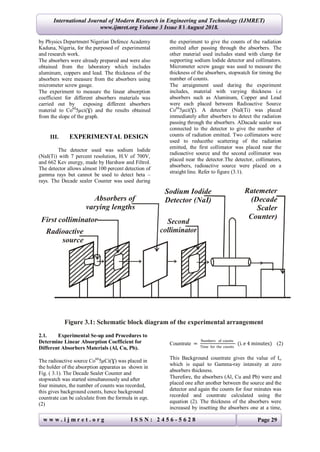
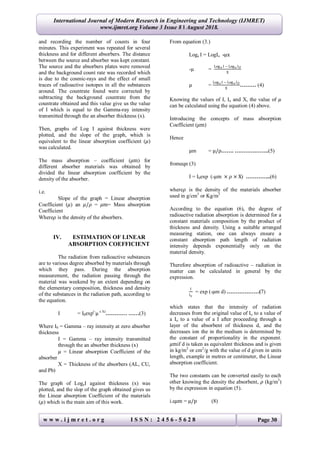
straight line. Refer to figure (3.1).
2.1. Experimental Se-up and Procedures to
Determine Linear Absorption Coefficient for
Different Absorbers Materials (Al, Cu, Pb).
The radioactive source Co60
5𝜇Ci(Ɣ) was placed in
the holder of the absorption apparatus as shown in
Fig. ( 3.1). The Decade Sealer Counter and
stopwatch was started simultaneously and after
four minutes, the number of counts was recorded,
this gives background counts, hence background
countrate can be calculate from the formula in eqn.
(2)
Countrate =
Numbers of counts
Time for the counts
(i. e 4 minutes) (2)
This Background countrate gives the value of Io
which is equal to Gamma-ray intensity at zero
absorbers thickness.
Therefore, the absorbers (Al, Cu and Pb) were and
placed one after another between the source and the
detector and again the counts for four minutes was
recorded and countrate calculated using the
equation (2). The thickness of the absorbers were
increased by insetting the absorbers one at a time,
Radioactive
source
First colliminator
Absorbers of
varying lengths
Sodium Iodide
Detector (NaI)
Ratemeter
(Decade
Scaler
Counter)
Figure 3.1: Schematic block diagram of the experimental arrangement
International Journal of Modern Research in Engineering and Technology (IJMRET)
www.ijmret.org Volume 3 Issue 8 ǁ August 2018.
w w w . i j m r e t . o r g I S S N : 2 4 5 6 - 5 6 2 8 Page 30
and recording the number of counts in four
minutes. This experiment was repeated for several
thickness and for different absorbers. The distance
between the source and absorber was kept constant.
The source and the absorbers plates were removed
and the background count rate was recorded which
is due to the cosmic-rays and the effect of small
traces of radioactive isotopes in all the substances
around. The countrate found were corrected by
subtracting the background countrate from the
countrate obtained and this value give us the value
of I which is equal to the Gamma-ray intensity
transmitted through the an absorber thickness (x).
Then, graphs of Log I against thickness were
plotted, and the slope of the graph, which is
equivalent to the linear absorption coefficient (𝜇)
was calculated.
The mass absorption – coefficient (𝜇m) for
different absorber materials was obtained by
divided the linear absorption coefficient by the
density of the absorber.
i.e.
Slope of the graph = Linear absorption
Coefficient (𝜇) an 𝜇/𝜌 = 𝜇m= Mass absorption
Coefficient
Where𝜌 is the density of the absorbers.
IV. ESTIMATION OF LINEAR
ABSORPTION COEFFICIENT
The radiation from radioactive substances
are to various degree absorbed by materials through
which they pass. During the absorption
measurement, the radiation passing through the
material was weekend by an extent depending on
the elementary composition, thickness and density
of the substances in the radiation path, according to
the equation.
I = I0exp(-
μ x X)
………… ……(3)
Where I0 = Gamma – ray intensity at zero absorber
thickness
I = Gamma – ray intensity transmitted
through the an absorber thickness (x)
𝜇 = Linear absorption Coefficient of the
absorber
X = Thickness of the absorbers (AL, CU,
and Pb)
The graph of LogeI against thickness (x) was
plotted, and the slop of the graph obtained gives us
the Linear absorption Coefficient of the materials
(𝜇) which is the main aim of this work.
From equation (3.)
Loge I = LogIo -μx
-μ =
Log e I − Log e I 𝑂
X
μ =
Log e I − Log e I 𝑂
X
……… (4)
Knowing the values of I, Io and X, the value of 𝜇
can be calculated using the equation (4) above.
Introducing the concepts of mass absorption
Coefficient (𝜇m)
Hence
μm = μ/ρ……. ……………….(5)
fromeqn (3)
I = I0exp (-μm × 𝜌 × X) …………..(6)
where𝜌 is the density of the materials absorber
used in g/cm3
or Kg/m3
According to the equation (6), the degree of
radioactive radiation absorption is determined for a
constant materials composition by the product of
thickness and density. Using a suitable arranged
measuring station, one can always ensure a
constant absorption path length of radiation
intensity depends exponentially only on the
material density.
Therefore absorption of radioactive – radiation in
matter can be calculated in general by the
expression.
I
Io
= exp (-μm d) ………………(7)
which states that the intensity of radiation
decreases from the original value of Io to a value of
a Io to a value of a I after proceeding through a
layer of the absorbent of thickness d, and the
decreases ion the in the medium is determined by
the constant of proportionality in the exponent.
𝜇mif d is taken as equivalent thickness and is given
in kg/m2
or cm2
/g with the value of d given in units
length, example in metres or centimeter, the Linear
absorption coefficient.
The two constants can be converted easily to each
other knowing the density the absorbent, 𝜌 (kg/m3
)
by the expression in equation (5).
i.e𝜇m = μ/p (8)
International Journal of Modern Research in Engineering and Technology (IJMRET)
www.ijmret.org Volume 3 Issue 8 ǁ August 2018.
w w w . i j m r e t . o r g I S S N : 2 4 5 6 - 5 6 2 8 Page 31
In practice, the use of 𝜇𝑚 is of advantage
because the dependence of the absorption on
energy can be described in such as manner in a
much simpler way.
V. RESULTS
The experiment for the determination of linear
absorption Coefficient for different materials
(absorbers) was carried out in NDA Physics
Laboratory.However, some limitations might have
been encountered during the experiments. Hence,
the results of this investigation is as follows:
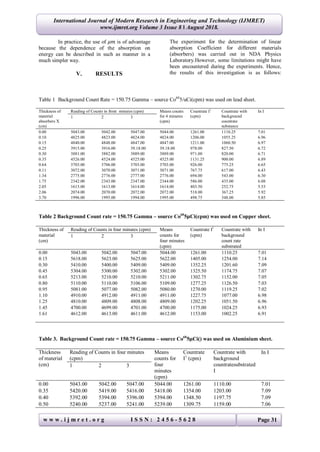
Table 1 Background Count Rate = 150.75 Gamma – source Co60
5/uCi(cpm) was used on lead sheet.
Thickness of
material
absorbers X
(cm)
Reading of Counts in front minutes (cpm) Means counts
for 4 minutes
(cpm)
Countrate I1
(cpm)
Countrate with
background
countrate
substance
In I
1 2 3
0.00 5043.00 5042.00 5047.00 5044.00 1261.00 1110.25 7.01
0.10 4825.00 4823.00 4824.00 4824.00 1206.00 1055.25 6.96
0.15 4840.00 4848.00 4847.00 4847.00 1211.00 1060.50 6.97
0.25 3915.00 3916.00 39.18.00 39.18.00 978.00 827.50 6.72
0.30 3881.00 3882.00 3889.00 3889.00 971.00 820.00 6.71
0.35 4526.00 4524.00 4525.00 4525.00 1131.25 900.00 6.89
0.64 3703.00 3706.00 3703.00 3703.00 926.00 775.25 6.65
0.11 3072.00 3070.00 3071.00 3071.00 767.75 617.00 6.43
1.34 2775.00 2776.00 2777.00 2776.00 694.00 543.00 6.30
1.75 2342.00 2343.00 2347.00 2344.00 586.00 435.00 6.08
2.05 1615.00 1613.00 1614.00 1614.00 403.50 252.75 5.53
2.06 2074.00 2070.00 2072.00 2072.00 518.00 367.25 5.92
3.70 1996.00 1995.00 1994.00 1995.00 498.75 348.00 5.85
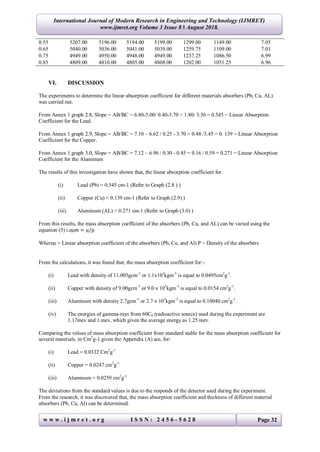
Table 2 Background Count rate = 150.75 Gamma – source Co60
5𝛍Ci(cpm) was used on Copper sheet.
Thickness of
material
(cm)
Reading of Counts in four minutes (cpm) Means
counts for
four minutes
(cpm)
Countrate I1
(cpm)
Countrate with
background
count rate
substrated
In I
1 2 3
0.00 5043.00 5042.00 5047.00 5044.00 1261.00 1110.25 7.01
0.15 5618.00 5623.00 5625.00 5622.00 1405.00 1254.00 7.14
0.30 5410.00 5400.00 5409.00 5409.00 1352.25 1201.60 7.09
0.45 5304.00 5300.00 5302.00 5302.00 1325.50 1174.75 7.07
0.65 5213.00 5210.00 5210.00 5211.00 1302.75 1152.00 7.05
0.80 5110.00 5110.00 5106.00 5109.00 1277.25 1126.50 7.03
0.95 5081.00 5077.00 5082.00 5080.00 1270.00 1119.25 7.02
1.10 4910.00 4912.00 4911.00 4911.00 1227.75 1077.00 6.98
1.25 4810.00 4809.00 4808.00 4809.00 1202.25 1051.50 6.96
1.45 4700.00 4699.00 4701.00 4700.00 1175.00 1024.25 6.93
1.61 4612.00 4613.00 4611.00 4612.00 1153.00 1002.25 6.91
Table 3. Background Count rate = 150.75 Gamma – source Co60
5𝛍Ci() was used on Aluminium sheet.
Thickness
of material
(cm)
Reading of Counts in four minutes
(cpm)
Means
counts for
four
minutes
(cpm)
Countrate
I1
(cpm)
Countrate with
background
countratesubstrated
I
In I
1 2 3
0.00 5043.00 5042.00 5047.00 5044.00 1261.00 1110.00 7.01
0.35 5420.00 5419.00 5416.00 5418.00 1354.00 1203.00 7.09
0.40 5392.00 5394.00 5396.00 5394.00 1348.50 1197.75 7.09
0.50 5240.00 5237.00 5241.00 5239.00 1309.75 1159.00 7.06
International Journal of Modern Research in Engineering and Technology (IJMRET)
www.ijmret.org Volume 3 Issue 8 ǁ August 2018.
w w w . i j m r e t . o r g I S S N : 2 4 5 6 - 5 6 2 8 Page 32
0.55 5207.00 5196.00 5194.00 5199.00 1299.00 1149.00 7.05
0.65 5040.00 5036.00 5041.00 5039.00 1259.75 1109.00 7.01
0.75 4949.00 4950.00 4948.00 4949.00 1237.25 1086.50 6.99
0.85 4809.00 4810.00 4805.00 4808.00 1202.00 1051.25 6.96
VI. DISCUSSION
The experiments to determine the linear absorption coefficient for different materials absorbers (Pb, Cu, AL)
was carried out.
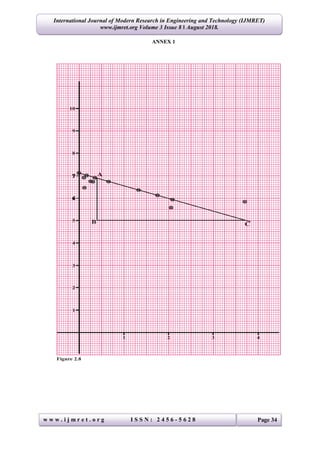
From Annex 1 graph 2.8, Slope = AB/BC = 6.80-5.00/ 0.40-3.70 = 1.80/ 3.30 = 0.545 = Linear Absorption
Coefficient for the Lead.
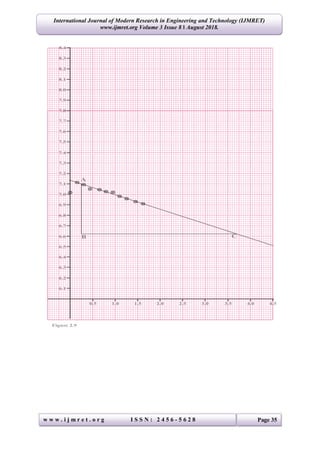
From Annex 1 graph 2.9, Slope = AB/BC = 7.10 – 6.62 / 0.25 - 3.70 = 0.48 /3.45 = 0. 139 = Linear Absorption
Coefficient for the Copper.
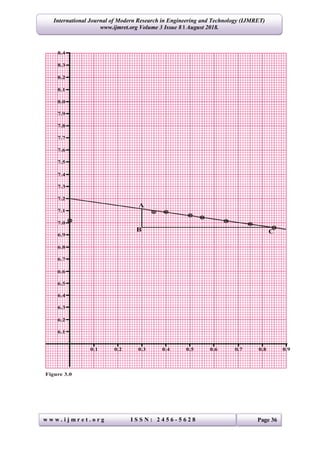
From Annex 1 graph 3.0, Slope = AB/BC = 7.12 – 6.96 / 0.30 - 0.85 = 0.16 / 0.59 = 0.271 = Linear Absorption
Coefficient for the Aluminum
The results of this investigation have shown that, the linear absorption coefficient for.
(i) Lead (Pb) = 0.545 cm-1 (Refer to Graph (2.8 ) )
(ii) Copper (Cu) = 0.139 cm-1 (Refer to Graph (2.9) )
(iii) Aluminum (AL) = 0.271 cm-1 (Refer to Graph (3.0) )
From this results, the mass absorption coefficient of the absorbers (Pb, Cu, and AL) can be varied using the
equation (5) i.eμm = μ/p
Whereμ = Linear absorption coefficient of the absorbers (Pb, Cu, and Al) P = Density of the absorbers
From the calculations, it was found that, the mass absorption coefficient for:-
(i) Lead with density of 11.005gcm-3
or 1.1x10³
kgm-3
is equal to 0.0495cm2
g-1
.
(ii) Copper with density of 9.00gcm-3
or 9.0 x 10³
kgm-3
is equal to 0.0154 cm2
g-1
.
(iii) Aluminum with density 2.7gcm-3
or 2.7 x 10³
kgm-3
is equal to 0.10040 cm2
g-1
.
(iv) The energies of gamma-rays from 60C0 (radioactive source) used during the experiment are
1.17mev and 1.mev, which given the average energy as 1.25 mev.
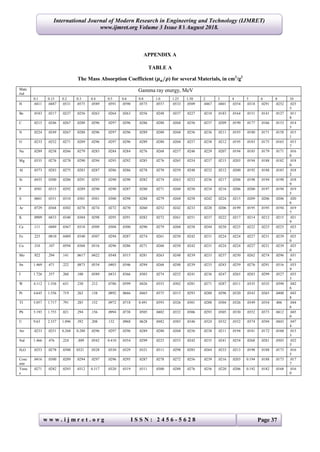
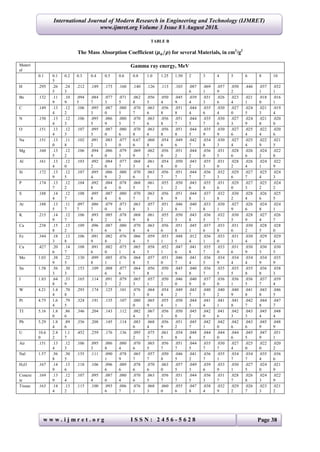
Comparing the values of mass absorption coefficient from standard stable for the mass absorption coefficient for
several materials, in Cm3
g-1 given the Appendix (A) are, for:
(i) Lead = 0.0332 Cm2
g-1
(ii) Copper = 0.0247 cm2
g-1
(iii) Aluminum = 0.0259 cm2
g-1
The deviations from the standard values is due to the responds of the detector used during the experiment.
From the research, it was discovered that, the mass absorption coefficient and thickness of different material
absorbers (Pb, Cu, Al) can be determined.
International Journal of Modern Research in Engineering and Technology (IJMRET)
www.ijmret.org Volume 3 Issue 8 ǁ August 2018.
w w w . i j m r e t . o r g I S S N : 2 4 5 6 - 5 6 2 8 Page 33
CONCLUSION
The results of this investigation shows that, the Linear Absorptions Coefficient for:
(i) Lead = 0.545 cm-1
(ii) Copper = 0.139 cm-1
(iii) Aluminum = 0.271 cm-1
VII. ACKNOWLEDGEMENTS
I grateful to the staff and management of Nigerian Defence Academy Kaduna, Nigeria for their support and
encouragements.
COMPETING INTEREST
There is no competing interest whatsoever that could have influenced the results of this study in any manner.
REFERENCES
[1.] ALBRIGHT, R. JOHN (1972) Introduction to Atomic and nuclear physics (Ed) Holt, Rinehant and
Winston, Inc, U.S.A, ppl – 75
[2.] ARTHUR BEISER (1987) Concepts of Modern physics Fourth Edition, McGraw – Hill Book
Company. PP 70-78
[3.] COOMBE R.A. (1968) An Introduction to Radioactivity for Engineers, First Edition, Aiden and
Mowbray Limited at the Alden press Oxford. PP 58-75
[4.] FOLDA K G. (1986) Industrial Application of Radiolso tapes. (Ed) Akademialkiado, Budapest,
Hungary PP – 20, 107 – 126.
[5.] GLENN F. KNOLL (1979) Radiation Detection and Measurement John Wiley and Sons PP 81 – 92.
[6.] IBIMIDUN C.O. (1989) Determination of radiation Dose from X-rays produced from materials
exposed tosr-90. Unpublished M.Sc. Thesis, Ahmadu Bello University, Zaria.
[7.] LAMARSH, R. JOHN, (1975) Introduction to Nuclear Engineering (Ed) Addison –Wesley
Publishing Company, Reading PP 1 – 608
[8.] SINGRU R. M. (1972). Introduction to experimental Nuclear Physics, wiley Eastern private Limited,
PP 26 –44, pp125-127.
[9.] TAIT W. H. (1980)Radiation Detection, TheButterwork Group, PP 144-148, PP177-180.
[10.] TYLER F. (1977) A Laboratory manual of physics fifth edition,SpottiswoodeBallantyne Limited,
Colchester and London PP 251-254.
[11.] Valerie H. Pitt (1975) Dictionary of physics, Lawrence Urdang Associate Limited, penguin Books PP
1-250.
[12.] WILLIAMS J. PRICE (1958) Nuclear Radiation Detection, McGraw – Hill Book Company, incl. PP1-
3, PP43-49.
[13.] Sharpe J. (1955) Nuclear Radiation Detectors, W. S. Cowell Limited. Great Britain PP 1-5
International Journal of Modern Research in Engineering and Technology (IJMRET)
www.ijmret.org Volume 3 Issue 8 ǁ August 2018.
w w w . i j m r e t . o r g I S S N : 2 4 5 6 - 5 6 2 8 Page 34
ANNEX 1
Figure 2.8
1 2 3 4
1
2
3
4
5
8
9
10
B
A
C
International Journal of Modern Research in Engineering and Technology (IJMRET)
www.ijmret.org Volume 3 Issue 8 ǁ August 2018.
w w w . i j m r e t . o r g I S S N : 2 4 5 6 - 5 6 2 8 Page 35
Figure 2.9
1.0 2.0 3.0 4.0
6.2
6.4
6.6
6.8
7.0
7.2
7.4
7.6
7.8
8.0
6.1
6.3
6.5
6.7
6.9
7.1
7.3
7.5
7.7
7.9
8.1
8.2
8.3
8.4
0.5 1.5 2.5 3.5 4.5
CB
A
International Journal of Modern Research in Engineering and Technology (IJMRET)
www.ijmret.org Volume 3 Issue 8 ǁ August 2018.
w w w . i j m r e t . o r g I S S N : 2 4 5 6 - 5 6 2 8 Page 36
0.2 0.4 0.6 0.8
6.2
6.4
6.6
6.8
7.0
7.2
7.4
7.6
7.8
8.0
6.1
6.3
6.5
6.7
6.9
7.1
7.3
7.5
7.7
7.9
8.1
8.2
8.3
8.4
0.1 0.3 0.5 0.7 0.9
B
A
C
Figure 3.0
International Journal of Modern Research in Engineering and Technology (IJMRET)
www.ijmret.org Volume 3 Issue 8 ǁ August 2018.
w w w . i j m r e t . o r g I S S N : 2 4 5 6 - 5 6 2 8 Page 37
APPENDIX A
TABLE A
The Mass Absorption Coefficient (𝝁 𝒂/𝝆) for several Materials, in cm2
/g2
Mate
rial
Gamma ray energy, MeV
0.1 0.15 0.2 0.3 0.4 0.5 0.6 0.8 1.0 1.25 1.50 2 3 4 5 6 8 10
H .0411 .0487 .0531 .0575 .0589 .0591 .0590 .0575 .0557 .0533 .0509 .0467 .0401 .0354 .0318 .0291 .0252 .025
5
Be .0183 .0217 .0237 .0256 .0263 .0264 .0263 .0256 .0248 .0237 .0227 .0210 .0183 .0164 .0151 .0141 .0127 .011
8
C .0215 .0246 .0267 .0288 .0296 .0297 .0296 .0286 .0280 .0268 .0256 .0237 .0209 .0190 .0177 .0166 .0153 .014
5
N .0224 .0249 .0267 .0288 .0296 .0297 .0296 .0289 .0280 .0268 .0256 .0236 .0211 .0193 .0180 .0171 .0158 .015
1
O .0233 .0252 .0271 .0289 .0296 .0297 .0296 .0289 .0280 .0268 .0257 .0238 .0212 .0195 .0183 .0175 .0163 .015
7
Na .0289 .0258 .0266 .0279 .0283 .0284 .0284 .0276 .0268 .0257 .0246 .0229 .0207 .0194 .0185 .0179 .0171 .016
8
Mg .0335 .0276 .0278 .0290 .0294 .0293 .0292 .0285 .0276 .0265 .0254 .0237 .0215 .0203 .0194 .0188 .0182 .018
0
Al .0373 .0283 .0275 .0283 .0287 .0286 .0286 .0278 .0270 .0259 .0248 .0232 .0212 .0200 .0192 .0188 .0183 .018
2
Si .0435 .0300 .0286 .0291 .0293 .0290 .0290 .0282 .0274 .0263 .0252 .0236 .0217 .0206 .0198 .0194 .0190 .018
9
P .0501 .0315 .0292 .0289 .0290 .0290 .0287 .0280 .0271 .0260 .0250 .0234 .0216 .0206 .0200 .0197 .0194 .019
5
S .0601 .0351 .0310 .0301 .0301 .0300 .0298 .0288 .0279 .0268 .0258 .0242 .0224 .0215 .0209 .0206 .0206 .020
6
Ar .0729 .0368 .0302 .0278 .0274 .0272 .0270 .0260 .0252 .0242 .0233 .0220 .0206 .0199 .0195 .0195 .0194 .019
7
K .0909 .0433 .0340 .0304 .0298 .0295 .0291 .0282 .0272 .0261 .0251 .0237 .0222 .0217 .0214 .0212 .0215 .021
9
Ca .111 .0489 .0367 .0318 .0309 .0304 .0300 .0290 .0279 .0268 .0258 .0244 .0230 .0225 .0222 .0223 .0225 .023
1
Fe .225 .0810 .0489 .0340 .0307 .0294 .0287 .0274 .0261 .0250 .0242 .0231 .0224 .0224 .0227 .0231 .0239 .025
0
Cu .310 .107 .0594 .0368 .0316 .0296 .0286 .0271 .0260 .0250 .0242 .0231 .0224 .0224 .0227 .0231 .0239 .025
0
Mo .922 .294 .141 .0617 .0422 .0348 .0315 .0281 .0263 .0248 .0239 .0233 .0237 .0250 .0262 .0274 .0296 .031
6
Sn 1.469 .471 .222 .0873 .0534 .0403 .0346 .0294 .0268 .0248 .0239 .0233 .0243 .0259 .0276 .0291 .0316 .033
9
I 1.726 .557 .260 .100 .0589 .0433 .0366 .0303 .0274 .0252 .0241 .0236 .0247 .0265 .0283 .0299 .0327 .035
3
W 4.112 1.356 .631 .230 .212 .0786 .0599 .0426 .0353 .0302 .0281 .0271 .0287 .0311 .0335 .0335 .0390 .042
6
Pt 4.645 1.556 .719 .262 .138 .0892 .0666 .0465 .0375 .0315 .0293 .0280 .0296 .0320 .0343 .0365 .0400 .043
8
TI 5.057 1.717 .791 .285 .152 .0972 .0718 0.491 .0393 .0326 .0301 .0288 .0304 .0326 .0349 .0354 .406 .044
6
Pb 5.193 1.753 .821 .294 .156 .0994 .0738 .0505 .0402 .0332 .0306 .0293 .0305 .0330 .0352 .0373 .0412 .045
0
U 9.63 2.337 1.096 .392 .208 .132 .0968 .0628 .0482 .0383 .0346 .0324 .0332 .0352 .0374 .0394 .0443 .047
4
Air .0233 .0251 0.268 0.288 .0296 .0297 .0296 .0289 .0280 .0268 .0256 .0238 .0211 .0194 .0181 .0172 .0160 .015
3
Nal 1.466 .476 .224 ..889 .0542 0.410 .0354 .0299 .0223 .0253 .0242 .0235 .0241 .0254 .0268 .0281 .0303 .032
5
H2O .0253 .0278 .0300 0321 .0328 .0330 .0329 .0321 .0311 .0298 .0285 .0264 .0233 .0213 .0198 .0188 .0173 .016
5
Conc
rete
.0416 .0300 .0289 .0294 .0297 .0296 .0295 .0287 .0278 .0272 .0256 .0239 .0216 .0203 0.194 .0188 .0173 .017
7
Tissu
e
.0271 .0282 .0293 .0312 0.317 .0320 .0319 .0311 .0300 .0288 .0276 .0256 .0220 .0206 0.192 .0182 .0168 .016
0
International Journal of Modern Research in Engineering and Technology (IJMRET)
www.ijmret.org Volume 3 Issue 8 ǁ August 2018.
w w w . i j m r e t . o r g I S S N : 2 4 5 6 - 5 6 2 8 Page 38
TABLE B
The Mass Absorption Coefficient (𝝁 𝒂/𝝆) for several Materials, in cm2
/g2
Materi
al
Gamma ray energy, MeV
0.1 0.1
5
0.2 0.3 0.4 0.5 0.6 0.8 1.0 1.25 1.50 2 3 4 5 6 8 10
H .295 .26
5
.24
3
.212 .189 .173 .160 .140 .126 .113 .103 .087
6
.069
1
.057
9
.050
2
.446 .037
1
.032
1
Be .132 .11
9
.10
9
.094
5
.084
7
.077
3
.071
5
.062
8
.056
5
.050
4
.045
9
.039
4
.031
3
.026
6
.023
4
.021
1
.018
0
.016
1
C .149 .13
4
.12
2
.106 .095
3
.087
0
.080
5
.070
7
.063
6
.056
8
.051
8
.044
4
.035
6
.030
4
.027
0
.024
5
.021
3
.019
4
N .150 .13
4
.12
3
.106 .095
5
.086
9
.080
5
.070
7
.063
6
.056
8
.051
7
.044
5
.035
7
.030
6
.027
3
.024
9
.021
8
.020
0
O .151 .13
4
.12
3
.107 .095
3
.087
0
.080
6
.070
8
.063
6
.056
8
.051
8
.044
5
.035
9
.030
9
.027
6
.025
4
.022
4
.020
6
Na .151 .13
0
.11
8
.102 .091
2
.083
3
.077
0
0.67
6
.060
8
.054
6
.049
6
.042
7
.034
8
.030
3
.027
4
.025
4
.022
9
.021
5
Mg .160 .13
5
.12
2
.106 .094
4
.086
0
.079
5
.069
9
.062
7
.056
0
.051
2
.044
2
.036
0
.031
5
.028
6
.026
6
.024
2
.022
8
Al .161 .13
4
.12
0
.103 .092
2
.084
0
.077
7
.068
3
.061
4
.054
8
.050
0
.043
2
.035
3
.031
0
.028
2
.026
4
.024
1
.022
9
Si .172 .13
9
.12
5
.107 .095
4
.086
9
.080
2
.070
6
.063
5
.056
7
.051
7
.044
7
.036
7
.032
3
.029
6
.027
7
.025
4
.024
3
P .174 .13
7
.12
2
.104 .092
8
.084
6
.078
0
.068
5
.061
7
.055
1
.050
2
.043
6
.035
8
.031
6
.029
0
.027
3
.025
2
.024
2
S .188 .14
4
.12
7
.108 .095
8
.087
4
.080
6
.070
7
.063
5
.056
8
.051
9
.044
8
.037
1
.032
8
.030
2
.028
4
.026
6
.025
5
Ar .188 .13
5
.11
7
.097
7
.086
7
.079
0
.073
0
.063
8
.057
3
.051
2
.046
8
.040
7
.033
8
.030
1
.027
9
.026
6
.024
8
.024
1
K .215 .14
9
.12
7
.106 .093
8
.085
2
.078
6
.068
9
.061
8
.055
2
.050
5
.043
8
.036
5
.032
7
.030
5
.028
9
.027
4
.026
7
Ca .238 .15
8
.13
2
.109 .096
5
.087
6
.080
9
.070
8
.063
4
.056
6
.051
8
.045
1
.037
6
.033
8
.031
6
.030
2
.028
5
.028
0
Fe .344 .18
3
.13
8
.106 .091
9
.082
8
.076
2
.066
4
.059
5
.053
1
.048
5
.012
4
.036
1
.033
0
.031
3
.030
4
.029
5
.029
4
Cu .427 .20
6
.14
7
.108 .091
6
.082
0
.075
1
.065
4
.058
5
.052
1
.047
6
.041
8
.035
7
.033
0
.031
6
.030
9
.030
3
.030
5
Mo 1.03 .38
9
.22
5
.130 .099
8
.085
1
.076
1
.064
8
.057
5
.051
0
.046
7
.041
4
.036
5
.034
9
.034
4
.034
4
.034
9
.035
9
Sn 1.58 .56
3
.30
3
.153 .109 .088
6
.077
6
.064
7
.056
8
.050
1
.045
9
.040
8
.036
7
.035
5
.035
5
.035
8
.036
8
.038
3
I 1.83 .64
8
.33
9
.165 .114 .091
3
.079
2
.065
3
.057
1
.050
2
.046
0
.040
9
.037
0
.036
0
.036
1
.036
5
.037
7
.039
4
W 4.21 1.4
4
.70
8
.293 .174 .125 .101 .076
3
.064
0
.054
4
.049
2
.043
7
.040
5
.040
2
.040
9
.041
8
.043
8
.046
5
Pt 4.75 1.6
4
.79
5
.324 .191 .135 .107 .080
0
.065
9
.055
4
.050
1
.044
5
.041
4
.041
1
.041
8
.042
7
.044
8
.047
7
TI 5.16 1.8
0
.86
6
.346 .204 .143 .112 .082
4
.067
5
.056
3
.050
8
.045
2
.042
0
.041
6
.042
3
.043
3
.045
4
.048
4
Pb 5.29 1.8
4
.89
6
.356 .208 .145 .114 .083
6
.068
4
.056
9
.051
2
.045
7
.042
1
.042
0
.042
6
.043
6
.045
9
.048
9
U 10.6
0
2.4
2
1.1
7
.452 .259 .176 .136 .095
2
.075
7
.061
5
.054
8
.048
4
.044
5
.044
0
.044
6
.045
5
.047
9
.051
1
Air .151 .13
4
.12
3
.106 .095
3
.086
8
.080
4
.070
6
.065
5
.056
7
.051
7
.044
5
.035
7
.030
7
.027
4
.025
0
.022
0
.020
2
Nal 1.57 .56
8
.30
5
.155 .111 .090
1
.078
9
.065
7
.057
7
.050
8
.046
5
.041
2
.036
7
.035
1
.034
7
.034
7
.035
4
.036
6
H2O .167 .14
9
.13
6
.118 .106 .096
6
.089
6
.078
6
.070
6
.063
0
.057
5
.049
3
.039
6
.033
9
.030
1
.027
5
.024
0
.021
9
Concre
te
.169 .13
9
.12
4
.107 .095
4
.087
0
.080
4
.070
6
.063
5
.056
7
.051
7
.044
5
.036
3
.031
7
.028
7
.026
8
.024
3
.022
9
Tissue .163 .14
4
.13
2
.115 .100 .093
6
.086
7
.076
1
.068
3
.060
0
.055
6
.047
8
.038
4
.032
9
.029
2
.026
7
.023
3
.021
2

Determination of Linear Absorption Coefficient for Different Materials

  • 1.
    International Journal ofModern Research in Engineering and Technology (IJMRET) www.ijmret.org Volume 3 Issue 8 ǁ August 2018. w w w . i j m r e t . o r g I S S N : 2 4 5 6 - 5 6 2 8 Page 28 Determination of Linear Absorption Coefficient for Different Materials IK Suleiman1 1 Department of Physics, Nigerian Defence Academy Kaduna, Nigeria. Author contribution. This study was carried by Author IKS collected and prepared the field samples, participated in the laboratory procedures, performed the statistical analysis ,wrote the draft of the manuscript , designed the study and contributed to the statistical analysis. ABSTRACT: Linear attenuation coefficient (𝜇) is a measure of the ability of a medium to diffuse and absorb radiation. In the interaction of radiation with matter, the linear absorption coefficient plays an important role because during the passage of radiation through a medium, its absorption depends on the wavelength of the radiation and the thickness and nature of the medium. Experiments to determine linear absorption coefficient for Lead, Copper and Aluminum were carried out in air. The result showed that linear absorption Coefficient for Lead is 0.545cm – 1 , Copper is 0.139cm-1 and Aluminum is 0.271cm-1 using gamma-rays. The results agree with standard values. Keywords: Linear Attenuation Coefficient, Medium, Radiation, Copper, Lead and Aluminum. I. INTRODUCTION Radiation is either the process of emitting electromagnetic energy (such as heat, light, gamma-roys x-rays etc), sub-atomic particles, electrons, neutrons, protons, alpha-particles etc, or energy or particles thus emitted. Nuclear radiation cannot be seen, heard, or smelled by unaided human senses but its presence is felt by damage done to the body. The effect they produce on materials is used to quantity them. Towards the end of the 19th Century a Chemist observed that salts of uranium emitted radiation which affects a photographic plate and induced electrical conductivity (ionization) in gases. It was found that, neither the quality nor the quantity of radiation emitted by a given chemical compound was in any way affected by such processes as temperature change or pressure change, and in the case of Uranium, it was found that the amount of radiation emitted did not depend in the compound, but was directly related to the quantity of Uranium in that compound. Another great Fresh physicist, Henri Becquend in 1896 was also among the first persons to observe the effect of nuclear radiation. He found that a photographic plate, sealed in complete darkness, was affected as though it had been exposed to light when placed near to Uranium source. Radiation loses energy as it transverse through matter. The higher energy of the radiation, the greater the distance it will transverse through the material. The distance the radiation having a certain amount of energy will transverse through a material depends on the density and thickness of the material. The distance transverse is called range. From this range the thickness of the material can be measure and this give birth to thickness gauger.However, the mass attenuation is used to find the range the thickness of the materials. The relationship between the range, thickness and energy is given as:- dI = Kdx or I = Ioe−kx ………………(1) which I: is the initial Intensity of the Alpha, Gamma, which Ioe is the intensity at a distance (x), thickness and k is the absorption coefficient of the particular, material2 , k depends on the type of radiation (alpha, beta, or gamma) and is directly proportional to the density (d) of the material, i.e k = μD. As Dx is infact, the mass per unit area M, of the materials, μ is referred to as the absorption coefficient of the radiation expressed in M2 kg-1. II. MATERIALS AND METHODS The radioactive source Co60 5𝜇ci(Ɣ), was acquired
  • 2.
    International Journal ofModern Research in Engineering and Technology (IJMRET) www.ijmret.org Volume 3 Issue 8 ǁ August 2018. w w w . i j m r e t . o r g I S S N : 2 4 5 6 - 5 6 2 8 Page 29 by Physics Department Nigerian Defence Academy Kaduna, Nigeria, for the purposed of experimental and research work. The absorbers were already prepared and were also obtained from the laboratory which includes aluminum, coppers and lead. The thickness of the absorbers were measure from the absorbers using micrometer screw gauge. The experiment to measure the linear absorption coefficient for different absorbers materials was carried out by exposing different absorbers material to Co60 5𝜇ci(Ɣ) and the results obtained from the slope of the graph. III. EXPERIMENTAL DESIGN The detector used was sodium lodide (NaI(Ti) with 7 percent resolution, H.V of 700V, and 662 Kev energy, made by Harshaw and Filtrol. The detector allows almost 100 percent detection of gamma rays but cannot be used to detect beta – rays. The Decade sealer Counter was used during the experiment to give the counts of the radiation emitted after passing through the absorbers. The other material used includes stand with clamp for supporting sodium lodide detector and collimators. Micrometer screw gauge was used to measure the thickness of the absorbers, stopwatch for timing the number of counts. The arraignment used during the experiment includes, material with varying thickness i.e absorbers such as Aluminum, Copper and Lead were each placed between Radioactive Source Co60 5𝜇ci(Ɣ). A detector (NaI(Ti) was placed immediately after absorbers to detect the radiation passing through the absorbers. ADacade sealer was connected to the detector to give the number of counts of radiation emitted. Two collimators were used to reducethe scattering of the radiation emitted, the first collimator was placed near the radioactive source and the second collimator was placed near the detector.The detector, collimators, absorbers, radioactive source were placed on a straight line. Refer to figure (3.1). 2.1. Experimental Se-up and Procedures to Determine Linear Absorption Coefficient for Different Absorbers Materials (Al, Cu, Pb). The radioactive source Co60 5𝜇Ci(Ɣ) was placed in the holder of the absorption apparatus as shown in Fig. ( 3.1). The Decade Sealer Counter and stopwatch was started simultaneously and after four minutes, the number of counts was recorded, this gives background counts, hence background countrate can be calculate from the formula in eqn. (2) Countrate = Numbers of counts Time for the counts (i. e 4 minutes) (2) This Background countrate gives the value of Io which is equal to Gamma-ray intensity at zero absorbers thickness. Therefore, the absorbers (Al, Cu and Pb) were and placed one after another between the source and the detector and again the counts for four minutes was recorded and countrate calculated using the equation (2). The thickness of the absorbers were increased by insetting the absorbers one at a time, Radioactive source First colliminator Absorbers of varying lengths Sodium Iodide Detector (NaI) Ratemeter (Decade Scaler Counter) Figure 3.1: Schematic block diagram of the experimental arrangement
  • 3.
    International Journal ofModern Research in Engineering and Technology (IJMRET) www.ijmret.org Volume 3 Issue 8 ǁ August 2018. w w w . i j m r e t . o r g I S S N : 2 4 5 6 - 5 6 2 8 Page 30 and recording the number of counts in four minutes. This experiment was repeated for several thickness and for different absorbers. The distance between the source and absorber was kept constant. The source and the absorbers plates were removed and the background count rate was recorded which is due to the cosmic-rays and the effect of small traces of radioactive isotopes in all the substances around. The countrate found were corrected by subtracting the background countrate from the countrate obtained and this value give us the value of I which is equal to the Gamma-ray intensity transmitted through the an absorber thickness (x). Then, graphs of Log I against thickness were plotted, and the slope of the graph, which is equivalent to the linear absorption coefficient (𝜇) was calculated. The mass absorption – coefficient (𝜇m) for different absorber materials was obtained by divided the linear absorption coefficient by the density of the absorber. i.e. Slope of the graph = Linear absorption Coefficient (𝜇) an 𝜇/𝜌 = 𝜇m= Mass absorption Coefficient Where𝜌 is the density of the absorbers. IV. ESTIMATION OF LINEAR ABSORPTION COEFFICIENT The radiation from radioactive substances are to various degree absorbed by materials through which they pass. During the absorption measurement, the radiation passing through the material was weekend by an extent depending on the elementary composition, thickness and density of the substances in the radiation path, according to the equation. I = I0exp(- μ x X) ………… ……(3) Where I0 = Gamma – ray intensity at zero absorber thickness I = Gamma – ray intensity transmitted through the an absorber thickness (x) 𝜇 = Linear absorption Coefficient of the absorber X = Thickness of the absorbers (AL, CU, and Pb) The graph of LogeI against thickness (x) was plotted, and the slop of the graph obtained gives us the Linear absorption Coefficient of the materials (𝜇) which is the main aim of this work. From equation (3.) Loge I = LogIo -μx -μ = Log e I − Log e I 𝑂 X μ = Log e I − Log e I 𝑂 X ……… (4) Knowing the values of I, Io and X, the value of 𝜇 can be calculated using the equation (4) above. Introducing the concepts of mass absorption Coefficient (𝜇m) Hence μm = μ/ρ……. ……………….(5) fromeqn (3) I = I0exp (-μm × 𝜌 × X) …………..(6) where𝜌 is the density of the materials absorber used in g/cm3 or Kg/m3 According to the equation (6), the degree of radioactive radiation absorption is determined for a constant materials composition by the product of thickness and density. Using a suitable arranged measuring station, one can always ensure a constant absorption path length of radiation intensity depends exponentially only on the material density. Therefore absorption of radioactive – radiation in matter can be calculated in general by the expression. I Io = exp (-μm d) ………………(7) which states that the intensity of radiation decreases from the original value of Io to a value of a Io to a value of a I after proceeding through a layer of the absorbent of thickness d, and the decreases ion the in the medium is determined by the constant of proportionality in the exponent. 𝜇mif d is taken as equivalent thickness and is given in kg/m2 or cm2 /g with the value of d given in units length, example in metres or centimeter, the Linear absorption coefficient. The two constants can be converted easily to each other knowing the density the absorbent, 𝜌 (kg/m3 ) by the expression in equation (5). i.e𝜇m = μ/p (8)
  • 4.
    International Journal ofModern Research in Engineering and Technology (IJMRET) www.ijmret.org Volume 3 Issue 8 ǁ August 2018. w w w . i j m r e t . o r g I S S N : 2 4 5 6 - 5 6 2 8 Page 31 In practice, the use of 𝜇𝑚 is of advantage because the dependence of the absorption on energy can be described in such as manner in a much simpler way. V. RESULTS The experiment for the determination of linear absorption Coefficient for different materials (absorbers) was carried out in NDA Physics Laboratory.However, some limitations might have been encountered during the experiments. Hence, the results of this investigation is as follows: Table 1 Background Count Rate = 150.75 Gamma – source Co60 5/uCi(cpm) was used on lead sheet. Thickness of material absorbers X (cm) Reading of Counts in front minutes (cpm) Means counts for 4 minutes (cpm) Countrate I1 (cpm) Countrate with background countrate substance In I 1 2 3 0.00 5043.00 5042.00 5047.00 5044.00 1261.00 1110.25 7.01 0.10 4825.00 4823.00 4824.00 4824.00 1206.00 1055.25 6.96 0.15 4840.00 4848.00 4847.00 4847.00 1211.00 1060.50 6.97 0.25 3915.00 3916.00 39.18.00 39.18.00 978.00 827.50 6.72 0.30 3881.00 3882.00 3889.00 3889.00 971.00 820.00 6.71 0.35 4526.00 4524.00 4525.00 4525.00 1131.25 900.00 6.89 0.64 3703.00 3706.00 3703.00 3703.00 926.00 775.25 6.65 0.11 3072.00 3070.00 3071.00 3071.00 767.75 617.00 6.43 1.34 2775.00 2776.00 2777.00 2776.00 694.00 543.00 6.30 1.75 2342.00 2343.00 2347.00 2344.00 586.00 435.00 6.08 2.05 1615.00 1613.00 1614.00 1614.00 403.50 252.75 5.53 2.06 2074.00 2070.00 2072.00 2072.00 518.00 367.25 5.92 3.70 1996.00 1995.00 1994.00 1995.00 498.75 348.00 5.85 Table 2 Background Count rate = 150.75 Gamma – source Co60 5𝛍Ci(cpm) was used on Copper sheet. Thickness of material (cm) Reading of Counts in four minutes (cpm) Means counts for four minutes (cpm) Countrate I1 (cpm) Countrate with background count rate substrated In I 1 2 3 0.00 5043.00 5042.00 5047.00 5044.00 1261.00 1110.25 7.01 0.15 5618.00 5623.00 5625.00 5622.00 1405.00 1254.00 7.14 0.30 5410.00 5400.00 5409.00 5409.00 1352.25 1201.60 7.09 0.45 5304.00 5300.00 5302.00 5302.00 1325.50 1174.75 7.07 0.65 5213.00 5210.00 5210.00 5211.00 1302.75 1152.00 7.05 0.80 5110.00 5110.00 5106.00 5109.00 1277.25 1126.50 7.03 0.95 5081.00 5077.00 5082.00 5080.00 1270.00 1119.25 7.02 1.10 4910.00 4912.00 4911.00 4911.00 1227.75 1077.00 6.98 1.25 4810.00 4809.00 4808.00 4809.00 1202.25 1051.50 6.96 1.45 4700.00 4699.00 4701.00 4700.00 1175.00 1024.25 6.93 1.61 4612.00 4613.00 4611.00 4612.00 1153.00 1002.25 6.91 Table 3. Background Count rate = 150.75 Gamma – source Co60 5𝛍Ci() was used on Aluminium sheet. Thickness of material (cm) Reading of Counts in four minutes (cpm) Means counts for four minutes (cpm) Countrate I1 (cpm) Countrate with background countratesubstrated I In I 1 2 3 0.00 5043.00 5042.00 5047.00 5044.00 1261.00 1110.00 7.01 0.35 5420.00 5419.00 5416.00 5418.00 1354.00 1203.00 7.09 0.40 5392.00 5394.00 5396.00 5394.00 1348.50 1197.75 7.09 0.50 5240.00 5237.00 5241.00 5239.00 1309.75 1159.00 7.06
  • 5.
    International Journal ofModern Research in Engineering and Technology (IJMRET) www.ijmret.org Volume 3 Issue 8 ǁ August 2018. w w w . i j m r e t . o r g I S S N : 2 4 5 6 - 5 6 2 8 Page 32 0.55 5207.00 5196.00 5194.00 5199.00 1299.00 1149.00 7.05 0.65 5040.00 5036.00 5041.00 5039.00 1259.75 1109.00 7.01 0.75 4949.00 4950.00 4948.00 4949.00 1237.25 1086.50 6.99 0.85 4809.00 4810.00 4805.00 4808.00 1202.00 1051.25 6.96 VI. DISCUSSION The experiments to determine the linear absorption coefficient for different materials absorbers (Pb, Cu, AL) was carried out. From Annex 1 graph 2.8, Slope = AB/BC = 6.80-5.00/ 0.40-3.70 = 1.80/ 3.30 = 0.545 = Linear Absorption Coefficient for the Lead. From Annex 1 graph 2.9, Slope = AB/BC = 7.10 – 6.62 / 0.25 - 3.70 = 0.48 /3.45 = 0. 139 = Linear Absorption Coefficient for the Copper. From Annex 1 graph 3.0, Slope = AB/BC = 7.12 – 6.96 / 0.30 - 0.85 = 0.16 / 0.59 = 0.271 = Linear Absorption Coefficient for the Aluminum The results of this investigation have shown that, the linear absorption coefficient for. (i) Lead (Pb) = 0.545 cm-1 (Refer to Graph (2.8 ) ) (ii) Copper (Cu) = 0.139 cm-1 (Refer to Graph (2.9) ) (iii) Aluminum (AL) = 0.271 cm-1 (Refer to Graph (3.0) ) From this results, the mass absorption coefficient of the absorbers (Pb, Cu, and AL) can be varied using the equation (5) i.eμm = μ/p Whereμ = Linear absorption coefficient of the absorbers (Pb, Cu, and Al) P = Density of the absorbers From the calculations, it was found that, the mass absorption coefficient for:- (i) Lead with density of 11.005gcm-3 or 1.1x10³ kgm-3 is equal to 0.0495cm2 g-1 . (ii) Copper with density of 9.00gcm-3 or 9.0 x 10³ kgm-3 is equal to 0.0154 cm2 g-1 . (iii) Aluminum with density 2.7gcm-3 or 2.7 x 10³ kgm-3 is equal to 0.10040 cm2 g-1 . (iv) The energies of gamma-rays from 60C0 (radioactive source) used during the experiment are 1.17mev and 1.mev, which given the average energy as 1.25 mev. Comparing the values of mass absorption coefficient from standard stable for the mass absorption coefficient for several materials, in Cm3 g-1 given the Appendix (A) are, for: (i) Lead = 0.0332 Cm2 g-1 (ii) Copper = 0.0247 cm2 g-1 (iii) Aluminum = 0.0259 cm2 g-1 The deviations from the standard values is due to the responds of the detector used during the experiment. From the research, it was discovered that, the mass absorption coefficient and thickness of different material absorbers (Pb, Cu, Al) can be determined.
  • 6.
    International Journal ofModern Research in Engineering and Technology (IJMRET) www.ijmret.org Volume 3 Issue 8 ǁ August 2018. w w w . i j m r e t . o r g I S S N : 2 4 5 6 - 5 6 2 8 Page 33 CONCLUSION The results of this investigation shows that, the Linear Absorptions Coefficient for: (i) Lead = 0.545 cm-1 (ii) Copper = 0.139 cm-1 (iii) Aluminum = 0.271 cm-1 VII. ACKNOWLEDGEMENTS I grateful to the staff and management of Nigerian Defence Academy Kaduna, Nigeria for their support and encouragements. COMPETING INTEREST There is no competing interest whatsoever that could have influenced the results of this study in any manner. REFERENCES [1.] ALBRIGHT, R. JOHN (1972) Introduction to Atomic and nuclear physics (Ed) Holt, Rinehant and Winston, Inc, U.S.A, ppl – 75 [2.] ARTHUR BEISER (1987) Concepts of Modern physics Fourth Edition, McGraw – Hill Book Company. PP 70-78 [3.] COOMBE R.A. (1968) An Introduction to Radioactivity for Engineers, First Edition, Aiden and Mowbray Limited at the Alden press Oxford. PP 58-75 [4.] FOLDA K G. (1986) Industrial Application of Radiolso tapes. (Ed) Akademialkiado, Budapest, Hungary PP – 20, 107 – 126. [5.] GLENN F. KNOLL (1979) Radiation Detection and Measurement John Wiley and Sons PP 81 – 92. [6.] IBIMIDUN C.O. (1989) Determination of radiation Dose from X-rays produced from materials exposed tosr-90. Unpublished M.Sc. Thesis, Ahmadu Bello University, Zaria. [7.] LAMARSH, R. JOHN, (1975) Introduction to Nuclear Engineering (Ed) Addison –Wesley Publishing Company, Reading PP 1 – 608 [8.] SINGRU R. M. (1972). Introduction to experimental Nuclear Physics, wiley Eastern private Limited, PP 26 –44, pp125-127. [9.] TAIT W. H. (1980)Radiation Detection, TheButterwork Group, PP 144-148, PP177-180. [10.] TYLER F. (1977) A Laboratory manual of physics fifth edition,SpottiswoodeBallantyne Limited, Colchester and London PP 251-254. [11.] Valerie H. Pitt (1975) Dictionary of physics, Lawrence Urdang Associate Limited, penguin Books PP 1-250. [12.] WILLIAMS J. PRICE (1958) Nuclear Radiation Detection, McGraw – Hill Book Company, incl. PP1- 3, PP43-49. [13.] Sharpe J. (1955) Nuclear Radiation Detectors, W. S. Cowell Limited. Great Britain PP 1-5
  • 7.
    International Journal ofModern Research in Engineering and Technology (IJMRET) www.ijmret.org Volume 3 Issue 8 ǁ August 2018. w w w . i j m r e t . o r g I S S N : 2 4 5 6 - 5 6 2 8 Page 34 ANNEX 1 Figure 2.8 1 2 3 4 1 2 3 4 5 8 9 10 B A C
  • 8.
    International Journal ofModern Research in Engineering and Technology (IJMRET) www.ijmret.org Volume 3 Issue 8 ǁ August 2018. w w w . i j m r e t . o r g I S S N : 2 4 5 6 - 5 6 2 8 Page 35 Figure 2.9 1.0 2.0 3.0 4.0 6.2 6.4 6.6 6.8 7.0 7.2 7.4 7.6 7.8 8.0 6.1 6.3 6.5 6.7 6.9 7.1 7.3 7.5 7.7 7.9 8.1 8.2 8.3 8.4 0.5 1.5 2.5 3.5 4.5 CB A
  • 9.
    International Journal ofModern Research in Engineering and Technology (IJMRET) www.ijmret.org Volume 3 Issue 8 ǁ August 2018. w w w . i j m r e t . o r g I S S N : 2 4 5 6 - 5 6 2 8 Page 36 0.2 0.4 0.6 0.8 6.2 6.4 6.6 6.8 7.0 7.2 7.4 7.6 7.8 8.0 6.1 6.3 6.5 6.7 6.9 7.1 7.3 7.5 7.7 7.9 8.1 8.2 8.3 8.4 0.1 0.3 0.5 0.7 0.9 B A C Figure 3.0
  • 10.
    International Journal ofModern Research in Engineering and Technology (IJMRET) www.ijmret.org Volume 3 Issue 8 ǁ August 2018. w w w . i j m r e t . o r g I S S N : 2 4 5 6 - 5 6 2 8 Page 37 APPENDIX A TABLE A The Mass Absorption Coefficient (𝝁 𝒂/𝝆) for several Materials, in cm2 /g2 Mate rial Gamma ray energy, MeV 0.1 0.15 0.2 0.3 0.4 0.5 0.6 0.8 1.0 1.25 1.50 2 3 4 5 6 8 10 H .0411 .0487 .0531 .0575 .0589 .0591 .0590 .0575 .0557 .0533 .0509 .0467 .0401 .0354 .0318 .0291 .0252 .025 5 Be .0183 .0217 .0237 .0256 .0263 .0264 .0263 .0256 .0248 .0237 .0227 .0210 .0183 .0164 .0151 .0141 .0127 .011 8 C .0215 .0246 .0267 .0288 .0296 .0297 .0296 .0286 .0280 .0268 .0256 .0237 .0209 .0190 .0177 .0166 .0153 .014 5 N .0224 .0249 .0267 .0288 .0296 .0297 .0296 .0289 .0280 .0268 .0256 .0236 .0211 .0193 .0180 .0171 .0158 .015 1 O .0233 .0252 .0271 .0289 .0296 .0297 .0296 .0289 .0280 .0268 .0257 .0238 .0212 .0195 .0183 .0175 .0163 .015 7 Na .0289 .0258 .0266 .0279 .0283 .0284 .0284 .0276 .0268 .0257 .0246 .0229 .0207 .0194 .0185 .0179 .0171 .016 8 Mg .0335 .0276 .0278 .0290 .0294 .0293 .0292 .0285 .0276 .0265 .0254 .0237 .0215 .0203 .0194 .0188 .0182 .018 0 Al .0373 .0283 .0275 .0283 .0287 .0286 .0286 .0278 .0270 .0259 .0248 .0232 .0212 .0200 .0192 .0188 .0183 .018 2 Si .0435 .0300 .0286 .0291 .0293 .0290 .0290 .0282 .0274 .0263 .0252 .0236 .0217 .0206 .0198 .0194 .0190 .018 9 P .0501 .0315 .0292 .0289 .0290 .0290 .0287 .0280 .0271 .0260 .0250 .0234 .0216 .0206 .0200 .0197 .0194 .019 5 S .0601 .0351 .0310 .0301 .0301 .0300 .0298 .0288 .0279 .0268 .0258 .0242 .0224 .0215 .0209 .0206 .0206 .020 6 Ar .0729 .0368 .0302 .0278 .0274 .0272 .0270 .0260 .0252 .0242 .0233 .0220 .0206 .0199 .0195 .0195 .0194 .019 7 K .0909 .0433 .0340 .0304 .0298 .0295 .0291 .0282 .0272 .0261 .0251 .0237 .0222 .0217 .0214 .0212 .0215 .021 9 Ca .111 .0489 .0367 .0318 .0309 .0304 .0300 .0290 .0279 .0268 .0258 .0244 .0230 .0225 .0222 .0223 .0225 .023 1 Fe .225 .0810 .0489 .0340 .0307 .0294 .0287 .0274 .0261 .0250 .0242 .0231 .0224 .0224 .0227 .0231 .0239 .025 0 Cu .310 .107 .0594 .0368 .0316 .0296 .0286 .0271 .0260 .0250 .0242 .0231 .0224 .0224 .0227 .0231 .0239 .025 0 Mo .922 .294 .141 .0617 .0422 .0348 .0315 .0281 .0263 .0248 .0239 .0233 .0237 .0250 .0262 .0274 .0296 .031 6 Sn 1.469 .471 .222 .0873 .0534 .0403 .0346 .0294 .0268 .0248 .0239 .0233 .0243 .0259 .0276 .0291 .0316 .033 9 I 1.726 .557 .260 .100 .0589 .0433 .0366 .0303 .0274 .0252 .0241 .0236 .0247 .0265 .0283 .0299 .0327 .035 3 W 4.112 1.356 .631 .230 .212 .0786 .0599 .0426 .0353 .0302 .0281 .0271 .0287 .0311 .0335 .0335 .0390 .042 6 Pt 4.645 1.556 .719 .262 .138 .0892 .0666 .0465 .0375 .0315 .0293 .0280 .0296 .0320 .0343 .0365 .0400 .043 8 TI 5.057 1.717 .791 .285 .152 .0972 .0718 0.491 .0393 .0326 .0301 .0288 .0304 .0326 .0349 .0354 .406 .044 6 Pb 5.193 1.753 .821 .294 .156 .0994 .0738 .0505 .0402 .0332 .0306 .0293 .0305 .0330 .0352 .0373 .0412 .045 0 U 9.63 2.337 1.096 .392 .208 .132 .0968 .0628 .0482 .0383 .0346 .0324 .0332 .0352 .0374 .0394 .0443 .047 4 Air .0233 .0251 0.268 0.288 .0296 .0297 .0296 .0289 .0280 .0268 .0256 .0238 .0211 .0194 .0181 .0172 .0160 .015 3 Nal 1.466 .476 .224 ..889 .0542 0.410 .0354 .0299 .0223 .0253 .0242 .0235 .0241 .0254 .0268 .0281 .0303 .032 5 H2O .0253 .0278 .0300 0321 .0328 .0330 .0329 .0321 .0311 .0298 .0285 .0264 .0233 .0213 .0198 .0188 .0173 .016 5 Conc rete .0416 .0300 .0289 .0294 .0297 .0296 .0295 .0287 .0278 .0272 .0256 .0239 .0216 .0203 0.194 .0188 .0173 .017 7 Tissu e .0271 .0282 .0293 .0312 0.317 .0320 .0319 .0311 .0300 .0288 .0276 .0256 .0220 .0206 0.192 .0182 .0168 .016 0
  • 11.
    International Journal ofModern Research in Engineering and Technology (IJMRET) www.ijmret.org Volume 3 Issue 8 ǁ August 2018. w w w . i j m r e t . o r g I S S N : 2 4 5 6 - 5 6 2 8 Page 38 TABLE B The Mass Absorption Coefficient (𝝁 𝒂/𝝆) for several Materials, in cm2 /g2 Materi al Gamma ray energy, MeV 0.1 0.1 5 0.2 0.3 0.4 0.5 0.6 0.8 1.0 1.25 1.50 2 3 4 5 6 8 10 H .295 .26 5 .24 3 .212 .189 .173 .160 .140 .126 .113 .103 .087 6 .069 1 .057 9 .050 2 .446 .037 1 .032 1 Be .132 .11 9 .10 9 .094 5 .084 7 .077 3 .071 5 .062 8 .056 5 .050 4 .045 9 .039 4 .031 3 .026 6 .023 4 .021 1 .018 0 .016 1 C .149 .13 4 .12 2 .106 .095 3 .087 0 .080 5 .070 7 .063 6 .056 8 .051 8 .044 4 .035 6 .030 4 .027 0 .024 5 .021 3 .019 4 N .150 .13 4 .12 3 .106 .095 5 .086 9 .080 5 .070 7 .063 6 .056 8 .051 7 .044 5 .035 7 .030 6 .027 3 .024 9 .021 8 .020 0 O .151 .13 4 .12 3 .107 .095 3 .087 0 .080 6 .070 8 .063 6 .056 8 .051 8 .044 5 .035 9 .030 9 .027 6 .025 4 .022 4 .020 6 Na .151 .13 0 .11 8 .102 .091 2 .083 3 .077 0 0.67 6 .060 8 .054 6 .049 6 .042 7 .034 8 .030 3 .027 4 .025 4 .022 9 .021 5 Mg .160 .13 5 .12 2 .106 .094 4 .086 0 .079 5 .069 9 .062 7 .056 0 .051 2 .044 2 .036 0 .031 5 .028 6 .026 6 .024 2 .022 8 Al .161 .13 4 .12 0 .103 .092 2 .084 0 .077 7 .068 3 .061 4 .054 8 .050 0 .043 2 .035 3 .031 0 .028 2 .026 4 .024 1 .022 9 Si .172 .13 9 .12 5 .107 .095 4 .086 9 .080 2 .070 6 .063 5 .056 7 .051 7 .044 7 .036 7 .032 3 .029 6 .027 7 .025 4 .024 3 P .174 .13 7 .12 2 .104 .092 8 .084 6 .078 0 .068 5 .061 7 .055 1 .050 2 .043 6 .035 8 .031 6 .029 0 .027 3 .025 2 .024 2 S .188 .14 4 .12 7 .108 .095 8 .087 4 .080 6 .070 7 .063 5 .056 8 .051 9 .044 8 .037 1 .032 8 .030 2 .028 4 .026 6 .025 5 Ar .188 .13 5 .11 7 .097 7 .086 7 .079 0 .073 0 .063 8 .057 3 .051 2 .046 8 .040 7 .033 8 .030 1 .027 9 .026 6 .024 8 .024 1 K .215 .14 9 .12 7 .106 .093 8 .085 2 .078 6 .068 9 .061 8 .055 2 .050 5 .043 8 .036 5 .032 7 .030 5 .028 9 .027 4 .026 7 Ca .238 .15 8 .13 2 .109 .096 5 .087 6 .080 9 .070 8 .063 4 .056 6 .051 8 .045 1 .037 6 .033 8 .031 6 .030 2 .028 5 .028 0 Fe .344 .18 3 .13 8 .106 .091 9 .082 8 .076 2 .066 4 .059 5 .053 1 .048 5 .012 4 .036 1 .033 0 .031 3 .030 4 .029 5 .029 4 Cu .427 .20 6 .14 7 .108 .091 6 .082 0 .075 1 .065 4 .058 5 .052 1 .047 6 .041 8 .035 7 .033 0 .031 6 .030 9 .030 3 .030 5 Mo 1.03 .38 9 .22 5 .130 .099 8 .085 1 .076 1 .064 8 .057 5 .051 0 .046 7 .041 4 .036 5 .034 9 .034 4 .034 4 .034 9 .035 9 Sn 1.58 .56 3 .30 3 .153 .109 .088 6 .077 6 .064 7 .056 8 .050 1 .045 9 .040 8 .036 7 .035 5 .035 5 .035 8 .036 8 .038 3 I 1.83 .64 8 .33 9 .165 .114 .091 3 .079 2 .065 3 .057 1 .050 2 .046 0 .040 9 .037 0 .036 0 .036 1 .036 5 .037 7 .039 4 W 4.21 1.4 4 .70 8 .293 .174 .125 .101 .076 3 .064 0 .054 4 .049 2 .043 7 .040 5 .040 2 .040 9 .041 8 .043 8 .046 5 Pt 4.75 1.6 4 .79 5 .324 .191 .135 .107 .080 0 .065 9 .055 4 .050 1 .044 5 .041 4 .041 1 .041 8 .042 7 .044 8 .047 7 TI 5.16 1.8 0 .86 6 .346 .204 .143 .112 .082 4 .067 5 .056 3 .050 8 .045 2 .042 0 .041 6 .042 3 .043 3 .045 4 .048 4 Pb 5.29 1.8 4 .89 6 .356 .208 .145 .114 .083 6 .068 4 .056 9 .051 2 .045 7 .042 1 .042 0 .042 6 .043 6 .045 9 .048 9 U 10.6 0 2.4 2 1.1 7 .452 .259 .176 .136 .095 2 .075 7 .061 5 .054 8 .048 4 .044 5 .044 0 .044 6 .045 5 .047 9 .051 1 Air .151 .13 4 .12 3 .106 .095 3 .086 8 .080 4 .070 6 .065 5 .056 7 .051 7 .044 5 .035 7 .030 7 .027 4 .025 0 .022 0 .020 2 Nal 1.57 .56 8 .30 5 .155 .111 .090 1 .078 9 .065 7 .057 7 .050 8 .046 5 .041 2 .036 7 .035 1 .034 7 .034 7 .035 4 .036 6 H2O .167 .14 9 .13 6 .118 .106 .096 6 .089 6 .078 6 .070 6 .063 0 .057 5 .049 3 .039 6 .033 9 .030 1 .027 5 .024 0 .021 9 Concre te .169 .13 9 .12 4 .107 .095 4 .087 0 .080 4 .070 6 .063 5 .056 7 .051 7 .044 5 .036 3 .031 7 .028 7 .026 8 .024 3 .022 9 Tissue .163 .14 4 .13 2 .115 .100 .093 6 .086 7 .076 1 .068 3 .060 0 .055 6 .047 8 .038 4 .032 9 .029 2 .026 7 .023 3 .021 2