1.Crystal structure
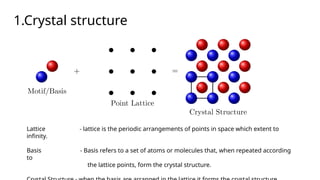
Lattice -lattice is the periodic arrangements of points in space which extent to
infinity.
Basis - Basis refers to a set of atoms or molecules that, when repeated according
to
the lattice points, form the crystal structure.
5.
2.Bravis lattices
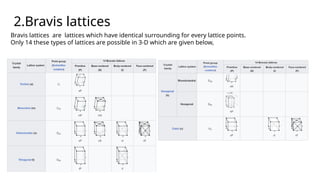
Bravis latticesare lattices which have identical surrounding for every lattice points.
Only 14 these types of lattices are possible in 3-D which are given below,
6.
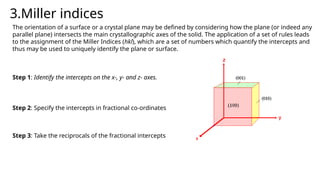
3.Miller indices
The orientationof a surface or a crystal plane may be defined by considering how the plane (or indeed any
parallel plane) intersects the main crystallographic axes of the solid. The application of a set of rules leads
to the assignment of the Miller Indices (hkl), which are a set of numbers which quantify the intercepts and
thus may be used to uniquely identify the plane or surface.
Step 1: Identify the intercepts on the x-, y- and z- axes.
Step 2: Specify the intercepts in fractional co-ordinates
Step 3: Take the reciprocals of the fractional intercepts
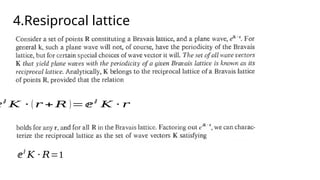
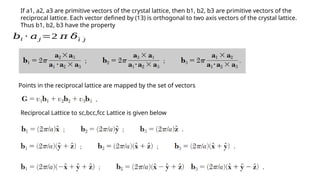
If a1, a2,a3 are primitive vectors of the crystal lattice, then b1, b2, b3 are primitive vectors of the
reciprocal lattice. Each vector defined by (13) is orthogonal to two axis vectors of the crystal lattice.
Thus b1, b2, b3 have the property
𝑏𝑖 ⋅ 𝑎𝑗 =2 𝜋 𝛿¨
𝑖 ˙
𝑗
Points in the reciprocal lattice are mapped by the set of vectors
Reciprocal Lattice to sc,bcc,fcc Lattice is given below
Free Electron Model
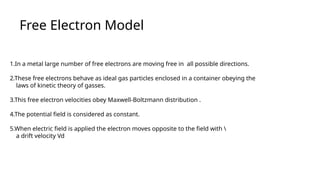
1.Ina metal large number of free electrons are moving free in all possible directions.
2.These free electrons behave as ideal gas particles enclosed in a container obeying the
laws of kinetic theory of gasses.
3.This free electron velocities obey Maxwell-Boltzmann distribution .
4.The potential field is considered as constant.
5.When electric field is applied the electron moves opposite to the field with
a drift velocity Vd
11.
2.Drude theory.
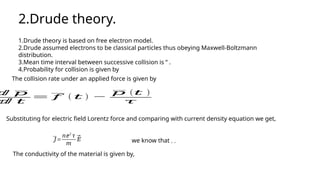
1.Drude theoryis based on free electron model.
2.Drude assumed electrons to be classical particles thus obeying Maxwell-Boltzmann
distribution.
3.Mean time interval between successive collision is ‘‘ .
4.Probability for collision is given by
The collision rate under an applied force is given by
ⅆ 𝑝
ⅆ 𝑡
= 𝑓 ( 𝑡 ) −
𝑝 (𝑡 )
𝜏
Substituting for electric field Lorentz force and comparing with current density equation we get,
𝐽=
𝑛ⅇ2
𝜏
𝑚
⃗
𝐸 we know that , ,
The conductivity of the material is given by,
12.
3.Summerfiel theory.
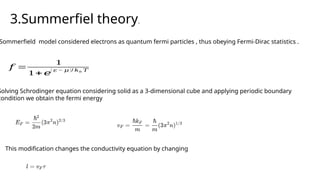
Sommerfield modelconsidered electrons as quantum fermi particles , thus obeying Fermi-Dirac statistics .
𝑓 =
1
1+ 𝑒
( 𝜀 − 𝜇)/ 𝑘𝑏 𝑇
Solving Schrodinger equation considering solid as a 3-dimensional cube and applying periodic boundary
condition we obtain the fermi energy
This modification changes the conductivity equation by changing
13.
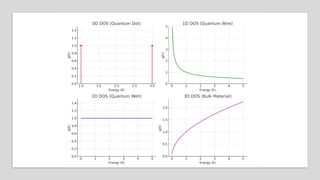
Density of States
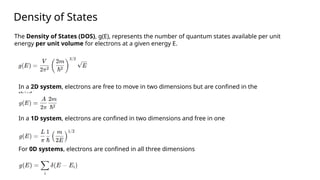
TheDensity of States (DOS), g(E), represents the number of quantum states available per unit
energy per unit volume for electrons at a given energy E.
In a 2D system, electrons are free to move in two dimensions but are confined in the
third.
In a 1D system, electrons are confined in two dimensions and free in one
For 0D systems, electrons are confined in all three dimensions
15.
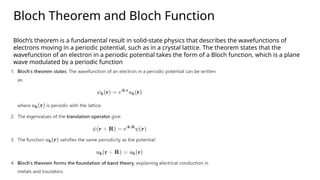
Bloch Theorem andBloch Function
Bloch’s theorem is a fundamental result in solid-state physics that describes the wavefunctions of
electrons moving in a periodic potential, such as in a crystal lattice. The theorem states that the
wavefunction of an electron in a periodic potential takes the form of a Bloch function, which is a plane
wave modulated by a periodic function
16.
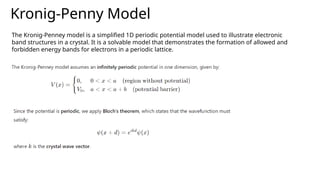
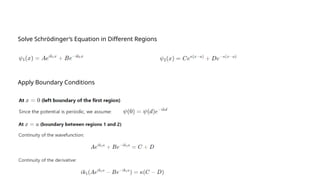
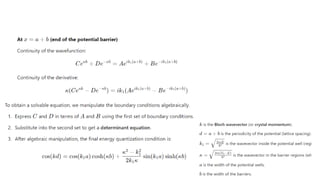
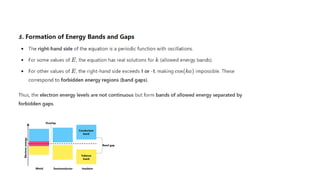
Kronig-Penny Model
The Kronig-Penneymodel is a simplified 1D periodic potential model used to illustrate electronic
band structures in a crystal. It is a solvable model that demonstrates the formation of allowed and
forbidden energy bands for electrons in a periodic lattice.
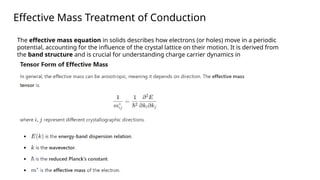
Effective Mass Treatmentof Conduction
The effective mass equation in solids describes how electrons (or holes) move in a periodic
potential, accounting for the influence of the crystal lattice on their motion. It is derived from
the band structure and is crucial for understanding charge carrier dynamics in
semiconductors.
21.
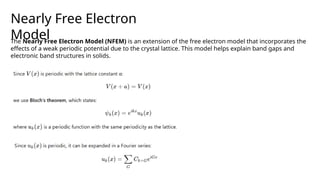
Nearly Free Electron
Model
TheNearly Free Electron Model (NFEM) is an extension of the free electron model that incorporates the
effects of a weak periodic potential due to the crystal lattice. This model helps explain band gaps and
electronic band structures in solids.
22.
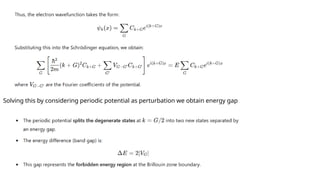
Solving this byconsidering periodic potential as perturbation we obtain energy gap
23.
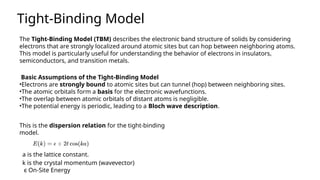
The Tight-Binding Model(TBM) describes the electronic band structure of solids by considering
electrons that are strongly localized around atomic sites but can hop between neighboring atoms.
This model is particularly useful for understanding the behavior of electrons in insulators,
semiconductors, and transition metals.
Tight-Binding Model
Basic Assumptions of the Tight-Binding Model
•Electrons are strongly bound to atomic sites but can tunnel (hop) between neighboring sites.
•The atomic orbitals form a basis for the electronic wavefunctions.
•The overlap between atomic orbitals of distant atoms is negligible.
•The potential energy is periodic, leading to a Bloch wave description.
This is the dispersion relation for the tight-binding
model.
k is the crystal momentum (wavevector)
a is the lattice constant.
ϵ On-Site Energy
24.
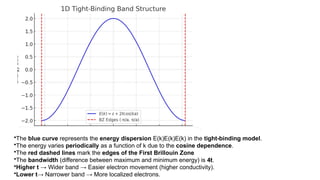
•The blue curverepresents the energy dispersion E(k)E(k)E(k) in the tight-binding model.
•The energy varies periodically as a function of k due to the cosine dependence.
•The red dashed lines mark the edges of the First Brillouin Zone
•The bandwidth (difference between maximum and minimum energy) is 4t.
•Higher t → Wider band → Easier electron movement (higher conductivity).
•Lower t→ Narrower band → More localized electrons.
25.
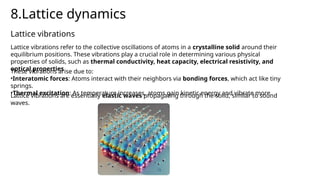
8.Lattice dynamics
Lattice vibrationsrefer to the collective oscillations of atoms in a crystalline solid around their
equilibrium positions. These vibrations play a crucial role in determining various physical
properties of solids, such as thermal conductivity, heat capacity, electrical resistivity, and
optical properties
Lattice vibrations
These vibrations arise due to:
•Interatomic forces: Atoms interact with their neighbors via bonding forces, which act like tiny
springs.
•Thermal excitation: As temperature increases, atoms gain kinetic energy and vibrate more
Lattice vibrations are essentially elastic waves propagating through the solid, similar to sound
waves.
26.
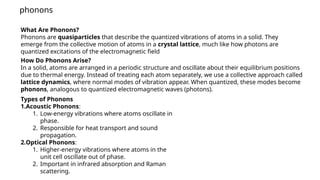
phonons
What Are Phonons?
Phononsare quasiparticles that describe the quantized vibrations of atoms in a solid. They
emerge from the collective motion of atoms in a crystal lattice, much like how photons are
quantized excitations of the electromagnetic field
How Do Phonons Arise?
In a solid, atoms are arranged in a periodic structure and oscillate about their equilibrium positions
due to thermal energy. Instead of treating each atom separately, we use a collective approach called
lattice dynamics, where normal modes of vibration appear. When quantized, these modes become
phonons, analogous to quantized electromagnetic waves (photons).
Types of Phonons
1.Acoustic Phonons:
1. Low-energy vibrations where atoms oscillate in
phase.
2. Responsible for heat transport and sound
propagation.
2.Optical Phonons:
1. Higher-energy vibrations where atoms in the
unit cell oscillate out of phase.
2. Important in infrared absorption and Raman
scattering.
27.
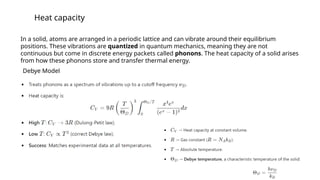
In a solid,atoms are arranged in a periodic lattice and can vibrate around their equilibrium
positions. These vibrations are quantized in quantum mechanics, meaning they are not
continuous but come in discrete energy packets called phonons. The heat capacity of a solid arises
from how these phonons store and transfer thermal energy.
Heat capacity
Debye Model
28.
Advanced concepts
1.Fermi LiquidTheory
2.Two-Fluid Model of Superconductivity
3.BCS Theory of Superconductivity
4.Josephson Effect
5.Magnetic property of solids
6.Optical property of solids
7.nanostructure
29.
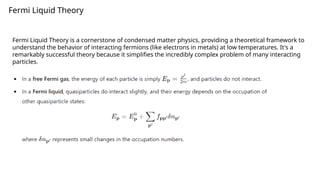
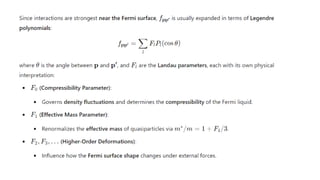
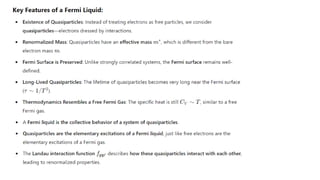
Fermi Liquid Theory
FermiLiquid Theory is a cornerstone of condensed matter physics, providing a theoretical framework to
understand the behavior of interacting fermions (like electrons in metals) at low temperatures. It's a
remarkably successful theory because it simplifies the incredibly complex problem of many interacting
particles.
32.
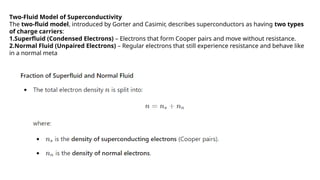
Two-Fluid Model ofSuperconductivity
The two-fluid model, introduced by Gorter and Casimir, describes superconductors as having two types
of charge carriers:
1.Superfluid (Condensed Electrons) – Electrons that form Cooper pairs and move without resistance.
2.Normal Fluid (Unpaired Electrons) – Regular electrons that still experience resistance and behave like
in a normal meta
33.
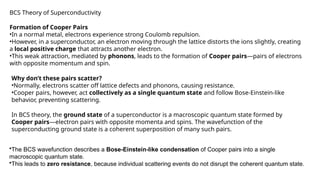
BCS Theory ofSuperconductivity
Formation of Cooper Pairs
•In a normal metal, electrons experience strong Coulomb repulsion.
•However, in a superconductor, an electron moving through the lattice distorts the ions slightly, creating
a local positive charge that attracts another electron.
•This weak attraction, mediated by phonons, leads to the formation of Cooper pairs—pairs of electrons
with opposite momentum and spin.
Why don’t these pairs scatter?
•Normally, electrons scatter off lattice defects and phonons, causing resistance.
•Cooper pairs, however, act collectively as a single quantum state and follow Bose-Einstein-like
behavior, preventing scattering.
In BCS theory, the ground state of a superconductor is a macroscopic quantum state formed by
Cooper pairs—electron pairs with opposite momenta and spins. The wavefunction of the
superconducting ground state is a coherent superposition of many such pairs.
•The BCS wavefunction describes a Bose-Einstein-like condensation of Cooper pairs into a single
macroscopic quantum state.
•This leads to zero resistance, because individual scattering events do not disrupt the coherent quantum state.
34.
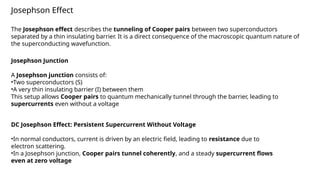
Josephson Effect
The Josephsoneffect describes the tunneling of Cooper pairs between two superconductors
separated by a thin insulating barrier. It is a direct consequence of the macroscopic quantum nature of
the superconducting wavefunction.
Josephson Junction
A Josephson junction consists of:
•Two superconductors (S)
•A very thin insulating barrier (I) between them
This setup allows Cooper pairs to quantum mechanically tunnel through the barrier, leading to
supercurrents even without a voltage
DC Josephson Effect: Persistent Supercurrent Without Voltage
•In normal conductors, current is driven by an electric field, leading to resistance due to
electron scattering.
•In a Josephson junction, Cooper pairs tunnel coherently, and a steady supercurrent flows
even at zero voltage
37.
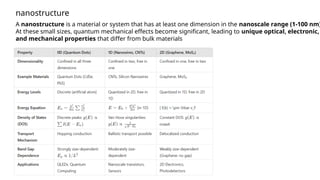
A nanostructure isa material or system that has at least one dimension in the nanoscale range (1-100 nm)
At these small sizes, quantum mechanical effects become significant, leading to unique optical, electronic,
and mechanical properties that differ from bulk materials
nanostructure
#1 AI-generated content may be incorrect.
---
This presentation will explore the foundational principles and advanced theories within solid state physics. We'll cover everything from lattice structures to complex electronic properties, lattice dynamics, and specialized topics such as superconductivity and nanostructures.
#2 We will begin by discussing the fundamentals of solid state physics, including lattice structures and crystal arrangements. Following that, we will delve into the electronic properties of solids, covering various theories and models. Next, we'll explore lattice dynamics, and finally conclude with special topics that address modern issues in solid state physics.
#9 The electronic properties of solids determine how they conduct electricity and interact with electromagnetic fields. This section will cover various theories and models that explain these properties.
#10 The free electron model simplifies the behavior of electrons in metals, leading to Drude's classical approach and Sommerfeld's quantum modifications, which successfully explain electrical conductivity.
#15 Bloch's theorem describes the wavefunctions of electrons in a periodic potential, leading to the concept of Bloch functions that characterize electron behavior in crystals.
#16 The Kronig-Penny model simplifies the study of energy bands in solids by using a periodic potential, providing insights into the formation of allowed and forbidden energy states.
#20 The concept of effective mass simplifies the treatment of conduction electrons in a crystal by accounting for the influence of the periodic potential on their motion.