COLUMBIA UNIVERSITY DEPT. OF UROLOGY
PEDIATRIC UROLOGY GRAND ROUNDS
Cryptorchidism:
Evaluation, consequences and
contemporary management
Overview
• Case
• Background and History
• Testicular development
and pathophysiology
• Evaluation and Diagnosis
• Associated pathology
• Management
• Conclusions
Overview
• Case
• Background and History
• Testicular development
and pathophysiology
• Evaluation and Diagnosis
• Associated pathology
• Management
• Conclusions
Case Presentation
• CC: Undescended testicle
• HPI: 3 month old otherwise healthy boy referred
from PCP with left undescended testicle since
birth.
Case Presentation
• Prenatal Hx: normal antenatal imaging; normal
AFI, full term, NSVD
• PMH: None
• PSH: None
• Meds: None
• All: NKDA
• SH: lives with mom and dad in WaHi
• FH: No GU hx
Physical Exam
• Vitals: 98.7 F, HR 101, BP 95/60, 99% on RA
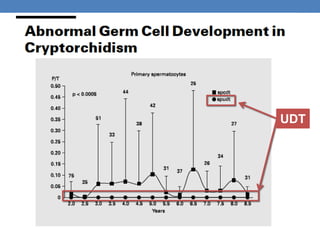
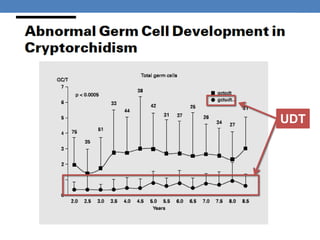
• Gen: NAD, well appearing baby boy
• Lungs: breathing comfortably on RA
• Abd: soft, nt/nd
• Back: no sacral dimple
• GU: circumcised phallus, R testicle descended
and palpable, L testicle non-palpable, scrotum
rugated and normal appearing
Case: Assessment
3 month old otherwise healthy boy with left non-
palpable testicle since birth.
How would you proceed?
Where’s the testicle?
Why should we care?
What do we do about it?
Overview
• Case
• Background and History
• Testicular development and
pathophysiology
• Evaluation and Diagnosis
• Associated pathology
• Management
• Conclusions
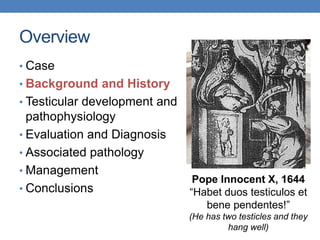
Pope Innocent X, 1644
“Habet duos testiculos et
bene pendentes!”
(He has two testicles and they
hang well)
Cryptorchidism
• “Hidden testis”
• One or both testicles are
not appropriately positioned
in the scrotum at birth
• Most common GU
congenital abnormality
Definitions
• Cryptorchidism – a testis that is not within the scrotum and
does not descend spontaneously by 4 mo
o Undescended testis (UDT) – stopped short on normal path
o Ectopic testis – descend normally through the external ring
but then are diverted to an aberrant position
o Absent testis – no testis due to agenesis or atrophy (Boys
who have bilaterally absent testes have anorchia)
o Retractile testis – normal testis that has been pulled into a
suprascrotal position by the cremasteric reflex
o Ascending testis – noted to be in a scrotal position in
childhood and then to become undescended
Surgical History of Undescended Testes
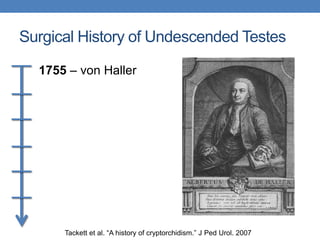
1755 – von Haller
Tackett et al. “A history of cryptorchidism.” J Ped Urol. 2007
Surgical History of Undescended Testes
1755 – von Haller
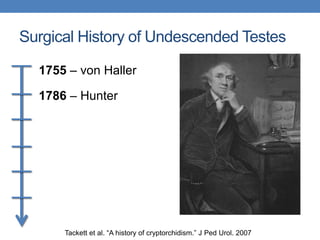
1786 – Hunter
Tackett et al. “A history of cryptorchidism.” J Ped Urol. 2007
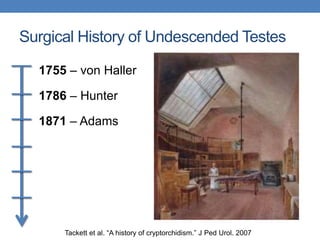
Surgical History of Undescended Testes
1755 – von Haller
1786 – Hunter
1871 – Adams
Tackett et al. “A history of cryptorchidism.” J Ped Urol. 2007
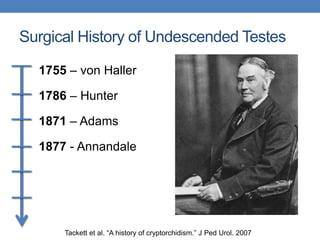
Surgical History of Undescended Testes
1755 – von Haller
1786 – Hunter
1871 – Adams
1877 - Annandale
Tackett et al. “A history of cryptorchidism.” J Ped Urol. 2007
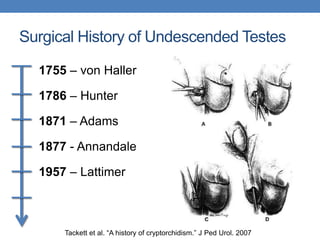
Surgical History of Undescended Testes
1755 – von Haller
1786 – Hunter
1871 – Adams
1877 - Annandale
1957 – Lattimer
Tackett et al. “A history of cryptorchidism.” J Ped Urol. 2007
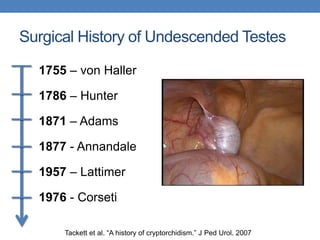
Surgical History of Undescended Testes
1755 – von Haller
1786 – Hunter
1871 – Adams
1877 - Annandale
1957 – Lattimer
1976 - Corseti
Tackett et al. “A history of cryptorchidism.” J Ped Urol. 2007
Overview
• Case
• Background and History
• Testicular development
and pathophysiology
• Evaluation and Diagnosis
• Associated pathology
• Management
• Conclusions
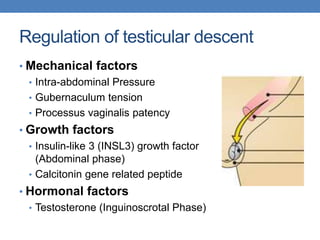
Regulation of testicular descent
• Mechanical factors
• Intra-abdominal Pressure
• Gubernaculum tension
• Processus vaginalis patency
• Growth factors
• Insulin-like 3 (INSL3) growth factor
(Abdominal phase)
• Calcitonin gene related peptide
• Hormonal factors
• Testosterone (Inguinoscrotal Phase)
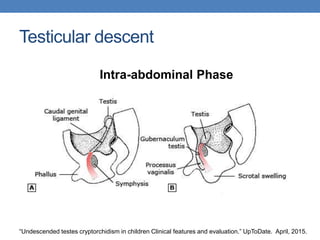
Testicular descent
Intra-abdominal Phase
“Undescended testes cryptorchidism in children Clinical features and evaluation.” UpToDate. April, 2015.
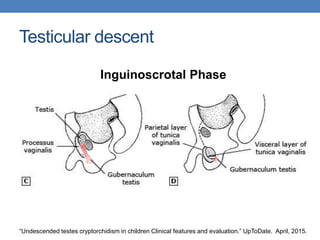
Testicular descent
Inguinoscrotal Phase
“Undescended testes cryptorchidism in children Clinical features and evaluation.” UpToDate. April, 2015.
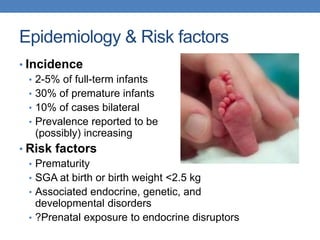
Epidemiology & Risk factors
• Incidence
• 2-5% of full-term infants
• 30% of premature infants
• 10% of cases bilateral
• Prevalence reported to be
(possibly) increasing
• Risk factors
• Prematurity
• SGA at birth or birth weight <2.5 kg
• Associated endocrine, genetic, and
developmental disorders
• ?Prenatal exposure to endocrine disruptors
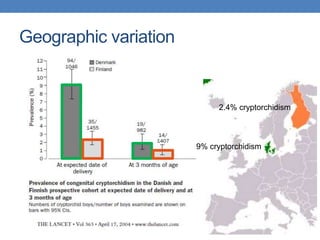
Geographic variation
9% cryptorchidism
2.4% cryptorchidism
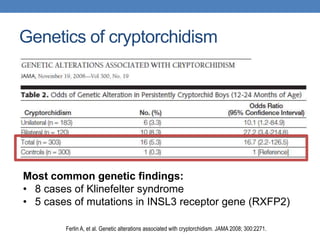
Genetics of cryptorchidism
Most common genetic findings:
• 8 cases of Klinefelter syndrome
• 5 cases of mutations in INSL3 receptor gene (RXFP2)
Ferlin A, et al. Genetic alterations associated with cryptorchidism. JAMA 2008; 300:2271.
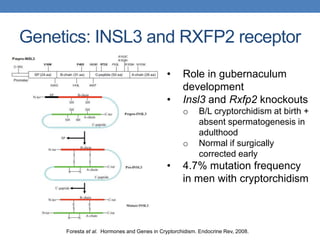
Genetics: INSL3 and RXFP2 receptor
• Role in gubernaculum
development
• Insl3 and Rxfp2 knockouts
o B/L cryptorchidism at birth +
absent spermatogenesis in
adulthood
o Normal if surgically
corrected early
• 4.7% mutation frequency
in men with cryptorchidism
Foresta et al. Hormones and Genes in Cryptorchidism. Endocrine Rev, 2008.
Associated conditions
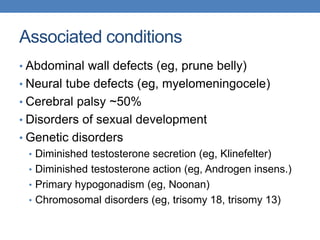
• Abdominal wall defects (eg, prune belly)
• Neural tube defects (eg, myelomeningocele)
• Cerebral palsy ~50%
• Disorders of sexual development
• Genetic disorders
• Diminished testosterone secretion (eg, Klinefelter)
• Diminished testosterone action (eg, Androgen insens.)
• Primary hypogonadism (eg, Noonan)
• Chromosomal disorders (eg, trisomy 18, trisomy 13)
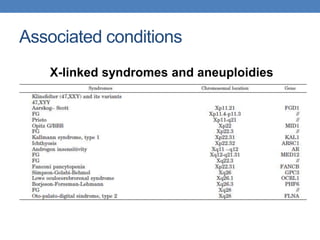
Associated conditions
X-linked syndromes and aneuploidies
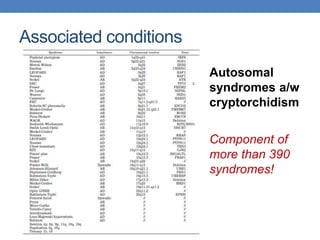
Associated conditions
Autosomal
syndromes a/w
cryptorchidism
Component of
more than 390
syndromes!
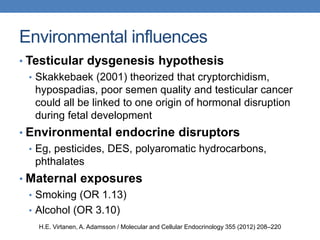
Environmental influences
• Testicular dysgenesis hypothesis
• Skakkebaek (2001) theorized that cryptorchidism,
hypospadias, poor semen quality and testicular cancer
could all be linked to one origin of hormonal disruption
during fetal development
• Environmental endocrine disruptors
• Eg, pesticides, DES, polyaromatic hydrocarbons,
phthalates
• Maternal exposures
• Smoking (OR 1.13)
• Alcohol (OR 3.10)
H.E. Virtanen, A. Adamsson / Molecular and Cellular Endocrinology 355 (2012) 208–220
Overview
• Case
• Background and History
• Testicular development and
pathophysiology
• Evaluation and Diagnosis
• Associated pathology
• Management
• Conclusions
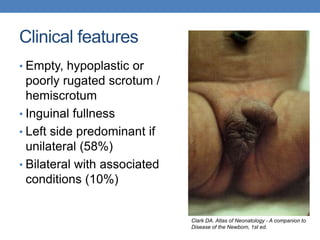
Clinical features
• Empty, hypoplastic or
poorly rugated scrotum /
hemiscrotum
• Inguinal fullness
• Left side predominant if
unilateral (58%)
• Bilateral with associated
conditions (10%)
Clark DA. Atlas of Neonatology - A companion to
Disease of the Newborn, 1st ed.
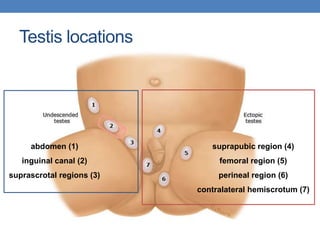
Testis locations
abdomen (1)
inguinal canal (2)
suprascrotal regions (3)
suprapubic region (4)
femoral region (5)
perineal region (6)
contralateral hemiscrotum (7)
Examination
• PCP should palpate testes for quality and
position at each recommended well-child visit
(AUA standard; Grade B)
• Full GU exam of phallus, meatus,
scrotum, and inguinal canals for hernias
• Maneuvers for retractile testis
• “Criss-cross apple-sauce”
• Warm compress
• Valsalva
• Cremasteric fatigue
Imaging
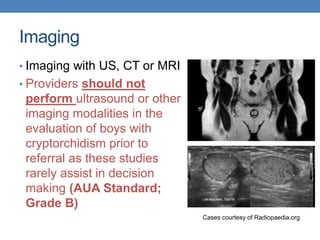
• Imaging with US, CT or MRI
• Providers should not
perform ultrasound or other
imaging modalities in the
evaluation of boys with
cryptorchidism prior to
referral as these studies
rarely assist in decision
making (AUA Standard;
Grade B)
Cases courtesy of Radiopaedia.org
• Meta-analysis
• 18 studies addressing the performance of imaging in
identifying and localizing nonpalpable UDT
• Mostly poor-quality studies
• Using surgery as the reference standard, the
sensitivity, specificity, and overall accuracy rates
at identifying testes were determined
• Penson DF, Krishnaswami S, Jules A, et al. AHRQ Comparative Effectiveness Review No. 88. December 2012
• Available at www.effectivehealthcare.ahrq.gov/undescended-testicle.cfm.
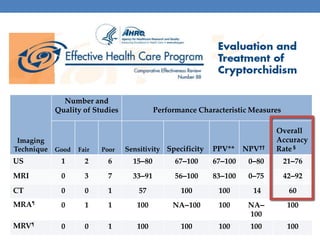
Imaging
Technique
Number and
Quality of Studies Performance Characteristic Measures
Good Fair Poor Sensitivity Specificity PPV** NPV††
Overall
Accuracy
Rate§
US 1 2 6 15–80 67–100 67–100 0–80 21–76
MRI 0 3 7 33–91 56–100 83–100 0–75 42–92
CT 0 0 1 57 100 100 14 60
MRA¶
0 1 1 100 NA–100 100 NA–
100
100
MRV¶
0 0 1 100 100 100 100 100
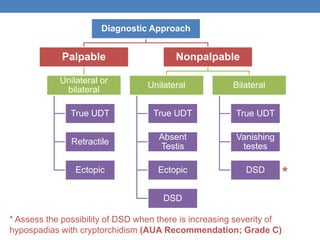
Diagnostic Approach
Palpable
Unilateral or
bilateral
True UDT
Retractile
Ectopic
Nonpalpable
Unilateral
True UDT
Absent
Testis
Ectopic
DSD
Bilateral
True UDT
Vanishing
testes
DSD
* Assess the possibility of DSD when there is increasing severity of
hypospadias with cryptorchidism (AUA Recommendation; Grade C)
*
Overview
• Case
• Background and History
• Testicular development
and pathophysiology
• Evaluation and Diagnosis
• Associated pathology
• Management
• Conclusions
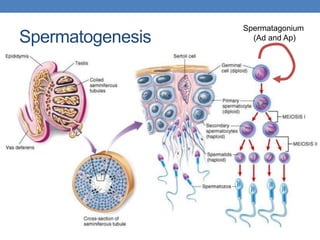
Spermatogenesis
Spermatagonium
(Ad and Ap)
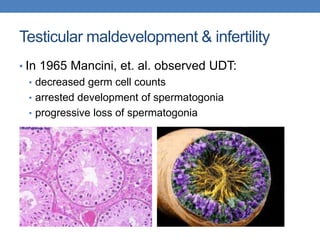
Testicular maldevelopment & infertility
• In 1965 Mancini, et. al. observed UDT:
• decreased germ cell counts
• arrested development of spermatogonia
• progressive loss of spermatogonia
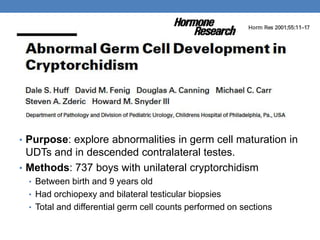
• Purpose: explore abnormalities in germ cell maturation in
UDTs and in descended contralateral testes.
• Methods: 737 boys with unilateral cryptorchidism
• Between birth and 9 years old
• Had orchiopexy and bilateral testicular biopsies
• Total and differential germ cell counts performed on sections
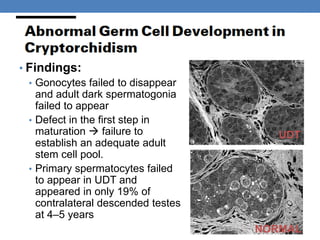
• Findings:
• Gonocytes failed to disappear
and adult dark spermatogonia
failed to appear
• Defect in the first step in
maturation  failure to
establish an adequate adult
stem cell pool.
• Primary spermatocytes failed
to appear in UDT and
appeared in only 19% of
contralateral descended testes
at 4–5 years
NORMAL
UDT
UDT
UDT
Impact on fertility
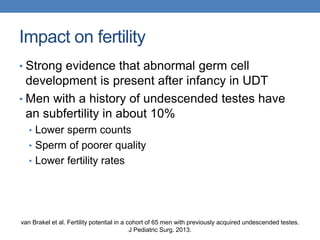
• Strong evidence that abnormal germ cell
development is present after infancy in UDT
• Men with a history of undescended testes have
an subfertility in about 10%
• Lower sperm counts
• Sperm of poorer quality
• Lower fertility rates
van Brakel et al. Fertility potential in a cohort of 65 men with previously acquired undescended testes.
J Pediatric Surg. 2013.
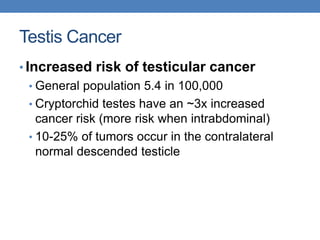
Testis Cancer
• Increased risk of testicular cancer
• General population 5.4 in 100,000
• Cryptorchid testes have an ~3x increased
cancer risk (more risk when intrabdominal)
• 10-25% of tumors occur in the contralateral
normal descended testicle
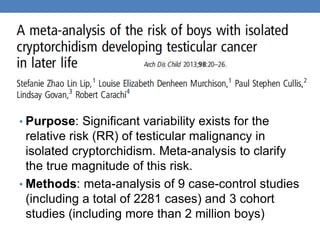
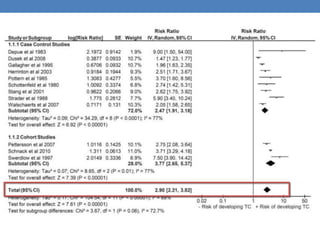
• Purpose: Significant variability exists for the
relative risk (RR) of testicular malignancy in
isolated cryptorchidism. Meta-analysis to clarify
the true magnitude of this risk.
• Methods: meta-analysis of 9 case-control studies
(including a total of 2281 cases) and 3 cohort
studies (including more than 2 million boys)
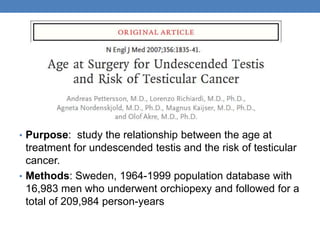
• Purpose: study the relationship between the age at
treatment for undescended testis and the risk of testicular
cancer.
• Methods: Sweden, 1964-1999 population database with
16,983 men who underwent orchiopexy and followed for a
total of 209,984 person-years
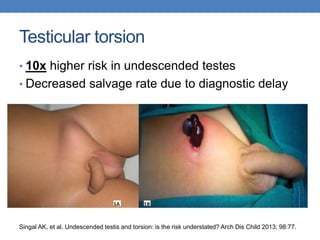
Testicular torsion
• 10x higher risk in undescended testes
• Decreased salvage rate due to diagnostic delay
Singal AK, et al. Undescended testis and torsion: is the risk understated? Arch Dis Child 2013; 98:77.
Overview
• Case
• Background and History
• Testicular development
and pathophysiology
• Evaluation and Diagnosis
• Associated pathology
• Management
• Conclusions
Treatment strategies
• Observation
• Medical hormonal therapy
• Surgery
• Exploratory laparoscopy
• Primary orchiopexy
• Single stage Fowler-Stephens orchiopexy
• Two stage Fowler-Stephens orchiopexy
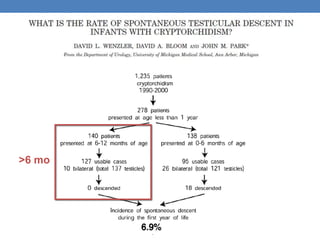
Observation
• Variable rates of spontaneous descent
• 7-88% reported in literature
• Testes complete descent within 3-4 months old
and spontaneous descent is rare after six months
of age
>6 mo
Medical Hormonal Therapy
• Rational
• Administration of gonadotropins (either hCG or LHRH)
may stimulate testicular descent
• Evidence
• Highly variable success rates reported from 0% to 75%
• Confounding variables in available studies including:
• inclusion/exclusion of retractile testes
• variable age/duration of treatment
• different dosing and regimens
• small cohorts
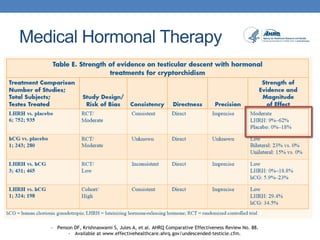
Medical Hormonal Therapy
• Penson DF, Krishnaswami S, Jules A, et al. AHRQ Comparative Effectiveness Review No. 88.
• Available at www.effectivehealthcare.ahrq.gov/undescended-testicle.cfm.
Medical Hormonal Therapy
• AHRQ Evidence Review
• hCG vs. placebo (AHRQ Evidence Rating: Low)
• LHRH vs. placebo (AHRQ Evidence Rating: Moderate)
• hCG vs. LHRH (AHRQ Evidence Rating: Low)
• “Providers should not use hormonal therapy to induce
testicular descent as evidence shows low response rates
and lack of evidence for long-term efficacy.” (AUA
Standard; Grade B)
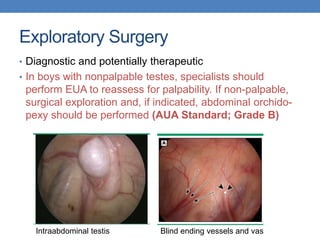
Exploratory Surgery
• Diagnostic and potentially therapeutic
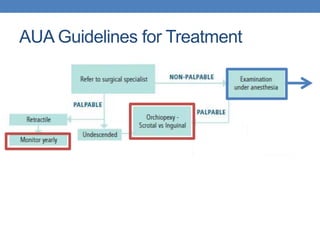
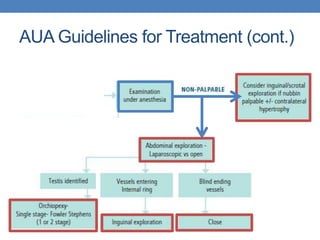
• In boys with nonpalpable testes, specialists should
perform EUA to reassess for palpability. If non-palpable,
surgical exploration and, if indicated, abdominal orchido-
pexy should be performed (AUA Standard; Grade B)
Blind ending vessels and vasIntraabdominal testis
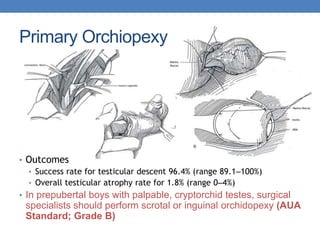
Primary Orchiopexy
• Outcomes
• Success rate for testicular descent 96.4% (range 89.1–100%)
• Overall testicular atrophy rate for 1.8% (range 0–4%)
• In prepubertal boys with palpable, cryptorchid testes, surgical
specialists should perform scrotal or inguinal orchidopexy (AUA
Standard; Grade B)
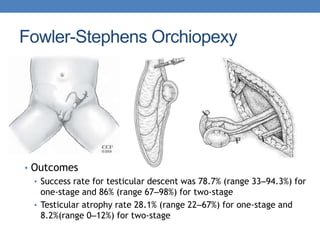
Fowler-Stephens Orchiopexy
• Outcomes
• Success rate for testicular descent was 78.7% (range 33–94.3%) for
one-stage and 86% (range 67–98%) for two-stage
• Testicular atrophy rate 28.1% (range 22–67%) for one-stage and
8.2%(range 0–12%) for two-stage
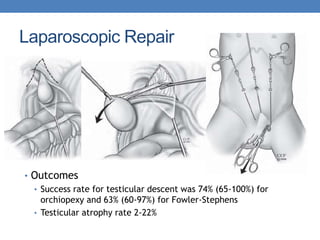
Laparoscopic Repair
• Outcomes
• Success rate for testicular descent was 74% (65-100%) for
orchiopexy and 63% (60-97%) for Fowler-Stephens
• Testicular atrophy rate 2-22%
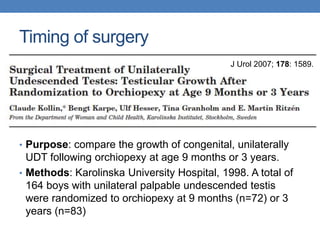
Timing of surgery
• Purpose: compare the growth of congenital, unilaterally
UDT following orchiopexy at age 9 months or 3 years.
• Methods: Karolinska University Hospital, 1998. A total of
164 boys with unilateral palpable undescended testis
were randomized to orchiopexy at 9 months (n=72) or 3
years (n=83)
J Urol 2007; 178: 1589.
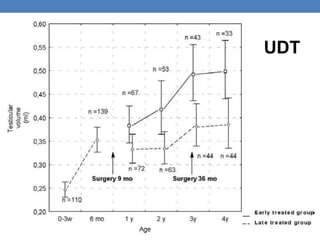
UDT
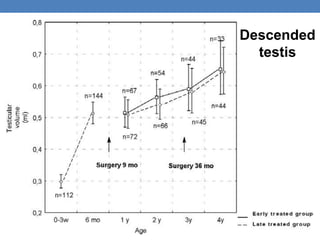
Descended
testis
Timing of surgery
• The growth of unilateral undescended testes may
be impaired compared with the normally
descended contralateral testes
• Treatment before one year of age may be
associated with partial catch-up growth
• In the absence of spontaneous testicular descent
by six months (corrected for gestational age),
specialists should perform surgery within the next
year (AUA Standard; Grade B)
AUA Guidelines for Treatment
AUA Guidelines for Treatment (cont.)
Overview
• Case
• Background and History
• Testicular development
and pathophysiology
• Evaluation and Diagnosis
• Associated pathology
• Management
• Conclusions
Future Directions
• Genetic and environmental factors that
contribute to cryptorchidism
• Define role of cross sectional imaging with CT,
MRV, or MRA in locating undescended testes
• Long term outcome data on fertility
• Comparative effectiveness of surgical
interventions based on location of testes
• One vs. two stage Fowler Stephens
• Open vs. Laparoscopic orchiopexy
Conclusions
• Cryptorchidism is extremely common
• Imaging for cryptorchidism is not recommended prior to
referral, which should occur by 6 months of age.
• Orchiopexy is the most successful therapy to relocate the
testis into the scrotum, while hormonal therapy is not
recommended.
• Successful scrotal repositioning of the testis may reduce
but does not prevent the potential long-term issues of
infertility and testis cancer.
• Appropriate counseling and follow-up of the patient is
essential.
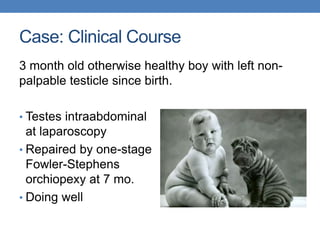
Case: Clinical Course
3 month old otherwise healthy boy with left non-
palpable testicle since birth.
• Testes intraabdominal
at laparoscopy
• Repaired by one-stage
Fowler-Stephens
orchiopexy at 7 mo.
• Doing well
References
• Campbell MF, Wein AJ, Kavoussi LR. Campbell-Walsh Urology. 9th ed. Philadelphia: W.B. Saunders; 2007.
• Cooper, C., et al. (2015, April 17). Undescended testes (cryptorchidism) in Children: Clinical features and
evaluation. Retrieved November 9, 2015, from UpToDate.
• Huff, et al. (2001). Abnormal germ cell development in cryptorchidism. Hormone Research, 55(1), 11–17.
• Janus, et al. (2014). American Urological Association (AUA) Guideline on Cryptorchidism, 1–38.
• Kollin, et al. (2007). Surgical Treatment of Unilaterally Undescended Testes: Testicular Growth After Randomization
to Orchiopexy at Age 9 Months or 3 Years. The Journal of Urology, 178(4), 1589–1593.
http://doi.org/10.1016/j.juro.2007.03.173
• Lip, et al. (2012). A meta-analysis of the risk of boys with isolated cryptorchidism developing testicular cancer in later
life. Archives of Disease in Childhood, 98(1), 20–26. http://doi.org/10.1136/archdischild-2012-302051
• Penson, et al. (2012). Evaluation and Treatment of Cryptorchidism. EHRQ Report.
• Pettersson, et al. (2007). Age at surgery for undescended testis and risk of testicular cancer. The New England
Journal of Medicine, 356(18), 1835–1841. http://doi.org/10.1056/NEJMoa067588
• Singal, et al. (2012). Undescended testis and torsion: is the risk understated? Archives of Disease in Childhood,
98(1), 77–79. http://doi.org/10.1136/archdischild-2012-302373
• Thorup, et al. (2013). The Relation between Adult Dark Spermatogonia andOther Parameters of Fertility Potential in
Cryptorchid Testes. Journal of Urology, 190(S), 1566–1571. http://doi.org/10.1016/j.juro.2013.01.058
• van Brakel, et al. (2014a). Journal of Pediatric Surgery. Journal of Pediatric Surgery, 49(4), 599–605.
http://doi.org/10.1016/j.jpedsurg.2013.09.020

Cryptorchidism (Undescended Testes)

  • 1.
    COLUMBIA UNIVERSITY DEPT.OF UROLOGY PEDIATRIC UROLOGY GRAND ROUNDS Cryptorchidism: Evaluation, consequences and contemporary management
  • 2.
    Overview • Case • Backgroundand History • Testicular development and pathophysiology • Evaluation and Diagnosis • Associated pathology • Management • Conclusions
  • 3.
    Overview • Case • Backgroundand History • Testicular development and pathophysiology • Evaluation and Diagnosis • Associated pathology • Management • Conclusions
  • 4.
    Case Presentation • CC:Undescended testicle • HPI: 3 month old otherwise healthy boy referred from PCP with left undescended testicle since birth.
  • 5.
    Case Presentation • PrenatalHx: normal antenatal imaging; normal AFI, full term, NSVD • PMH: None • PSH: None • Meds: None • All: NKDA • SH: lives with mom and dad in WaHi • FH: No GU hx
  • 6.
    Physical Exam • Vitals:98.7 F, HR 101, BP 95/60, 99% on RA • Gen: NAD, well appearing baby boy • Lungs: breathing comfortably on RA • Abd: soft, nt/nd • Back: no sacral dimple • GU: circumcised phallus, R testicle descended and palpable, L testicle non-palpable, scrotum rugated and normal appearing
  • 7.
    Case: Assessment 3 monthold otherwise healthy boy with left non- palpable testicle since birth. How would you proceed? Where’s the testicle? Why should we care? What do we do about it?
  • 8.
    Overview • Case • Backgroundand History • Testicular development and pathophysiology • Evaluation and Diagnosis • Associated pathology • Management • Conclusions Pope Innocent X, 1644 “Habet duos testiculos et bene pendentes!” (He has two testicles and they hang well)
  • 9.
    Cryptorchidism • “Hidden testis” •One or both testicles are not appropriately positioned in the scrotum at birth • Most common GU congenital abnormality
  • 10.
    Definitions • Cryptorchidism –a testis that is not within the scrotum and does not descend spontaneously by 4 mo o Undescended testis (UDT) – stopped short on normal path o Ectopic testis – descend normally through the external ring but then are diverted to an aberrant position o Absent testis – no testis due to agenesis or atrophy (Boys who have bilaterally absent testes have anorchia) o Retractile testis – normal testis that has been pulled into a suprascrotal position by the cremasteric reflex o Ascending testis – noted to be in a scrotal position in childhood and then to become undescended
  • 11.
    Surgical History ofUndescended Testes 1755 – von Haller Tackett et al. “A history of cryptorchidism.” J Ped Urol. 2007
  • 12.
    Surgical History ofUndescended Testes 1755 – von Haller 1786 – Hunter Tackett et al. “A history of cryptorchidism.” J Ped Urol. 2007
  • 13.
    Surgical History ofUndescended Testes 1755 – von Haller 1786 – Hunter 1871 – Adams Tackett et al. “A history of cryptorchidism.” J Ped Urol. 2007
  • 14.
    Surgical History ofUndescended Testes 1755 – von Haller 1786 – Hunter 1871 – Adams 1877 - Annandale Tackett et al. “A history of cryptorchidism.” J Ped Urol. 2007
  • 15.
    Surgical History ofUndescended Testes 1755 – von Haller 1786 – Hunter 1871 – Adams 1877 - Annandale 1957 – Lattimer Tackett et al. “A history of cryptorchidism.” J Ped Urol. 2007
  • 16.
    Surgical History ofUndescended Testes 1755 – von Haller 1786 – Hunter 1871 – Adams 1877 - Annandale 1957 – Lattimer 1976 - Corseti Tackett et al. “A history of cryptorchidism.” J Ped Urol. 2007
  • 17.
    Overview • Case • Backgroundand History • Testicular development and pathophysiology • Evaluation and Diagnosis • Associated pathology • Management • Conclusions
  • 18.
    Regulation of testiculardescent • Mechanical factors • Intra-abdominal Pressure • Gubernaculum tension • Processus vaginalis patency • Growth factors • Insulin-like 3 (INSL3) growth factor (Abdominal phase) • Calcitonin gene related peptide • Hormonal factors • Testosterone (Inguinoscrotal Phase)
  • 19.
    Testicular descent Intra-abdominal Phase “Undescendedtestes cryptorchidism in children Clinical features and evaluation.” UpToDate. April, 2015.
  • 20.
    Testicular descent Inguinoscrotal Phase “Undescendedtestes cryptorchidism in children Clinical features and evaluation.” UpToDate. April, 2015.
  • 21.
    Epidemiology & Riskfactors • Incidence • 2-5% of full-term infants • 30% of premature infants • 10% of cases bilateral • Prevalence reported to be (possibly) increasing • Risk factors • Prematurity • SGA at birth or birth weight <2.5 kg • Associated endocrine, genetic, and developmental disorders • ?Prenatal exposure to endocrine disruptors
  • 22.
  • 23.
    Genetics of cryptorchidism Mostcommon genetic findings: • 8 cases of Klinefelter syndrome • 5 cases of mutations in INSL3 receptor gene (RXFP2) Ferlin A, et al. Genetic alterations associated with cryptorchidism. JAMA 2008; 300:2271.
  • 24.
    Genetics: INSL3 andRXFP2 receptor • Role in gubernaculum development • Insl3 and Rxfp2 knockouts o B/L cryptorchidism at birth + absent spermatogenesis in adulthood o Normal if surgically corrected early • 4.7% mutation frequency in men with cryptorchidism Foresta et al. Hormones and Genes in Cryptorchidism. Endocrine Rev, 2008.
  • 25.
    Associated conditions • Abdominalwall defects (eg, prune belly) • Neural tube defects (eg, myelomeningocele) • Cerebral palsy ~50% • Disorders of sexual development • Genetic disorders • Diminished testosterone secretion (eg, Klinefelter) • Diminished testosterone action (eg, Androgen insens.) • Primary hypogonadism (eg, Noonan) • Chromosomal disorders (eg, trisomy 18, trisomy 13)
  • 26.
  • 27.
  • 28.
    Environmental influences • Testiculardysgenesis hypothesis • Skakkebaek (2001) theorized that cryptorchidism, hypospadias, poor semen quality and testicular cancer could all be linked to one origin of hormonal disruption during fetal development • Environmental endocrine disruptors • Eg, pesticides, DES, polyaromatic hydrocarbons, phthalates • Maternal exposures • Smoking (OR 1.13) • Alcohol (OR 3.10) H.E. Virtanen, A. Adamsson / Molecular and Cellular Endocrinology 355 (2012) 208–220
  • 29.
    Overview • Case • Backgroundand History • Testicular development and pathophysiology • Evaluation and Diagnosis • Associated pathology • Management • Conclusions
  • 30.
    Clinical features • Empty,hypoplastic or poorly rugated scrotum / hemiscrotum • Inguinal fullness • Left side predominant if unilateral (58%) • Bilateral with associated conditions (10%) Clark DA. Atlas of Neonatology - A companion to Disease of the Newborn, 1st ed.
  • 31.
    Testis locations abdomen (1) inguinalcanal (2) suprascrotal regions (3) suprapubic region (4) femoral region (5) perineal region (6) contralateral hemiscrotum (7)
  • 32.
    Examination • PCP shouldpalpate testes for quality and position at each recommended well-child visit (AUA standard; Grade B) • Full GU exam of phallus, meatus, scrotum, and inguinal canals for hernias • Maneuvers for retractile testis • “Criss-cross apple-sauce” • Warm compress • Valsalva • Cremasteric fatigue
  • 33.
    Imaging • Imaging withUS, CT or MRI • Providers should not perform ultrasound or other imaging modalities in the evaluation of boys with cryptorchidism prior to referral as these studies rarely assist in decision making (AUA Standard; Grade B) Cases courtesy of Radiopaedia.org
  • 34.
    • Meta-analysis • 18studies addressing the performance of imaging in identifying and localizing nonpalpable UDT • Mostly poor-quality studies • Using surgery as the reference standard, the sensitivity, specificity, and overall accuracy rates at identifying testes were determined • Penson DF, Krishnaswami S, Jules A, et al. AHRQ Comparative Effectiveness Review No. 88. December 2012 • Available at www.effectivehealthcare.ahrq.gov/undescended-testicle.cfm.
  • 35.
    Imaging Technique Number and Quality ofStudies Performance Characteristic Measures Good Fair Poor Sensitivity Specificity PPV** NPV†† Overall Accuracy Rate§ US 1 2 6 15–80 67–100 67–100 0–80 21–76 MRI 0 3 7 33–91 56–100 83–100 0–75 42–92 CT 0 0 1 57 100 100 14 60 MRA¶ 0 1 1 100 NA–100 100 NA– 100 100 MRV¶ 0 0 1 100 100 100 100 100
  • 36.
    Diagnostic Approach Palpable Unilateral or bilateral TrueUDT Retractile Ectopic Nonpalpable Unilateral True UDT Absent Testis Ectopic DSD Bilateral True UDT Vanishing testes DSD * Assess the possibility of DSD when there is increasing severity of hypospadias with cryptorchidism (AUA Recommendation; Grade C) *
  • 37.
    Overview • Case • Backgroundand History • Testicular development and pathophysiology • Evaluation and Diagnosis • Associated pathology • Management • Conclusions
  • 38.
  • 39.
    Testicular maldevelopment &infertility • In 1965 Mancini, et. al. observed UDT: • decreased germ cell counts • arrested development of spermatogonia • progressive loss of spermatogonia
  • 40.
    • Purpose: exploreabnormalities in germ cell maturation in UDTs and in descended contralateral testes. • Methods: 737 boys with unilateral cryptorchidism • Between birth and 9 years old • Had orchiopexy and bilateral testicular biopsies • Total and differential germ cell counts performed on sections
  • 41.
    • Findings: • Gonocytesfailed to disappear and adult dark spermatogonia failed to appear • Defect in the first step in maturation  failure to establish an adequate adult stem cell pool. • Primary spermatocytes failed to appear in UDT and appeared in only 19% of contralateral descended testes at 4–5 years NORMAL UDT
  • 42.
  • 43.
  • 44.
    Impact on fertility •Strong evidence that abnormal germ cell development is present after infancy in UDT • Men with a history of undescended testes have an subfertility in about 10% • Lower sperm counts • Sperm of poorer quality • Lower fertility rates van Brakel et al. Fertility potential in a cohort of 65 men with previously acquired undescended testes. J Pediatric Surg. 2013.
  • 46.
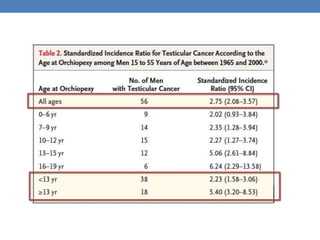
    Testis Cancer • Increasedrisk of testicular cancer • General population 5.4 in 100,000 • Cryptorchid testes have an ~3x increased cancer risk (more risk when intrabdominal) • 10-25% of tumors occur in the contralateral normal descended testicle
  • 47.
    • Purpose: Significantvariability exists for the relative risk (RR) of testicular malignancy in isolated cryptorchidism. Meta-analysis to clarify the true magnitude of this risk. • Methods: meta-analysis of 9 case-control studies (including a total of 2281 cases) and 3 cohort studies (including more than 2 million boys)
  • 49.
    • Purpose: studythe relationship between the age at treatment for undescended testis and the risk of testicular cancer. • Methods: Sweden, 1964-1999 population database with 16,983 men who underwent orchiopexy and followed for a total of 209,984 person-years
  • 51.
    Testicular torsion • 10xhigher risk in undescended testes • Decreased salvage rate due to diagnostic delay Singal AK, et al. Undescended testis and torsion: is the risk understated? Arch Dis Child 2013; 98:77.
  • 52.
    Overview • Case • Backgroundand History • Testicular development and pathophysiology • Evaluation and Diagnosis • Associated pathology • Management • Conclusions
  • 53.
    Treatment strategies • Observation •Medical hormonal therapy • Surgery • Exploratory laparoscopy • Primary orchiopexy • Single stage Fowler-Stephens orchiopexy • Two stage Fowler-Stephens orchiopexy
  • 54.
    Observation • Variable ratesof spontaneous descent • 7-88% reported in literature • Testes complete descent within 3-4 months old and spontaneous descent is rare after six months of age
  • 55.
  • 56.
    Medical Hormonal Therapy •Rational • Administration of gonadotropins (either hCG or LHRH) may stimulate testicular descent • Evidence • Highly variable success rates reported from 0% to 75% • Confounding variables in available studies including: • inclusion/exclusion of retractile testes • variable age/duration of treatment • different dosing and regimens • small cohorts
  • 57.
    Medical Hormonal Therapy •Penson DF, Krishnaswami S, Jules A, et al. AHRQ Comparative Effectiveness Review No. 88. • Available at www.effectivehealthcare.ahrq.gov/undescended-testicle.cfm.
  • 58.
    Medical Hormonal Therapy •AHRQ Evidence Review • hCG vs. placebo (AHRQ Evidence Rating: Low) • LHRH vs. placebo (AHRQ Evidence Rating: Moderate) • hCG vs. LHRH (AHRQ Evidence Rating: Low) • “Providers should not use hormonal therapy to induce testicular descent as evidence shows low response rates and lack of evidence for long-term efficacy.” (AUA Standard; Grade B)
  • 59.
    Exploratory Surgery • Diagnosticand potentially therapeutic • In boys with nonpalpable testes, specialists should perform EUA to reassess for palpability. If non-palpable, surgical exploration and, if indicated, abdominal orchido- pexy should be performed (AUA Standard; Grade B) Blind ending vessels and vasIntraabdominal testis
  • 60.
    Primary Orchiopexy • Outcomes •Success rate for testicular descent 96.4% (range 89.1–100%) • Overall testicular atrophy rate for 1.8% (range 0–4%) • In prepubertal boys with palpable, cryptorchid testes, surgical specialists should perform scrotal or inguinal orchidopexy (AUA Standard; Grade B)
  • 61.
    Fowler-Stephens Orchiopexy • Outcomes •Success rate for testicular descent was 78.7% (range 33–94.3%) for one-stage and 86% (range 67–98%) for two-stage • Testicular atrophy rate 28.1% (range 22–67%) for one-stage and 8.2%(range 0–12%) for two-stage
  • 62.
    Laparoscopic Repair • Outcomes •Success rate for testicular descent was 74% (65-100%) for orchiopexy and 63% (60-97%) for Fowler-Stephens • Testicular atrophy rate 2-22%
  • 63.
    Timing of surgery •Purpose: compare the growth of congenital, unilaterally UDT following orchiopexy at age 9 months or 3 years. • Methods: Karolinska University Hospital, 1998. A total of 164 boys with unilateral palpable undescended testis were randomized to orchiopexy at 9 months (n=72) or 3 years (n=83) J Urol 2007; 178: 1589.
  • 64.
  • 65.
  • 66.
    Timing of surgery •The growth of unilateral undescended testes may be impaired compared with the normally descended contralateral testes • Treatment before one year of age may be associated with partial catch-up growth • In the absence of spontaneous testicular descent by six months (corrected for gestational age), specialists should perform surgery within the next year (AUA Standard; Grade B)
  • 67.
  • 68.
    AUA Guidelines forTreatment (cont.)
  • 69.
    Overview • Case • Backgroundand History • Testicular development and pathophysiology • Evaluation and Diagnosis • Associated pathology • Management • Conclusions
  • 70.
    Future Directions • Geneticand environmental factors that contribute to cryptorchidism • Define role of cross sectional imaging with CT, MRV, or MRA in locating undescended testes • Long term outcome data on fertility • Comparative effectiveness of surgical interventions based on location of testes • One vs. two stage Fowler Stephens • Open vs. Laparoscopic orchiopexy
  • 71.
    Conclusions • Cryptorchidism isextremely common • Imaging for cryptorchidism is not recommended prior to referral, which should occur by 6 months of age. • Orchiopexy is the most successful therapy to relocate the testis into the scrotum, while hormonal therapy is not recommended. • Successful scrotal repositioning of the testis may reduce but does not prevent the potential long-term issues of infertility and testis cancer. • Appropriate counseling and follow-up of the patient is essential.
  • 72.
    Case: Clinical Course 3month old otherwise healthy boy with left non- palpable testicle since birth. • Testes intraabdominal at laparoscopy • Repaired by one-stage Fowler-Stephens orchiopexy at 7 mo. • Doing well
  • 73.
    References • Campbell MF,Wein AJ, Kavoussi LR. Campbell-Walsh Urology. 9th ed. Philadelphia: W.B. Saunders; 2007. • Cooper, C., et al. (2015, April 17). Undescended testes (cryptorchidism) in Children: Clinical features and evaluation. Retrieved November 9, 2015, from UpToDate. • Huff, et al. (2001). Abnormal germ cell development in cryptorchidism. Hormone Research, 55(1), 11–17. • Janus, et al. (2014). American Urological Association (AUA) Guideline on Cryptorchidism, 1–38. • Kollin, et al. (2007). Surgical Treatment of Unilaterally Undescended Testes: Testicular Growth After Randomization to Orchiopexy at Age 9 Months or 3 Years. The Journal of Urology, 178(4), 1589–1593. http://doi.org/10.1016/j.juro.2007.03.173 • Lip, et al. (2012). A meta-analysis of the risk of boys with isolated cryptorchidism developing testicular cancer in later life. Archives of Disease in Childhood, 98(1), 20–26. http://doi.org/10.1136/archdischild-2012-302051 • Penson, et al. (2012). Evaluation and Treatment of Cryptorchidism. EHRQ Report. • Pettersson, et al. (2007). Age at surgery for undescended testis and risk of testicular cancer. The New England Journal of Medicine, 356(18), 1835–1841. http://doi.org/10.1056/NEJMoa067588 • Singal, et al. (2012). Undescended testis and torsion: is the risk understated? Archives of Disease in Childhood, 98(1), 77–79. http://doi.org/10.1136/archdischild-2012-302373 • Thorup, et al. (2013). The Relation between Adult Dark Spermatogonia andOther Parameters of Fertility Potential in Cryptorchid Testes. Journal of Urology, 190(S), 1566–1571. http://doi.org/10.1016/j.juro.2013.01.058 • van Brakel, et al. (2014a). Journal of Pediatric Surgery. Journal of Pediatric Surgery, 49(4), 599–605. http://doi.org/10.1016/j.jpedsurg.2013.09.020