Dr. Ifeh M. O.
Surgery Department
Federal Medical Centre,
Yenagoa, Nigeria
Undescended testes
OUTLINE
Introduction
Historical perspective
incidence
Relevant Embryology /Anatomy
Aetiopathogenesis
Classification
Pathology
Presentation/Clinical feature
Management
Complications
Conclusion
Introduction
one of the commonest surgical problems in males at
paediatric surgery clinic
one of the causes of vacant scrotum/ Cryptorchidism
cause of cryptorchidism is multifactorial and it exhibit wide
variation in phenotypic expression
Has delitarious effects on the testis overtime when left
untreated
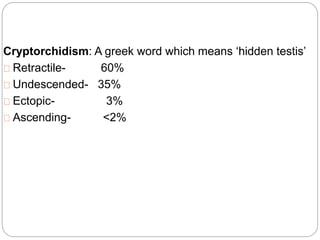
Cryptorchidism: A greek word which means ‘hidden testis’
Retractile- 60%
Undescended- 35%
Ectopic- 3%
Ascending- <2%
Undescended testis: is arrested along its normal path
of descent
Retractile testis: can be manipulated into scrotum
where it remains without tension
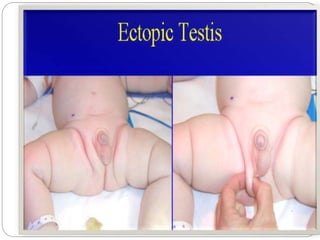
Ectopic testis is located outside the normal path of
descent
Ascended: previously descended, then “ascends”
spontaneously
Historical perspective
1786, Hunter first drew attention to the mechanism of
descent
1820, Rosenmerkal attempted the first surgical
orchidopexy but
1877, Annandale performed the first successful
orchiopexy
Incidence/epidemiology
3.4 % in term boys; by 1 year incidence is 0.8%
Occurs on the right-50%, left-35%, bilateral-10-15%
Approximately 40% of the nonpalpable testes are intra-
abdominal, 40% are inguinal, and 20% are atrophic or
absent
No definite racial differences in incidence are reported.
Incidence contd
The familial cluster is 3.6-fold overall, 6.9-fold if a
brother is affected, and 4.6-fold if the father is affected.
the precise molecular and genetic mechanisms
underlying cryptorchidism in humans remain unknown.
Premature infants- 30%
Also more common in low-birth-weight male newborns,
IUGR, and twin gestation.
birth weight alone is the principal determinant of
cryptorchidism at birth and at 1 year of life, independent of
the length of gestation ( Hjertkvist et al, 1989 ;
Mayr et al, 1999 ).
Anatomy
Anatomy contd
Anatomy contd
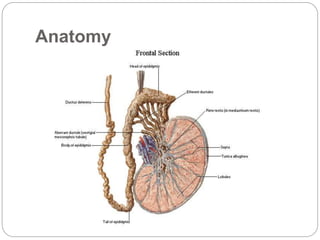
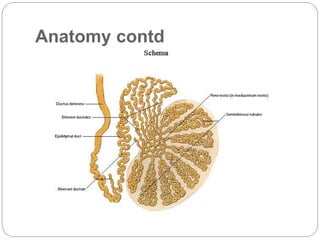
The 3 arteries- testicular, cremasteric and artery to the
vas, all anastomosed mainly at the head of epididymis
hence ligation of the testicular artery is not necessarily
followed by testicular atrophy.
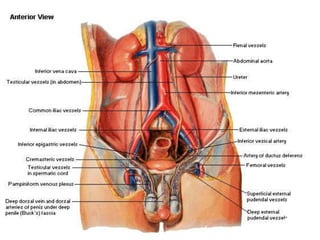
Lymphatic drainage: to the para-aortic lymph nodes at the
level of the renal vessels..
Anatomy contd
Nerve supply
T10 sympathetic fibres via the renal and aortic plexus.
convey afferent (pain) fibres—hence referred pain from
the testis to the loin.
Anatomy contd
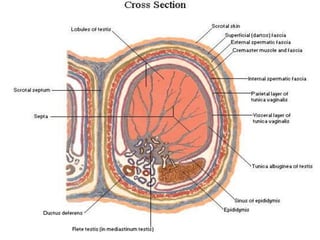
Spermatic cord
3 layers of fascia: external spermatic, cremasteric
+cremaster muscle & internal spermatic
3 arteries: testicular, cremasteric & artery to the vas
3 veins: pampiniform plexus of veins, cremasteric & vein
of the vas
3 nerves — nerve to the cremaster from the genito-
femoral nerve, sympathetic fibres (T10–11 spinal
segments) , & ilio-inguinal nerve (on and not in the cord)
Anatomy contd
scrotum
The skin of the scrotum is thin, pigmented & rugose
maintains a temperature 3-4⁰C lower than core body
temperature
Its development depends on the descent of testis
Embryology
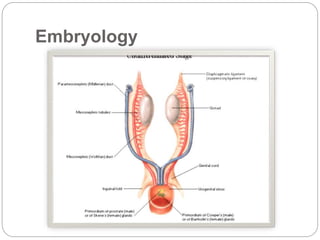
The testes develop in the retroperitoneum
At 4 to 6 weeks' gestation, the genital ridges organize,
followed by migration of primordial germ cells
Embryology
Embryology contd
testicular differentiation is initiated in the 7th week by the
SRY gene
8 week testis hormonally active
o Sertoli cells secretes mullerian inhibiting substance (MIS)
o Leydig cells secrete testosterone..
MIS causes degeneration of mullerian structures
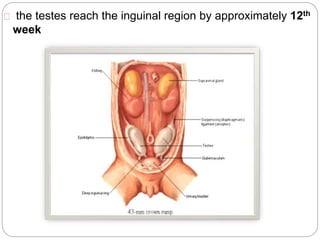
the testes reach the inguinal region by approximately 12th
week
Embryology contd
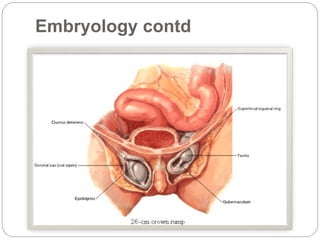
by 28th weeks migrate through the inguinal canal
32nd week – emerges from superficial inguinal ring.
35-40th week –descends into the scrotum
Left testis descends before the right
About 96% of testes have descended at birth
Embryology contd
• This descent occur as a result of a complex interaction of
hormonal and mechanical factors
Hormonal factors:
Testosterone
Dihydrotestosterone
Mullerian-inhibiting factor
HCG
Genital branch of genitofemoral nerve which secret CGRP
(elaborated by testosterone)
Non androgen–insulin like factor 3
Mechanical factors
Shortening and traction of the gubernaculum testis
Enlargement/elongation of processus vaginalis
Intra-abdominal pressure from increase visceral size
Straightening of fetus
Resolution of physiological hernia
Enlargement of testes/growth of epididymis
Propulsive force of the developing cremasteric muscle
Failure of any of these mechanisms may cause testicular
non-descent or maldescent.
Hormonal (inguinoscrotal) phase is more commonly
deranged
Germ cell maturation
• 8 wk: gonocytes (fetal stem cells)
15 wk: spermatogonia
3 months of age: adult dark spermatogonia (adult stem
cells) appear and remain
o Neonatal surge in LH, FSH, T
4-5years: primary spermatocytes
Puberty: spermatogenesis
Aetiology
Abnormal insertion of genital branch of genitofemoral nerve
Causes of poor intra-abdominal pressure: omphalocele,
diaphragmatic hernia, gastrochisis, Eagle-Barrett
syndrome, Beckwith-wiedeman’s syndrome, trisomies,
Extrophy of bladder
Retroperitoneal adhesions
Obstruction –later adhesion at the deep ring
Short vas deferens
Short testicular vessel
Aetiology contd
Hypothalamic-pituitary dysfunction>deficient hormonal
stimulation
Gubernaculum testis: when minor is dominant,
abnormally inserted, poorly or absence of extra-
abdominal part ->> ineficient pull
Defective folding
Severe intrauterine hypotonia
Classification
A. Based on palpation (Kaplan-1993)
Impalpable:
High canalicular
Deep inguinal ring
Intra-abdominal
Accounts for 20% of UDT.
Palpable:
Neck of scrotum
Superficial inguinal ring
Low canalicular
Accounts for 80% of UDT
Classification contd
B. Based on exploration findings:
intra-abdominal
intracanalicular
extracanalicular (suprapubic or infrapubic), or
ectopic.
Pathological changes
often macroscopically normal in early childhood but by
puberty some degree of atrophy occur..
Microscopic evidence of tubular atrophy is evident by 5-6
years of age, & hyalinization is present by the time of
puberty.
loss of volume and progressive germ cell depletion starting
at 6 months of age
Pathological changes
Other histologic changes include:
decreased tubular diameter, and
decreased numbers of Leydig cells,
atrophy of Leydig cells
degeneration of Sertoli cells
Pathological changes contd
Abnormal germ cell development (Huff et al,1987)
o Delayed disappearance of Gonocytes
o Delayed appearance of Adult dark spermatogonia
o failure of primary spermatocytes to develop, and
o reduced total germ cell counts
Other types of cryptorchidism
Retractile testis:
o reduced androgens between 1-9yrs
o hyperactive cremasteric reflex
o often induced by cold, fear, pain
o stimulation of cutaneous branch of genitofemoral nerve.
Ascending testis: failure of spermatic cord to
grow/enlongate in proportion to body growth
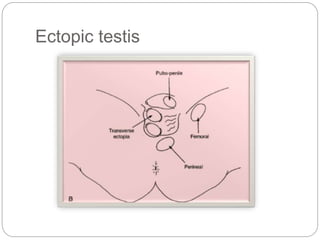
Ectopic testis
Clinical features
Most patients presents in infancy and around school age. A
few present after puberty.
Absence of one or both testes
swelling in the groin (may be the testis or a hernia)
May present with attacks of pain in the groin due either to
recurrent torsion of the testis or strangulation of an
associated hernia.
Clinical features contd
gestational age at birth- usually preterm
±maternal hormonal treatment
Determining if the testis was palpable in the scrotum at
any time is important
past history of inguinal surgery should be noted
family history of cryptorchidism and other associated
conditions.
Examination
Marked variation from the norm for height, weight & fat
distribution may suggest anorchia due to possible intersex
or pituitary deficiency
± Signs of syndromic features e.g kallmann’s
under developed scrotal skin with little or no rugae &
appears triangular in unilateral UDT or flat in bilateral UDTs
± hypertrophy of contralateral testis
Examination contd
Examination of potential ectopic sites- penile, femoral, &
perineal areas if the testicle cannot be felt.
If there is hypothalamic-pituitary dysfunction, the patient is
obese and the penis small for the age.
Technique:
Examination under anaesthesia is also done for impalpable
testis before exploration
Clinical distinction between retractile and undescended
testis may be difficult
Cryptorchidism is associated with:
inguinal hernia and/or patent processus vaginalis
hypospadias
cerebral palsy
mental retardation
Down syndrome
Wilms tumor
Prune belly syndrome, and
Prader-Willi syndrome
Investigation
Imaging
Abdominal USS
CT Scan
MRI
Because imaging has not been proved to be reliable in
demonstrating whether the testis is present or absent, its
routine use is discouraged
Laboratory Investigations
Karyotyping
↑ FSH- likely represent bilateral anorchia
HCG Stimulation tests- has clinical use where
gonadothrophins are normal
FBC, Urinalysis, Serum electrolytes
Diagnostic Laparoscopy
Complications of undescended
testis
Infertility
Associated hernia
o indirect inguinal hernia usually accompanies a congenital
undescended testis in about 90% cases but rarely
symptomatic.
Testicular atrophy: due to pressure effects and
histological changes.
Trauma
Complication contd
Tumour:
o 10% of testicular cancer originate in cryptochid testis.
Torsion
Epididymo-orchitis in a chryptochid right testis can
mimic appendicitis
Psychologic effects of an empty scrotum
Testicular-Epididymal fusion abnormality
Hormonal treatment
Indications
bilateral UDT
hypothalamic-pituitary dysfunction
patients unfit for surgery
when diagnosis of retractile testes is uncertain
LHRH and hCG are used with varying degrees of
success
Multiple dosage schedules have been proposed
Success rate low
Adverse effects of hormonal
therapy:
increase in scrotal rugae, pigmentation
growth of pubic hair
increased penile size
priapism
Premature closure of epiphyseal plate
Increased appetite and weight gain
Surgical treatment
Surgery remains the gold standard
Orchidopexy
Should be performed as early as 6months because of
rarity of spontaneous descent after 6mnths
possible improvement in fertility
Interval of 6months in bilateral undescended testes
Principles of orchidopexy
(originally described by Bevan in 1899)
Adequate exposure
Herniotomy
Mobilization of cord
Fixation of testis
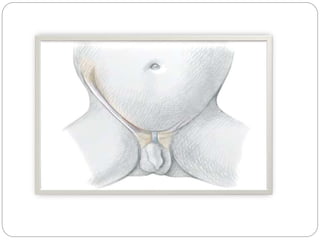
Orchidopexy for the palpable UDT
general anesthesia; useful to re-examine the child-
previously nonpalpable testis may become palpable.
groin crease incision is made Careful dissection to
expose the external oblique aponeurosis and the external
ring.
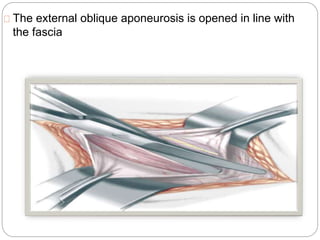
The external oblique aponeurosis is opened in line with
the fascia
Rolling the cord structures under a finger may help
confirm the exact site of the canal.
Care inside the canal is taken to identify and preserve
the ilioinguinal nerve.
The cord is isolated by sweeping the cremasteric fibres
off it.
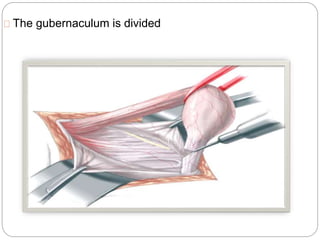
The gubernaculum is divided
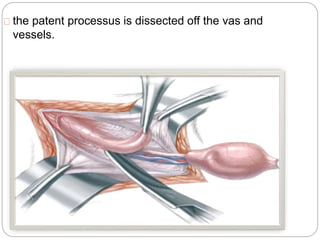
the patent processus is dissected off the vas and
vessels.
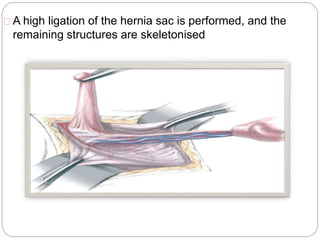
A high ligation of the hernia sac is performed, and the
remaining structures are skeletonised
Manoeuvres to gain sufficient length include:
dissection of retroperitoneal attachments of the cord
(Prentiss manoeuvre)
Divide (or pass the testis under) the inferior epigastric
vessels after opening the floor of the canal (transversalis
fascia), allowing a more medial and thus direct route to the
scrotum.
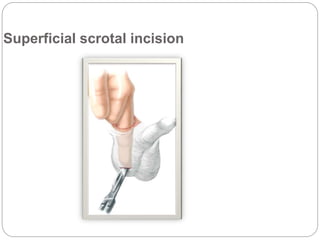
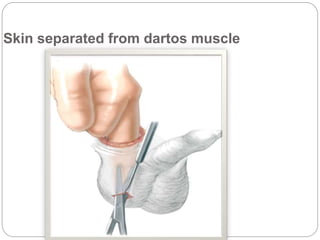
Superficial scrotal incision
Skin separated from dartos muscle
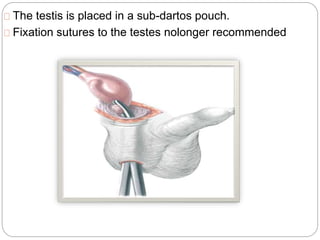
The testis is placed in a sub-dartos pouch.
Fixation sutures to the testes nolonger recommended
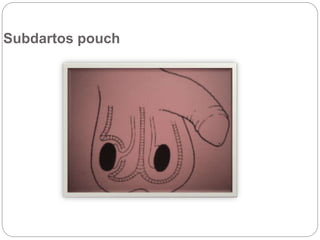
Subdartos pouch
Impalpable UDTs
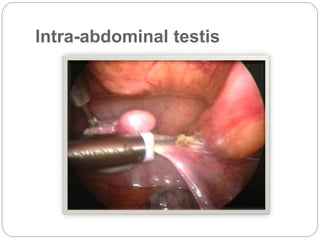
laparoscopy -best means of identifying intra-abdominal
testis, vas and vessels.
If laparoscopy indicates blind-ending gonadal vessels and
vas deferens, the patient is said to have vanishing testis
syndrome and no further action is necessary
Impalpable UDTs contd
If intra-abdominal testis identified consider staged
orchidopexy or microvascular transfer
If vas vessels seen entering inguinal canal, the groin
should be explored..
The length of the gonadal vessels is the limiting factor to
getting the intra-abdominal testis into the scrotum
Intra-abdominal testis
Options for intra-abdominal UDT
1. Standard inguinal orchidopexy (has a high failure rate)
2. A two-stage Fowler-Stephens orchidopexy (open or
laparoscopy).
The testicular artery is sacrificed.
The rationale is that the testicular arterial supply comes
from three sources.
At a 2nd stage (after 6 months of age, when collaterals
have formed), the testis is brought down on a wide pedicle
of peritoneum containing the remaining vessels.
Options for intra-abdominal UDT
contd
3. Microvascular testicular autotransplantation
employs microsurgical techniques
reserved for older children with internal spermatic
artery large enough to be anastomosed to inferior
epigastric artery.
4. Refluo Testicular
Autotransplantation
Provides only venous drainage by microvascular
anastomosis of testicular veins to inferior epigastric
veins
Based on discovery that failure in Fowler-Stephens was
due to testicular congestion
Reduced operating time and increased success
5. Jones Preperitoneal Approach
Preperitoneal cavity accessed by splitting abdominal
obliques
Testes mobilized transperitoneally and passed to the
scrotum through the inguinal canal or posterior wall
6. Orchidectomy :
usually reserved for postpubertal men with a contralateral
normally positioned testis.
Bilateral impalpable testis
Raise suspicion of an intersex condition
karyotype and hormonal profile should be characterized
Can involve measurement of MIS or an HCG stimulation
test to detect the presence or absence of functioning
testicular tissue.
Postoperative Complications
Haematoma
Infection
unsatisfactory position (requiring revision),
ilioinguinal nerve injury
damage to the vas
testicular atrophy
and torsion testis.
Outcome
Early orchidopexy may improve fertility
No evidence that it reduces risk of malignancy but allows
early identification.
conclusion
Undescended testis is relatively common and early
surgical correction should be done to prevent
complications

undescended testes

  • 1.
    Dr. Ifeh M.O. Surgery Department Federal Medical Centre, Yenagoa, Nigeria Undescended testes
  • 2.
    OUTLINE Introduction Historical perspective incidence Relevant Embryology/Anatomy Aetiopathogenesis Classification Pathology Presentation/Clinical feature Management Complications Conclusion
  • 3.
    Introduction one of thecommonest surgical problems in males at paediatric surgery clinic one of the causes of vacant scrotum/ Cryptorchidism cause of cryptorchidism is multifactorial and it exhibit wide variation in phenotypic expression Has delitarious effects on the testis overtime when left untreated
  • 4.
    Cryptorchidism: A greekword which means ‘hidden testis’ Retractile- 60% Undescended- 35% Ectopic- 3% Ascending- <2%
  • 5.
    Undescended testis: isarrested along its normal path of descent Retractile testis: can be manipulated into scrotum where it remains without tension Ectopic testis is located outside the normal path of descent Ascended: previously descended, then “ascends” spontaneously
  • 6.
    Historical perspective 1786, Hunterfirst drew attention to the mechanism of descent 1820, Rosenmerkal attempted the first surgical orchidopexy but 1877, Annandale performed the first successful orchiopexy
  • 7.
    Incidence/epidemiology 3.4 % interm boys; by 1 year incidence is 0.8% Occurs on the right-50%, left-35%, bilateral-10-15% Approximately 40% of the nonpalpable testes are intra- abdominal, 40% are inguinal, and 20% are atrophic or absent No definite racial differences in incidence are reported.
  • 8.
    Incidence contd The familialcluster is 3.6-fold overall, 6.9-fold if a brother is affected, and 4.6-fold if the father is affected. the precise molecular and genetic mechanisms underlying cryptorchidism in humans remain unknown.
  • 9.
    Premature infants- 30% Alsomore common in low-birth-weight male newborns, IUGR, and twin gestation. birth weight alone is the principal determinant of cryptorchidism at birth and at 1 year of life, independent of the length of gestation ( Hjertkvist et al, 1989 ; Mayr et al, 1999 ).
  • 10.
  • 11.
  • 13.
    Anatomy contd The 3arteries- testicular, cremasteric and artery to the vas, all anastomosed mainly at the head of epididymis hence ligation of the testicular artery is not necessarily followed by testicular atrophy. Lymphatic drainage: to the para-aortic lymph nodes at the level of the renal vessels..
  • 14.
    Anatomy contd Nerve supply T10sympathetic fibres via the renal and aortic plexus. convey afferent (pain) fibres—hence referred pain from the testis to the loin.
  • 15.
    Anatomy contd Spermatic cord 3layers of fascia: external spermatic, cremasteric +cremaster muscle & internal spermatic 3 arteries: testicular, cremasteric & artery to the vas 3 veins: pampiniform plexus of veins, cremasteric & vein of the vas 3 nerves — nerve to the cremaster from the genito- femoral nerve, sympathetic fibres (T10–11 spinal segments) , & ilio-inguinal nerve (on and not in the cord)
  • 17.
    Anatomy contd scrotum The skinof the scrotum is thin, pigmented & rugose maintains a temperature 3-4⁰C lower than core body temperature Its development depends on the descent of testis
  • 18.
    Embryology The testes developin the retroperitoneum At 4 to 6 weeks' gestation, the genital ridges organize, followed by migration of primordial germ cells
  • 19.
  • 20.
    Embryology contd testicular differentiationis initiated in the 7th week by the SRY gene 8 week testis hormonally active o Sertoli cells secretes mullerian inhibiting substance (MIS) o Leydig cells secrete testosterone.. MIS causes degeneration of mullerian structures
  • 21.
    the testes reachthe inguinal region by approximately 12th week
  • 22.
    Embryology contd by 28thweeks migrate through the inguinal canal 32nd week – emerges from superficial inguinal ring. 35-40th week –descends into the scrotum Left testis descends before the right About 96% of testes have descended at birth
  • 23.
  • 24.
    • This descentoccur as a result of a complex interaction of hormonal and mechanical factors Hormonal factors: Testosterone Dihydrotestosterone Mullerian-inhibiting factor HCG Genital branch of genitofemoral nerve which secret CGRP (elaborated by testosterone) Non androgen–insulin like factor 3
  • 25.
    Mechanical factors Shortening andtraction of the gubernaculum testis Enlargement/elongation of processus vaginalis Intra-abdominal pressure from increase visceral size Straightening of fetus Resolution of physiological hernia Enlargement of testes/growth of epididymis Propulsive force of the developing cremasteric muscle
  • 26.
    Failure of anyof these mechanisms may cause testicular non-descent or maldescent. Hormonal (inguinoscrotal) phase is more commonly deranged
  • 27.
    Germ cell maturation •8 wk: gonocytes (fetal stem cells) 15 wk: spermatogonia 3 months of age: adult dark spermatogonia (adult stem cells) appear and remain o Neonatal surge in LH, FSH, T 4-5years: primary spermatocytes Puberty: spermatogenesis
  • 28.
    Aetiology Abnormal insertion ofgenital branch of genitofemoral nerve Causes of poor intra-abdominal pressure: omphalocele, diaphragmatic hernia, gastrochisis, Eagle-Barrett syndrome, Beckwith-wiedeman’s syndrome, trisomies, Extrophy of bladder Retroperitoneal adhesions Obstruction –later adhesion at the deep ring Short vas deferens Short testicular vessel
  • 29.
    Aetiology contd Hypothalamic-pituitary dysfunction>deficienthormonal stimulation Gubernaculum testis: when minor is dominant, abnormally inserted, poorly or absence of extra- abdominal part ->> ineficient pull Defective folding Severe intrauterine hypotonia
  • 30.
    Classification A. Based onpalpation (Kaplan-1993) Impalpable: High canalicular Deep inguinal ring Intra-abdominal Accounts for 20% of UDT. Palpable: Neck of scrotum Superficial inguinal ring Low canalicular Accounts for 80% of UDT
  • 31.
    Classification contd B. Basedon exploration findings: intra-abdominal intracanalicular extracanalicular (suprapubic or infrapubic), or ectopic.
  • 32.
    Pathological changes often macroscopicallynormal in early childhood but by puberty some degree of atrophy occur.. Microscopic evidence of tubular atrophy is evident by 5-6 years of age, & hyalinization is present by the time of puberty. loss of volume and progressive germ cell depletion starting at 6 months of age
  • 33.
    Pathological changes Other histologicchanges include: decreased tubular diameter, and decreased numbers of Leydig cells, atrophy of Leydig cells degeneration of Sertoli cells
  • 34.
    Pathological changes contd Abnormalgerm cell development (Huff et al,1987) o Delayed disappearance of Gonocytes o Delayed appearance of Adult dark spermatogonia o failure of primary spermatocytes to develop, and o reduced total germ cell counts
  • 35.
    Other types ofcryptorchidism Retractile testis: o reduced androgens between 1-9yrs o hyperactive cremasteric reflex o often induced by cold, fear, pain o stimulation of cutaneous branch of genitofemoral nerve. Ascending testis: failure of spermatic cord to grow/enlongate in proportion to body growth
  • 36.
  • 38.
    Clinical features Most patientspresents in infancy and around school age. A few present after puberty. Absence of one or both testes swelling in the groin (may be the testis or a hernia) May present with attacks of pain in the groin due either to recurrent torsion of the testis or strangulation of an associated hernia.
  • 39.
    Clinical features contd gestationalage at birth- usually preterm ±maternal hormonal treatment Determining if the testis was palpable in the scrotum at any time is important past history of inguinal surgery should be noted family history of cryptorchidism and other associated conditions.
  • 40.
    Examination Marked variation fromthe norm for height, weight & fat distribution may suggest anorchia due to possible intersex or pituitary deficiency ± Signs of syndromic features e.g kallmann’s under developed scrotal skin with little or no rugae & appears triangular in unilateral UDT or flat in bilateral UDTs ± hypertrophy of contralateral testis
  • 41.
    Examination contd Examination ofpotential ectopic sites- penile, femoral, & perineal areas if the testicle cannot be felt. If there is hypothalamic-pituitary dysfunction, the patient is obese and the penis small for the age. Technique: Examination under anaesthesia is also done for impalpable testis before exploration Clinical distinction between retractile and undescended testis may be difficult
  • 42.
    Cryptorchidism is associatedwith: inguinal hernia and/or patent processus vaginalis hypospadias cerebral palsy mental retardation Down syndrome Wilms tumor Prune belly syndrome, and Prader-Willi syndrome
  • 43.
    Investigation Imaging Abdominal USS CT Scan MRI Becauseimaging has not been proved to be reliable in demonstrating whether the testis is present or absent, its routine use is discouraged
  • 44.
    Laboratory Investigations Karyotyping ↑ FSH-likely represent bilateral anorchia HCG Stimulation tests- has clinical use where gonadothrophins are normal FBC, Urinalysis, Serum electrolytes Diagnostic Laparoscopy
  • 45.
    Complications of undescended testis Infertility Associatedhernia o indirect inguinal hernia usually accompanies a congenital undescended testis in about 90% cases but rarely symptomatic. Testicular atrophy: due to pressure effects and histological changes. Trauma
  • 46.
    Complication contd Tumour: o 10%of testicular cancer originate in cryptochid testis. Torsion Epididymo-orchitis in a chryptochid right testis can mimic appendicitis Psychologic effects of an empty scrotum Testicular-Epididymal fusion abnormality
  • 47.
    Hormonal treatment Indications bilateral UDT hypothalamic-pituitarydysfunction patients unfit for surgery when diagnosis of retractile testes is uncertain LHRH and hCG are used with varying degrees of success Multiple dosage schedules have been proposed Success rate low
  • 48.
    Adverse effects ofhormonal therapy: increase in scrotal rugae, pigmentation growth of pubic hair increased penile size priapism Premature closure of epiphyseal plate Increased appetite and weight gain
  • 49.
    Surgical treatment Surgery remainsthe gold standard Orchidopexy Should be performed as early as 6months because of rarity of spontaneous descent after 6mnths possible improvement in fertility Interval of 6months in bilateral undescended testes
  • 50.
    Principles of orchidopexy (originallydescribed by Bevan in 1899) Adequate exposure Herniotomy Mobilization of cord Fixation of testis
  • 51.
    Orchidopexy for thepalpable UDT general anesthesia; useful to re-examine the child- previously nonpalpable testis may become palpable. groin crease incision is made Careful dissection to expose the external oblique aponeurosis and the external ring.
  • 53.
    The external obliqueaponeurosis is opened in line with the fascia
  • 54.
    Rolling the cordstructures under a finger may help confirm the exact site of the canal. Care inside the canal is taken to identify and preserve the ilioinguinal nerve. The cord is isolated by sweeping the cremasteric fibres off it.
  • 55.
  • 56.
    the patent processusis dissected off the vas and vessels.
  • 57.
    A high ligationof the hernia sac is performed, and the remaining structures are skeletonised
  • 58.
    Manoeuvres to gainsufficient length include: dissection of retroperitoneal attachments of the cord (Prentiss manoeuvre) Divide (or pass the testis under) the inferior epigastric vessels after opening the floor of the canal (transversalis fascia), allowing a more medial and thus direct route to the scrotum.
  • 59.
  • 60.
    Skin separated fromdartos muscle
  • 61.
    The testis isplaced in a sub-dartos pouch. Fixation sutures to the testes nolonger recommended
  • 62.
  • 63.
    Impalpable UDTs laparoscopy -bestmeans of identifying intra-abdominal testis, vas and vessels. If laparoscopy indicates blind-ending gonadal vessels and vas deferens, the patient is said to have vanishing testis syndrome and no further action is necessary
  • 64.
    Impalpable UDTs contd Ifintra-abdominal testis identified consider staged orchidopexy or microvascular transfer If vas vessels seen entering inguinal canal, the groin should be explored.. The length of the gonadal vessels is the limiting factor to getting the intra-abdominal testis into the scrotum
  • 65.
  • 66.
    Options for intra-abdominalUDT 1. Standard inguinal orchidopexy (has a high failure rate) 2. A two-stage Fowler-Stephens orchidopexy (open or laparoscopy). The testicular artery is sacrificed. The rationale is that the testicular arterial supply comes from three sources. At a 2nd stage (after 6 months of age, when collaterals have formed), the testis is brought down on a wide pedicle of peritoneum containing the remaining vessels.
  • 67.
    Options for intra-abdominalUDT contd 3. Microvascular testicular autotransplantation employs microsurgical techniques reserved for older children with internal spermatic artery large enough to be anastomosed to inferior epigastric artery.
  • 68.
    4. Refluo Testicular Autotransplantation Providesonly venous drainage by microvascular anastomosis of testicular veins to inferior epigastric veins Based on discovery that failure in Fowler-Stephens was due to testicular congestion Reduced operating time and increased success
  • 69.
    5. Jones PreperitonealApproach Preperitoneal cavity accessed by splitting abdominal obliques Testes mobilized transperitoneally and passed to the scrotum through the inguinal canal or posterior wall
  • 70.
    6. Orchidectomy : usuallyreserved for postpubertal men with a contralateral normally positioned testis.
  • 71.
    Bilateral impalpable testis Raisesuspicion of an intersex condition karyotype and hormonal profile should be characterized Can involve measurement of MIS or an HCG stimulation test to detect the presence or absence of functioning testicular tissue.
  • 72.
    Postoperative Complications Haematoma Infection unsatisfactory position(requiring revision), ilioinguinal nerve injury damage to the vas testicular atrophy and torsion testis.
  • 73.
    Outcome Early orchidopexy mayimprove fertility No evidence that it reduces risk of malignancy but allows early identification.
  • 74.
    conclusion Undescended testis isrelatively common and early surgical correction should be done to prevent complications