A SURVEY OF CRYPTOGRAPHIC
ALGORITHMS
1
ABSTRACT
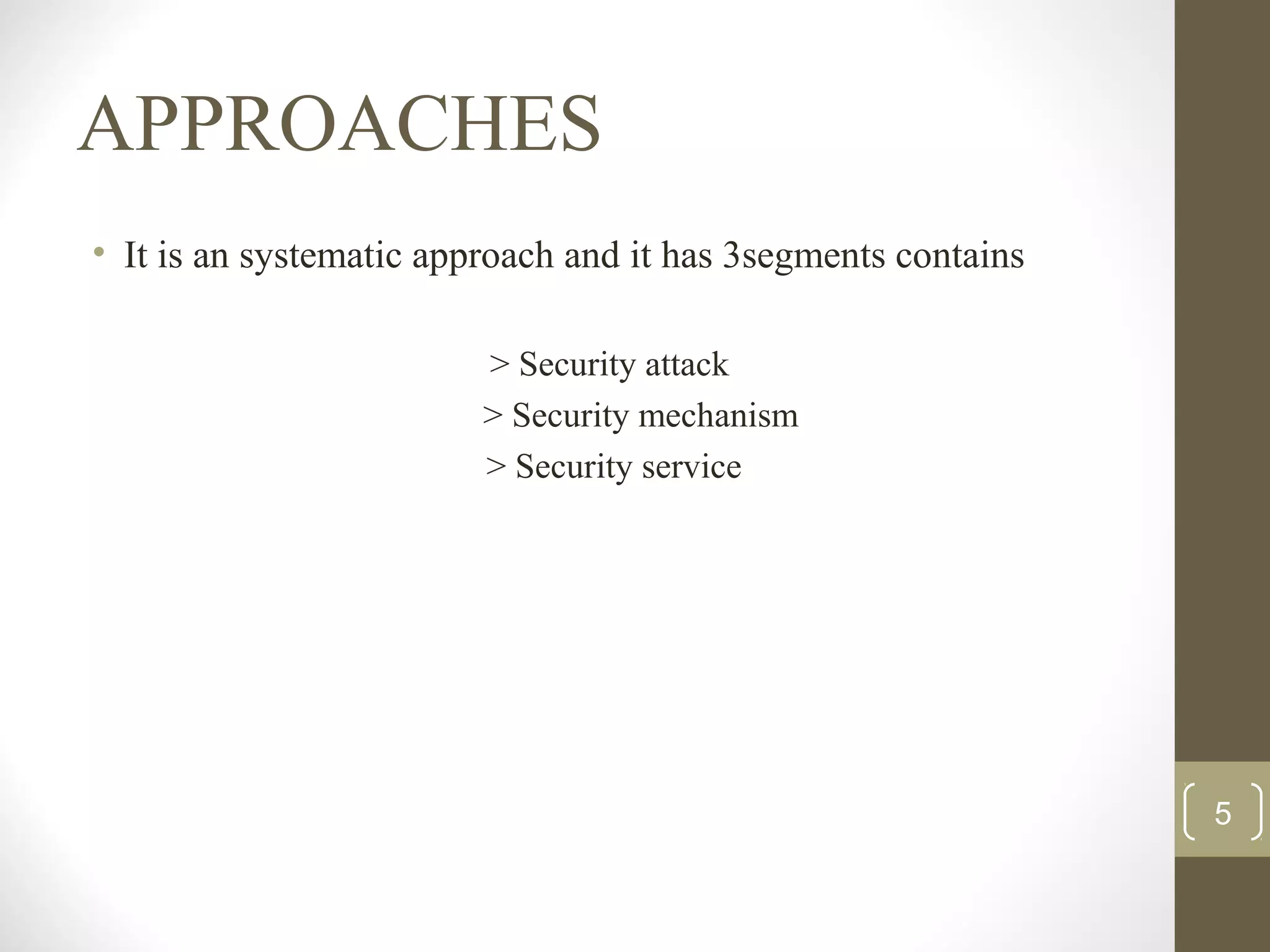
• When survey a variety of cryptographic algorithms falling into
four main
categories:
DES (block cipher), RC4 (stream cipher),
SHA-1(hash) and RSA (public-key cryptography).
• We are using cryptography method in this survey which is
related to the security concepts.
2
CRYPTOGRAPHY
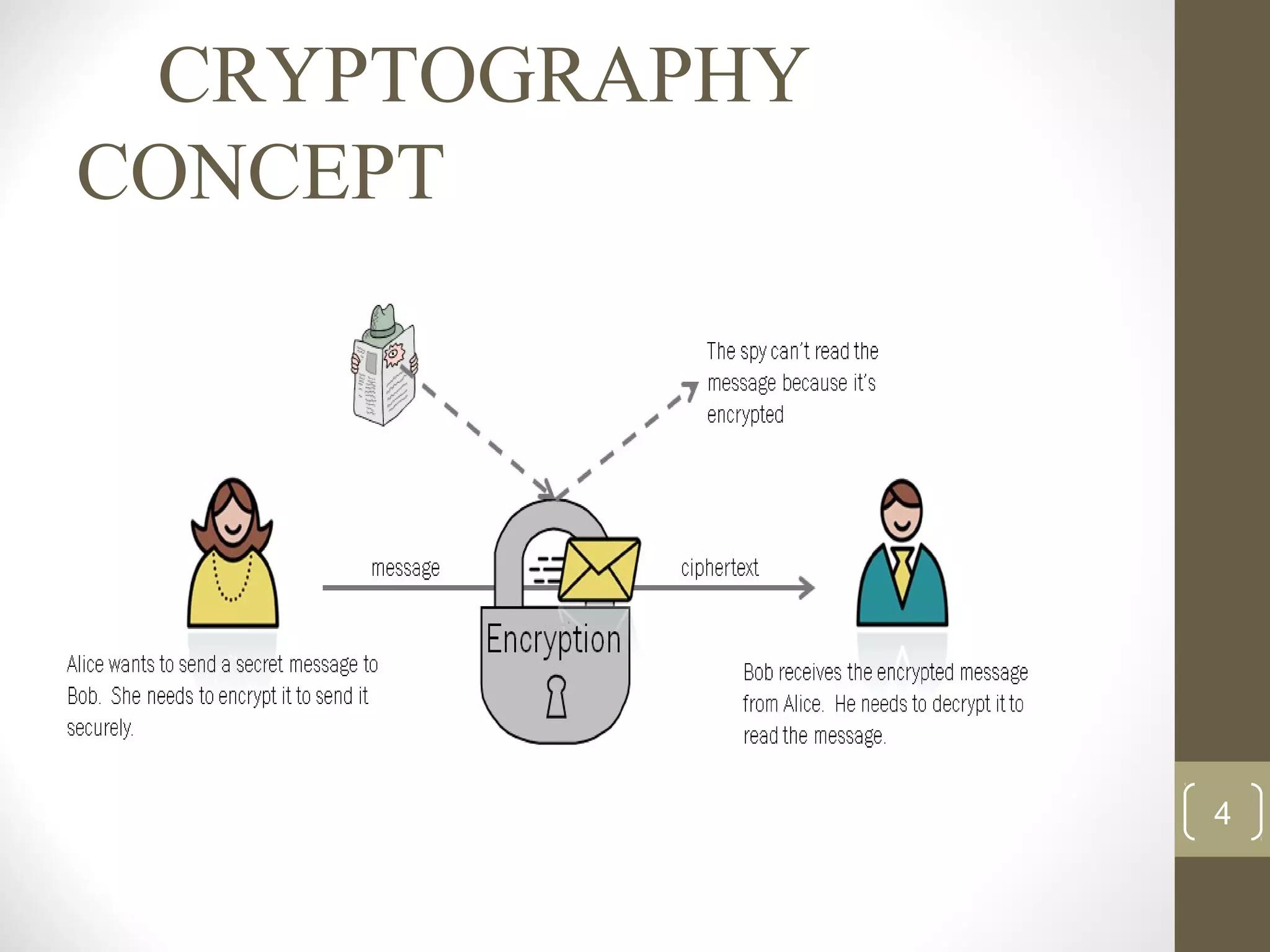
• Cryptographic algorithms are a means of discreetly conveying
secret information between one party and another.
• The plaintext message is encrypted from sender side using a
crypto-graphic algorithm and decrypted the plaintext to the
receiver side.
• This will encrypt and decrypt by using cipher text which is
convert to duplicate message to hide the message from the
hacker.
3
CRYPTOGRAPHY
CONCEPT
4
APPROACHES
• It is an systematic approach and it has 3segments contains
> Security attack
> Security mechanism
> Security service
5
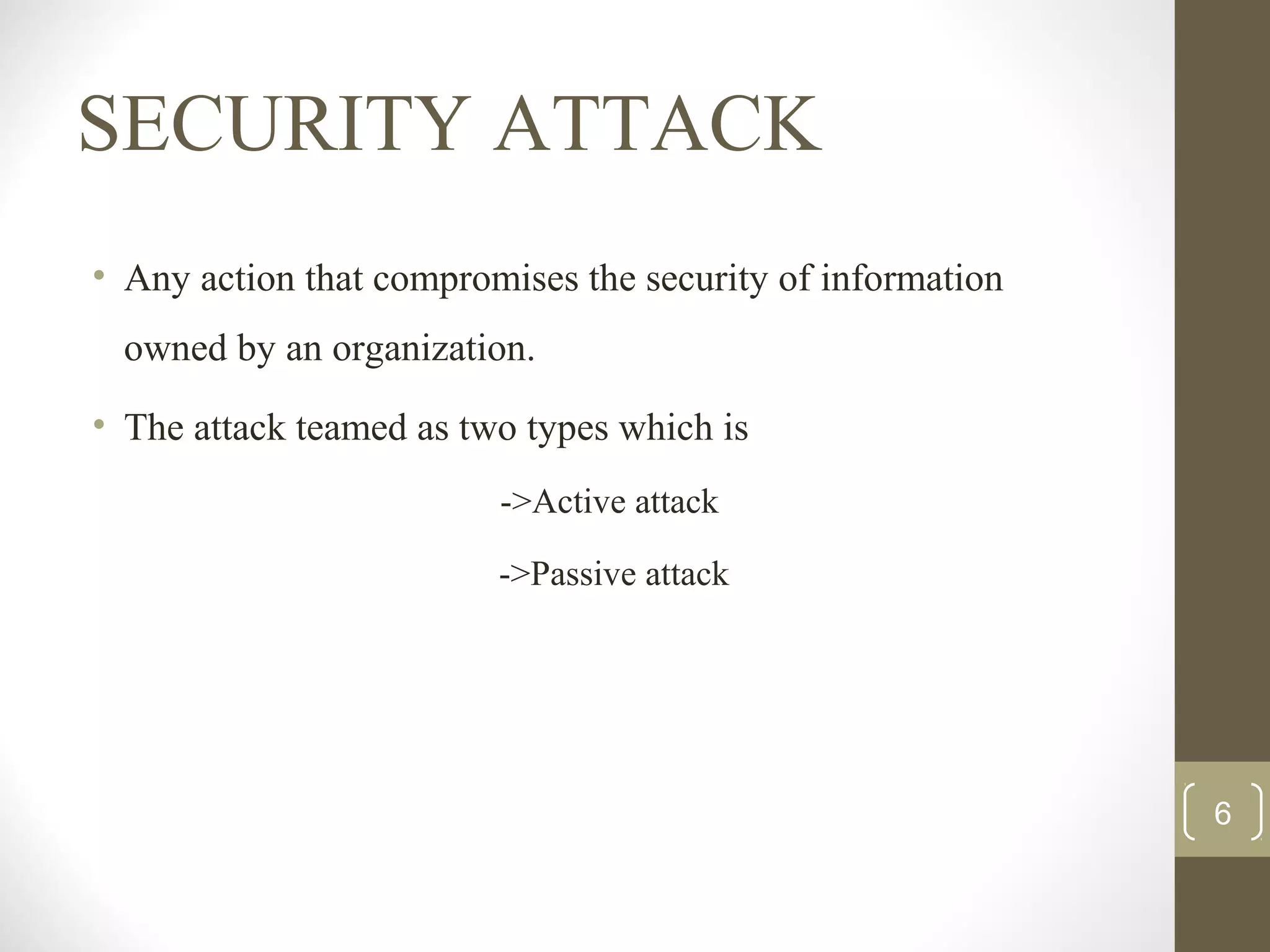
SECURITY ATTACK
• Any action that compromises the security of information
owned by an organization.
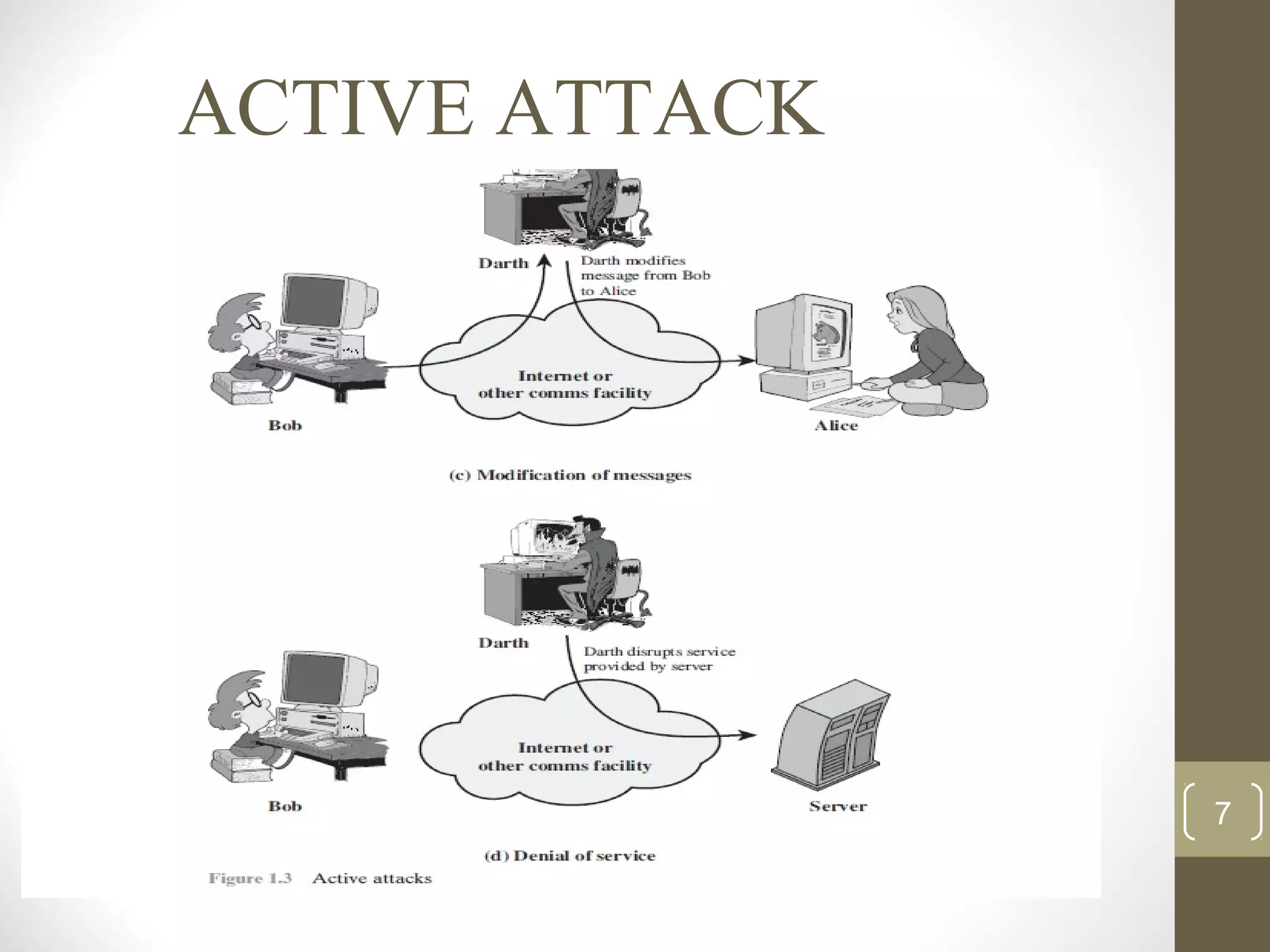
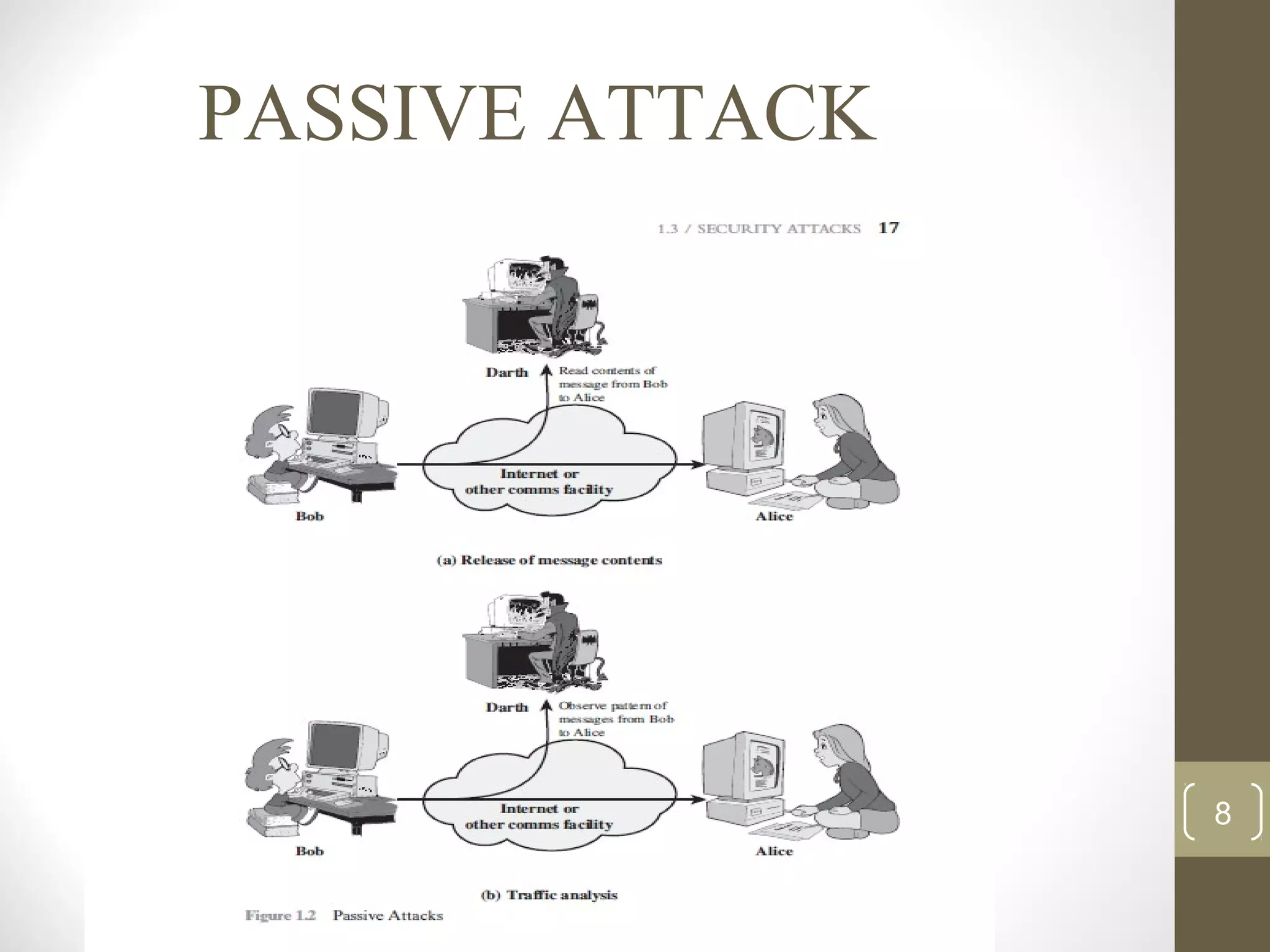
• The attack teamed as two types which is
->Active attack
->Passive attack
6
ACTIVE ATTACK
7
PASSIVE ATTACK
8
SECURITY MECHANISM
• The mechanisms are divided into those that are implemented in a
mechanism.
• It has specific protocol layer, such as TCP or an application-layer
protocol.
• That are not specific to any particular protocol layer or security
service either detect or prevent.
9
SECURITY SERVICES
• It is processing service or communication services mainly used for
protected the resources
• It is implemented by security mechanism
* Authentication
* Access control
* Data confidentiality
10
CLASSICAL ENCRYPTION
TECHNIQUES
• Symmetric encryption, also referred to as conventional encryption or single-
key encryption
• It was only type of encryption in use prior to the development of public key
encryption in the 1970s.
• It remains by far the most widely used of the two types of encryption.
-Symmetric
-Assymmetric
11
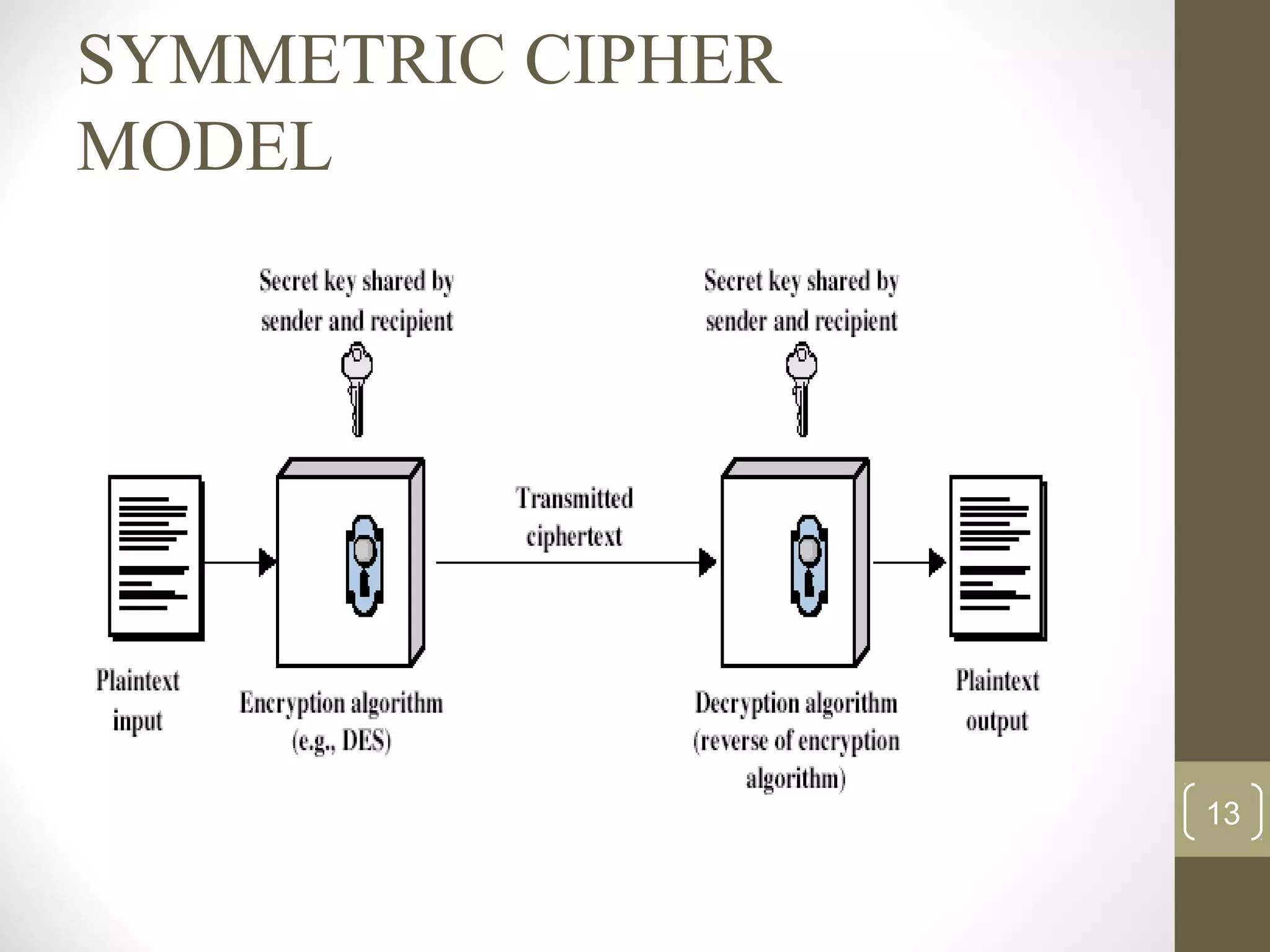
SYMMETRIC ALGORITHMS
• Symmetric algorithms are key-based algorithms that use the same
key for encryption and decryption.
• The Caesar cipher mentioned & Both block ciphers and stream
ciphers fall into this category
• Stream ciphers are symmetric algorithms that operate on plaintext
input one bit (or byte) at a time.
• Block ciphers are symmetric algorithms that operate on larger
blocks, usually 64 bits in size
12
SYMMETRIC CIPHER
MODEL
13
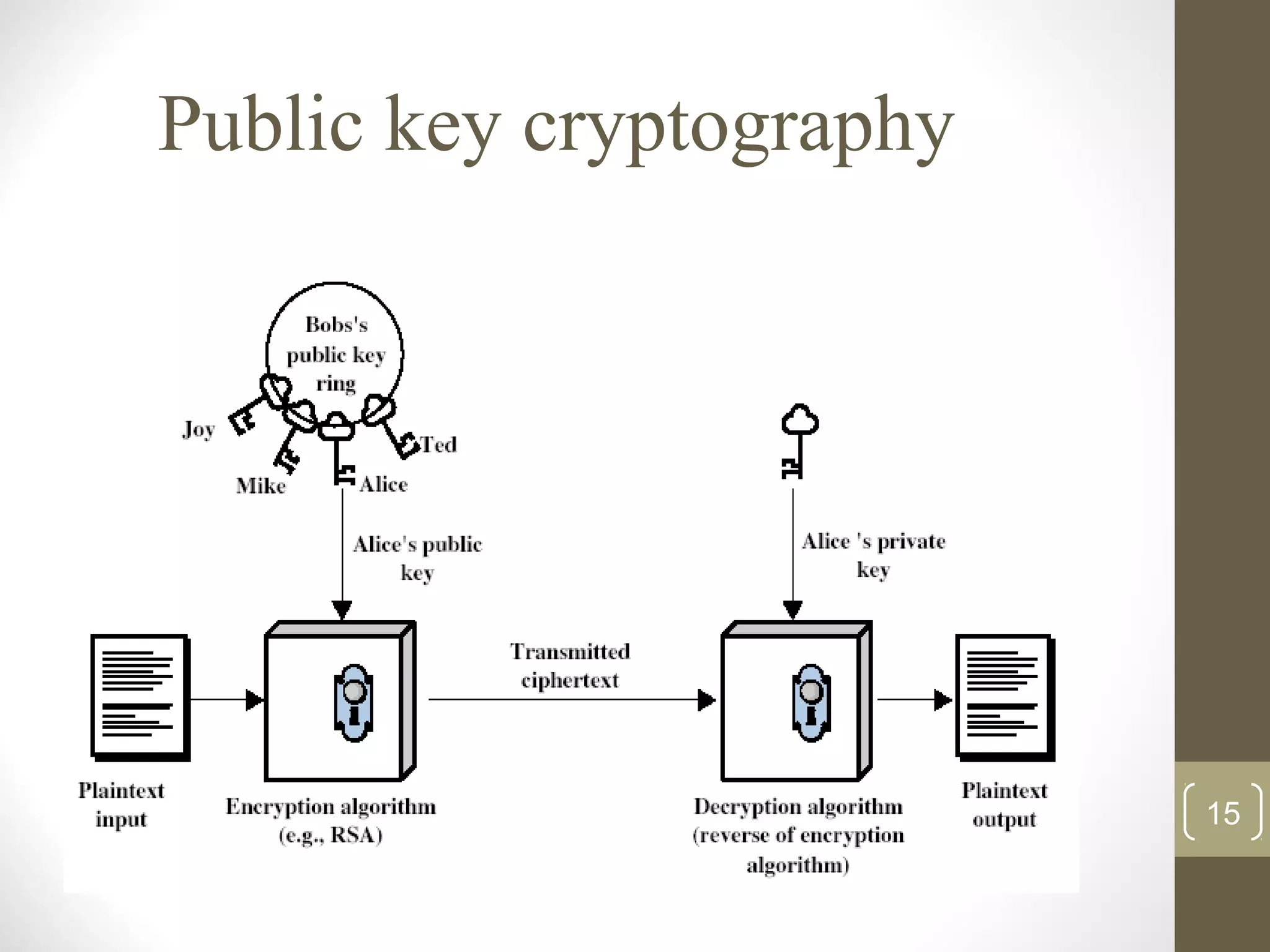
Public key cryptography
• public-key/two-key/asymmetric
cryptography involves the use of two keys:
• a public-key, which may be known by anybody,
and can be used to encrypt messages, and verify
signatures
• a private-key, known only to the recipient, used to
decrypt messages, and sign (create) signatures is
Asymmetric
• Because those who encrypt messages or verify
signatures cannot decrypt messages or create
signatures 14
Public key cryptography
15
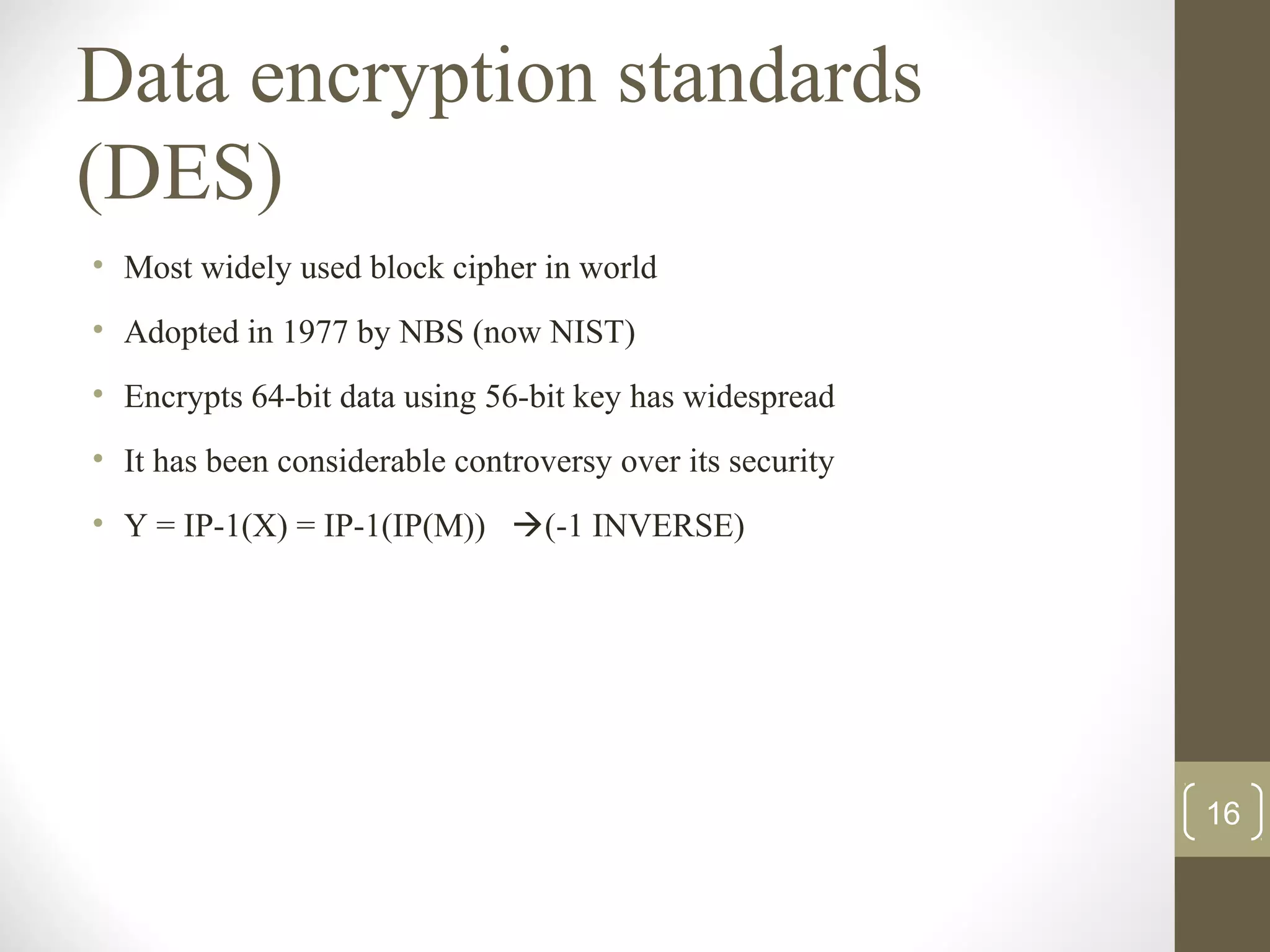
Data encryption standards
(DES)
• Most widely used block cipher in world
• Adopted in 1977 by NBS (now NIST)
• Encrypts 64-bit data using 56-bit key has widespread
• It has been considerable controversy over its security
• Y = IP-1(X) = IP-1(IP(M)) (-1 INVERSE)
16
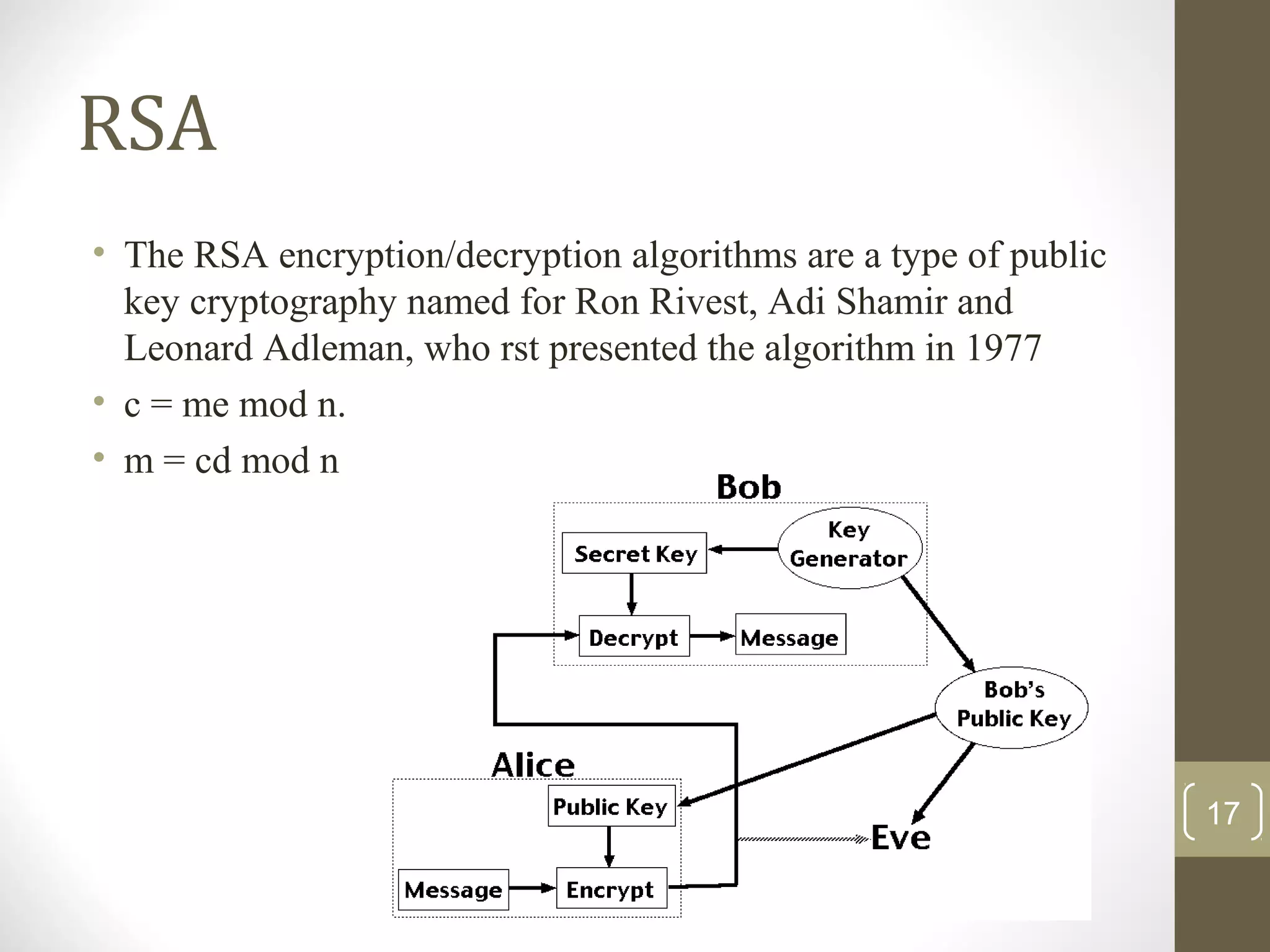
RSA
• The RSA encryption/decryption algorithms are a type of public
key cryptography named for Ron Rivest, Adi Shamir and
Leonard Adleman, who rst presented the algorithm in 1977
• c = me mod n.
• m = cd mod n
17
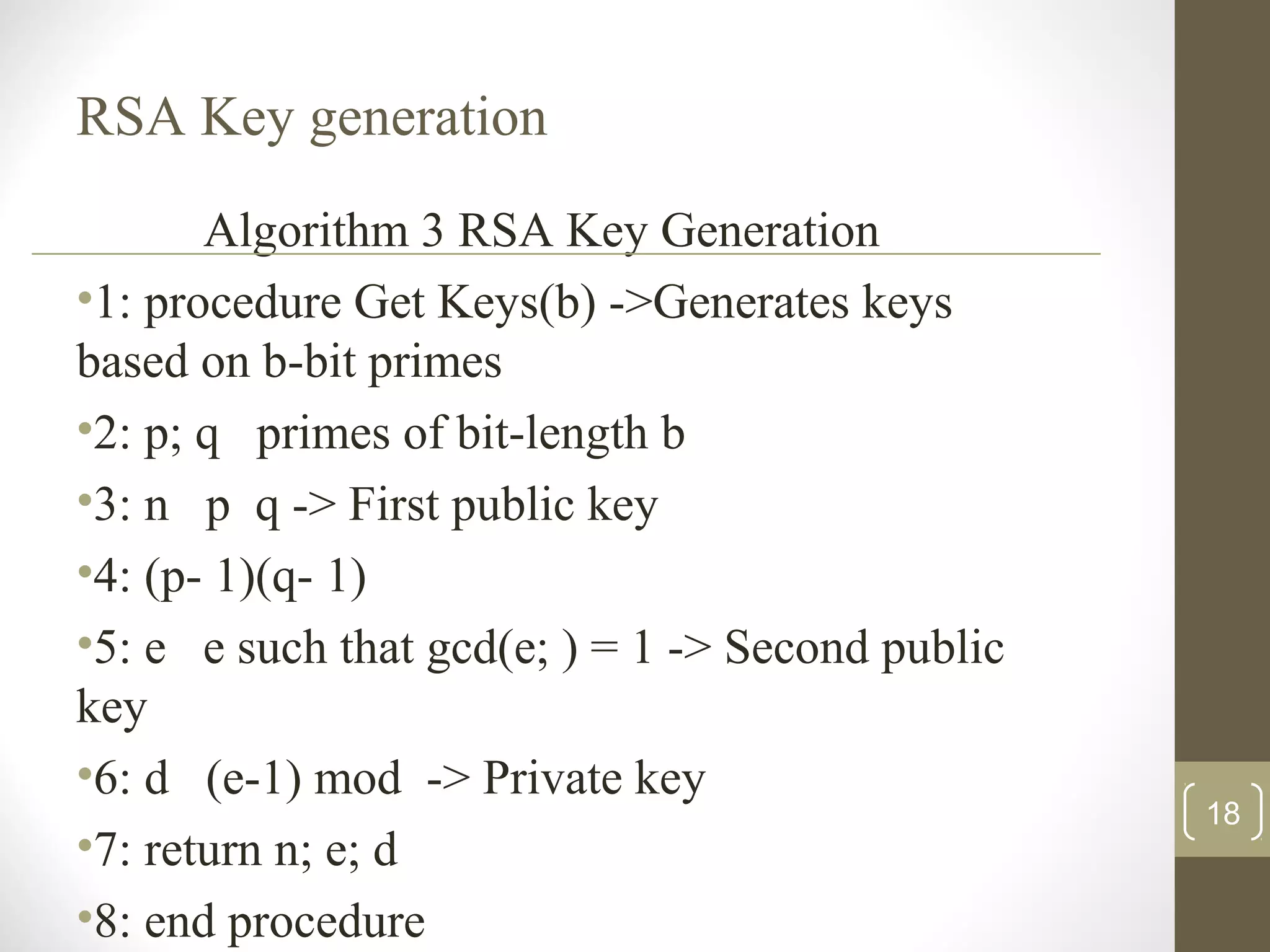
RSA Key generation
Algorithm 3 RSA Key Generation
•1: procedure Get Keys(b) ->Generates keys
based on b-bit primes
•2: p; q primes of bit-length b
•3: n p q -> First public key
•4: (p- 1)(q- 1)
•5: e e such that gcd(e; ) = 1 -> Second public
key
•6: d (e-1) mod -> Private key
•7: return n; e; d
•8: end procedure
18
CONCULSION
• The purpose of this research was to learn about cryptographic algorithms and to
analyze
• The efficiency of the RSA encryption algorithm when implemented with direct
subroutines and in direct languages.
• Future work could include implementing the algorithm in languages that better
allow bit-level manipulation, such as C.
19
THANK U
20

cryptography deepan fav subject

  • 1.
    A SURVEY OFCRYPTOGRAPHIC ALGORITHMS 1
  • 2.
    ABSTRACT • When surveya variety of cryptographic algorithms falling into four main categories: DES (block cipher), RC4 (stream cipher), SHA-1(hash) and RSA (public-key cryptography). • We are using cryptography method in this survey which is related to the security concepts. 2
  • 3.
    CRYPTOGRAPHY • Cryptographic algorithmsare a means of discreetly conveying secret information between one party and another. • The plaintext message is encrypted from sender side using a crypto-graphic algorithm and decrypted the plaintext to the receiver side. • This will encrypt and decrypt by using cipher text which is convert to duplicate message to hide the message from the hacker. 3
  • 4.
  • 5.
    APPROACHES • It isan systematic approach and it has 3segments contains > Security attack > Security mechanism > Security service 5
  • 6.
    SECURITY ATTACK • Anyaction that compromises the security of information owned by an organization. • The attack teamed as two types which is ->Active attack ->Passive attack 6
  • 7.
  • 8.
  • 9.
    SECURITY MECHANISM • Themechanisms are divided into those that are implemented in a mechanism. • It has specific protocol layer, such as TCP or an application-layer protocol. • That are not specific to any particular protocol layer or security service either detect or prevent. 9
  • 10.
    SECURITY SERVICES • Itis processing service or communication services mainly used for protected the resources • It is implemented by security mechanism * Authentication * Access control * Data confidentiality 10
  • 11.
    CLASSICAL ENCRYPTION TECHNIQUES • Symmetricencryption, also referred to as conventional encryption or single- key encryption • It was only type of encryption in use prior to the development of public key encryption in the 1970s. • It remains by far the most widely used of the two types of encryption. -Symmetric -Assymmetric 11
  • 12.
    SYMMETRIC ALGORITHMS • Symmetricalgorithms are key-based algorithms that use the same key for encryption and decryption. • The Caesar cipher mentioned & Both block ciphers and stream ciphers fall into this category • Stream ciphers are symmetric algorithms that operate on plaintext input one bit (or byte) at a time. • Block ciphers are symmetric algorithms that operate on larger blocks, usually 64 bits in size 12
  • 13.
  • 14.
    Public key cryptography •public-key/two-key/asymmetric cryptography involves the use of two keys: • a public-key, which may be known by anybody, and can be used to encrypt messages, and verify signatures • a private-key, known only to the recipient, used to decrypt messages, and sign (create) signatures is Asymmetric • Because those who encrypt messages or verify signatures cannot decrypt messages or create signatures 14
  • 15.
  • 16.
    Data encryption standards (DES) •Most widely used block cipher in world • Adopted in 1977 by NBS (now NIST) • Encrypts 64-bit data using 56-bit key has widespread • It has been considerable controversy over its security • Y = IP-1(X) = IP-1(IP(M)) (-1 INVERSE) 16
  • 17.
    RSA • The RSAencryption/decryption algorithms are a type of public key cryptography named for Ron Rivest, Adi Shamir and Leonard Adleman, who rst presented the algorithm in 1977 • c = me mod n. • m = cd mod n 17
  • 18.
    RSA Key generation Algorithm3 RSA Key Generation •1: procedure Get Keys(b) ->Generates keys based on b-bit primes •2: p; q primes of bit-length b •3: n p q -> First public key •4: (p- 1)(q- 1) •5: e e such that gcd(e; ) = 1 -> Second public key •6: d (e-1) mod -> Private key •7: return n; e; d •8: end procedure 18
  • 19.
    CONCULSION • The purposeof this research was to learn about cryptographic algorithms and to analyze • The efficiency of the RSA encryption algorithm when implemented with direct subroutines and in direct languages. • Future work could include implementing the algorithm in languages that better allow bit-level manipulation, such as C. 19
  • 20.