Lecture 2
Classical Cryptosystems
        Shift cipher
     Substitution cipher
      Vigenère cipher
         Hill cipher

                           1
Shift Cipher
• A Substitution Cipher
• The Key Space:
   – [0 … 25]
• Encryption given a key K:
   – each letter in the plaintext P is replaced with the K’th
     letter following the corresponding number (shift
     right)
• Decryption given K:
   – shift left
• History: K = 3, Caesar’s cipher

                                                                2
Shift Cipher
• Formally:
• Let P=C=K=Z26 For 0≤K≤25
      ek(x) = x+K mod 26
  and
      dk(y) = y-K mod 26

  ሺ‫ܼ ∈ ݕ ,ݔ‬ଶ଺ ሻ


                                 3
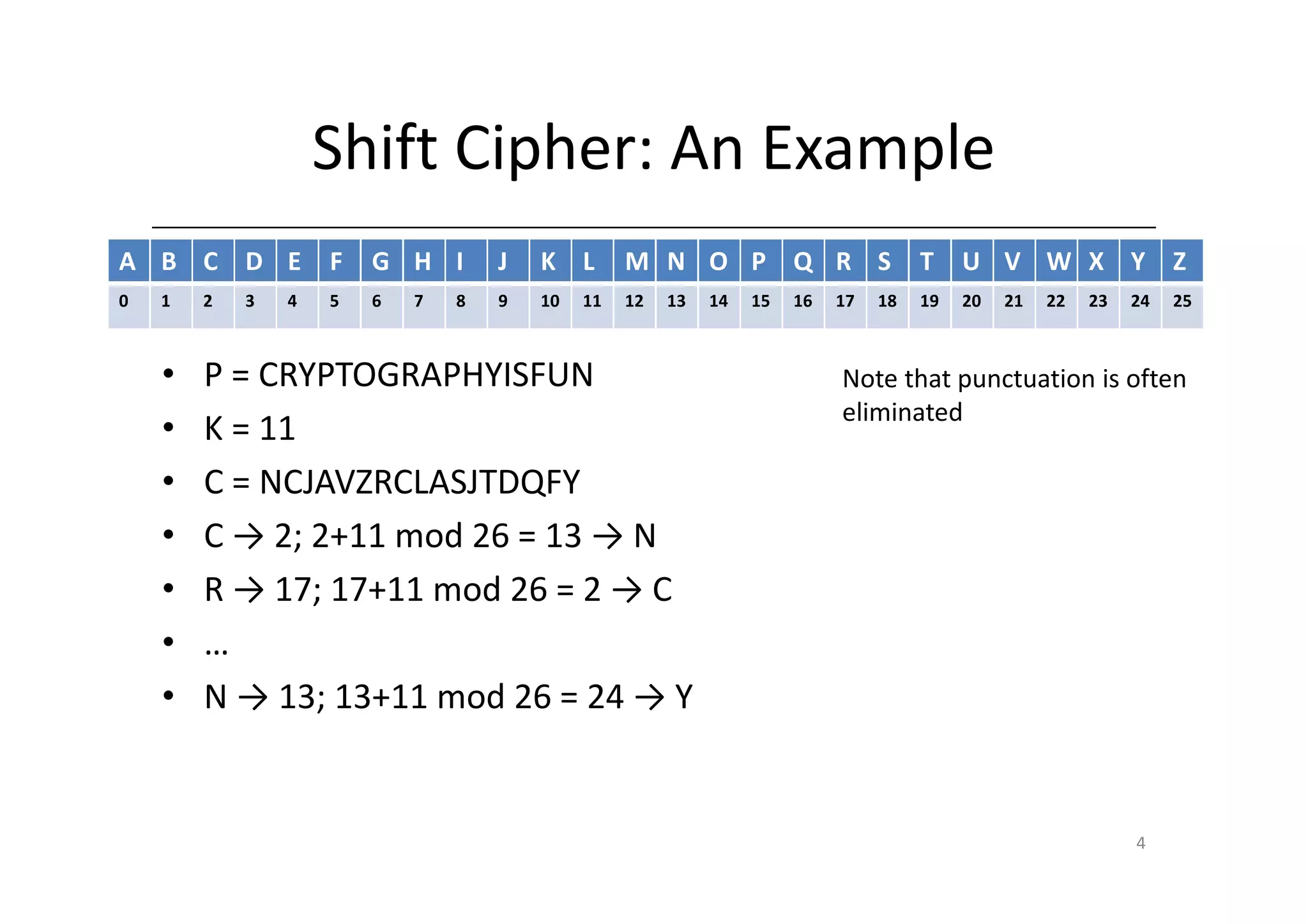
Shift Cipher: An Example
A B C D E           F   G H I       J   K L       M N O P Q R S                      T    U V W X Y Z
0   1   2   3   4   5   6   7   8   9   10   11   12   13   14   15   16   17   18   19   20   21   22   23   24   25


    •   P = CRYPTOGRAPHYISFUN                                              Note that punctuation is often
                                                                           eliminated
    •   K = 11
    •   C = NCJAVZRCLASJTDQFY
    •   C → 2; 2+11 mod 26 = 13 → N
    •   R → 17; 17+11 mod 26 = 2 → C
    •   …
    •   N → 13; 13+11 mod 26 = 24 → Y


                                                                                                              4
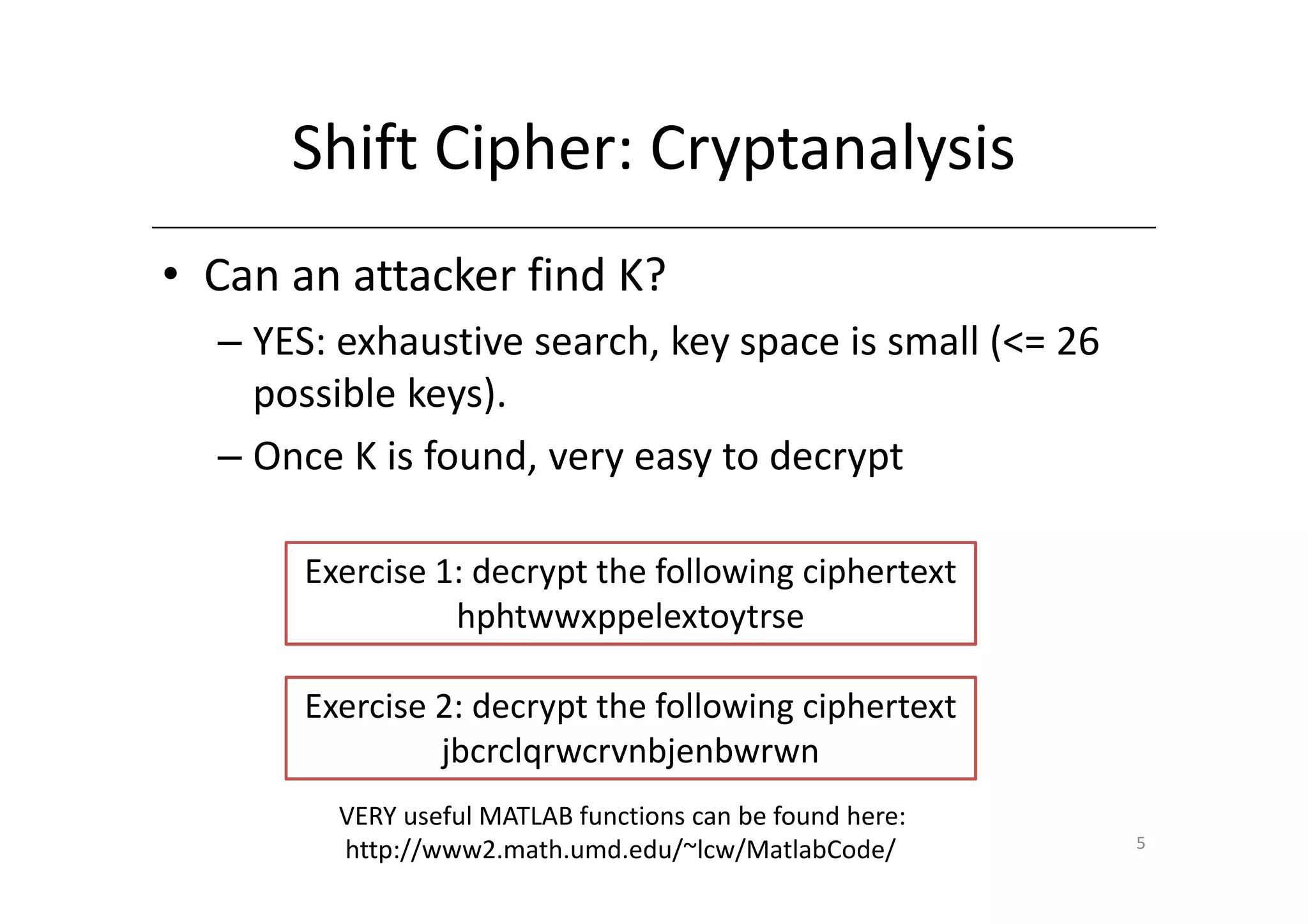
Shift Cipher: Cryptanalysis
• Can an attacker find K?
  – YES: exhaustive search, key space is small (<= 26
    possible keys).
  – Once K is found, very easy to decrypt

       Exercise 1: decrypt the following ciphertext
                 hphtwwxppelextoytrse

       Exercise 2: decrypt the following ciphertext
                jbcrclqrwcrvnbjenbwrwn
         VERY useful MATLAB functions can be found here:
                                                           5
         http://www2.math.umd.edu/~lcw/MatlabCode/
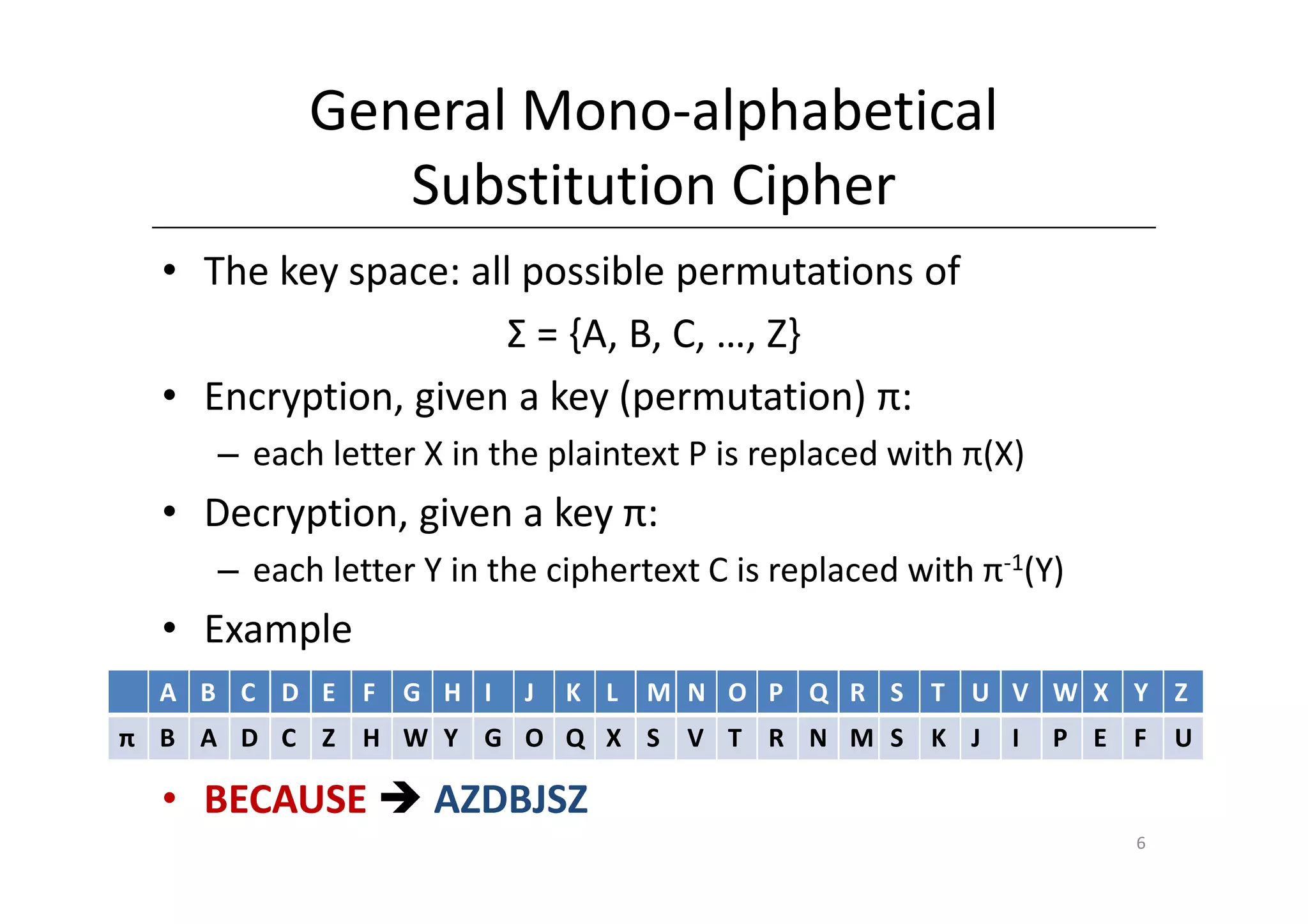
General Mono-alphabetical
              Substitution Cipher
  • The key space: all possible permutations of
                      Σ = {A, B, C, …, Z}
  • Encryption, given a key (permutation) π:
     – each letter X in the plaintext P is replaced with π(X)
  • Decryption, given a key π:
     – each letter Y in the ciphertext C is replaced with π-1(Y)
  • Example
  A B C D E F G H I       J   K L   M N O P Q R S T U V W X Y Z
π B A D C Z H W Y G O Q X S V T R N M S K J                 I   P E F U

  • BECAUSE         AZDBJSZ
                                                                    6
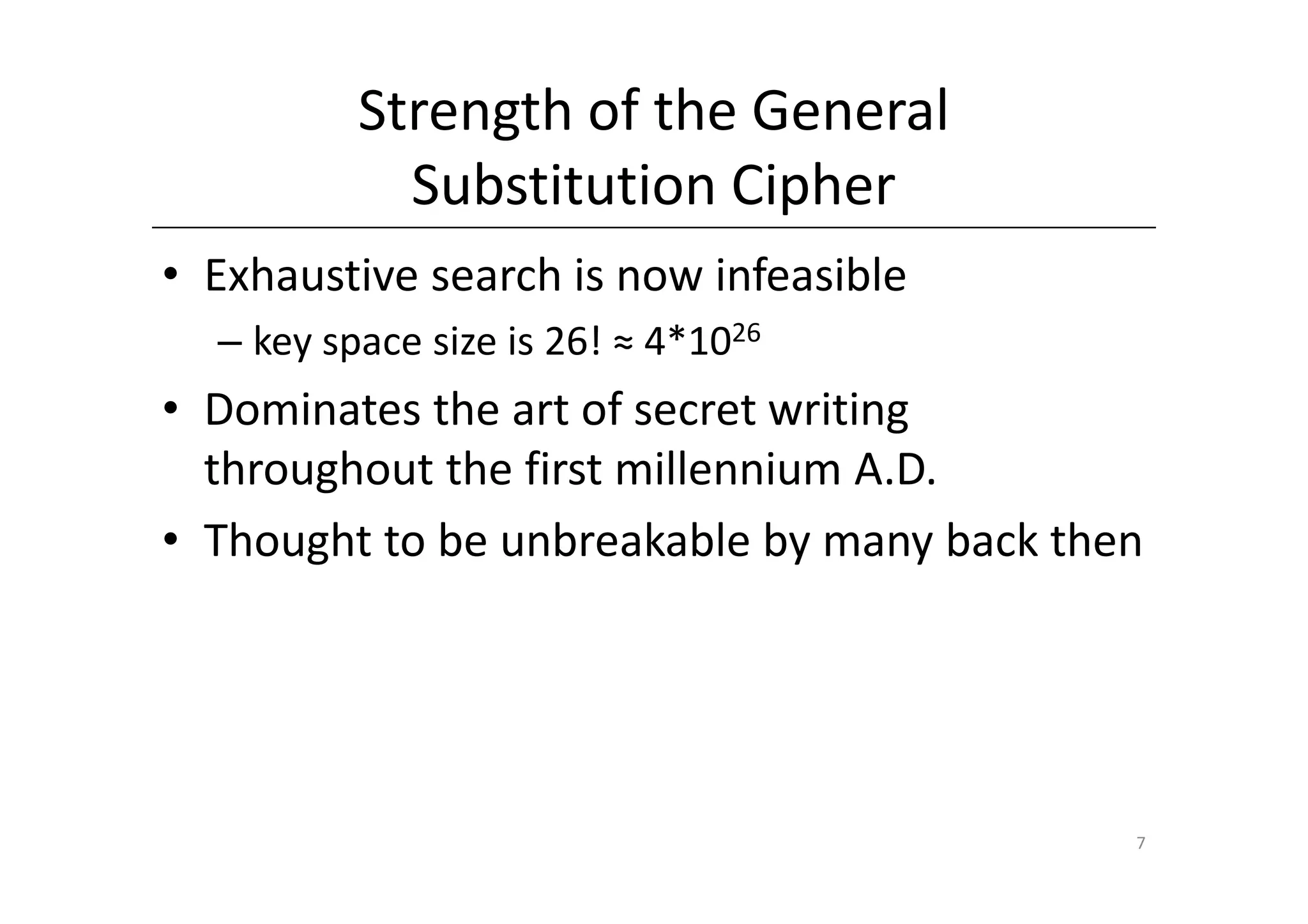
Strength of the General
            Substitution Cipher
• Exhaustive search is now infeasible
  – key space size is 26! ≈ 4*1026
• Dominates the art of secret writing
  throughout the first millennium A.D.
• Thought to be unbreakable by many back then


                                            7
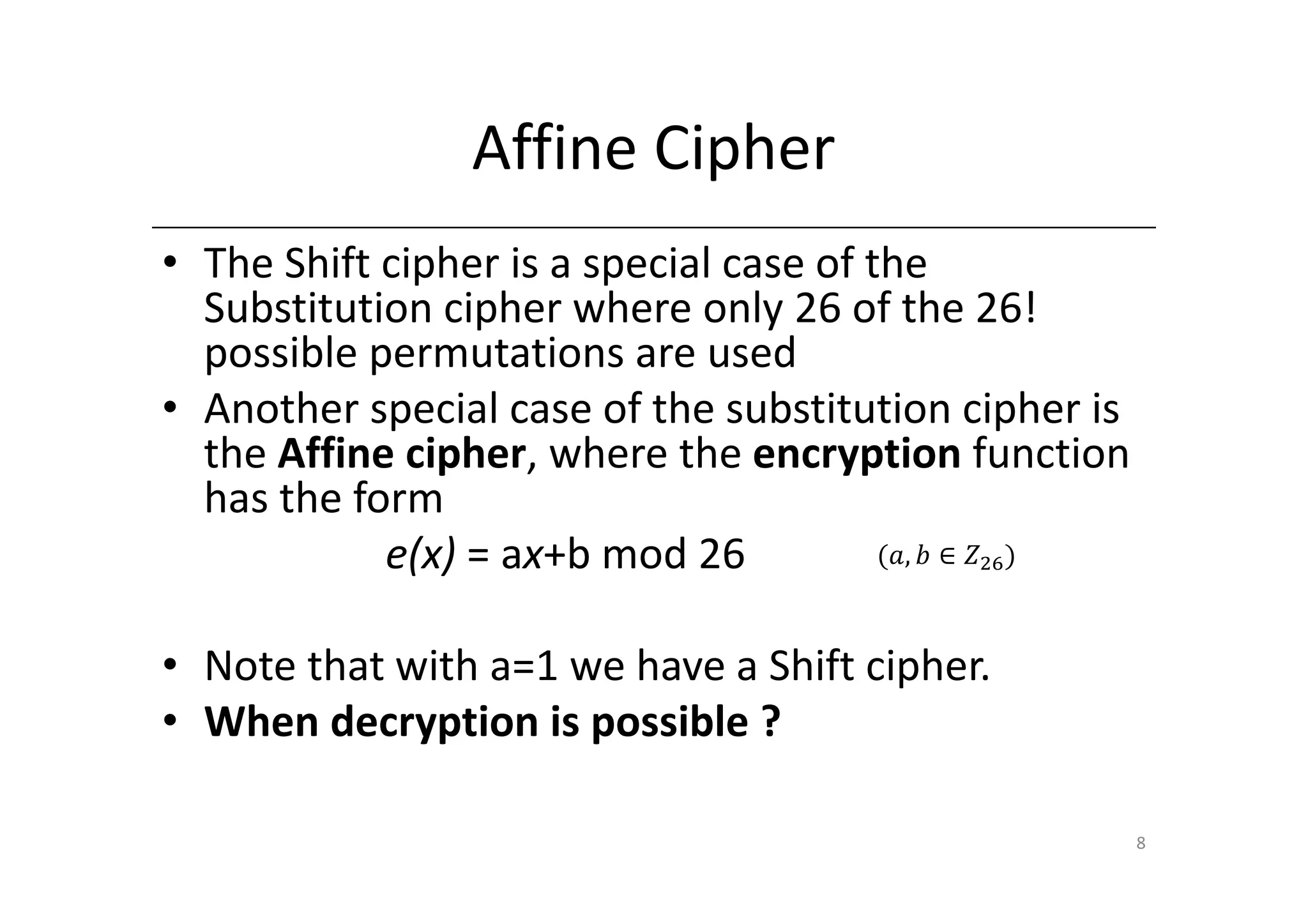
Affine Cipher
• The Shift cipher is a special case of the
  Substitution cipher where only 26 of the 26!
  possible permutations are used
• Another special case of the substitution cipher is
  the Affine cipher, where the encryption function
  has the form
            e(x) = ax+b mod 26           ሺܽ, ܾ ∈ ܼଶ଺ ሻ


• Note that with a=1 we have a Shift cipher.
• When decryption is possible ?

                                                         8
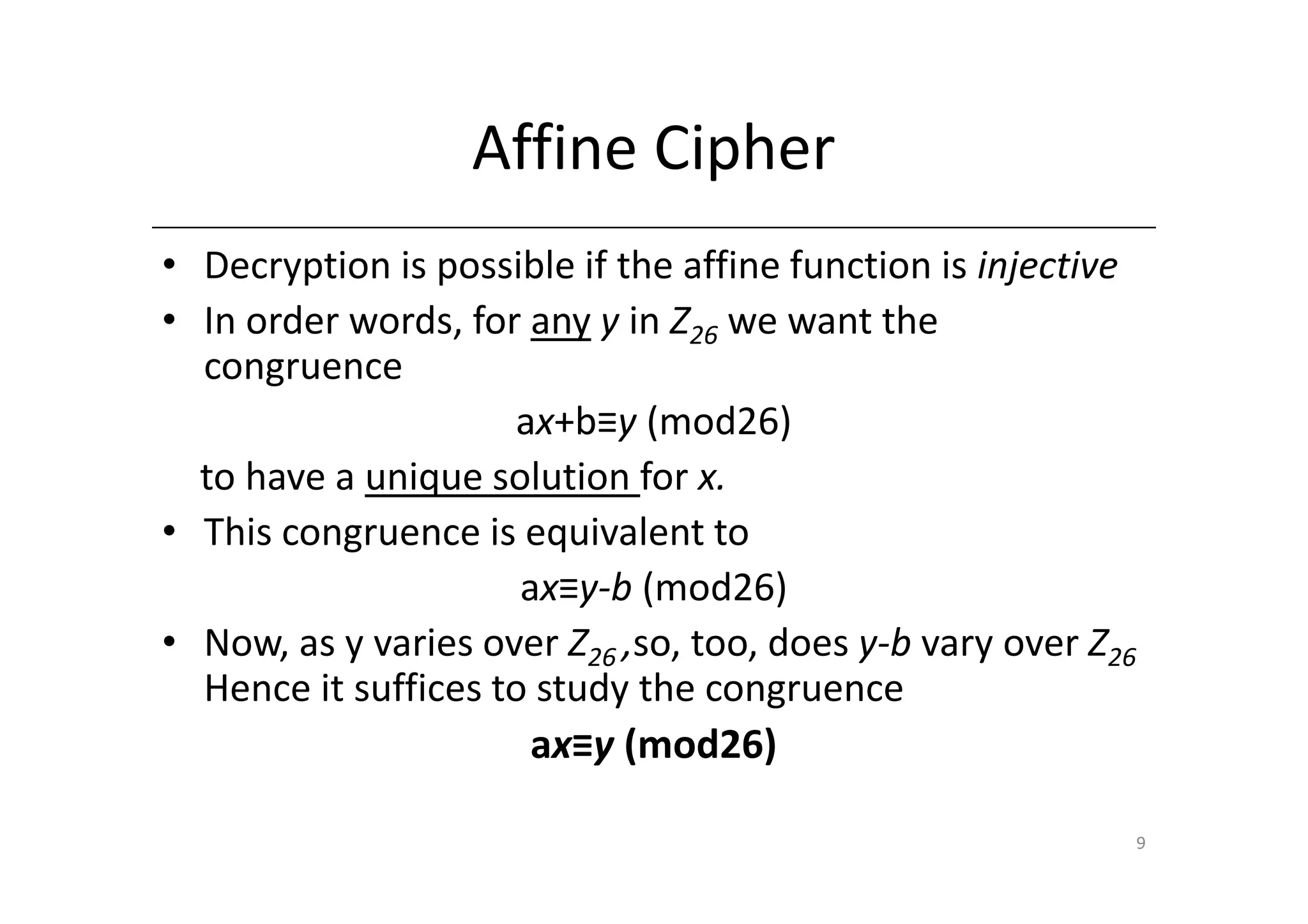
Affine Cipher
• Decryption is possible if the affine function is injective
• In order words, for any y in Z26 we want the
  congruence
                     ax+b≡y (mod26)
  to have a unique solution for x.
• This congruence is equivalent to
                      ax≡y-b (mod26)
• Now, as y varies over Z26 ,so, too, does y-b vary over Z26
  Hence it suffices to study the congruence
                       ax≡y (mod26)

                                                               9
Affine Cipher
                       ax≡y (mod26)
• This congruence has a unique solution for every y if and
  only if gcd(a,26)=1 (i.e.: a and 26 are relatively prime)
• gcd=greatest common divisor

• Suppose that gcd(a,26)=d>1
      for example gcd(4,26)=2
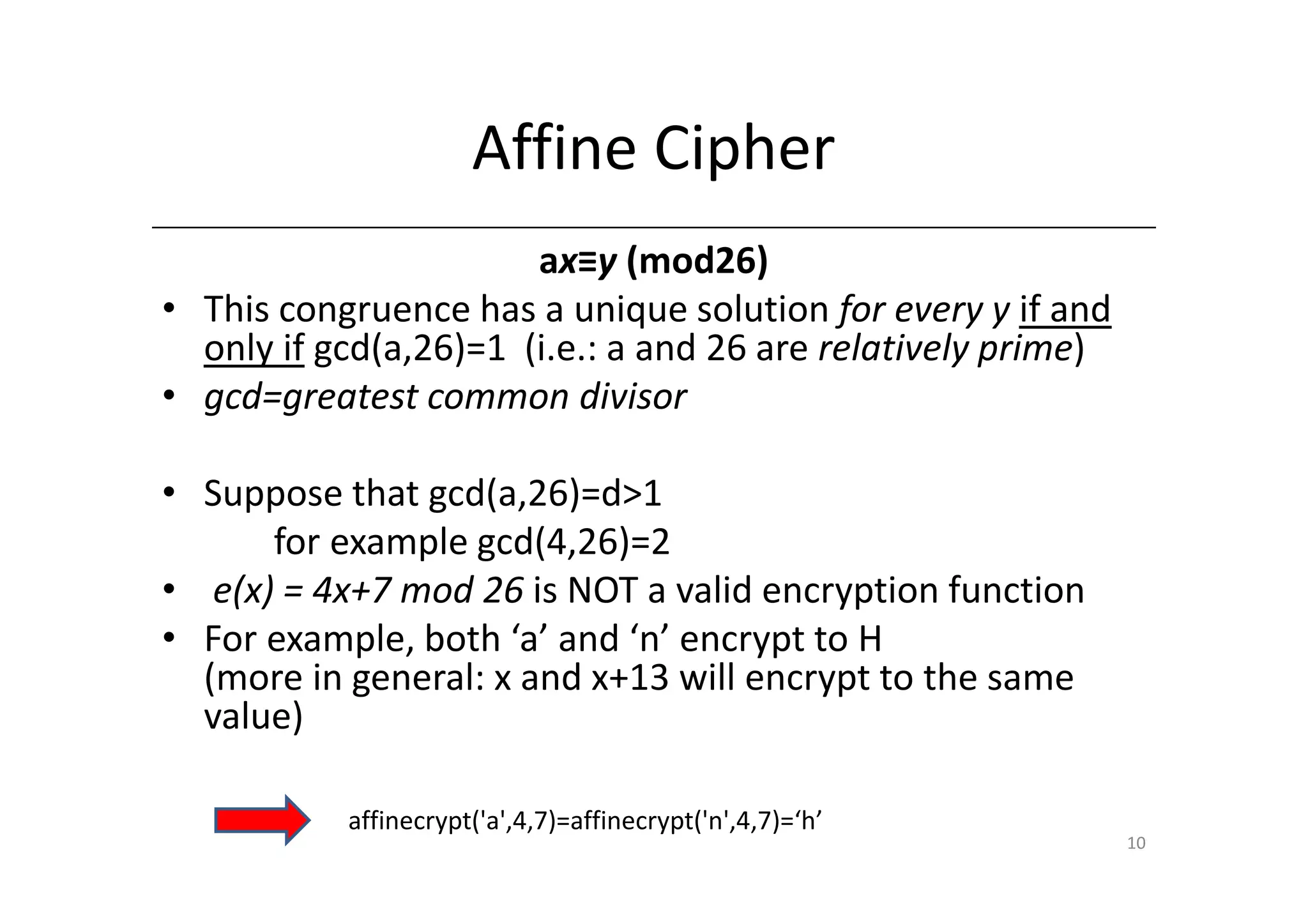
• e(x) = 4x+7 mod 26 is NOT a valid encryption function
• For example, both ‘a’ and ‘n’ encrypt to H
  (more in general: x and x+13 will encrypt to the same
  value)

           affinecrypt('a',4,7)=affinecrypt('n',4,7)=‘h’
                                                              10
Cryptanalysis of Substitution Ciphers:
         Frequency Analysis
• Basic ideas:
  – Each language has certain features: frequency of
    letters, or of groups of two or more letters.
  – Substitution ciphers preserve the language
    features.
  – Substitution ciphers are vulnerable to frequency
    analysis attacks.


                                                       11
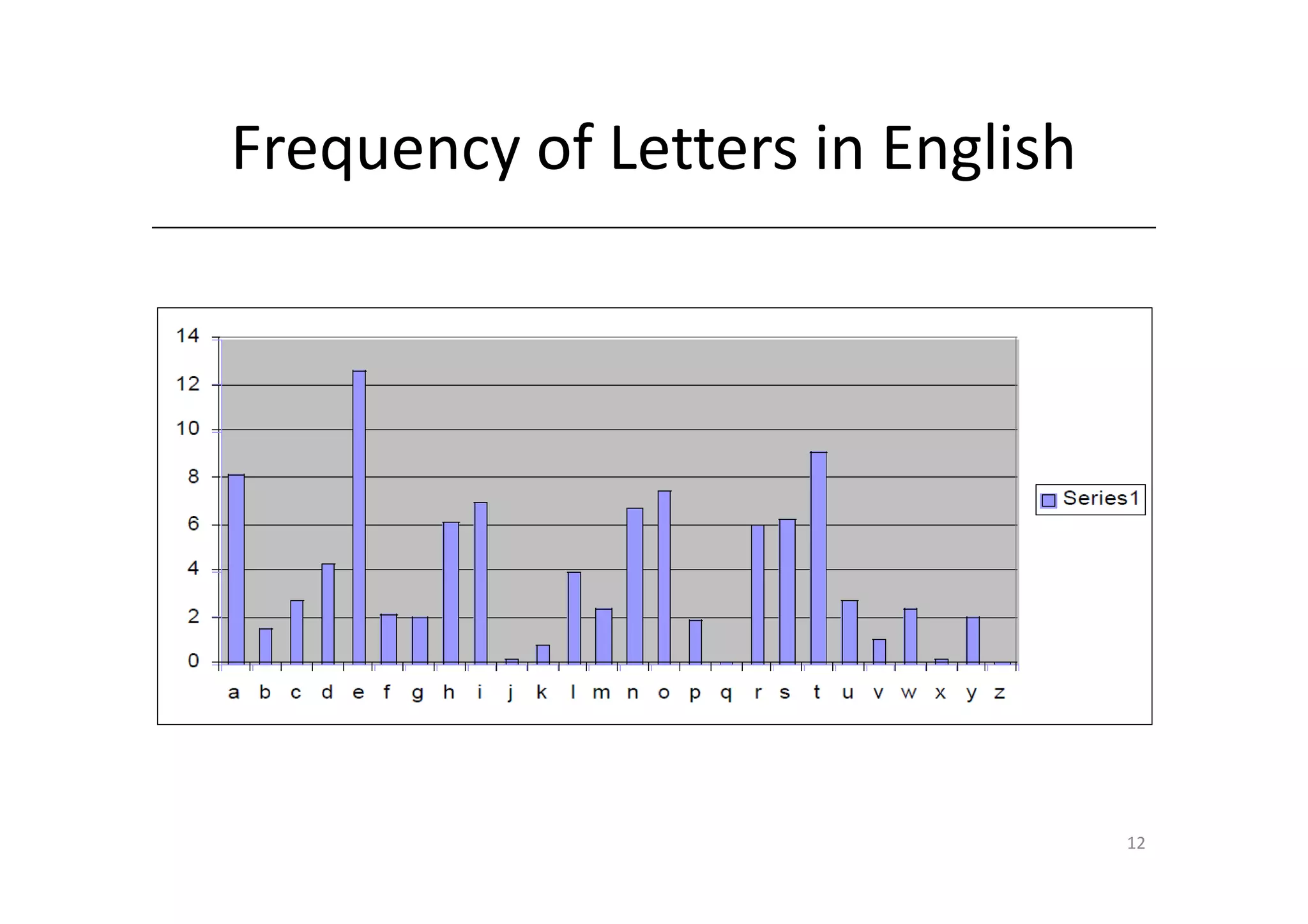
Frequency of Letters in English


                                  12
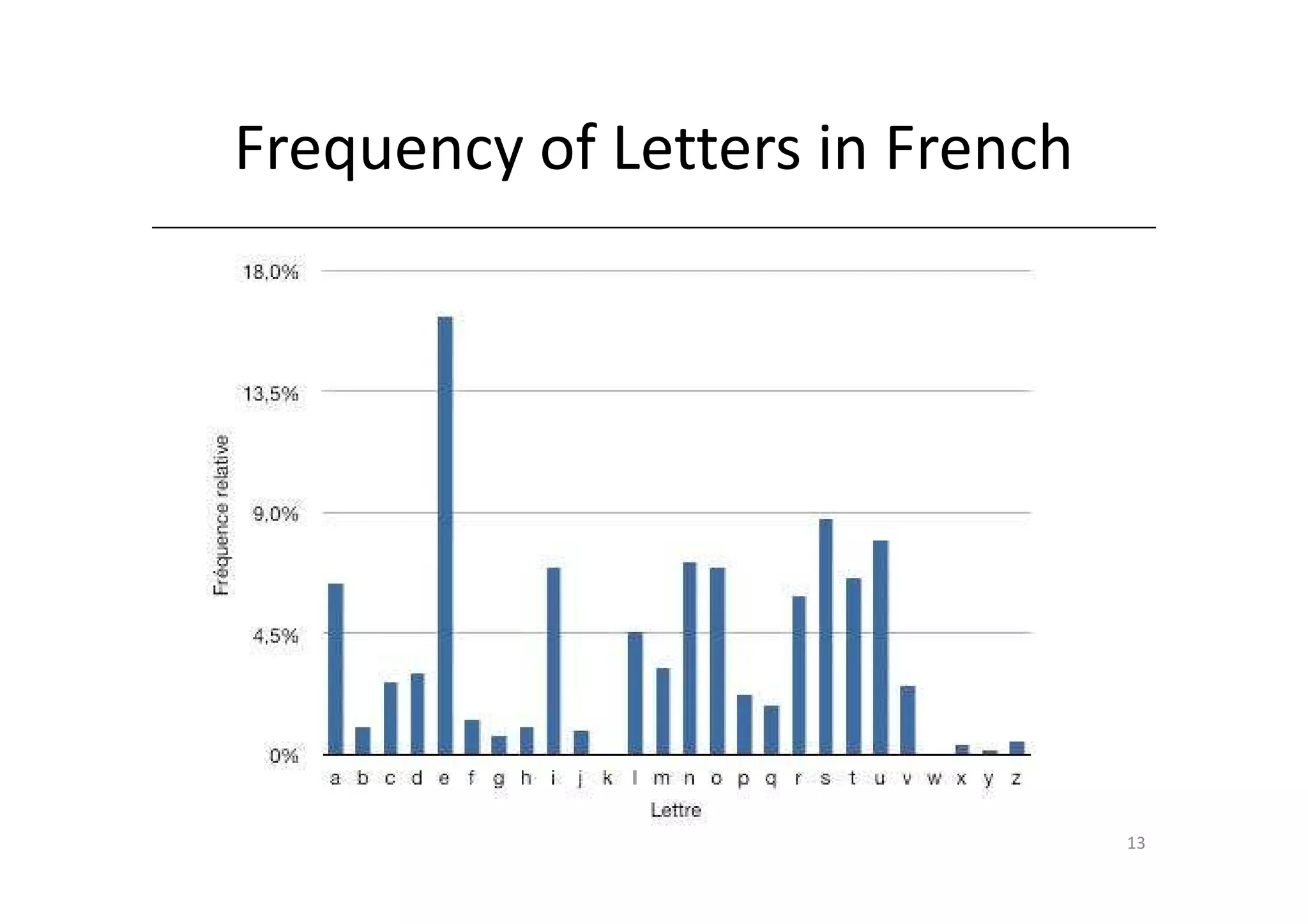
Frequency of Letters in French


                                 13
Other Frequency Features of English
• Vowels, which constitute 40 % of plaintext, are
  often separated by consonants.
• Letter “A” is often found in the beginning of a
  word or second from last.
• Letter “I” is often third from the end of a
  word.
• Letter “Q” is followed only by “U”
• And more …
                                                14
Substitution Ciphers: Cryptanalysis
• The number of different ciphertext characters
  or combinations are counted to determine the
  frequency of usage.
• The cipher text is examined for patterns,
  repeated series, and common combinations.
• Replace ciphertext characters with possible
  plaintext equivalents using known language
  characteristics

                                              15
Frequency Analysis History
• Earliest known description of frequency
  analysis is in a book by the ninth-century
  scientist al-Kindi
• Rediscovered or introduced in Europe during
  the Renaissance
• Frequency analysis made substitution cipher
  insecure


                                                16
Improve the Security of the
           Substitution Cipher
• Using nulls
  – e.g., using numbers from 1 to 99 as the ciphertext
    alphabet, some numbers representing nothing are
    inserted randomly
• Deliberately misspell words
  – e.g., “Thys haz thi ifekkt off diztaughting thi ballans off
    frikwenseas”
• Homophonic substitution cipher
  – each letter is replaced by a variety of substitutes
• These make frequency analysis more difficult, but
  not impossible

                                                             17
Summary
• Shift ciphers are easy to break using brute
  force attacks, they have small key space.
• Substitution ciphers preserve language
  features and are vulnerable to frequency
  analysis attacks.


                                                18
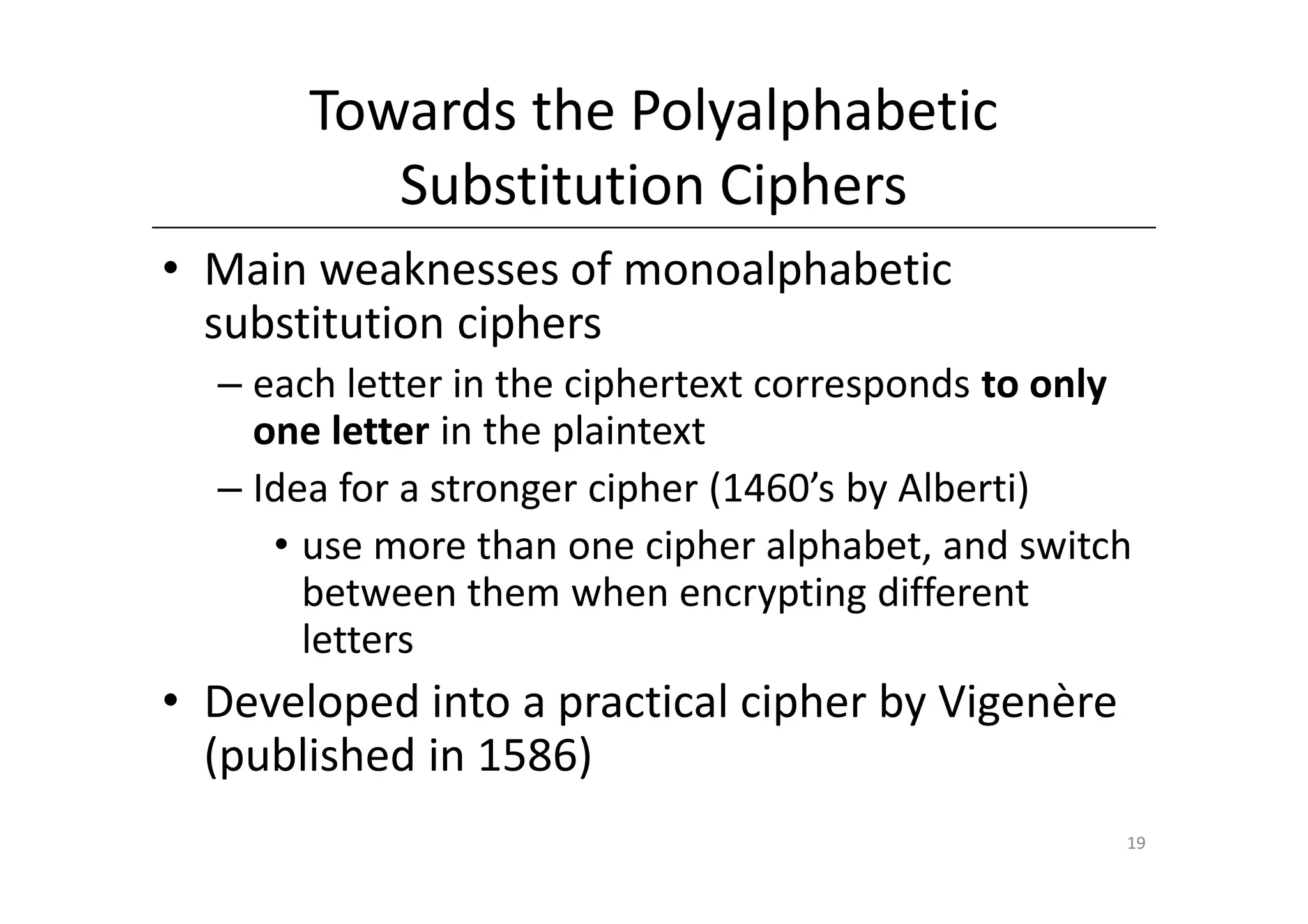
Towards the Polyalphabetic
          Substitution Ciphers
• Main weaknesses of monoalphabetic
  substitution ciphers
  – each letter in the ciphertext corresponds to only
    one letter in the plaintext
  – Idea for a stronger cipher (1460’s by Alberti)
     • use more than one cipher alphabet, and switch
       between them when encrypting different
       letters
• Developed into a practical cipher by Vigenère
  (published in 1586)
                                                    19
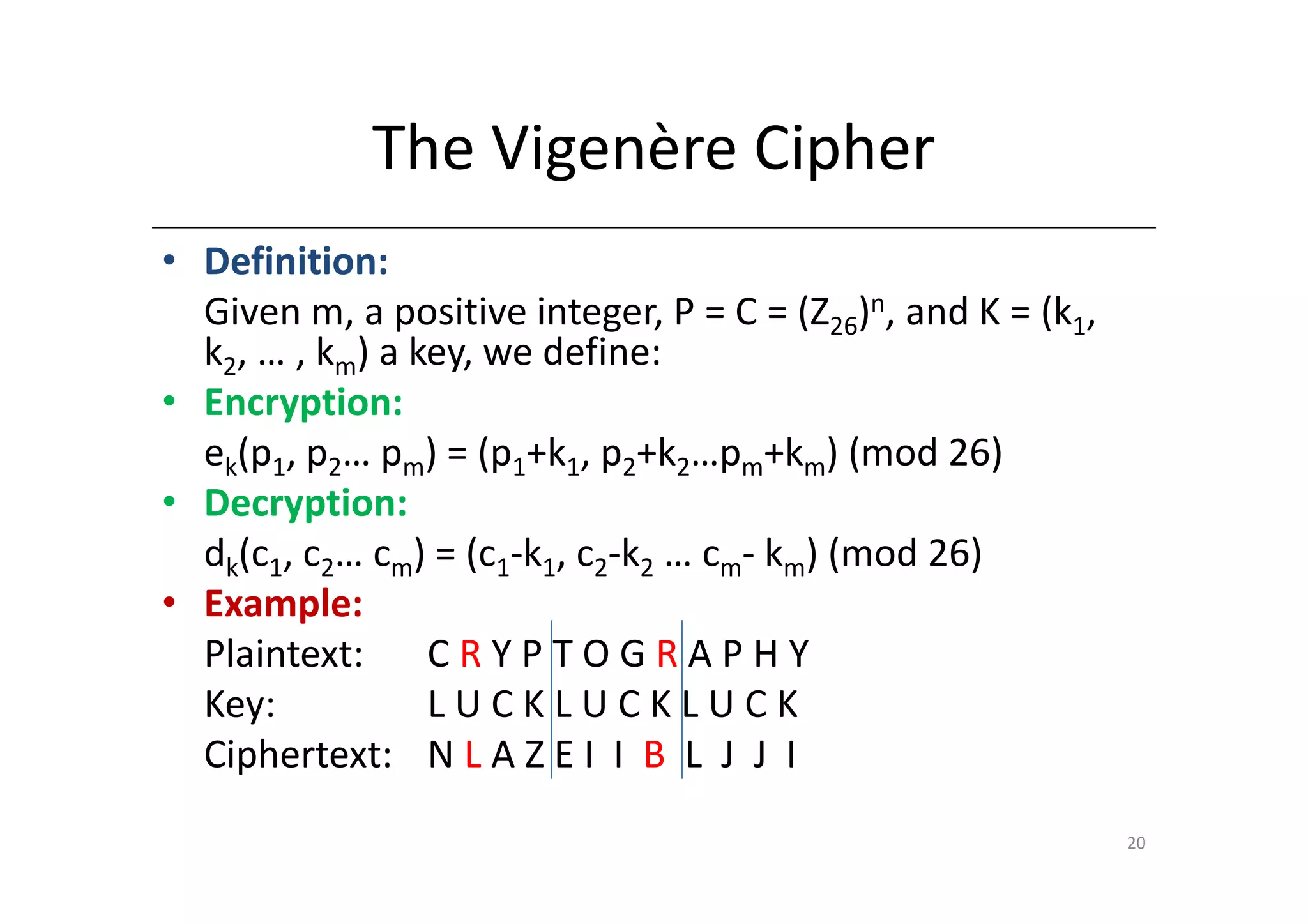
The Vigenère Cipher
• Definition:
  Given m, a positive integer, P = C = (Z26)n, and K = (k1,
  k2, … , km) a key, we define:
• Encryption:
  ek(p1, p2… pm) = (p1+k1, p2+k2…pm+km) (mod 26)
• Decryption:
  dk(c1, c2… cm) = (c1-k1, c2-k2 … cm- km) (mod 26)
• Example:
  Plaintext:     CRYPTOGRAPHY
  Key:           LUCKLUCKLUCK
  Ciphertext: N L A Z E I I B L J J I
                                                              20
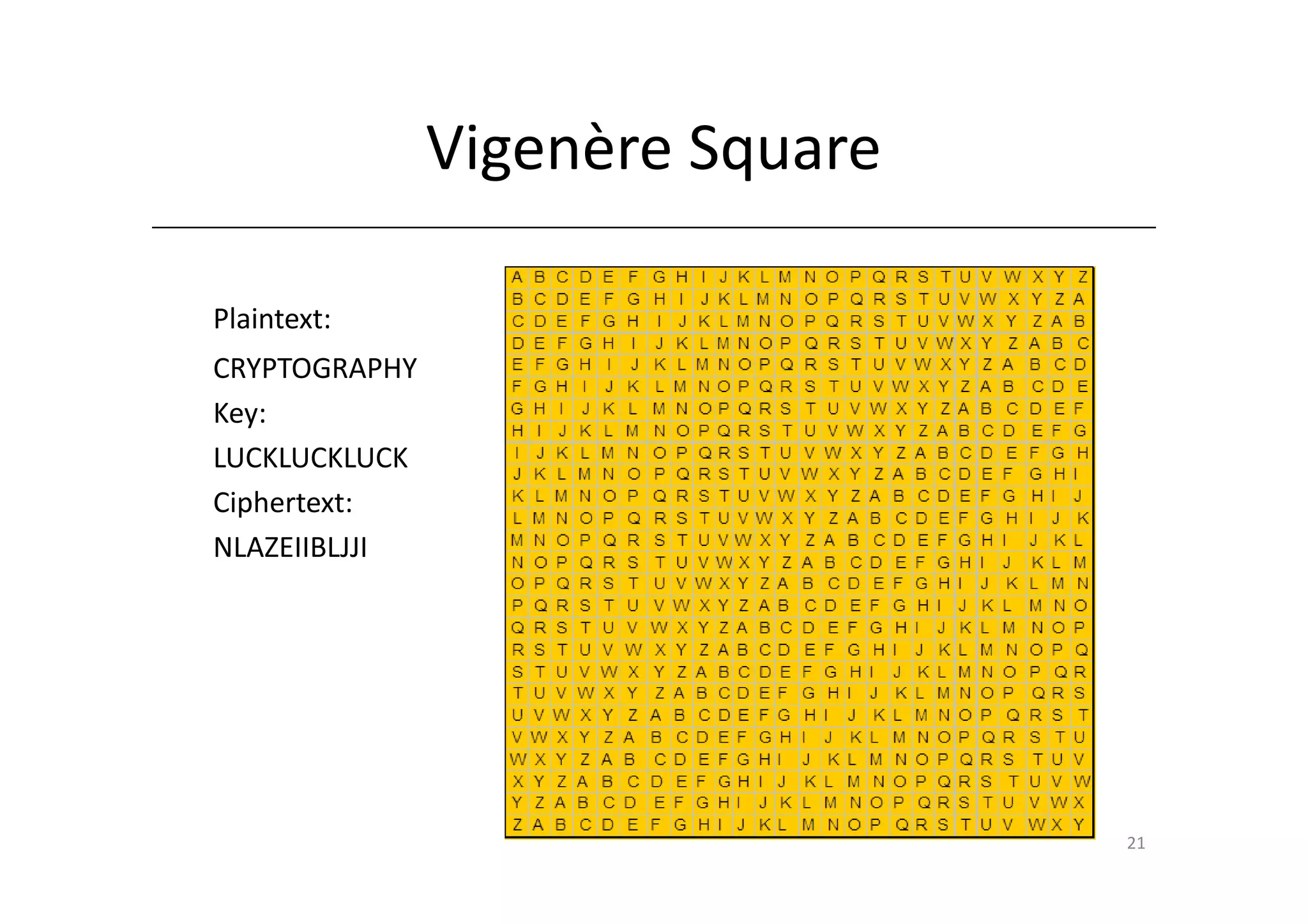
Vigenère Square

Plaintext:
CRYPTOGRAPHY
Key:
LUCKLUCKLUCK
Ciphertext:
NLAZEIIBLJJI


                                 21
Security of Vigenere Cipher
• Vigenere masks the frequency with which a
  character appears in a language: one letter in
  the ciphertext corresponds to multiple letters
  in the plaintext. Makes the use of frequency
  analysis more difficult.
• Any message encrypted by a Vigenere cipher
  is a collection of as many shift ciphers as there
  are letters in the key.

                                                  22
Vigenere Cipher: Cryptanalysis
• Find the length of the key.
• Divide the message into that many shift cipher
  encryptions.
• Use frequency analysis to solve the resulting
  shift ciphers.
  – how?


                                               23
How to Find the Key Length?
• For Vigenere, as the length of the keyword
  increases, the letter frequency shows less
  English (or French)-like characteristics and
  becomes more random (when key length ->
  infinite, see One Time Pad).
• Two methods to find the key length:
  – Kasisky test
  – Index of coincidence (Friedman)

                                                 24
Kasisky Test
• (First described in 1863 by Friedrich Kasiski)
• Note: two identical segments of plaintext, will be
  encrypted to the same ciphertext, if they occur in
  the text at a distance Δ, (Δ≡0 (mod m), m is the
  key length).
• Algorithm:
  – Search for pairs of identical segments of length at
    least 3
  – Record distances between the two segments: Δ1, Δ2,
    …
  – m divides gcd(Δ1, Δ2, …)

                                                          25
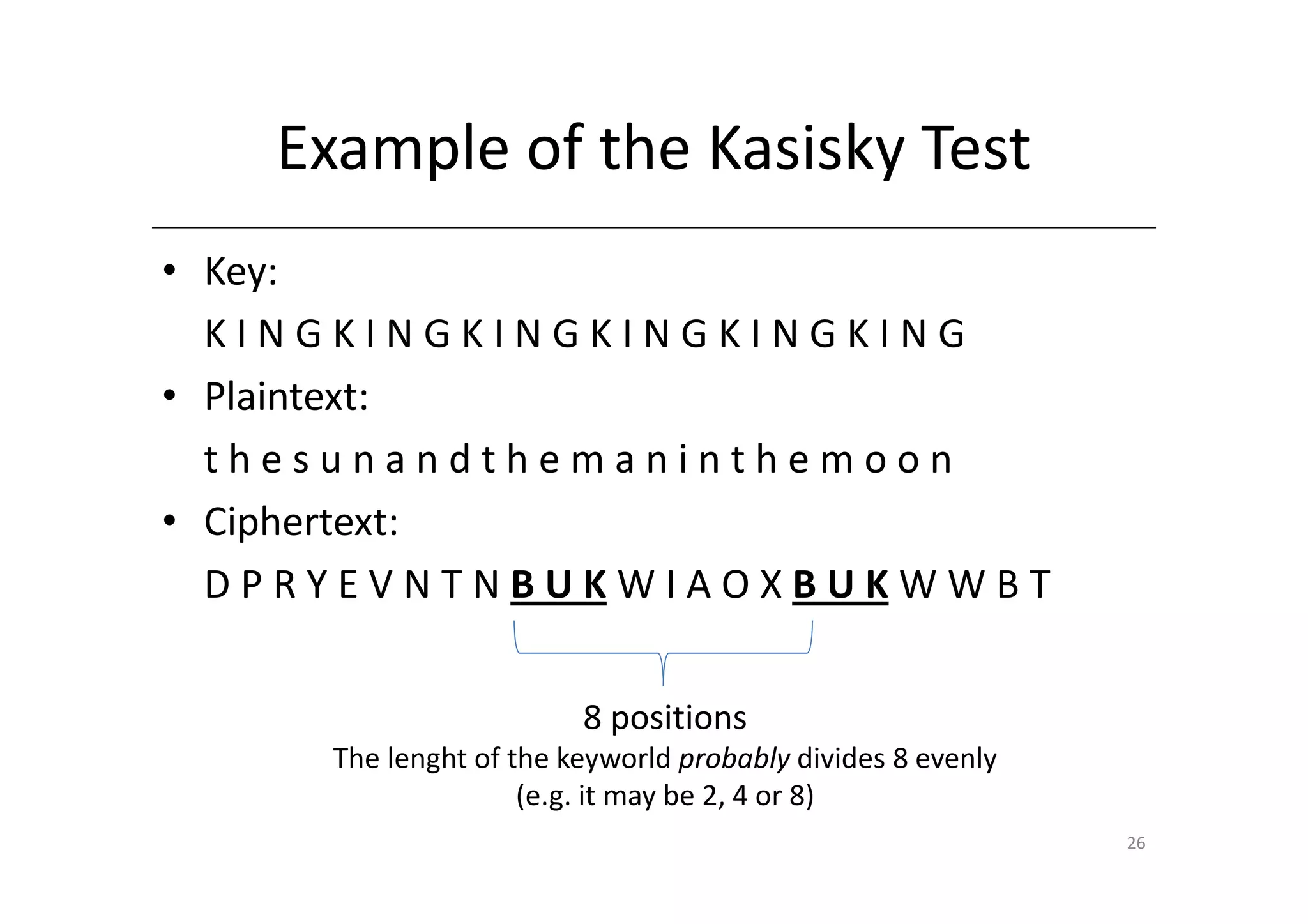
Example of the Kasisky Test
• Key:
  KINGKINGKINGKINGKINGKING
• Plaintext:
  thesunandthemaninthemoon
• Ciphertext:
  DPRYEVNTNBUKWIAOXBUKWWBT


                        8 positions
     The lenght of the keyworld probably divides 8 evenly
                    (e.g. it may be 2, 4 or 8)
                                                            26
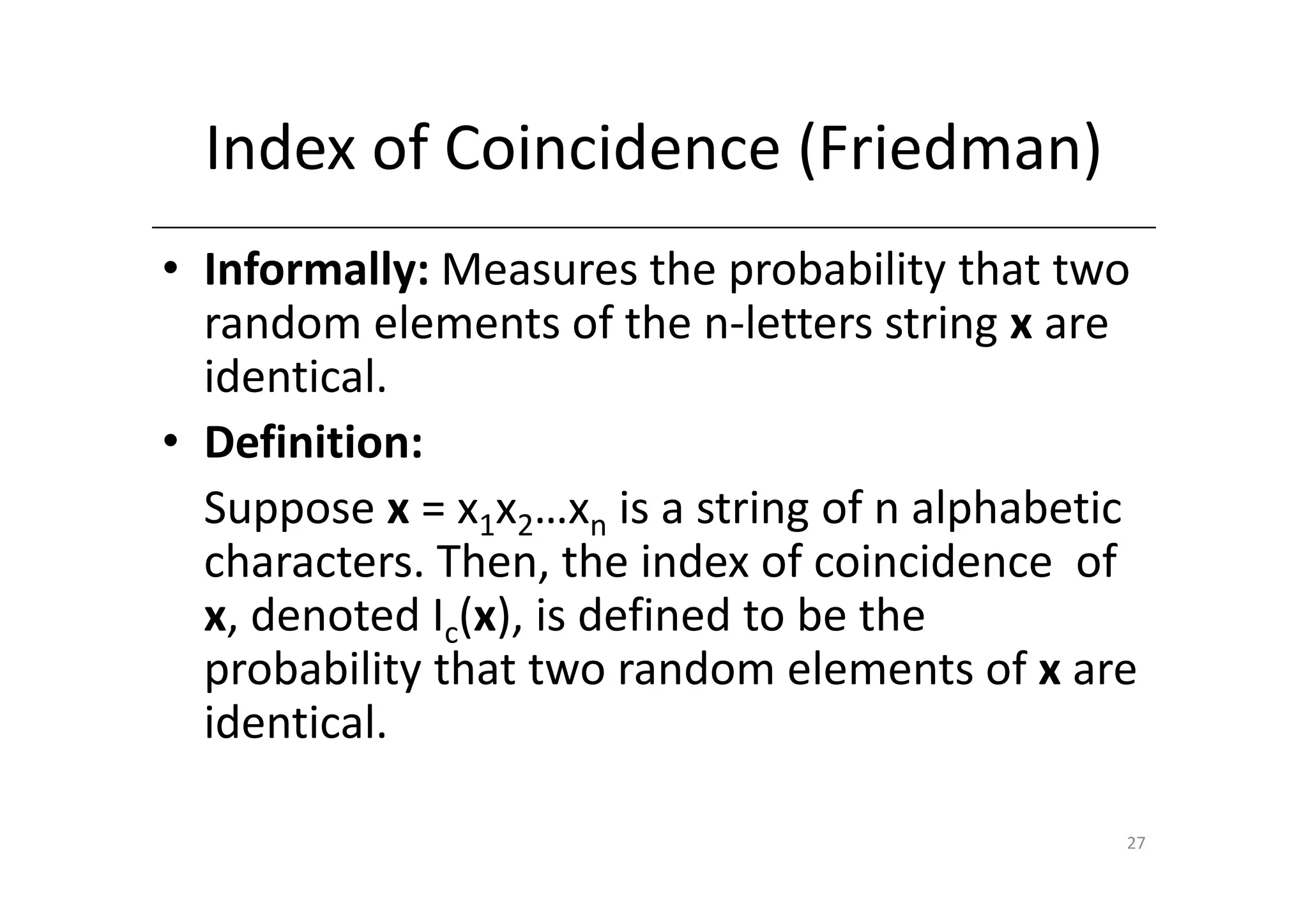
Index of Coincidence (Friedman)
• Informally: Measures the probability that two
  random elements of the n-letters string x are
  identical.
• Definition:
  Suppose x = x1x2…xn is a string of n alphabetic
  characters. Then, the index of coincidence of
  x, denoted Ic(x), is defined to be the
  probability that two random elements of x are
  identical.

                                                27
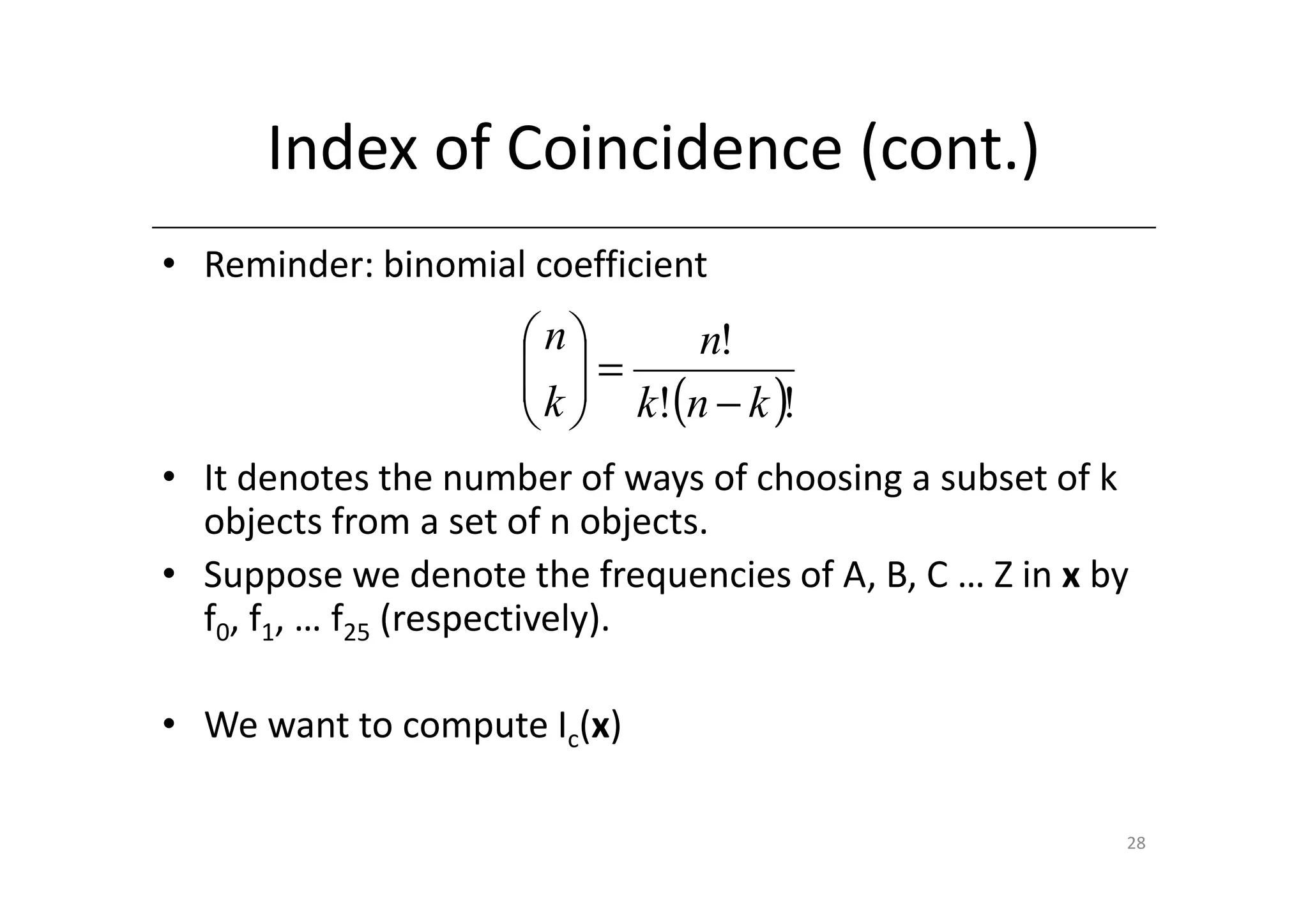
Index of Coincidence (cont.)
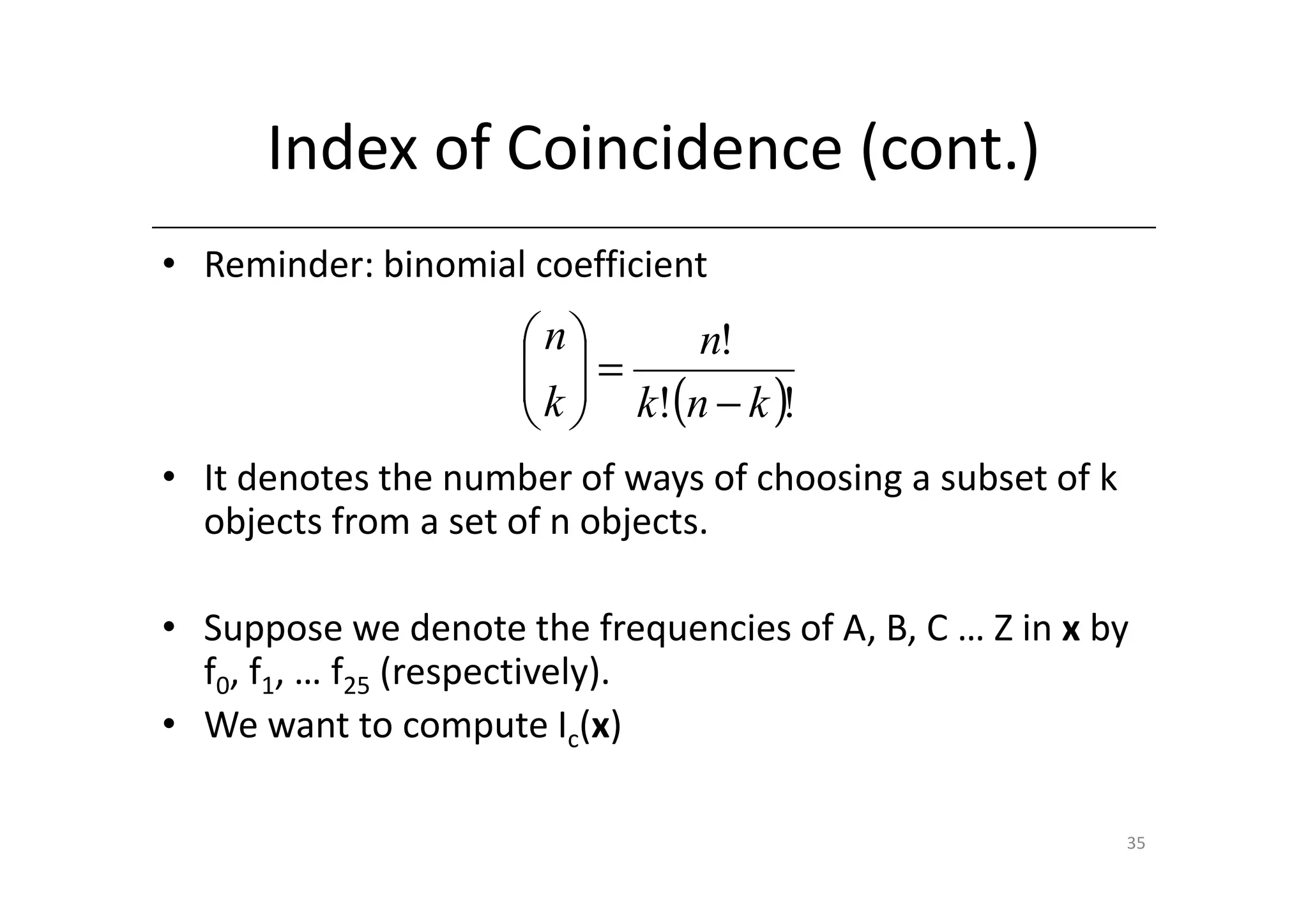
• Reminder: binomial coefficient
                     n       n!
                      =
                      k  k!(n − k )!
                      
• It denotes the number of ways of choosing a subset of k
  objects from a set of n objects.
• Suppose we denote the frequencies of A, B, C … Z in x by
  f0, f1, … f25 (respectively).

• We want to compute Ic(x)

                                                         28
Begin Math


             29
Elements of Probability Theory
• A random experiment has an unpredictable
  outcome.
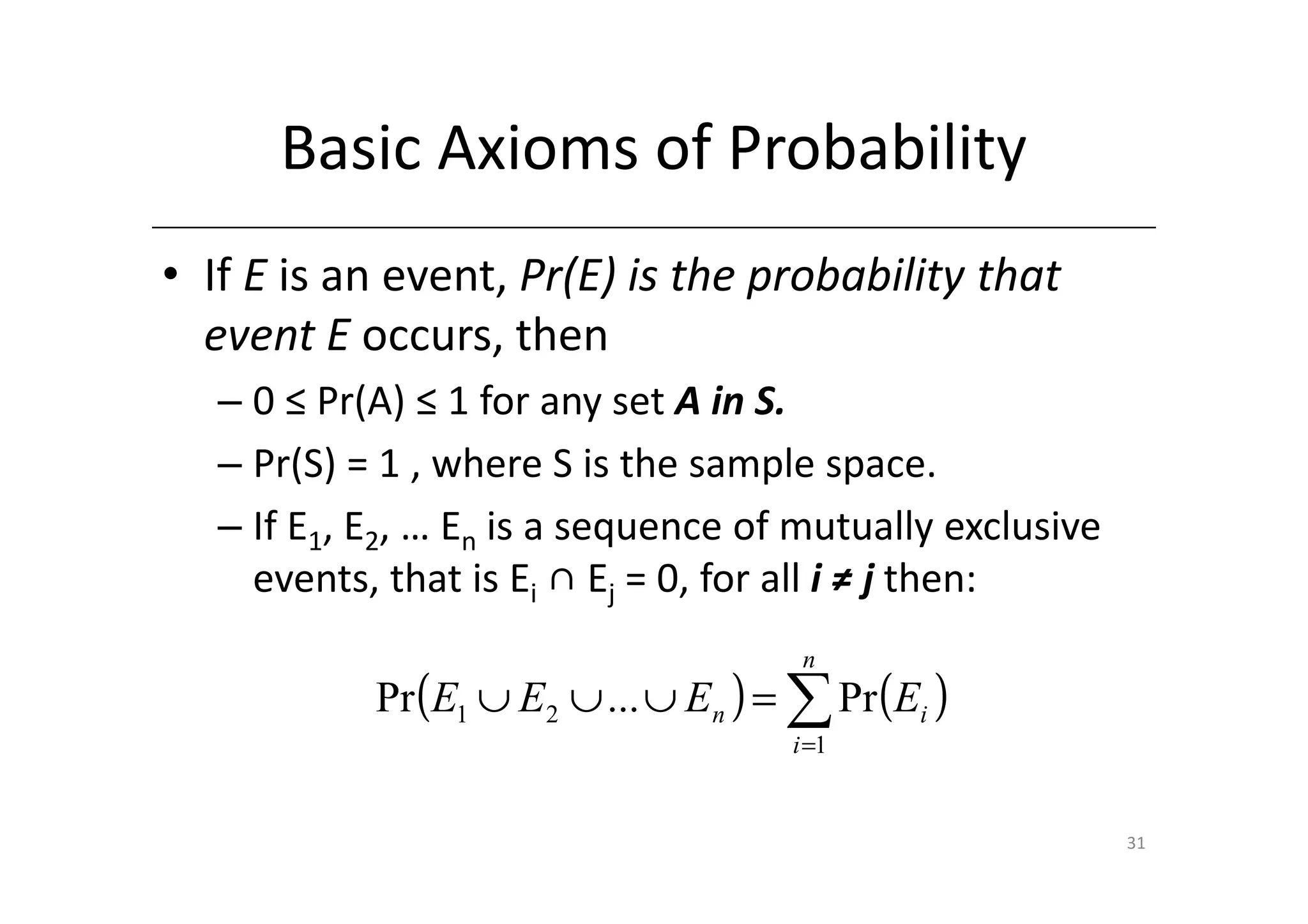
• Definition
  The sample space (S) of a random
  phenomenon is the set of all outcomes for a
  given experiment.
• Definition
  The event (E) is a subset of a sample space, an
  event is any collection of outcomes.
                                                30
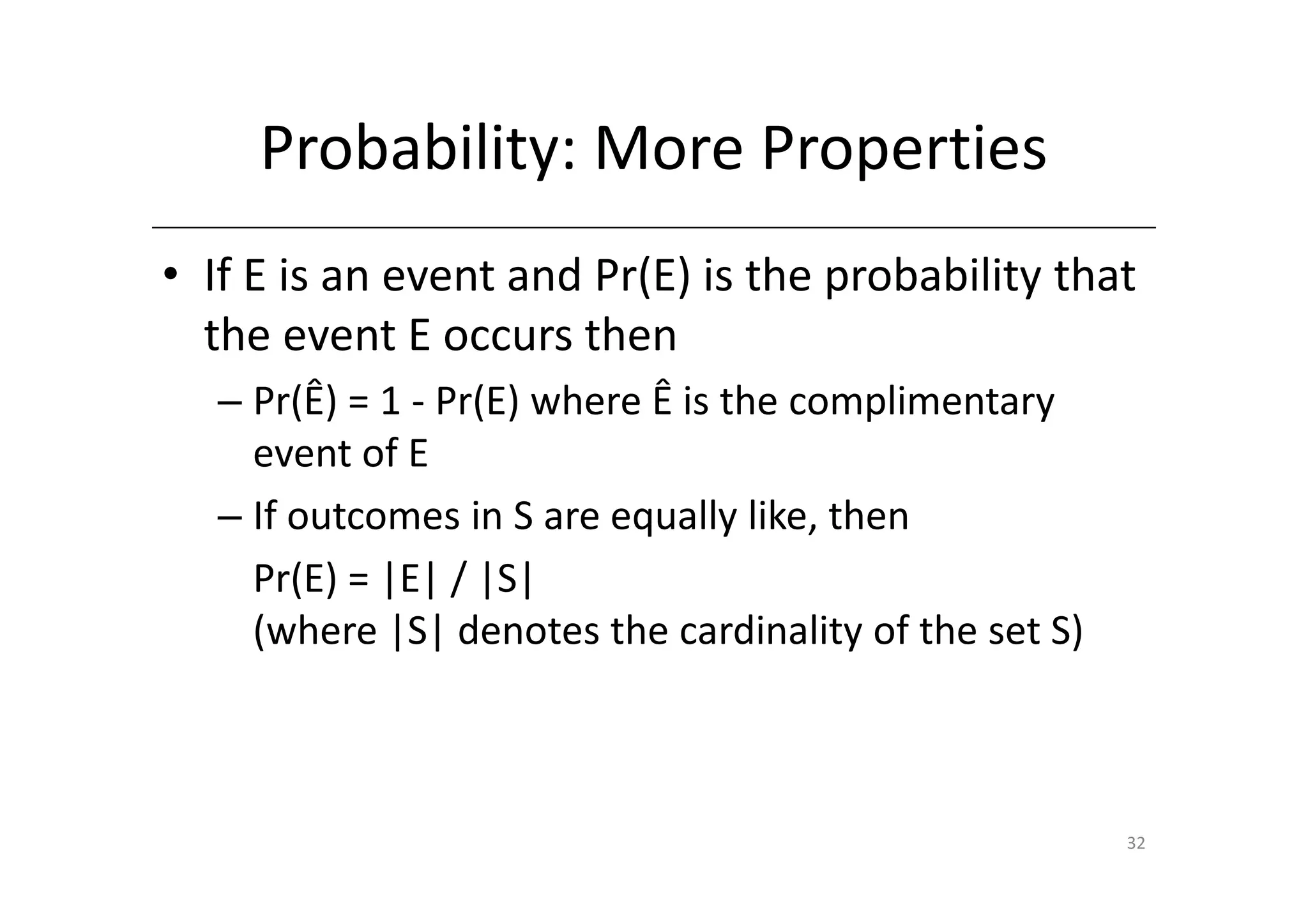
Basic Axioms of Probability
• If E is an event, Pr(E) is the probability that
  event E occurs, then
   – 0 ≤ Pr(A) ≤ 1 for any set A in S.
   – Pr(S) = 1 , where S is the sample space.
   – If E1, E2, … En is a sequence of mutually exclusive
     events, that is Ei ∩ Ej = 0, for all i ≠ j then:
                                       n
            Pr (E1 ∪ E2 ∪ ... ∪ En ) = ∑ Pr (Ei )
                                      i =1


                                                           31
Probability: More Properties
• If E is an event and Pr(E) is the probability that
  the event E occurs then
  – Pr(Ê) = 1 - Pr(E) where Ê is the complimentary
    event of E
  – If outcomes in S are equally like, then
    Pr(E) = |E| / |S|
    (where |S| denotes the cardinality of the set S)


                                                       32
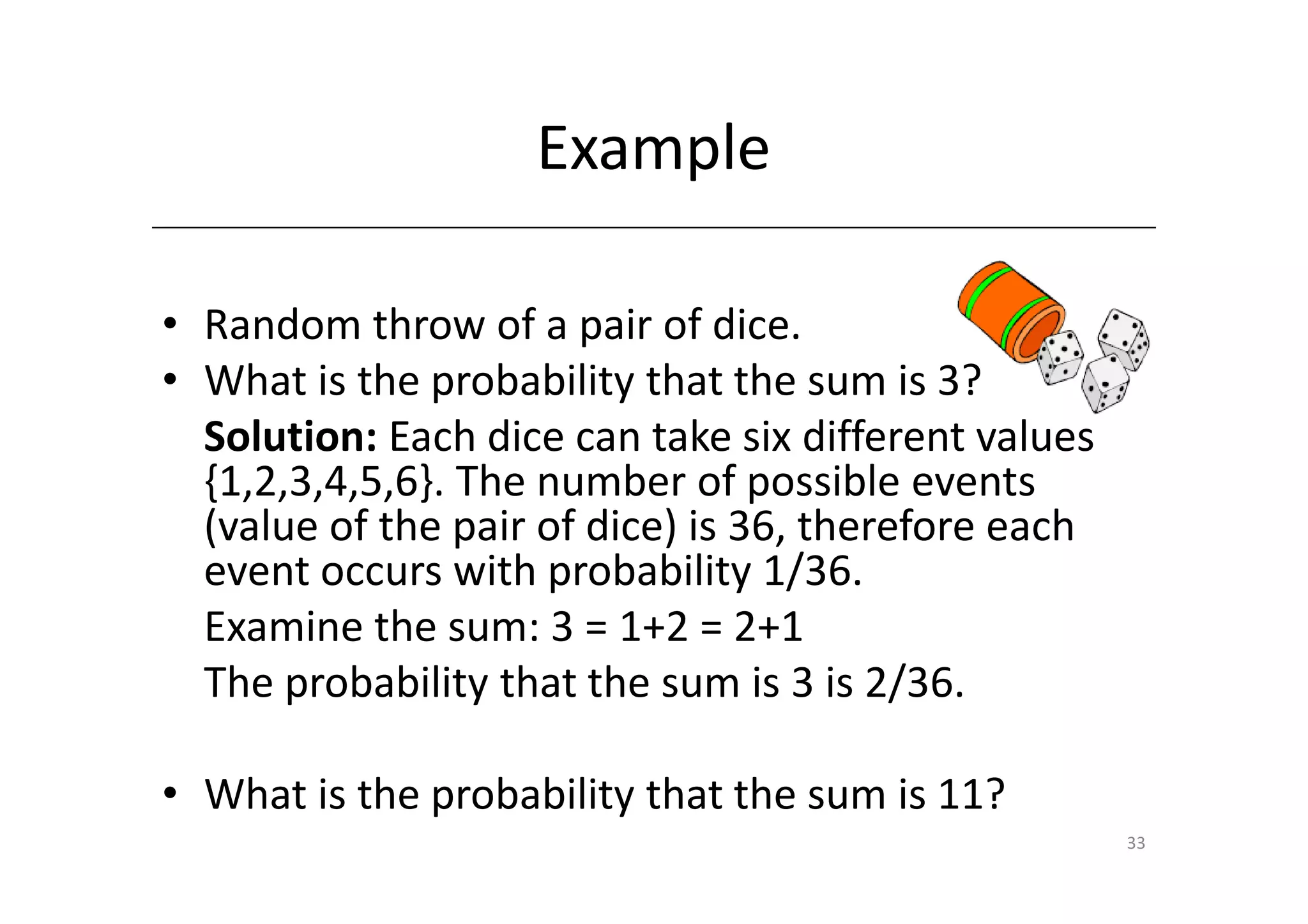
Example

• Random throw of a pair of dice.
• What is the probability that the sum is 3?
  Solution: Each dice can take six different values
  {1,2,3,4,5,6}. The number of possible events
  (value of the pair of dice) is 36, therefore each
  event occurs with probability 1/36.
  Examine the sum: 3 = 1+2 = 2+1
  The probability that the sum is 3 is 2/36.

• What is the probability that the sum is 11?
                                                      33
End Math


           34
Index of Coincidence (cont.)
• Reminder: binomial coefficient
                     n       n!
                      =
                      k  k!(n − k )!
                      
• It denotes the number of ways of choosing a subset of k
  objects from a set of n objects.

• Suppose we denote the frequencies of A, B, C … Z in x by
  f0, f1, … f25 (respectively).
• We want to compute Ic(x)

                                                            35
Index of Coincidence (cont.)
• We can choose two elements of x (whose size is n) in
 n          Example: if n=3, nchoosek(3,2)=3; there are 3 ways of
   ways.
  2         choosing couples of n=3 items. Example: string ABC
                                 fi 
• For each i in [0…25], there are   ways of choosing
                                  2
                                   
  both elements to be i. Hence we have the formula
                            25
                                  fi     25
                            ∑ 2 
                                  
                            i =0     =
                                           ∑ f (f i   i   − 1)
                 I c (x ) =                i =0

                                n             n(n − 1)
                                
                                2
                                
                                                                      36
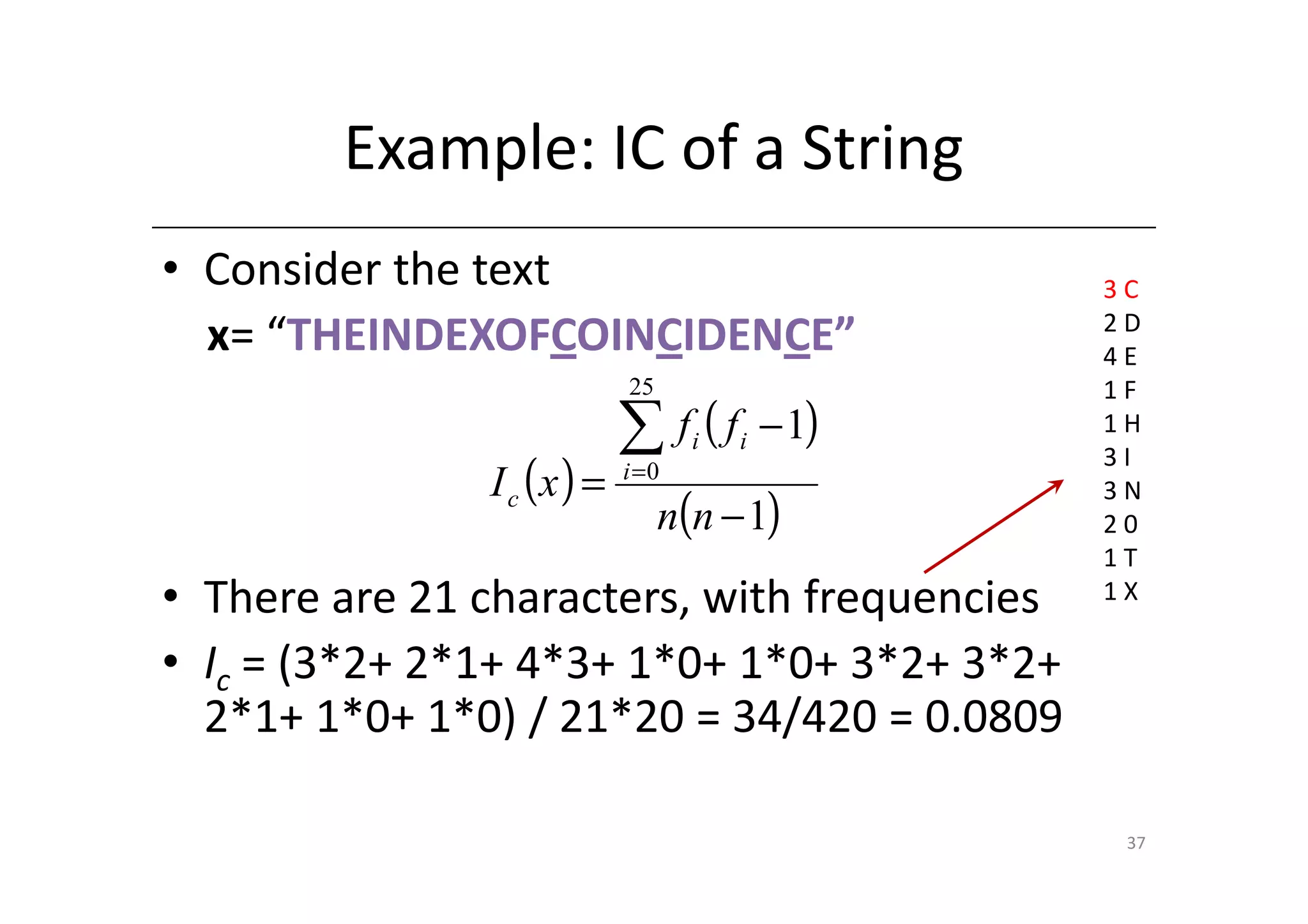
Example: IC of a String
• Consider the text                               3C
                                                  2D
  x= “THEINDEXOFCOINCIDENCE”                      4E
                            25                    1F
                            ∑ f (f i   i   − 1)   1H

               I c (x ) =   i =0
                                                  3I

                                 n(n − 1)
                                                  3N
                                                  20
                                                  1T
• There are 21 characters, with frequencies       1X

• Ic = (3*2+ 2*1+ 4*3+ 1*0+ 1*0+ 3*2+ 3*2+
  2*1+ 1*0+ 1*0) / 21*20 = 34/420 = 0.0809

                                                   37
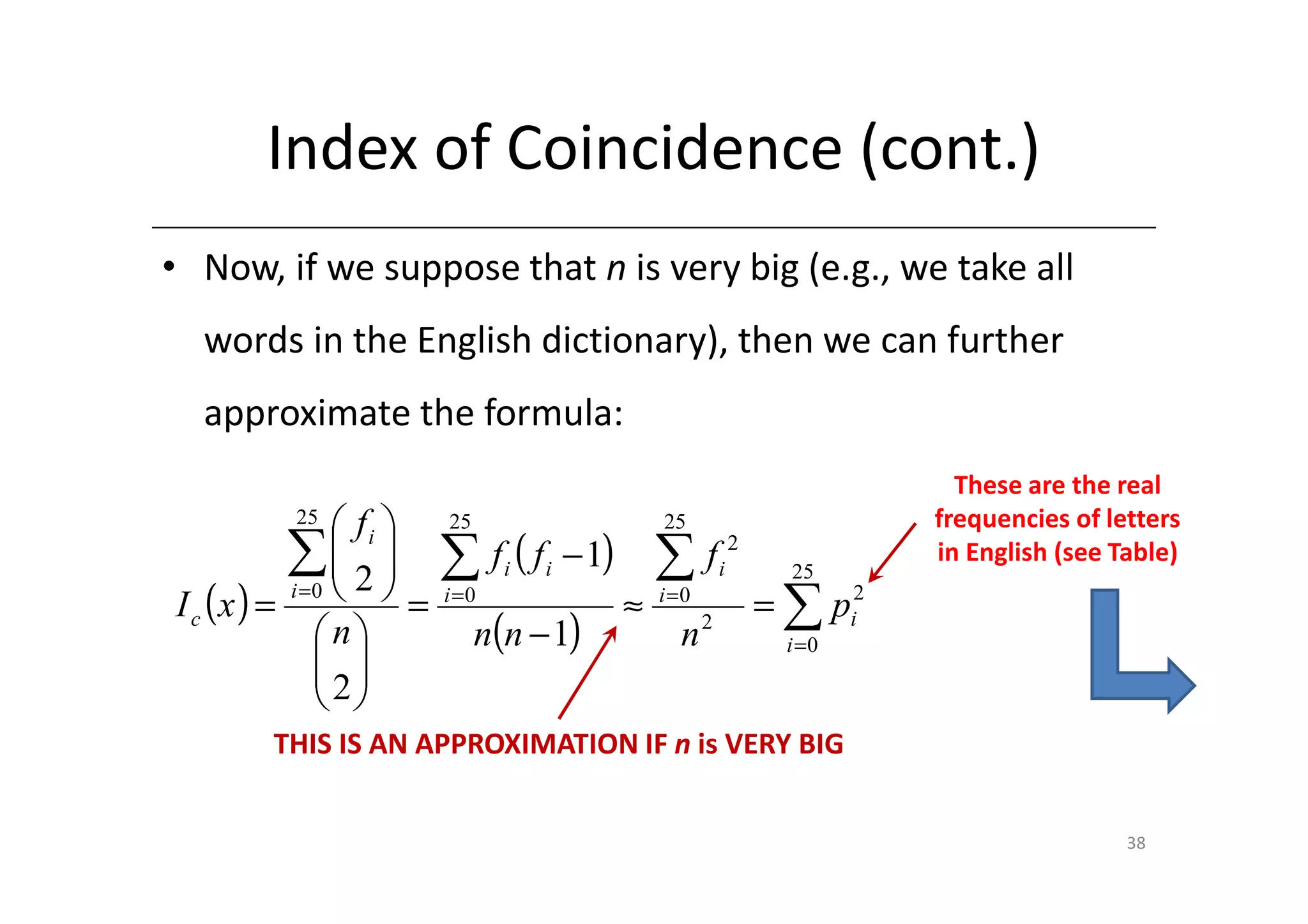
Index of Coincidence (cont.)
• Now, if we suppose that n is very big (e.g., we take all
  words in the English dictionary), then we can further
  approximate the formula:
                                                                              These are the real
          25
                fi    25                          25                      frequencies of letters
          ∑ 2 
                      ∑      f i ( f i − 1)       ∑      fi 2     25
                                                                            in English (see Table)
I c (x ) =   =                                                  = ∑ pi2
          i =0          i =0
                                                ≈   i =0

             n             n(n − 1)                 n2            i =0
              
              2
              
        THIS IS AN APPROXIMATION IF n is VERY BIG


                                                                                             38
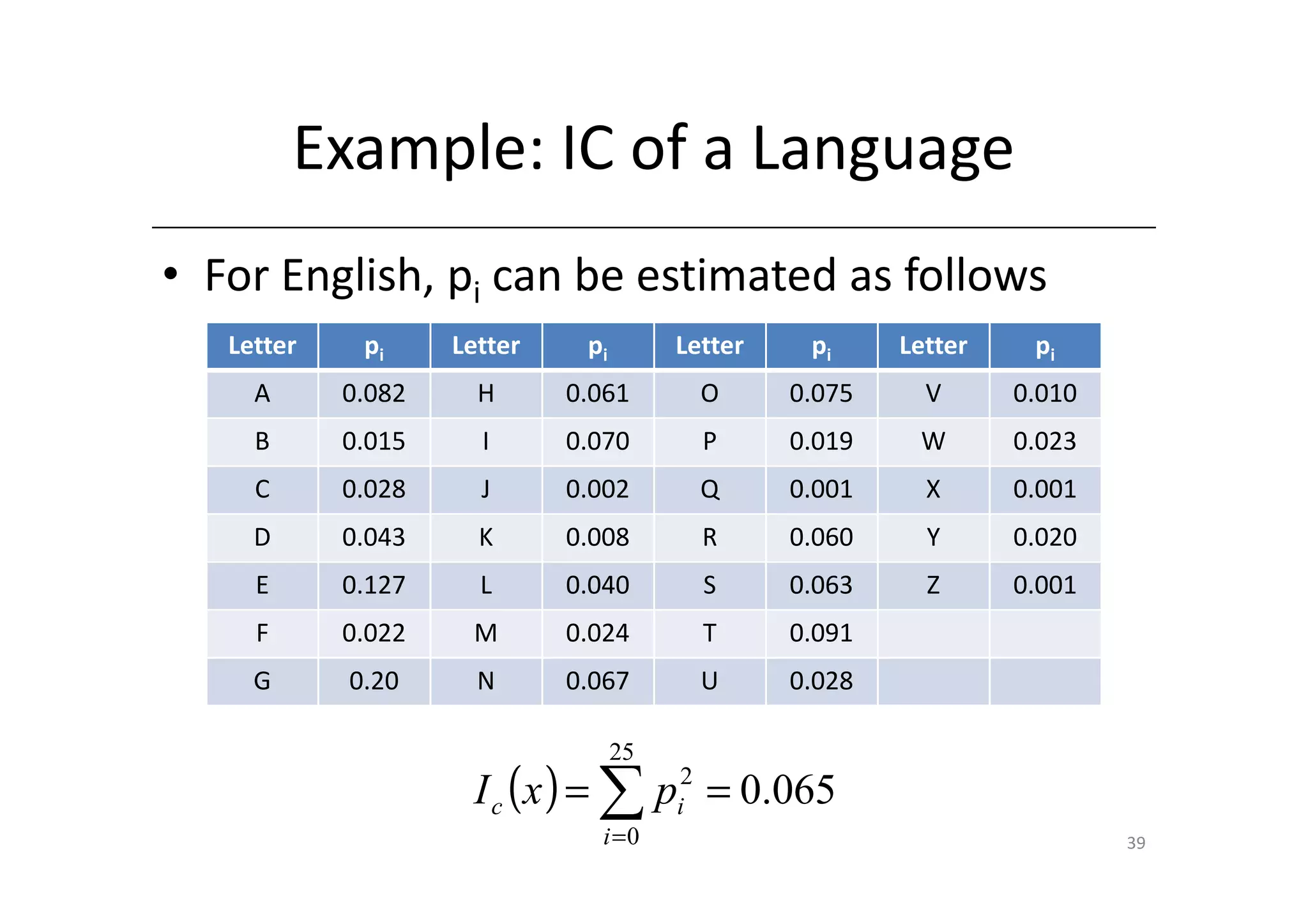
Example: IC of a Language
• For English, pi can be estimated as follows
   Letter    pi     Letter    pi        Letter    pi     Letter    pi
     A      0.082     H      0.061        O      0.075     V      0.010
     B      0.015     I      0.070        P      0.019    W       0.023
     C      0.028     J      0.002        Q      0.001     X      0.001
     D      0.043     K      0.008        R      0.060     Y      0.020
     E      0.127     L      0.040        S      0.063     Z      0.001
     F      0.022    M       0.024        T      0.091
     G      0.20      N      0.067        U      0.028

                                   25
                     I c (x ) = ∑ pi2 = 0.065
                               i =0                                       39
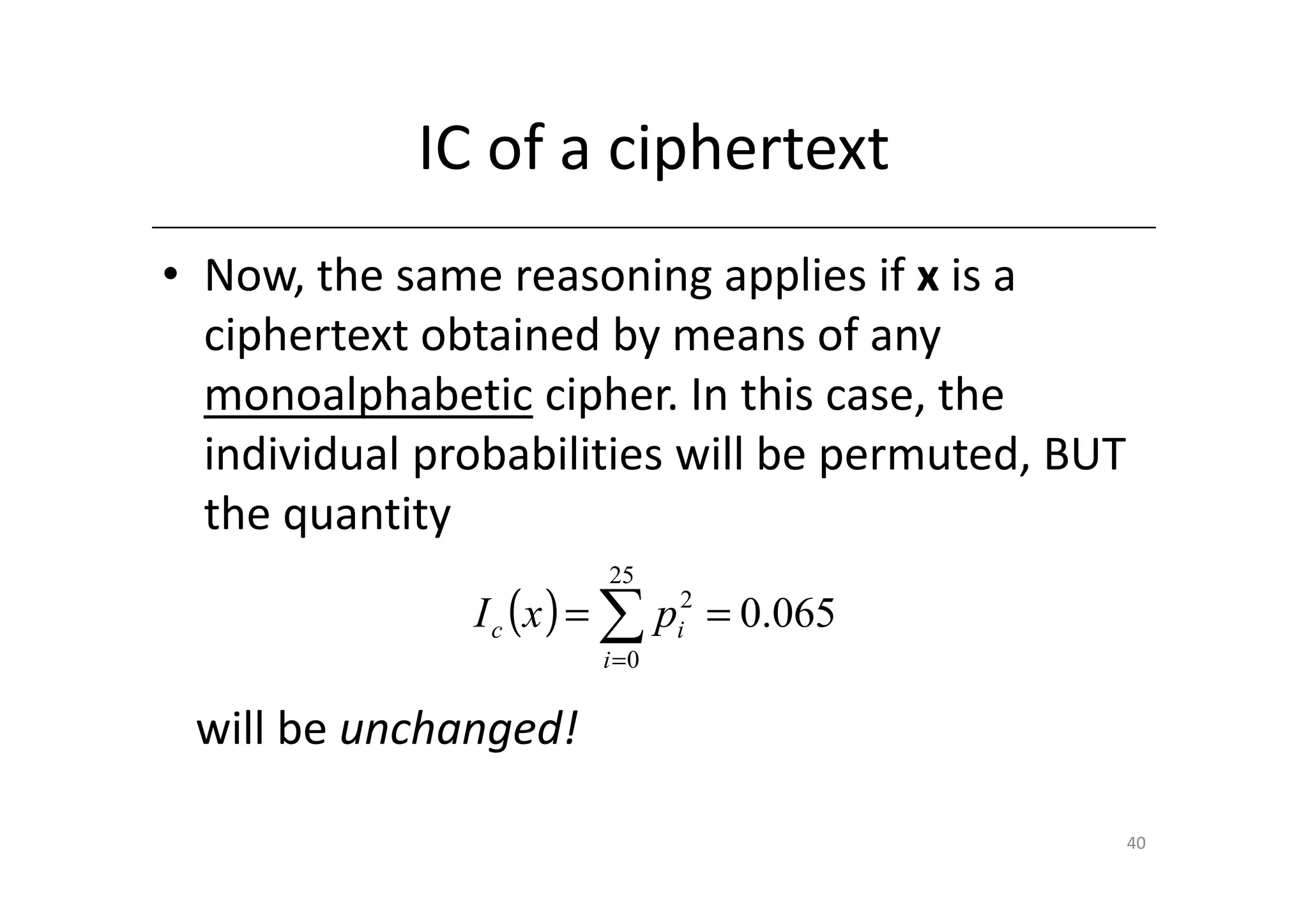
IC of a ciphertext
• Now, the same reasoning applies if x is a
  ciphertext obtained by means of any
  monoalphabetic cipher. In this case, the
  individual probabilities will be permuted, BUT
  the quantity
                       25
               I c (x ) = ∑ pi2 = 0.065
                       i =0


 will be unchanged!

                                                   40
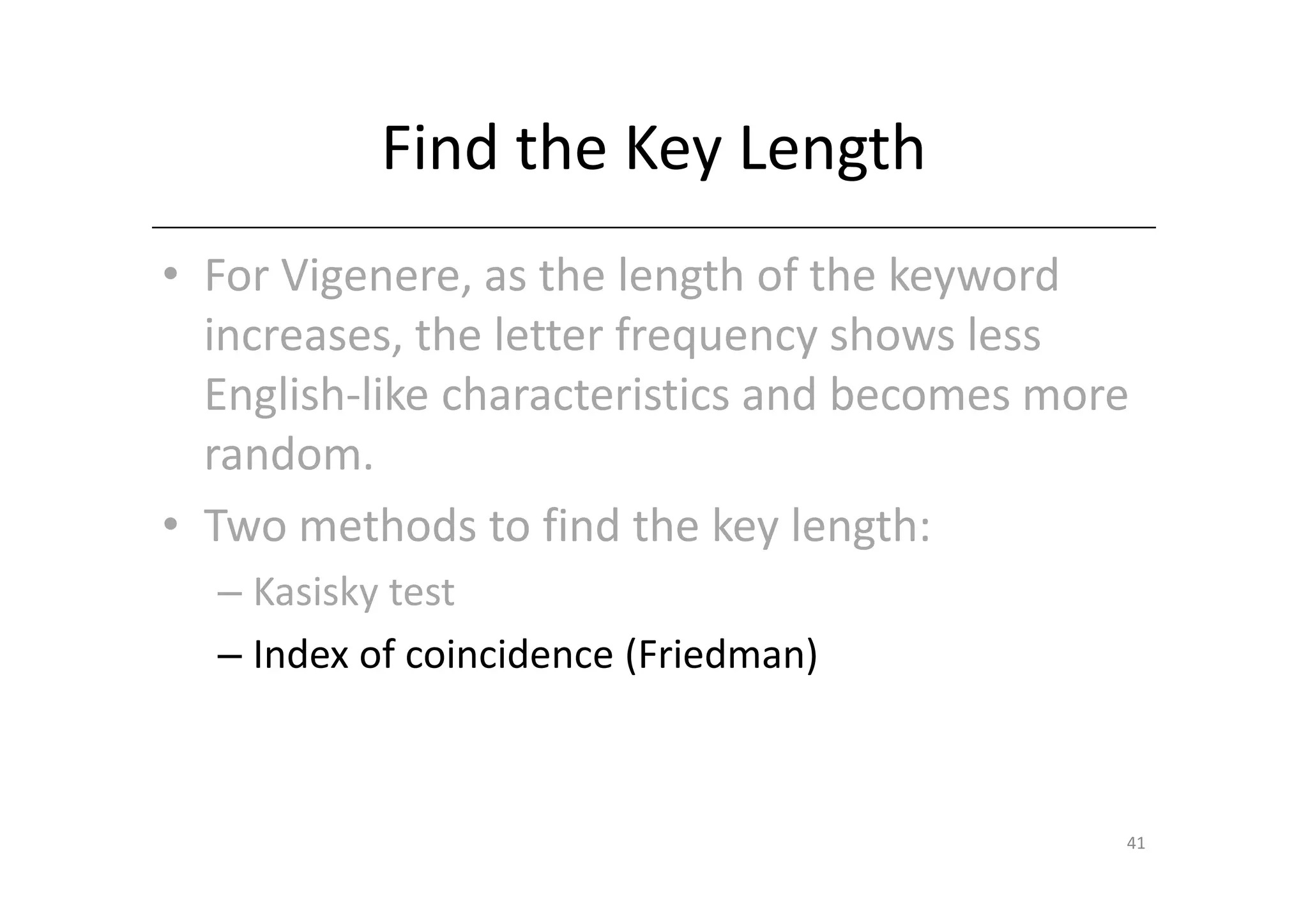
Find the Key Length
• For Vigenere, as the length of the keyword
  increases, the letter frequency shows less
  English-like characteristics and becomes more
  random.
• Two methods to find the key length:
  – Kasisky test
  – Index of coincidence (Friedman)


                                              41
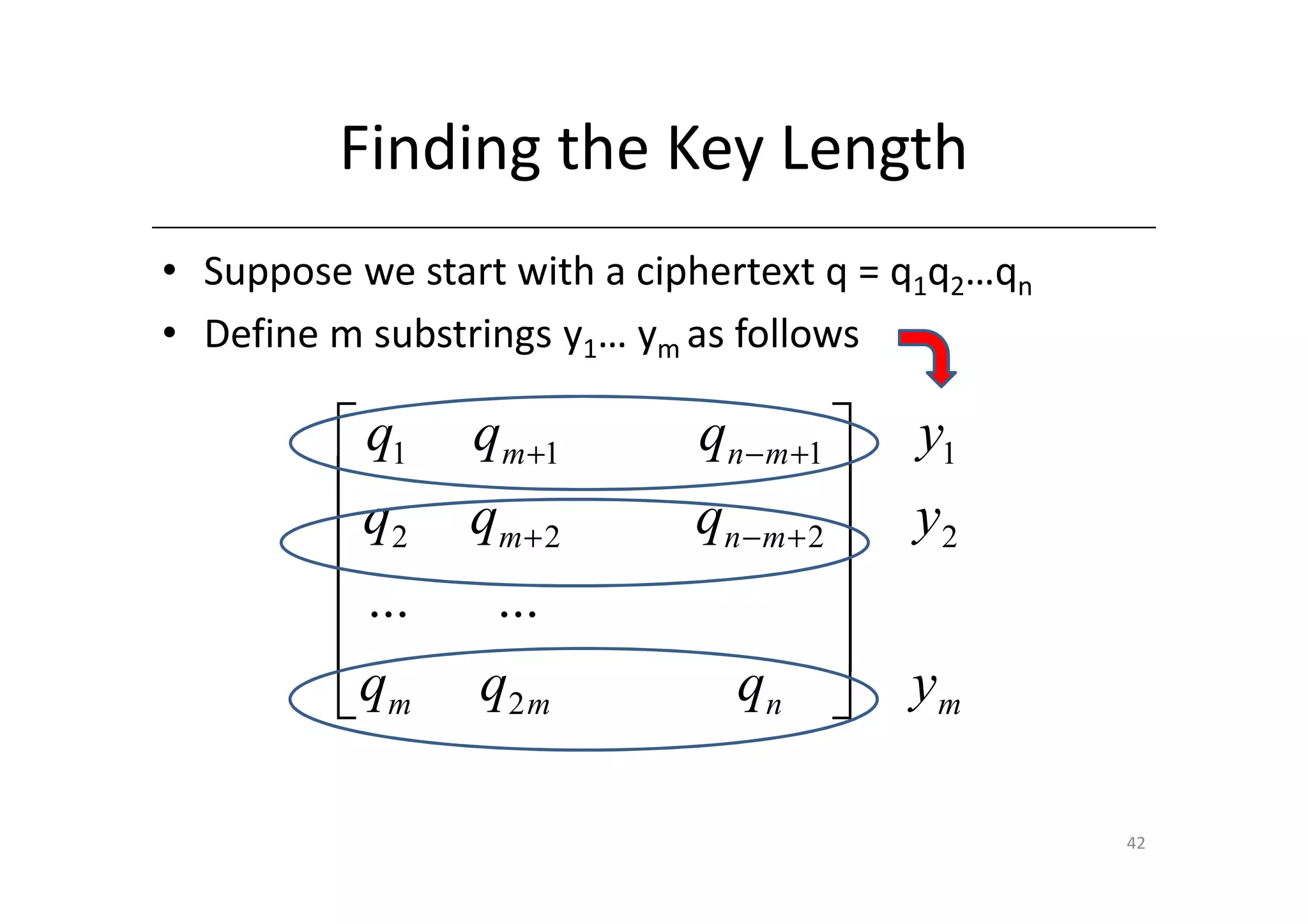
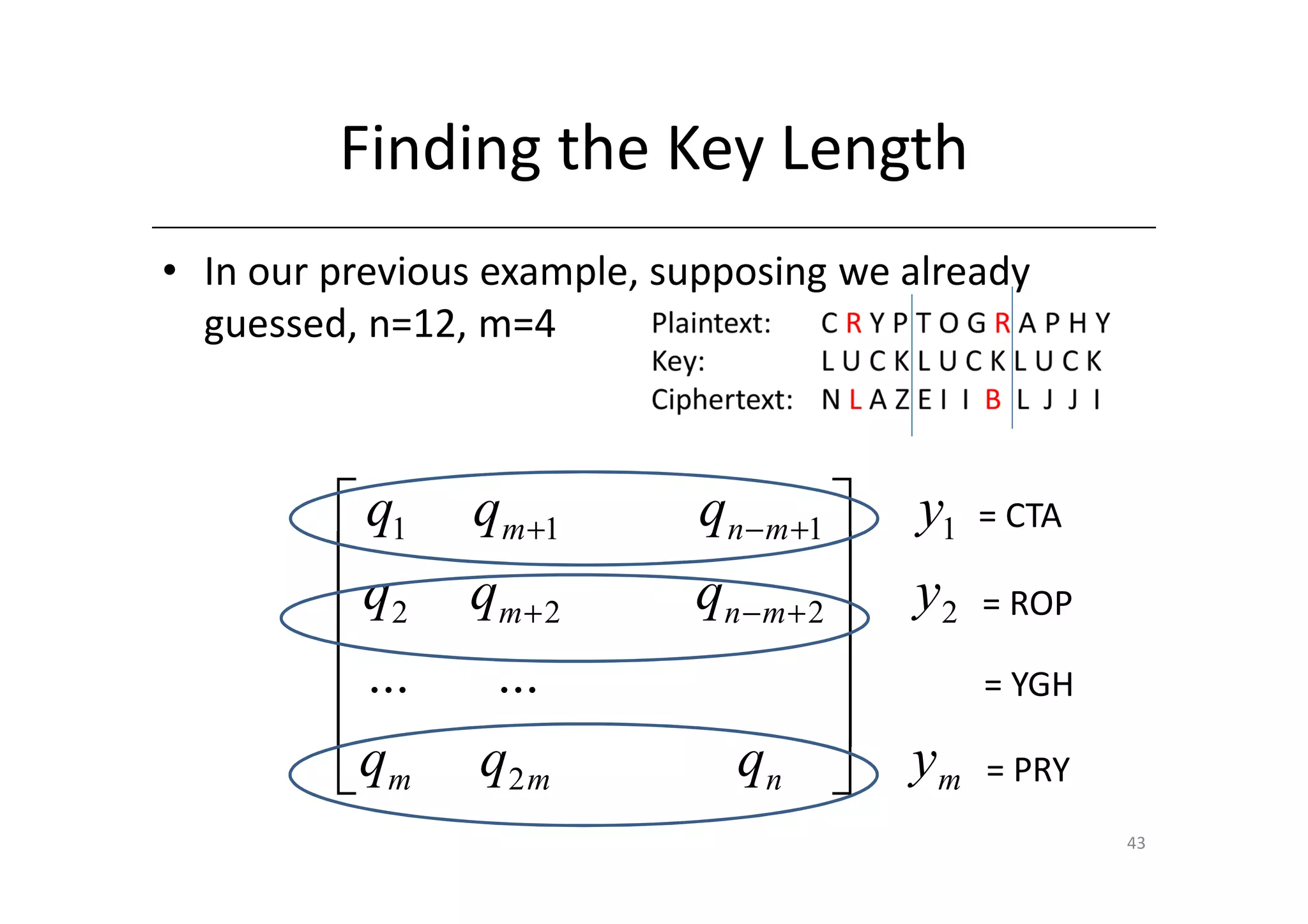
Finding the Key Length
• Suppose we start with a ciphertext q = q1q2…qn
• Define m substrings y1… ym as follows

          q1    qm +1       qn − m +1     y1
         q      qm + 2                 
                             qn − m + 2    y2
          2
          ...    ...                   
                                       
          qm    q2 m          qn          ym

                                                   42
Finding the Key Length
• In our previous example, supposing we already
  guessed, n=12, m=4


          q1    qm +1      qn − m +1     y1   = CTA
         q      qm + 2                
                            qn − m + 2    y2
          2                                    = ROP
          ...    ...                          = YGH
                                      
          qm    q2 m         qn          ym   = PRY
                                                        43
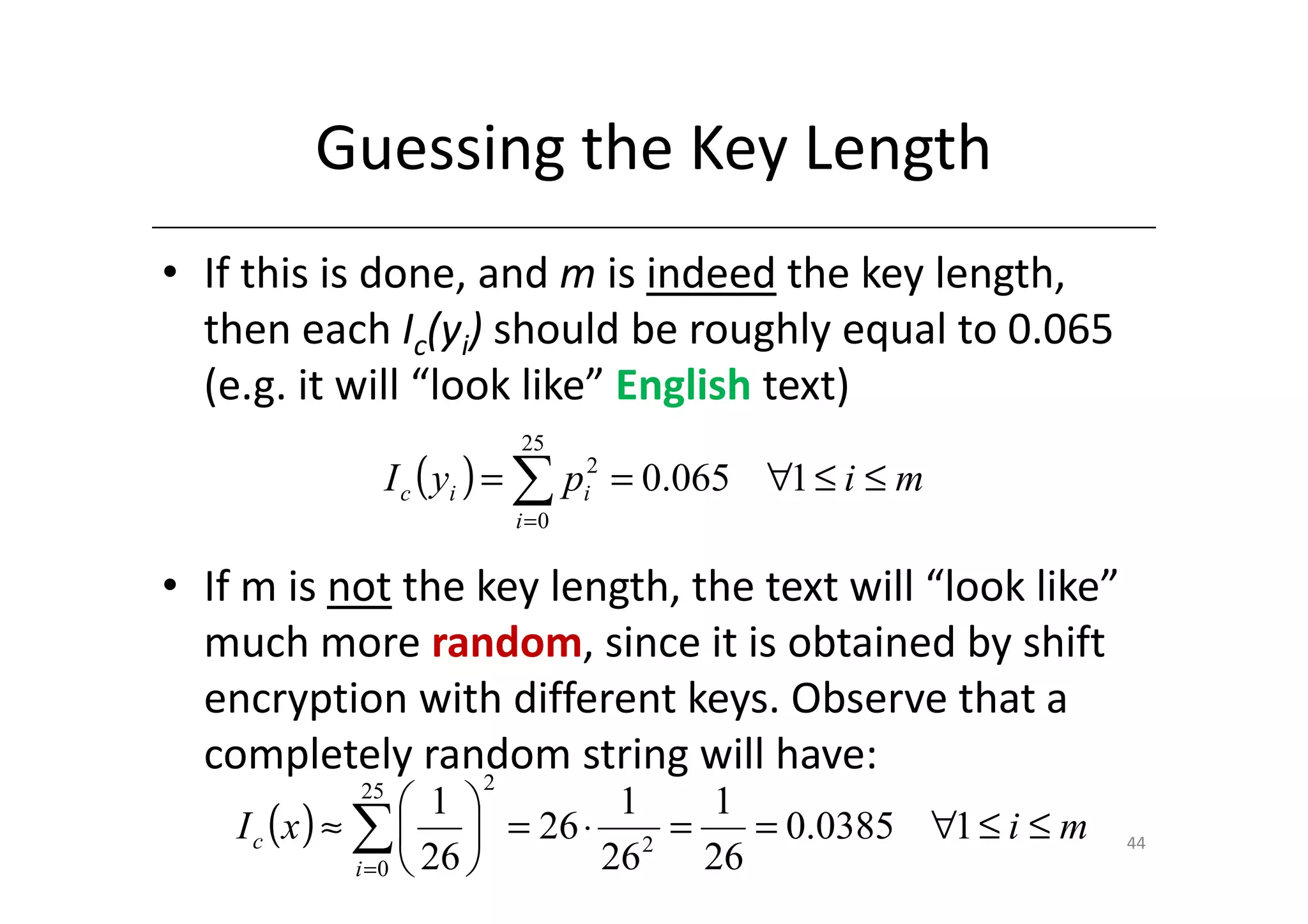
Guessing the Key Length
• If this is done, and m is indeed the key length,
  then each Ic(yi) should be roughly equal to 0.065
  (e.g. it will “look like” English text)
                         25
                I c ( yi ) = ∑ pi2 = 0.065 ∀1 ≤ i ≤ m
                        i =0


• If m is not the key length, the text will “look like”
  much more random, since it is obtained by shift
  encryption with different keys. Observe that a
  completely random string will have:
                  2
           25
                       1 
    I c ( x ) ≈ ∑   = 26 ⋅ 2 =
                              1  1
                                    = 0.0385 ∀1 ≤ i ≤ m   44
                i = 0  26  26  26
Guessing the Key Length
• For French language, the index of coincidence
  is approximately 0.0778
• The values 0.065 (or 0.0778 for French) and
  0.0385 are sufficiently far apart that we will
  often be able to determine the correct
  keyword length (or confirm a guess that has
  already been made using the Kasiski test)


                                               45
Finding the Key, if Key Length Known
• Consider vectors yi, and look for the most
  frequent letter
• Check if mapping that letter to e will not result
  in unlikely mapping for other letters
• Use mutual index of coincidence between two
  strings
  – To determine relative shifts, and hence the key


                                                      46
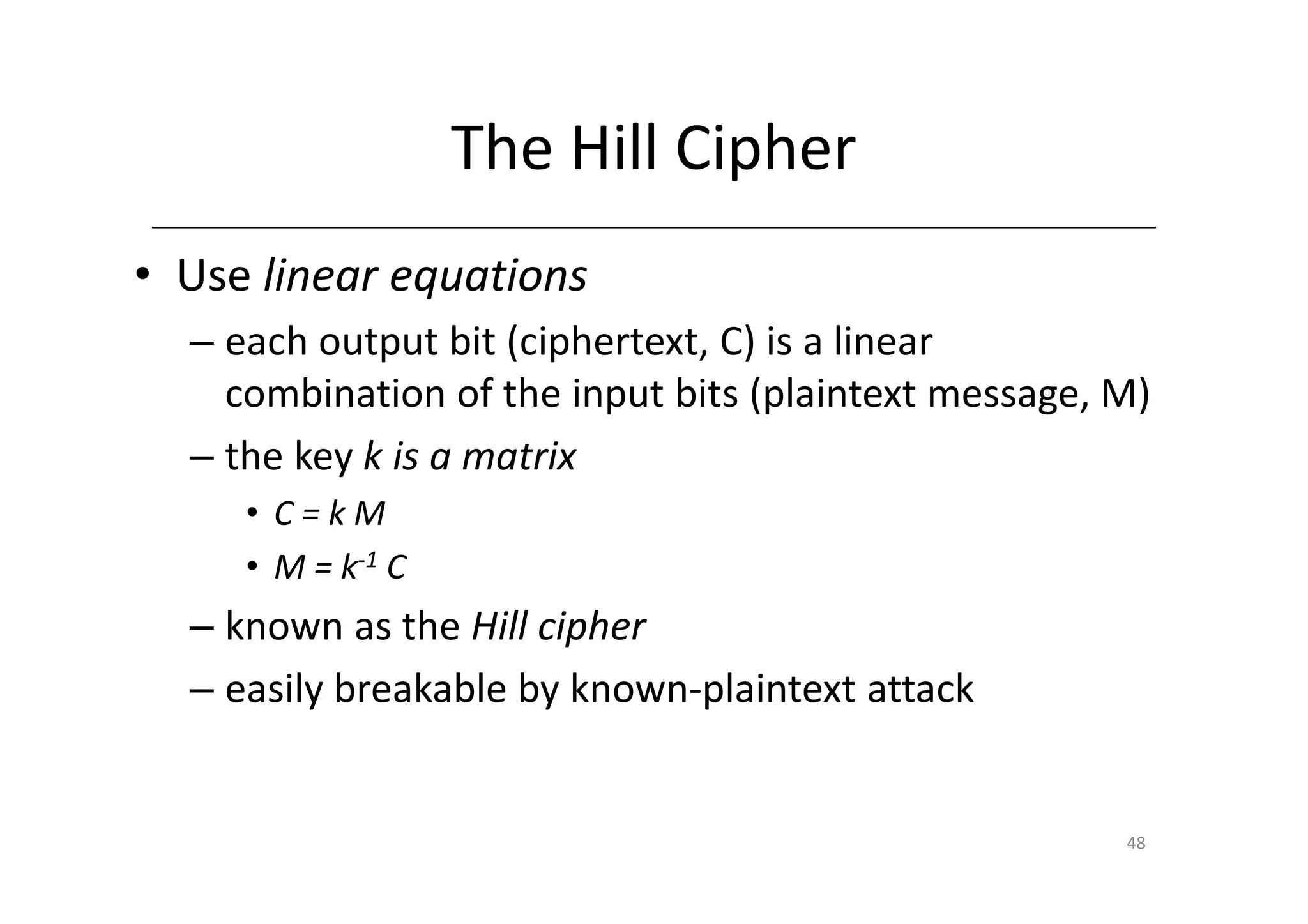
Summary
• Vigenère cipher is vulnerable:
  once the key length is found, a cryptanalyst
  can apply frequency analysis.


                                                 47
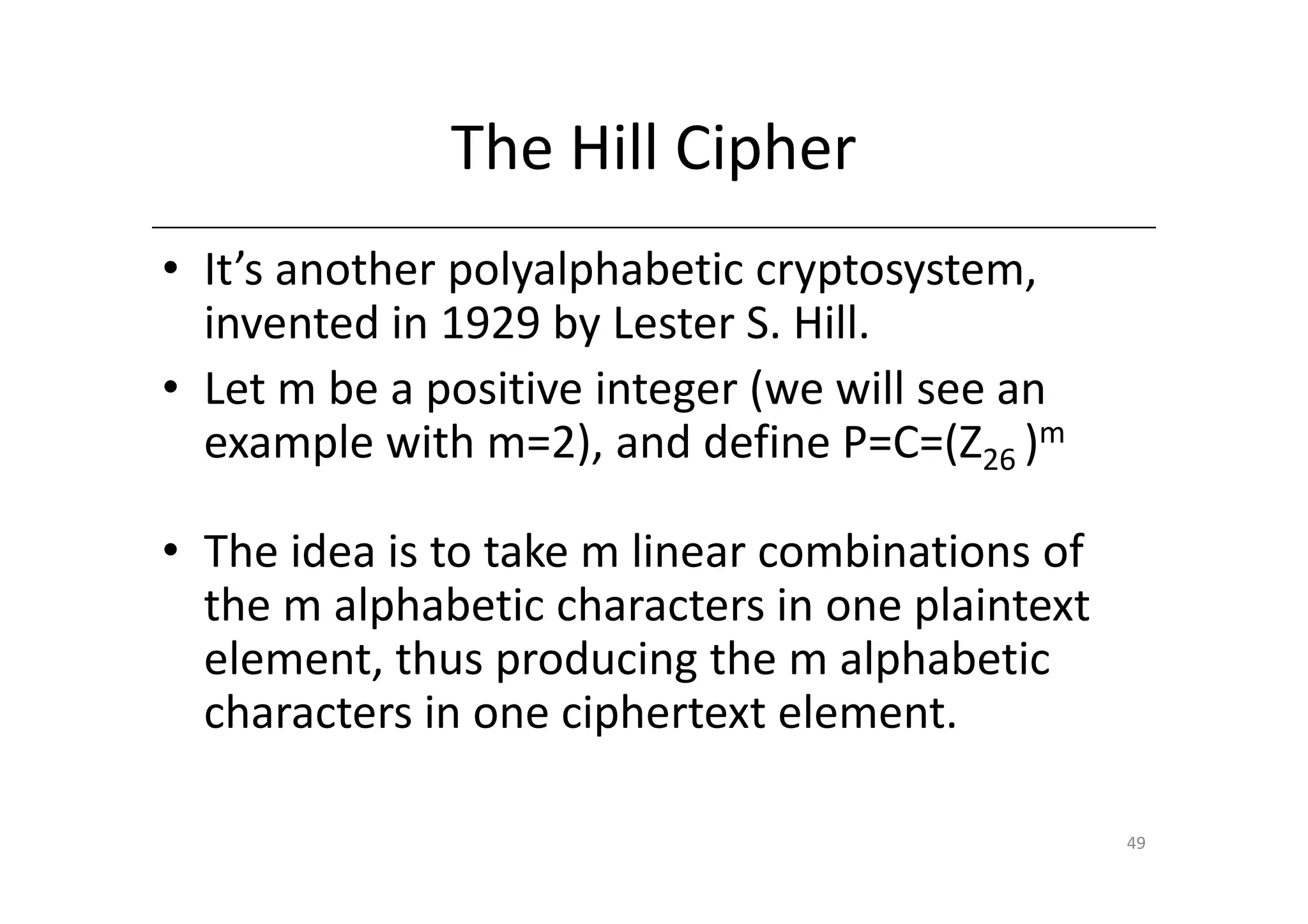
The Hill Cipher
• Use linear equations
  – each output bit (ciphertext, C) is a linear
    combination of the input bits (plaintext message, M)
  – the key k is a matrix
     • C=kM
     • M = k-1 C
  – known as the Hill cipher
  – easily breakable by known-plaintext attack


                                                      48
The Hill Cipher
• It’s another polyalphabetic cryptosystem,
  invented in 1929 by Lester S. Hill.
• Let m be a positive integer (we will see an
  example with m=2), and define P=C=(Z26 )m

• The idea is to take m linear combinations of
  the m alphabetic characters in one plaintext
  element, thus producing the m alphabetic
  characters in one ciphertext element.

                                                 49
The Hill Cipher
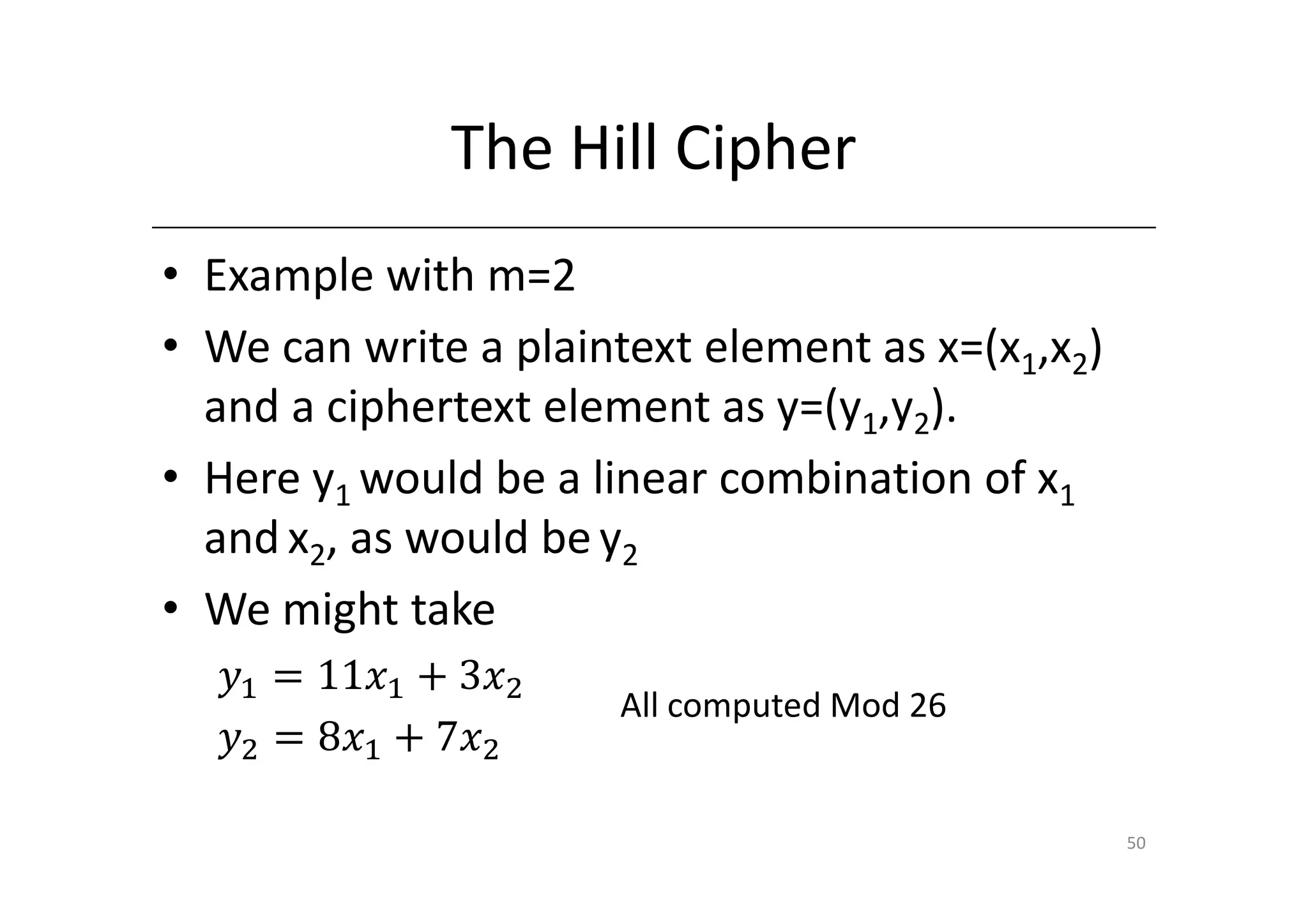
• Example with m=2
• We can write a plaintext element as x=(x1,x2)
  and a ciphertext element as y=(y1,y2).
• Here y1 would be a linear combination of x1
  and x2, as would be y2
• We might take
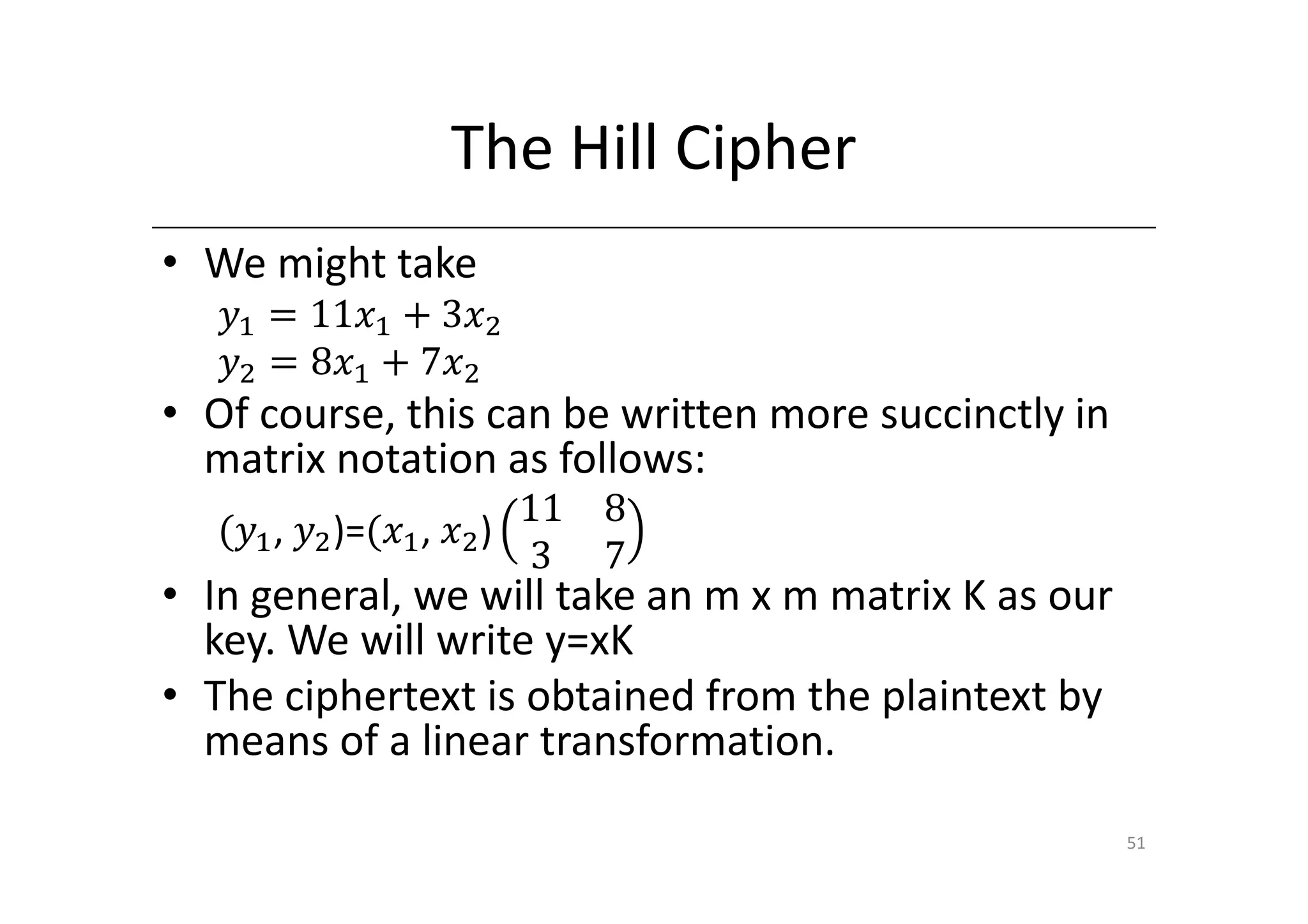
  ‫ݕ‬ଵ ൌ 11‫ݔ‬ଵ ൅ 3‫ݔ‬ଶ
                      All computed Mod 26
  ‫ݕ‬ଶ ൌ 8‫ݔ‬ଵ ൅ 7‫ݔ‬ଶ

                                                  50
The Hill Cipher
• We might take
   ‫ݕ‬ଵ ൌ 11‫ݔ‬ଵ ൅ 3‫ݔ‬ଶ
   ‫ݕ‬ଶ ൌ 8‫ݔ‬ଵ ൅ 7‫ݔ‬ଶ
• Of course, this can be written more succinctly in
  matrix notation as follows:
                         11 8
   ሺ‫ݕ‬ଵ , ‫ݕ‬ଶ )=ሺ‫ݔ‬ଵ , ‫ݔ‬ଶ )
                         3 7
• In general, we will take an m x m matrix K as our
  key. We will write y=xK
• The ciphertext is obtained from the plaintext by
  means of a linear transformation.

                                                      51
The Hill Cipher (Decryption)
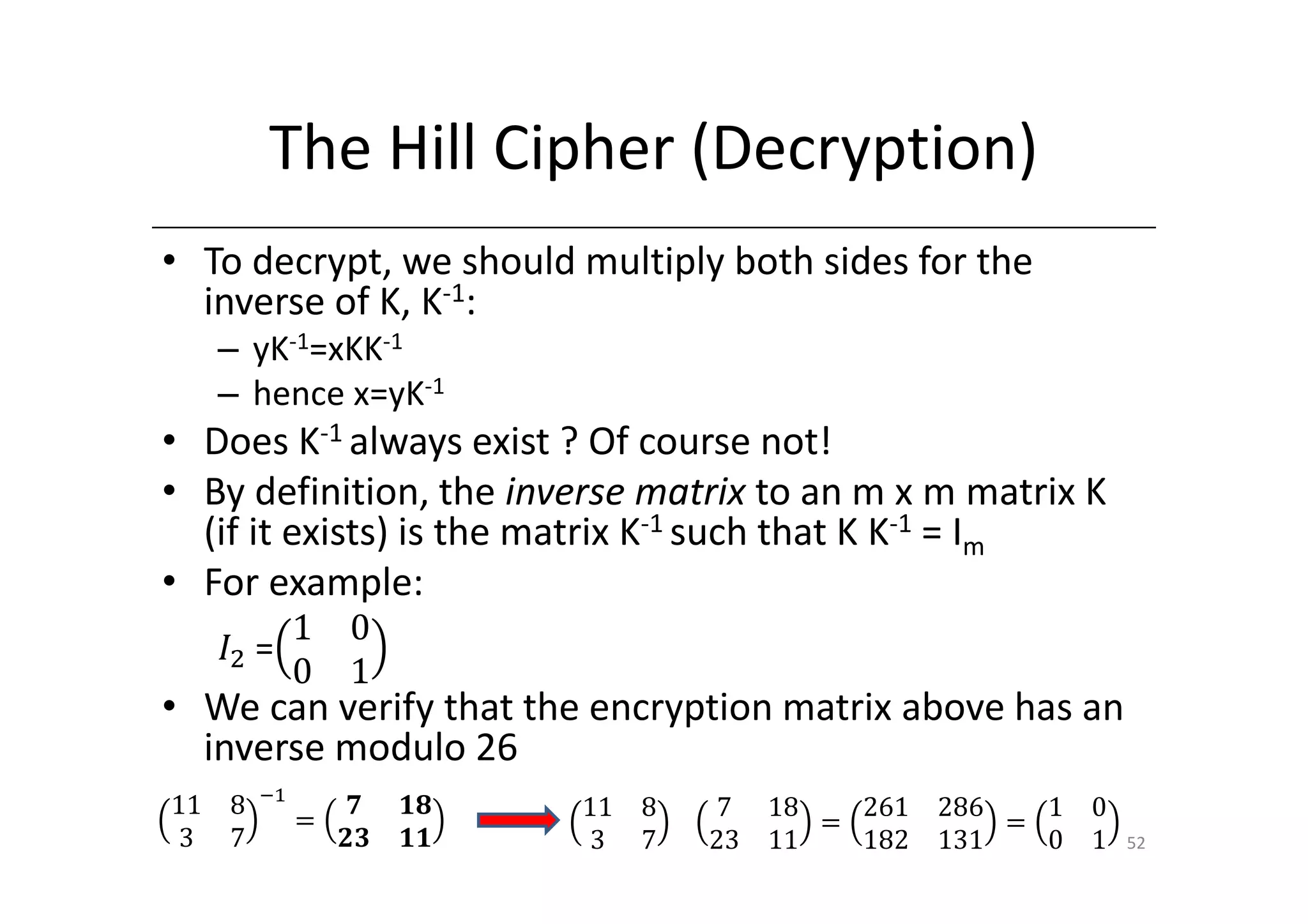
• To decrypt, we should multiply both sides for the
  inverse of K, K-1:
     – yK-1=xKK-1
     – hence x=yK-1
• Does K-1 always exist ? Of course not!
• By definition, the inverse matrix to an m x m matrix K
  (if it exists) is the matrix K-1 such that K K-1 = Im
• For example:
           1 0
     ‫ܫ‬ଶ 	=
           0 1
• We can verify that the encryption matrix above has an
  inverse modulo 26
         ିଵ
11   8             ૠ ૚ૡ   11   8   7 18    261   286   1 0
              ൌ                          ൌ           ൌ
 3   7            ૛૜ ૚૚    3   7   23 11   182   131   0 1   52
The Hill Cipher (example)
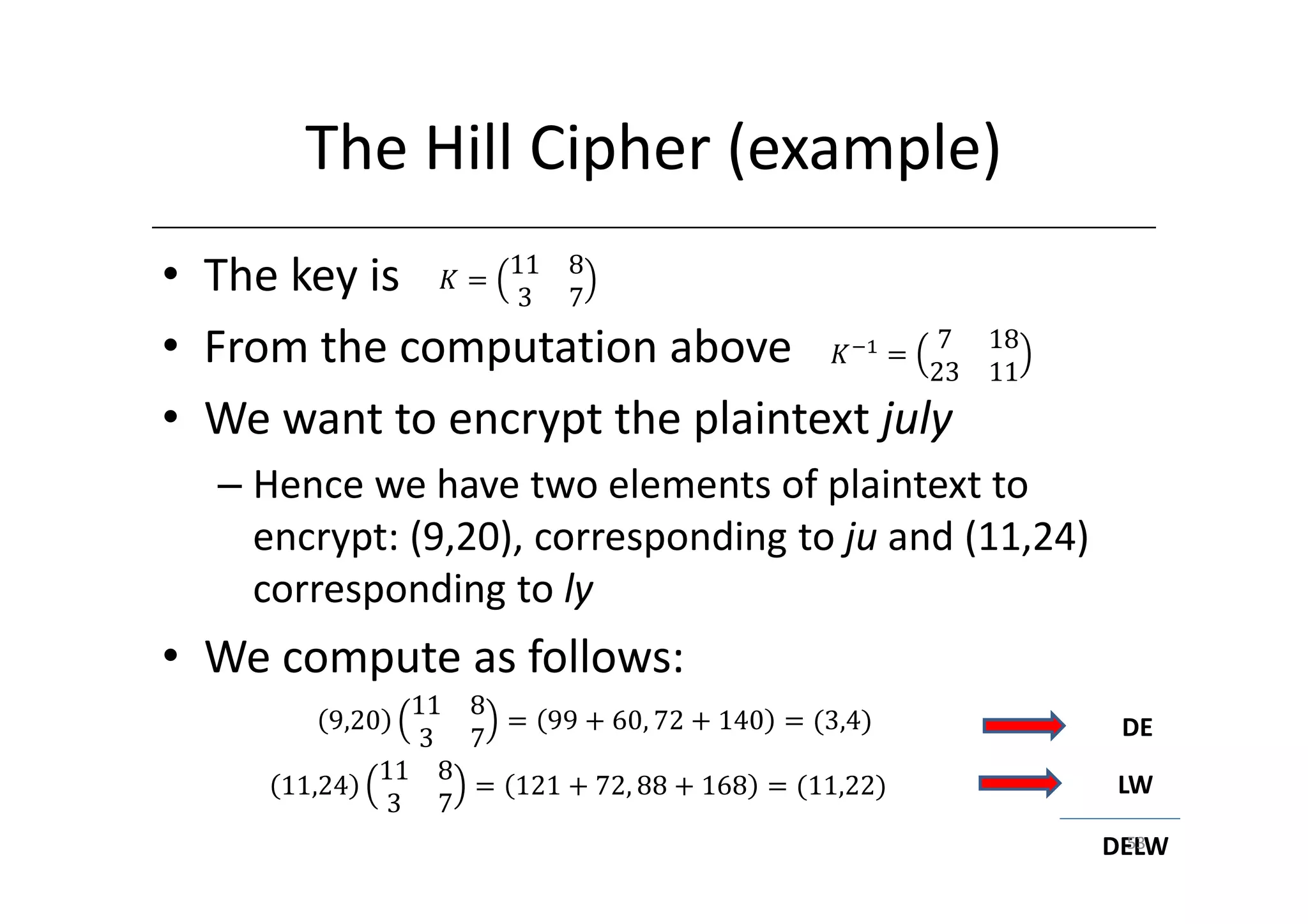
• The key is ‫ ܭ‬ൌ 11 7
                  3
                    8


• From the computation above ‫ି ܭ‬ଵ ൌ 237            18
                                                   11
• We want to encrypt the plaintext july
  – Hence we have two elements of plaintext to
    encrypt: (9,20), corresponding to ju and (11,24)
    corresponding to ly
• We compute as follows:
               11 8
        9,20        ൌ 99 ൅ 60, 72 ൅ 140 ൌ ሺ3,4ሻ          DE
                3 7
             11 8                                       LW
     11,24        ൌ 121 ൅ 72, 88 ൅ 168 ൌ ሺ11,22ሻ
             3 7
                                                          53
                                                        DELW
The Hill Cipher (example)
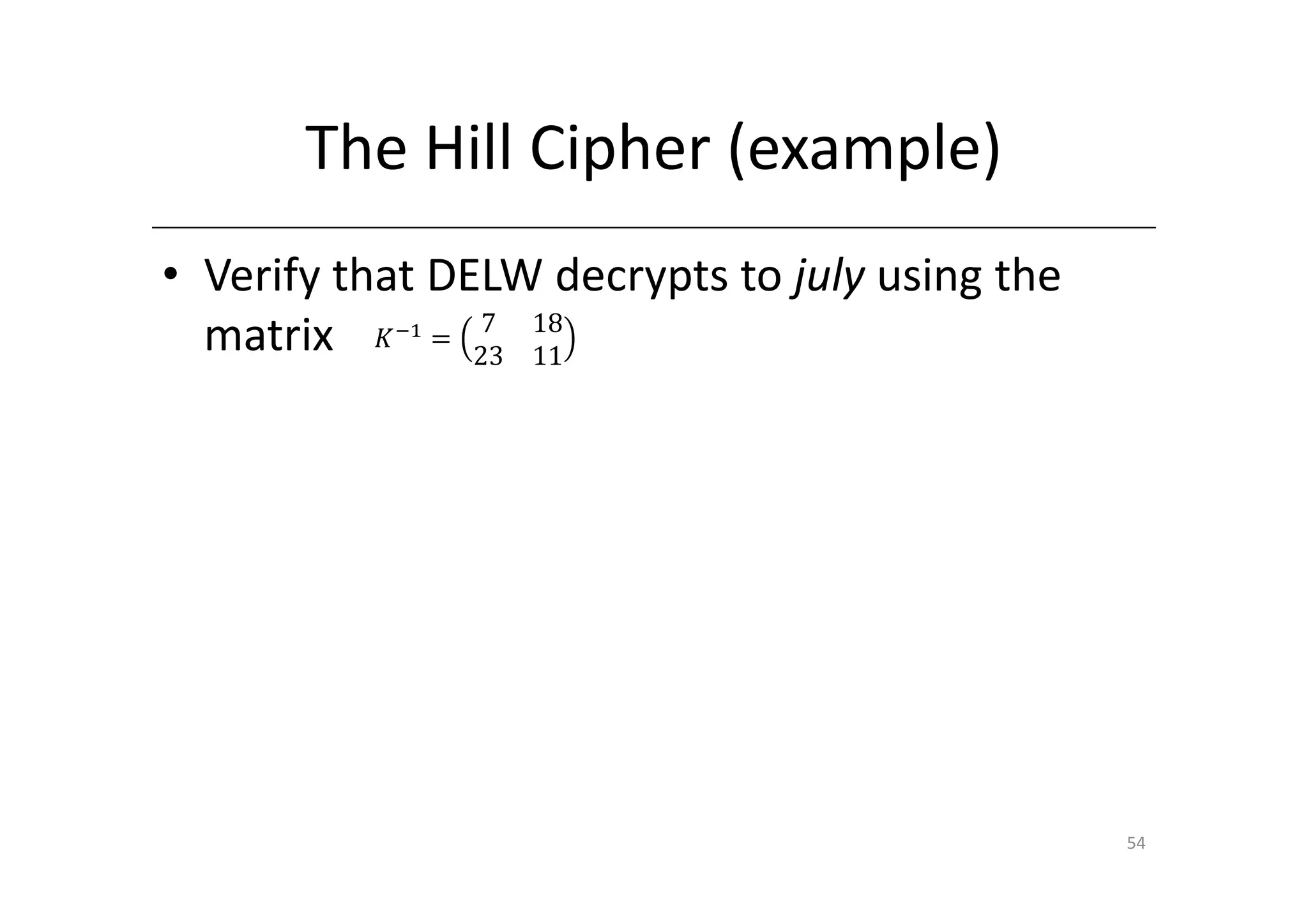
• Verify that DELW decrypts to july using the
  matrix ‫ି ܭ‬ଵ ൌ 23 18
                 7
                   11


                                                54
The Hill Cipher
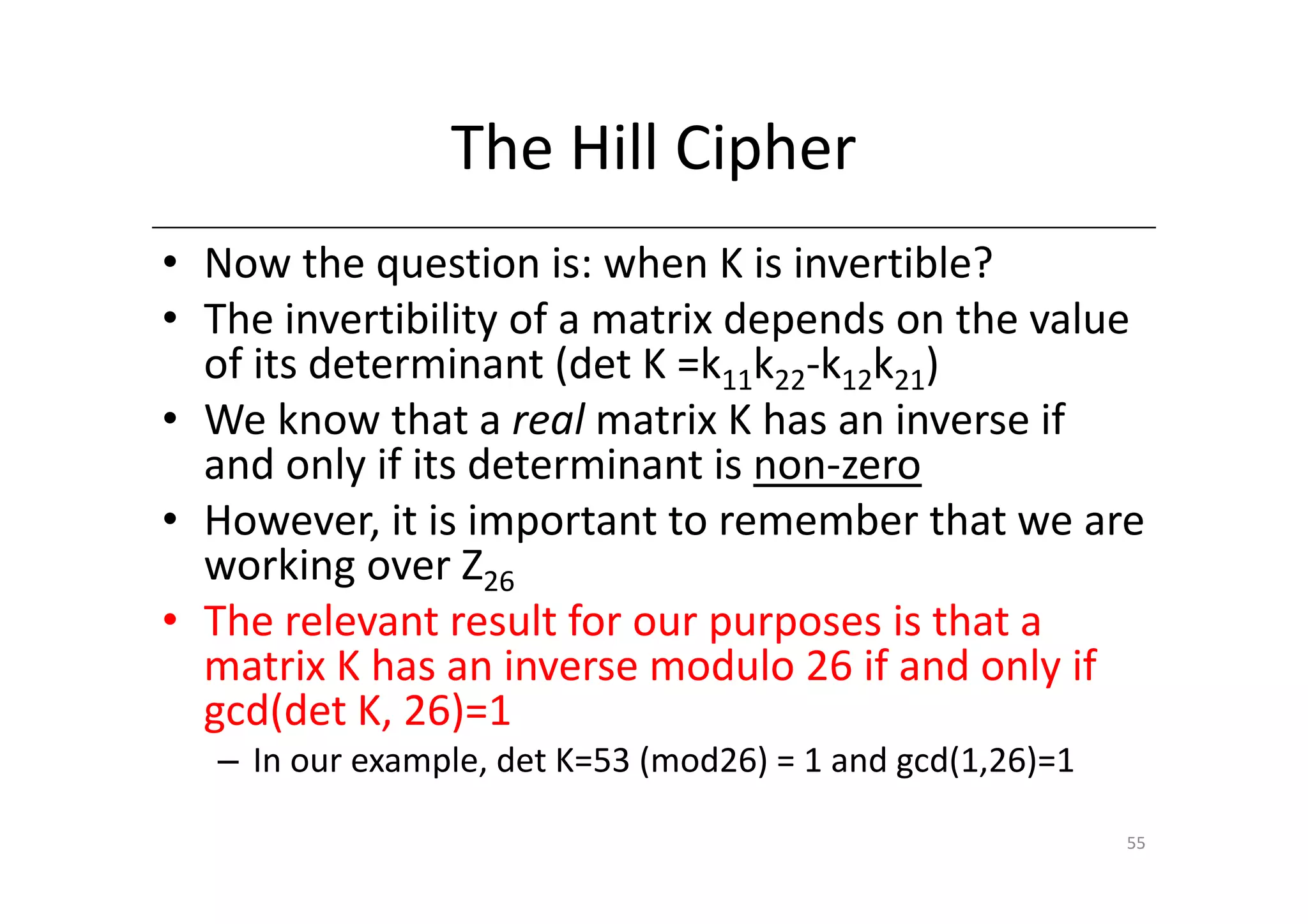
• Now the question is: when K is invertible?
• The invertibility of a matrix depends on the value
  of its determinant (det K =k11k22-k12k21)
• We know that a real matrix K has an inverse if
  and only if its determinant is non-zero
• However, it is important to remember that we are
  working over Z26
• The relevant result for our purposes is that a
  matrix K has an inverse modulo 26 if and only if
  gcd(det K, 26)=1
  – In our example, det K=53 (mod26) = 1 and gcd(1,26)=1

                                                           55
The Hill Cipher
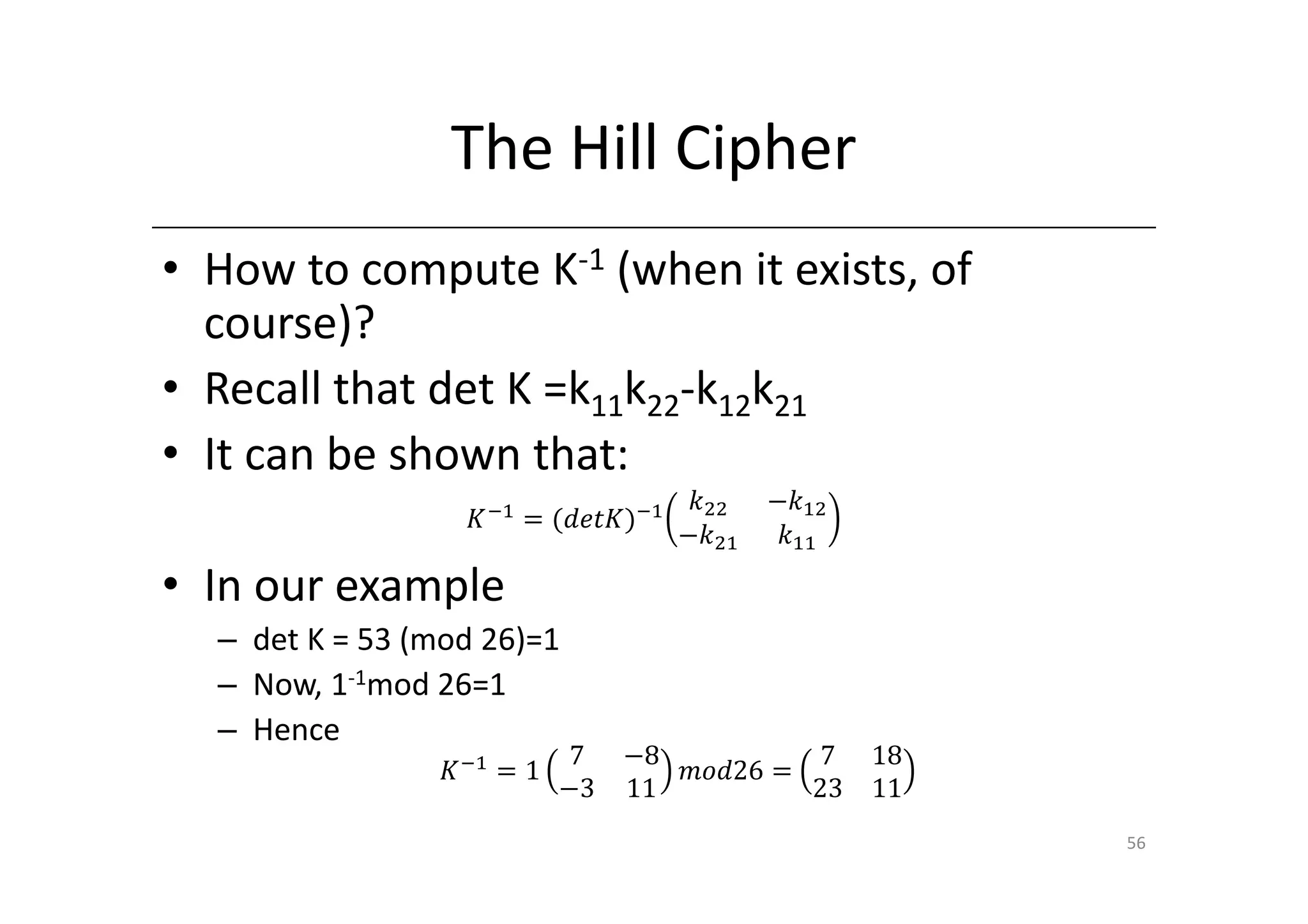
• How to compute K-1 (when it exists, of
  course)?
• Recall that det K =k11k22-k12k21
• It can be shown that:
                                     ݇ଶଶ   െ݇ଵଶ
                  ‫ି ܭ‬ଵ ൌ ሺ݀݁‫ܭݐ‬ሻିଵ
                                    െ݇ଶଵ    ݇ଵଵ

• In our example
  – det K = 53 (mod 26)=1
  – Now, 1-1mod 26=1
  – Hence
                            7   െ8          7     18
                ‫ି ܭ‬ଵ ൌ 1           ݉‫ 62݀݋‬ൌ
                           െ3   11         23     11
                                                       56

2 classical cryptosystems

  • 1.
    Lecture 2 Classical Cryptosystems Shift cipher Substitution cipher Vigenère cipher Hill cipher 1
  • 2.
    Shift Cipher • ASubstitution Cipher • The Key Space: – [0 … 25] • Encryption given a key K: – each letter in the plaintext P is replaced with the K’th letter following the corresponding number (shift right) • Decryption given K: – shift left • History: K = 3, Caesar’s cipher 2
  • 3.
    Shift Cipher • Formally: •Let P=C=K=Z26 For 0≤K≤25 ek(x) = x+K mod 26 and dk(y) = y-K mod 26 ሺ‫ܼ ∈ ݕ ,ݔ‬ଶ଺ ሻ 3
  • 4.
    Shift Cipher: AnExample A B C D E F G H I J K L M N O P Q R S T U V W X Y Z 0 1 2 3 4 5 6 7 8 9 10 11 12 13 14 15 16 17 18 19 20 21 22 23 24 25 • P = CRYPTOGRAPHYISFUN Note that punctuation is often eliminated • K = 11 • C = NCJAVZRCLASJTDQFY • C → 2; 2+11 mod 26 = 13 → N • R → 17; 17+11 mod 26 = 2 → C • … • N → 13; 13+11 mod 26 = 24 → Y 4
  • 5.
    Shift Cipher: Cryptanalysis •Can an attacker find K? – YES: exhaustive search, key space is small (<= 26 possible keys). – Once K is found, very easy to decrypt Exercise 1: decrypt the following ciphertext hphtwwxppelextoytrse Exercise 2: decrypt the following ciphertext jbcrclqrwcrvnbjenbwrwn VERY useful MATLAB functions can be found here: 5 http://www2.math.umd.edu/~lcw/MatlabCode/
  • 6.
    General Mono-alphabetical Substitution Cipher • The key space: all possible permutations of Σ = {A, B, C, …, Z} • Encryption, given a key (permutation) π: – each letter X in the plaintext P is replaced with π(X) • Decryption, given a key π: – each letter Y in the ciphertext C is replaced with π-1(Y) • Example A B C D E F G H I J K L M N O P Q R S T U V W X Y Z π B A D C Z H W Y G O Q X S V T R N M S K J I P E F U • BECAUSE AZDBJSZ 6
  • 7.
    Strength of theGeneral Substitution Cipher • Exhaustive search is now infeasible – key space size is 26! ≈ 4*1026 • Dominates the art of secret writing throughout the first millennium A.D. • Thought to be unbreakable by many back then 7
  • 8.
    Affine Cipher • TheShift cipher is a special case of the Substitution cipher where only 26 of the 26! possible permutations are used • Another special case of the substitution cipher is the Affine cipher, where the encryption function has the form e(x) = ax+b mod 26 ሺܽ, ܾ ∈ ܼଶ଺ ሻ • Note that with a=1 we have a Shift cipher. • When decryption is possible ? 8
  • 9.
    Affine Cipher • Decryptionis possible if the affine function is injective • In order words, for any y in Z26 we want the congruence ax+b≡y (mod26) to have a unique solution for x. • This congruence is equivalent to ax≡y-b (mod26) • Now, as y varies over Z26 ,so, too, does y-b vary over Z26 Hence it suffices to study the congruence ax≡y (mod26) 9
  • 10.
    Affine Cipher ax≡y (mod26) • This congruence has a unique solution for every y if and only if gcd(a,26)=1 (i.e.: a and 26 are relatively prime) • gcd=greatest common divisor • Suppose that gcd(a,26)=d>1 for example gcd(4,26)=2 • e(x) = 4x+7 mod 26 is NOT a valid encryption function • For example, both ‘a’ and ‘n’ encrypt to H (more in general: x and x+13 will encrypt to the same value) affinecrypt('a',4,7)=affinecrypt('n',4,7)=‘h’ 10
  • 11.
    Cryptanalysis of SubstitutionCiphers: Frequency Analysis • Basic ideas: – Each language has certain features: frequency of letters, or of groups of two or more letters. – Substitution ciphers preserve the language features. – Substitution ciphers are vulnerable to frequency analysis attacks. 11
  • 12.
    Frequency of Lettersin English 12
  • 13.
  • 14.
    Other Frequency Featuresof English • Vowels, which constitute 40 % of plaintext, are often separated by consonants. • Letter “A” is often found in the beginning of a word or second from last. • Letter “I” is often third from the end of a word. • Letter “Q” is followed only by “U” • And more … 14
  • 15.
    Substitution Ciphers: Cryptanalysis •The number of different ciphertext characters or combinations are counted to determine the frequency of usage. • The cipher text is examined for patterns, repeated series, and common combinations. • Replace ciphertext characters with possible plaintext equivalents using known language characteristics 15
  • 16.
    Frequency Analysis History •Earliest known description of frequency analysis is in a book by the ninth-century scientist al-Kindi • Rediscovered or introduced in Europe during the Renaissance • Frequency analysis made substitution cipher insecure 16
  • 17.
    Improve the Securityof the Substitution Cipher • Using nulls – e.g., using numbers from 1 to 99 as the ciphertext alphabet, some numbers representing nothing are inserted randomly • Deliberately misspell words – e.g., “Thys haz thi ifekkt off diztaughting thi ballans off frikwenseas” • Homophonic substitution cipher – each letter is replaced by a variety of substitutes • These make frequency analysis more difficult, but not impossible 17
  • 18.
    Summary • Shift ciphersare easy to break using brute force attacks, they have small key space. • Substitution ciphers preserve language features and are vulnerable to frequency analysis attacks. 18
  • 19.
    Towards the Polyalphabetic Substitution Ciphers • Main weaknesses of monoalphabetic substitution ciphers – each letter in the ciphertext corresponds to only one letter in the plaintext – Idea for a stronger cipher (1460’s by Alberti) • use more than one cipher alphabet, and switch between them when encrypting different letters • Developed into a practical cipher by Vigenère (published in 1586) 19
  • 20.
    The Vigenère Cipher •Definition: Given m, a positive integer, P = C = (Z26)n, and K = (k1, k2, … , km) a key, we define: • Encryption: ek(p1, p2… pm) = (p1+k1, p2+k2…pm+km) (mod 26) • Decryption: dk(c1, c2… cm) = (c1-k1, c2-k2 … cm- km) (mod 26) • Example: Plaintext: CRYPTOGRAPHY Key: LUCKLUCKLUCK Ciphertext: N L A Z E I I B L J J I 20
  • 21.
  • 22.
    Security of VigenereCipher • Vigenere masks the frequency with which a character appears in a language: one letter in the ciphertext corresponds to multiple letters in the plaintext. Makes the use of frequency analysis more difficult. • Any message encrypted by a Vigenere cipher is a collection of as many shift ciphers as there are letters in the key. 22
  • 23.
    Vigenere Cipher: Cryptanalysis •Find the length of the key. • Divide the message into that many shift cipher encryptions. • Use frequency analysis to solve the resulting shift ciphers. – how? 23
  • 24.
    How to Findthe Key Length? • For Vigenere, as the length of the keyword increases, the letter frequency shows less English (or French)-like characteristics and becomes more random (when key length -> infinite, see One Time Pad). • Two methods to find the key length: – Kasisky test – Index of coincidence (Friedman) 24
  • 25.
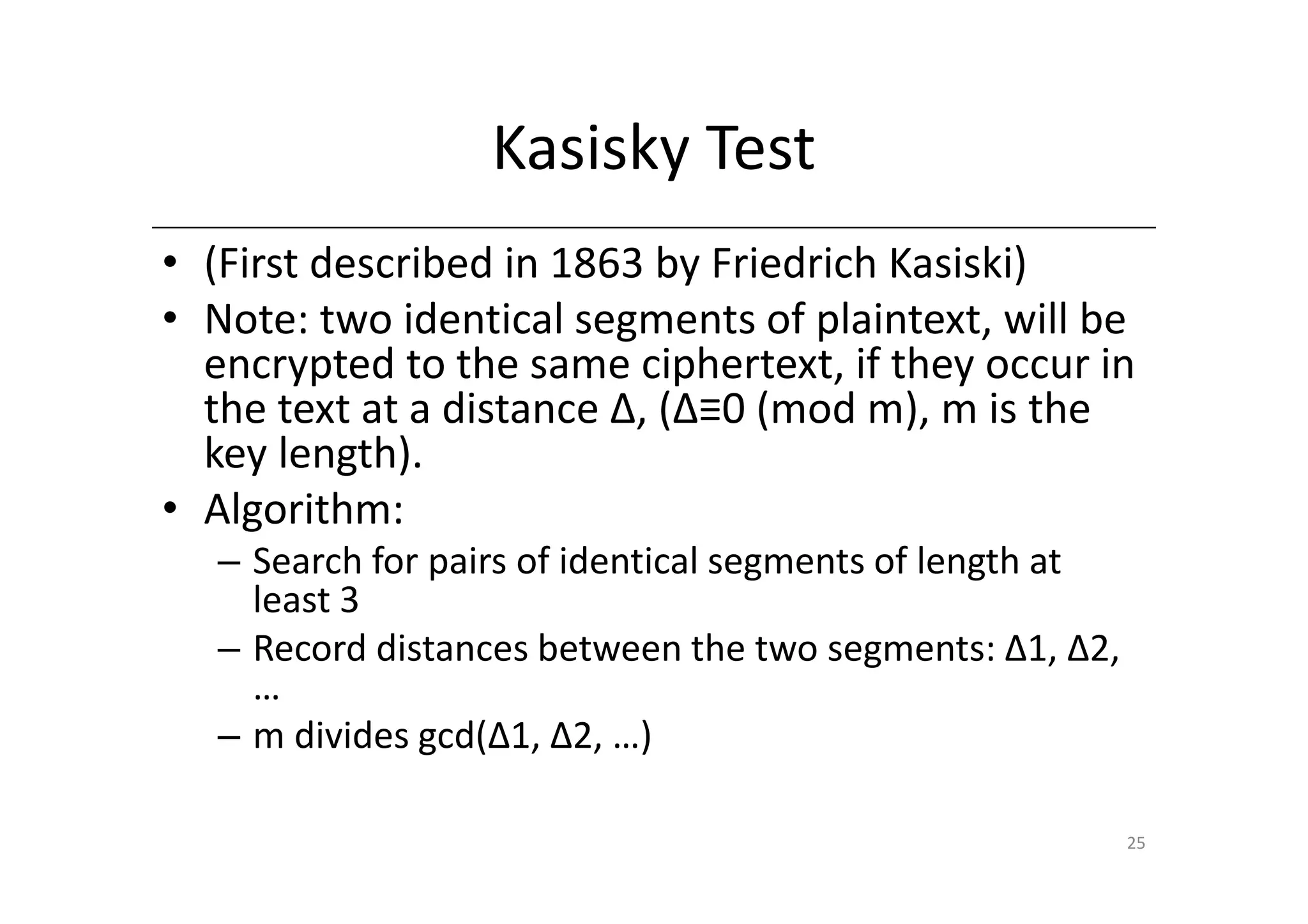
    Kasisky Test • (Firstdescribed in 1863 by Friedrich Kasiski) • Note: two identical segments of plaintext, will be encrypted to the same ciphertext, if they occur in the text at a distance Δ, (Δ≡0 (mod m), m is the key length). • Algorithm: – Search for pairs of identical segments of length at least 3 – Record distances between the two segments: Δ1, Δ2, … – m divides gcd(Δ1, Δ2, …) 25
  • 26.
    Example of theKasisky Test • Key: KINGKINGKINGKINGKINGKING • Plaintext: thesunandthemaninthemoon • Ciphertext: DPRYEVNTNBUKWIAOXBUKWWBT 8 positions The lenght of the keyworld probably divides 8 evenly (e.g. it may be 2, 4 or 8) 26
  • 27.
    Index of Coincidence(Friedman) • Informally: Measures the probability that two random elements of the n-letters string x are identical. • Definition: Suppose x = x1x2…xn is a string of n alphabetic characters. Then, the index of coincidence of x, denoted Ic(x), is defined to be the probability that two random elements of x are identical. 27
  • 28.
    Index of Coincidence(cont.) • Reminder: binomial coefficient n n!  =  k  k!(n − k )!   • It denotes the number of ways of choosing a subset of k objects from a set of n objects. • Suppose we denote the frequencies of A, B, C … Z in x by f0, f1, … f25 (respectively). • We want to compute Ic(x) 28
  • 29.
  • 30.
    Elements of ProbabilityTheory • A random experiment has an unpredictable outcome. • Definition The sample space (S) of a random phenomenon is the set of all outcomes for a given experiment. • Definition The event (E) is a subset of a sample space, an event is any collection of outcomes. 30
  • 31.
    Basic Axioms ofProbability • If E is an event, Pr(E) is the probability that event E occurs, then – 0 ≤ Pr(A) ≤ 1 for any set A in S. – Pr(S) = 1 , where S is the sample space. – If E1, E2, … En is a sequence of mutually exclusive events, that is Ei ∩ Ej = 0, for all i ≠ j then: n Pr (E1 ∪ E2 ∪ ... ∪ En ) = ∑ Pr (Ei ) i =1 31
  • 32.
    Probability: More Properties •If E is an event and Pr(E) is the probability that the event E occurs then – Pr(Ê) = 1 - Pr(E) where Ê is the complimentary event of E – If outcomes in S are equally like, then Pr(E) = |E| / |S| (where |S| denotes the cardinality of the set S) 32
  • 33.
    Example • Random throwof a pair of dice. • What is the probability that the sum is 3? Solution: Each dice can take six different values {1,2,3,4,5,6}. The number of possible events (value of the pair of dice) is 36, therefore each event occurs with probability 1/36. Examine the sum: 3 = 1+2 = 2+1 The probability that the sum is 3 is 2/36. • What is the probability that the sum is 11? 33
  • 34.
  • 35.
    Index of Coincidence(cont.) • Reminder: binomial coefficient n n!  =  k  k!(n − k )!   • It denotes the number of ways of choosing a subset of k objects from a set of n objects. • Suppose we denote the frequencies of A, B, C … Z in x by f0, f1, … f25 (respectively). • We want to compute Ic(x) 35
  • 36.
    Index of Coincidence(cont.) • We can choose two elements of x (whose size is n) in n Example: if n=3, nchoosek(3,2)=3; there are 3 ways of   ways.  2 choosing couples of n=3 items. Example: string ABC    fi  • For each i in [0…25], there are   ways of choosing 2   both elements to be i. Hence we have the formula 25  fi  25 ∑ 2    i =0  = ∑ f (f i i − 1) I c (x ) = i =0  n n(n − 1)    2   36
  • 37.
    Example: IC ofa String • Consider the text 3C 2D x= “THEINDEXOFCOINCIDENCE” 4E 25 1F ∑ f (f i i − 1) 1H I c (x ) = i =0 3I n(n − 1) 3N 20 1T • There are 21 characters, with frequencies 1X • Ic = (3*2+ 2*1+ 4*3+ 1*0+ 1*0+ 3*2+ 3*2+ 2*1+ 1*0+ 1*0) / 21*20 = 34/420 = 0.0809 37
  • 38.
    Index of Coincidence(cont.) • Now, if we suppose that n is very big (e.g., we take all words in the English dictionary), then we can further approximate the formula: These are the real 25  fi  25 25 frequencies of letters ∑ 2    ∑ f i ( f i − 1) ∑ fi 2 25 in English (see Table) I c (x ) =   = = ∑ pi2 i =0 i =0 ≈ i =0 n n(n − 1) n2 i =0    2   THIS IS AN APPROXIMATION IF n is VERY BIG 38
  • 39.
    Example: IC ofa Language • For English, pi can be estimated as follows Letter pi Letter pi Letter pi Letter pi A 0.082 H 0.061 O 0.075 V 0.010 B 0.015 I 0.070 P 0.019 W 0.023 C 0.028 J 0.002 Q 0.001 X 0.001 D 0.043 K 0.008 R 0.060 Y 0.020 E 0.127 L 0.040 S 0.063 Z 0.001 F 0.022 M 0.024 T 0.091 G 0.20 N 0.067 U 0.028 25 I c (x ) = ∑ pi2 = 0.065 i =0 39
  • 40.
    IC of aciphertext • Now, the same reasoning applies if x is a ciphertext obtained by means of any monoalphabetic cipher. In this case, the individual probabilities will be permuted, BUT the quantity 25 I c (x ) = ∑ pi2 = 0.065 i =0 will be unchanged! 40
  • 41.
    Find the KeyLength • For Vigenere, as the length of the keyword increases, the letter frequency shows less English-like characteristics and becomes more random. • Two methods to find the key length: – Kasisky test – Index of coincidence (Friedman) 41
  • 42.
    Finding the KeyLength • Suppose we start with a ciphertext q = q1q2…qn • Define m substrings y1… ym as follows  q1 qm +1 qn − m +1  y1 q qm + 2  qn − m + 2  y2  2  ... ...     qm q2 m qn  ym 42
  • 43.
    Finding the KeyLength • In our previous example, supposing we already guessed, n=12, m=4  q1 qm +1 qn − m +1  y1 = CTA q qm + 2  qn − m + 2  y2  2 = ROP  ... ...  = YGH    qm q2 m qn  ym = PRY 43
  • 44.
    Guessing the KeyLength • If this is done, and m is indeed the key length, then each Ic(yi) should be roughly equal to 0.065 (e.g. it will “look like” English text) 25 I c ( yi ) = ∑ pi2 = 0.065 ∀1 ≤ i ≤ m i =0 • If m is not the key length, the text will “look like” much more random, since it is obtained by shift encryption with different keys. Observe that a completely random string will have: 2 25  1  I c ( x ) ≈ ∑   = 26 ⋅ 2 = 1 1 = 0.0385 ∀1 ≤ i ≤ m 44 i = 0  26  26 26
  • 45.
    Guessing the KeyLength • For French language, the index of coincidence is approximately 0.0778 • The values 0.065 (or 0.0778 for French) and 0.0385 are sufficiently far apart that we will often be able to determine the correct keyword length (or confirm a guess that has already been made using the Kasiski test) 45
  • 46.
    Finding the Key,if Key Length Known • Consider vectors yi, and look for the most frequent letter • Check if mapping that letter to e will not result in unlikely mapping for other letters • Use mutual index of coincidence between two strings – To determine relative shifts, and hence the key 46
  • 47.
    Summary • Vigenère cipheris vulnerable: once the key length is found, a cryptanalyst can apply frequency analysis. 47
  • 48.
    The Hill Cipher •Use linear equations – each output bit (ciphertext, C) is a linear combination of the input bits (plaintext message, M) – the key k is a matrix • C=kM • M = k-1 C – known as the Hill cipher – easily breakable by known-plaintext attack 48
  • 49.
    The Hill Cipher •It’s another polyalphabetic cryptosystem, invented in 1929 by Lester S. Hill. • Let m be a positive integer (we will see an example with m=2), and define P=C=(Z26 )m • The idea is to take m linear combinations of the m alphabetic characters in one plaintext element, thus producing the m alphabetic characters in one ciphertext element. 49
  • 50.
    The Hill Cipher •Example with m=2 • We can write a plaintext element as x=(x1,x2) and a ciphertext element as y=(y1,y2). • Here y1 would be a linear combination of x1 and x2, as would be y2 • We might take ‫ݕ‬ଵ ൌ 11‫ݔ‬ଵ ൅ 3‫ݔ‬ଶ All computed Mod 26 ‫ݕ‬ଶ ൌ 8‫ݔ‬ଵ ൅ 7‫ݔ‬ଶ 50
  • 51.
    The Hill Cipher •We might take ‫ݕ‬ଵ ൌ 11‫ݔ‬ଵ ൅ 3‫ݔ‬ଶ ‫ݕ‬ଶ ൌ 8‫ݔ‬ଵ ൅ 7‫ݔ‬ଶ • Of course, this can be written more succinctly in matrix notation as follows: 11 8 ሺ‫ݕ‬ଵ , ‫ݕ‬ଶ )=ሺ‫ݔ‬ଵ , ‫ݔ‬ଶ ) 3 7 • In general, we will take an m x m matrix K as our key. We will write y=xK • The ciphertext is obtained from the plaintext by means of a linear transformation. 51
  • 52.
    The Hill Cipher(Decryption) • To decrypt, we should multiply both sides for the inverse of K, K-1: – yK-1=xKK-1 – hence x=yK-1 • Does K-1 always exist ? Of course not! • By definition, the inverse matrix to an m x m matrix K (if it exists) is the matrix K-1 such that K K-1 = Im • For example: 1 0 ‫ܫ‬ଶ = 0 1 • We can verify that the encryption matrix above has an inverse modulo 26 ିଵ 11 8 ૠ ૚ૡ 11 8 7 18 261 286 1 0 ൌ ൌ ൌ 3 7 ૛૜ ૚૚ 3 7 23 11 182 131 0 1 52
  • 53.
    The Hill Cipher(example) • The key is ‫ ܭ‬ൌ 11 7 3 8 • From the computation above ‫ି ܭ‬ଵ ൌ 237 18 11 • We want to encrypt the plaintext july – Hence we have two elements of plaintext to encrypt: (9,20), corresponding to ju and (11,24) corresponding to ly • We compute as follows: 11 8 9,20 ൌ 99 ൅ 60, 72 ൅ 140 ൌ ሺ3,4ሻ DE 3 7 11 8 LW 11,24 ൌ 121 ൅ 72, 88 ൅ 168 ൌ ሺ11,22ሻ 3 7 53 DELW
  • 54.
    The Hill Cipher(example) • Verify that DELW decrypts to july using the matrix ‫ି ܭ‬ଵ ൌ 23 18 7 11 54
  • 55.
    The Hill Cipher •Now the question is: when K is invertible? • The invertibility of a matrix depends on the value of its determinant (det K =k11k22-k12k21) • We know that a real matrix K has an inverse if and only if its determinant is non-zero • However, it is important to remember that we are working over Z26 • The relevant result for our purposes is that a matrix K has an inverse modulo 26 if and only if gcd(det K, 26)=1 – In our example, det K=53 (mod26) = 1 and gcd(1,26)=1 55
  • 56.
    The Hill Cipher •How to compute K-1 (when it exists, of course)? • Recall that det K =k11k22-k12k21 • It can be shown that: ݇ଶଶ െ݇ଵଶ ‫ି ܭ‬ଵ ൌ ሺ݀݁‫ܭݐ‬ሻିଵ െ݇ଶଵ ݇ଵଵ • In our example – det K = 53 (mod 26)=1 – Now, 1-1mod 26=1 – Hence 7 െ8 7 18 ‫ି ܭ‬ଵ ൌ 1 ݉‫ 62݀݋‬ൌ െ3 11 23 11 56